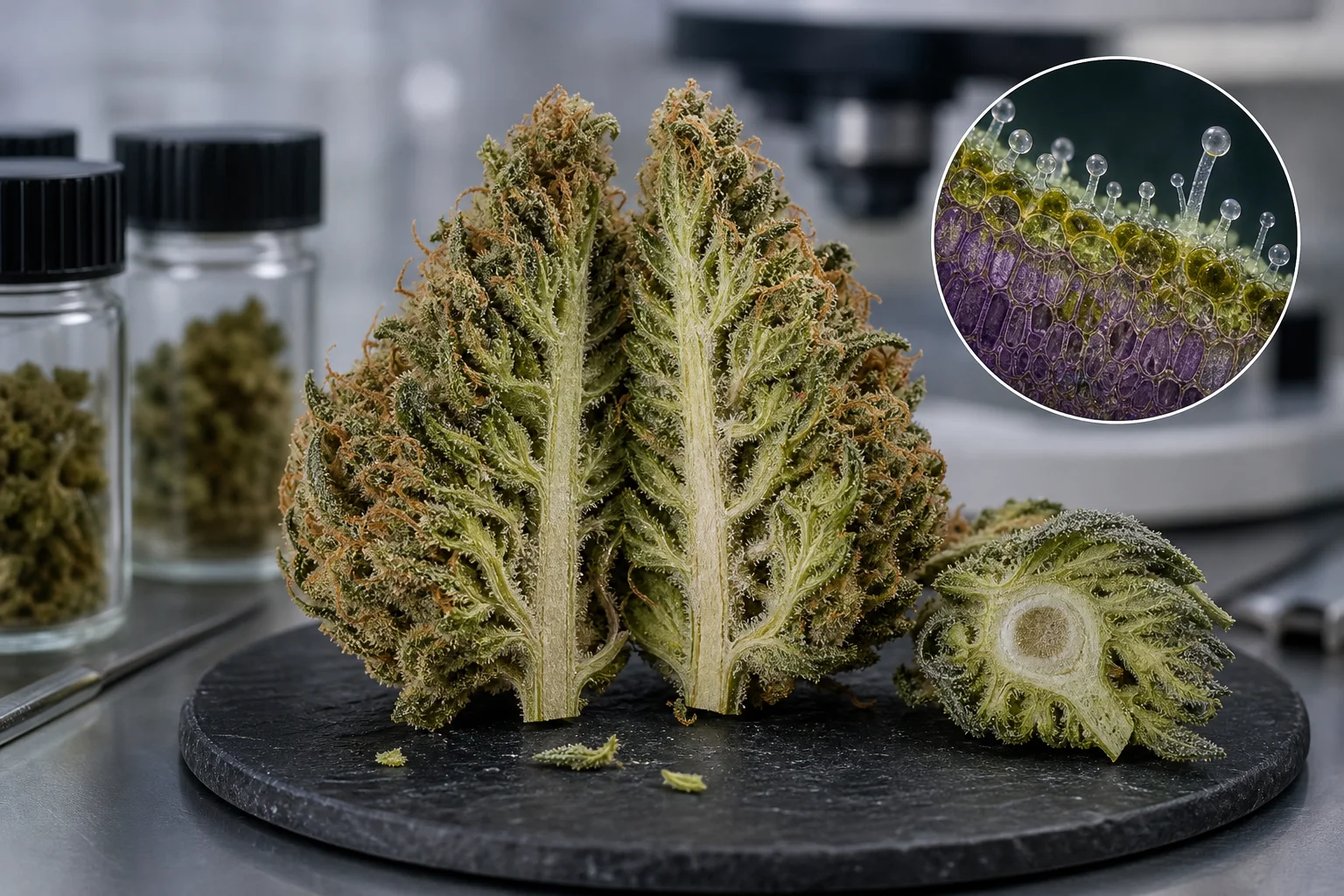
Macro + micro view that contrasts exterior dryness with potential interior moisture: illustrates why surface dryness alone is a poor safety indicator. Source research links show drying method affects internal moisture and volatiles. Limit: photo is illustrative, not diagnostic for microbial load. ([pubmed.ncbi.nlm.nih.gov](https://pubmed.ncbi.nlm.nih.gov/38702447/))
The harvest crossroads: what happens immediately after the cut
You cut a plant and, in the space of hours to days, a cascade of physical and chemical changes begins. Cells lose water; fragile volatile oils (terpenes) begin to evaporate; acid cannabinoids (like THCA) can convert to their neutral forms (like THC) under heat or over time; and any microorganisms present may either be suppressed by drying or, if conditions are wrong, flourish. These steps are not cosmetic. They alter aroma, measured potency, and the laboratory results that regulators use to decide whether a product is safe to sell. (pubmed.ncbi.nlm.nih.gov)
Because these changes start immediately, the window between cut and controlled drying is a critical control point for a grower. Even choices that feel small—how long trimmed flower rests before it enters a drying room, whether branches are hung whole or trimmed and trayed—shift drying kinetics and therefore how moisture and volatiles redistribute. The scientific literature shows measurable differences between drying methods (for example, freeze-drying vs tray-drying) in both the volatilome and the cannabinoid profile. (pubmed.ncbi.nlm.nih.gov)
Maine regulators require testing to guard public safety, and those tests reflect a supply chain that begins at this harvest crossroads. For adult-use products in Maine, mandatory analyte categories (pesticides, microbes, mycotoxins, solvents, metals, potency, and others) must be passed before retail—so what happens post-harvest affects both quality and compliance. The adult-use open data dashboard and mandatory testing rules are useful to understand which outcomes are most sensitive to post-harvest handling. (www11.maine.gov)
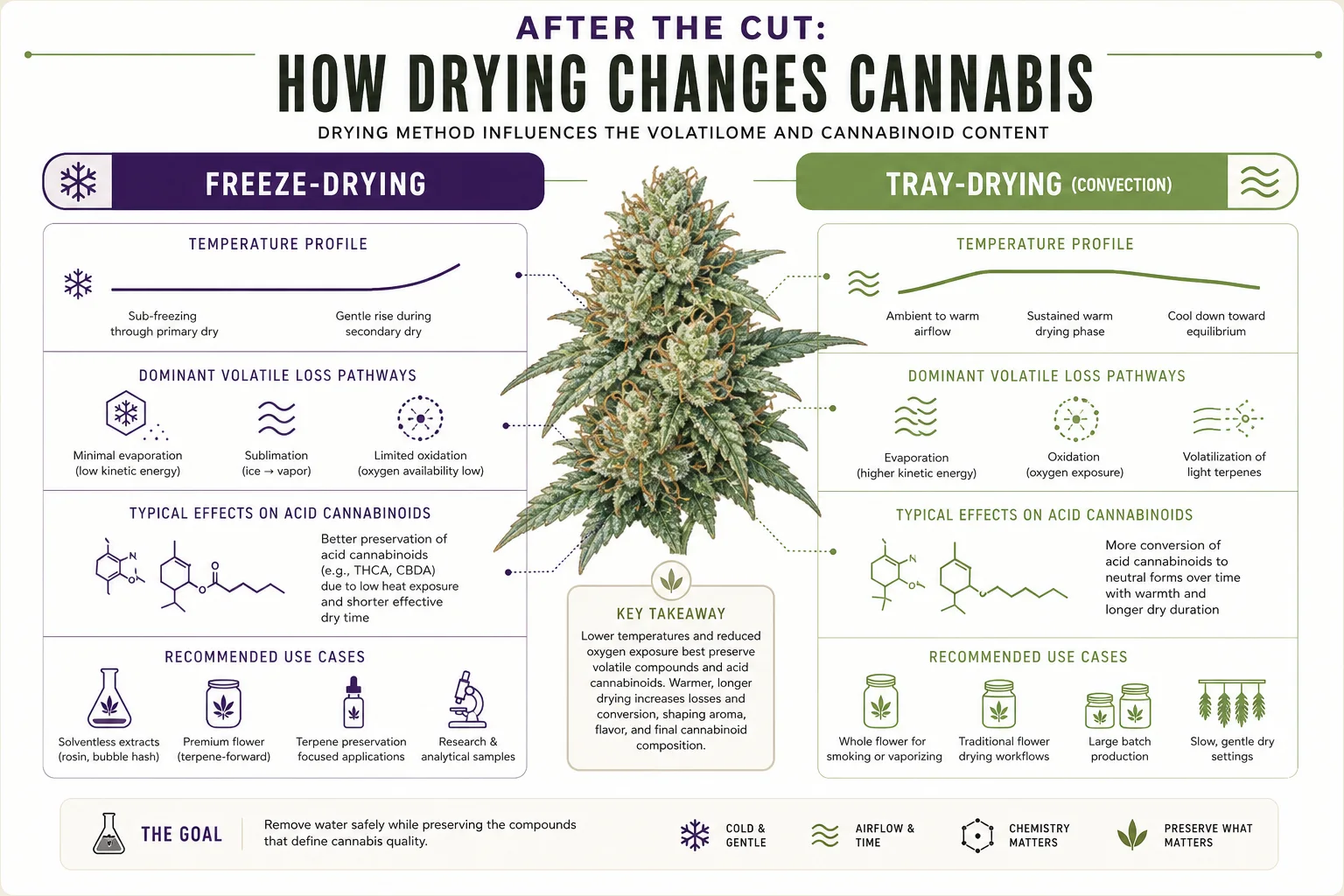
Explainer diagram comparing freeze-drying and tray-drying outcomes for terpene retention and cannabinoid-acid preservation. Based on controlled drying studies; useful to teach trade-offs. Limit: simplification of cultivar-specific data. ([pubmed.ncbi.nlm.nih.gov](https://pubmed.ncbi.nlm.nih.gov/38702447/))
Research context: The influence of drying and storage conditions on the volatilome and cannabinoid content of Cannabis sativa L. inflorescencesMoisture movement: drying versus desiccation
Drying is not a single event; it's a controlled removal of water where the goal is to slow microbial activity and stabilize product weight and combustion properties, while avoiding overly rapid loss that damages structure and volatiles. Moisture moves from plant cells into intercellular spaces, then into the surrounding air—driven by vapor-pressure gradients, temperature, and relative humidity. If the surface dries too quickly, internal moisture gets trapped, which can lead to case-hardening: a dry exterior and wet interior where mold and bacteria can persist out of reach of routine moisture checks. Scientific drying kinetics, modeled in post-harvest research, demonstrate that temperature and airflow profiles change the moisture gradient and final water activity. (pubmed.ncbi.nlm.nih.gov)
Practically, growers should monitor both percent moisture content (by weight) and water activity (aw). Maine's adult-use testing dashboard explicitly includes water activity as a measured category and shows that while outright water-activity failures are uncommon, microbial and yeast/mold failures occur at higher rates—often linked to improper drying or conditioning. That means a pass on a moisture weight test alone doesn't guarantee microbiological safety; water activity better predicts whether microbes can grow. (www11.maine.gov)
The remedy is controlled drying: moderate temperatures (to avoid thermal degradation), stable RH that encourages even moisture loss, and good airflow without direct hot drafts. Some research shows advanced approaches—vacuum-microwave finishing, controlled-atmosphere chambers—can speed drying and preserve volatiles relative to traditional slow-air room drying, but these are capital-intensive and chemovar-dependent. In short: drying aims to remove enough moisture to stop microbial growth while retaining structure and oils; desiccation aims to remove everything and often wrecks aroma and texture. (pubmed.ncbi.nlm.nih.gov)
Volatiles and cannabinoids: chemistry in motion
Terpenes—the volatile oils that give cannabis much of its smell—are, by definition, volatile. They are the first to change after harvest, and their loss or transformation will reshape aroma long before total cannabinoid concentration moves much. Studies comparing drying methods show that some approaches preserve a higher fraction of monoterpenes and sesquiterpenes, while others accelerate their loss. Freeze-drying, for instance, can protect cannabinoid acids but may lead to terpene loss compared with gentle tray drying; conversely, some controlled-atmosphere methods preserve terpenes better while also cutting drying time. The takeaway: chemistry outcomes are a trade-off of method, speed, temperature, and cultivar. (pubmed.ncbi.nlm.nih.gov)
Cannabinoids themselves are relatively stable at room temperature but not impervious. Acid forms (THCA, CBDA) can decarboxylate into their neutral counterparts (THC, CBD) with heat and time; sustained elevated temperatures accelerate this. Kinetic studies conclude that cannabinoid degradation follows predictable rates over broad temperature ranges, which helps for shelf-life modelling but also shows that storage and processing temperatures matter for potency labeling and age-related changes. In other words, what a lab reports for THC on Day 1 may differ from what's measured months later, especially if storage conditions were warm. (pubmed.ncbi.nlm.nih.gov)
Volatile losses also matter for perceived quality. Terpenes contribute to user experience and to some aroma-linked chemical interactions with cannabinoids. Because terpenes evaporate more quickly than cannabinoids change chemically, a product that looks fresh can have a notably different smell and measured terpene profile after suboptimal drying, curing, or packaging. Lab panels that include terpenes and full VOC profiling are useful but must be read as snapshots, not immutable signatures. (pubmed.ncbi.nlm.nih.gov)
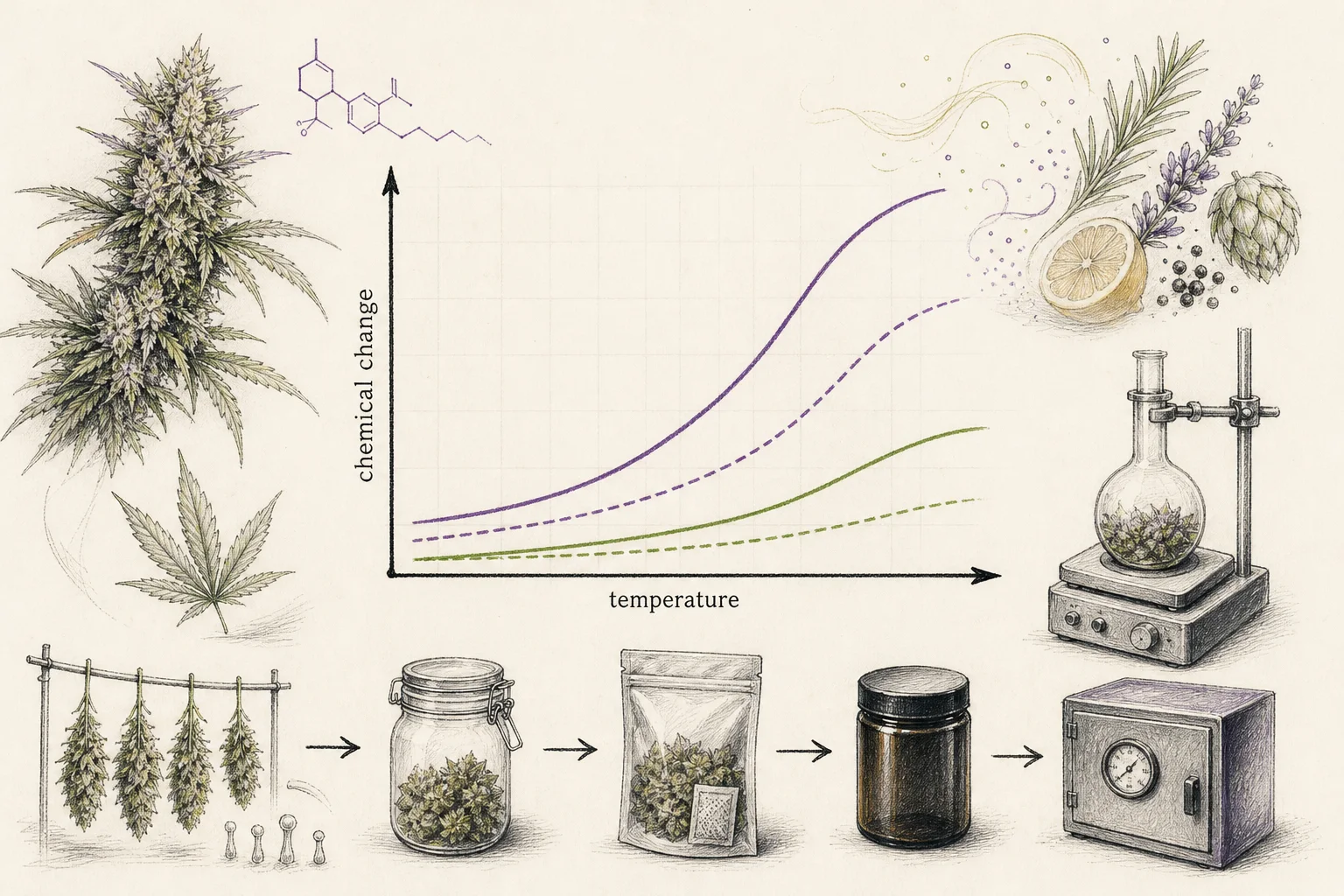
An evidence-based conceptual chart illustrating that higher storage temperatures accelerate cannabinoid transformation and volatile loss. Based on thermal stability kinetics studies; chart should be illustrative, without numeric axes, to avoid implying specific shelf-life numbers. ([pubmed.ncbi.nlm.nih.gov](https://pubmed.ncbi.nlm.nih.gov/33420535/))
Curing, conditioning, and the process records that protect you
Curing is the slow, post-dry equilibration step where moisture redistributes within the flower and fragile components stabilize. Proper curing reduces harshness, helps preserve terpenes, promotes even moisture profiles, and gives time for slow biochemical conversions to settle. Good curing is more about time, container material, and periodic monitoring than about fancy equipment: controlled humidity containers, small-batch burping schedules, and consistent, documented conditions. From a compliance perspective, these records are the primary evidence that a licensee followed standard procedures before a sample hit the lab. (pubmed.ncbi.nlm.nih.gov)
Recordkeeping matters for two reasons. First, Maine’s adult-use rules and testing guidelines require traceability and chain-of-custody for tested samples; accurate process records simplify investigations if a COA shows an unexpected failure. Second, remediation rules differ by analyte: some failures (yeast/mold, solvents) allow for remediation and retesting under specific conditions while others (certain metals, pesticide residues) do not. Documentation of drying time, humidity history, and corrective actions can be essential when working with a lab or the Office of Cannabis Policy. (maine.gov)
From a horticultural view, written batch records are also the single best tool small growers have to learn what works across seasons and cultivars. Keep: harvest date/time, cultivar, trim level at drying, drying-room RH/T, drying duration, curing container type, burp schedule, and final water-activity measurements. Those notes turn anecdote into repeatable practice and protect you if a later test fails. No amount of pretty bud photography replaces an honest process log. (Serious growers: your future self will thank you.)
Packaging, COAs, and why appearance cannot certify safety
Packaging is the bridge between the grow room and the consumer—and a major factor in how chemistry changes after harvest. Light, oxygen, and permeable plastics accelerate terpene loss and cannabinoid degradation; inert, opaque containers slow those changes. That’s why the scientific literature and industry best practices point toward light-blocking, low-gas-permeability packaging for longer shelf stability. But packaging cannot sterilize a product that was contaminated before it was sealed. A flower with interior moisture pockets or a pre-existing microbial load can still fail microbial testing even in excellent packaging. (pubmed.ncbi.nlm.nih.gov)
Certificates of Analysis (COAs) are the formal, lab-issued statements about a sample at a moment in time. They are essential compliance documents in Maine’s adult-use program and useful consumer information, but a COA is not a perpetual guarantee. A COA reflects the sample that was tested and the lab methods used; if a retail unit was packaged from a different lot, or stored under different conditions, those differences matter. Maine’s open-data reporting and the testing rules make clear that mandatory testing applies at defined stages and that retesting rules and remediation pathways exist—so read a COA as a time-stamped data point, not a lifetime warranty. (www11.maine.gov)
Appearance is unreliable as a safety proxy. Visible mold or unusual dust is an obvious red flag, but many microbiological failures are invisible to the eye. A bud can look green and dense while harboring elevated yeast/mold counts or residual solvents from producers’ handling steps. That’s precisely why Maine’s AUCP requires laboratory testing for multiple analyte categories before product reaches consumers. Do not rely on look, smell, or press reports alone to determine safety. (legislature.maine.gov)
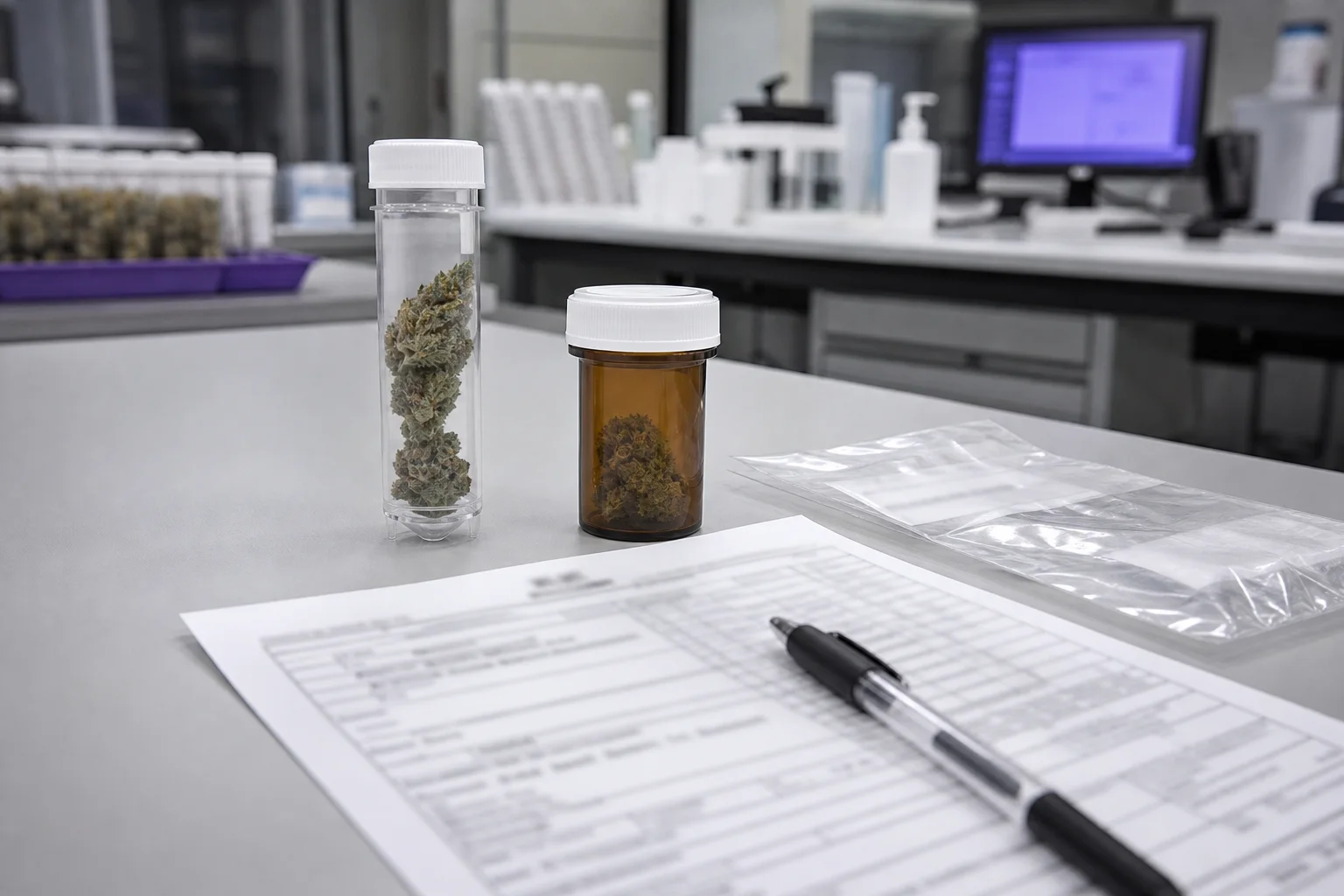
Photograph of a sample submission kit and a deliberately blurred chain-of-custody sheet to teach why process records and proper sampling matter for COAs and regulatory compliance. Limit: do not display readable personal or lab identifiers. ([maine.gov](https://www.maine.gov/dafs/ocp/sites/maine.gov.dafs.ocp/files/inline-files/AUCP_Mandatory_Testing_Best_Practice_Guide_Sample_Collection%20v.08.12.2024.pdf))
Storage: time, temperature, and the slow unwinding of quality
Once sealed, cannabis continues to change—albeit more slowly. Temperature remains the single biggest determinant of shelf-life kinetics: higher temperatures speed cannabinoid degradation and terpene loss, as shown in kinetic stability studies. Humidity inside packaging affects water activity and therefore microbial stability; oxygen exposure promotes oxidative changes. For longer storage, cool, dark, low-oxygen conditions preserve potency and aroma best. Studies that model cannabinoid decay over months allow reasonable shelf-life projections, but they assume consistent storage conditions—so real-world results vary. (pubmed.ncbi.nlm.nih.gov)
From a safety angle, CDC and poison-control data are clear: packaging and storage decisions also have public-health consequences. Child-resistant packaging and keeping cannabis out of reach—locked and stored separately from food—are essential. In the last decade, unintentional pediatric exposures rose in jurisdictions with adult-use access, largely from edibles but also from products left accessible. Good storage practice is both quality and safety practice. (cdc.gov)
For licensed producers in Maine, the combination of product-tracking rules, required labeling, and COAs gives regulators and consumers traceability. For home growers and small producers who gift or keep product for personal use, the same principles apply: document, package thoughtfully, and store with safety in mind.
Practical checks, lab testing, and how Maine’s medical and adult‑use systems differ
If you run a garden or a small facility in Maine, adopt a short checklist at harvest: measure and log initial moisture and aw, pick a drying method matched to your cultivar and capacity, keep clear curing records, sample and submit for mandatory testing if you plan to sell in the adult-use channel, and package into light-blocking, low-permeability containers. Those steps reduce surprise failures and preserve what you cultivated. Remember: process records are as important as the end product for both learning and compliance. (maine.gov)
Maine’s medical program differs from adult use in its voluntary testing structure. OCP audit testing found substantial contamination in some medical samples when tested to adult-use standards—illustrating that products circulating in a voluntary-testing environment may not meet the stricter mandatory thresholds. If you’re producing for medical patients or retail, be aware of those program differences and align practices where public safety expectations are higher. (legislature.maine.gov)
Finally, labs report what they can measure; method sensitivity, sample homogeneity, and sampling strategy affect results. When you read a COA, look for sampling notes, the lab’s scope and accreditation, and whether retesting pathways were used. When in doubt, consult OCP guidance documents and your certified testing facility—both are part of Maine’s system for turning on-farm practice into verifiable product data. (maine.gov)
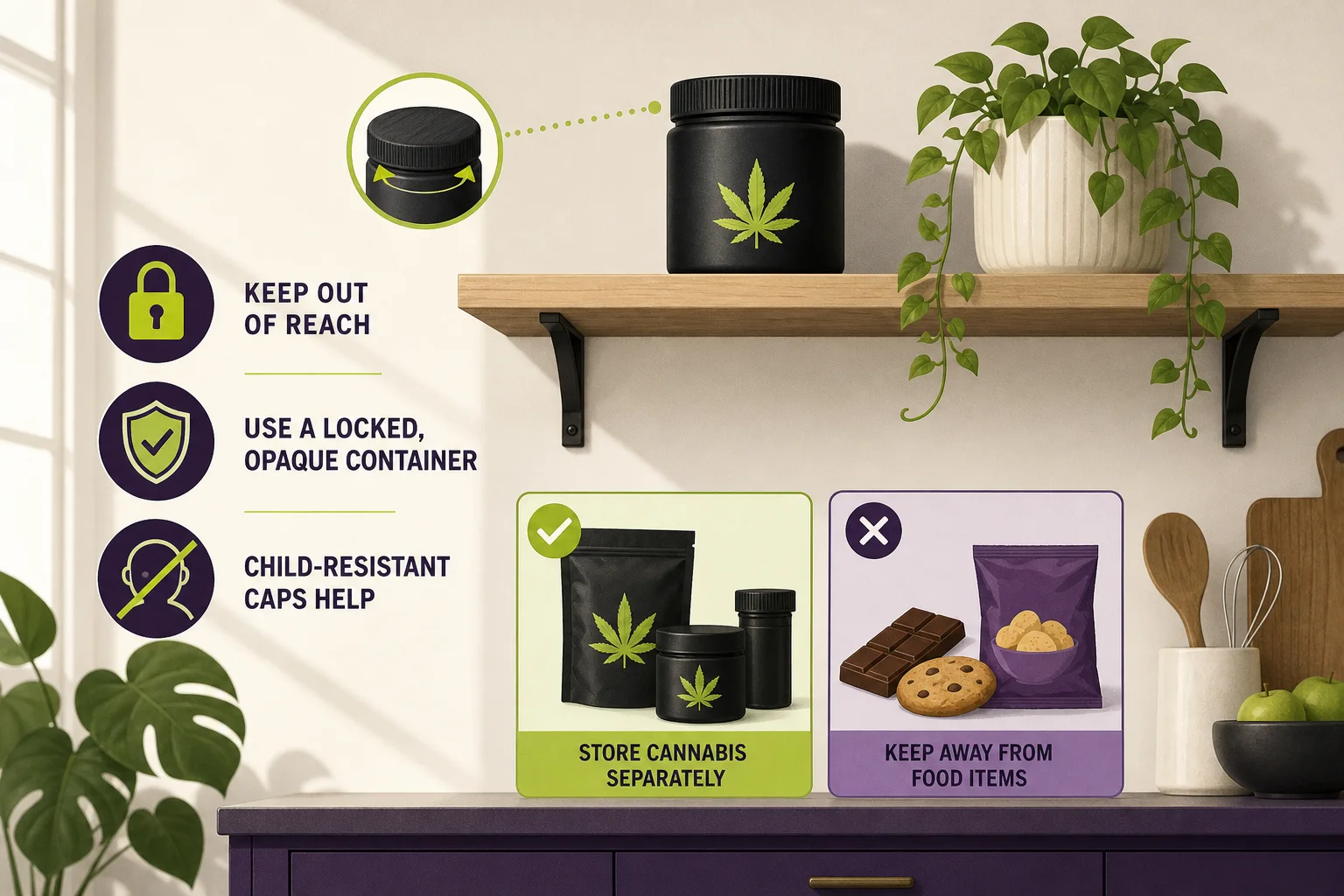
Educational diagram that shows recommended safe storage elements—locked container, child-resistant closure, out-of-sight placement—and explains public-safety rationale. Based on CDC guidance about unintentional exposures. Limit: not a prescription or legal instruction. ([cdc.gov](https://www.cdc.gov/cannabis/health-effects/poisoning.html))
Research context: Cannabis and PoisoningEvidence limits and an honest summary
The peer-reviewed literature on how every cultivar responds to every drying protocol is still developing. Many published experiments use model systems (leaves vs. whole buds) or capital-intensive methods (vacuum-microwave, controlled-atmosphere chambers) that small growers can’t easily replicate. Likewise, lab reports are snapshots; terpene and cannabinoid panels change with time and handling. Use the evidence to guide controlled, repeatable on-farm trials, and document carefully so that you can learn which practices preserve the characteristics you value while meeting Maine’s safety requirements. (pubmed.ncbi.nlm.nih.gov)
Key takeaways
- Drying and curing are distinct processes: drying removes bulk water; curing equilibrates and stabilizes. Both affect safety and chemistry. (pubmed.ncbi.nlm.nih.gov)
- Terpenes decline faster than cannabinoids; method choice matters for aroma retention. (pubmed.ncbi.nlm.nih.gov)
- Water activity (aw) predicts microbial risk better than percent moisture by weight. Maine’s data track microbial failures tied to post-harvest handling. (www11.maine.gov)
- A COA is a time-stamped lab result, not an eternal safety certificate; packaging and storage affect subsequent chemistry. (www11.maine.gov)
- Appearance cannot confirm lab compliance—many dangerous contaminants are invisible. Follow Maine’s mandatory testing and keep process records. (legislature.maine.gov)
FAQ
Q: How quickly should I move my cut plants into drying?
A: Move material into controlled drying as soon as practically possible—hours, not days—especially in warm, humid weather. Rapidly uncontrolled ambient drying risks microbial growth or uneven moisture. Document the time between cut and drying for traceability. (pubmed.ncbi.nlm.nih.gov)
Q: Can I tell safety from smell or appearance?
A: No. Smell and appearance offer quality clues but cannot confirm absence of pesticides, heavy metals, or many microbes. Maine requires lab testing in the adult-use program because visual checks miss many hazards. (www11.maine.gov)
Q: Which is more important: moisture percentage or water activity?
A: Both matter, but water activity better predicts microbial growth. Maine’s testing program includes water activity and microbial categories because weight-based moisture alone can be misleading. ()
Questions this guide answers
How quickly should I move cut plants into drying?
Move material into controlled drying as soon as practical—within hours when possible. Delays in warm or humid conditions increase microbial risk and uneven moisture; document timings for traceability. ([pubmed.ncbi.nlm.nih.gov](https://pubmed.ncbi.nlm.nih.gov/38702447/))
Can smell or appearance confirm a product is safe?
No. Appearance and aroma give quality hints but cannot detect many contaminants (pesticides, metals, some microbes). Maine’s mandatory testing exists because visual checks are insufficient. ([www11.maine.gov](https://www11.maine.gov/dafs/ocp/open-data/adult-use/testing-data))
Which matters more for microbial safety: moisture % or water activity?
Water activity (aw) is a better predictor of microbial growth. Moisture percentage can mislead if water is trapped internally; labs and Maine guidance emphasize aw for microbial risk assessment. ([www11.maine.gov](https://www11.maine.gov/dafs/ocp/open-data/adult-use/testing-data))
Does a COA guarantee product safety forever?
No. A COA documents results for a specific sample at a specific time. Subsequent storage, repackaging, or mixed lots can change product chemistry and safety. ([www11.maine.gov](https://www11.maine.gov/dafs/ocp/open-data/adult-use/testing-data))
Should small growers invest in vacuum or controlled-atmosphere drying?
These technologies can preserve terpenes and speed drying, but benefits depend on scale and cultivar. Many small growers see bigger gains from consistent RH/temperature control and strong curing records. ([pubmed.ncbi.nlm.nih.gov](https://pubmed.ncbi.nlm.nih.gov/38611577/))
Educational information only. Cannabis affects people differently and this is not medical advice.