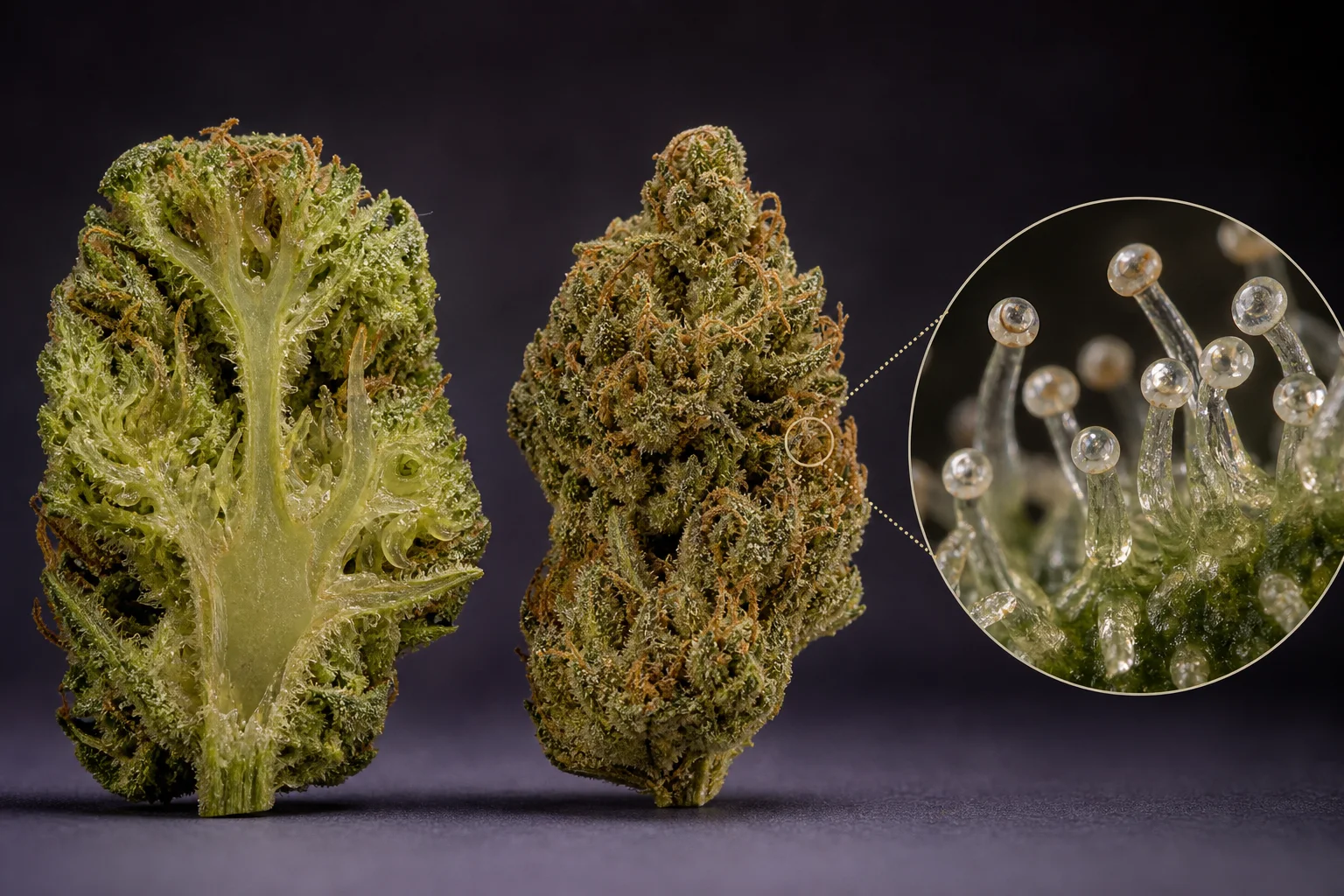
Macro photograph series showing trichome integrity and cross-sectioned bud tissue to illustrate how surface dryness can mask internal moisture pockets; useful to visualize why visual inspection can miss microbial risk. Research connection: demonstrates physical features discussed in the moisture movement and curing sections. Limitations: photographs cannot show water activity or invisible chemical residues—lab testing is required for those measurements.
Introduction
Drying and conditioning are where a harvest becomes a product. What happens in the next hours, days, and months—not just in the field—changes weight, aroma, chemistry, and safety. This article walks through the physical movement of moisture, how volatiles and cannabinoids change, what packaging and storage actually do, what to record, and why visual inspection alone cannot certify a batch. Throughout, I lean on peer-reviewed work and Maine’s own program data so you can match on‑farm practice to testing realities. (pubmed.ncbi.nlm.nih.gov)
1) Moisture movement: the physics that decide rot or shelf life
Moisture movement after harvest is driven by gradients. Cut flowers start with free water in cells and bound water attached to cell walls and macromolecules; when you hang or rack flower, vapor pressure differences and airflow move free water out first. If drying is too rapid at the surface and slow in the center, a shell can form: the exterior looks dry while pockets inside remain wet—an environment that supports fungal growth. The underlying physics and the role of relative humidity and temperature are well-described in post-harvest plant literature and summarized for cannabis in recent studies. (ncbi.nlm.nih.gov)
Two practical metrics matter: moisture content (a raw percentage by weight) and water activity (a_w), the latter being the variable microbiology cares about. Water activity predicts whether yeast and many molds can grow. Maine’s adult‑use testing dataset for recent quarters reports water activity testing for usable cannabis and infused products and shows very low failure rates for water activity in tested samples; still, water activity is the laboratory number that correlates with microbial risk better than how ‘dry’ a bud looks. Recording both moisture content and water activity during drying (and before packaging) reduces surprises at testing and helps narrow remediation needs. (maine.gov)
Finally, drying rate is a tradeoff. Gentle, controlled drying reduces stress to trichome glands and preserves volatile compounds; too-slow drying at high relative humidity increases mold risk. Fast, hot drying fixes cannabinoids earlier and can drive decarboxylation and terpene loss. This presents a set of levers—temperature, RH, airflow, and time—that can be adjusted to balance preservation versus speed according to cultivar structure and production goals.
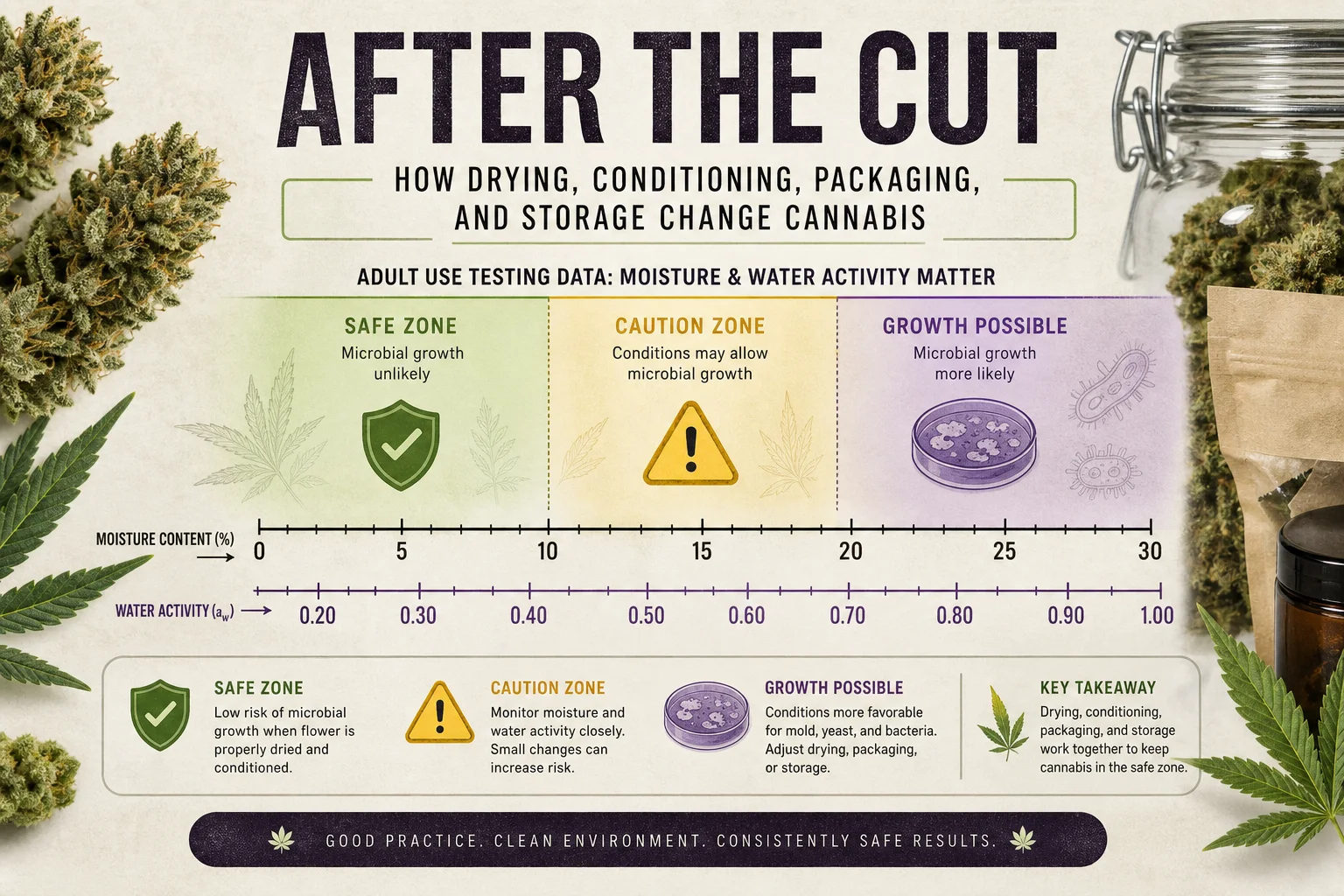
An explanatory illustration that maps moisture content (%) to water activity (a_w) ranges and overlays common microbial growth thresholds. Research connection: links the practical measurement (a_w) to microbial risk and Maine OCP testing practices. Limitations: schematic only; exact thresholds depend on substrate and species and require laboratory confirmation.
Research context: Adult Use Testing Data2) Volatile chemistry: what you lose, what transforms
Volatiles (terpenes and minor aromatics) are small, often volatile molecules that evaporate, oxidize, or react during drying and storage. Studies document quick initial loss: some terpenes can drop by a large fraction in weeks under typical storage. The mechanisms are evaporation driven by vapor pressure and chemical changes like oxidation when oxygen is present or acid-to-neutral conversions when heat is applied. Controlled drying and low-oxygen packaging are options that can slow these losses. (pubmed.ncbi.nlm.nih.gov)
Cannabinoids are chemically more robust than many terpenes but are not inert. Acid cannabinoids (THCA, CBDA) decarboxylate into neutral cannabinoids (THC, CBD) with heat and over time; oxidation converts THC to CBN and other products. The balance between preservation and deliberate decarboxylation (when making certain products) is a process decision. Freeze-drying preserves cannabinoid acids most effectively, but many volatile aromatics are lost in that process—another practical tradeoff described in controlled studies. (pubmed.ncbi.nlm.nih.gov)
Because terpenes strongly influence perceived effect and product identity, their loss matters commercially and for the user experience. Packaging and storage approaches that limit oxygen and light exposure—paired with cool temperatures—tend to preserve the volatile profile longer. Recent controlled research on nitrogen-modified atmosphere packaging (MAP) shows benefit in volatile retention for at least some storage windows, though method, time, and cultivar all change outcomes. (pmc.ncbi.nlm.nih.gov)
3) Conditioning: more than leaving buds in a jar
Conditioning is the slow redistribution of remaining moisture and the continued biochemical transformation of the flower in a controlled, closed environment. Proper conditioning equalizes moisture between inner and outer tissues, allows enzymatic and nonenzymatic reactions to proceed at a slower pace, and can help preserve terpenes when managed carefully. Conditioning protocols vary, but common steps include: finishing initial drying to a safe point (e.g., target a_w and/or moisture content), moving material to a controlled container with short daily airing (burping) events, and transferring to longer-term storage containers once equilibrium is reached.
Recordkeeping during conditioning can include date/time of harvest, initial moisture content/a_w, drying set points, container type for the conditioning period, dates and durations of burping/airing, and periodic a_w checks. These records are not paperwork for its own sake; they provide a defensible trail if a lab test flags a microbial or potency discrepancy later. Maine’s testing rules require COAs and reporting for adult-use sales, so internal process records can narrow the troubleshooting window if a sample needs retest or remediation. (maine.gov)
Conditioning also moderates the sensory profile: some reactions reduce harsh chlorophyll notes and promote the development of subtler aromatics. That said, conditioning cannot resolve wet pockets or contamination introduced before the conditioning period—those issues are best identified earlier in the post-harvest chain.
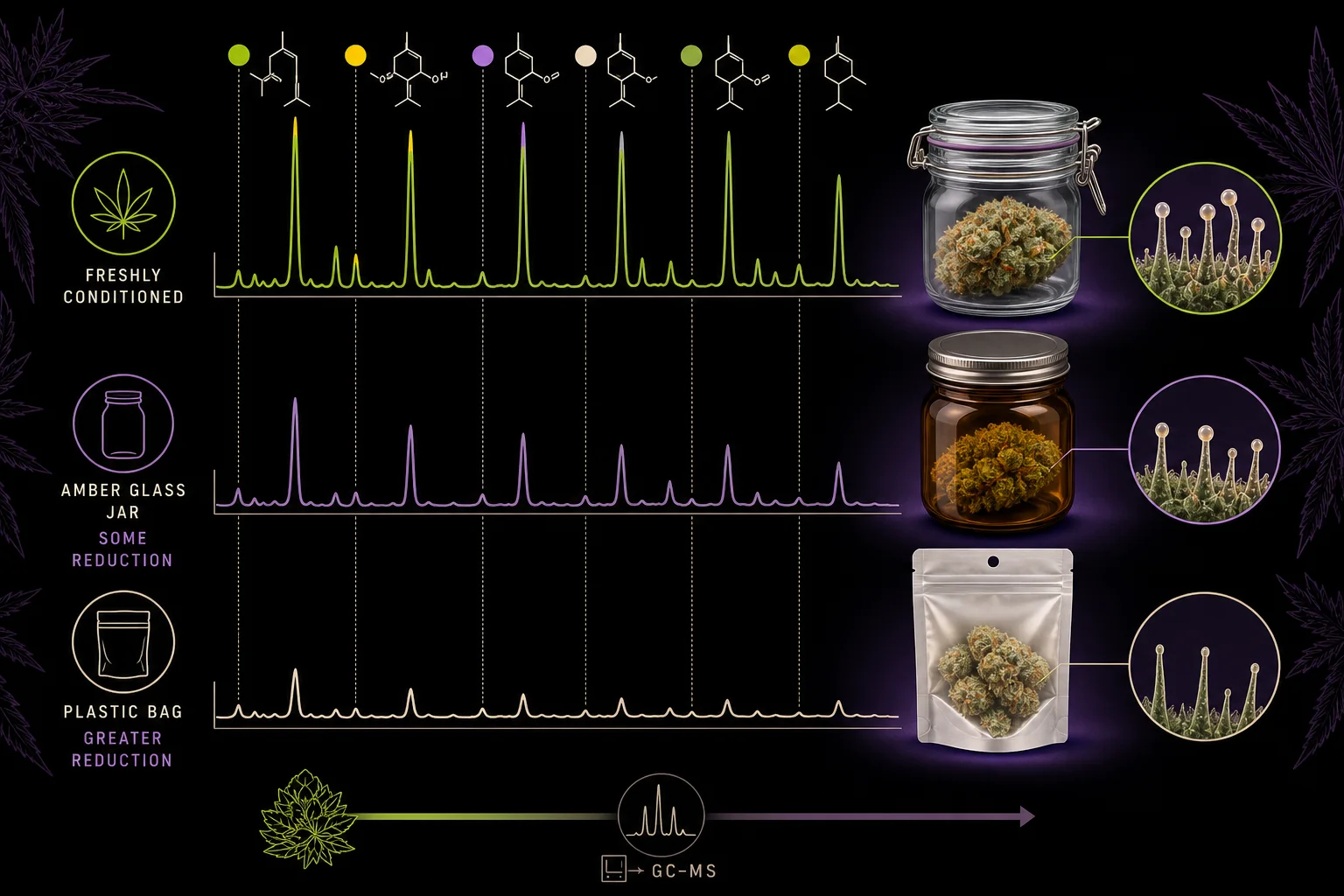
Side-by-side schematic chromatograms (annotated, non‑readable peak heights) that show relative terpene presence after storage in glass vs HDPE vs open tray. Research connection: reflects findings that container material and atmosphere influence volatile retention. Limitations: illustrative chromatograms only; not a real lab report.
Research context: The influence of drying and storage conditions on the volatilome and cannabinoid content of Cannabis sativa L. inflorescences.4) Packaging decisions: materials and atmosphere matter
Packaging is the first defensive layer for long-term stability. Studies comparing storage in glass versus high-density polyethylene (HDPE) or open trays show that inert, non‑permeable containers such as amber glass preserve VOC profiles better than porous plastics or open-air trays. Light, oxygen, and permeable surfaces accelerate terpene loss and oxidative cannabinoid changes. The PubMed study comparing storage vessels found glass bottles generally beneficial for retaining volatile profiles relative to open trays and HDPE boxes. (pubmed.ncbi.nlm.nih.gov)
Active atmosphere strategies—flushing with nitrogen or using oxygen scavengers—can materially slow terpene loss and oxidative cannabinoid changes for defined time windows. The nitrogen-modified atmosphere packaging (MAP) research shows improved retention of high-value volatiles under commercial conditions during short-term storage. MAP is not a universal solution: tight process control, validated sealing, and temperature control are still required, and MAP systems vary in performance by cultivar and initial volatile load. (pmc.ncbi.nlm.nih.gov)
Labeling and container choice also interact with Maine regulatory requirements. For adult-use items, mandatory testing and COAs accompany products offered for sale; packaging practices that align with the tested product are important—changing packaging or reconditioning a previously tested item may trigger retesting per OCP rules. A chain-of-custody note is advisable when a tested batch is moved into a new package. (maine.gov)
5) Storage: temperature, light, and time
Temperature is one of the single biggest drivers of stability. Cooler, stable temperatures slow evaporation and chemical reactions; fluctuating or warm storage accelerates terpene loss and cannabinoid degradation. Dark storage reduces photodegradation; UV and visible light accelerate breakdown reactions. Studies and institutional lab practice point toward cool, dark, and stable environments for preserving both volatiles and cannabinoids. (ncbi.nlm.nih.gov)
Time is inevitable. Even under excellent storage, terpenes decline over months and cannabinoid profiles can shift slowly. Some studies report substantial terpene losses in just one month in typical commercial conditions; cannabinoid decarboxylation and oxidation proceed on longer timelines but are measurable. Batch records can help define realistic shelf-life expectations; batch labels commonly include packaging date and COA test date. For items sold under Maine’s adult-use program, OCP testing reflects the item as sampled; if conditions change meaningfully after testing, the product may no longer match the tested condition. (pmc.ncbi.nlm.nih.gov)
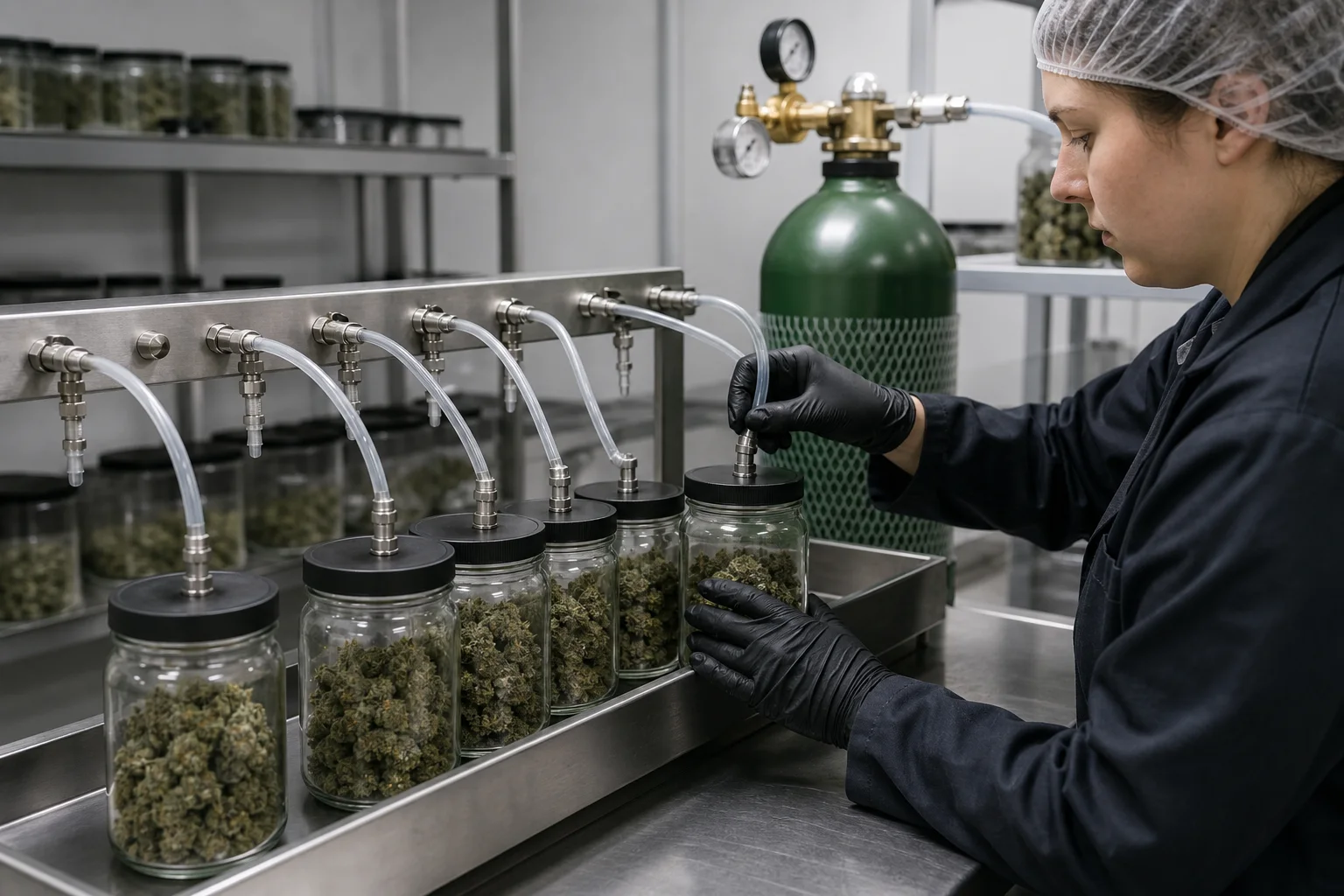
Documentary photo of a small-scale MAP (nitrogen flush) packaging line used commercially for short-term retention of volatiles. Research connection: complements evidence that nitrogen atmosphere can slow terpene loss. Limitations: operational photo—does not show analytical outcomes or guarantee preservation for all cultivars or durations.
Research context: Is nitrogen-modified atmosphere packaging a tool for retention of volatile terpenes and cannabinoids in stored Cannabis sativa inflorescence?6) Records, testing, and Maine program distinctions
Maine operates both a medical program and an adult‑use program; the latter requires mandatory testing in defined analyte categories before sale. The adult-use open-data testing dashboard provides quarterly summaries, COA reporting rules, and failure categories—valuable for growers wanting to align records and corrective actions with regulatory realities. For example, OCP’s data show that water activity failures in adult-use initial mandatory tests are low in recent quarters, but other analytes (potency, pesticides, metals) still appear in the data, underscoring why rigorous pre-package process control matters. Keep clear batch-level documents: harvest date/time, drying/conditioning log, moisture and a_w readings, container and packaging lot, test lab and COA ID, and any remediation steps. These records make internal tracebacks practical and support regulatory compliance if a retest or investigation is required. (maine.gov)
An important distinction: the medical program historically had different testing expectations and sampling patterns; Maine’s adult-use regime places mandatory analytical checkpoints on products sold in the retail supply chain. Operators participating in both channels often use separate process flows and record systems to avoid cross-program compliance gaps.
7) Why appearance cannot certify safety
A visually attractive bud is not the same as a microbiologically or chemically safe one. Mold and mycotoxin risks can come from microscopic spores or chemical residues that are invisible to the eye. Water activity testing is the laboratory signal that correlates with microbial growth potential; visual dryness cannot substitute for a_w. The OCP testing data and scientific literature both caution that visual inspection misses analytical failures that matter for consumer safety and for program compliance. (maine.gov)
Also, terpenes and cannabinoid profile changes can alter perceived potency and aroma without giving any visible cue. Packaging that traps moisture in a sealed container (the classic “sweating” jar) can look fine but incubate microbes. Finally, edible or infused product safety depends not only on flower quality but also on manufacturing controls—appearance of source flower indicates one aspect of input quality but does not document whether solvents or cross-contaminants were present during processing.
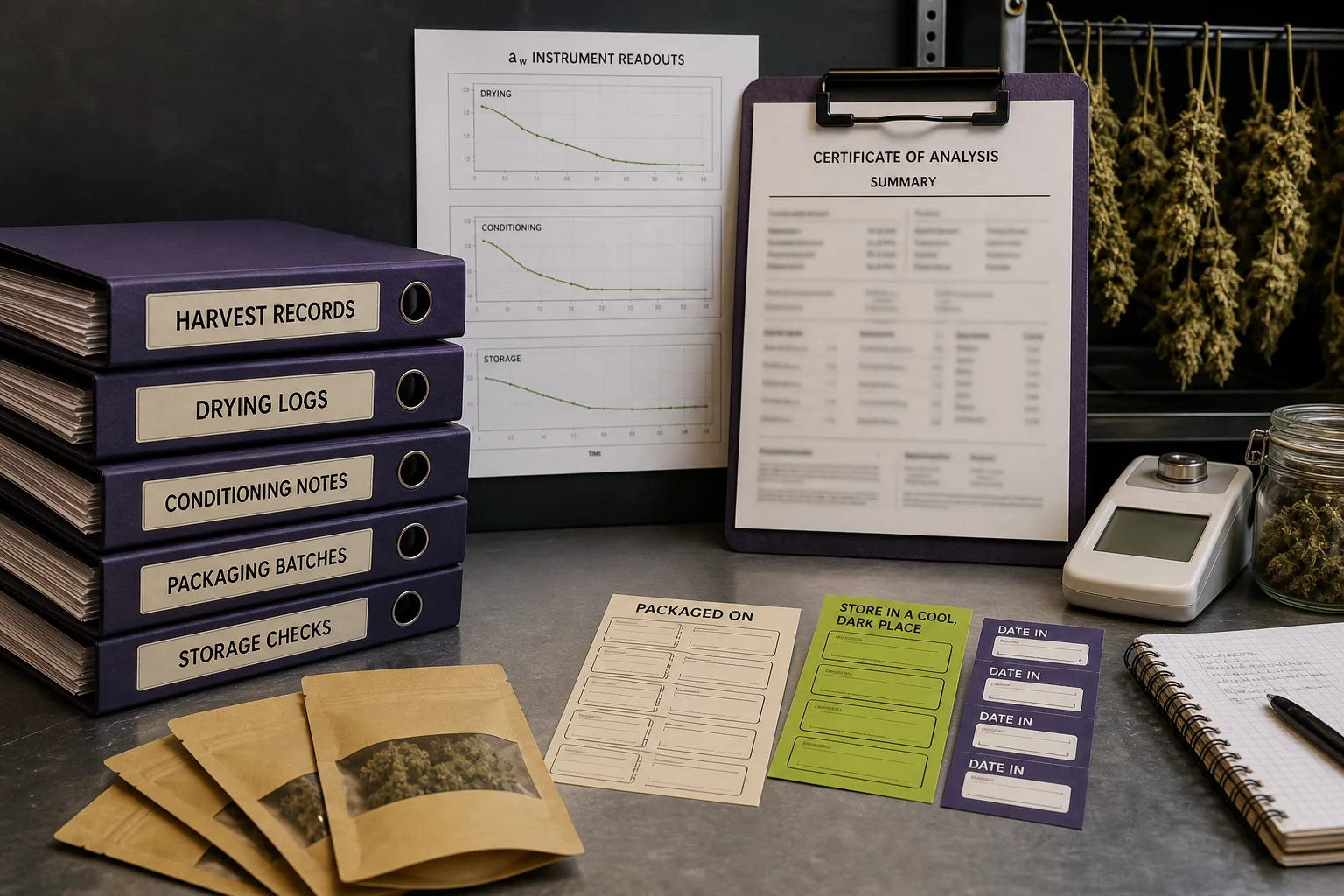
A tidy, real-world evidence photo showing the types of records recommended: harvest log, water activity printouts, COA reference, and packaging labels. Research connection: demonstrates the paper trail that helps trace test failures and supports compliance with Maine’s adult‑use testing rules. Limitations: does not substitute for lab data and must be paired with validated instrument logs.
Research context: Adult Use Testing Data8) Practical checklist for growers and caregivers
- Typical records include initial moisture content and water activity before packaging, with notation of instruments used and their calibration dates.
- Drying logs commonly document drying temperature, RH, airflow, and time for each hung rack, plus burping intervals during the conditioning period and periodic a_w checks.
- Packaging choices: inert materials such as amber glass frequently preserve VOCs; document packaging lot and sealing method. If MAP is used, note flush gas, concentration, and validation tests.
- Storage practice notes: cool, dark, and stable environments are associated with longer stability. Batch labels often show packaging date and COA test date; substantial changes to storage conditions may require retesting per program rules.
- Child-safe storage practices include sealed and locked storage and retaining original containers where practical; have Poison Control’s number available. Visual appeal is not a substitute for laboratory testing—test data and records provide the documented evidence of analytical results.
Conclusion: controlled processes matter more than appearances
Post-harvest handling is about managing physical and chemical change. Moisture movement determines microbial risk; volatile chemistry determines aroma; packaging and atmosphere slow or accelerate those processes; records connect what was done to the test result a third-party lab produces. The science is clear that sight and smell alone are insufficient to vouch for stability or analytical status—measurements, documentation, and post-harvest workflow design provide the evidence that aligns product presentation with laboratory results. (pubmed.ncbi.nlm.nih.gov)
Questions this guide answers
What is water activity and why is it important?
Water activity (a_w) is the available water that microbes can use to grow. Unlike simple moisture percentage, a_w predicts whether yeasts and molds can proliferate. Labs test a_w; growers should record it before packaging because visual dryness can be misleading. ([maine.gov](https://www.maine.gov/dafs/ocp/open-data/adult-use/testing-data))
Will a sealed jar prevent terpene loss forever?
No. Sealing in a cool, dark jar slows terpene evaporation and oxidation but does not stop chemical change. Losses happen over weeks to months even under good storage; active approaches (e.g., nitrogen flush) can extend retention for certain windows. ([pmc.ncbi.nlm.nih.gov](https://pmc.ncbi.nlm.nih.gov/articles/PMC11660729/))
Can a beautiful-looking bud pass Maine’s required testing?
Appearance and aroma do not guarantee a pass. Maine’s adult‑use testing checks for pesticides, metals, microbes, potency, and more. A visual check can miss chemical residues or microscopic contamination; lab testing and records are the authority. ([maine.gov](https://www.maine.gov/dafs/ocp/open-data/adult-use/testing-data))
How should I store cannabis in a home with children?
Keep cannabis locked, out of sight, and in original or child-resistant containers. Poison Control recommends immediate contact (1-800-222-1222) or webPOISONCONTROL if ingestion is suspected. Do not rely on visual cues to judge safety. ([poison.org](https://www.poison.org/articles/medical-marijuana))
What process records matter the most if a COA flags my batch?
Key records: harvest date; drying set points and durations; moisture content and a_w readings; curing schedule and burp logs; packaging type and lot; COA lab, test date, and results. These let you trace where a deviation may have occurred. ([maine.gov](https://www.maine.gov/dafs/ocp/open-data/adult-use/testing-data))
Educational information only. Cannabis affects people differently and this is not medical advice.