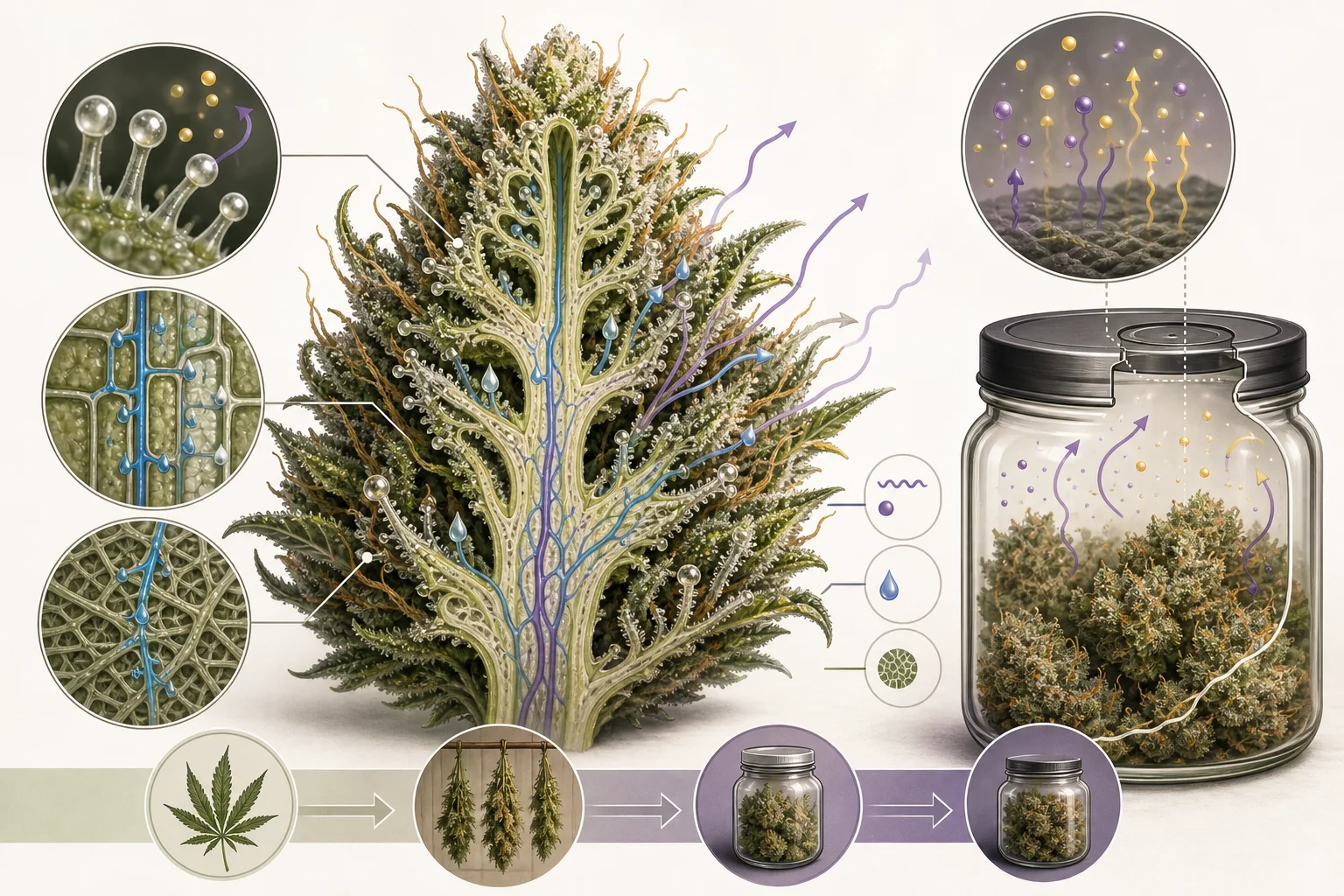
Schematic cross‑section showing water leaving capillaries and trichome headspace volatiles evaporating during drying and curing. This visual summarizes mechanisms explored in postharvest literature but is schematic, not a picture of a particular cultivar. Research connections: volatility and cannabinoid changes (pubmed study: https://pubmed.ncbi.nlm.nih.gov/38702447/).
Why post‑harvest handling matters
You don’t stop farming when you cut a plant. The minutes, hours, and weeks after harvest rearrange chemistry and biology in a cannabis bud: water moves out of tissues, volatile molecules evaporate or oxidize, decarboxylation continues to a degree, and microbes either die, sit dormant, or grow depending on conditions. The modern literature shows these changes are predictable in direction but sensitive to method and environment (see controlled studies on drying and storage effects on cannabinoids and the volatilome: https://pubmed.ncbi.nlm.nih.gov/38702447/ and a broader review of postharvest operations: https://pubmed.ncbi.nlm.nih.gov/36004888/).
For growers and small processors the practical stakes are threefold: (1) quality — how the finished aroma, mouthfeel, and cannabinoid balance look and taste; (2) safety — whether microbes, mycotoxins, or chemical residues end up over regulatory limits; and (3) regulatory traceability — whether your harvest, batch records, and Certificates of Analysis (COAs) allow a product to be sold in Maine’s adult‑use and medical systems (Maine Office of Cannabis Policy testing rules: https://www.maine.gov/dafs/ocp/open-data/adult-use/testing-data).
This article walks through the physical drivers — moisture movement and volatile loss — the common process choices and tradeoffs, how Maine’s testing and record system interacts with post‑harvest work, and why looking at a bud is not the same as testing it.
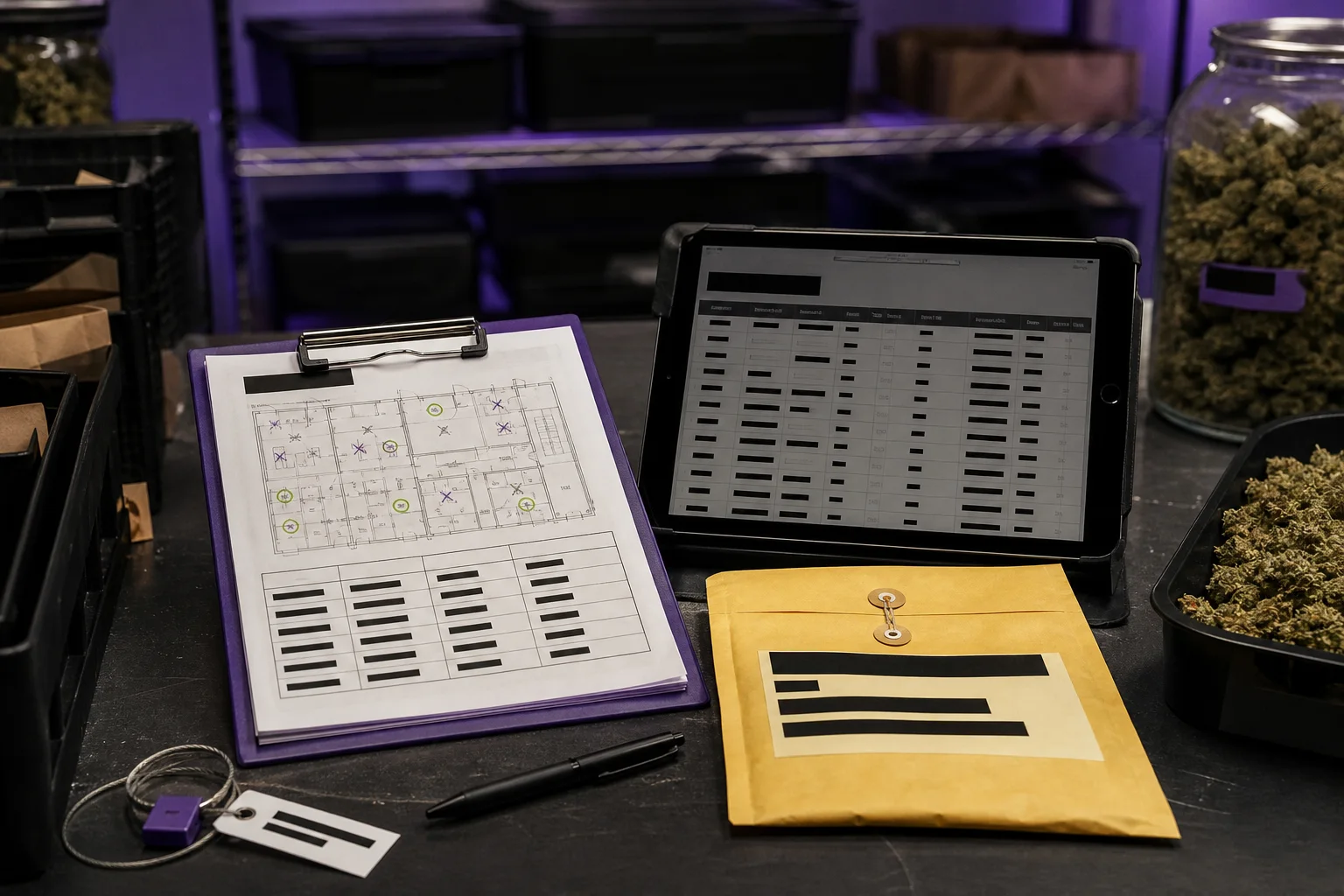
A non‑readable mockup showing how lot IDs, sample location maps, and COA filenames should be recorded. Use this as an instructional artifact — not an actual lab report. Research connection: Maine OCP mandatory testing and electronic data deliverables (https://www.maine.gov/dafs/ocp/open-data/adult-use/testing-data).
Research context: Adult Use Testing DataMoisture movement: water activity, equilibrium, and why meters matter
Two related but distinct measurements govern microbial risk and shelf stability: equilibrium moisture content (EMC) and water activity (aw). EMC describes how much water a dried plant will hold at a given relative humidity; water activity describes how available that water is to microbes. Both change as a bud moves from the field to a dry box and then to packaged storage, and both respond to temperature and ambient relative humidity.
Controlling the drying curve — how fast surface water and bound water leave a bud — sets the final EMC and the aw. Rapid over‑drying shrinks structure and accelerates loss of volatile terpenes; too slow, and interior moisture can linger and allow yeast and molds to grow. Standards and calibration services that underpin accurate hygrometers and humidity control systems are described by NIST (National Institute of Standards and Technology), which provides humidity metrology and calibration guidance useful for growers who instrument drying rooms and storage (see NIST humidity program: https://www.nist.gov/programs-projects/humidity).
Practical implication: use objective instruments (calibrated hygrometers, water‑activity meters when possible) and record conditions, because visual checks or a “feel” test do not reveal EMC or aw reliably. Instruments linked to NIST‑traceable calibrations reduce one big source of process drift.
Drying methods and tradeoffs: hot air, ambient, and freeze drying
Different drying methods reach safe storage moisture on different timeframes and with different side effects. Hot‑air ovens and controlled heated tunnels shorten drying time and can provide microbial reductions quickly, but high temperatures accelerate volatile loss and can increase decarboxylation. Ambient air drying (hung in a dark, ventilated room) preserves more of the volatile profile but requires more time and stricter environmental control. Freeze drying preserves volatiles and cannabinoids well in many trials but requires expensive equipment and careful handling (a controlled study on drying approaches and microbial and cannabinoid outcomes is available: https://pubmed.ncbi.nlm.nih.gov/39942976/).
Those tradeoffs show up in measurable ways: hot drying can reduce microbial load fast and get moisture down to typical safe storage levels quickly, while ambient drying can retain a “fresher” terpene bouquet but leave higher short‑term microbial loads if airflow or temperatures aren’t ideal. Freeze drying often produces the best chemical preservation in lab comparisons, but costs and texture changes make it impractical for many small‑batch producers.
Design the process to the desired outcome: safety margins for microbial counts and regulatory testing, sensory goals for aroma and smoothness, and economics. Whatever you choose, document time, temperature, RH, and any active steps (fans, desiccants, humidity packs) so you can correlate finished product COAs to what was done in the room.
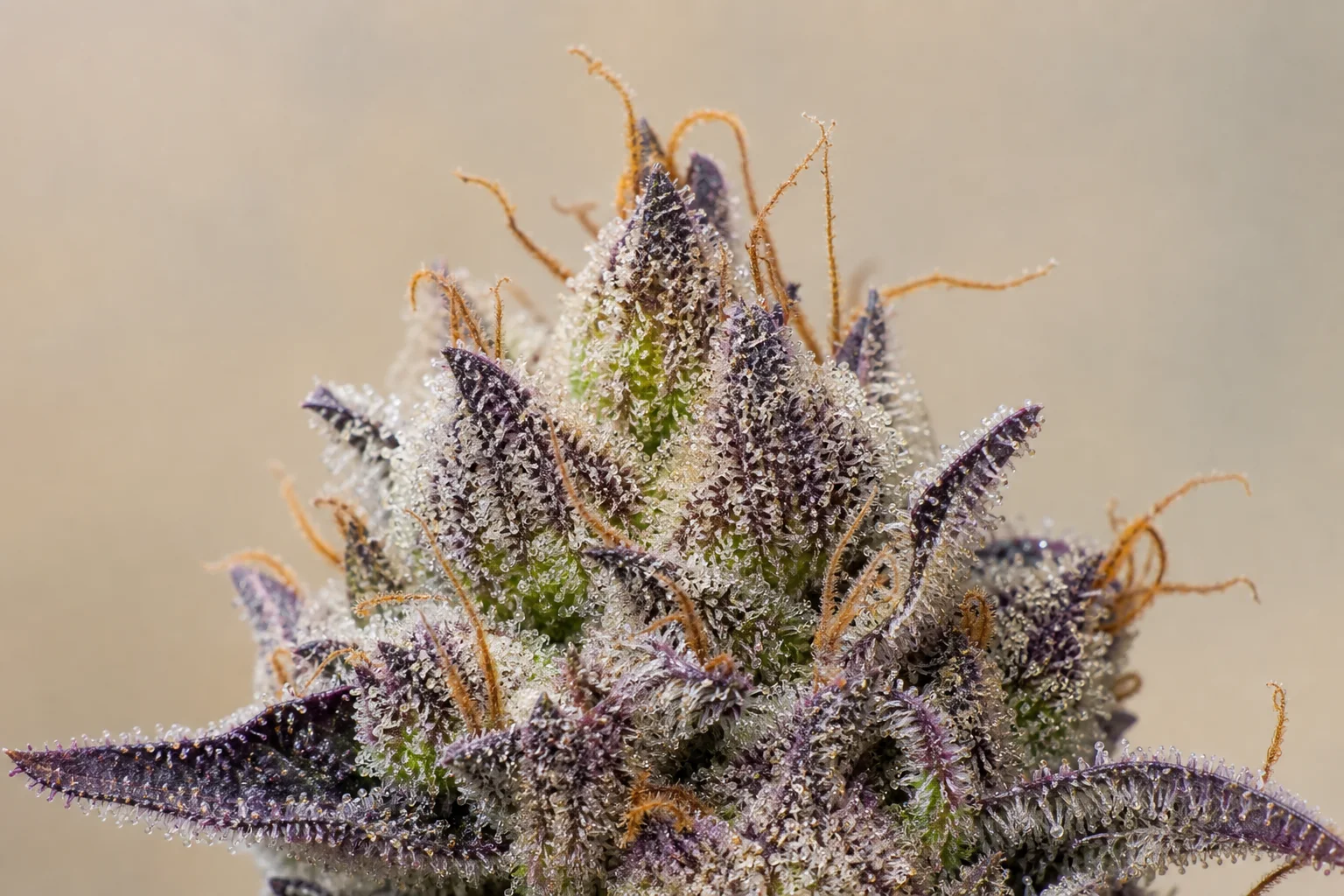
High‑magnification macro photo emphasizing trichome heads where many volatiles and cannabinoids are concentrated. This shows why volatile loss is tied to trichome integrity; laboratory volatilome studies focus on these structures (see https://pubmed.ncbi.nlm.nih.gov/39942976/).
Research context: Postharvest Drying and Curing Affect Cannabinoid Contents and Microbial Levels in Industrial Hemp (Cannabis sativa L.)Volatiles and cannabinoids: what goes, what stays, and why the terpene profile shifts
Terpenes are volatile — literally. During drying and early storage, many terpenes evaporate or oxidize; some oxidized terpenoids change aroma (fresh citrus can become sweeter or musty). Decarboxylation (loss of the acidic carboxyl group from THCA/CBDA to produce THC/CBD) progresses with heat and time; it’s measurable in controlled studies and is sensitive to drying temperature and storage conditions (evidence: https://pubmed.ncbi.nlm.nih.gov/38702447/ and the postharvest review: https://pubmed.ncbi.nlm.nih.gov/36004888/).
That means a COA for potency run on a sample early in the process can differ from potency months later. Likewise, the terpene fingerprint that a customer experiences can be meaningfully different from what was present at harvest because of evaporation and chemical rearrangements during conditioning and storage (see the volatilome-focused work: https://pubmed.ncbi.nlm.nih.gov/38702447/).
For quality‑focused growers, slow, controlled post‑harvest conditioning (moderate RH, dark, gentle container changes) can allow some enzymatic activity to mellow chlorophyll and preserve terpenes better than rapid over‑drying. Still, even the best conditioning loses some volatiles over months; temperature and headspace humidity in packaging play a large role in how fast aroma fades.
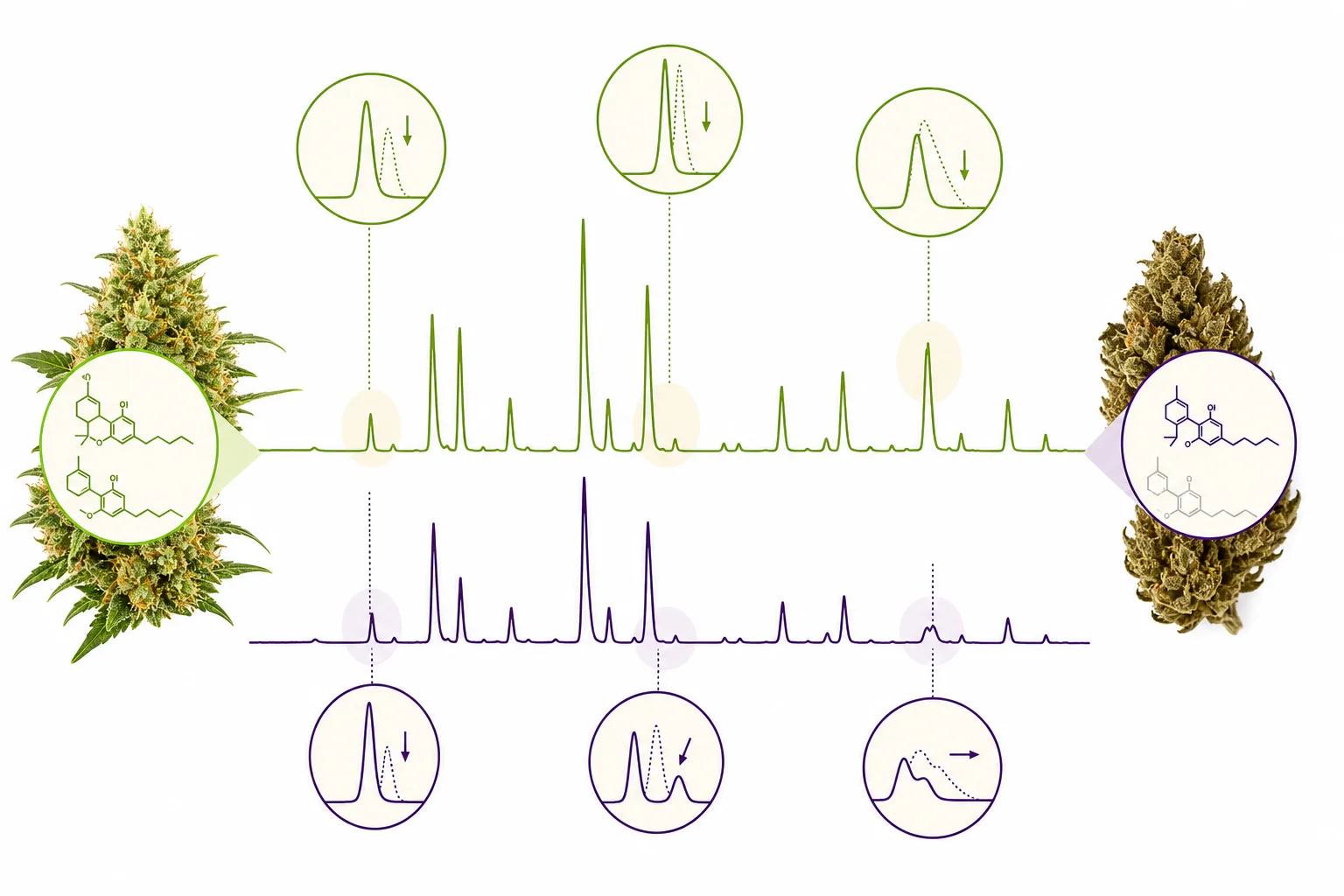
An explanatory, non‑numeric schematic chromatogram showing how peak heights (relative terpene abundance) can change with drying/storage. This is a conceptual teaching image tied to volatilome analyses; it intentionally includes no real data or numeric labels. Linked to volatilome research (https://pubmed.ncbi.nlm.nih.gov/38702447/).
Research context: The influence of drying and storage conditions on the volatilome and cannabinoid content of Cannabis sativa L. inflorescences.Microbial risks, testing limits, and why appearance cannot certify safety
A bud can look pristine and still carry spores, yeast, bacteria, or mycotoxins; conversely, a slightly discolored leaf isn’t always dangerous. Maine’s adult‑use testing program requires mandatory testing categories (residual solvents, metals, microbes and mycotoxins, pesticides, potency, etc.) and records COAs for saleable products — those regulatory thresholds are how safety is verified in the marketplace (see Maine Office of Cannabis Policy adult‑use testing data: https://www.maine.gov/dafs/ocp/open-data/adult-use/testing-data).
Laboratory testing is a snapshot of the sample that was submitted. Sampling decisions (how many buds, where they came from in a batch, whether the sample was surface‑dusted or interior) drive whether a COA reflects the whole lot. Microbes are heterogeneously distributed; bad pockets can be missed unless sampling plans are robust and traceability is tight. That’s why visual inspection alone is inadequate: biological hazards are invisible until cultured or chemically assayed (postharvest microbial outcomes and the effect of drying/conditioning are measured in the hemp/cannabis literature: https://pubmed.ncbi.nlm.nih.gov/39942976/).
Public‑health systems echo the same safety framing: accidental ingestion (especially by children) and cannabis‑involved emergency visits are a concern tied to product forms and packaging — safe storage and child‑resistant packaging are regulatory and public health priorities (see Poison Control guidance and CDC emergency‑visit data: https://www.poison.org/articles/my-child-ate-a-cannabis-edible and https://www.cdc.gov/mmwr/volumes/72/wr/mm7228a1.htm). Appearance is a poor proxy for microbial safety and offers no information about potency or residual chemical contaminants.
Conditioning, packaging, and storage: best practices and materials science
Post‑harvest conditioning is the controlled slow equilibration between bud interior and container headspace; done well it reduces chlorophyll harshness and helps preserve aroma. Common practical targets for conditioned flower are container relative humidity in the 55–62% range and cool, dark storage — although exact numbers vary across recipes and the crop. Packages that wick moisture or off‑gas volatile compounds (low‑quality plastics) accelerate loss; glass and high‑barrier pouches remain common for longer shelf life.
Active humidity control (single‑use humidity packs, regulated humidity cabinets) and oxygen‑control strategies (limiting headspace oxygen, cold storage) slow volatile loss and microbial growth, but they are not substitutes for a documented, validated drying and post‑harvest conditioning process. Calibration and accuracy matter: instruments that are poorly calibrated give false comfort. NIST humidity standards and calibration services are the backbone for reliable hygrometers and environmental control devices (https://www.nist.gov/programs-projects/humidity).
Time matters too: most studies show significant volatile and some potency changes in the first weeks after drying, with additional drift over months. If your business model depends on consistent sensory or potency profiles, plan a stability schedule and retest representative stored samples periodically.
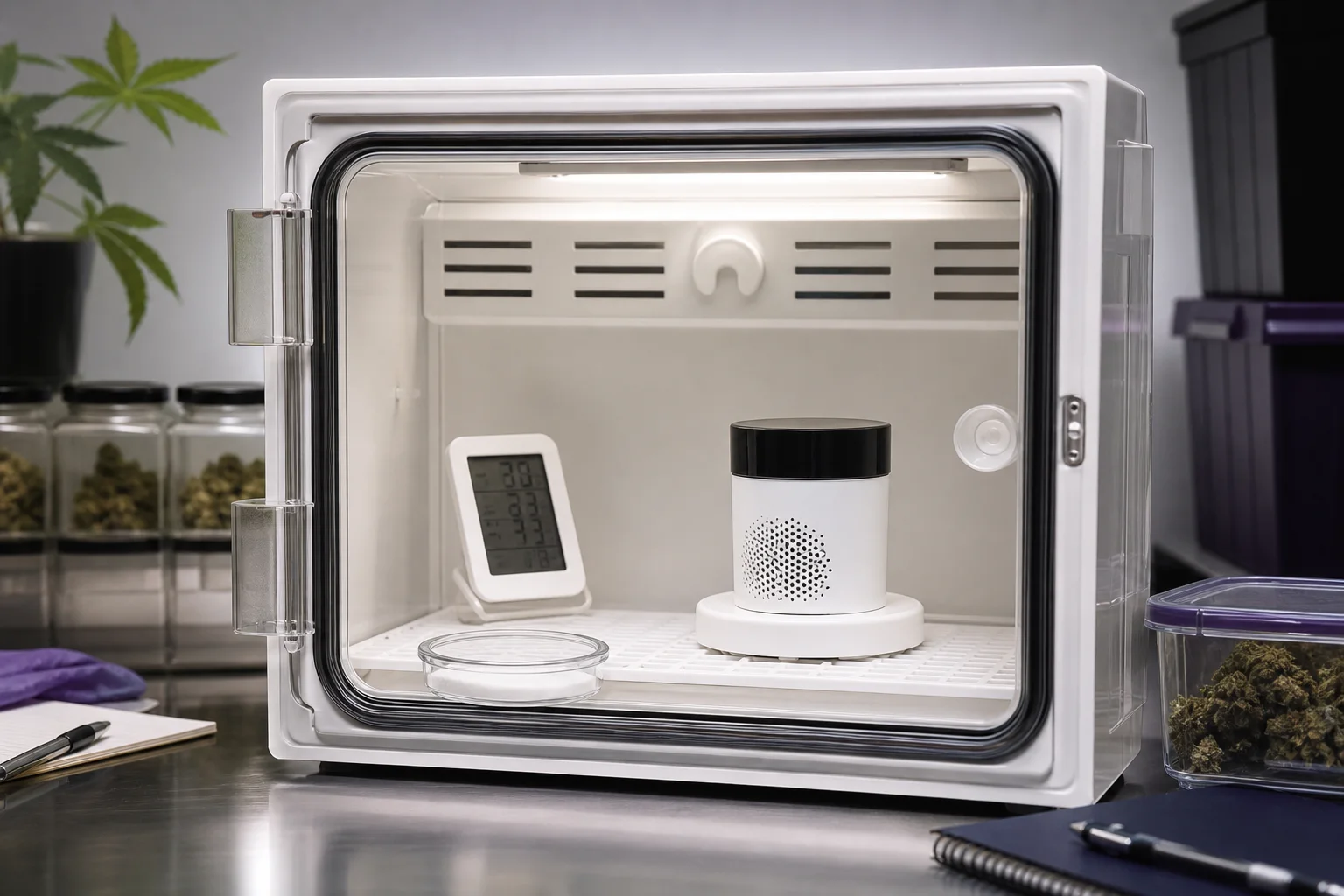
Photographic documentation of a humidity calibration setup or bench; emphasizes the importance of instrument accuracy for drying and storage control. Limit: shows equipment, not specific calibration certificates or numbers. Research/metrology connection: NIST humidity standards and calibration services (https://www.nist.gov/programs-projects/humidity).
Research context: Humidity | NISTProcess records, sampling plans, and Maine regulatory context
Maine’s adult‑use program requires mandatory testing before sale and submission of testing data to OCP; COAs and electronic data deliverables form the legal record that links a batch to its analytical results (https://www.maine.gov/dafs/ocp/open-data/adult-use/testing-data). The statute and program guidance also describe what analytes are mandatory and how failures are handled (see program documentation at the Maine Legislature resource: https://legislature.maine.gov/doc/11360).
For small producers, a defensible record system includes harvest dates and times, lot IDs, drying/conditioning logs (RH, temperature, times), packaging lot numbers, and the COA file names/IDs. Good records let you correlate a failure back to a step in the chain and — when appropriate under Maine rules — perform a retest or remediation pathway as allowed by the OCP.
Remember: lab data is only as good as sampling. Work with your testing lab to develop a statistically supported sampling plan for lots so that submitted samples are representative. Keep handling and chain‑of‑custody notes with each shipment to the lab so you can demonstrate consistent practices if questions arise.
Practical monitoring, limitations of the evidence, and closing notes
Measure what matters: calibrated RH sensors in drying rooms, water‑activity meters for finished goods if you can afford one, and clear lot coding tied to COAs. Expect variability: published studies span hemp and cannabinoid‑type cannabis, different cultivars, and controlled lab setups — so while the direction of effects (terpene loss, microbial reductions with heat, etc.) is robust, the exact numbers and timelines will vary in your farm’s real conditions (see the review and controlled studies: https://pubmed.ncbi.nlm.nih.gov/36004888/ and https://pubmed.ncbi.nlm.nih.gov/38702447/).
Regulatory reality matters: in Maine adult‑use items are subject to mandatory testing before sale; medical programs may operate under different administrative rules — check the program guidance and OCP communications for the latest distinctions and rule changes (Maine OCP data and program pages: https://www.maine.gov/dafs/ocp/open-data/adult-use/testing-data and https://legislature.maine.gov/doc/11360). Regard COAs and sampling plans as part of your safety and quality system, not as mere paperwork.
If you want to dig deeper: the cited peer‑review literature and federal metrology guidance give practical entry points to build calibrated, recorded processes that protect quality and reduce risk. Slow the water, protect the volatiles, document each step, and don’t let a pretty bud be your only inspection.
Key takeaways
- Drying and storage actively change cannabinoids and terpene profiles; method and time matter (lab studies document measurable differences: https://pubmed.ncbi.nlm.nih.gov/38702447/).
- Water activity and equilibrium moisture are the best predictors of microbial risk — not how a bud looks or feels (NIST humidity resources: https://www.nist.gov/programs-projects/humidity).
- Rapid high‑heat drying lowers microbes fast but sacrifices volatiles; slow ambient conditioning can preserve aroma but need tight environmental control (comparative drying study: https://pubmed.ncbi.nlm.nih.gov/39942976/).
- Maine’s adult‑use system requires mandatory testing and COAs; sampling and records determine whether a COA reflects the whole lot (Maine OCP testing data: https://www.maine.gov/dafs/ocp/open-data/adult-use/testing-data).
- Packaging, headspace RH control, and storage temperature strongly influence shelf stability; use high‑barrier materials and calibrated monitoring devices.
- Visual appearance cannot certify safety; laboratory testing and representative sampling do that work (public health guidance on risks and accidental ingestion: https://www.poison.org/articles/my-child-ate-a-cannabis-edible).
FAQs
Q: Can I tell if a bud is safe by smell or look?
A: No. Appearance and aroma are poor indicators of microbial contamination or chemical residues. Only lab testing and representative sampling can confirm safety or compliance.
Q: How soon after harvest should I test a batch for potency and contaminants?
A: Test after you’ve completed your intended drying and post‑harvest conditioning protocol but before packaging as required by Maine OCP for adult‑use sales. Sampling plans should represent the lot and be tied to your process records.
Q: Do desiccant packs or humidity packs solve storage problems?
A: They help control headspace RH and slow volatile loss, but they don’t replace proper drying, post‑harvest conditioning, and representative lab testing. Packs must be compatible with the product and documented in your process.
Q: If a COA passes, is the whole lot safe forever?
A: A passing COA reflects the tested sample at the time of analysis. Potency and volatiles can shift with time; microbial and chemical hazards are affected by storage. Periodic stability checks are a good practice.
Q: Are laboratory standards the same nationwide?
A: No. Labs vary in method, sensitivity, and sampling practices. Use accredited labs, maintain chain‑of‑custody, and align sampling plans with Maine OCP guidance.
Q: How should a small grower keep meaningful records?
A: Record harvest date/time, lot ID, drying room RH and temperature logs, conditioning container IDs and RH, packaging lot numbers, and the lab sample ID/COA. Keep digital backups tied to batch codes.
Evidence limits and transparency
Most peer‑reviewed studies mix hemp and cannabinoid‑type cannabis and use controlled lab methods; results indicate direction and mechanisms but not identical timelines for every cultivar or farm. Metrology guidance (NIST) helps with instrument calibration but does not prescribe a single, universally accepted RH target for all crops. Maine regulatory pages describe testing categories and data submission rules but program guidance can evolve; consult OCP materials for the latest administrative details (https://www.maine.gov/dafs/ocp/open-data/adult-use/testing-data).
Questions this guide answers
Can I tell if a bud is safe by smell or look?
No. Appearance and aroma do not reliably indicate microbial contamination or chemical residues; only representative lab testing and proper sampling confirm safety.
When should I test for potency and contaminants?
Test after your intended drying and curing are complete but before final packaging when required by program rules. Make sure samples are representative of the lot and that chain‑of‑custody and process records are maintained.
Do humidity packs fix storage problems?
Humidity packs can manage headspace relative humidity and slow volatile loss, but they don't replace correct drying/curing and documented sampling/testing.
If a COA passes, is the whole lot safe forever?
A passing COA reflects the tested sample at the time of analysis. Potency and volatile profiles drift over time and storage; periodic retesting or stability monitoring is prudent.
What monitoring tools are most useful?
Calibrated hygrometers for rooms, water‑activity meters for finished goods (if affordable), and robust lot records tied to your lab sample IDs are the most practical, high‑impact investments.
Educational information only. Cannabis affects people differently and this is not medical advice.