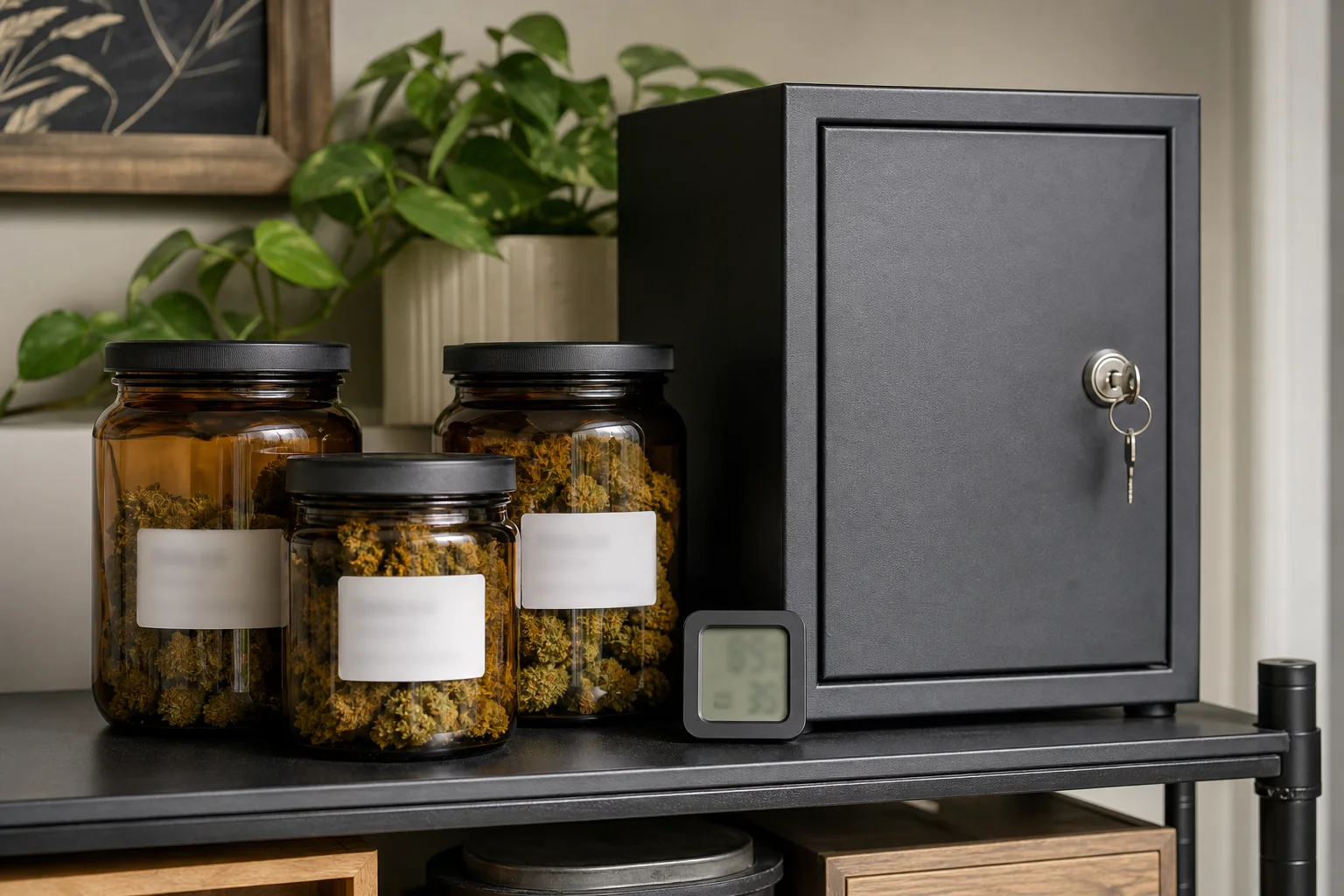
Hero image showing an evidence‑based home storage setup: opaque/amber containers, a digital hygrometer for temperature and RH monitoring, and locked storage. This visual connects practical storage choices to traceability and child‑safety recommendations in Maine OCP guidance and storage research. Limit: does not show readable labels or any regulatory documents with legible text.
Why storage matters: quality, safety, and traceability
Good storage is more than neat jars on a shelf — it’s where product care, household safety, and record keeping meet. For flower and concentrates, exposure to light, heat, oxygen, and moisture changes the plant chemistry you cultivated: THC and other cannabinoids can degrade, volatile terpenes evaporate or oxidize, and microbes or mold can grow when moisture and time line up wrong. Laboratory studies show measurable losses in cannabinoids and terpenes under warm, oxygen‑exposed, or humid conditions, and that degradation pathways change with temperature and storage method. (pubmed.ncbi.nlm.nih.gov)
Those chemical changes matter for two reasons. First, they change the sensory character and performance of product you sell or use — aroma fades, profiles shift, and concentrates can darken as oxidation proceeds. Second, storage choices intersect with public health: poorly stored edibles or infused ingredients increase the chance of accidental ingestion by children or pets, an issue called out by public health surveillance and poison centers. Clear storage rules at home and in retail settings are a straightforward way to lower those risks. (cdc.gov)
Maine’s Office of Cannabis Policy (OCP) highlights testing, labeling, and the importance of safe, locked storage at home; adult‑use products sold in Maine must pass mandatory testing and are labeled with batch and test information — while medical products currently have different testing requirements. That difference matters for your records: if you serve medical patients, track any caregiver testing and documentation separately. (maine.gov)
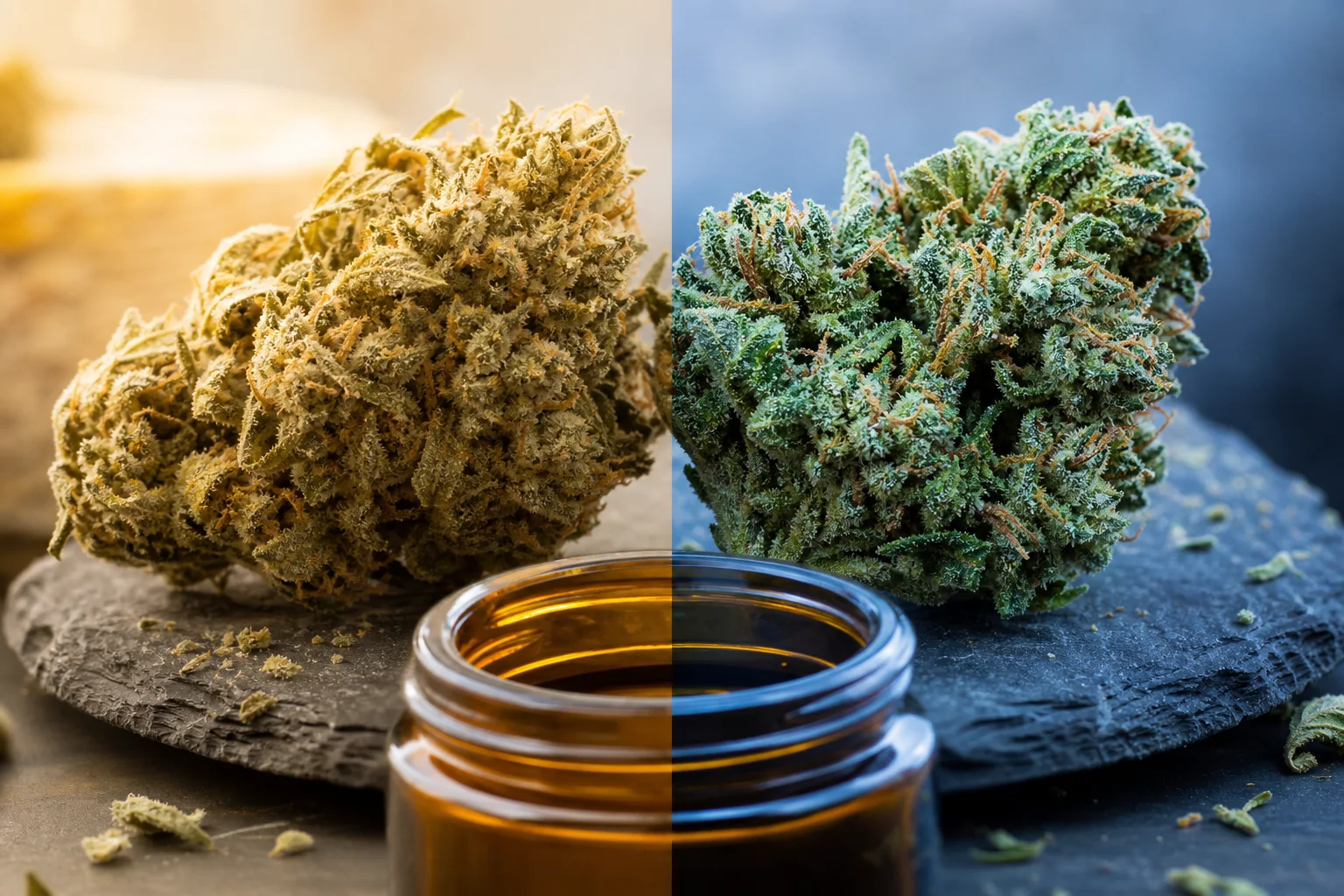
Macro comparative image illustrating how light and heat accelerate chemical change: one bud photographed under warm light (slightly faded pigments) and one under cool, dark conditions (fresher color). Use this to teach how visual cues can indicate degradation but note that chemical testing is required for precise measurement. Limit: no readable lab reports or numerical data in the image.
Research context: Thermal stability of cannabinoids in dried cannabis: a kinetic studyLight and heat: what to avoid, and why
Light and elevated temperatures speed chemical change. Many peer‑reviewed studies quantify cannabinoid and terpene losses at warm temperatures and under light exposure. Thermal studies on dried cannabis flower followed samples across -20°C to +40°C and reported that higher temperatures accelerate cannabinoid degradation and can shift the profile toward oxidized products over months. Terpenes—the volatile compounds that shape aroma—are even more sensitive and evaporate or oxidize faster than cannabinoids. (pubmed.ncbi.nlm.nih.gov)
A practical approach is to minimize light and temperature swings. Store sealed product in opaque or dark containers and keep them somewhere cool and stable — avoid sunny windows, near stoves, or heaters. “Cool” in laboratory terms often means refrigerated or below typical room‑temperature extremes; many studies show better chemical retention at lower temperatures, though freezer storage can create other issues for flower (brittleness, trichome loss) unless packaging and moisture control are excellent. A small thermometer in your storage area helps when repeatable control is needed. (pubmed.ncbi.nlm.nih.gov)
For small‑batch growers: if you’re packaging for distribution, state labeling that records Date Harvested and Date Tested (seen on Maine OCP examples) becomes part of quality tracking — keeping product cool between harvest, test, and sale reduces the drift between the label and the product in the jar. (maine.gov)
Air and moisture: seals, desiccants, and water activity
Oxygen and uncontrolled moisture are twin drivers of degradation and microbial risk. Oxygen oxidizes cannabinoids and terpenes; moisture above safe thresholds raises the risk of mold and microbial growth. The scientific literature on post‑harvest storage emphasizes the importance of controlling water activity (aW) and relative humidity — not just “dry” by feel. Studies on cannabis post‑harvest storage show that both whole and ground flower fare better when stored with stable, appropriate humidity and limited oxygen exposure. Techniques include vacuum or inert‑gas packaging, nitrogen flushing, and using calibrated humidity packs to hold relative humidity in a targeted range. (pubmed.ncbi.nlm.nih.gov)
What does this look like in practice at home or in a small grow? Airtight jars (glass with a good seal) are a common option; avoid prolonged storage of ground flower (which has more exposed surface area), and consider humidity control packs sized to the jar. If vacuum sealing is used, be mindful that brittle, resinous material can be crushed — package gently and label clearly. For longer archival storage of high‑value material, vacuum or refrigerated storage in sealed, low‑oxygen packaging tends to preserve cannabinoids better than an open jar. (pubmed.ncbi.nlm.nih.gov)
Finally: measure, don’t guess. A small hygrometer and digital thermometer are inexpensive tools that let you target a storage environment and document it in your batch notes.
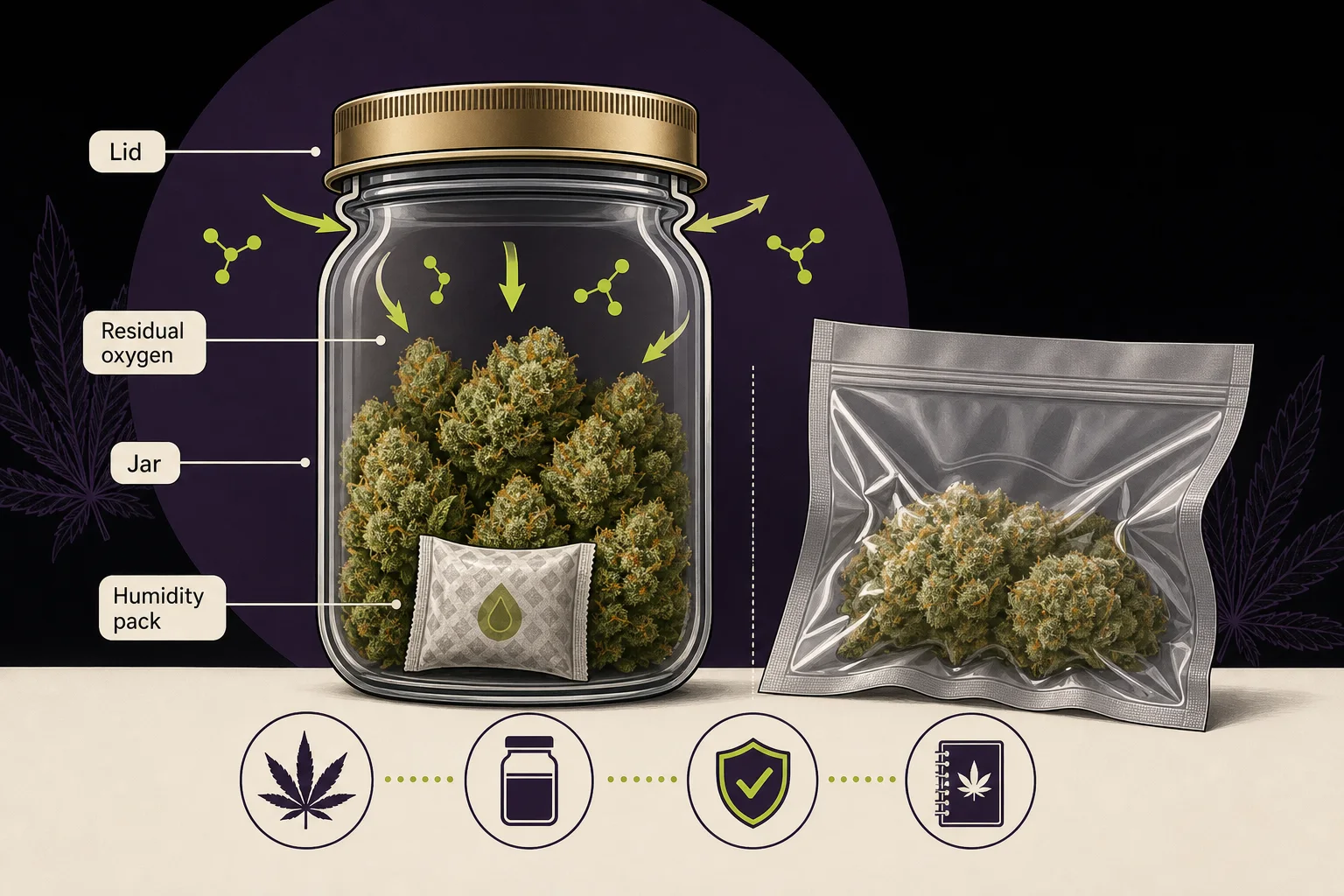
Scientific diagram explaining how oxygen and moisture move in and out of storage containers and how humidity packs and vacuuming alter those pathways. The image connects post‑harvest studies on aW and oxidative loss to practical interventions. Limit: no product logos, no numerical claims or labeled test values.
Research context: Metabolic Profiling of Cannabis Secondary Metabolites for Evaluation of Optimal Postharvest Storage ConditionsClear identification: labels, batch codes, and the records that matter
Good labels are short, specific, and consistent. Maine OCP examples show the exact fields that make sense on a small operation label: Product type, Weight, Batch number, Date Harvested, Date Tested, and License or Caregiver ID. These are not just regulatory boxes — they let you and your customers trace a product back to a harvest, a drying and post‑harvest conditioning approach, and a lab result. If something goes wrong (a failed test, an accidental exposure), solid labels and chain‑of‑custody notes let you act quickly and accurately. (maine.gov)
Record keeping should be simple and structured. For each batch consider a one‑page record: cultivar, seed/clone source, grow notes (light, nutrients, pest control measures), harvest date/time, drying and conditioning regimen (temperature, RH, container), final weight, packaging date, storage location, lab test ID & date (if applicable), and who handled packaging. Use consistent batch numbers (date + sequence works well, e.g., 2026‑09‑01‑B01). Keep an electronic copy with backups and a short physical log near your packaging area. This makes product care repeatable and defensible.
Child and pet safety: secure storage and emergency steps
Accidental ingestion by children and pets is a major public health concern. Poison centers and CDC surveillance both flag increasing pediatric exposures associated with edibles and poorly stored infused products; public health guidance emphasizes locked storage and clear labeling as primary prevention. Poison Control explicitly warns that edibles and medical products can look like ordinary food, and that current regulations do not uniformly guarantee child‑safe storage across all product types — a reality for caregivers and growers to heed. (poison.org)
Two practical, evidence‑based habits reduce risk: keep all cannabis products locked and inaccessible to children and pets, and avoid storing edibles where food is commonly prepared or served. Lockable containers or a dedicated locked cabinet are common controls; for retail or shared kitchens, protocols like separate labeled storage and limited access help reduce the chance of accidental access. Maine OCP public materials explicitly advise storing cannabis locked and away from young people and pets. (maine.gov)
If an accidental ingestion is suspected, Poison Control is the immediate, non‑emergency resource for triage and advice (call the local poison center or 1‑800‑222‑1222 in New England). For severe symptoms (difficulty breathing, seizures, unresponsiveness), emergency services are the appropriate contact. Keeping product packaging or a photo of the product available for clinicians or poison specialists speeds assessment. (poison.org)
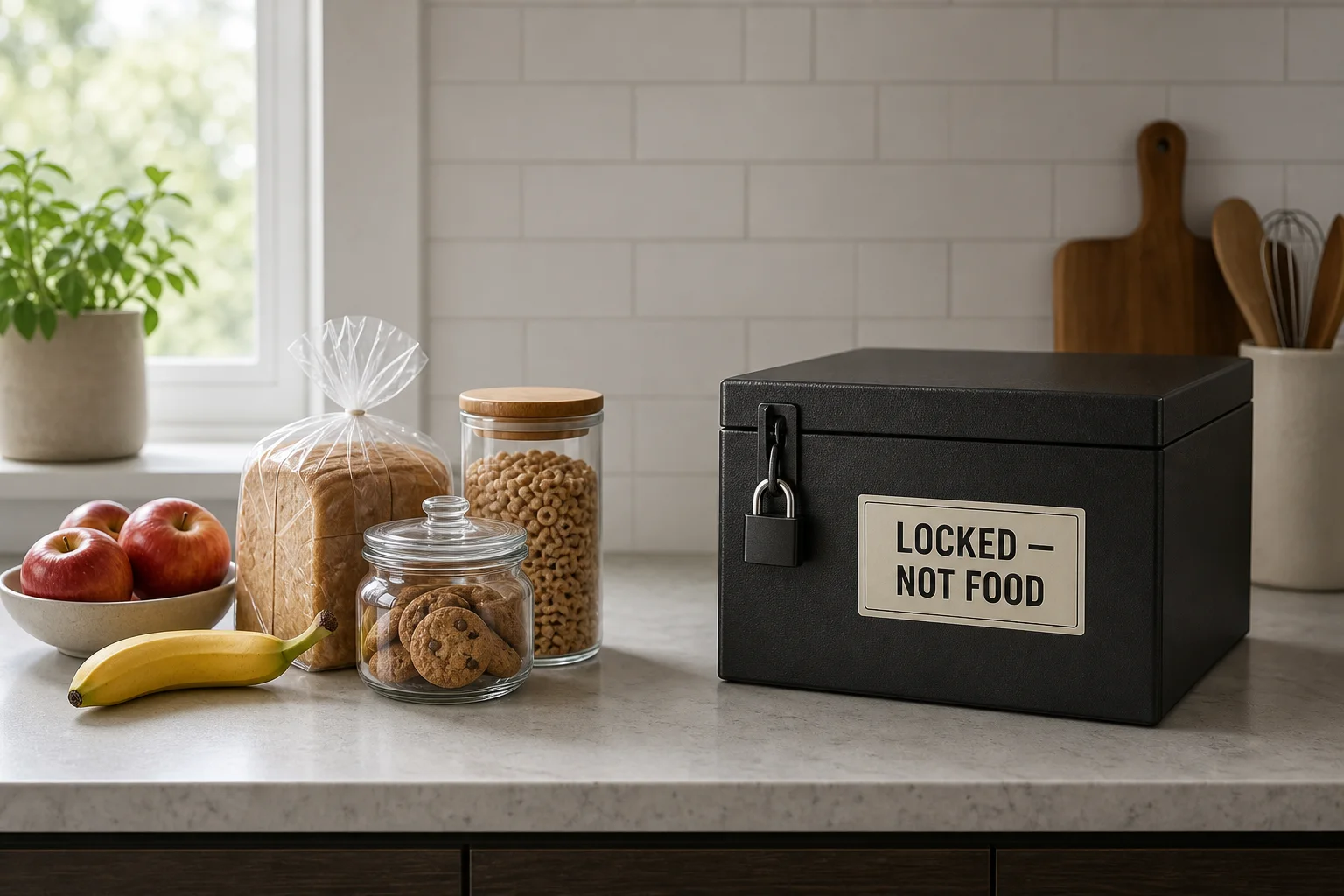
Photo showing best practices for preventing accidental ingestion: edibles in a clearly marked, lockable separate container stored apart from ordinary food items. This reflects Poison Control and CDC recommendations on locked and separate storage to reduce pediatric exposures. Limit: do not show real product packaging or any readable brand/labeling.
Research context: Medical marijuana poisoning in kidsPractical storage options for small batches and home growers
Match storage method to product type and intended shelf life. Short term (days–weeks): glass jars with good lids, opaque when possible, kept in a cool, dark cabinet at stable humidity (use a small RH pack if you live in a humid climate). Medium term (months): sealed glass, humidity packs, cool area or small refrigerator dedicated to non‑food items. Long‑term archival (high‑value genetics): low‑oxygen packaging, freezer or cold storage with careful moisture control and rigid secondary containment to protect trichomes. Studies show refrigerated or frozen storage can slow chemical changes, but note mechanical damage risk (trichome loss) and condensation if packaging isn’t moisture‑tight. (pubmed.ncbi.nlm.nih.gov)
Avoid: leaving jars open, storing in clear containers exposed to daylight, and long storage of ground material. For concentrates: choose small, inert containers (glass or PTFE‑lined) and keep them cool; for infused oils, keep away from high heat that accelerates oxidation. If packaging for others, adopt a consistent protocol for packaging date, batch number, and a basic storage note on the label (e.g., “Store cool, dark, and locked”).
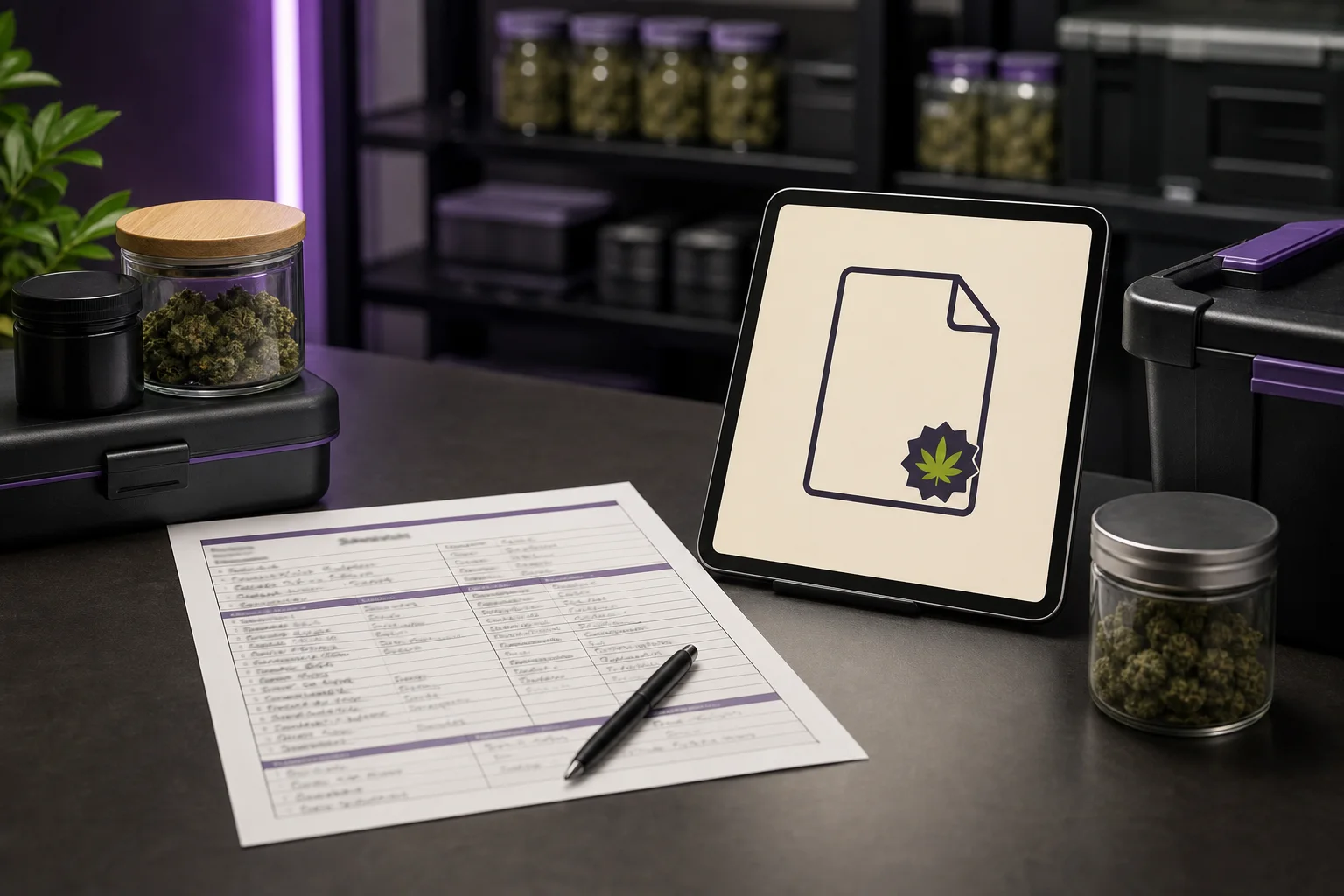
Visual teaching piece showing a tight one‑page batch sheet next to a tablet displaying a scanned certificate of analysis (COA) icon. This connects Maine OCP labeling examples to practical record keeping; the image deliberately avoids readable test numbers or report data. Limit: no legible COA values or personal data.
Research context: Cannabis 101 (Maine OCP)Batch notes that actually help you repeat success
Think of batch notes as a recipe that factors in what mattered. For each discrete harvest or processed lot, record:
- Unique batch code, cultivar, and plant IDs.
- Harvest date/time and environment notes (flower maturity cues, trichome description).
- Drying and conditioning regimen: drying temperature, starting RH, length of dry, jar conditioning RH targets, frequency of burping.
- Final weight and moisture/water activity if measured.
- Packaging: date, container type, seal method, any desiccant or humidity pack used.
- Storage conditions: room name, temperature range, RH range, and special steps (vacuum, nitrogen flush, refrigeration).
- Lab test details: lab name, test date, test ID, and links to COA (certificate of analysis) or scanned results when available. (Note: Maine’s adult‑use testing is mandatory; medical products may not have mandatory testing — track whatever testing you do.) (maine.gov)
Good batch notes are short, auditable, and searchable. Use a spreadsheet or simple database with fields that match your physical label. When you identify a successful combination of cultivar + dry/conditioning + storage, you’ll be able to replicate it — and if something fails, you’ll have the facts to diagnose why.
Evidence limits and practical judgment
The peer‑reviewed literature gives clear direction on trends — heat, light, oxygen, and moisture accelerate chemical and microbial changes — but exact shelf‑life predictions are context dependent. Studies use different chemovars, packaging materials, and analytical methods; lab conditions (accelerated aging, controlled humidity) are not identical to a farmhouse cabinet. That means: use studies as a roadmap, not a calendar. Measure what you can (weight, RH, temp) and document the rest so your own data become the strongest evidence for your operation’s practices. (pubmed.ncbi.nlm.nih.gov)
Also note regulatory differences: Maine’s adult‑use program requires mandatory testing and standardized labeling that supports traceability, while medical programs may have different testing requirements — check OCP guidance and keep your records aligned with which system your product flows through. (maine.gov)
Quick checklist and closing notes
- Keep it dark, cool, and steady: opaque containers, stable temperature, minimal light exposure. (pubmed.ncbi.nlm.nih.gov)
- Control humidity and oxygen: airtight jars, humidity packs, or vacuum/inert‑gas packaging for longer storage. (pubmed.ncbi.nlm.nih.gov)
- Lock it up: edibles and attractive packaging are a pediatric and pet risk — store locked and separately from food. Poison Control and public health guidance support locked storage and clear labeling. (poison.org)
- Label every package with batch code, dates, weight, and test ID when applicable. Keep batch notes synced to labels. (maine.gov)
Storage is where good growing meets good responsibility. Small steps — a hygrometer, consistent batch codes, and a lockable cabinet — keep product honest and households safer.
Questions this guide answers
What temperature and humidity should I target for storing cured flower?
Aim for a cool, stable place: many growers keep cured flower at typical cool‑room temperatures (roughly 10–20°C) with a stable relative humidity near 55–62%. Labs show cooler, stable conditions preserve cannabinoids and terpenes better than warm or fluctuating temperatures, but exact targets depend on your drying/curing process and packaging. Measure and record temperature and RH for best reproducibility. ([pubmed.ncbi.nlm.nih.gov](https://pubmed.ncbi.nlm.nih.gov/33420535/))
Can I store flower in the freezer to keep it fresh?
Freezing can slow chemical changes and is used for long‑term archival storage of high‑value material, but it also risks trichome damage and condensation unless packaging is moisture‑tight and vacuum or low‑oxygen sealed. For medium‑term storage, cool, dark, sealed containers with humidity control are simpler and effective. ([pubmed.ncbi.nlm.nih.gov](https://pubmed.ncbi.nlm.nih.gov/38611521/))
Are there legal requirements in Maine about labeling and safe storage?
Maine’s OCP requires adult‑use cannabis to pass mandatory testing and shows example labels with Date Harvested, Date Tested, and Batch number; the OCP also advises keeping cannabis locked and away from children and pets. Medical program testing rules can differ, so keep separate records for medical‑designation products. ([maine.gov](https://www.maine.gov/dafs/ocp/sites/maine.gov.dafs.ocp/files/2023-08/Maine%20Cannabis%20101.pdf))
What should I do if a child or pet eats an edible?
Call your regional poison center or the national Poison Control number for non‑emergencies; for severe symptoms (trouble breathing, seizure, unconsciousness) call emergency services immediately. Keep the product package or a photo available; poison specialists and clinicians use that information to advise next steps. ([poison.org](https://www.poison.org/articles/medical-marijuana))
How granular should my batch notes be for small batches?
Keep a one‑page record per batch: cultivar, harvest date, dry/curing regimen, final weight, packaging date and method, storage location and conditions, and lab test ID/date when applicable. Use consistent batch codes and an electronic backup so you can reproduce successful practices and diagnose issues. ([maine.gov](https://www.maine.gov/dafs/ocp/sites/maine.gov.dafs.ocp/files/2023-08/Maine%20Cannabis%20101.pdf))
Educational information only. Cannabis affects people differently and this is not medical advice.