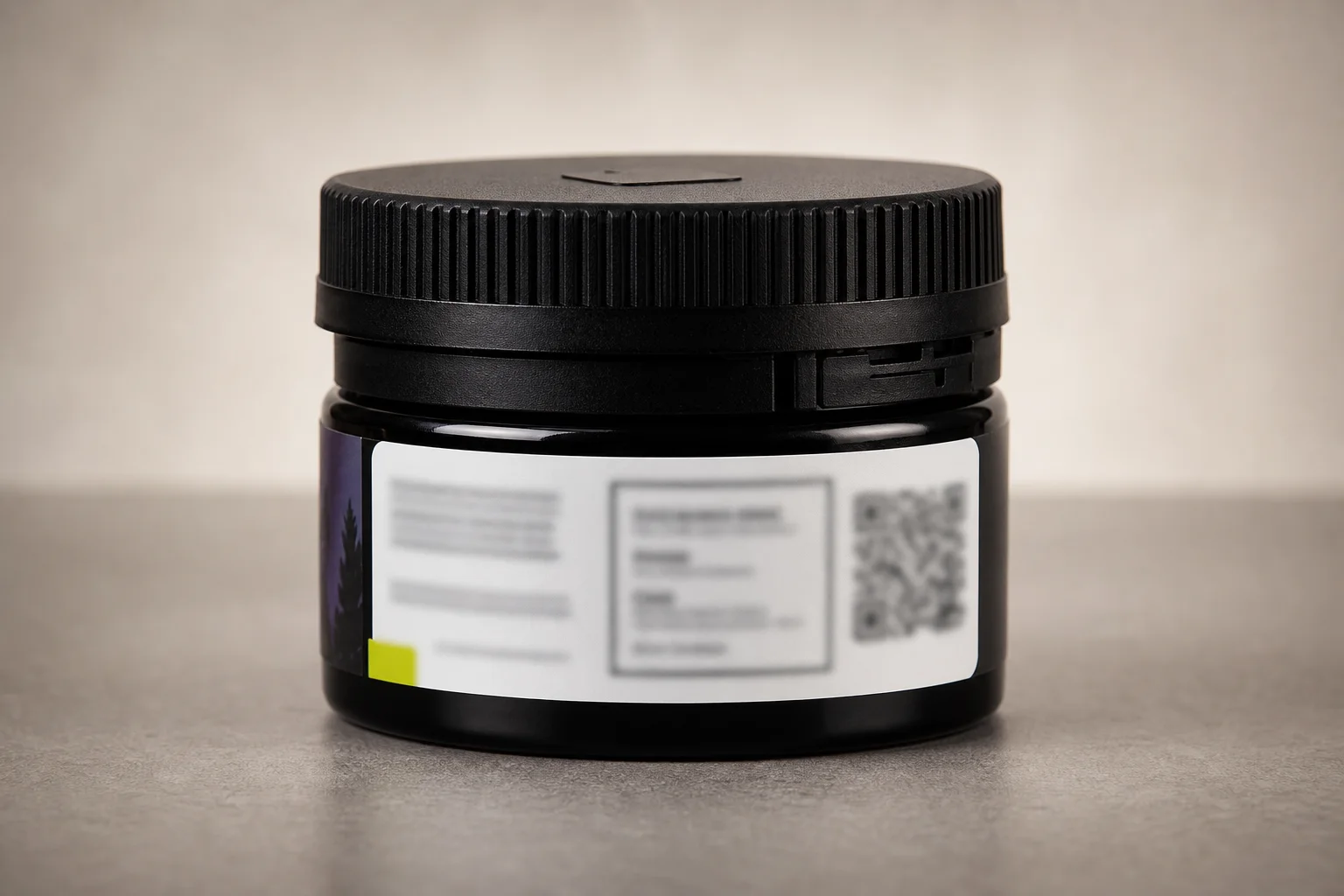
Photograph showing the kinds of labelling details to look for: a visible batch or lot number, a packaging date or QR code area, and child-resistant packaging. This image illustrates traceability cues discussed in the checklist; it does not show readable lab results or logos. Limit: a photograph cannot prove what happened before packaging — only documentation can. Source: Maine OCP consumer resources.
Why ask about source and freshness (but focus on facts, not effects)
Cannabis is an agricultural product: the plant's genetics, where it was grown, how and when it was cut, and how it has been handled since harvest determine the product you hold. Those upstream choices affect chemical stability (THC, other cannabinoids, and volatile terpenes), the chance of unwanted contaminants, and the meaningfulness of any test result you read on a label. Laboratory testing and labeling create useful data points, but they are snapshots: a test shows composition at the sample time, not forever. Recent reviews and studies describe how temperature and heat exposure can degrade cannabinoids and change measured values over time, which is why harvest, drying, and post‑harvest conditioning matter for freshness. (pubmed.ncbi.nlm.nih.gov)
For people buying regulated product in Maine, state rules require accurate and non-deceptive labeling and a set of packaging standards intended for safety and information. That legal framework helps — but it does not remove uncertainty about the product's age, how long it sat on a shelf, or what happened between test and sale. When possible, ask practical questions that reveal context rather than marketing claims. Maine's Office of Cannabis Policy (OCP) publishes consumer resources and program data that can help consumers learn about how the programs work and what the state requires of licensees. (maine.gov)
This article keeps the focus strictly on source, harvest context, storage, testing context, and how to handle uncertainty. It does not address personal health decisions or claim medical outcomes. The following sections present the checklist and explain why each item matters, with references to Maine authority and scientific literature where relevant.
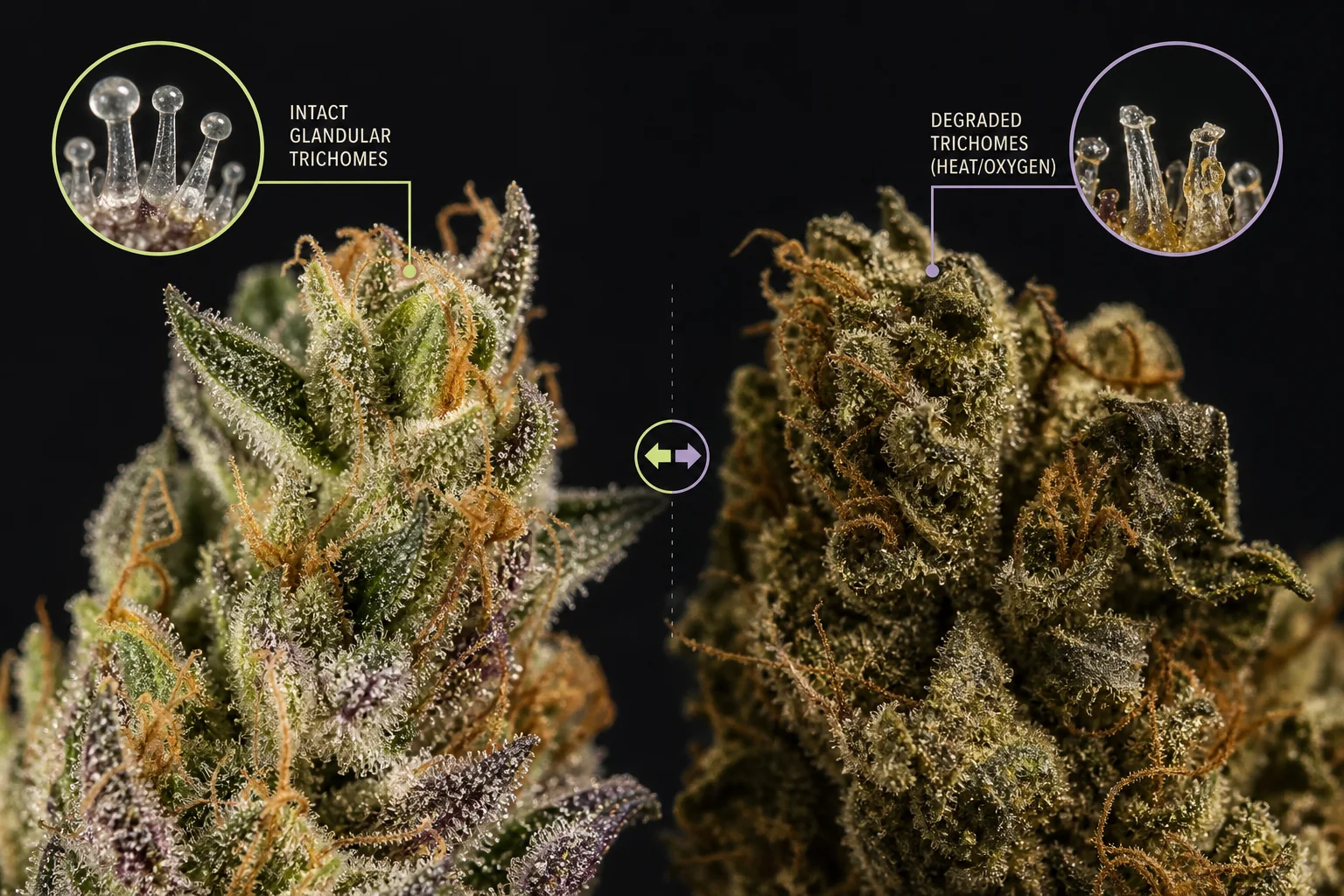
A botanical macro and annotated schematic comparing trichome integrity on a freshly cured bud versus a bud exposed to heat or prolonged storage. This visual supports the article's explanation that cannabinoids and terpenes change after harvest; it is illustrative and does not show lab numbers. Limit: microscopy/photography cannot quantify chemical changes — only lab analysis can. Source: PubMed studies on cannabinoid degradation.
Research context: Effect of temperature in the degradation of cannabinoids1) Ask about the grower and growing environment
What to ask: "Who grew this? Is the farm or licensee named on the package? Was it grown indoors, outdoors, or in a greenhouse?" A named licensee or grower and a batch or lot number are the first two clues to traceability. If you can connect that lot number back to a licensed facility, you can sometimes learn whether the operation is subject to specific production standards and recordkeeping. Maine's OCP keeps resources about licensing, program data, and consumer materials — those are useful starting points for confirming a licensee's participation in the regulated market. (maine.gov)
Why it matters: Growing environment influences contaminant risk (soil or pesticide residues, mold risks in wet climates) and chemical profile (light, nutrients, and stressors change terpene and cannabinoid expression). Traceability — seeing a batch or lot number and a grower name — is the backbone of any claim about origin.
What to accept as a red flag: vague marketing language with no lot numbers or no identifiable licensee, or claims that contradict what you can verify through state resources. Maine law forbids false or deceptive labeling; if you suspect a label is misleading, OCP is the place to ask. (legislature.maine.gov)
2) Ask about harvest date and post‑harvest handling
What to ask: "When was this harvested (or at least trimmed/packaged)? How long was it stored between harvest and testing? Was a controlled drying and conditioning protocol used?" A harvest date or a packaging date gives you a concrete time anchor; drying and post‑harvest conditioning details tell you whether the grower used commonly recommended steps that reduce mold risk and stabilize volatile compounds.
Why it matters: Cannabinoids and terpenes are not chemically frozen at harvest. Drying, post‑harvest conditioning, and storage conditions (time, temperature, humidity, and exposure to light and oxygen) change concentrations and aroma. Studies measuring cannabinoid stability show that heat exposure and long storage can produce degradation products and cause measured levels to shift, so a “THC percentage” on a test result is best read as a time‑and‑sample‑specific number. (pubmed.ncbi.nlm.nih.gov)
What to accept as a red flag: no dates on the package and no batch or lot identifier you can trace. If the product has been repackaged or labeled in ways that obscure identifying information, Maine labeling rules specifically restrict deceptive or obscuring practices. (legislature.maine.gov)
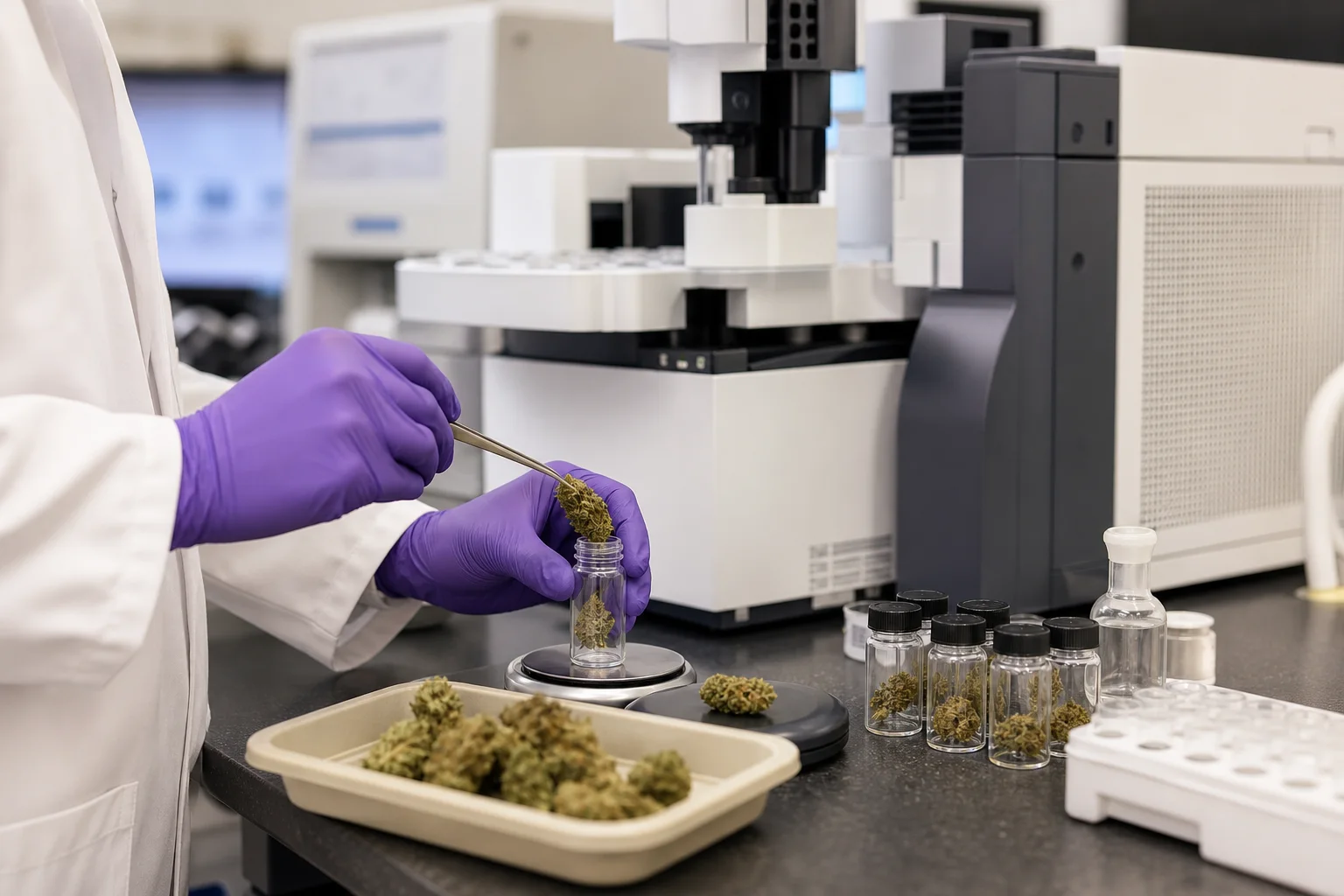
An instructive image showing a lab sampling moment — a technician preparing and homogenizing a flower sample beside analytical equipment. This shows testing context (sample prep and instrument analysis) but does not display any readable COA or results. Limit: the image illustrates process, not the quality of any specific test or lab. Source: PubMed review on cannabinoid analysis and OCP testing discussions.
Research context: Cannabinoids-Characteristics and Potential for Use in Food Production · Cannabis Conversations Panel Series | Office of Cannabis Policy3) Ask about testing: what, when, and where
What to ask: "Does the label or a linked certificate of analysis (COA) show a batch or lot number and the lab that tested it? When was the sample taken relative to the harvest or packaging date? Which analytes were tested (cannabinoids, terpenes, pesticides, heavy metals, microbiology)?" A COA tied to a batch number and a test date is the clearest proof of what the lab measured and when.
Why it matters: Laboratory results validate composition and screen for contaminants — but they are a test of the sample that was taken, not an ongoing assurance. Different labs use different methods and instruments; results can vary with sample preparation and testing protocols. Maine's regulatory materials and OCP panels emphasize that testing reduces risk but does not remove all uncertainty about a product's history. Ask for the lab name and COA, and check whether the lab is accredited or otherwise recognized. (maine.gov)
What to accept as a red flag: a test claim with no lab name, unverifiable COA, or a COA that doesn't match the listed batch/lot. Also be cautious when a COA shows only cannabinoid numbers and omits pesticide or microbiological screens where you would expect them, depending on product type.
4) Ask about packaging and storage before sale
What to ask: "How was this packaged and stored in the retail setting? Is the package child-resistant and tamper-evident? Was the product kept away from heat and light?" In Maine, adult‑use products must be prepackaged in child‑resistant and tamper‑evident packaging or placed into such packaging at final sale; that is a legal safeguard you can expect to see on regulated retail products. (legislature.maine.gov)
Why it matters: Light, heat, oxygen, and humidity accelerate chemical changes; packaging that blocks light and limits oxygen exchange helps preserve terpenes and cannabinoids. Retail handling matters, too — a product sitting in a hot vehicle or next to a window for weeks may change in smell and measured chemistry compared with a freshly stored package.
What to accept as a red flag: open or re-sealed packages without clear chain-of-custody or repackaged cannabis without batch labelling. Also, products in damaged packaging, or packages that lack the required safety features under state law, should raise immediate questions. (legislature.maine.gov)
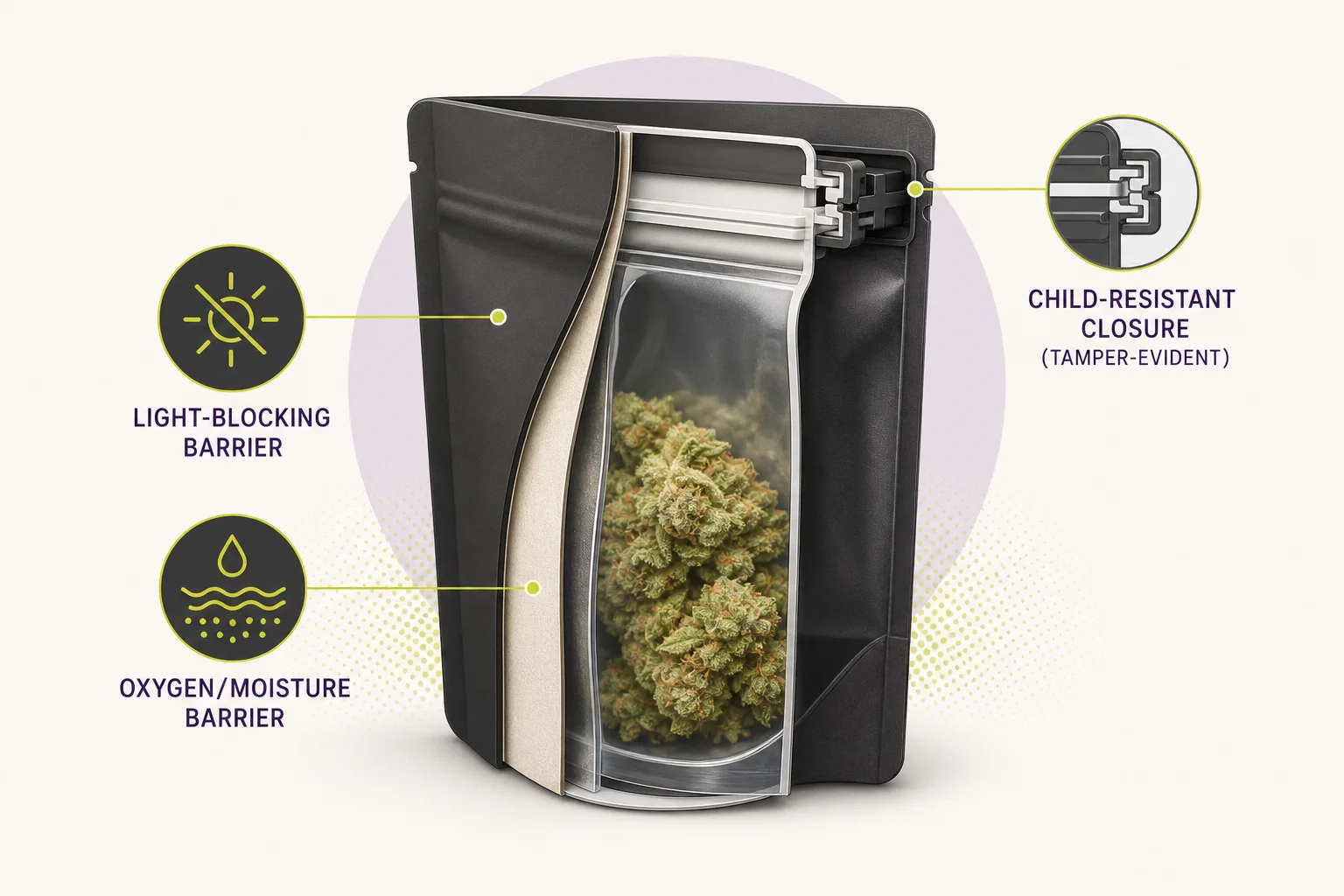
A clear diagram explaining packaging functions that affect freshness: UV/light barrier, oxygen-impermeable lining, and child-resistant closure. This illustration teaches how packaging choices tie to chemical stability and to Maine's packaging rules. Limit: diagrams simplify complex material science and do not substitute for material specifications. Source: Maine statute on labeling and OCP safe storage guidance.
Research context: Maine Title 28-B §701: Labeling and packaging · Safe Storage for ME | Office of Cannabis Policy5) Read the label — and read limits into the label
What to ask: "Does the label include a batch/lot number and a test or packaging date? Is there a COA link or QR code? Does the label avoid imagery that targets minors (as required by Maine law)?" Labels that follow Maine statute provide structured information and avoid prohibited imagery; that legal context helps you know what to expect. (legislature.maine.gov)
Why it matters: A label gives you both legal protections and informational context; but remember that label numbers are backward‑looking. For example, a THC percentage on the label comes from a sample tested on a particular date; that number can decline under poor storage or with time. The most useful labels include batch numbers and a traceable COA so you can inspect the test date and what analytes were measured. (pubmed.ncbi.nlm.nih.gov)
What to accept as a red flag: marketing claims that cannot be verified by a COA or a traceable lot number, or labeling that obscures required information. If a package contains images or wording that seem to target minors, that may violate Maine rules and is another reason to question the product. (legislature.maine.gov)
6) What to do when you find uncertainty (practical next steps)
Ask the retailer for documentation: a COA with a sample date and lab name, and the farm/lot number. If the label lacks that, or if the COA doesn't match the package identifiers, ask the retailer how long the product has been in their inventory and how it was stored. If answers are vague or inconsistent, you can contact OCP with consumer questions or concerns about labeling, safety, or deceptive practices. Maine's OCP publishes consumer resources and maintains a complaint process for regulated businesses. (maine.gov)
For suspected contamination or unexpected adverse effects, Poison Control operates a 24/7 hotline that can provide immediate information. They note that keeping the product and COA, if available, may help responders and investigators. Poison.org offers clear, nonjudgmental steps and a national hotline (1-800-222-1222) for urgent concerns. That resource is for immediate safety and response — not for evaluating long‑term product histories. (poison.org)
Finally, preserve evidence: keep packaging, the COA link or printout, and notes about purchase and storage dates. Those records are invaluable if you need to report a labeling discrepancy or a safety concern to regulators or the retailer.
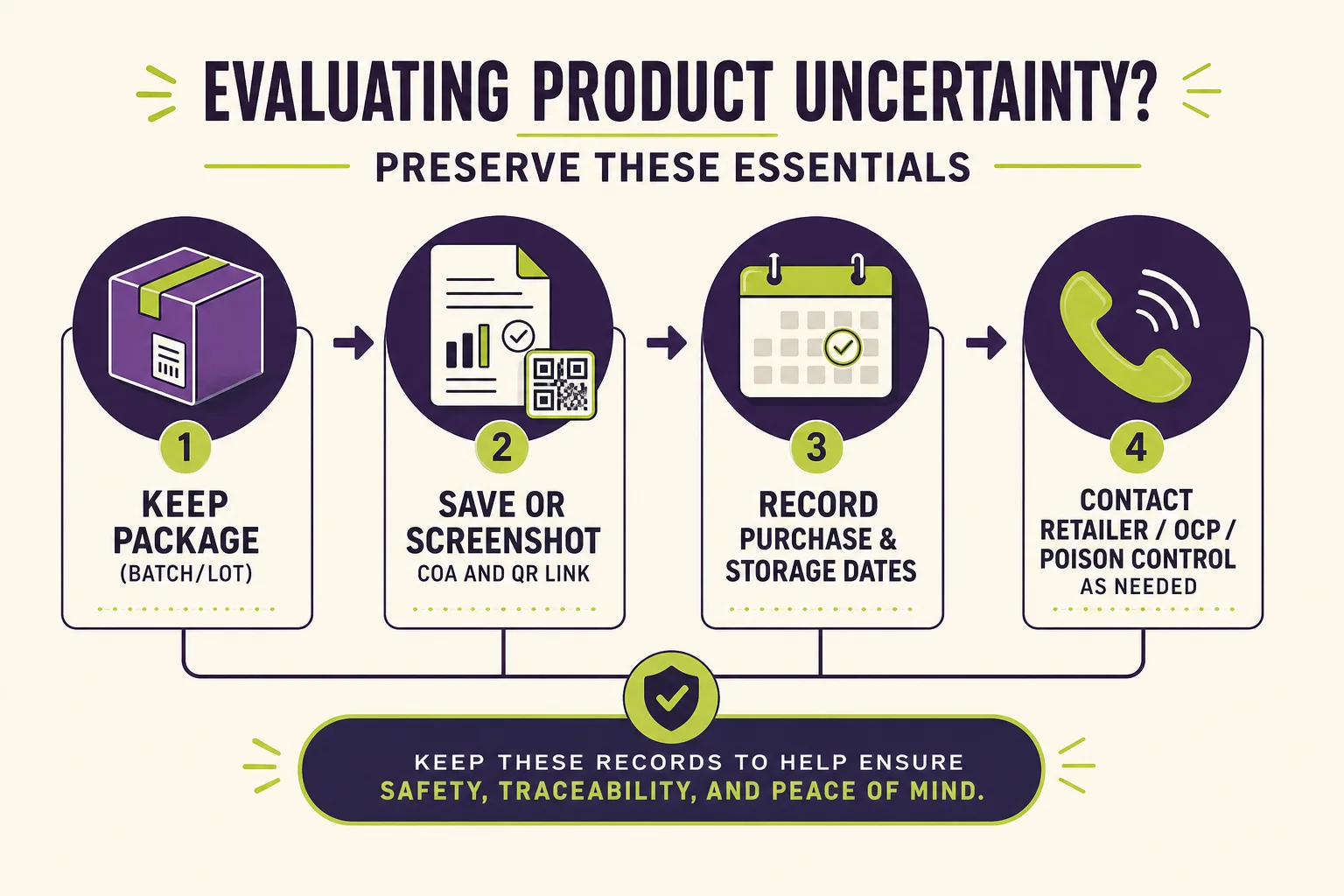
A simple flowchart showing the documentary evidence to preserve if you encounter uncertainty: package with batch/lot, linked COA, purchase/packaging dates, and storage notes. This visual reinforces the practical steps to reduce uncertainty and to report concerns. Limit: the flowchart is procedural, not legal advice. Source: Maine OCP consumer resources and Poison Control safety guidance.
Research context: Office of Cannabis Policy Consumer Resources · Cannabis: Risks and effects | Poison Control7) A compact checklist you can use in the store or at home
- Is the grower or licensed producer named, and is a lot/batch number visible? (yes / no)
- Is there a harvest/packaging/test date? (yes / no)
- Is there a COA linked to the batch, and does the COA show the lab name and test date? (yes / no)
- Which analytes were tested? (cannabinoids / pesticides / microbiology / heavy metals / other)
- Is packaging child-resistant and tamper-evident as required in Maine? (yes / no)
- Does the label avoid prohibited imagery and appear to comply with Maine labeling rules? (yes / no)
- How was the product stored at the retailer? (cool/dark / exposed / unknown)
- Can the retailer show inventory time-in-store or a traceable chain-of-custody? (yes / no)
If you answer "no" or "unknown" to more than two of these, consider the product to have appreciable uncertainty about source or freshness; options include asking for a different lot, requesting documentation, or consulting OCP for guidance. Remember: a COA is not a permanent assurance, but it is the best available piece of evidence about what was measured and when. (maine.gov)
Key limitations of the evidence
Scientific studies document degradation pathways and show that heat, light, and thermal exposure change cannabinoid and terpene profiles, but exact rates of change depend on product form, matrix (flower vs. oil vs. edible), packaging, and storage. That means you can reduce uncertainty by asking the right questions, but you cannot remove it entirely from a packaged product without repeat testing. Regulatory documents and OCP consumer materials explain program rules and expectations for labeling, but only a laboratory COA tied to a batch gives you a measured snapshot of composition. (pubmed.ncbi.nlm.nih.gov)
Regulatory and testing practices differ between Maine's medical and adult‑use programs in administrative detail and participant structure; the practical checklist above applies to both, but questions about program‑specific protections (for example, certain patient programs or municipal opt‑ins) are best asked of OCP resources. The law requires non‑deceptive labels and child‑resistant packaging for adult‑use products in Maine, which helps set minimum expectations. (legislature.maine.gov)
Sources and further reading
- Maine Office of Cannabis Policy — Consumer Resources and FAQs. (maine.gov)
- Maine Title 28-B §701, Labeling and Packaging (statute). (legislature.maine.gov)
- PubMed: "Effect of temperature in the degradation of cannabinoids" (study on thermal degradation). (pubmed.ncbi.nlm.nih.gov)
- PubMed review: "Cannabinoids—Characteristics and Potential for Use in Food Production" (stability and need for more data). (pubmed.ncbi.nlm.nih.gov)
- Poison.org: Practical safety advice and Poison Control hotline guidance. (poison.org)
Key takeaways
- Ask for a grower name, batch/lot number, and a COA that lists the lab and test date; those provide traceability and a measurement snapshot. (maine.gov)
- Harvest, drying, and storage conditions influence measured cannabinoid and terpene numbers; tests are time‑specific, not permanent assurances. (pubmed.ncbi.nlm.nih.gov)
- Maine law requires non‑deceptive labeling and child‑resistant packaging for adult‑use products; use that legal baseline when evaluating packages. (legislature.maine.gov)
- If documentation is missing or inconsistent, ask the retailer, preserve packaging and COA copies, and contact OCP or Poison Control for safety concerns. (maine.gov)
FAQs
Q: Does the THC percentage on a label tell me how the product will smell or taste?
A: No. THC percentage is a lab measurement for a sample at a specific time and does not directly predict volatile terpene content (aroma) or how those volatiles will change with storage. Look for a COA that includes terpenes if aroma stability matters to you. (pubmed.ncbi.nlm.nih.gov)
Q: If a package lacks a COA, is it illegal?
A: Not necessarily — requirements vary by program and product type — but regulated retailers commonly provide a COA or make test data accessible. In Maine, deceptive or obscuring labels are prohibited; if you encounter a product without traceable test documentation, ask the retailer and, if unresolved, contact OCP. (legislature.maine.gov)
Q: How long does cannabis stay “fresh”?
A: There is no single answer — freshness depends on the product form, packaging barrier properties, and storage conditions. Cooler, dark, low‑oxygen conditions slow chemical change. Peer‑reviewed studies show measurable degradation under heat and prolonged storage, so a product with recent packaging and COA is easier to evaluate than an undated package. (pubmed.ncbi.nlm.nih.gov)
Q: Who do I contact if I suspect mislabeling or contamination?
A: For consumer questions or complaints about labeling or regulated business practices in Maine, contact the Office of Cannabis Policy. For potential poisoning or urgent health concerns after use, Poison Control operates a national hotline (1‑800‑222‑1222). Preserve packaging and COAs if available. (maine.gov)
Q: Can I rely on a QR code on the package?
A: QR codes are convenient, but they are only as useful as the information they link to. Verify that the linked COA shows a batch number and a test date that match the package. If the QR code points to a generic page or lacks those identifiers, request a full COA from the retailer. (maine.gov)
Disclaimer: Educational information only. Cannabis affects people differently and this is not medical advice.
Questions this guide answers
Does the THC percentage predict aroma or freshness?
No. THC percentage is a snapshot laboratory measurement and does not directly reflect volatile terpenes (aroma) or how those compounds will change with storage. Look for COAs that include terpenes for information about aroma-related compounds.
What if a product lacks a visible COA or lot number?
Ask the retailer for documentation; if the information cannot be provided or seems inconsistent, contact the Maine Office of Cannabis Policy for guidance about labeling and compliance.
Who should I contact about potential contamination or adverse reactions?
For immediate health concerns or suspected poisoning, call Poison Control (1-800-222-1222). For labeling or regulatory complaints in Maine, contact the Office of Cannabis Policy and preserve the package and any COA.
How does storage affect cannabis shelf life?
Storage conditions (light, temperature, humidity, oxygen exposure) significantly affect chemical stability. Cooler, dark, low-oxygen storage slows degradation, but exact rates vary by product form and packaging.
Are lab results always reliable?
Lab results are reliable for the specific sample and method used but can vary between labs and with sampling methods. A COA tied to a lot and lab is the best available evidence, but it is a point-in-time measurement.
Educational information only. Cannabis affects people differently and this is not medical advice.