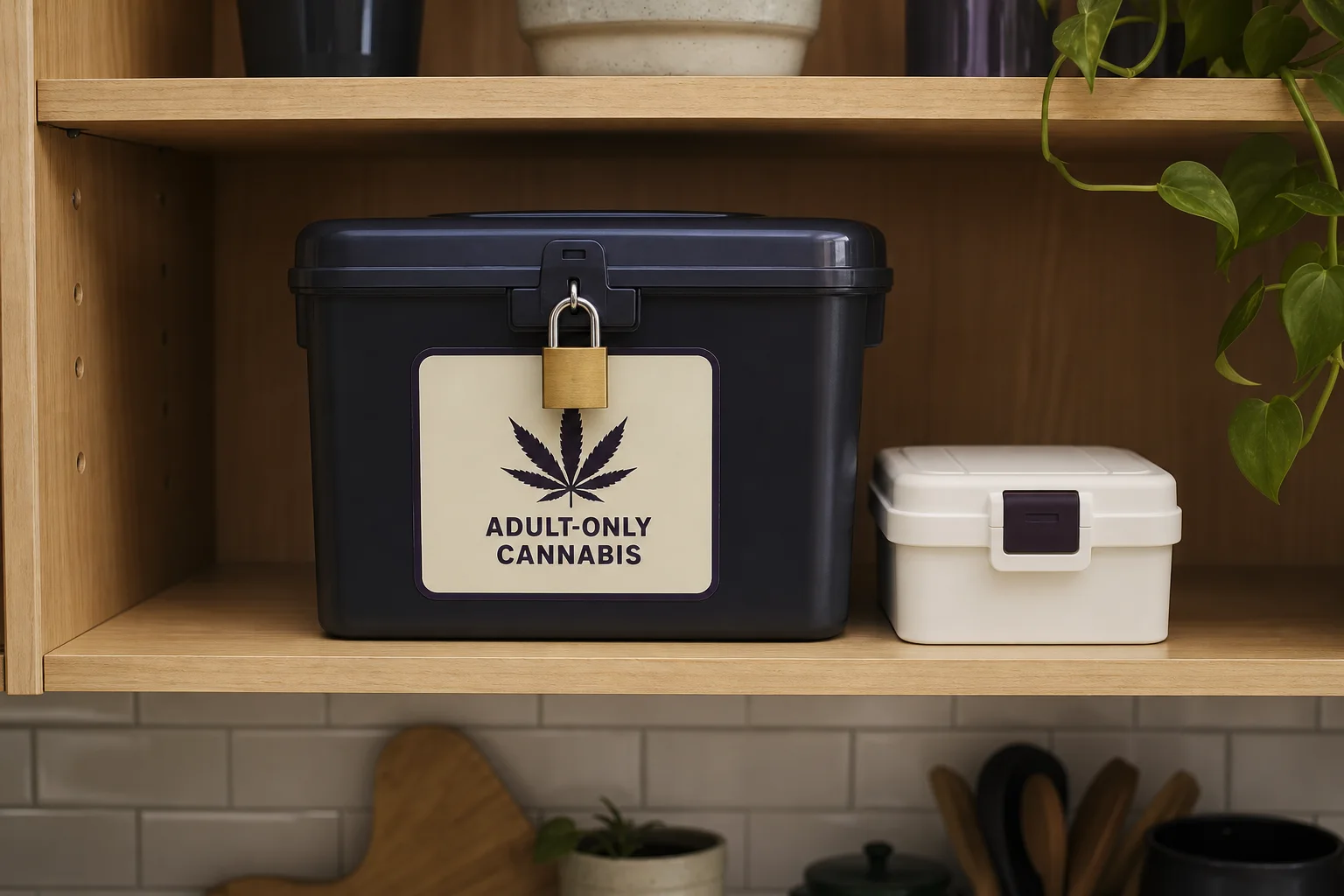
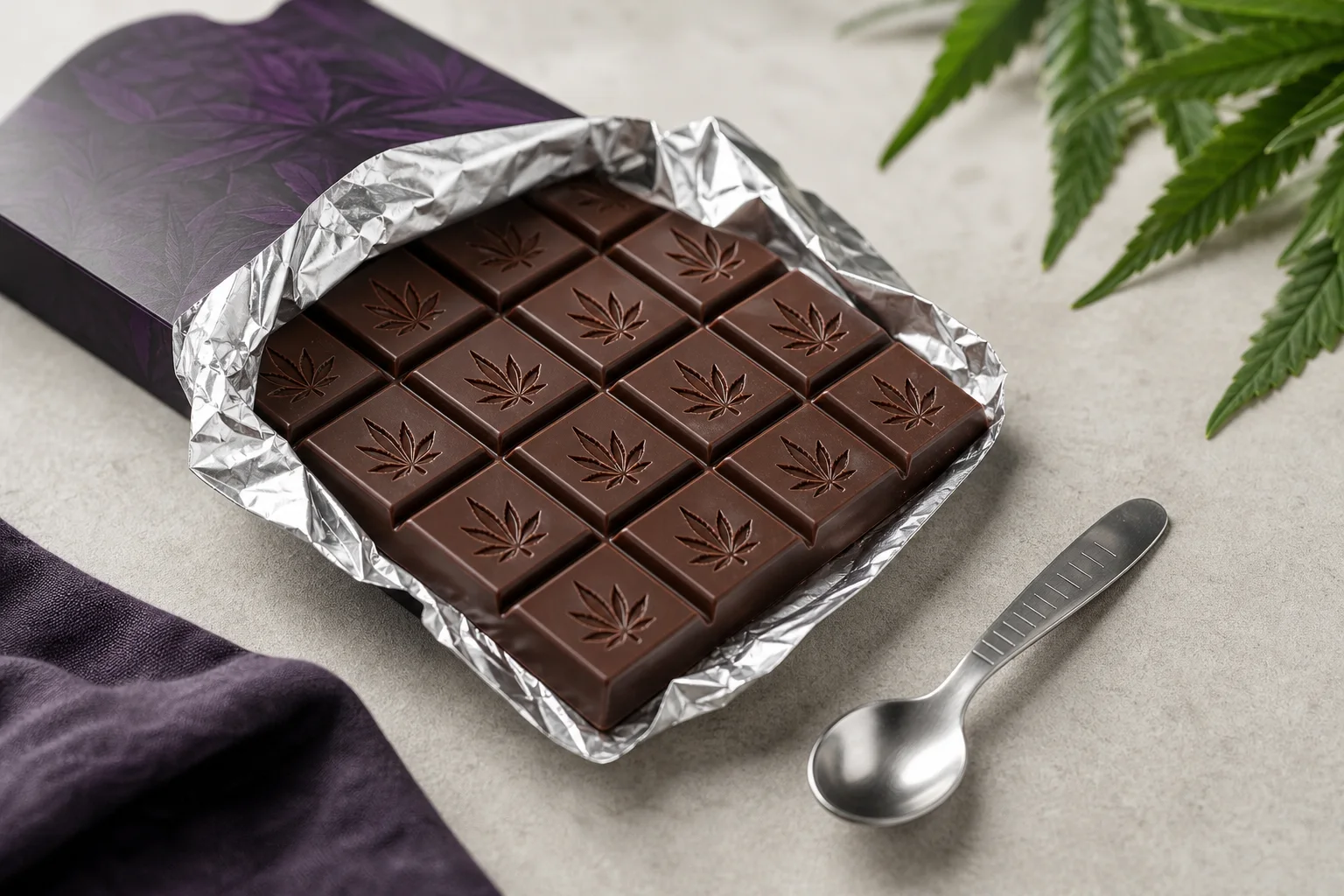
A close, documentary-style macro showing individually marked servings and a measuring spoon. This image illustrates the Maine requirement that single servings be marked or individually wrapped and the practical importance of checking 'THC per serving' versus total package THC. It shows a real-world packaging cue but does not display readable potency numbers or brand marks. Source documents explain the labeling requirements but do not guarantee lab accuracy.
Introduction
Edible cannabis is quietly persuasive: it looks like the snack you meant to eat, it fits in a pocket, and it can last for hours. Those same features make it a product that rewards patience and careful reading more than bravado. In Maine, licensed edible products carry specific labeling and packaging rules intended to reduce confusion — but label language and real-world biology don’t always line up neatly. This article explains the why and how so you can use good judgment, avoid accidental exposures, and understand why an article can’t and shouldn’t prescribe a dose. (Educational information only — not medical advice.)
Why edibles act differently: delayed, variable, and longer
When you eat cannabis the chemistry of absorption changes. Unlike inhaled THC, which reaches the bloodstream almost immediately through the lungs and produces effects within minutes, oral THC must pass through the digestive tract and the liver before it shows up in systemic circulation. This “first-pass” metabolism changes timing and the balance of active molecules the body sees, so effects can be delayed for 30 minutes to 2 hours and sometimes longer. Clinical reviews of oral cannabis pharmacokinetics report consistently slower, more variable absorption and later peak concentrations than inhaled routes. (pubmed.ncbi.nlm.nih.gov)
That variability matters. The same edible dose can produce different peak levels and subjective effects in different people — and in the same person on different days — because absorption depends on stomach contents, individual gut and liver metabolism, concurrent medications, and the food matrix that carries the cannabinoid. A small clinical series showed wide intersubject differences in both THC blood levels and reported effects after eating identical brownies. (pubmed.ncbi.nlm.nih.gov)
Because effects come on slowly and can last much longer than smoked cannabis, overconsumption is a well-documented risk. Public health agencies have reported cases where people consumed multiple servings before feeling anything — then experienced severe intoxication or required emergency care. That pattern was a key lesson in early regulation of edibles in other states. (cdc.gov)
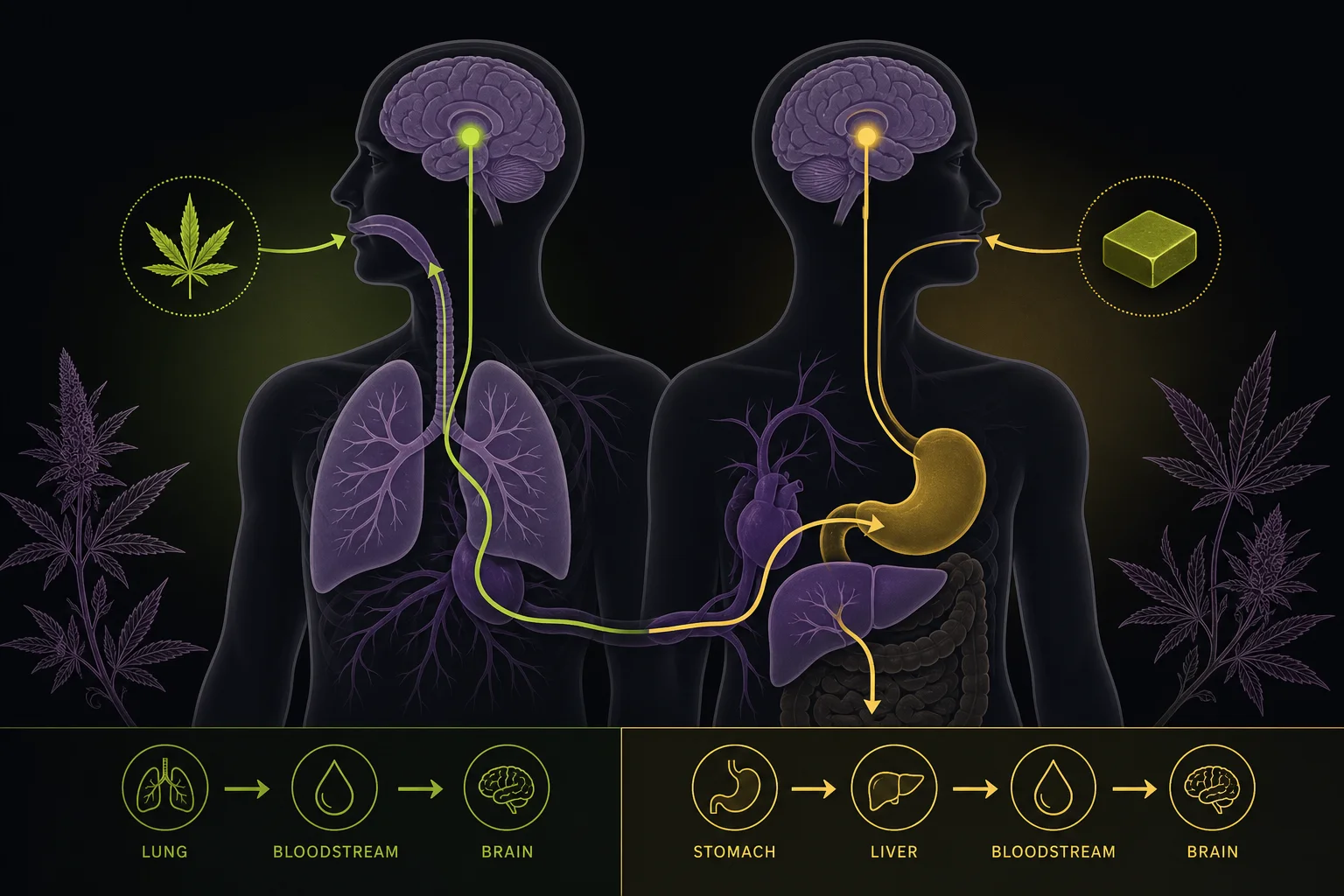
A simplified schematic comparing inhalation (fast lung absorption) and oral ingestion (stomach→liver first-pass metabolism→systemic circulation) to illustrate delayed and variable onset. The diagram is explanatory only and does not display numerical pharmacokinetic values. It reflects concepts described in systematic reviews of oral THC pharmacokinetics. ([pubmed.ncbi.nlm.nih.gov](https://pubmed.ncbi.nlm.nih.gov/32585912/))
Questions this guide answers
How long should I wait before taking another serving of an edible?
Because onset is delayed and variable, wait at least 2 hours before considering another serving of a product you haven’t used before. Clinical reports and public-health guidance note peak effects may occur 1–3 hours after ingestion and can last longer.
What does “THC per serving” mean on Maine labels?
It describes the amount of THC in one standardized serving; Maine rules also require the number of servings per package so the total THC per package can be understood. Don’t assume a whole product equals one serving. ([maine.gov](https://www.maine.gov/dafs/ocp/sites/maine.gov.dafs.ocp/files/inline-files/18-691-CMR-Ch1%2009-08-22_0.pdf))
Are fast-acting edibles safer because they act quicker?
Fast-acting formulations may shorten onset for some users, which can reduce one common route to overconsumption, but research is still emerging. New formats introduce different uncertainties; treat claims cautiously. ([pubmed.ncbi.nlm.nih.gov](https://pubmed.ncbi.nlm.nih.gov/41958200/))
What should I do if a child eats an edible?
Call Poison Control right away (1-800-222-1222 in the U.S.) and seek emergency care if breathing is difficult, consciousness is reduced, or severe symptoms develop. Pediatric exposures often require medical assessment. ([poison.org](https://www.poison.org/articles/my-child-ate-a-cannabis-edible))
Can this article tell me the right dose for me?
No. Dose response to oral THC varies widely with biology, tolerance, medications, and product factors. Clinical dose guidance belongs in a clinical setting, not a general article. ([pubmed.ncbi.nlm.nih.gov](https://pubmed.ncbi.nlm.nih.gov/32585912/))
Educational information only. Cannabis affects people differently and this is not medical advice.