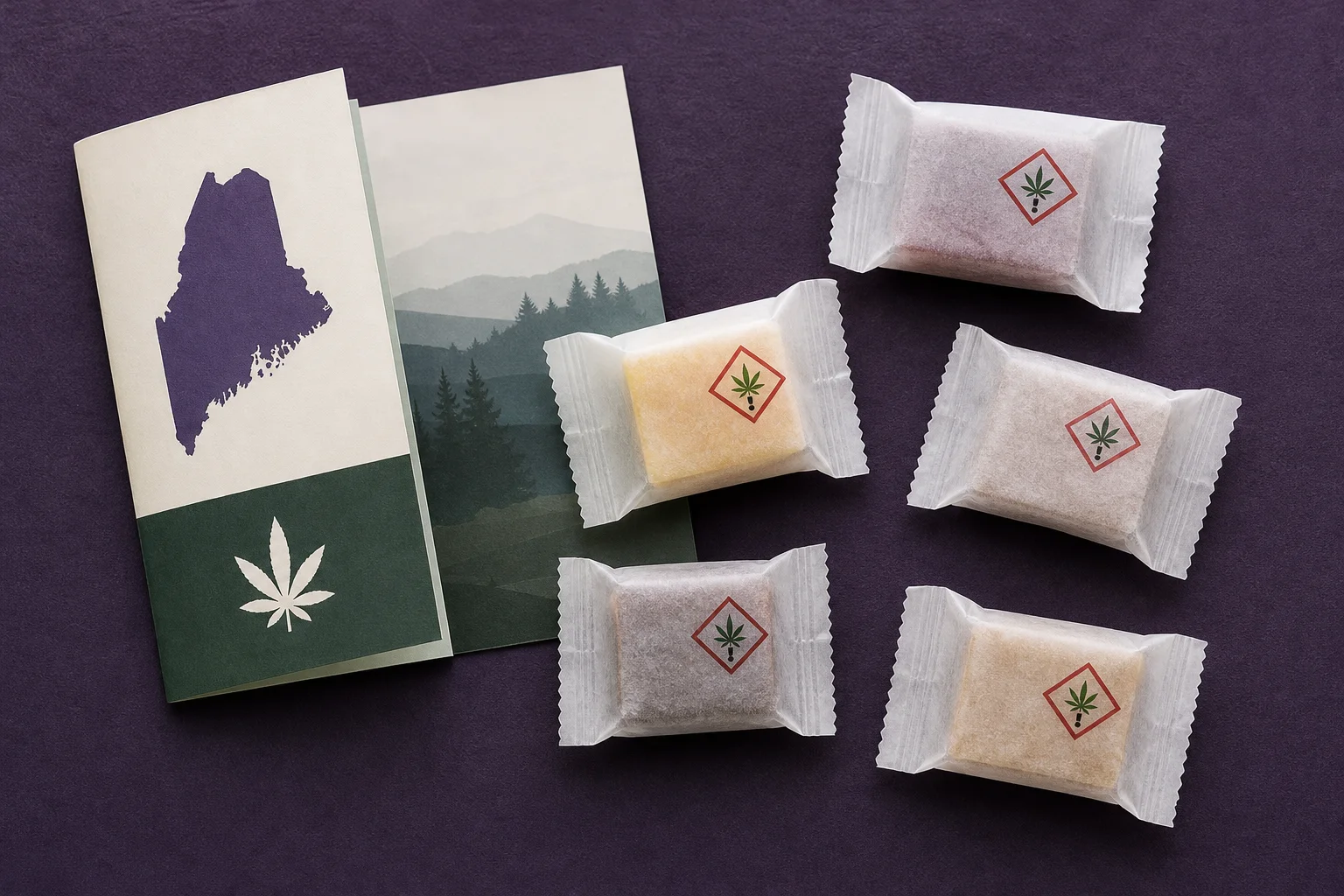
Documentary-style still showing individually wrapped servings with the Maine universal cannabis symbol. This image illustrates the labeling practice that helps identify single standardized servings; however, a visible symbol does not guarantee label accuracy or uniform biological effect. Source material demonstrates how packaging intersects with consumer safety guidance.
How edibles differ: delayed onset and unpredictable timing
Edible cannabis is not simply “cannabis in food.” When you eat THC or other cannabinoids, the chemistry and the human body conspire to make effects arrive slowly and vary widely between people. Unlike inhalation — where THC moves rapidly from lungs to blood and the brain — oral consumption requires digestion and liver processing. That first‑pass metabolism converts some THC into 11‑hydroxy‑THC, a metabolite that can be more potent and longer‑lasting for some people. Clinical and review literature describes this as an inherently variable process: onset can be 30 minutes to 2 hours or longer, and the peak and duration depend on formulation, co‑consumed food, and metabolism. (pubmed.ncbi.nlm.nih.gov)
This variability is not theoretical. Public‑health reports and case investigations have repeatedly shown accidental overconsumption occurs because people assume effects appear within minutes and repeat a serving. The Centers for Disease Control and Prevention notes that edibles can take 30 minutes to 2 hours to be felt and that labeling and potency measurements may be inaccurate, increasing the risk of poisoning. Those realities make patience the single most useful habit with edibles: wait, then wait some more. (cdc.gov)
The science is still evolving. Systematic reviews of oral THC and cannabinoid pharmacokinetics emphasize that oral formulations (capsules, baked goods, oils) have widely different absorption and effects, and that better research is needed to predict an individual’s response reliably. In practice, that means the same edible product can feel markedly different between two people — and even for the same person on different days. (pubmed.ncbi.nlm.nih.gov)
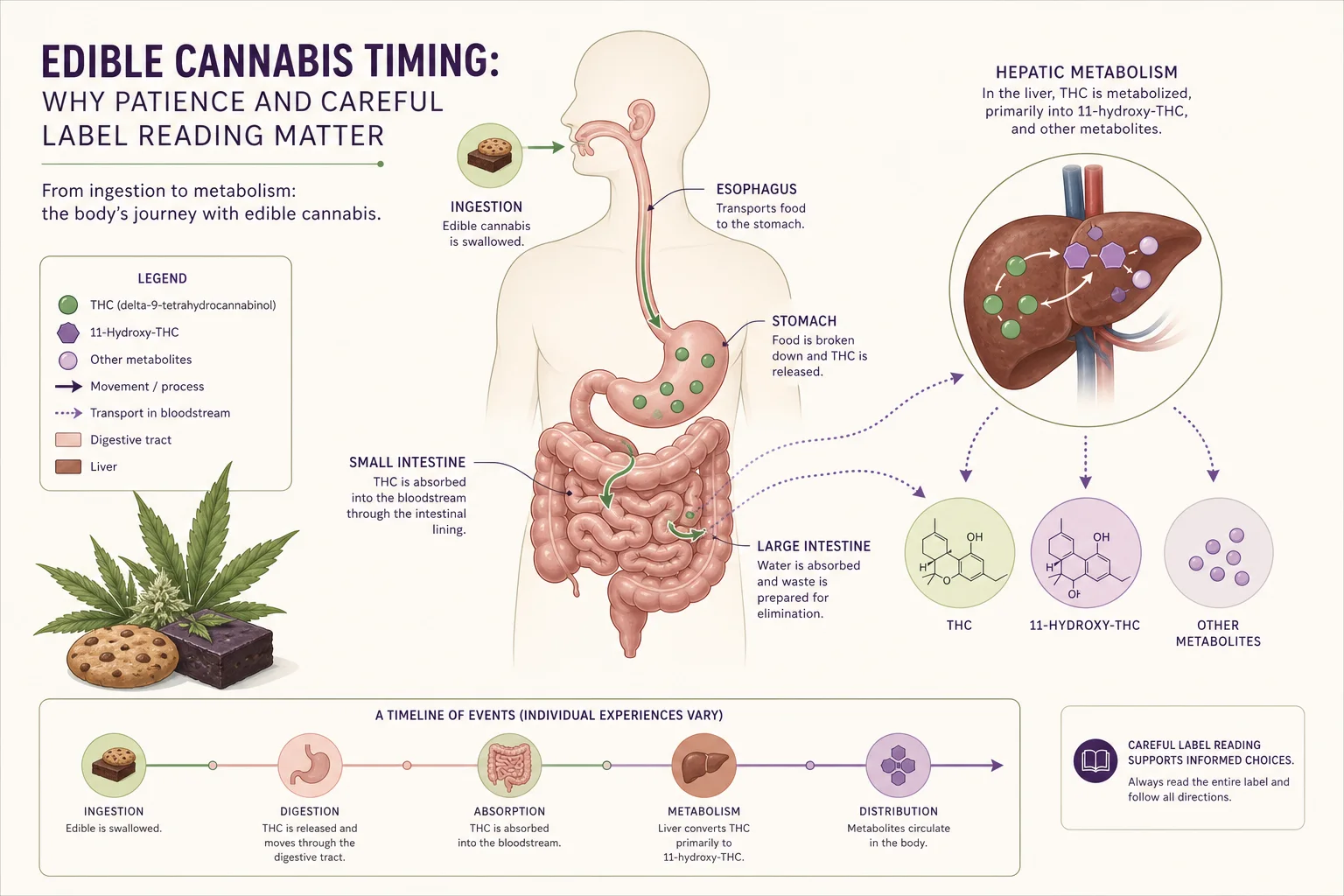
An explanatory diagram mapping oral absorption, hepatic first‑pass metabolism to 11‑hydroxy‑THC, and the resulting delayed, variable time course. This visual summarizes mechanisms discussed in pharmacokinetic reviews, but it is schematic—individual timelines vary.
Research context: Oral Administration of Cannabis and Δ-9‑tetrahydrocannabinol (THC) Preparations: A Systematic ReviewServing vs package labels: why the small print matters
Most packaged edibles list the total amount of THC in the entire product and then list a per‑serving amount. That simple distinction can make or break an experience. If a package contains 100 mg THC but lists 10 servings, one serving equals 10 mg — yet many people eat the whole package or interpret a “piece” as a serving when the packaging means otherwise. In Maine, statute and program rules require that labels include information on the amount of THC per serving and per package, and the OCP also specifies how the universal symbol and serving marks should appear on edibles to improve clarity. Looking for “per serving,” the number of servings, and whether each individual piece is stamped or wrapped as a single standardized serving reduces the risk of mistaken multi‑serving consumption. (legislature.maine.gov)
Label accuracy matters too. The Office of Cannabis Policy has issued guidance noting complaints and investigations where potency values on medical‑program edibles were inaccurate; this is a known source of unpredictability and a reason to regard listed potency as informative but not infallible. Packaging and labeling are improving, but at present they are part of the risk picture, not a perfect solution. (maine.gov)
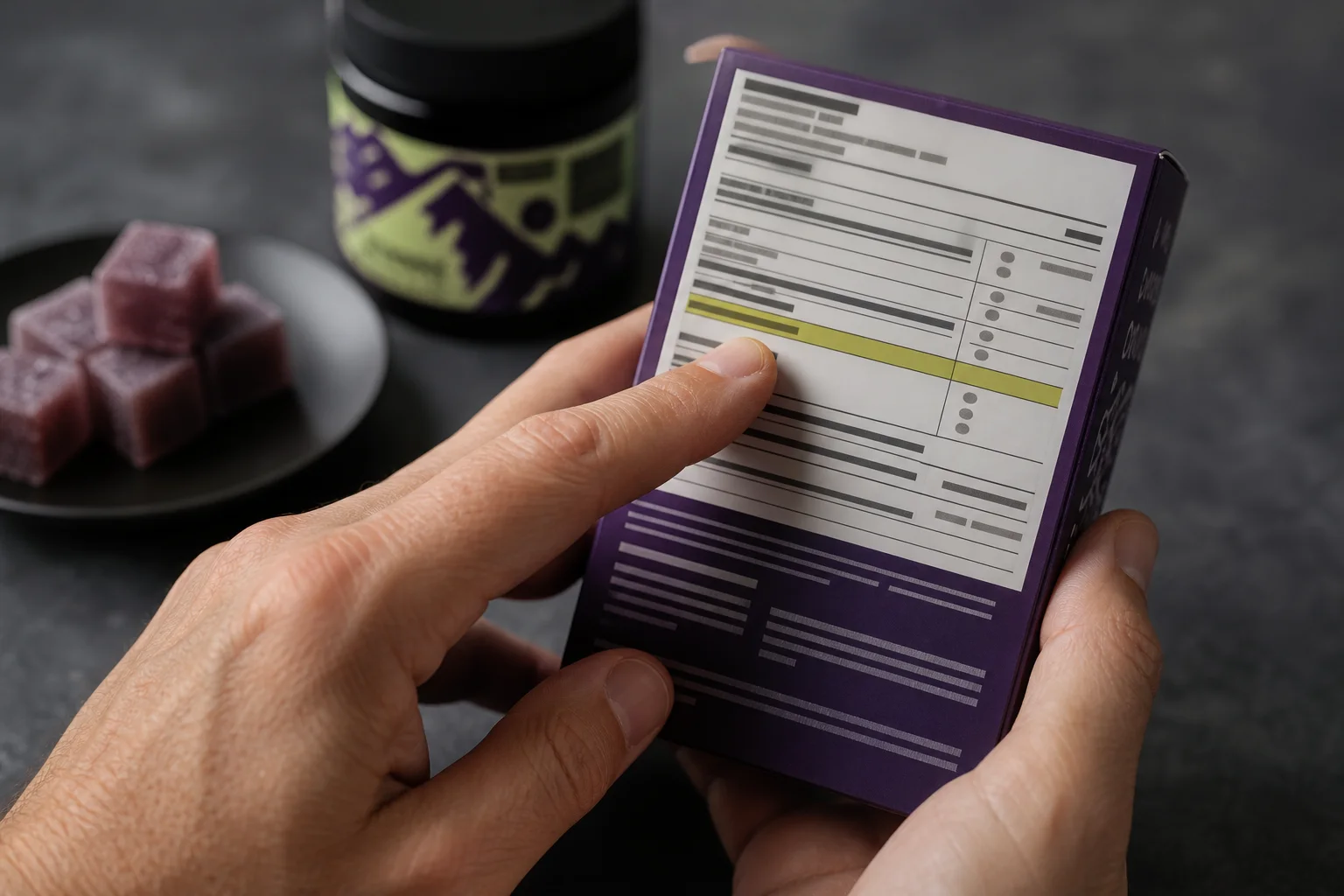
Close-up photograph demonstrating how to locate ‘mg THC per serving’ and total‑serving information on a product label. This shows the practical label-reading skill advocated by Maine OCP resources; it does not imply every label is accurate or complete.
Research context: Guidance: Verifying Potency Information on Medical Cannabis & Cannabis Product Labels (PDF)What drives variability? Product, food, and body
Several concrete factors change how fast and how strongly an edible acts:
-
Formulation and fats: THC is lipophilic. Edibles made with fats (butter, oils) or encapsulated in oil can have higher and faster absorption than a dry cookie with the same nominal THC content. Lipid‑rich formulations often increase bioavailability compared with water‑based products. (pubmed.ncbi.nlm.nih.gov)
-
Food in the stomach: Taking an edible on an empty stomach often gives a different time‑course and intensity compared with taking it after a high‑fat meal. That’s part of why clinical studies document wide inter‑ and intra‑individual differences. (pubmed.ncbi.nlm.nih.gov)
-
Hepatic metabolism and genetics: The liver metabolizes THC, and individual differences in enzyme activity change the balance between THC and 11‑hydroxy‑THC. Age, other medications, and genetics can all alter the trajectory of effects. Reviews of oral THC point to this first‑pass metabolism as a leading reason oral dosing is less predictable than inhalation. (pubmed.ncbi.nlm.nih.gov)
These factors matter because they are largely out of the consumer’s control. You can control reading the label, how many servings you set aside, whether you avoid alcohol and other sedating substances, and whether you wait between tries — but you cannot reliably predict exactly how your liver will convert that single serving on a given day. That uncertainty is why conservative use practices are commonly advised. (cdc.gov)
Maine rules and what the label should (and won’t) tell you
Maine’s Office of Cannabis Policy publishes resources for both adult‑use and medical programs. Packaging rules require clear marking of servings and the universal cannabis symbol, and statute directs the OCP to set label and warning requirements; those rules are designed to reduce accidental exposures and improve transparency. For edible products, OCP guidance specifically recommends that each single standardized serving be marked or wrapped with the universal symbol. That helps a consumer quickly identify a single dose in a multi‑piece product. (legislature.maine.gov)
However, Maine’s labels won’t remove biological uncertainty. The OCP has documented investigations where a product’s measured THC content did not match its label — including cases in the medical program — and provides guidance for verifying potency information. That means a responsible reader regards potency figures as best‑available measurements rather than absolute certainties. For adults navigating medical versus adult‑use programs, the key operational differences often relate to testing, allowed product formulations, and dispensing practices; OCP resources and program rules list those distinctions and the compliance requirements producers must follow. (maine.gov)
Finally, federal law still restricts THC in interstate food systems; the FDA also publishes warnings about packaging that mimics children’s foods and stresses that THC in conventional food supply chains remains unlawful. State labeling reduces some risks but does not change pharmacology. (fda.gov)
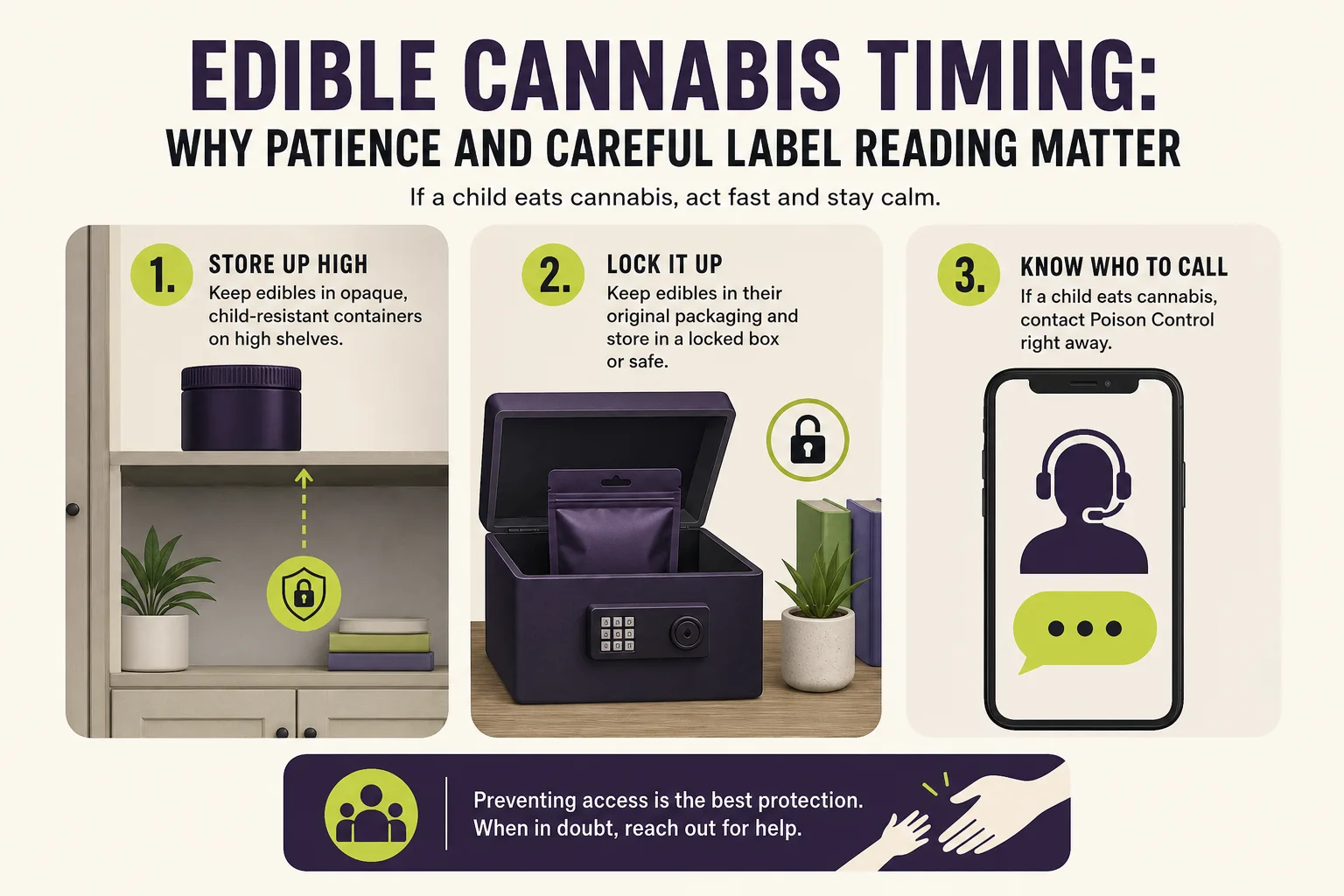
A practical, non-alarming infographic showing secure storage strategies and the poison control phone resource. This visual links household prevention steps to public‑health advice; it is educational and not a substitute for emergency medical assessment.
Research context: My child ate a cannabis edibleHousehold safety and accidental exposure: what the evidence shows
Children and uninformed adults are at real risk. Poison‑control centers report that children — particularly those under five — and teenagers are the most common groups to be exposed to THC edibles unintentionally, and clinical reports list vomiting, lethargy, dizziness, difficulty walking, and breathing difficulties among the effects seen in pediatric exposures. National public‑health data and Poison Control guidance emphasize secure storage, child‑resistant packaging, and avoiding products that resemble common snacks as central prevention strategies. (poison.org)
Public‑health investigations have also documented severe outcomes when a packaged edible listed an entire‑package THC load that exceeded what a consumer expected, leading to multiple servings consumed quickly. Those reports prompted calls for stricter labeling, smaller per‑serving THC limits in some states, and clearer per‑piece serving marks. In Maine, the universal symbol and serving standards are part of that prevention response. But local rules and practice change over time; staying updated with OCP resources is a reasonable habit for caregivers and growers alike. (cdc.gov)
In the event of accidental exposure, public‑health guidance identifies contacting local poison control or webPOISONCONTROL as the usual first step for triage information; it also notes that severe signs such as breathing difficulty, unresponsiveness, or seizures typically prompt involvement of emergency medical services. Poison control centers function as central public resources for managing unexpected ingestion. (poison.org)
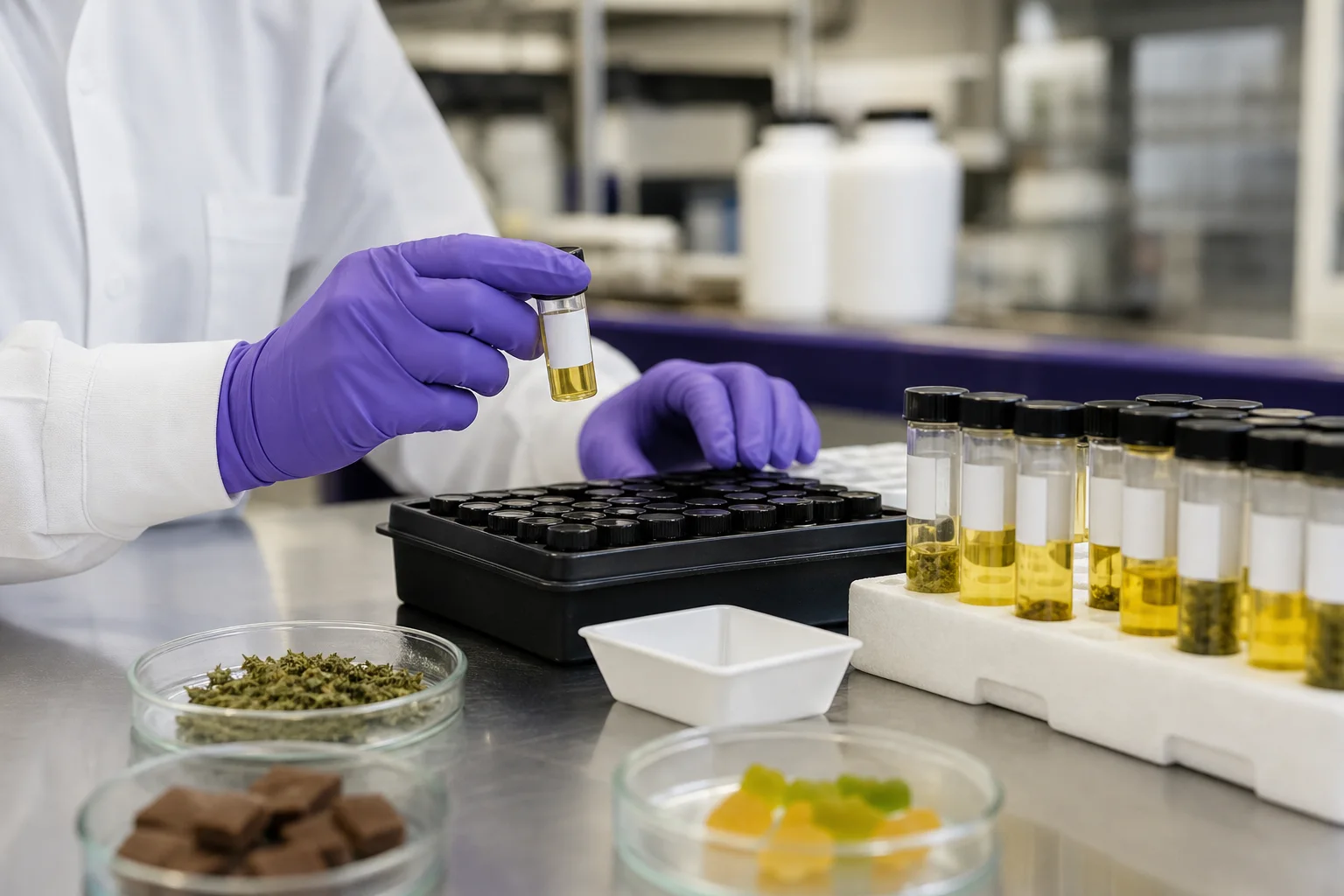
Documentary lab image showing sample preparation for potency testing. It supports discussion about label accuracy and OCP investigations into potency discrepancies, while not depicting specific results. Laboratory photos illustrate that measurement requires methodical testing and that labels are estimates, not perfect guarantees.
Research context:Why this article cannot prescribe a dose — and what to consider instead
It would be tempting to say “take X mg,” but neither the science nor ethical education permits handing out a single‑number dose here. The same nominal mg of THC can feel mild for one adult and intense for another depending on formulation, recent food intake, medications, age, and genetic metabolism. Systematic reviews and pharmacokinetic research underline the poor reproducibility of oral dosing across individuals. Because of that uncertainty, dosing guidance is individualized and typically falls within the domain of licensed clinicians who have a full medical picture and knowledge of local program status. (pubmed.ncbi.nlm.nih.gov)
Practical risk‑reduction habits include reading labels for “per serving” information and number of servings; setting aside extra product so the whole package is not eaten unintentionally; avoiding alcohol and other sedating substances around the same time as edibles; allowing common public‑health waiting intervals (for example, a commonly cited 2‑hour window) before considering additional servings; keeping products in child‑resistant, opaque containers; and reviewing potential drug interactions or other medical concerns through licensed healthcare channels or official clinical guidance if questions remain. These are safety‑focused steps that acknowledge uncertainty without implying a single dose fits everyone. (maine.gov)
Putting it together: a simple plan before you try an edible
A short pre‑use checklist can reduce surprises:
-
Check the package: locate “mg THC per serving” and the number of servings. Confirm whether each piece is intended as a single serving (marked/stamped or individually wrapped). If the label is unclear, regard the product cautiously. (www11.maine.gov)
-
Set the context: public‑health guidance commonly recommends avoiding driving or operating heavy equipment for several hours after ingestion; some people arrange for a sober friend or family member to be nearby when trying a higher‑potency product for the first time. Keep poison control numbers accessible. (cdc.gov)
-
Wait and track: waiting a full 2 hours before taking more aligns with common public‑health guidance; keep a simple note — product, estimated serving, time — to learn your pattern over repeated, carefully controlled tries. Consider early experiences low‑information experiments. (pubmed.ncbi.nlm.nih.gov)
-
Secure storage: store edibles where children, pets, and visitors cannot find them. Use opaque containers and the original child‑resistant packaging where possible. Maine’s outreach materials emphasize this as a public‑health priority. (maine.gov)
Evidence limits and where future research is headed
The most important scientific constraint to remember is that oral cannabinoid pharmacology is variable and incompletely predictable. Reviews call for standardized formulations, better analytical methods, and more trials that compare product types and food interactions to produce clearer, evidence‑based dosing guidance. Until then, public‑health agencies emphasize precaution, improved labeling, and safer packaging as the practical harm‑reduction measures available today. (pubmed.ncbi.nlm.nih.gov)
Key takeaways
- Edible effects are delayed and variable; waiting is essential. (cdc.gov)
- Read “per serving” and number of servings — packages may contain multiple doses. (www11.maine.gov)
- Product form, food, and liver metabolism change how an edible acts; one mg is not a universal experience. (pubmed.ncbi.nlm.nih.gov)
- Keep edibles secured away from children; contact poison control for accidental ingestion. (poison.org)
- This article does not and cannot prescribe a dose; individualized clinical questions are generally handled by licensed clinicians, and conservative practices are commonly emphasized in public‑health guidance. (pubmed.ncbi.nlm.nih.gov)
FAQ
Q: How long should I wait to feel an edible?
A: Effects can begin 30 minutes to 2 hours after ingestion and sometimes later; waiting at least 2 hours before additional servings is commonly recommended. This range reflects digestion and liver metabolism variability. (cdc.gov)
Q: What’s the difference between “per serving” and the label’s total THC?
A: “Per serving” shows how much THC is in one standardized serving; total THC is the package sum. Eating multiple servings multiplies the total amount consumed. Maine rules require clear per‑serving information on labels. (legislature.maine.gov)
Q: Are edible labels always accurate?
A: Not always. Maine’s OCP has investigated discrepancies in potency labeling; labels are improving but should be regarded as best‑available estimates rather than absolute certainties. (maine.gov)
Questions this guide answers
How long should I wait to feel an edible?
Effects can begin 30 minutes to 2 hours after ingestion and sometimes later; wait at least 2 hours before taking more. This range reflects digestion and liver metabolism variability. ([cdc.gov](https://www.cdc.gov/cannabis/health-effects/poisoning.html))
What’s the difference between “per serving” and the label’s total THC?
“Per serving” shows how much THC is in one standardized serving; total THC is the package sum. If you eat multiple servings, you take multiple doses. Maine rules require clear per‑serving info on labels. ([legislature.maine.gov](https://www.legislature.maine.gov/legis/statutes/28-B/title28-Bsec701.html))
Are edible labels always accurate?
Not always. Maine’s OCP has investigated discrepancies in potency labeling; labels are improving but should be treated as best‑available estimates rather than absolute guarantees. ([maine.gov](https://www.maine.gov/dafs/ocp/sites/maine.gov.dafs.ocp/files/inline-files/Guidance%20Verifying%20Potency%20Information%20on%20Medical%20Cannabis%20%26%20Cannabis%20Product%20Labels.pdf))
What should I do if a child eats an edible?
Call poison control or seek emergency care if symptoms are severe (trouble breathing, unresponsiveness, seizures). Pediatric exposures can cause vomiting, drowsiness, confusion, or breathing problems. ([poison.org](https://www.poison.org/articles/my-child-ate-a-cannabis-edible))
Is there a single “safe” THC dose for everyone?
No. Individual biology and product differences make a single universal dose inappropriate. Discuss individualized questions with a medical provider and use conservative habits. ([pubmed.ncbi.nlm.nih.gov](https://pubmed.ncbi.nlm.nih.gov/32585912/))
Educational information only. Cannabis affects people differently and this is not medical advice.