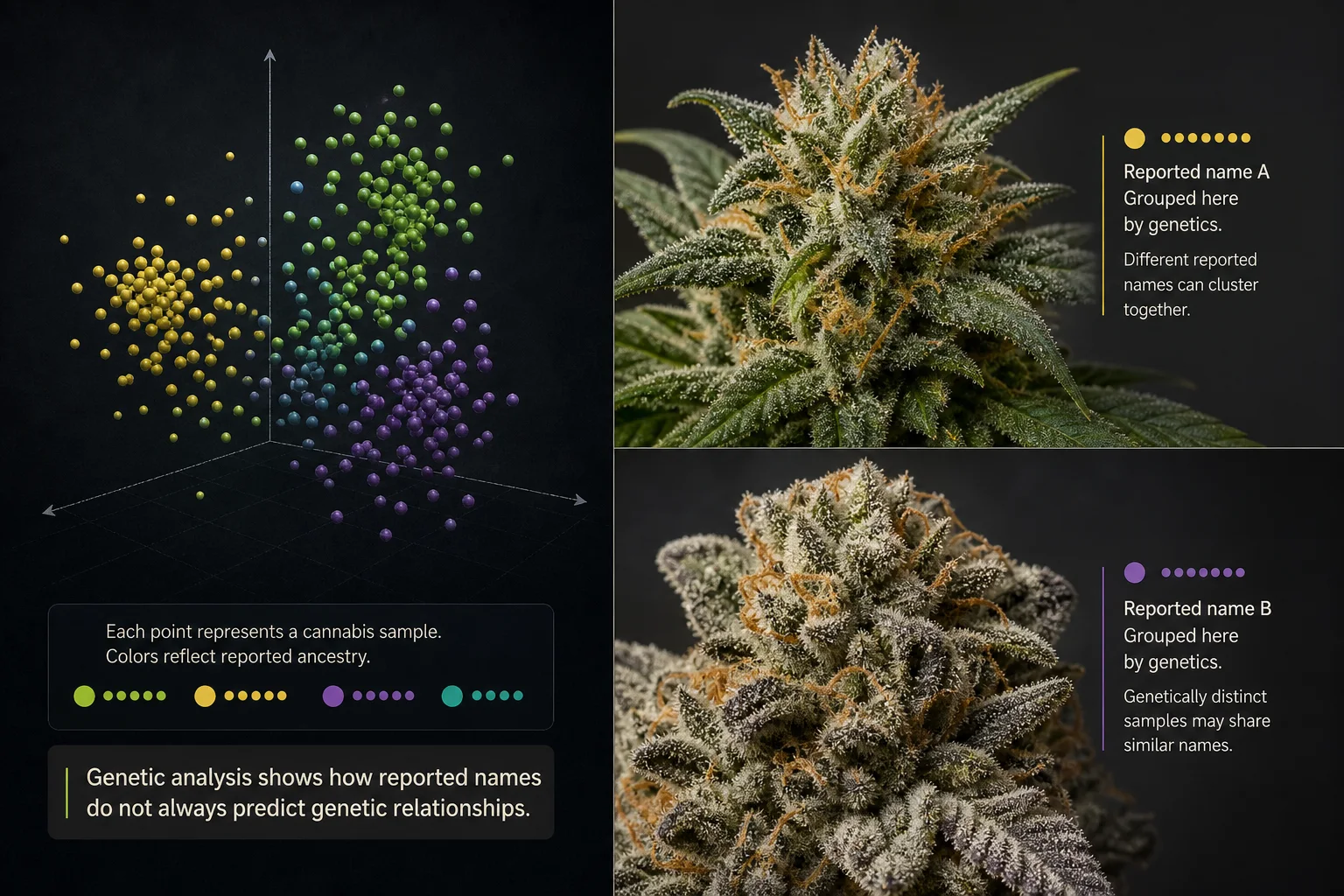
This documentary-style composite illustrates how samples with the same commercial name can cluster differently genetically while also showing distinct phenotypes. It teaches that name and genetic grouping can diverge. Figure concept grounded in population-genetic work on cannabis; image is explanatory and not a lab result. Source data indicate variability but individual plots are illustrative only. ([pubmed.ncbi.nlm.nih.gov](https://pubmed.ncbi.nlm.nih.gov/26308334/))
What a strain name actually is
A strain name is a human shorthand: a signpost used by breeders, sellers, and communities to point at a lineage, a look, or a hoped-for aroma. Names can capture a breeder’s intent, a cross’s history, or a popular description — and they often become brand identifiers. But they are not a laboratory report or a genetic passport. When someone hands you a name, you’re getting a label that bundles context, reputation, and sometimes marketing. (pubmed.ncbi.nlm.nih.gov)
Because names are created and reused in an informal market, identical names have been applied to genetically and chemically different plants. In other words, a familiar name does not guarantee the plant's chemistry, genetic markers, or consistent sensory profile across producers or batches. Multiple scientific studies have tested commercial samples and show that names often correlate only loosely with genetic identity. (pubmed.ncbi.nlm.nih.gov)
That doesn't mean names are useless. They are a starting point for communication: a shorthand for consumers, a historical tag for breeders, and a storekeeper’s inventory handle. Consider a name the first clue — not the final answer — and move on to lineage, batch data, tests, and your own notes to build a reliable picture.
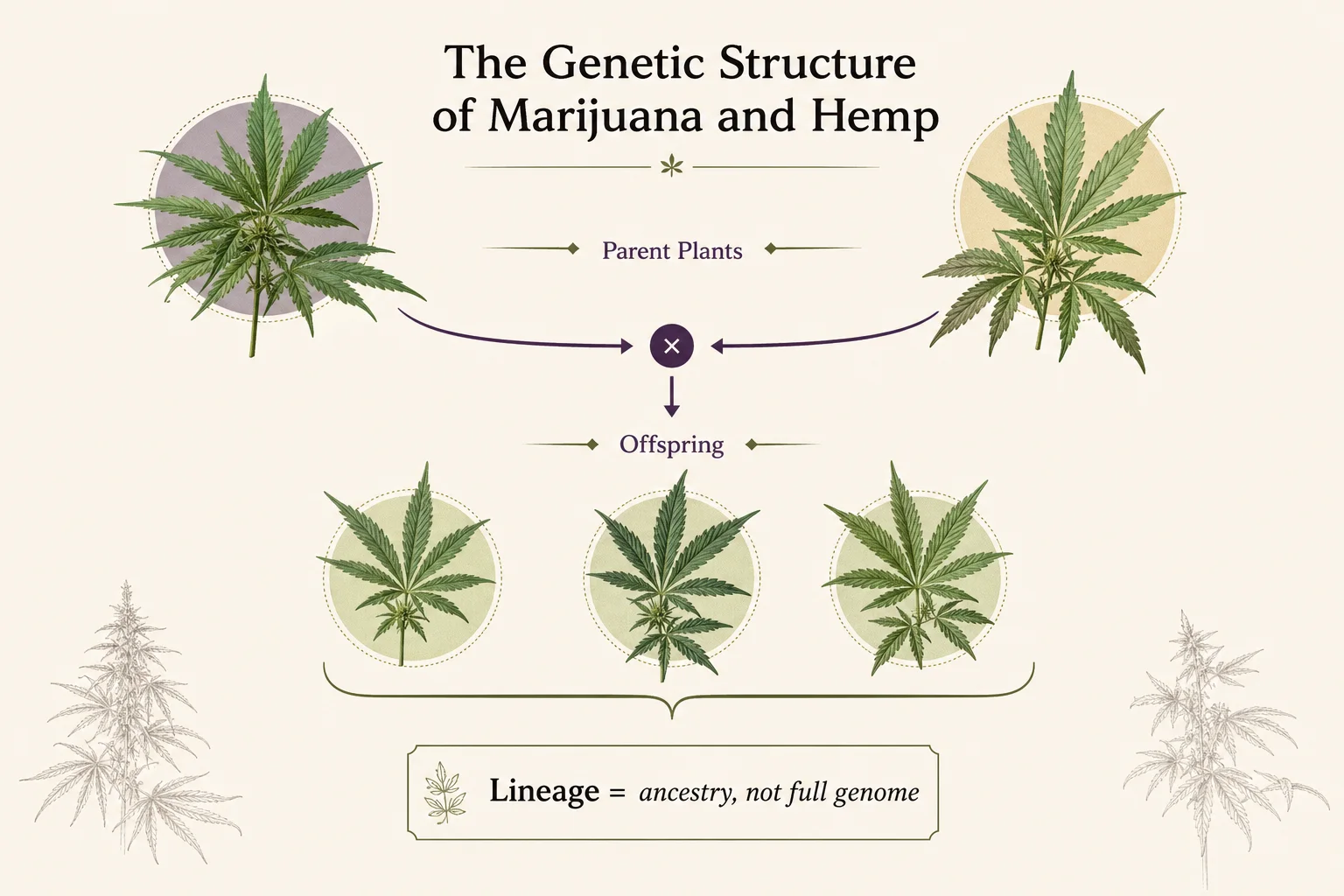
A clear lineage diagram that teaches the difference between breeder-reported parentage and whole-genome identity. Useful for explaining why pedigree information is informative but not determinative. Based on genetic commentary in the literature. ([pubmed.ncbi.nlm.nih.gov](https://pubmed.ncbi.nlm.nih.gov/26308334/))
Research context: The Genetic Structure of Marijuana and HempBreeder lineage vs. genetic identity
When a breeder lists parent plants, they are describing ancestry — which matters for expectation-setting — but ancestry is not the same as the current plant's full genome or chemical make-up. Crosses can segregate, and traits like cannabinoid and terpene production are shaped by many genes as well as by environment. Genetic studies show that commonly used categories like “sativa” and “indica” are genetically messy and that strain names do not always reflect a single, consistent genetic identity across samples. (pubmed.ncbi.nlm.nih.gov)
Modern genotyping can identify relatedness, chemotype-linked markers, and population structure, but these techniques are not yet universally applied in small-batch production. When labs and breeders combine genetic markers with chemical profiles, they can more reliably classify cultivars — but this requires standardized sampling, validated methods, and open records. Recent research illustrates both the promise and the current limits of genetic classification in the cannabis industry. (pubmed.ncbi.nlm.nih.gov)
For growers and patients, the practical lesson: lineage tells you where a plant came from; genotype testing tells you what genes it carries; and only chemical testing of a specific batch tells you what's actually present in that harvest.
Chemotype: what lab data can — and can’t — tell you
A lab report (cannabinoids and terpene panel) describes what was present in a specific sample at test time. Cannabinoid percentages, measured as delta-9-THC, CBD, and other cannabinoids, give a snapshot of that batch's chemotype. Terpene panels report a suite of volatile compounds that contribute to aroma and may shape perceived effects. But lab numbers are a single point of evidence: they depend on sample selection, testing methods, limits of detection, and how the sample was stored and prepared before testing. (fda.gov)
Analytical labs use validated methods, but methods differ (GC vs. LC, decarboxylation reporting, etc.), and results are influenced by sample heterogeneity. A bag of flower is not chemically uniform; trichome density, moisture, and intra-bud variation mean a single lab sample may not represent every nug in a jar. Regulatory testing improves transparency, but a single certificate of analysis (COA) is best interpreted together with batch ID, harvest date, and testing method notes. (fda.gov)
In short: lab data are indispensable for understanding a batch, but they do not retroactively make a strain name a precise predictor. COAs can be used to compare batches; prioritize recent batches, clear sampling notes, and consistent methods when assessing similarity between products.

A laboratory-context photo that teaches how chemical testing is done while respecting that a COA is specific to a sample. Panels and instruments are shown for educational clarity; no numerical outputs are visible so viewers learn process without misreading results. ([fda.gov](https://www.fda.gov/media/164690/download))
Research context: Cannabis-Derived Products Data Acceleration Plan / Guidance (download) · Genotype and chemotype insights of high-THC medicinal Cannabis sativa L.: the role of SSR markers in the identification of cultivarsGarden observation: phenotype, environment, and timing
Growers know that the same genetic clone can look and smell different in different environments. Light quality, nutrients, root health, microbial interactions, and day-to-day climate during flowering all shape phenotype — the visible and aromatic expression of a plant. Two plants with close genetic identity can show divergent terpene expression or bud density depending on cultivation choices. This is why small-batch gardens that publish cultivation notes (feed schedule, light type, VPD, harvest window) offer more honest context than a name alone. (pubmed.ncbi.nlm.nih.gov)
Phenotype observation (sugar leaves, trichome color and density, terpene-forward smell tests) is an important bridge between the lab and the consumer: it lets growers validate whether lab numbers correspond with what the garden produced. Garden notes are observational and variable — they are evidence, not proof. They are best considered alongside batch testing and careful record-keeping to raise confidence. (pubmed.ncbi.nlm.nih.gov)
Timing matters: harvest date, drying and curing protocols, and storage conditions change a product's chemistry over weeks and months. A COA taken immediately after harvest is not the same as a test taken months later; volatile terpenes can decline with time, and decarboxylation changes the balance of acid and neutral cannabinoids. Sellers and patients can look for harvest date and storage guidance on batch records or product pages. (fda.gov)
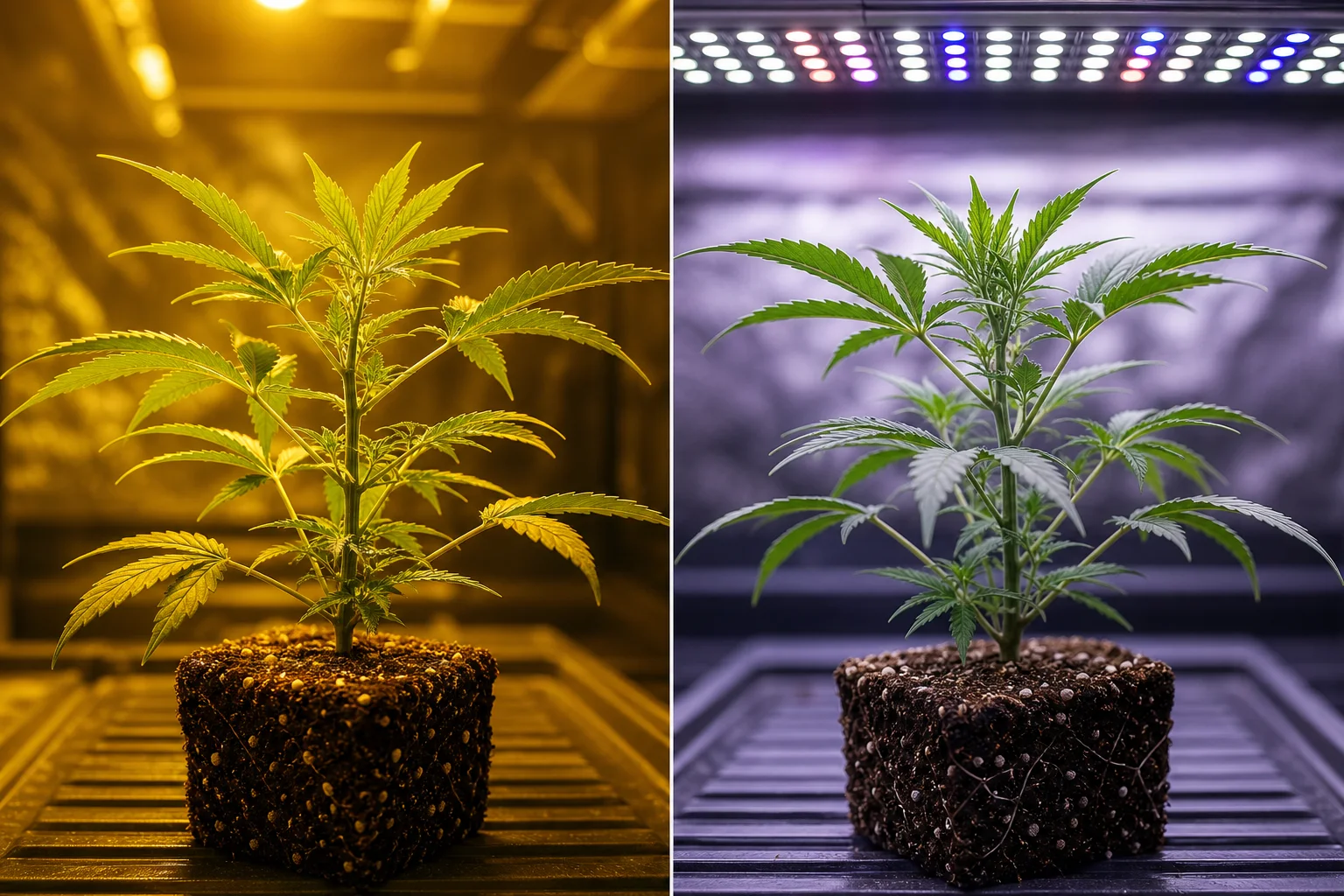
Shows environment-driven phenotypic differences: identical genetics can express different terpene and bud structure when cultivation differs. This visual helps growers and patients see why garden notes matter. It is illustrative and not a replicated experiment. ([pubmed.ncbi.nlm.nih.gov](https://pubmed.ncbi.nlm.nih.gov/41275303/))
Research context: Genotype and chemotype insights of high-THC medicinal Cannabis sativa L.: the role of SSR markers in the identification of cultivarsIndividual experience: dose, route, and tolerance
How a person experiences a product depends on route of administration (inhalation, oral, sublingual), prior exposure, concurrent medications, body weight, and expectations. A named cultivar that reliably produces a floral aroma for one person may feel different to another simply because of dose, setting, or biology. Public health summaries emphasize variability in responses and advise caution when trying new products. (ncbi.nlm.nih.gov)
This is why consumer-facing education that pairs a name with batch data, suggested serving sizes on tested extracts, and clear storage instructions is important. It also explains why patient journals and careful single-variable experiments (keep everything else constant: same dose, same route, same setting) are valuable when someone seeks a consistent experience. Those journals are personal data points, not generalizable proof.
In cases of adverse reactions (excessive sedation, confusion, or an unexpected interaction with another drug), Poison Control and local health resources are commonly contacted for immediate assistance; recording the product’s batch number and testing details can help investigators or clinicians. (poison.org)
Reading Maine labels, tests, and program rules
Maine’s Office of Cannabis Policy (OCP) governs the medical program through statute and rule; the OCP also publishes resources about labeling, testing, and batch tracking that affect how much information is available to patients and consumers. Under Maine rules, batch tracking, testing facility certification, and product labeling requirements create a regulatory baseline for transparency. Participants in Maine’s medical program may review the MMCP rules and guidance documents to understand what information is required and where to find it. (maine.gov)
One visible example of regulation is Maine’s “Universal Symbol,” used to mark cannabis-containing products so consumers can recognize them at a glance. While the symbol helps identify cannabis products, it doesn’t carry chemotype or batch information; that information comes from COAs and batch records required under OCP rules and implementing regulations. The symbol functions as a safety flag, not a chemistry summary. (maine.gov)
Maine’s administrative rules and the OCP guidance on testing and manufacturing describe minimum standards for testing facilities and batch recordkeeping. For patients and growers, useful actions include checking the batch number and COA, noting the test date and testing method, and looking for harvest date or curing details that indicate freshness. When OCP rule text and guidance are unclear, OCP resources listed on the state site provide authoritative interpretation. (maine.gov)
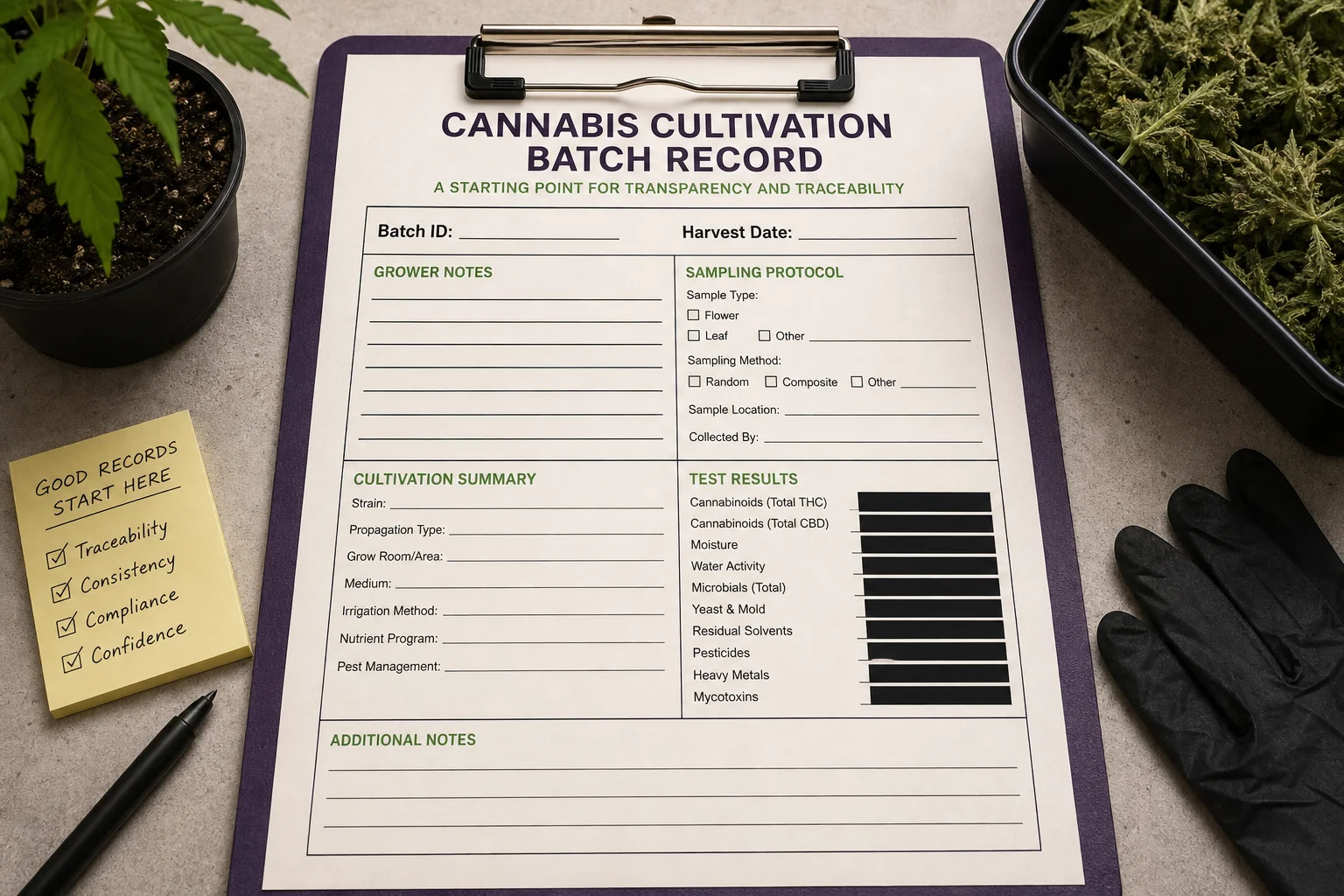
An archival-style, redacted batch-record mockup that teaches what to look for: batch ID, harvest date, and sampling notes. The document is demonstrative; no real data are shown. This emphasizes recordkeeping as evidence for reproducibility. ([fda.gov](https://www.fda.gov/media/164690/download))
Research context: Cannabis-Derived Products Data Acceleration Plan / Guidance (download) · Rules and Statutes | Office of Cannabis PolicyA practical checklist for patients and growers
-
Identify the name, but don’t stop there. Note the strain name and breeder; then look for batch ID and harvest date. Names are shorthand — consider them a starting tag, not a prediction. (pubmed.ncbi.nlm.nih.gov)
-
When available, request and scan the COA. Check the cannabinoid panel, terpene list, testing method, lab accreditation, and test date. COAs that specify sampling protocol and the lab’s method (LC vs GC) help when comparing apples to apples. (fda.gov)
-
Read the grow notes if they are published. If a producer publishes cultivation notes (light type, feed program, harvest window), use them to gauge whether a batch will match previous experiences. Garden observation closes the loop between genetics and the finished product. (pubmed.ncbi.nlm.nih.gov)
-
Keep a personal logbook as a record. Note dose, route, time of day, and subjective response. Track only one variable at a time (for example: same product and dose, different day), and update notes when the producer reports a new batch or harvest. Personal data help detect patterns — but are not a substitute for lab or genetic evidence.
-
Safety considerations include storing products away from children, verifying packaging matches Maine labeling guidance, and contacting Poison Control resources for exposures or adverse reactions. Licensed clinicians are a resource for medical questions about interactions. (poison.org)
-
Growers benefit from keeping clear batch records, archiving harvest- and curing-date information, and working with an accredited lab that documents sampling and methods. These records make it easier to explain variability and to tell a repeatable story about a cultivar. (fda.gov)
Closing note on evidence limits
The science of cannabis genetics and chemotype classification has improved dramatically, but it is still emerging. Studies show meaningful genetic structure in cannabis populations and identify markers linked to cannabinoid pathways, yet the industry lacks universal standards for naming and public databases of validated genotype–chemotype pairs. That means even the best information has limits: genetic markers can predict chemotypes in many cases, lab panels report only the sample tested, and garden observations remain conditional on environment and timing. Read multiple sources of evidence together — name, lineage, batch COA, and garden notes — to form a clearer, more nuanced view of what a product is likely to contain. (pubmed.ncbi.nlm.nih.gov)
Questions this guide answers
Does a strain name predict THC or CBD levels?
No. Names can suggest lineage or breeder intent, but THC/CBD levels vary by genetics and environment; only a batch-specific lab test (COA) shows measured cannabinoid levels. ([pubmed.ncbi.nlm.nih.gov](https://pubmed.ncbi.nlm.nih.gov/41275303/))
If two dispensaries sell the same strain name, are they the same product?
Not necessarily. The same name can hide different genetics, growing environments, harvest dates, and lab results. Compare batch IDs and COAs to confirm similarity. ([pubmed.ncbi.nlm.nih.gov](https://pubmed.ncbi.nlm.nih.gov/33526091/))
What should I look for on a Maine cannabis label?
Look for the batch number, harvest or test date, COA link or QR code, and the universal symbol for cannabis. For medical program participants, OCP rules explain required records and testing standards. ([maine.gov](https://www.maine.gov/dafs/ocp/resources/universal-symbol))
Are terpene panels reliable predictors of experience?
Terpene panels describe volatile compounds in a sample, but they are one piece of the puzzle. Dose, route, tolerance, and other cannabinoids shape experience; terpene lists alone do not guarantee a specific response. ([pubmed.ncbi.nlm.nih.gov](https://pubmed.ncbi.nlm.nih.gov/41275303/))
Where can I get help for an unexpected reaction?
If someone has a severe reaction or exposure (especially a child), contact Poison Control immediately. Save product packaging and batch details for clinicians or health responders. ([poison.org](https://www.poison.org/articles/medical-marijuana))
Educational information only. Cannabis affects people differently and this is not medical advice.