
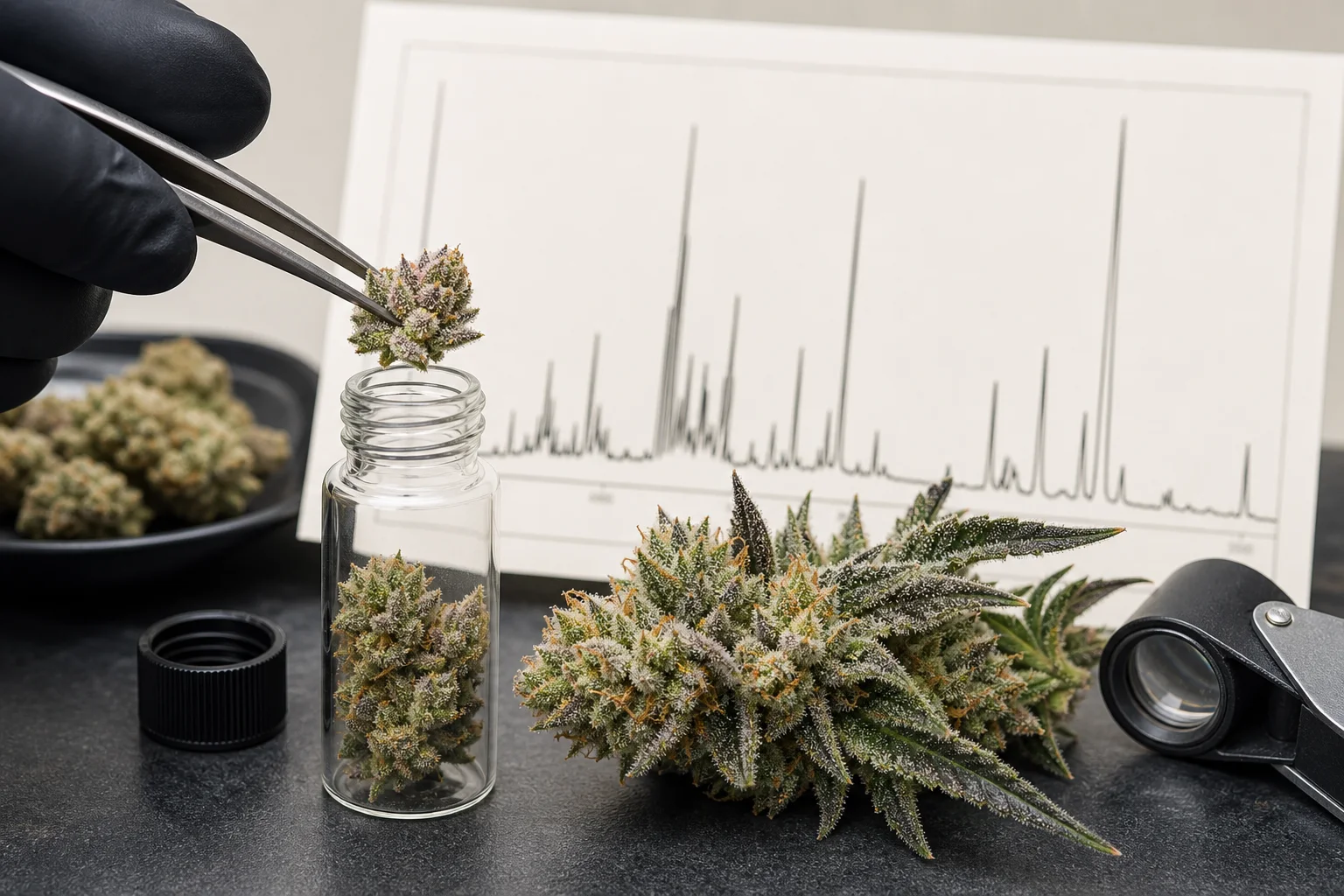
This documentary-style composition links plant source (trichomes), the sampling vial used for headspace analysis, and an example chromatogram to show that terpene panels originate from lab measurements of plant volatiles. It teaches the viewer that numbers begin at the plant and pass through sampling and instrument steps that affect results. Note: the chromatogram should be schematic, not show real patient or consumer data.
1) What a terpene panel is — and what it isn’t
A terpene panel is a chemical readout: a lab measures volatile organic compounds (VOCs) that are present in a sample and reports their identity and quantity. Modern testing programs report dozens of terpenes (linalool, myrcene, limonene, etc.), sometimes with concentrations expressed as percent of dry weight or milligrams per gram. These data are a snapshot of chemistry, not a reliable predictor of aroma or of how a human will respond. NIST and analytical reviews emphasize that terpene measurement is a metrology problem—methods, reference materials and laboratory competence matter for accurate results. (nist.gov)
A terpene list on a Certificate of Analysis (COA) reports what an instrument detected under the lab’s method and with that sample preparation. It does not capture every volatile present, nor does it reconstruct what your nose will perceive from a jar or after you grind flower. Sample handling, extraction method, and instrument calibration shape what the lab reports; different labs can give different numbers for the same batch for perfectly good technical reasons. Reviews of analytical methodology show large method-to-method variation and recommend fit-for-purpose validation when comparing results across labs. (pubmed.ncbi.nlm.nih.gov)
Finally: a terpene panel is not a product label for effects. Scientific work on cannabis biosynthesis shows wide chemical diversity and complex plant genetics behind terpenoid production—but the presence of a compound does not reliably predict a specific subjective outcome for an adult consumer or patient. Approach chemistry as information, not prophecy. (pmc.ncbi.nlm.nih.gov)
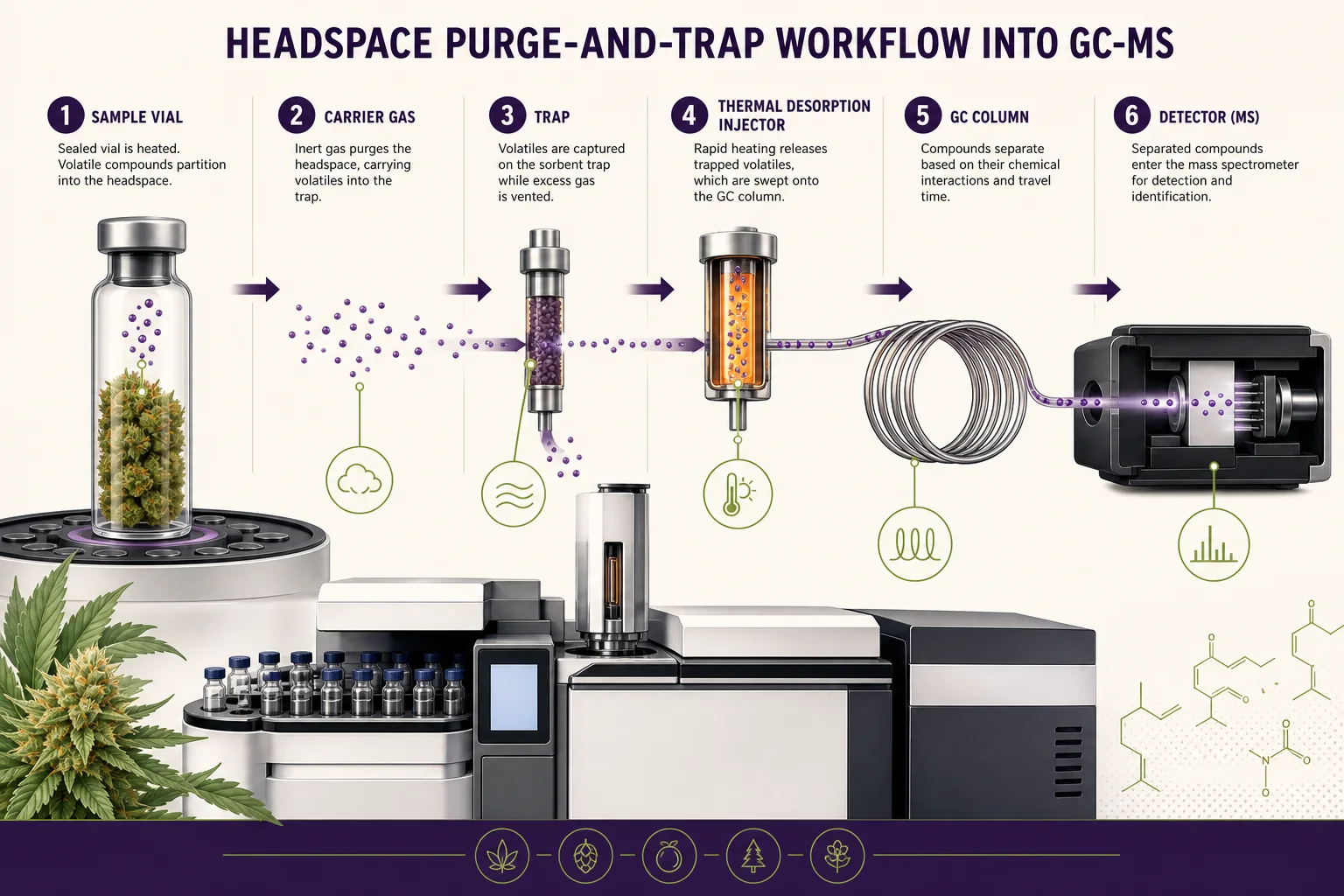
An instructional diagram of headspace purge-and-trap leading into GC-MS illustrates the common lab pathway for measuring terpenes, tying the article’s explanation of analytical methods to a readable visual. Diagrams are schematic and do not display numerical results.
Research context: NIST Tools for Cannabis Laboratory Quality Assurance2) How labs measure terpenes (the quick tour)
Common approaches for volatile profiling are headspace sampling followed by gas chromatography (GC) coupled to a detector such as flame ionization (FID) or mass spectrometry (MS). ‘Headspace’ methods sample the vapor phase above plant material; purge-and-trap headspace is a common concentration strategy. NIST documentation and cannabis analytical reviews describe headspace-GC and GC–MS as the practical standard for terpene panels because they target volatile, thermally stable compounds. (nist.gov)
Every step—how the sample is homogenized, how much is heated, what solvent (if any) is used, and which calibration standards are applied—changes the numbers you see. NIST’s Cannabis Laboratory Quality Assurance Program (CannaQAP) works directly with labs to identify inter-lab variability and promote reference materials and consensus methods so results become more comparable. That work is important: volatile compounds are lost easily during drying and storage, and measurement uncertainty can be substantial without robust quality controls. (nist.gov)
Two practical consequences: a) COAs are most comparable when the lab and method are known; b) look for method details on the COA or lab report (headspace vs solvent extract, instrument type, calibration, limits of quantitation). If the COA lacks method metadata, interpret the numbers as limited. (pubmed.ncbi.nlm.nih.gov)
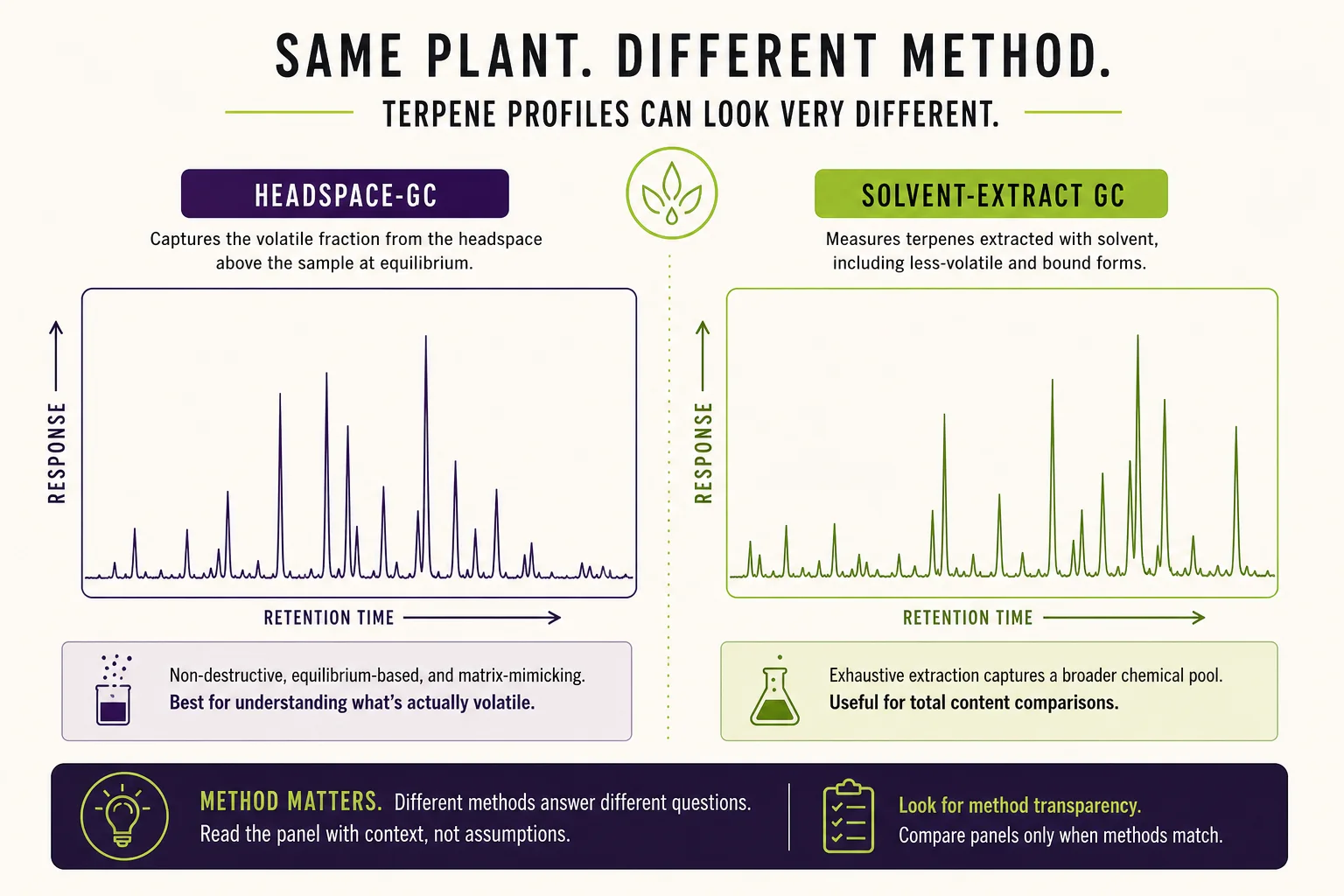
A pair of schematic chromatograms compares a gentle headspace profile with a solvent-extract profile to make the point that method choice changes reported terpene totals and relative abundances. This visual teaches method-dependent variation without showing real data.
Research context: Cannabis Sativa L.: a comprehensive review on the analytical methodologies for cannabinoids and terpenes characterization.3) Step-by-step: reading the panel without turning numbers into promises
Step 1 — Identity: Look at which compounds are listed. Labs usually report the most abundant terpenes first. If a COA lists 10–20 terpenes, that’s normal; rare terpenes beyond the reporting list may be present but below detection limits. Step 2 — Units: Are numbers percent dry weight, mg/g, or relative peak area? Percent or mg/g are quantitative; peak area alone is semi-quantitative and depends strongly on the method. Step 3 — Detection limits: Labs typically include limits of detection (LOD) and limits of quantitation (LOQ). Values reported below LOQ are noisy and merit cautious interpretation. (pubmed.ncbi.nlm.nih.gov)
Read the ‘other’ lines: many COAs include a column for unidentified volatiles, moisture content, or a total terpene percentage. Total terpene % is useful to compare batches, but it is method-dependent—an extract method that draws more volatile material may register a higher total than a gentle headspace method. Refrain from equating a higher total terpene % with a universal sensory or effect “better.” (tsapps.nist.gov)
Finally, place the panel in context: matching the COA date to the batch and noting whether the sample was taken before or after drying, curing, or trimming. A COA for a lab sample taken from a frozen or poorly conditioned sample may not reflect the jar opened at home. In Maine, adult-use COAs are required for retail; medical supply chains may not have the same mandatory testing coverage—check with your registered dispensary or caregiver about which tests were run. (maine.gov)
4) Smell language: how sensory descriptions and chemical names relate
Sensory descriptors—‘citrus’, ‘earthy’, ‘pine’, ‘floral’—are shorthand, not chemistry. A single aroma descriptor usually arises from multiple volatiles interacting at different concentrations. For example, limonene contributes citrusy notes while pinene gives pine-like clarity; but low concentrations of an additional sesquiterpene or trace esters can shift perception. Analytical studies and reviews emphasize that aroma is an emergent property of mixture composition, concentration, and human olfactory variability. (pubmed.ncbi.nlm.nih.gov)
Human perception is nonlinear: small changes in concentration can move an aroma from ‘present but faint’ to ‘dominant.’ Further, individual differences in olfaction and personal experience shape what people label as ‘relaxing’ or ‘uplifting.’ This is why the same jar can smell very different to different people, and why sensory panels (trained humans) remain valuable complements to instrument panels. But trained panels are not commonly reported on retail COAs. (pubmed.ncbi.nlm.nih.gov)
So when a label reads “lemon-forward because of limonene,” regard it as a plausible sensory cue, not a promise that everyone will smell lemon or feel a particular way. Aroma descriptors can help identify samples whose sensory profile you prefer; batch records and your own experience remain central to judging consistency across harvests. (pubmed.ncbi.nlm.nih.gov)
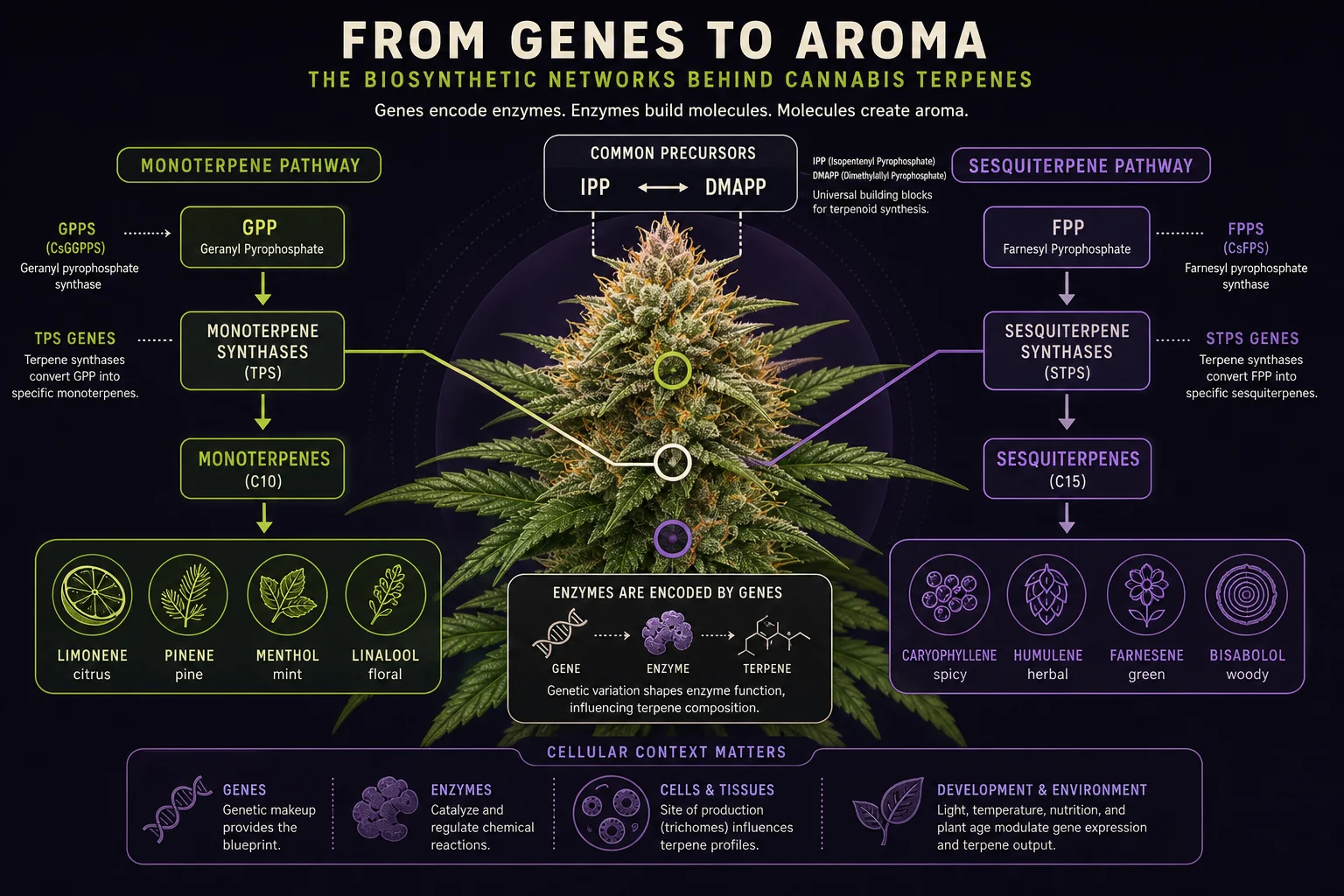
A combined botanical/gene-network diagram demonstrates how plant genetics and biochemical pathways produce terpenes—supporting the article’s point that genetics set potential and environment tunes expression. The graphic should be explanatory and not present experimental numbers.
Research context: Gene Networks Underlying Cannabinoid and Terpenoid Accumulation in Cannabis5) Batch context: why terpenes vary from harvest to jar
Terpene chemistry changes across a plant’s life cycle. Genetics set the biosynthetic potential, but environment and cultivation practices tune expression: light spectrum and intensity, nutrient timing, harvest window, and mechanical stress all change terpenoid pathways. Gene network studies document the plant-side complexity behind terpene accumulation, showing why two plants with the same ‘strain name’ can still have distinct chemical fingerprints. (pmc.ncbi.nlm.nih.gov)
Post-harvest handling matters too. Drying temperature and speed, curing time, trimming method, and storage conditions (temperature, humidity, and oxygen exposure) all affect volatile retention. NIST measurements and interlab studies note that drying and storage systematically reduce volatile emissions; a COA taken soon after harvest can overstate what’s in the jar weeks later. That’s why growers who want consistent profiles pair a harvest SOP with batch-level COAs taken using a defined sampling protocol. (tsapps.nist.gov)
On the consumer side, small-batch growers often document lot numbers and COA dates; adults and medical patients may ask their dispensary whether a COA corresponds to the actual packaged lot. In Maine, adult-use transfers require mandatory testing and COAs; medical products may have different testing histories—check with your caregiver or dispensary. (www11.maine.gov)
6) Why “this terpene equals this effect” is overreach
The idea that a single terpene reliably produces a fixed effect in people oversimplifies both chemistry and psychology. Most terpene research comes from in vitro, animal, or small human studies that characterize receptor interactions, odorant activity, or pharmacokinetics of isolated molecules. Translating those findings into a predictable subjective response for a mixed cannabis product in a diverse adult population is a bridge too far—current evidence does not support simple one-to-one promises. Reviews of cannabis chemistry urge caution about extrapolating bench chemistry to consumer outcomes. (pubmed.ncbi.nlm.nih.gov)
Measurement variability makes prediction harder. Labs use different methods, and terpenes degrade or off-gas over time; a COA is a measurement under specific conditions, not a permanent assurance for every jar. NIST’s work on measurement uncertainty and interlaboratory comparison is precisely an attempt to make the chemistry repeatable enough to be useful—but even the best metrology doesn’t convert chemistry into individual experience. (nist.gov)
Consider terpene panels as one dimension among many—genetics, cannabinoid profile, batch history, sensory testing (your nose), and prior personal experience. Be cautious about vendors or labels that promise fixed mental states or clinical outcomes tied to a terpene list. Those claims go beyond what the science and Maine rules support. (maine.gov)
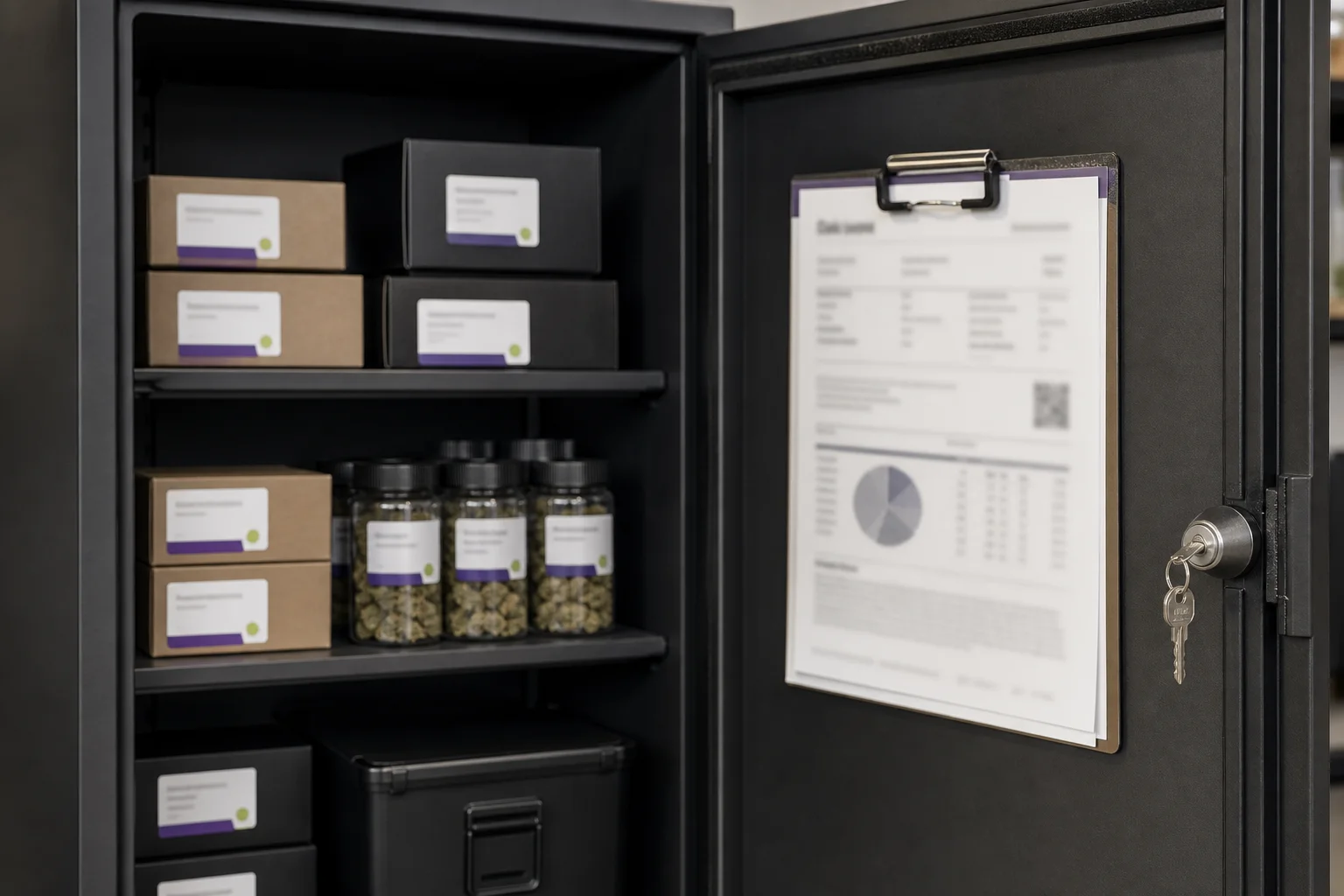
A practical, documentary photo showing lot-level labels, a visible COA cover sheet (no readable numbers), and locked storage underscores chain-of-custody and storage points made in the checklist. It teaches the consumer to match COA and lot number and to practice safe storage.
Research context: Understanding Cannabis Testing Requirements & Results in Maine7) Practical checklist for Maine adults and medical patients
-
Match the COA to the lot number and date on the package; if no lot-level COA is available, consider requesting one. Maine’s adult-use program posts testing data and requires COAs for transfers; medical products may have different testing histories—confirm with your caregiver or dispensary. (maine.gov)
-
Review the method metadata: headspace vs solvent extract, instrument, LOD/LOQ, units (mg/g or %), and the COA date. Numbers reported below LOQ are uncertain and merit cautious interpretation. If the COA lacks method details, consider requesting them. (pubmed.ncbi.nlm.nih.gov)
-
Sensory checks: a legal adult can sniff a small bit and compare aroma to the COA descriptors. Medical patients can discuss batch consistency with registered dispensary staff. Household safety: store cannabis products out of reach of children and pets; Poison Control and CDC data show that unintentional pediatric exposures to edibles and other cannabis products remain a public-health concern—safe storage is important. (poison.org)
Evidence limits and honest uncertainty
Terpene panels are useful, but their interpretive power is limited by sampling, method, and human variability. Laboratory science continues to improve—NIST and academic groups are creating reference materials, running proficiency programs, and refining vapor and headspace methods—but that work focuses on measurement quality rather than producing definitive psychotropic predictions. When reading a COA, consider it a technically valuable snapshot with known uncertainties, not a certificate of human experience. (nist.gov)
Maine’s regulatory picture separates adult-use mandatory testing from medical product practice: adult-use transfers are subject to required analyte tests and COAs under OCP rules, while medical caregivers and dispensaries may use voluntary testing and different formats—so consider asking for batch-specific information. Regulatory updates happen; consult OCP resources for the current rule set. (www11.maine.gov)
For those who want to dig deeper, review lab method sections, request raw data or chromatograms when feasible, and prioritize suppliers who publish method metadata and participate in inter-lab comparisons or proficiency testing. The research community recommends this transparency as the route toward interpretability and trust. (pubmed.ncbi.nlm.nih.gov)
Key takeaways and reading resources follow below. For further safety information about accidental ingestion, contact your local poison center or call 1-800-222-1222 in the U.S. See references for primary sources.
Questions this guide answers
Do terpene numbers predict how I’ll feel?
No. Terpene panels show what compounds are present and at what concentrations under a lab’s method. Human response depends on many factors—cannabinoids, dose, personal biology, prior experience, and context—so terpene lists cannot reliably predict an individual’s subjective outcome.
Why are COAs different between labs for the same batch?
Differences in sample preparation, headspace vs solvent extraction, calibration standards, and instrument settings can yield different quantitative results. NIST and proficiency programs aim to reduce variability, but method differences remain a main reason COAs can differ.
Does Maine require terpene testing for medical cannabis?
Maine’s adult-use program requires mandatory testing and COAs for transfers; medical caregivers and dispensaries may voluntarily test and verify labels but are not subject to the same mandatory contaminant testing. Check the OCP guidance for specifics and ask your supplier for batch COAs.
What should I do if a child eats an edible or is exposed to cannabis?
Contact your local poison center or call 1-800-222-1222 immediately for guidance. Poison Control resources emphasize keeping all cannabis products out of reach of children and seeking urgent help for concerning symptoms.
Where can I learn more about how terpenes are measured?
Technical reviews and NIST resources explain headspace-GC and GC–MS methods, measurement uncertainty, and laboratory quality assurance. These resources help explain why method metadata (LOD/LOQ, instrument type) is important on a COA.
Educational information only. Cannabis affects people differently and this is not medical advice.