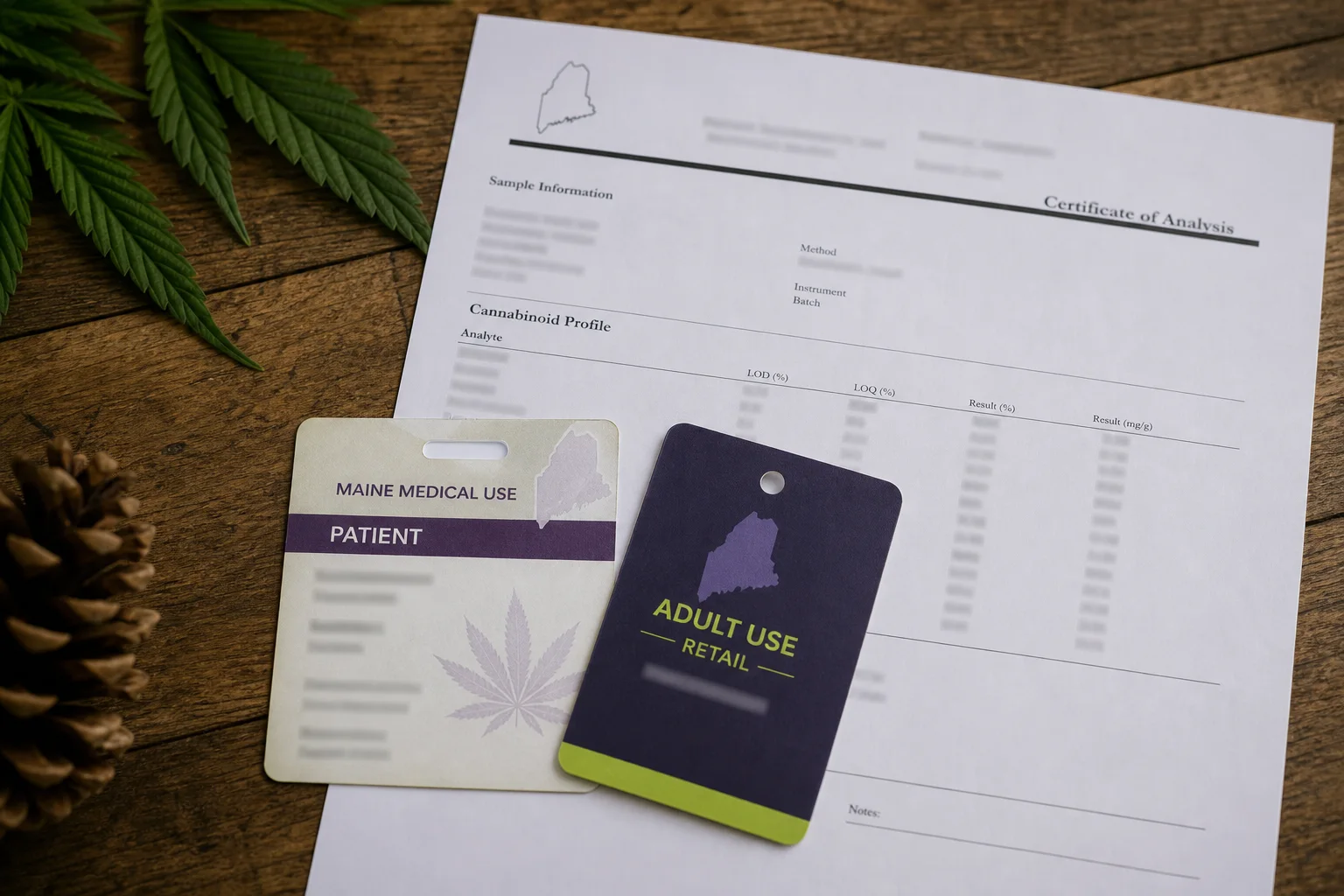
A documentary‑style composition showing the distinct paperwork and a lab report that underpin Maine’s two systems. This image is intended to teach that program identity is a paper‑traceable difference; it does not show patient names or readable COA values. Source documents were used for composition, not for data extraction.
Published: September 28, 2026
Why this map matters now
Maine runs two separate cannabis systems: a Medical Use program and an Adult‑Use program. They look similar—same plant family, many of the same cultivars—but they answer to different laws, different inspections, different testing rules, and (critically) different user expectations. That separation matters for people who grow, package, test, and buy cannabis: it changes who can participate, what records must be kept, how products are labeled, and which legal protections apply. For the legal framework and program rules, see Maine OCP’s Medical Use and Adult‑Use rule pages. (maine.gov)
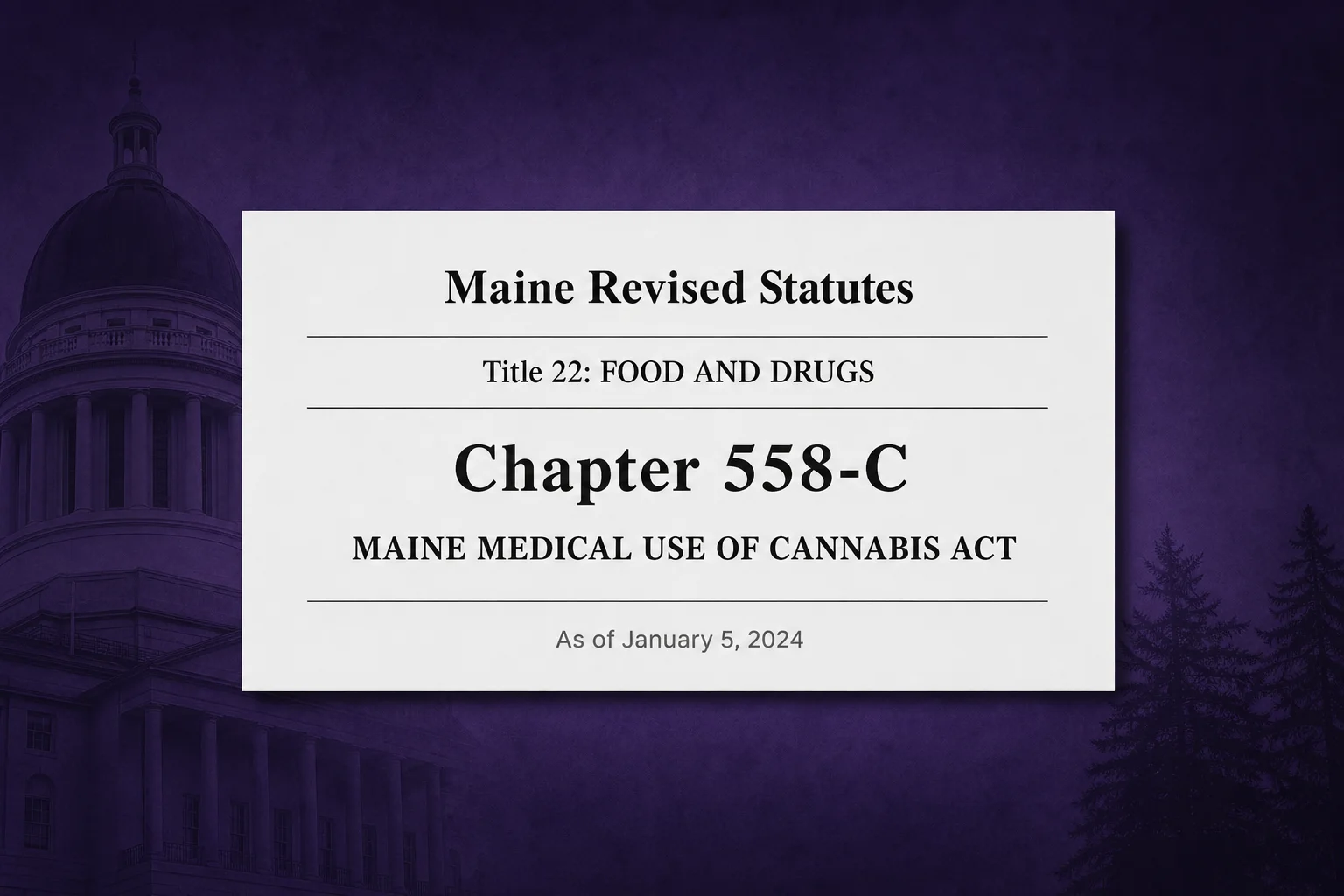
An archival view of the Maine Medical Use of Cannabis Act header teaches where the medical program’s statutory protections originate. This is an archival, non‑editable screenshot and does not replace legal counsel or interpretation.
Research context: MRS Title 22, Chapter 558-C. MAINE MEDICAL USE OF CANNABIS ACT (PDF)1) Participants: who’s allowed and how they show it
Maine’s medical program is built around registered qualifying patients, caregivers, registered dispensaries, and related registration certificates. Qualifying patients get registry identification cards or are represented by a registered caregiver; dispensaries and caregivers carry specific registration certificates in the MMCP system. Those registrations create a traceable chain for medical products and give statutory protections around certain activities. The legal foundation for the medical program sits in Title 22, Chapter 558‑C of the Maine Revised Statutes. (maine.gov)
The adult‑use program instead relies on licensure under the Cannabis Legalization Act and OCP’s adult‑use rules. Licenses—issued to cultivators, manufacturers, retailers, and others—carry different scopes and compliance obligations than medical registrations. Adult‑use participants do not require a medical registry card; they must meet OCP licensing standards, carry business licenses, and follow adult‑use packaging, testing, and advertising rules set by OCP. (maine.gov)
On the ground, that matters because the two tracks create different routes to market. A clinic‑certified patient (or their caregiver) may access certain dispensary services and statutory protections under Title 22 that a casual adult purchaser does not. For growers and small producers, choosing to operate under medical registration versus adult‑use licensure changes who you sell to, what records you keep, and what inspections and criminal‑history processes you’ll face. (web.legis.maine.gov)
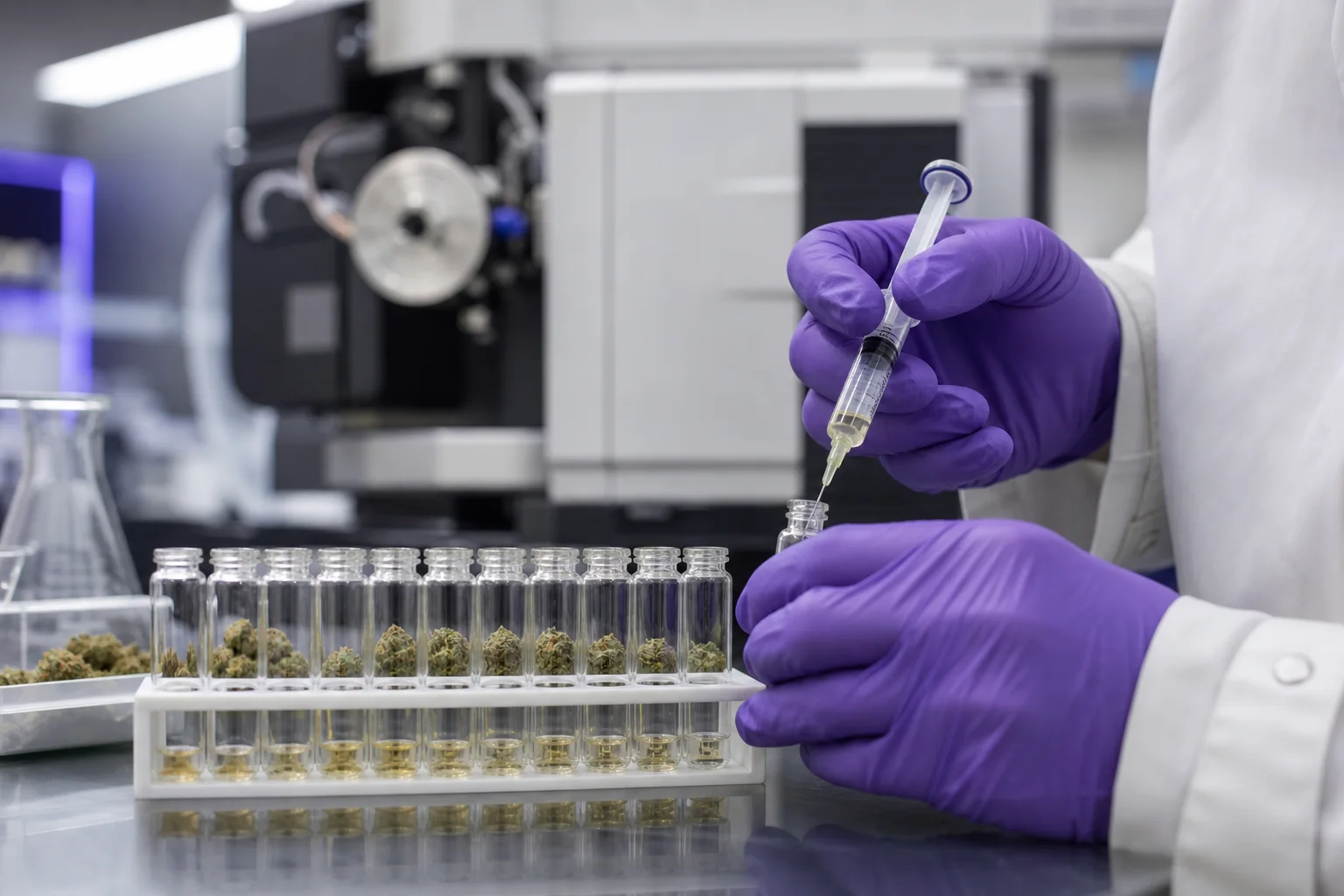
A lab documentary macro that illustrates the physical reality of certified testing: sample vials, clean benches, and instrumentation preparation. It teaches that testing is method‑dependent; it does not show lab identifiers, numeric results, or proprietary methods.
Research context: Understanding Maine Cannabis Testing Requirements & Results (guidance PDF)2) Testing: what gets tested, who tests it, and how strict is it?
Maine requires certified testing for both programs, but the rules and the certification process for testing facilities are described explicitly in the OCP adult‑use testing rules and in program guidance documents. Beginning in 2024, OCP formalized testing rules and set standards for cannabis testing facility certification; OCP also publishes plain‑language guidance to help people read test reports. The list of certified labs and the testing standards that labs must meet are public. (maine.gov)
What labs report and how they do it matters more than most users realize. Independent scientific reviews show that cannabinoid and contaminant measurements can vary from lab to lab and depend heavily on validated methods, proper method validation, and consistent sample handling. In short: a potency or contaminant number is only as reliable as the lab method and its validation. That’s why Maine’s lab certification rules (and the written method validation that labs are expected to follow) are an important difference between a regulated product and an untested one. (pubmed.ncbi.nlm.nih.gov)
Practically speaking for growers: if you plan to move product into either market, budget time and recordkeeping for sampling and chain‑of‑custody. The adult‑use rules include an explicit chapter for the testing of adult‑use cannabis (18‑691 CMR, ch. 40), and OCP’s guidance explains how to interpret panels—what cannabinoids, terpenes, moisture, and contaminants mean on a certificate of analysis. That testing backbone is a main reason product identity is meaningful in Maine’s regulated markets. (maine.gov)
3) Labels and packaging: what a label must (and mustn’t) tell you
Adult‑use labels are tightly proscribed: Maine requires a universal cannabis symbol on many products, specific potency disclosure formats, batch/lot IDs, and child‑resistant packaging rules for edibles. OCP runs a voluntary packaging, labeling & advertising review for adult‑use materials but mandatory labeling standards still apply. These rules were developed to reduce accidental ingestion, provide basic chemical information, and keep marketing out of reach of minors. (maine.gov)
Medical program labeling historically emphasized patient safety through registrant tracking (plant tags for patient cultivation, registry card identification, and dispensary recordkeeping) and allowed some differences in how products are packaged and distributed under the MMCP rule set. The statute gives certain protections to patients and establishes that medical registrants must follow program rules—so labels and documentation that support patient care and legal compliance take a different shape than consumer‑facing adult labels. (maine.gov)
Labels are not a complete safety guarantee. Federal agencies caution that potency and ingredient claims depend on analytical accuracy, and some claims (for example, medical benefit claims) fall under FDA jurisdiction and are not allowed without appropriate approval. So a clear label helps, but reading a certificate of analysis and knowing the certifying lab and methods remains essential when you want to compare products across programs or producers. (fda.gov)
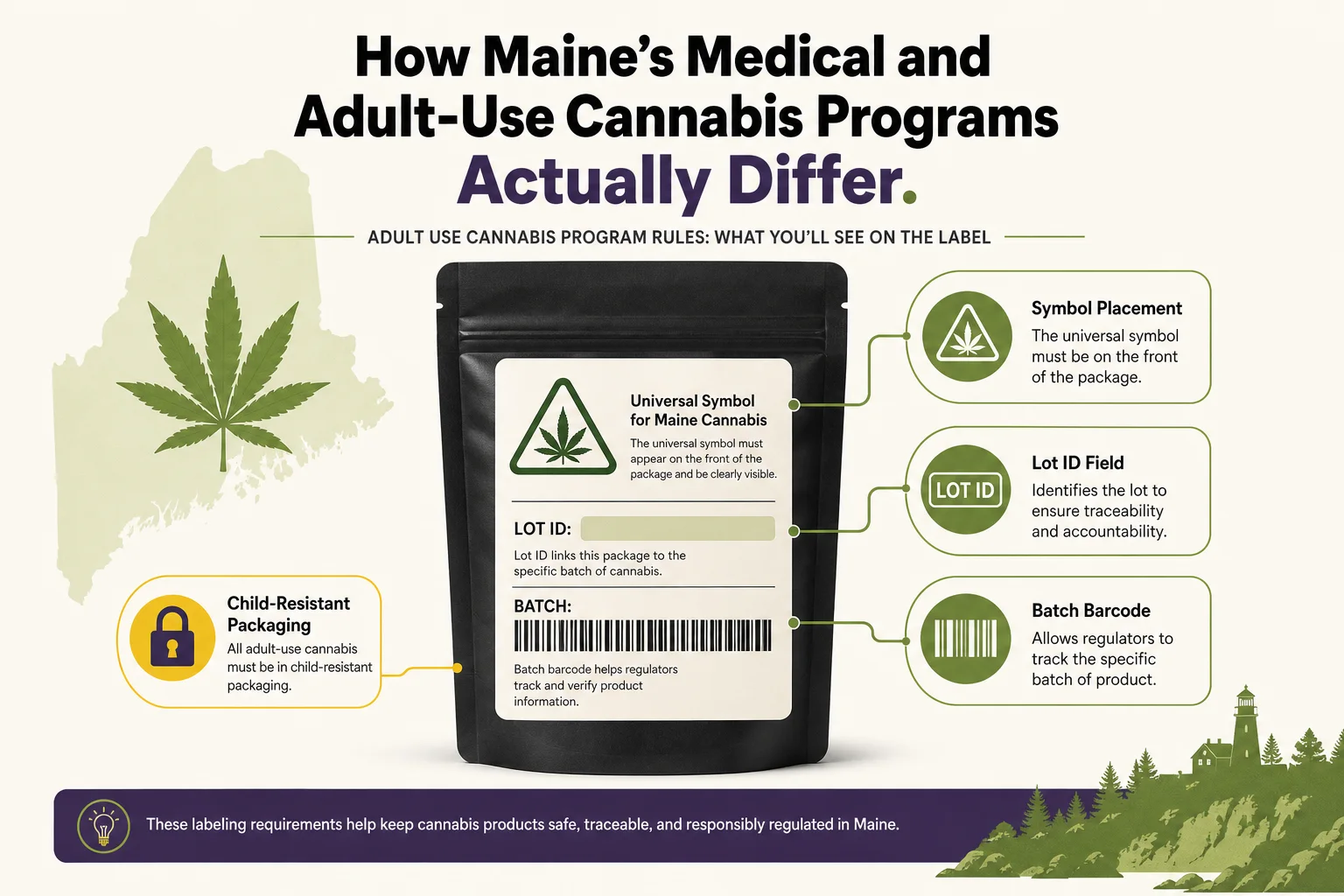
An explanatory infographic teaching which label elements Maine requires for many adult‑use products: the universal symbol, lot ID, and child‑resistant packaging icons. The diagram avoids presenting any actual potency numbers. Limits: regulatory text may have changed—refer to OCP for latest specifics.
Research context: Adult Use Cannabis Program Rules4) Legal protections, inspections, and enforcement differences
Registered qualifying patients and certain caregivers receive explicit statutory protections under the Medical Use Act (Title 22), including protections related to employment, parental rights, and limits on certain types of civil penalties—protections that trace back to the medical statute’s intent. The MMCP also authorizes inspections to ensure compliance but places some limits (for example, inspection of dwelling units is constrained in specific ways). Those statutory protections are a meaningful legal difference between being a documented patient and being an adult consumer. (legislature.maine.gov)
Adult‑use participants operate within a statewide licensing, inspection, and compliance regime created after legalization; violations can trigger administrative penalties, license suspension or revocation, and criminal enforcement under applicable statutes and rules. In November 2024 OCP’s adult‑use rules became effective for multiple chapters, including testing facility certification and licensing chapters—creating a clear, modern framework for enforcement. For businesses, that means adult‑use licensure brings a different compliance burden than medical registration. (maine.gov)
The bottom line: program identity changes risk and relief. Patients who rely on statutory protections have a documented route to certain legal shields; businesses under adult‑use licensure face inspection and compliance regimes designed for commercial scale and consumer protection. Growers choosing which route to supply should weigh regulatory costs, market access, and the recordkeeping demands each pathway requires. (web.legis.maine.gov)
5) Consumer and public health impacts to watch
Public health authorities emphasize that legalization and the growth of a regulated market alter patterns of use, exposures, and accidental ingestions. CDC materials note shifts in routes of use (smoking, vaping, edibles) and call for continued surveillance of health outcomes. Poison Control and pediatric surveillance reports repeatedly warn that edibles are a leading cause of unintentional pediatric exposures; both medical and adult‑use markets must plan labels and storage guidance accordingly. (cdc.gov)
From a product‑safety perspective, the scientific literature shows broad variability in measurements of cannabinoids and contaminants across labs and jurisdictions; this argues for strong lab certification, transparent method validation, and careful interpretation of results—especially when moving products between programs or comparing products from different labs. In other words: a tested, clearly labeled product reduces uncertainty, but does not eliminate it. (pubmed.ncbi.nlm.nih.gov)
Finally, FDA statements remind us that the federal regulatory landscape around cannabis‑derived products (especially hemp‑derived CBD) remains complex and that certain claims are outside the bounds of consumer labeling without clear FDA authorization. This federal context doesn't erase state rules, but it does shape what product claims are lawful and how public‑facing information should be phrased. (fda.gov)
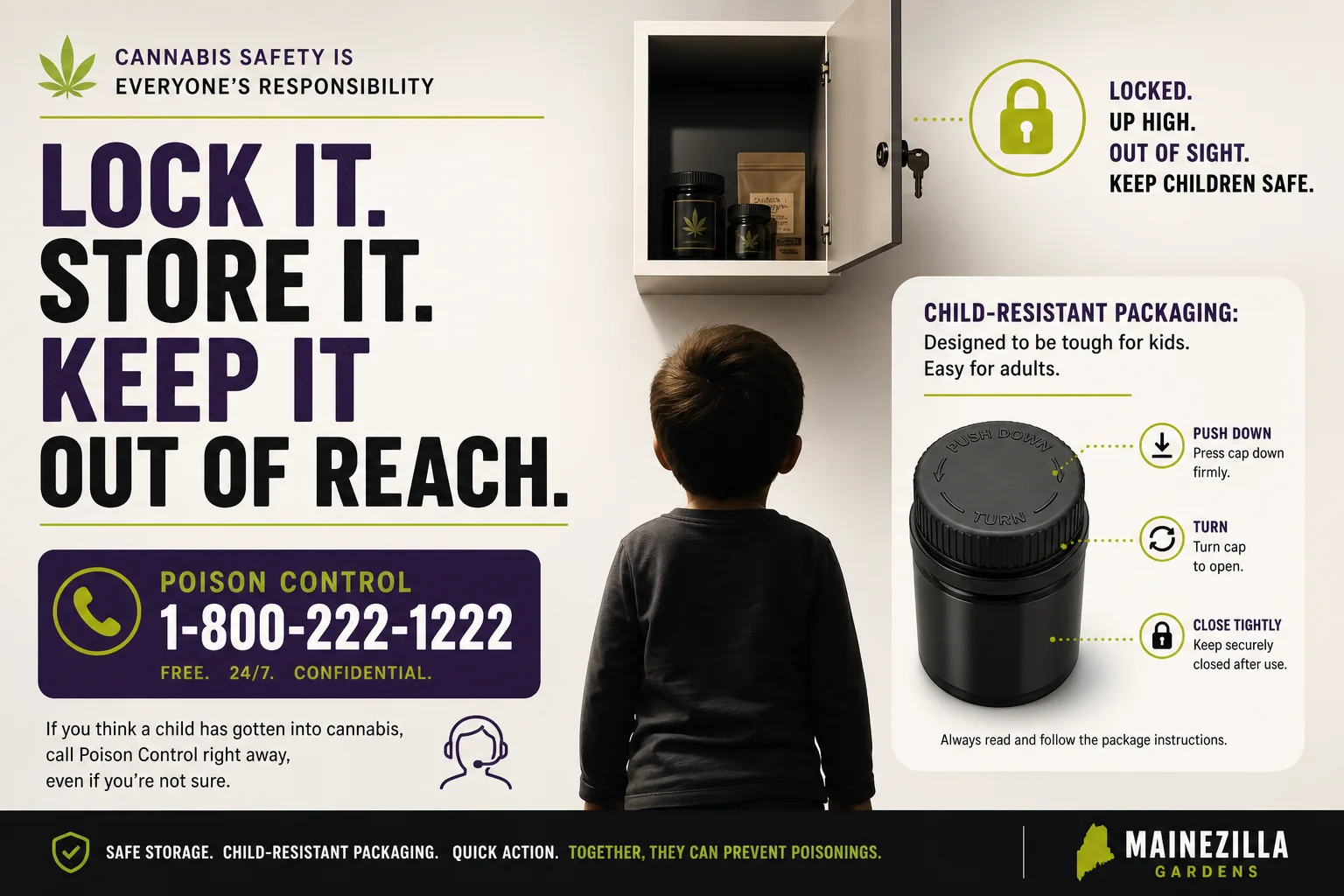
A public‑health poster composition teaching immediate steps if a child ingests an edible and storage best practices. It is educational and does not substitute for local emergency instructions.
Research context: Medical marijuana poisoning in kids6) Practical choices for Maine growers and small producers
If you grow in Maine and want to place product into the medical or adult‑use stream, the choice affects who you sell to, what paperwork you keep, and where you’ll send product for testing. Medical registrations tie you to patient‑focused records and statutory protections; adult‑use licensure ties you to commercial compliance, broader consumer labeling requirements, and a different testing/lot framework. Both paths ask for careful batch records, sample retention, and chain‑of‑custody practices. (maine.gov)
For small‑batch producers, the compliance difference is also a market decision: supplying the medical market may demand closer coordination with patients and caregivers and possibly different packaging; supplying adult‑use requires meeting standardized packaging and symbol rules, and dealing with larger retail distribution patterns. Either way, consistent testing and transparent Certificates of Analysis—in which lab identity, methods, and sample dates are clear—are the single best practice that spans both programs. (maine.gov)
If you’re a grower already selling into one program and considering the other, consult OCP’s rule pages and guidance documents, and keep dated records of when rules or interpretations change. The OCP rule pages and the MMCP statute are the authoritative sources for dates, registration requirements, and program scope in Maine. (maine.gov)
7) Evidence limits and what we still don’t know
State rulebooks and lab certification requirements create boundaries, but they don’t erase scientific uncertainty. Peer‑reviewed analyses repeatedly show inter‑lab variability and method weaknesses for cannabinoids and contaminants; harmonized, validated methods remain an active area of research. That means potency and contaminant numbers are useful, but must be interpreted with method details and an understanding of lab quality. (pubmed.ncbi.nlm.nih.gov)
On health outcomes, CDC surveillance captures population trends and acute harms (like pediatric exposures) but cannot resolve every causal question about long‑term outcomes for specific products or concentrations. For individual health questions, talk to clinicians—this article provides structural, not medical, guidance. (cdc.gov)
Finally, rules change. Several adult‑use rule chapters took effect in late 2024; statutes and program interpretations can be amended by lawmakers or rulemaking. If you are making program decisions, verify rule dates and language on OCP and the Legislature’s statute pages—those are the primary records. (maine.gov)
Key takeaways
- Maine runs two distinct systems: the Medical Use program (Title 22) and a separate Adult‑Use regime administered under the Cannabis Legalization Act. (legislature.maine.gov)
- Testing matters: lab certification, validated methods, and clear chain‑of‑custody underpin trustworthy potency and contaminant numbers. (maine.gov)
- Labels reduce risk but don’t replace reading a lab report; product claims are limited and must follow state rules and federal limits on medical claims. (maine.gov)
- Program identity changes who can buy, who can sell, what protections apply, and what inspections or penalties are possible. (maine.gov)
- For growers and small producers, the best cross‑program practice is rigorous batch records, trustworthy lab relationships, and dated compliance checks against OCP rules. (maine.gov)
FAQs
Q: Can a patient use medical cannabis protections in an adult‑use purchase? A: No. Statutory protections for qualifying patients flow from medical registration under Title 22. Adult‑use retail transactions follow adult‑use licensure rules; they do not confer medical‑program protections. Check OCP and Title 22 for specifics. (legislature.maine.gov)
Q: Are adult‑use products tested to the same standards as medical products in Maine? A: Both programs require testing by certified labs, but the adult‑use testing rules are spelled out in OCP’s adult‑use testing chapter. Lab certification, methods, and reporting practices are the critical consistency factors. Always inspect the lab’s COA details. (maine.gov)
Q: Do labels tell you everything you need to know about safety? A: Labels provide required information—symbol, potency disclosures, lot IDs—but labels don’t show method validation, limit of detection, or sampling details. For safety‑critical decisions, review the Certificate of Analysis and the lab’s accreditation/certification. (maine.gov)
Q: Who do I contact if I suspect a contaminated product or a bad lab report? A: Report concerns to OCP’s Compliance Team, and keep the COA and batch information. If the issue involves an acute health event—especially with a child—contact Poison Control at 1‑800‑222‑1222 or use webPOISONCONTROL. (maine.gov)
Q: How stable are rules and lab lists? A: Rules and the list of certified labs evolve. For the current rule texts and certified‑lab lists, consult OCP’s rule pages and the agency guidance documents—those are the authoritative and dated sources. (maine.gov)
Sources reviewed
- Office of Cannabis Policy — Medical Use Rules and Statutes. https://www.maine.gov/dafs/ocp/medical-use/rules-statutes. (Maine OCP). (maine.gov)
- Office of Cannabis Policy — Adult Use Cannabis Program Rules. https://www.maine.gov/dafs/ocp/adult-use/rules-statutes/rules. (Maine OCP). (maine.gov)
- MRS Title 22, Chapter 558‑C. MAINE MEDICAL USE OF CANNABIS ACT. https://www.legislature.maine.gov/legis/statutes/22/title22ch558-C.pdf. (Maine Legislature). (legislature.maine.gov)
- OCP Guidance — Understanding Maine Cannabis Testing Requirements & Results (Oct 2023 guidance). https://www.maine.gov/dafs/ocp/sites/maine.gov.dafs.ocp/files/2023-10/Understanding%20Maine%20Cannabis%20Testing%20Requirements%20%26%20Results.pdf. (Maine OCP). (maine.gov)
- CDC — Cannabis and Public Health (health effects, surveillance). https://www.cdc.gov/cannabis/health-effects/. (CDC). (cdc.gov)
- FDA — What You Need to Know About Products Containing Cannabis or Cannabis‑derived Compounds. https://www.fda.gov/consumers/consumer-updates/what-you-need-know-and-what-were-working-find-out-about-products-containing-cannabis-or-cannabis. (FDA). (fda.gov)
- PubMed — "Fit‑for‑purpose analytics for cannabis: identification, quantification, and standardization of cannabinoids, flavonoids and terpenes." https://pubmed.ncbi.nlm.nih.gov/42565826/. (PubMed). (pubmed.ncbi.nlm.nih.gov)
- Poison Control — Medical marijuana poisoning in kids. https://www.poison.org/articles/medical-marijuana. (Poison Control). ()
Visual evidence package
-
Hero (role: hero, after_section: -1)
- alt: "Side‑by‑side documentary map: a Maine medical registry card, an adult‑use retail tag, and a redacted certificate of analysis on a wooden table."
- caption: "A documentary‑style composition showing the distinct paperwork and a lab report that underpin Maine’s two systems. This image is intended to teach that program identity is a paper‑traceable difference; it does not show patient names or readable COA values. Source documents were used for composition, not for data extraction."
- prompt: "Documentary flatlay photograph: Maine medical registry card (generic redacted), Maine adult‑use retail tag (generic), and a redacted cannabis Certificate of Analysis (no readable numeric values), arranged on a Maine wood table under soft natural light. Shot with a macro lens to show texture, neutral background, no logos or readable personal data, educational styling, high detail, true‑to‑life colors."
- source_urls: ["https://www.maine.gov/dafs/ocp/medical-use/rules-statutes"]
-
Section visual (role: section, after_section: 0)
- alt: "Archival screenshot of Maine statute header for Title 22, Chapter 558‑C."
- caption: "An archival view of the Maine Medical Use of Cannabis Act header teaches where the medical program’s statutory protections originate. This is an archival, non‑editable screenshot and does not replace legal counsel or interpretation."
- prompt: "High‑resolution archival screenshot composition of the Maine Legislature PDF header for Title 22, Chapter 558‑C, captured as documentary image; crop to show chapter title and date only; do not render or enhance text beyond legibility."
- source_urls: ["https://www.legislature.maine.gov/legis/statutes/22/title22ch558-C.pdf"]
-
Section visual (role: section, after_section: 1)
- alt: "Macro photo of a certified testing lab bench showing labeled vials and a capped syringe used for sample prep (no readable labels)."
- caption: "A lab documentary macro that illustrates the physical reality of certified testing: sample vials, clean benches, and instrumentation preparation. It teaches that testing is method‑dependent; it does not show lab identifiers, numeric results, or proprietary methods."
- prompt: "Documentary macro photograph inside a certified cannabis testing lab: unlabeled sample vials in a rack, gloved hands holding a sterile syringe for sample prep, soft focus mass spec instrument in the background, clinical lighting, neutral color grading, no readable text or logos."
- source_urls: [""]
Questions this guide answers
What is the legal source for Maine’s medical cannabis program?
The Medical Use program is established in Title 22, Chapter 558‑C of the Maine Revised Statutes; OCP publishes the implementing rules and program guidance. See the statute text and OCP rule pages for the authoritative legal language. ([legislature.maine.gov](https://www.legislature.maine.gov/legis/statutes/22/title22ch558-C.pdf))
How do I know a lab result is reliable?
Check that the lab is certified by the state, that the COA lists the analytic methods and limits of detection, and that sample collection and chain‑of‑custody are documented. Inter‑lab variability exists, so validated methods matter. ([maine.gov](https://www.maine.gov/dafs/ocp/sites/maine.gov.dafs.ocp/files/2023-10/Understanding%20Maine%20Cannabis%20Testing%20Requirements%20%26%20Results.pdf))
Are labeling rules the same for medical and adult‑use products?
No. Adult‑use labels have standardized symbol, lot ID, and child‑resistant packaging requirements; medical program documentation emphasizes registry and dispensary recordkeeping. Check OCP guidance for current label formats. ([maine.gov](https://www.maine.gov/dafs/ocp/adult-use/PLA-review))
Who should I call if a child ingests cannabis?
Contact Poison Control right away at 1‑800‑222‑1222 or use webPOISONCONTROL for immediate guidance; accidental ingestion can be serious, and help is available 24/7. ([poison.org](https://www.poison.org/articles/my-child-ate-a-cannabis-edible))
Where can I find the current list of certified testing laboratories in Maine?
OCP publishes guidance and lists of certified testing facilities in Maine; consult OCP’s testing guidance and the adult‑use rules chapter on testing for the most recent list. ([maine.gov](https://www.maine.gov/dafs/ocp/sites/maine.gov.dafs.ocp/files/2023-10/Understanding%20Maine%20Cannabis%20Testing%20Requirements%20%26%20Results.pdf))
Educational information only. Cannabis affects people differently and this is not medical advice.