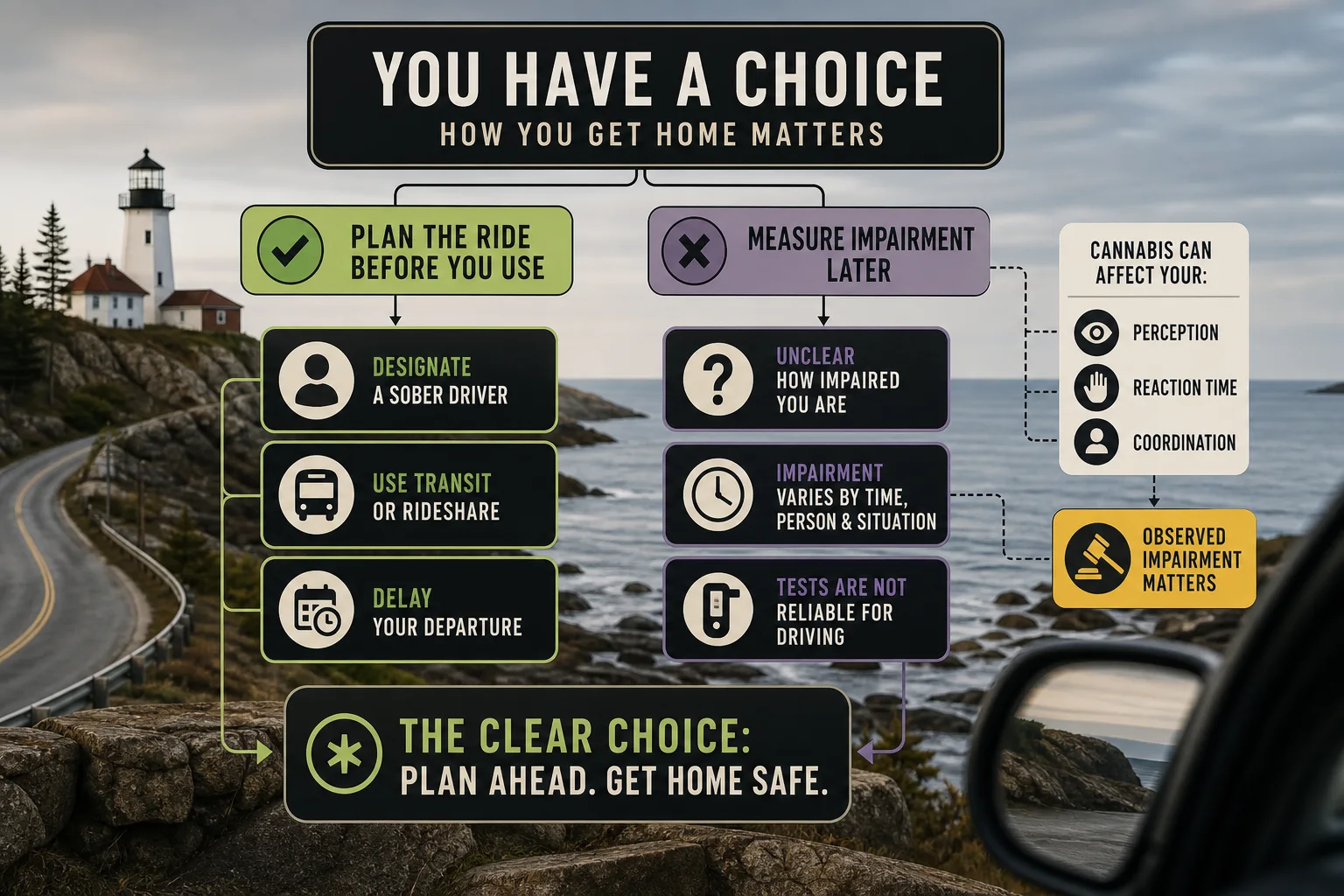
Hero illustration: a decision flow diagram that visualizes the core message — decide how you’ll travel before using cannabis. This graphic is instructional, not diagnostic: it summarizes public‑health guidance and the legal emphasis on observed impairment rather than a single laboratory number. Source informs the diagram’s framing but not individual legal or medical advice. Source URLs: https://www.cdc.gov/cannabis/health-effects/driving.html
Why deciding before you ride is a clearer safety approach
Driving requires fast, coordinated performance across perception, attention, decision‑making, and motor control. Acute cannabis exposure can alter one or more of those systems, and a body of research links recent cannabis use with higher crash risk in many settings. The Centers for Disease Control and Prevention advises that people who plan to drive avoid cannabis before driving, and that those who use should make pre‑trip arrangements that do not rely on later self‑assessment. (cdc.gov)
Framed as risk management, the choice is simple: (A) arrange travel in advance (a sober driver, public transit, rideshare, or delayed departure), or (B) rely on a post‑use self‑check to judge fitness to operate a vehicle. Option A reduces uncertainty by substituting a predictable logistics decision for an uncertain medical and cognitive judgment. The direct costs of planning (time, a rideshare, arranging a driver) are typically limited when compared with the potential consequences of a crash, arrest, or injury.
Maine statutes and official guidance emphasize observed impairment and how it affects vehicle control, rather than measurement of a single blood concentration alone. That legal framing shifts attention to behavior and functional performance as the focal point for enforcement and public‑safety messaging. (maine.gov)
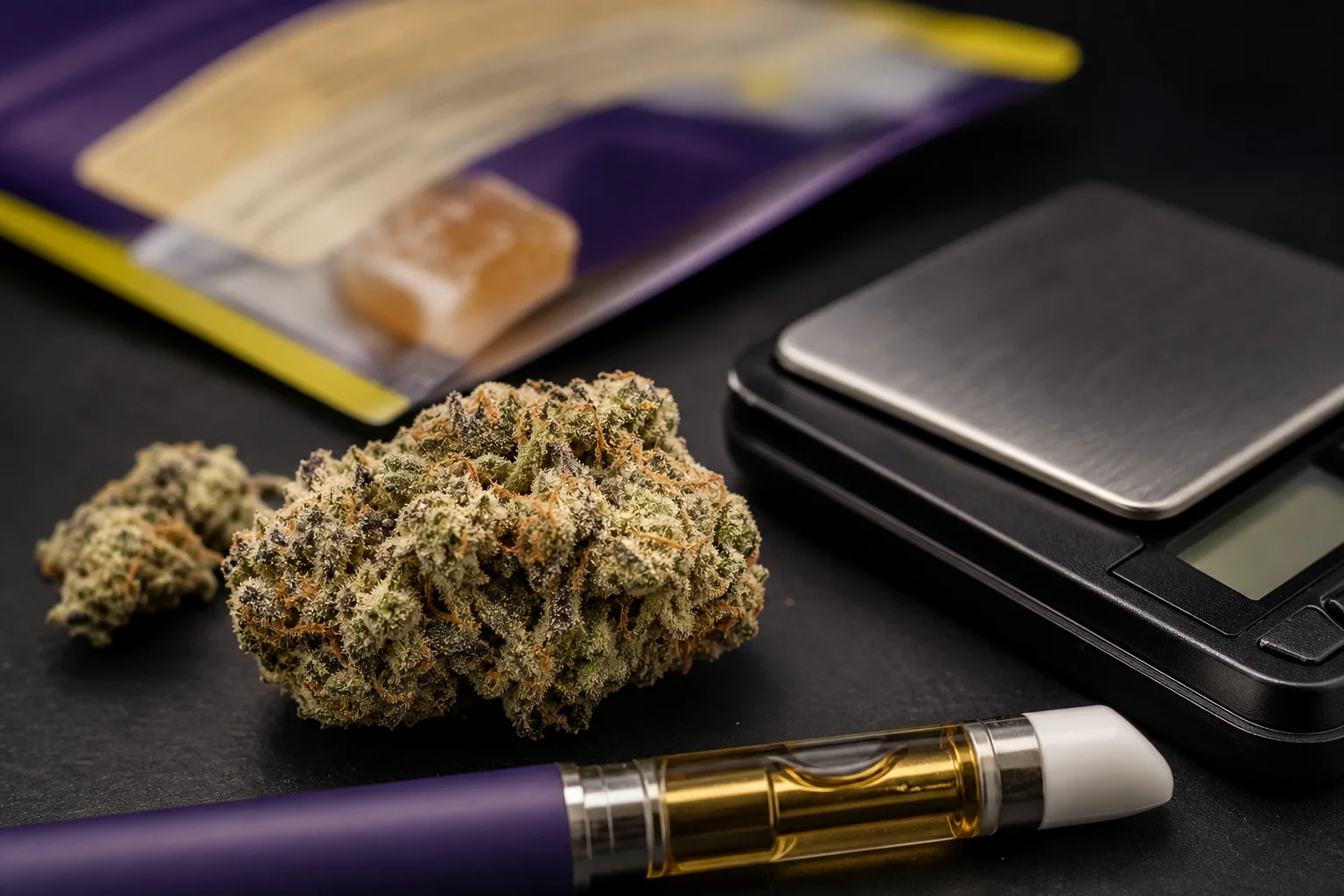
Product variability visual: macro photography that juxtaposes flower, a measured concentrate device, and an edible package to teach how route and product change onset and duration. This image supports the section on product variability and does not imply dosage recommendations. Source URLs: https://pubmed.ncbi.nlm.nih.gov/33497784/
Research context: Determining the magnitude and duration of acute Δ9‑THC‑induced driving and cognitive impairment: A systematic and meta‑analytic reviewHow cannabis can change the abilities you need for safe driving
Cannabis influences perception, attention, psychomotor control, and decision‑making. Both experimental and observational studies report measurable changes after recent exposure: slower reaction times, greater lateral lane variability, and reduced divided attention. Those performance differences translate into real‑world implications for traffic safety because the laboratory or simulator tasks map onto everyday driving demands. Meta‑analytic syntheses identify changes in driving‑relevant skills following inhaled or oral THC, though the size and timecourse of effects vary with dose, route, and user history. (pubmed.ncbi.nlm.nih.gov)
In practical settings some drivers adopt compensations such as slowing down, but many epidemiologic studies still show a net increase in crash risk associated with recent cannabis use. Impairment can be subtle at first — a delayed swerve, a missed visual cue — and those small errors can escalate into more serious events when traffic, weather, or other unpredictable road users intervene. (cdc.gov)
Researchers also note important uncertainties: how long impairment lasts for various product types, how tolerance in frequent users affects on‑road risk, and which specific cognitive deficits most directly cause crashes. Those gaps make simple, pre‑trip planning a useful fallback: a decision about travel before using sidesteps many of the unanswered questions about current impairment. (pubmed.ncbi.nlm.nih.gov)
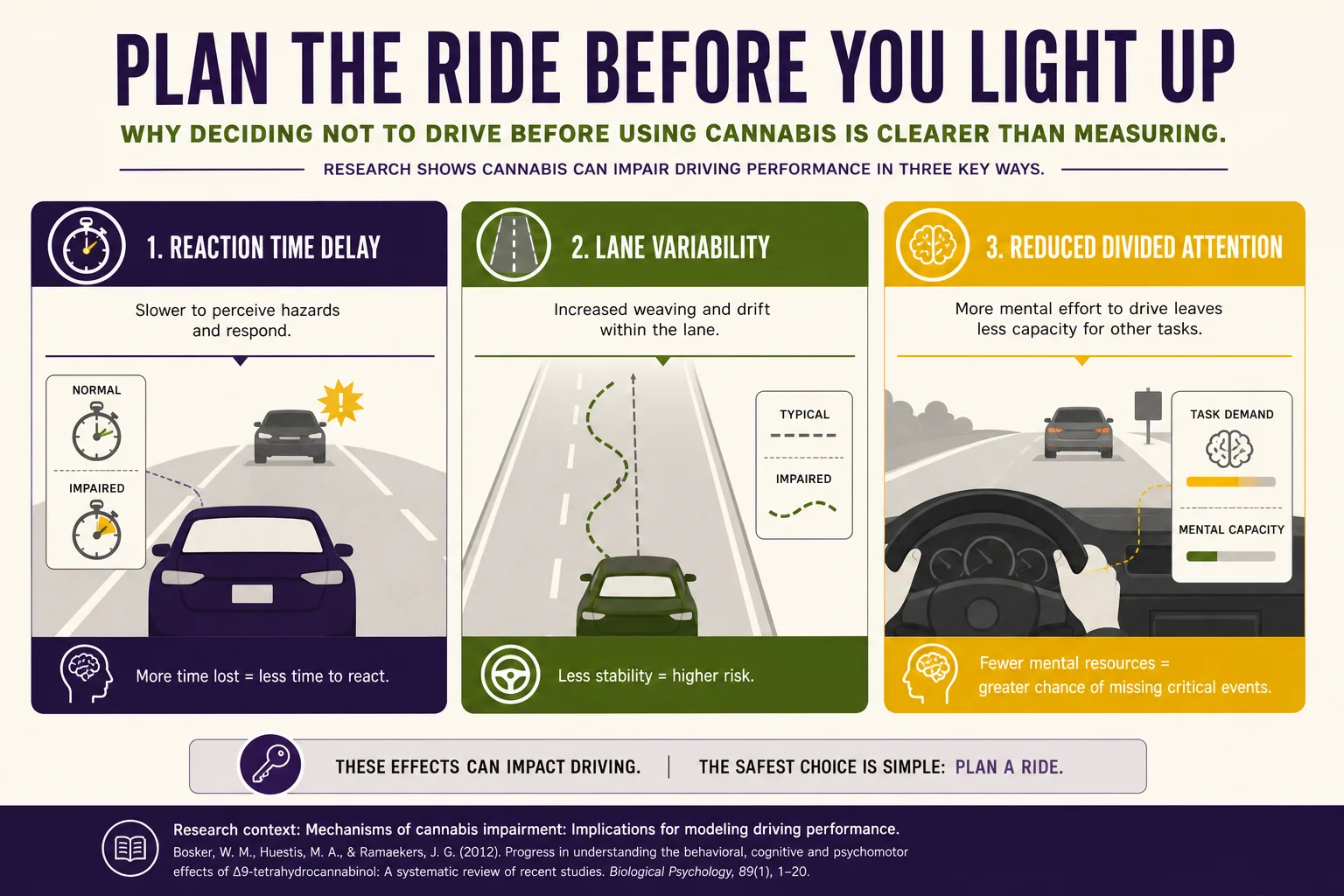
Mechanisms infographic: evidence‑based diagram linking cognitive domains (reaction time, visual attention, coordination) to everyday driving tasks. It summarizes laboratory and simulator findings without asserting precise individual outcomes. Source URLs: https://pubmed.ncbi.nlm.nih.gov/34634690/
Research context: Mechanisms of cannabis impairment: Implications for modeling driving performanceWhy trying to measure impairment after the fact is unreliable
Many people assume they can assess fitness to drive after using cannabis — by waiting a set number of hours, checking subjective feelings, or relying on a saliva or blood number. Current evidence shows these approaches have significant limitations.
Subjective feeling is an unreliable indicator. Individuals frequently misjudge their own impairment, sometimes feeling calmer while objective measures of reaction time or attention are still degraded. Laboratory work demonstrates weak correlations between self‑rated sobriety and objective performance; self‑assessment can therefore misclassify impairment in situations where accuracy is most important. (pubmed.ncbi.nlm.nih.gov)
Biological tests are also imperfect for now. THC and some metabolites may be detectable in blood, saliva, or urine long after acute effects have subsided in some users, and a low measured concentration does not reliably guarantee unimpaired performance for another individual. Unlike alcohol, where validated blood alcohol concentration (BAC) thresholds have well‑established relationships with crash risk at the population level, no single THC concentration has uniformly predictable implications for individual driving ability across varied users and contexts. That mismatch is why many public‑health messages focus on observable behavior and pre‑trip planning instead of a simple numerical cutoff. (cdc.gov)
Variability is the rule: product, route, dose, and the person
Modern cannabis products vary widely: flower, concentrates, edibles, tinctures, and topicals differ in absorption, onset, and duration. Inhaled THC typically leads to a quicker rise in blood concentration and often a shorter window of peak effect, whereas oral THC (edibles) shows delayed onset and a longer, less predictable duration. This diversity makes any single “wait X hours” guideline approximate at best. (pubmed.ncbi.nlm.nih.gov)
Individual characteristics matter as much as product differences. Frequent use and resulting tolerance are associated with smaller acute changes on some laboratory measures, yet tolerance does not imply absence of impairment across all driving‑relevant skills. Age, body composition, co‑existing health conditions, recent food intake, and other factors influence how strongly and how long THC affects a specific person. Meta‑analyses reflect heterogeneity tied to user history and route of administration. (pubmed.ncbi.nlm.nih.gov)
Because of this variability, it is difficult to convert a puff, a gummy, or a measured milligram into a reliable prediction of driving performance without many additional personal data points. In practice, a simple planning approach — making travel arrangements before using — avoids much of this complexity.
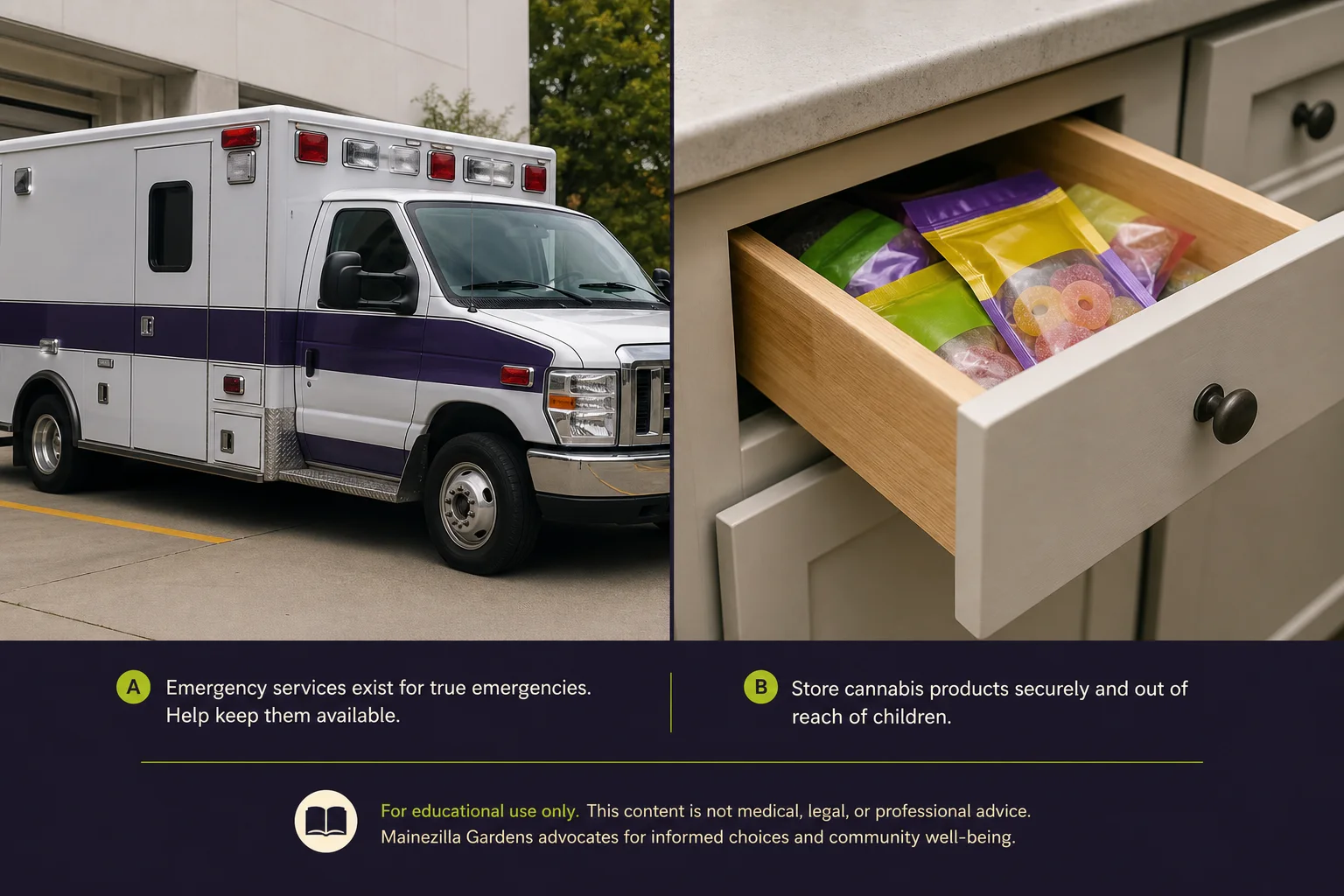
Edible safety photographic brief: juxtaposes emergency response imagery with a realistic household risk scenario to teach why storage and planning matter. This photograph supports the discussion about pediatric exposures and emergency responses; it does not include clinical data or imply causation for any single event. Source URLs: https://www.poison.org/articles/my-child-ate-a-cannabis-edible
Research context: My child ate a cannabis edibleWhen substances mix: amplification of impairment
Road‑safety research consistently shows that combining substances tends to amplify performance decrements. Alcohol plus cannabis, in simulator studies and some observational work, is associated with larger impairments than either substance alone. Some analyses link combined use to elevated crash risk compared with single‑substance use; the interaction is not simply additive, because alcohol appears to influence how cannabis affects motor control and judgment. (pubmed.ncbi.nlm.nih.gov)
From an event‑planning perspective, this matters: social situations often include alcohol, prescription sedatives, or over‑the‑counter medicines that can interact. When multiple substances are likely present, arranging travel in advance becomes more important for maintaining predictable control over a vehicle.
Poison‑center and clinical reports also highlight the special risks posed by edibles, including unexpected strong effects that can make decision‑making and reaction slower than anticipated. Separating consumption plans from driving plans reduces the chance that immediate, compound effects lead to poor operational choices. (poison.org)
Maine’s rules, medical program participants, and how legal frameworks shape choices
Maine’s Office of Cannabis Policy (OCP) provides consumer education that outlines legal boundaries and safer‑use information for both medical program participants and adult‑use consumers. State guidance clarifies that operating a vehicle while impaired by cannabis may result in enforcement under operating‑under‑the‑influence statutes; medical program participation does not create an exemption from laws targeting impaired operation. This is a relevant point for medical program participants who use cannabis for symptom management but also have to consider safe travel arrangements if their product affects driving. (maine.gov)
Maine statutes addressing operation while impaired apply across types of vehicles (motor vehicles, watercraft, and snowmobiles) and focus on whether a person’s control of a vehicle is impaired in practice. That legal standard means observed unsafe operation can form the basis for enforcement even without a specific measured THC threshold. The emphasis in law is therefore on observed function and public safety more than on a single lab value or on post‑use self‑assessment. (legislature.maine.gov)
Medical program participants commonly coordinate with their health care providers about timing and functional goals as part of managing daily activities that include driving. Official state education stresses planning travel arrangements and being mindful of how specific products and timing may interact with responsibilities that include vehicle operation. (maine.gov)
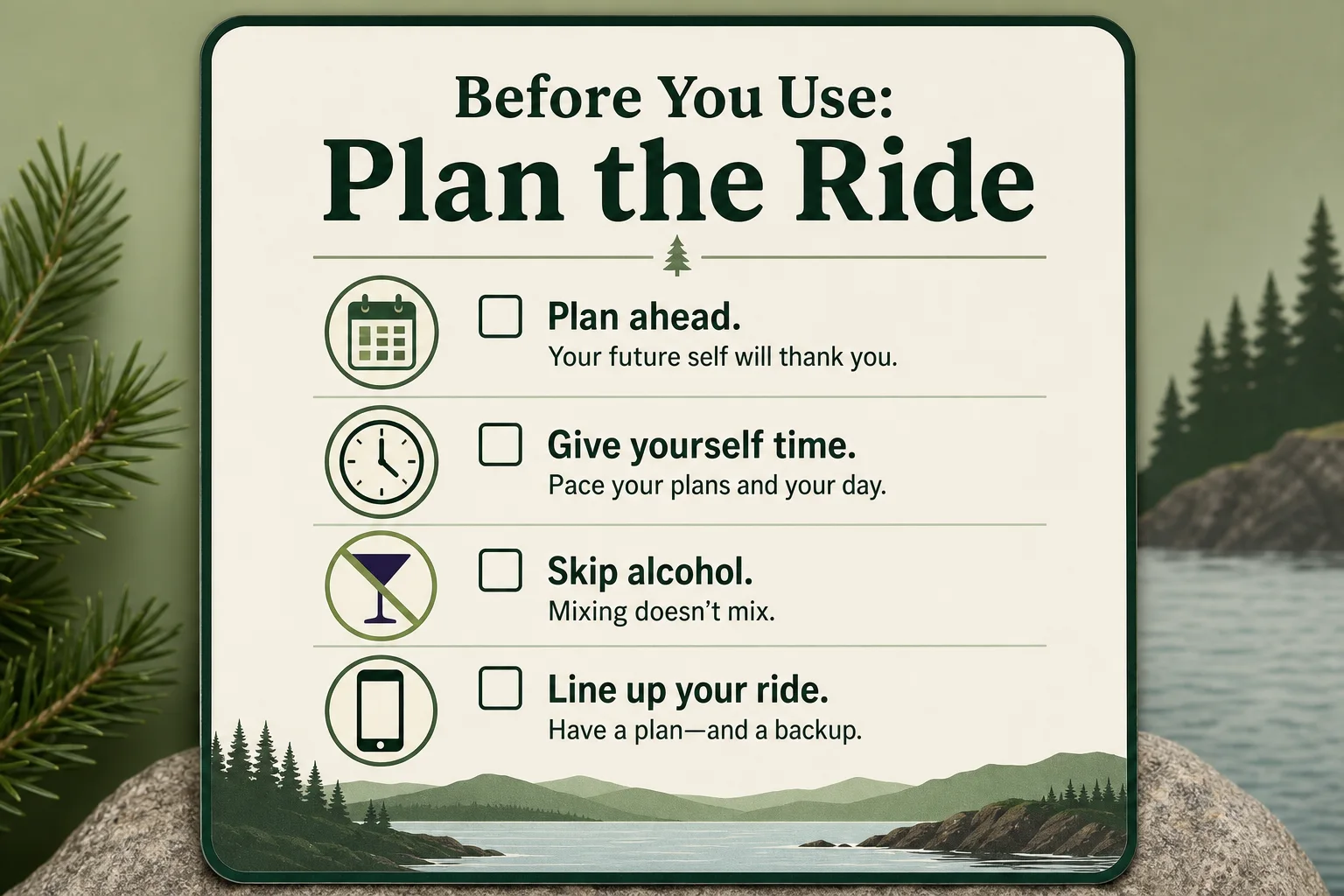
Practical checklist visual: a pocket‑card design showing the four‑item planning checklist (decide before use, match product to plans, avoid mixing, build backups). This artifact is a teaching tool based on CDC and Maine OCP guidance; it is not an official state card and contains no legal text or exact statutory language. Source URLs: https://www.maine.gov/dafs/ocp/sites/maine.gov.dafs.ocp/files/2023-08/Maine%20Cannabis%20101.pdf
Research context:Practical planning: a short checklist framed as options and habits
-
Decide before you use. Consider making a travel plan that assumes you will not drive during the product’s expected window of effect. Habitual checks — for example, confirming how you will get home before opening a package — align with CDC and Maine OCP guidance around harm‑reduction planning. (cdc.gov)
-
Match product and timing to plans. Think about onset and duration when product choice and timing intersect with driving needs. Inhalation tends to act faster and often has a shorter peak window for many users; oral dosing has slower onset and a longer, less predictable duration. When a day requires prolonged alert driving, these pharmacokinetic differences can inform which options to consider relative to travel arrangements. (pubmed.ncbi.nlm.nih.gov)
-
Limit mixing. If you plan to drive later, be aware that combining alcohol, sedatives, or other impairing substances with cannabis changes the impairment profile. Traffic‑safety research links combined use to greater decrements in performance and higher crash risk in multiple studies. When multiple substances are expected, advance travel arrangements help manage the compounded uncertainty. (pubmed.ncbi.nlm.nih.gov)
-
Build simple backups. Examples include budgeting for a rideshare, exchanging contact information with a designated sober companion, or postponing departure. Small logistic steps can make non‑driving the default choice. Caregivers and program participants often store products in secure locations and use child‑resistant packaging to limit accidental pediatric exposures; poison‑control data frequently cite edibles in pediatric exposures and related hospital visits. (poison.org)
Limits of the evidence and why a conservative, pre‑trip decision is commonly recommended
Cannabis‑and‑driving science has advanced, but important constraints remain. Compared with alcohol, the association between a single THC concentration (in blood or saliva) and impairment is weaker and more variable across individuals. Observational crash studies show associations but cannot always disentangle exact timing, dosage, or causal sequences; laboratory studies illuminate mechanisms but differ in participant selection, dosing, and tasks. Meta‑analyses synthesize this complexity and repeatedly find increased risk in many contexts, while also documenting heterogeneity across study designs and populations. (pubmed.ncbi.nlm.nih.gov)
Those scientific limits support bright‑line, simple choices for non‑specialist decision makers. A pre‑trip decision about travel converts a nuanced, uncertain judgment about current impairment into a straightforward logistics choice: who will provide transportation, which mode will be used, or whether departure will be delayed. Clarity reduces cognitive burden in real‑world situations that may include fatigue, mixed substances, and unexpected events.
Public‑health guidance from agencies such as the CDC and Maine OCP converge on recommending pre‑trip planning and avoiding use before driving as practical ways to align legal obligations, reduce reliance on subjective self‑checks, and lower exposure to layered risks on the road. (cdc.gov)
Key takeaways
- A clear safety approach is deciding not to drive before using cannabis and arranging travel in advance. (cdc.gov)
- Subjective feeling and single THC tests are unreliable measures of individual driving impairment. (pubmed.ncbi.nlm.nih.gov)
- Edibles and combined substance use increase unpredictability of effects and are associated with higher risk of impaired driving; extra planning can reduce that uncertainty. (poison.org)
- Maine law focuses on observed impairment in actual control of a vehicle; medical program participation does not exempt individuals from operating‑under‑the‑influence statutes. (maine.gov)
- Practical steps include deciding travel arrangements before use, considering product timing relative to driving needs, limiting mixing of substances, and arranging simple backup transport options.
Frequently asked questions
Q: Can a blood or saliva THC number tell me if I’m safe to drive?
A: Not reliably. Unlike alcohol, THC concentrations do not have a uniform relationship with driving impairment for every person. Measured levels can reflect recent use, prior use, or long‑term metabolite presence and do not consistently predict current functional ability to operate a vehicle. Functional assessment and advance travel planning are generally more useful than relying on a single lab value. (pubmed.ncbi.nlm.nih.gov)
Q: If I’m a medical program participant, does a recommendation allow me to drive after using cannabis?
A: No — medical program participation or a clinical recommendation does not create a legal exemption from operating‑under‑the‑influence laws. Medical program participants remain subject to the same legal standards about observed impairment; many participants discuss timing and functional goals with their providers when driving is part of daily responsibilities. (maine.gov)
Q: How long should I wait after using an edible before driving?
A: There is no universally reliable single waiting time because edibles have delayed onset and a longer, less predictable duration than inhalation. The practical alternative is to plan travel arrangements before consuming edibles, or to have a conservative, pre‑arranged transportation plan that does not rely on subjective feelings of recovery. (pubmed.ncbi.nlm.nih.gov)
Q: What if I feel fine — is driving okay?
A: Feeling fine does not necessarily indicate unimpaired reaction time, attention, or coordination. Subjective self‑assessment is often inaccurate; advance travel arrangements reduce reliance on how a person feels at a single moment. (pubmed.ncbi.nlm.nih.gov)
Q: Are there reliable devices to test impairment in the field?
A: At present, there is no widely validated, universally accepted roadside device that identifies cannabis‑related impairment in individuals with the same population‑level calibration as alcohol breathalyzers. Research is active in this area; until robust, legally accepted tools are in place, pre‑trip planning and attention to behavior remain practical options. (pubmed.ncbi.nlm.nih.gov)
Q: What about accidental pediatric exposures from edibles — how does that factor into planning?
A: Safe storage and awareness of packaging are important considerations. Poison‑control centers report that children are frequently affected by edibles; caregivers commonly store products out of reach and in child‑resistant packaging, and contact Poison Control immediately if ingestion is suspected. ()
Questions this guide answers
Can a blood THC number tell me if I’m safe to drive?
No. Blood or saliva THC levels don’t consistently correlate with impairment for individuals the way blood alcohol does; planning and functional caution are more reliable than a single lab value.
Does medical cannabis allow me to drive if I feel fine?
No. Medical authorization does not excuse operation while impaired; Maine law focuses on actual impairment and public safety, so patients should plan transportation accordingly.
How long after edibles is it safe to drive?
There’s no universal single waiting time. Edibles have delayed onset and longer, variable durations; the safest approach is to plan not to drive after consuming edibles or to arrange sober transportation.
Are there reliable roadside tests for cannabis impairment?
Not yet. Research is ongoing, and no widely validated device matches alcohol breathalyzers for predicting individual impairment; conservative planning remains the practical strategy.
What should caregivers do to prevent accidental edible ingestion by children?
Store products locked and out of sight, keep them in child‑resistant packaging, avoid packaging that mimics common snacks, and call Poison Control immediately if ingestion is suspected.
Educational information only. Cannabis affects people differently and this is not medical advice.