
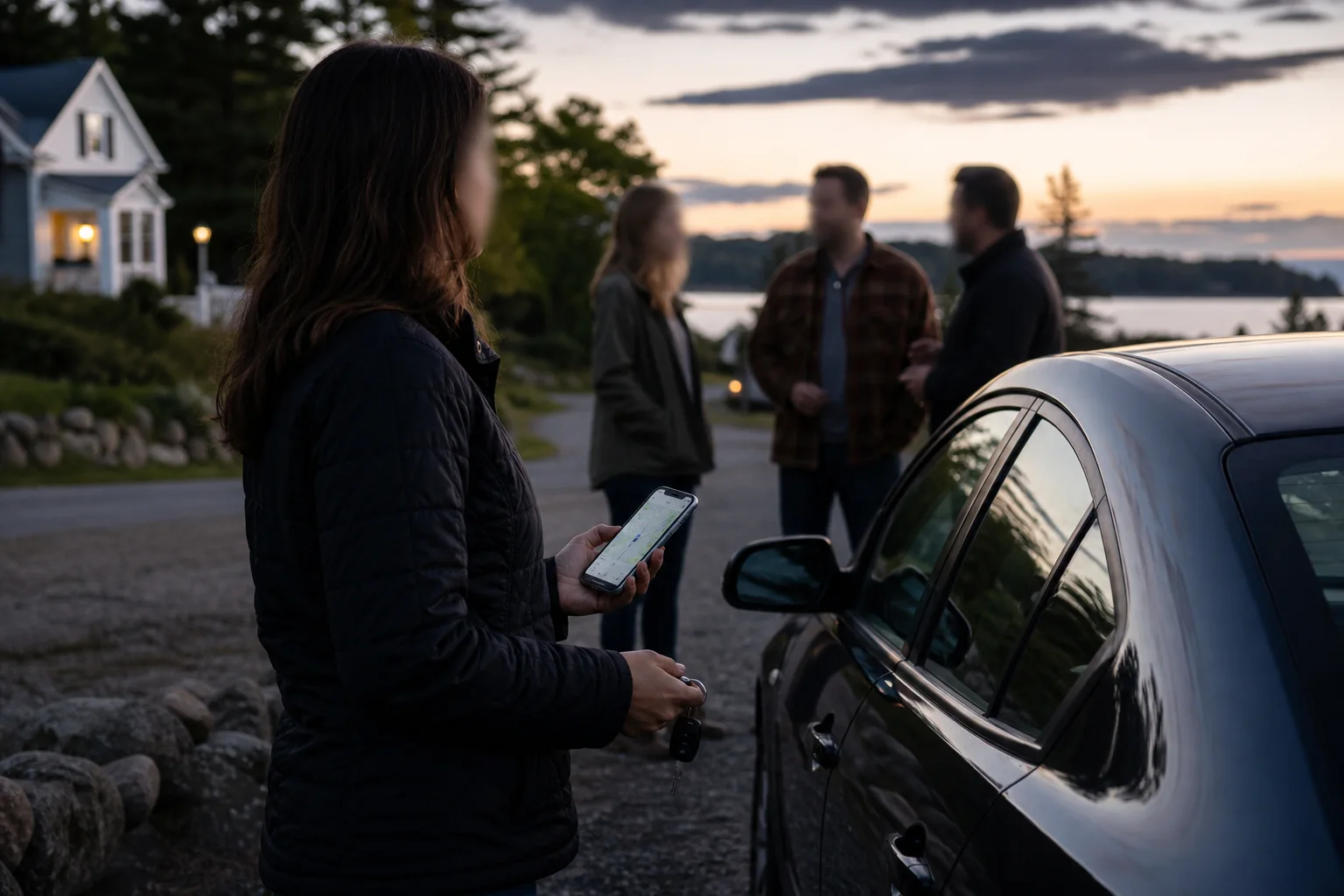
Hero documentary photo illustrating the central behavior promoted in this article: preplanning a sober ride. The image shows a real‑world, low‑tech harm‑reduction choice and is paired with Maine‑focused guidance; it does not imply clinical outcomes or legal status. Source documents emphasize choosing not to drive after cannabis use. Limit: photo is illustrative of social practice, not scientific measurement.
Introduction: the simple, practical safety case
If you’re going to use cannabis and you might need to travel later, decide on a no‑drive plan before you consume. It sounds obvious, but the habit of “I’ll figure it out later” is common — and risky. Planning a ride or designating a sober driver before consumption removes subjective judgment at the moment when coordination, attention, and reaction time may already be affected.
Public health agencies and driving researchers emphasize that cannabis can impair skills needed for safe driving — reaction time, coordination, judgment, and perception — and many agencies recommend avoiding intoxicating substances before driving. That clear prevention stance is the practical baseline for safety planning. (cdc.gov)
There are three practical reasons to plan a ride before using: impairment varies widely between people and products; other substances (including alcohol and some medicines) can multiply impairment; and both physiologic tests (blood/oral fluid) and personal confidence are poor substitutes for a precommitted safety plan. This article walks through the evidence and the practical choices a responsible adult in Maine can make.
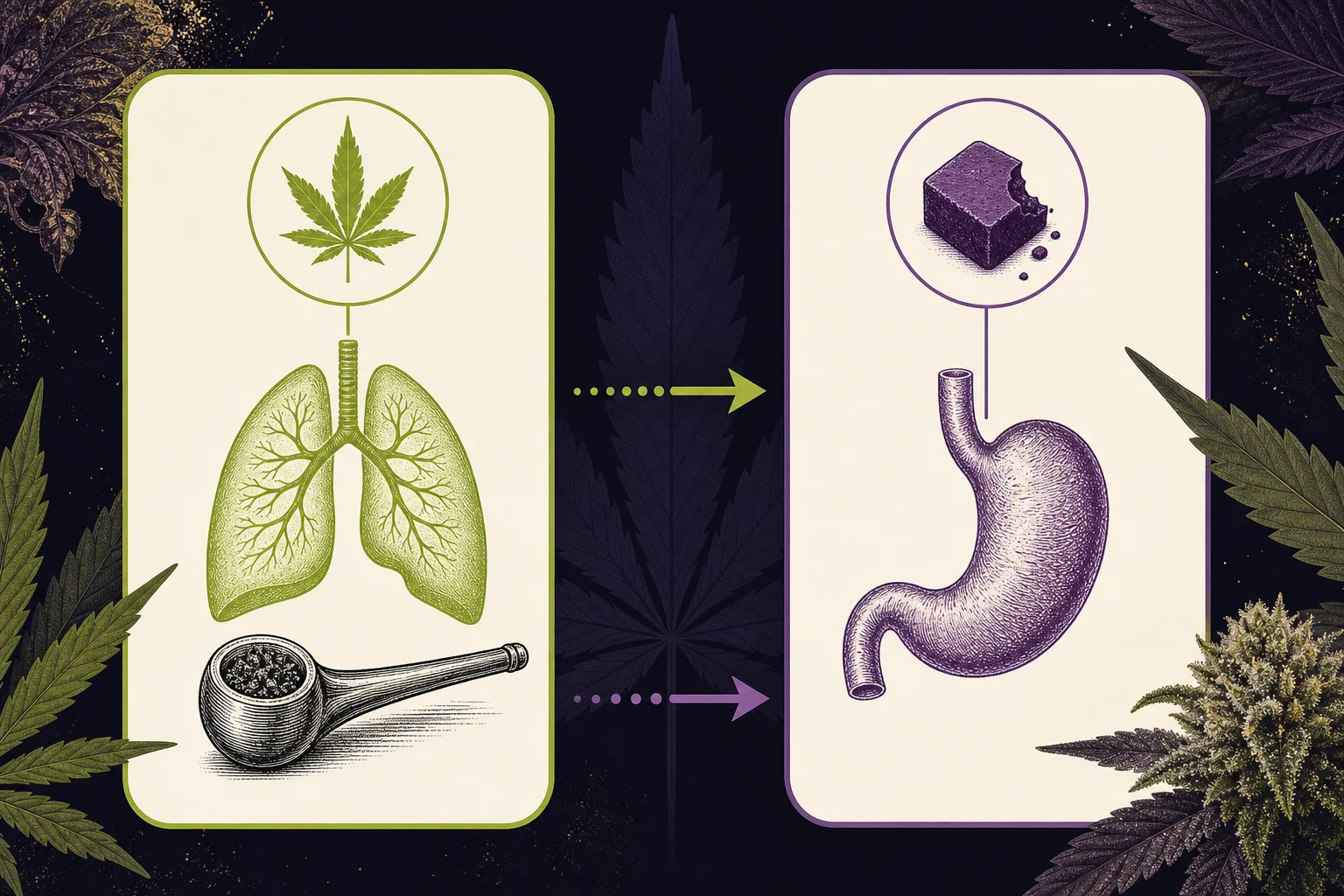
Explanatory illustration comparing inhalation versus oral routes: typical onset and variability are shown conceptually (no numeric values). This visual supports the section on variability by highlighting why timing is unpredictable between product types. Limit: conceptual only—no readable numbers or guarantees about specific wait times.
Research context: Recent Advances in the Science of Cannabis-Impaired Driving (review)The no‑drive decision: a safety habit, not a moral lecture
A “no‑drive” decision is a simple boundary: if I’m going to use cannabis tonight, I will not plan to drive until I am confident I’m no longer impaired — and I will arrange an alternative before using. For most people the decision means choosing one of a few predictable options: a sober designated driver, a rideshare or taxi, public transit where available, or overnighting where you are.
Making the choice before use removes the need for real‑time impairment judgment. By the time you’re under the influence, your perception of your own impairment can be altered; the choice is easier and safer when made while sober. The Centers for Disease Control and Prevention (CDC) explicitly recommends choosing not to drive after cannabis use and planning alternate travel in advance. (cdc.gov)
A no‑drive routine also creates social norms. If you and your friends agree ahead of time to designate one person as the sober driver or to pool funds for a rideshare, decision fatigue and peer pressure are less likely to tip you into a risky choice later. This is the pragmatic side of harm reduction: make the safer choice simple and frictionless.
Why impairment is variable: dose, mode, tolerance, and person
Cannabis is not a single, consistent exposure. The effects of a single session depend on the product (flower, concentrate, edible), the dose of delta‑9‑THC, route of administration (inhaled vs oral), and the timing since use. A fast inhalation may produce a rapid peak and shorter window in many users; an edible has a delayed onset with a longer, less predictable window. Experimental reviews show that both magnitude and duration of impairment vary substantially by these factors. (pmc.ncbi.nlm.nih.gov)
Individual factors matter too. Regular users may show different acute impairment patterns than occasional users; age, body composition, and prior cannabis exposure shape the response. A meta‑analysis found that regular cannabis users sometimes show smaller experimental impairment effects than occasional users, but that impairment still occurs across user types and across different driving‑related skills. That variability makes a single universal “wait X hours” rule unreliable for everyone. (pubmed.ncbi.nlm.nih.gov)
That unpredictability is exactly why preplanning is smarter than retrospective measurement. If you wait until you think you have “sobered up” to test yourself with a quick drive, you’re gambling on multiple uncertain factors at once. Remove the gamble by arranging a sober option in advance.
Laboratory documentary image showing the kinds of settings where THC presence is measured. This supports the section on testing limits: it demonstrates analytic work without suggesting that test presence equals impairment for an individual. Limit: labels are intentionally blurred and no test results or numeric readouts are visible.
Research context: Determining the magnitude and duration of acute Δ9-THC-induced driving and cognitive impairment: A systematic and meta-analytic reviewCombined substances: the risks multiply, never simply add
Using cannabis together with alcohol or sedating prescription medications is common, and it’s important to understand interaction effects. Studies consistently show that combining alcohol and cannabis produces greater impairment than either alone — for many measures of driving performance the combination appears multiplicative rather than merely additive. This means that small amounts of alcohol that might be near social thresholds can produce notably larger impairment when combined with THC. (pmc.ncbi.nlm.nih.gov)
Medical and OTC medications matter as well. Certain sleep aids, opioids, benzodiazepines, and even some antihistamines can increase drowsiness or affect coordination. If you’re using cannabis along with these agents, the period before driving during which impairment may be a concern can be much longer and less predictable — again arguing for preplanned no‑drive choices rather than ad‑hoc tests or relying on how you feel in the moment. Public health guidance warns explicitly about the increased danger of mixing substances for driving tasks. (cdc.gov)
Practically: if a social night includes alcohol or you’re taking a drug that causes drowsiness, consider the whole evening as a no‑drive event and plan accordingly. Avoid relying on “I’ll wait an hour” logic — interactions and individual metabolism complicate that simple math.
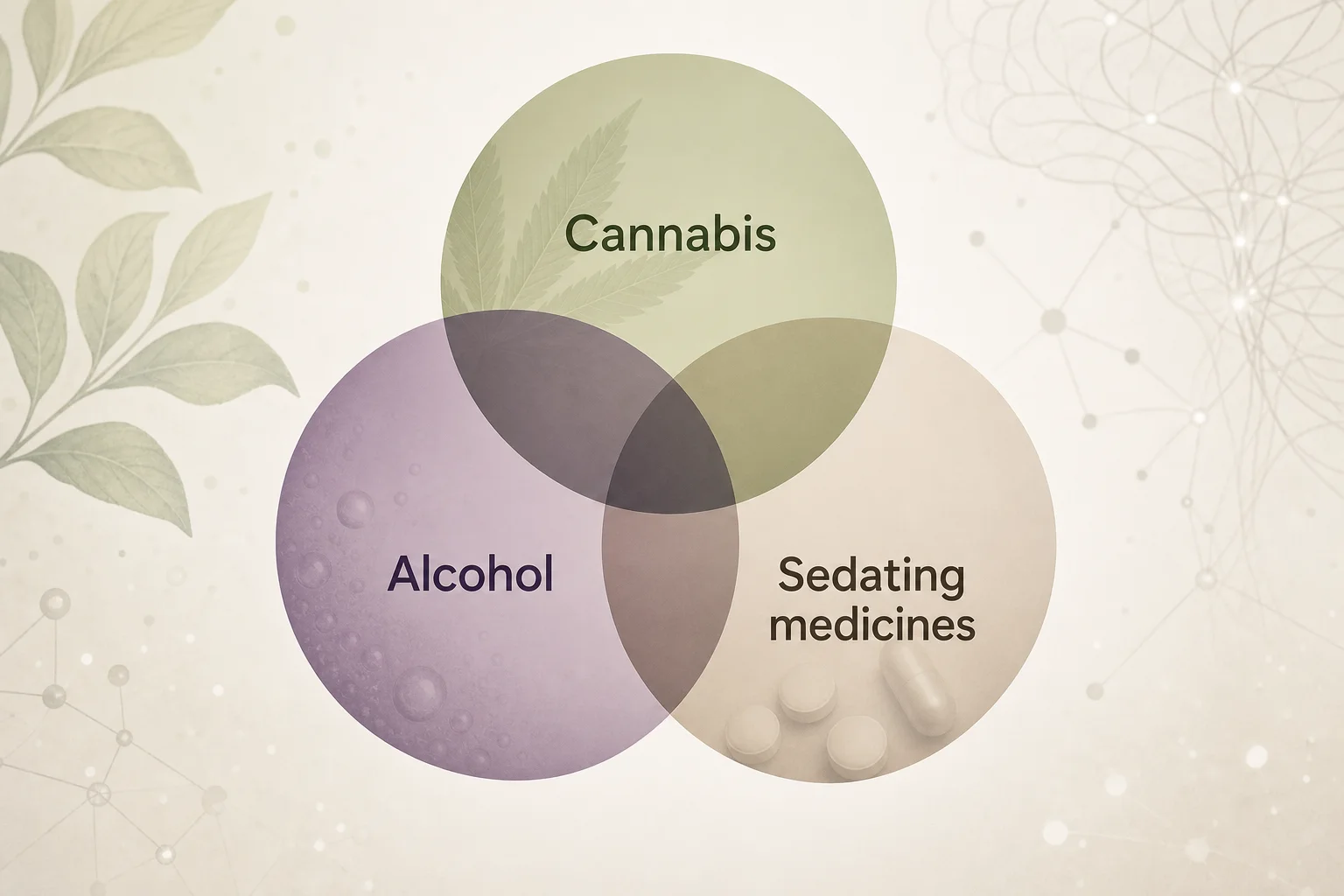
A careful evidence diagram (no numeric labels) that visually communicates how combined substances can overlap to increase driving impairment risk. This supports the article’s discussion of interaction effects and is deliberately conceptual—no exact risk values are represented. Limit: avoid causal arrows that claim specific multipliers or percentages.
Research context: Recent Advances in the Science of Cannabis-Impaired Driving (review) · Cannabis and DrivingThe limits of tests and of personal confidence
Many people reach for probing their own level of impairment: walk in a straight line, do a phone app test, or rely on roadside THC testing. Two realities undermine that approach. First, subjective confidence is a poor indicator: people often overestimate or underestimate their impairment, and cannabis can alter perception of risk and performance. Second, available biological tests do not reliably indicate impairment at the individual level.
Blood or oral‑fluid assays can detect recent cannabis exposure or THC presence, but THC concentration does not map cleanly to impairment like blood alcohol concentration does for alcohol. The CDC and reviews of the literature both note the difficulty of connecting THC levels to an individual’s driving ability. Laboratory and epidemiological research shows a correlation between recent use and crash risk at population levels, but not a precise per‑person impairment threshold that could be used to say “you are safe now.” (cdc.gov)
Law enforcement tools and workplace drug tests are designed to detect exposure and may have legal or employment consequences, but they are not a reliable personal safety gauge. That’s why public‑health messaging often stays behaviorally simple: if you plan to drive, avoid using beforehand; and if you used, do not assume a negative test or your subjective sense of sobriety is proof of fitness to drive. Plan the ride first.
Practical planning tools: steps to make a no‑drive choice work
Translate the principle into practice with a short checklist that fits most social situations: (1) decide in advance whether you’ll use and whether you will drive, (2) if you’ll use, choose at least one alternative (designated sober person, rideshare, transit, stay overnight), (3) share the plan with those you’re with so it’s socially supported.
Small investments reduce risk. Pooling funds for a rideshare, saving a local taxi number in your phone, or identifying a friend who will stay sober are low‑effort moves that pay off. If you’re using cannabis at home and might need to drive later, set a concrete plan (sleep on it, have a sober driver lined up, or schedule a pickup at a known time). The goal is to make the safer choice more convenient than the risky one.
If you’re in Maine and rely on medical cannabis for symptom management, it can help to discuss timing with your clinician and think about transportation around expected medication schedules. For adult‑use consumers, packaging guidance and state consumer resources are available; many sources advise starting low with an unfamiliar product and arranging transportation before use. Maine’s Office of Cannabis Policy offers consumer education that emphasizes lawful use boundaries and safety planning. (maine.gov)
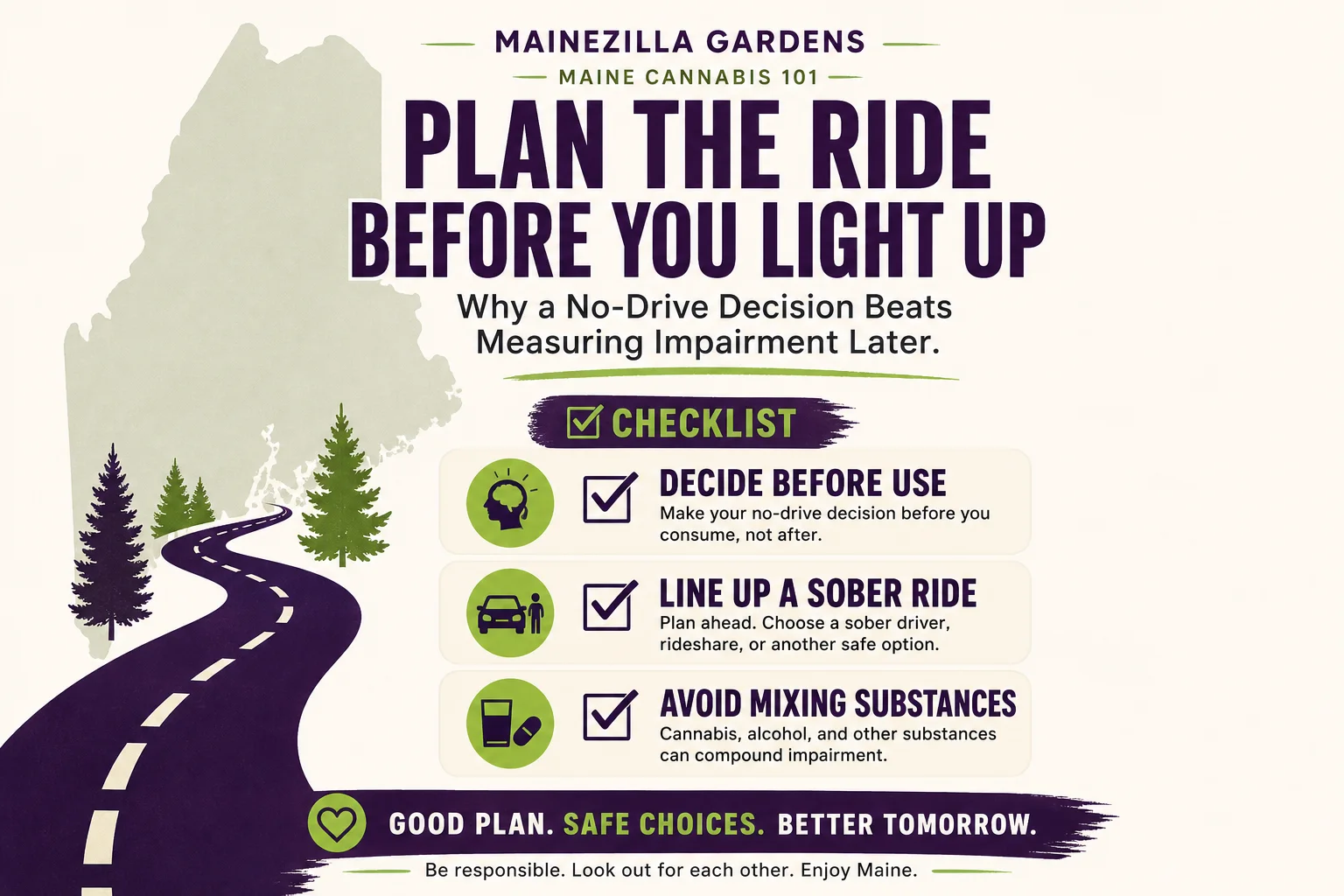
A mockup-style image of a consumer checklist based on Maine OCP guidance, meant to teach practical preplanning steps (e.g., set a sober driver, arrange rides). This connects the advice to state consumer education while remaining illustrative. Limit: the image is a design mockup for education; it does not cite legal text or display official logos.
Research context: Maine Cannabis 101Laws, evidence, and Maine specifics: what to know legally and practically
From a legal perspective, driving under the influence of drugs, including cannabis, is illegal and treated in many places with enforcement and penalties similar to alcohol‑impaired driving. In Maine, statutes outline how alcohol levels and confirmed positive drug tests may be considered as evidence in impairment determinations; the presence of a drug or metabolite can be admitted as part of the evidentiary case rather than serving as a direct per‑se scientific measure of impairment. This legal nuance means that even if THC levels don’t map precisely to impairment scientifically, biological tests and circumstantial evidence can still influence criminal and civil outcomes. (legislature.maine.gov)
Maine operates both a Medical Use of Cannabis Program and an Adult Use Cannabis Program, with different regulatory rules and consumer education materials. Medical patients may have different consumption patterns and clinical guidance, but the core public‑safety message is consistent: plan non‑driving transportation when using cannabis. The Office of Cannabis Policy provides consumer‑facing guidance that adults should read and keep in mind. (maine.gov)
Finally, evidence limitations matter for policy and personal behavior. While epidemiology links recent cannabis use to elevated crash risk at the population level, laboratory driving‑simulator and on‑road research vary by design and can produce mixed estimates of magnitude and duration of impairment. That scientific uncertainty is not permission to gamble — it is a reason to adopt clear, simple personal rules that reduce risk even when the science does not give a single number to follow. (pmc.ncbi.nlm.nih.gov)
Bringing it home: habits that protect you and your community
Commit to a short, repeatable habit: when cannabis use is possible, decide in advance how you will get home. Keep a small set of practical tools handy — a rideshare app loaded with payment, a sober friend’s contact, or a go‑bag for overnight stays. Teach the habit to friends and family; social norms change faster when people plan together.
If you manage a social gathering or work in retail or caregiving, make preplanned transport normal. That extends the benefit beyond the individual — fewer impaired drivers on the road reduces risk for everyone.
In short: a more reliable approach is to avoid relying on retrospective measures of impairment and instead plan your ride ahead of time.
Key evidence limits and honest caveats
Research shows average effects of cannabis on driving‑related skills and increased crash risk at population levels, but it does not produce a single blood or saliva THC threshold that predicts impairment for every person at every time. Individual variability, different product formulations, and co‑use of other substances make precise prediction difficult. Where the science is incomplete, conservative personal rules and attention to legal guidance are prudent. (cdc.gov)
This article is educational and not legal or medical advice. If you need legal interpretation of Maine statutes or clinical guidance about using cannabis with medications, consult a qualified professional. The practical takeaways here — deciding on transportation in advance, avoiding mixing substances before driving, and considering roadside or biological tests primarily as legal evidence rather than as a personal safety checklist — align with public health guidance from the CDC and Maine OCP. (cdc.gov)
Questions this guide answers
If I ‘feel fine,’ is it OK to drive after using cannabis?
Subjective feeling is a poor indicator of driving fitness. Cannabis can alter judgment and perception; public health guidance recommends planning not to drive rather than relying on how you feel. ([cdc.gov](https://www.cdc.gov/cannabis/health-effects/driving.html))
Can a blood or saliva THC test tell me if I’m safe to drive?
No. Biological tests detect THC or metabolites but do not reliably map to impairment for an individual. They can be used in legal contexts but are not a personal safety pass. ([pmc.ncbi.nlm.nih.gov](https://pmc.ncbi.nlm.nih.gov/articles/PMC8106655/))
Does waiting a few hours after use make driving safe?
Because impairment duration depends on product, dose, and individual factors, a fixed time interval is unreliable. Planning a sober ride before use is the safer approach. ([pmc.ncbi.nlm.nih.gov](https://pmc.ncbi.nlm.nih.gov/articles/PMC12864297/))
How does Maine law treat cannabis and driving?
Maine law treats drug‑impaired driving seriously. Evidence like confirmed positive tests can be used in court, but statutes and rules focus on impairment, not just presence of a metabolite. Consult legal counsel for specifics. ([legislature.maine.gov](https://legislature.maine.gov/statutes/29-a/title29-Asec2432.html))
Are medical cannabis patients treated differently when it comes to driving?
Medical authorization doesn’t exempt someone from impaired driving laws. Patients should coordinate timing and transportation with their clinician and plan sober travel when using cannabis. ([maine.gov](https://www.maine.gov/dafs/ocp/sites/maine.gov.dafs.ocp/files/2023-08/Maine%20Cannabis%20101.pdf))
Educational information only. Cannabis affects people differently and this is not medical advice.