

Hero image: a documentary‑style composition showing a physical planning checklist, map, and keys. The photo is intended to teach the habit of precommitting to a sober ride. This image demonstrates the article’s central recommendation: decide not to drive before use. It is illustrative and does not show readable personal schedules, statistics, or logos.
Introduction
Driving is a complex, high‑stakes task. It demands rapid decision‑making, attention to changing conditions, coordination, and precise reaction times. Cannabis affects brain systems that support those skills, and while research shows an association between acute cannabis use and car crashes, it remains difficult—often impossible—to map a single lab test, product label, or feeling to whether a given person is safe to drive at a specific moment. A straightforward, practical approach for adults who plan to use cannabis and then travel by car is this: decide before you use. Choose not to drive, or arrange a sober ride. This article explains why that planning step is both evidence‑grounded and practical for Maine growers, registered patients, and adult consumers alike. (cdc.gov)
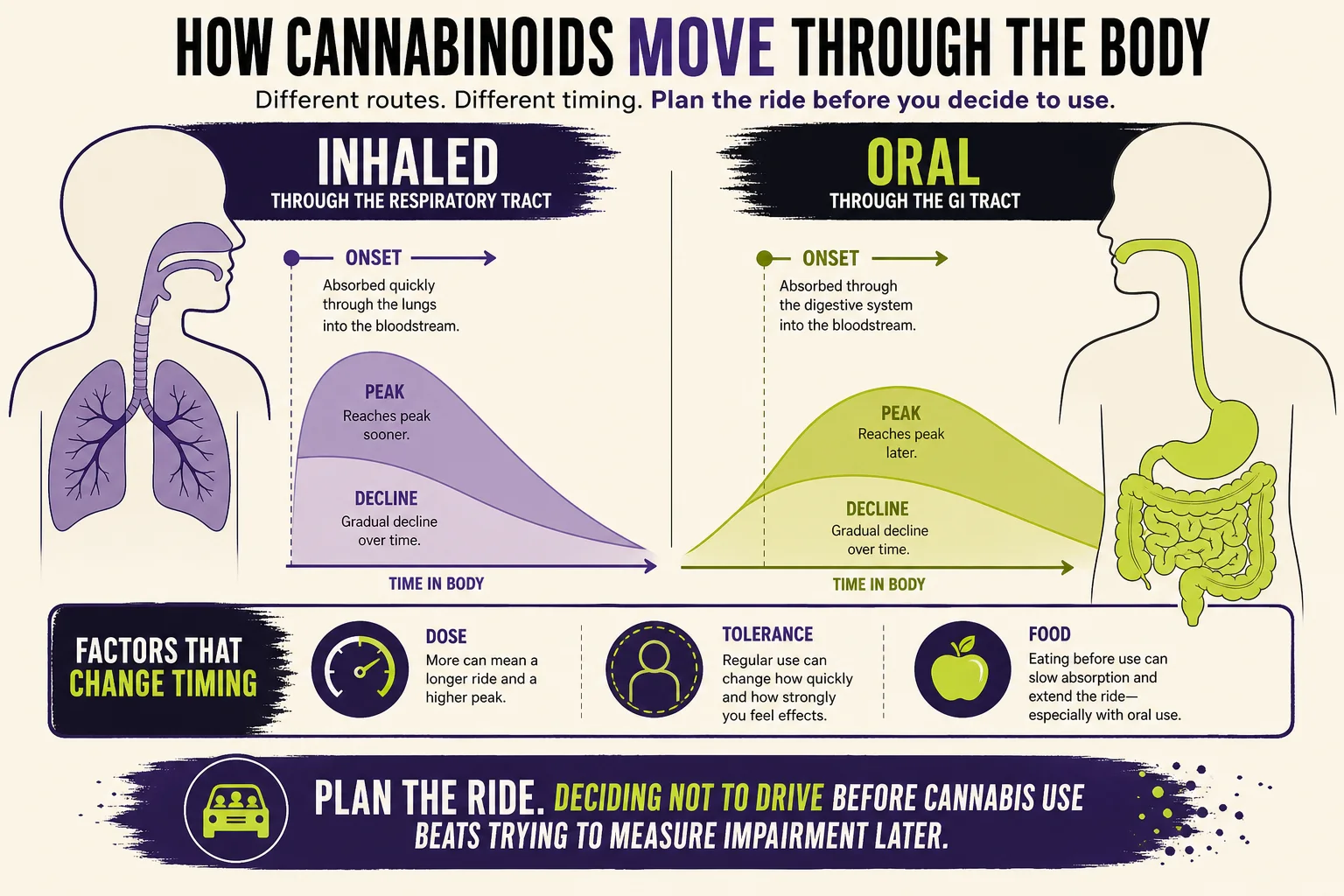
Illustration: diagram comparing inhaled versus oral (edible) routes, showing relative onset and duration bands to teach why timing windows differ. This is a conceptual schematic—not a graph of precise values—and is intended to demonstrate variability in onset and duration between product types. It does not display numeric concentrations or thresholds.
Research context: Cannabis and Driving · Office of Cannabis Policy Resource Library (includes Maine Cannabis 101)The no‑drive decision: why planning beats measuring after the fact
A no‑drive decision is a precommitted safety rule: you resolve, before consuming, that you will not operate a motor vehicle for a chosen window of time or until you have a sober ride. That approach is simpler and more protective than the common alternative—using cannabis and then attempting to judge your own fitness to drive. Self‑assessment after use invites bias, variable tolerance, and situational stress. Preplanning removes the momentary pressure to make a judgment while under the influence and replaces it with a behavioural default: don’t drive.
Two practical advantages stand out. First, planning removes the need for a post‑use test or sensation to be “the decider.” Tests and feelings are noisy; planning is decisive. Second, planning is flexible: you can build it into a social night out, a work schedule, a caregiving duty, or a medical use routine. The point is not moralizing consumption; it is risk management—minimizing the need to make a safety‑critical decision while judgment or coordination may be altered. The CDC’s public guidance is explicit: if you intend to drive, avoiding alcohol or drugs, including cannabis, is the approach recommended to reduce risk. (cdc.gov)
Biological variability and the limits of post‑use measurement
People vary widely in how they absorb, metabolize, and respond to cannabinoids. THC (Δ9‑tetrahydrocannabinol) is the primary psychoactive compound in many cannabis products, but blood or saliva THC concentrations do not map neatly to impairment the way blood alcohol concentration (BAC) does for alcohol. THC is lipophilic, distributes into body fat, and its metabolites can remain detectable long after peak impairment has passed. That means a positive test may reflect past use rather than current impairment, and low or zero THC in one sample does not guarantee unimpaired driving in every context. The CDC notes the difficulty of connecting the presence or concentration of THC to impairment in an individual person. (cdc.gov)
Laboratory and field research echoes this complexity: study results are heterogeneous because of differences in dose, route (smoking, vaping, edible), individual tolerance from repeated use, and the timing of measurement. Analytical methods themselves are not perfect; forensic and laboratory measurement of cannabinoids face challenges in separating recent, impairing use from non‑impairing background levels. NIST documents technical limits in accurate THC determinations and warns laboratories about the measurement challenges that can affect interpretation. That technical uncertainty translates into legal and practical uncertainty for anyone trying to “test themselves” after consuming. (tsapps.nist.gov)
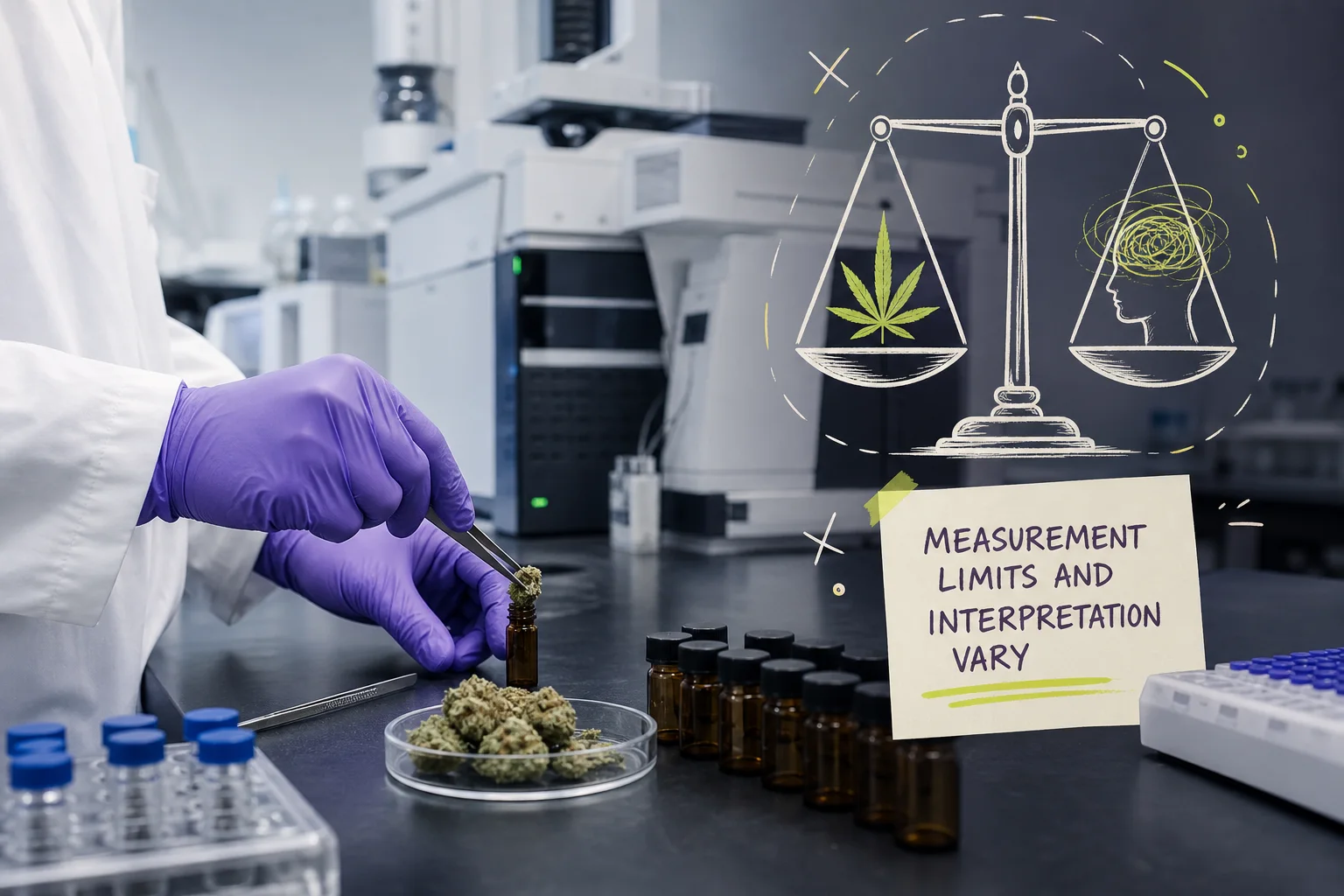
Laboratory image: a non‑identifiable lab scene and schematic to teach the audience about analytical limitations in THC measurement. The visual connects to NIST’s guidance on measurement complexity and does not show readable test results, case identifiers, or numbers.
Research context: Accurate THC Determinations in Seized Cannabis Samples for Forensic Laboratories (NIST)Co‑use and additive risk: why mixed substances matter more than a single reading
Combining cannabis with alcohol or other central nervous system depressants increases impairment, often more than either substance alone. Meta‑analyses and experimental studies find that simultaneous use typically produces additive or greater‑than‑additive decrements in driving tasks such as lane control, reaction time, and hazard detection. In other words, a modest amount of one substance combined with a modest amount of another can produce impairment larger than you’d expect from either single substance. That interaction is difficult to predict from any one after‑the‑fact measurement because test results for different substances may not be collected at the same time, and their time courses differ. The evidence is consistent: the combination of cannabis and alcohol produces greater driving performance decrements than either drug in isolation. Planning not to drive eliminates the need to judge complex cross‑substance interactions on the fly. (pubmed.ncbi.nlm.nih.gov)
The problem with “I feel fine”: limits of subjective confidence
People are poor judges of impairment. Subjective feelings of alertness or caution don't reliably predict performance on tasks requiring divided attention, rapid judgments, or precise motor coordination. With cannabis the situation can be counterintuitive: some users report feeling clearer or more focused after dosing even while objective testing shows slowed reaction times or impaired lane control. Cognitive compensation—driving more slowly, following farther back—may partially mask impairment but does not eliminate crash risk.
Relying on “I feel fine” is especially consequential when time pressure, responsibility, or social expectations push someone to make a quick choice. Those pressures are precisely when impaired judgment is most risky. A preplanned no‑drive decision replaces an unreliable internal check with a simple external rule: use only when you have a sober plan to travel home. This behavioural default reduces the chance that momentary confidence—subject to bias and social pressure—leads to a risky choice. (cdc.gov)
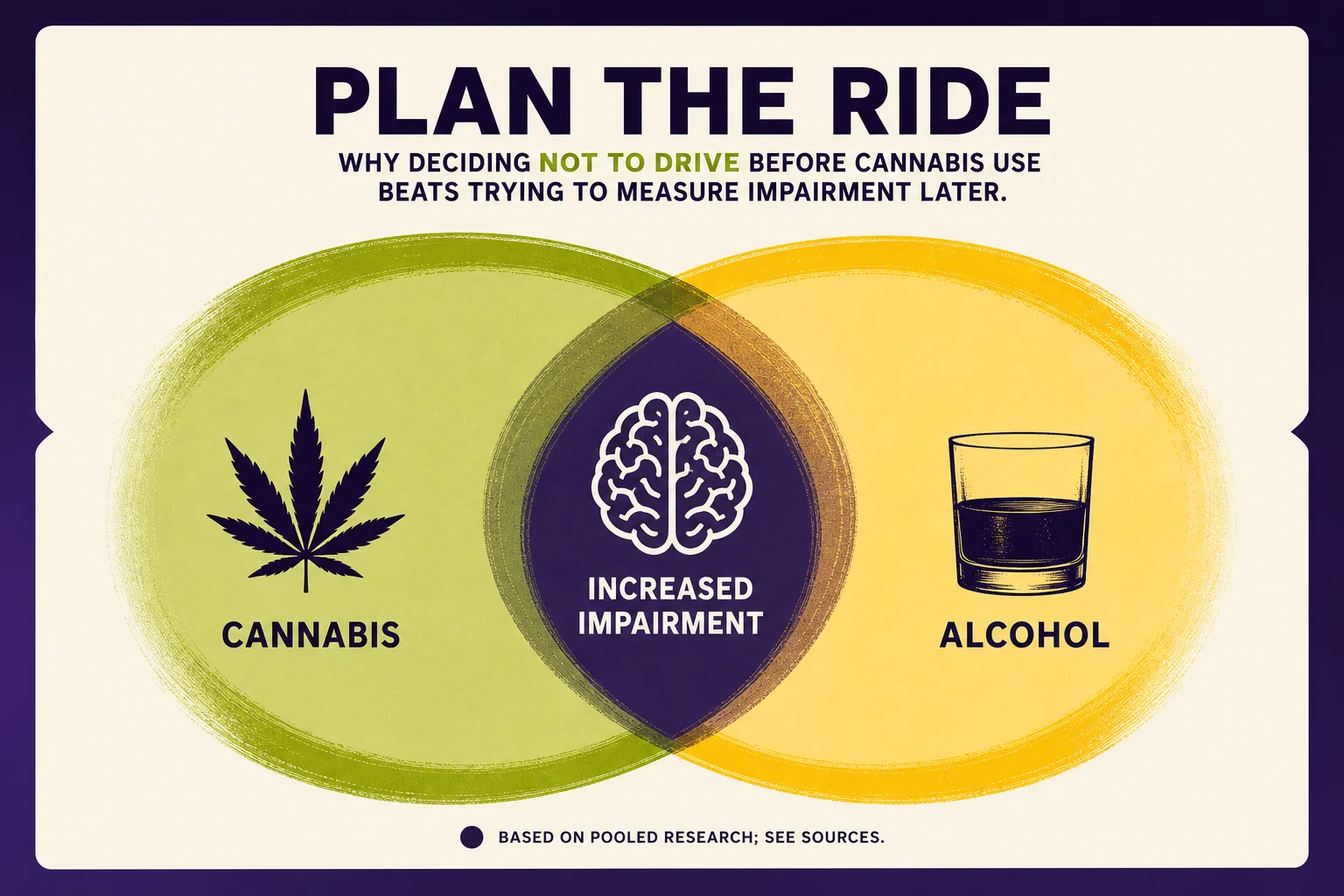
Conceptual evidence diagram: visual teaching the additive risk of combined cannabis and alcohol use on driving performance. The diagram intentionally uses qualitative arrows and overlapping shaded areas rather than numeric scales, reflecting scientific evidence that co‑use increases impairment without overstating precise magnitudes.
Research context: The effects of cannabis and alcohol on driving performance and driver behaviour: a systematic review and meta‑analysis · Mechanisms of cannabis impairment: Implications for modeling driving performanceMaine rules, testing, and what they mean for you
Maine’s regulatory materials and statutes set expectations about lawfulness and testing, and they demonstrate another reason to plan. Maine’s Office of Cannabis Policy provides consumer education resources on lawful use boundaries and public safety, including harm‑reduction messaging around driving and cannabis. The state’s implied‑consent law requires submission to chemical tests when there is probable cause to believe someone operated while under the influence; chemical testing can include blood, breath, or urine for alcohol and drugs. That framework means that law enforcement can lawfully seek biological samples when driving under suspicion; however, laboratory results require careful interpretation and do not equate to a simple numeric threshold for THC analogous to BAC. (maine.gov)
Note how this matters for a Maine grower, registered patient, or adult consumer: having a plan to avoid driving after use reduces the likelihood of an investigatory stop and the complications of submitting to on‑scene or subsequent testing. It also aligns with Maine OCP educational priorities, which emphasize safe use and storing products responsibly. The medical program and adult‑use program in Maine overlap in safety expectations (don’t drive while impaired) but differ in access, labeling, and program rules; either way, a practical operational choice is the same: decide not to drive before consuming. (maine.gov)
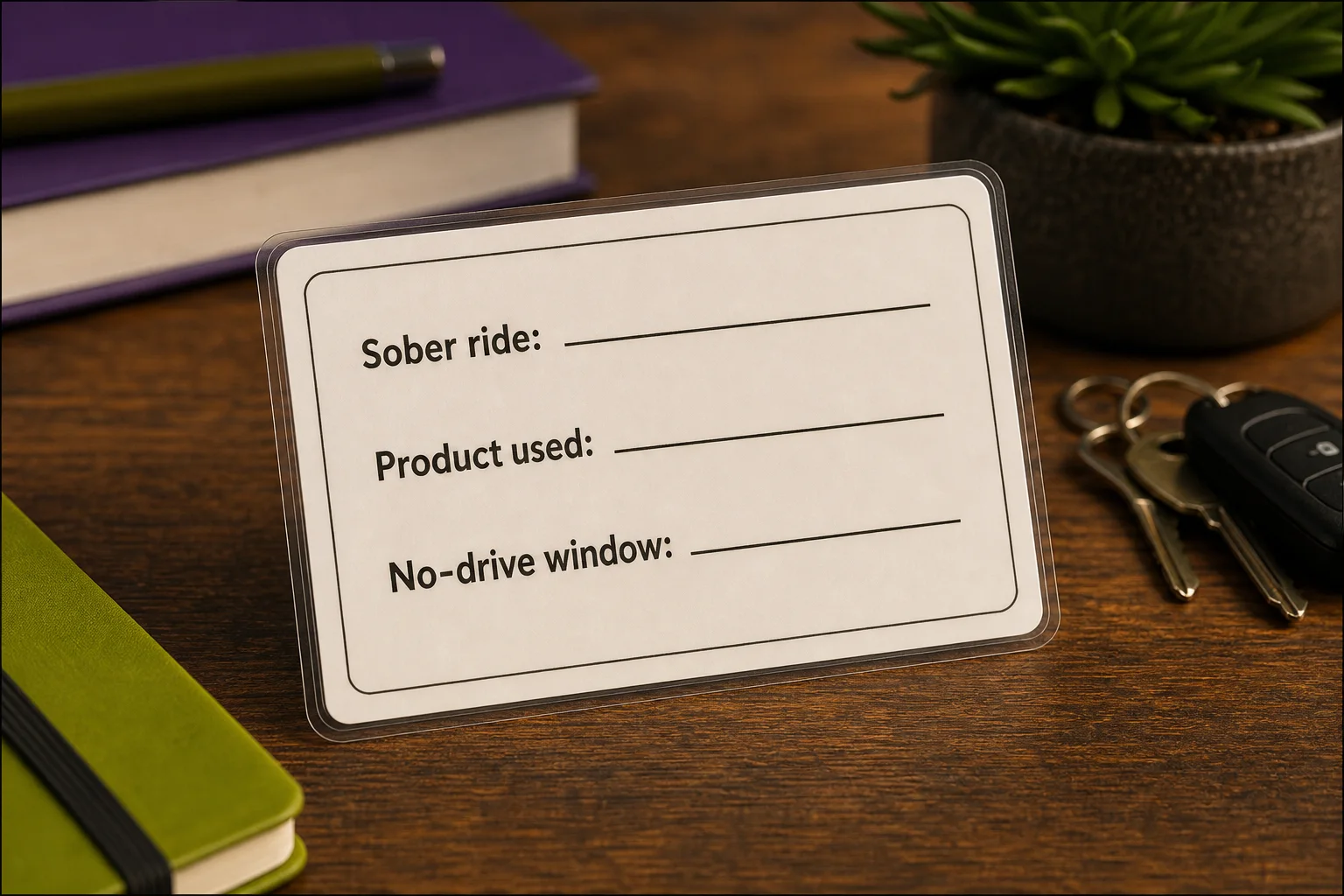
Practical planning visual: an educational ‘Plan the Ride’ card template that viewers can adapt. The image teaches a simple habit—predeciding travel arrangements—and is non‑identifiable and intentionally non‑specific (no medical advice, no dosage suggestions, no dates or statistics).
Research context: Office of Cannabis Policy Resource Library (includes Maine Cannabis 101)Practical steps: how to plan the ride before using cannabis
-
Make a default rule. Decide before consumption that for certain products or settings you will not drive for a set window, or simply not drive at all that day after using. Keep that rule visible—on a phone note or a clipboard in a grow room. Planning removes spur‑of‑the‑moment judgments.
-
Match the plan to product and context. Inhaled products typically act faster and wear off sooner than edibles; edibles take longer to peak and are harder to titrate. If you expect to use an edible, assume a longer no‑drive window than for a single puff. But remember: timing is variable by person, dose, and tolerance—so err on the side of caution.
-
Arrange alternatives. Identify a designated sober driver, rideshare app, taxi, public transit option, or a friend who will be sober. If you’re at home, keep a backup plan like a spare bed or a family member on call.
-
Avoid mixing substances. If you plan to consume alcohol or other sedating medicines, do not add cannabis to the mix before driving. Co‑use increases impairment unpredictably and substantially. (pubmed.ncbi.nlm.nih.gov)
-
Communicate. Tell the people you’ll be with what your plan is—especially if social pressure tends to push everyone toward a shared judgment call. A visible plan reduces second‑guessing and normalizes the safety default.
-
For medical patients, integrate dosing into daily routines that separate use from driving windows. If driving is an essential part of your day for work or caregiving, schedule dosing times when you have a clear, sober interval before any driving obligation.
Evidence limits and honest uncertainties
A responsible educational article must say where evidence is limited. First, while epidemiologic and experimental studies show that cannabis can impair driving‑related skills and increase crash risk, the exact magnitude of risk for a single person at a single moment is uncertain. Second, legal tests for THC or its metabolites are helpful for forensic, clinical, and public‑health purposes, but they cannot perfectly classify current impairment in all cases. Third, tolerance complicates prediction: frequent users may have different subjective and objective profiles than infrequent users, and research has not resolved how tolerance changes crash risk for day‑to‑day tasks in real‑world settings. Finally, many controlled driving studies use simulators or small samples under standardized conditions; while informative, they cannot perfectly reproduce the messy conditions of real roads.
Those limits do not mean we should do nothing. They mean relying on a conservative behavioural approach: plan not to drive. That practice removes dependence on imperfect tests, variable feelings, and the uncertain interaction of co‑used substances. It is a strategy rooted in the precautionary principle and supported by public‑health guidance and the best current science. (cdc.gov)
Conclusion: a small planning step with outsized safety returns
If you grow, use, distribute information about, or depend on cannabis as a registered patient, a practical option is also straightforward: plan the ride before you light, vape, or eat. This single habit—resolving in advance not to drive and arranging a sober way home—avoids ambiguous tests, uncomfortable stops, and split‑second decisions made while impaired. It respects the uncertainty in the science and aligns with Maine’s public safety expectations. The science shows cannabis can affect the skills driving requires, combined use increases risk, and measurements after the fact are often ambiguous. The practical takeaway for people living and working in Maine is clear: decide not to drive before you use.
Questions this guide answers
Does a positive THC test mean I was driving impaired?
Not necessarily. THC and its metabolites can be detectable long after peak effects. A positive test can indicate recent or past use and does not automatically prove current impairment. Context, timing, and specific tests matter.
If I feel fine, can I drive?
Feeling ‘fine’ is an unreliable measure. Subjective confidence can mismatch objective performance on reaction time and attention. Planning a sober travel option before use is safer than relying on how you feel afterward.
How do Maine laws affect chemical testing after a traffic stop?
Maine’s implied‑consent framework allows chemical testing (blood, breath, urine) when there is probable cause to suspect impaired operation. Test results enter legal and administrative processes and require careful interpretation. ([legislature.maine.gov](https://legislature.maine.gov/statutes/29-A/title29-Asec2521.html))
Do edibles change the no‑drive planning window?
Yes. Edibles usually have a slower onset and longer, more variable time course than inhaled products, so a longer no‑drive window is prudent. Exact timing varies by product, dose, and individual.
What if I need to drive for work or caregiving?
If driving is essential, schedule cannabis use only at times that leave a clear, sober interval before required driving duties, and communicate plans with employers or caregivers as appropriate. Planning reduces conflict and risk.
Educational information only. Cannabis affects people differently and this is not medical advice.