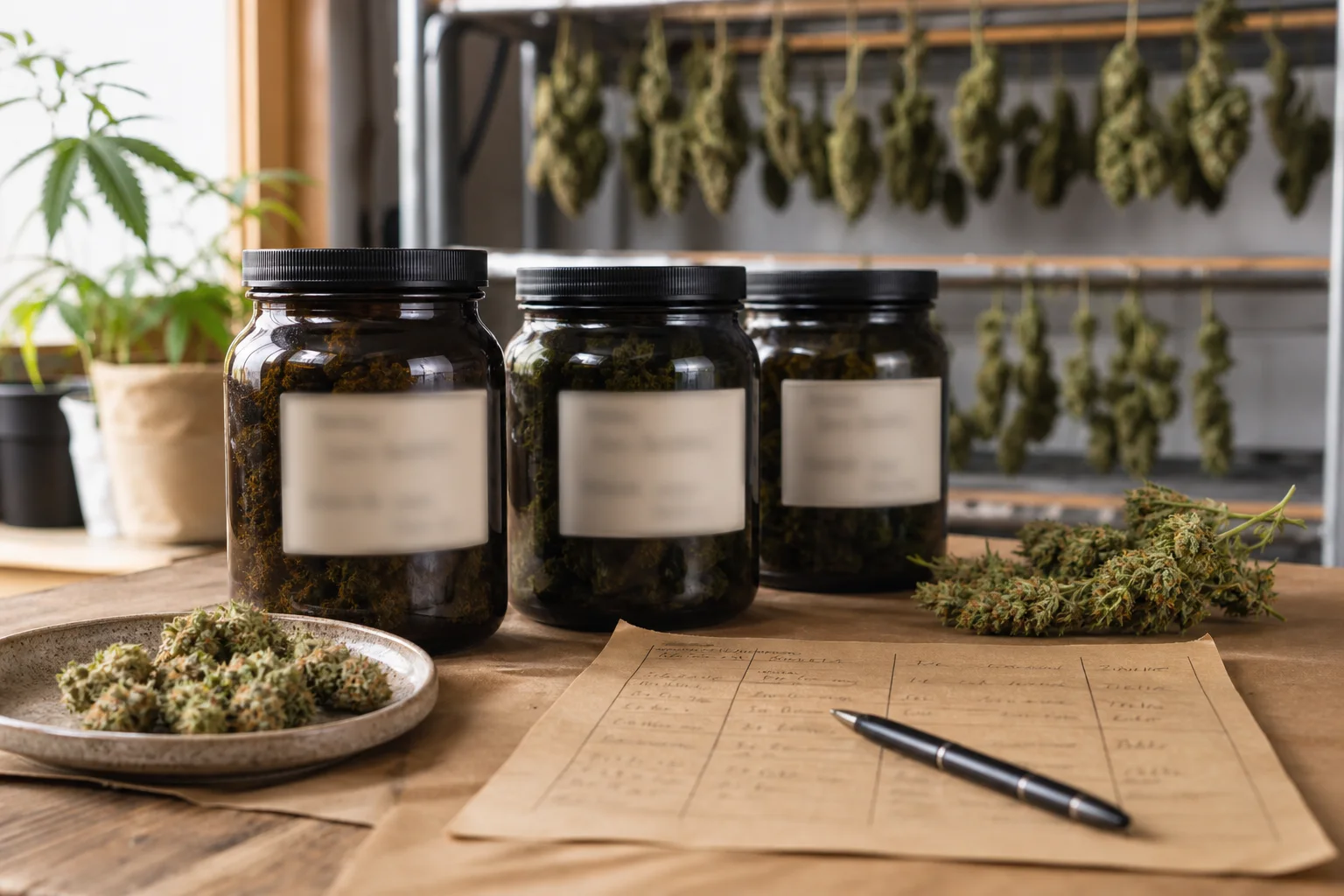
Documentary-style macro: harvest log beside small-batch jars. This image teaches what useful traceability looks like—harvest/batch dates, licensee identifiers, and non-ambiguous packaging—while reminding readers that paperwork complements chemistry. The photo is illustrative; a visible log is not a substitute for a lab COA. Source documents vary by licensee. Limit: does not show lab data or readable personal information.
Why source and freshness matter
Whether you buy flower from a licensed Maine medical caregiver or an adult‑use store, what you hold in the jar is the end of a chain: genetics, harvest timing, drying and curing, storage, and testing. Chemistry changes after harvest—acid cannabinoids convert, terpenes evaporate, and oxidation can alter profiles—so targeted questions about source and freshness help you assess what the product likely contains and how stable it may be. Multiple published studies have shown measurable shifts in cannabinoids and terpene profiles with different drying and storage conditions. (pubmed.ncbi.nlm.nih.gov)
Freshness is a mix of chemistry and documentation. A labeled harvest date and a batch‑specific lab report provide concrete records you can use to reduce uncertainty. Absent those records, inferences about what remains in the jar become more speculative: volatile compounds are lost, and some cannabinoids can change form depending on heat, light, and oxygen exposure.
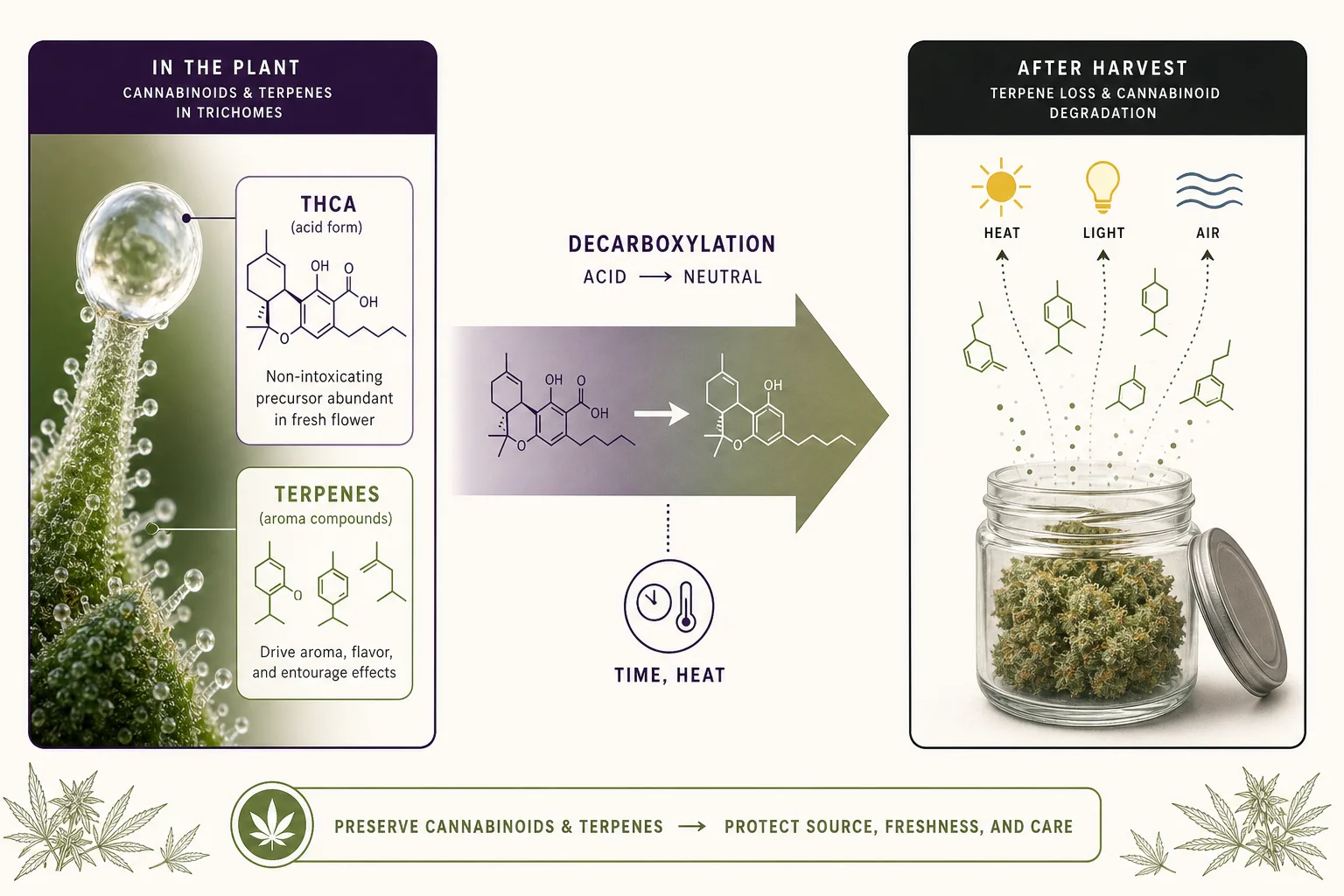
Explanatory illustration showing the main chemical transformations after harvest (acid cannabinoids → neutral cannabinoids; terpene volatilization) and the environmental drivers (light, heat, oxygen). The diagram is schematic—based on published kinetic observations—but not a lab report. Useful for teaching what to expect, not for predicting exact values for a specific batch.
Research context: The influence of drying and storage conditions on the volatilome and cannabinoid content of Cannabis sativa L. inflorescencesCheck 1 — Who grew it and when was it harvested?
Look for the grower or licensee name and a harvest or batch date on labels or supporting paperwork. In regulated markets, licensee traceability and batch records are the first verifiable facts; in Maine the Office of Cannabis Policy (OCP) maintains consumer resources and guidance that explain what regulated operators must keep and make available. Knowing harvest dates matters because freshly dried flower and aged flower can have very different chemical profiles: maturation after drying can reduce acid cannabinoids and deplete volatile terpenes. When a licensee does not provide at least the harvest month, the product’s age is unknown to the buyer. (maine.gov)
If an operation lists only a broad production window (for example, "early summer harvest"), that is informative but less precise than a batch date. Traceability becomes more useful when batch numbers, harvest dates, and chain‑of‑custody notes are all present; that combination lets a later lab report be matched back to the original lot.
Check 2 — Harvest context: how was it dried and cured?
Drying and curing are not just folklore—they shape aroma and chemical stability. Important items to look for or request in batch notes: whether material was shade‑ or sun‑dried, whether freeze‑drying (lyophilization) was used, how long curing was performed, and in what containers (open trays, sealed jars, vacuum pouches, etc.). Controlled, slower drying and proper curing tend to preserve terpenes and limit astringency; rapid or high‑temperature drying can change the volatilome and accelerate acid‑to‑neutral cannabinoid conversions. Recent analytical work documents that drying method and storage container materially change terpene and cannabinoid content. If processing notes are not provided with the product, that increases uncertainty about how the product's aroma and chemistry evolved. (pubmed.ncbi.nlm.nih.gov)
Practically, curing at moderate humidity in sealed containers for weeks is often described in industry protocols, while rack drying or oven drying are alternative approaches used for speed. Each approach carries different expected outcomes for terpene retention and leaf harshness; when those features matter to you, seek out batch processing details.
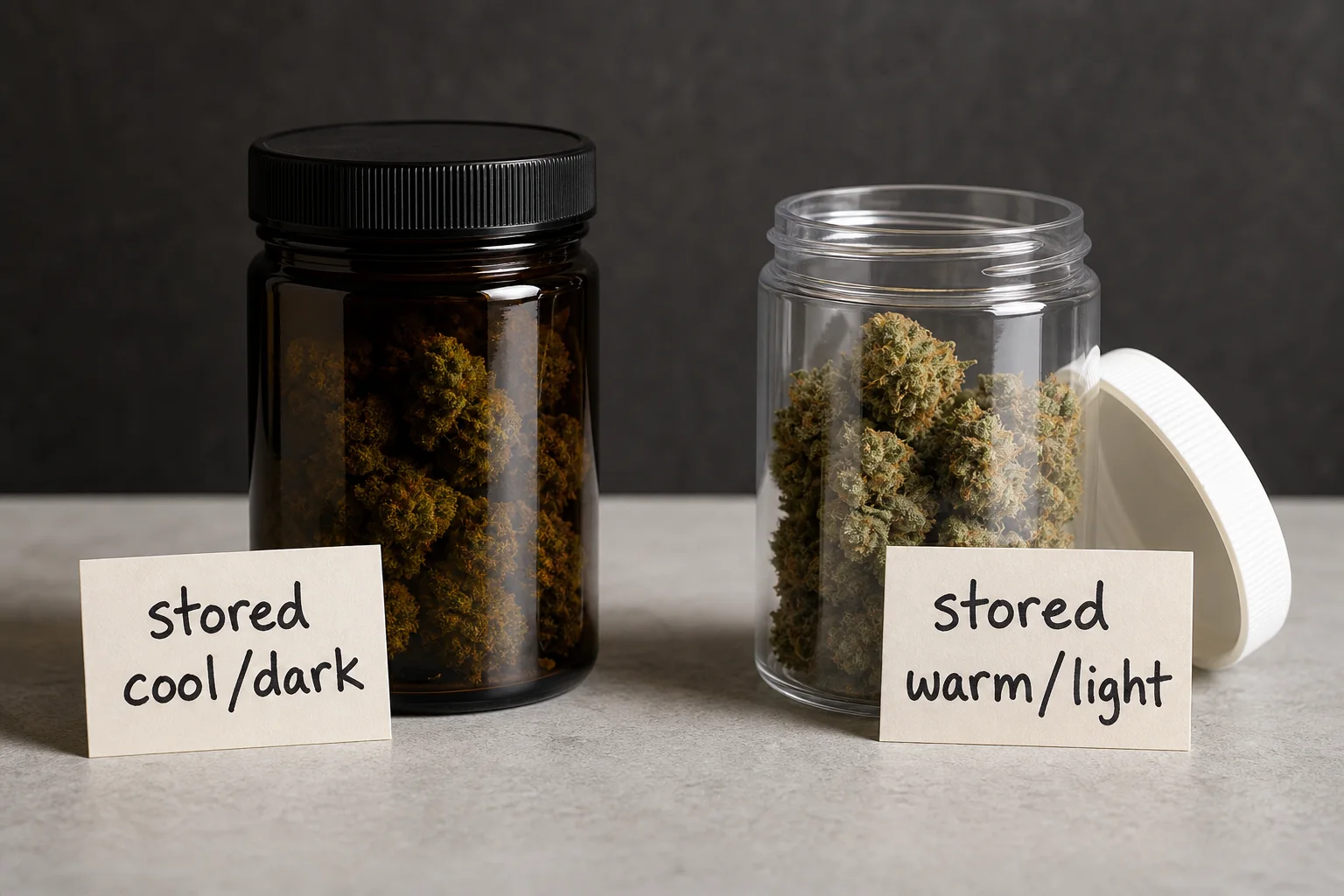
Comparative macro photo to show how container material and opacity influence aging. This image teaches why opaque glass and limited headspace matter. It does not claim specific shelf-life numbers; those depend on many variables described in the text and literature.
Research context: Metabolic Profiling of Cannabis Secondary Metabolites for Evaluation of Optimal Postharvest Storage ConditionsCheck 3 — Storage before sale: time, temperature, light, and oxygen
Review records or ask for information about how the product was stored between drying and sale. Key variables are time (age), temperature, light exposure, and whether the product sat in sealed, inert containers. Light and air accelerate cannabinoid loss and conversions (for example, conversion to oxidized components under some conditions), and studies show faster changes when products are exposed to light or fluctuating temperatures. Freezer storage of extracts or sealed materials often preserves chemical profiles longer for certain matrices, but the behavior depends on product type (flower vs resin vs extract). If a seller reports room‑temperature storage in clear jars for months, expect some loss of volatile terpenes and possible cannabinoid change. (pubmed.ncbi.nlm.nih.gov)
Storage container material also matters: glass, certain plastics, and multilayer foil pouches have different permeabilities to oxygen and light. Opaque, sealed containers reduce light exposure and slow evaporation of volatile compounds; by contrast, clear packaging can accelerate changes when combined with light exposure and heat. Humidity control during storage is another factor often documented in batch notes or post‑harvest logs.
Check 4 — Testing: what was measured, when, and by whom?
Lab certificates of analysis (COAs) are central but not self‑contained truth. Look for the COA for the specific batch or lot number and examine three things: the analysis date relative to harvest, the lab name and accreditation, and the analytes reported (THC, THCA, CBD, CBDA, CBN, total terpene profile, pesticides, residual solvents, microbials). A COA is a snapshot tied to a tested sample; a COA filed months after harvest documents the tested state at analysis time, which may not match the product state at the moment it is opened.
Confirm whether the lab is a state‑approved laboratory or uses methods recognized by regulators; Maine’s OCP resources and licensing materials explain consumer rights to certain information from licensees. If a COA omits terpene content or reports only a single "total THC" value without acid/neutral breakdown, the amount of inference possible about freshness and expected performance is reduced. Different labs may use varying sample preparation approaches, analytical instrumentation, and reporting conventions; those differences affect comparability of results. (maine.gov)
When assessing a COA, note the limits of detection and the method used (for example, HPLC vs GC for different analytes) because those details influence whether acid cannabinoids were measured separately or were decarboxylated during analysis.
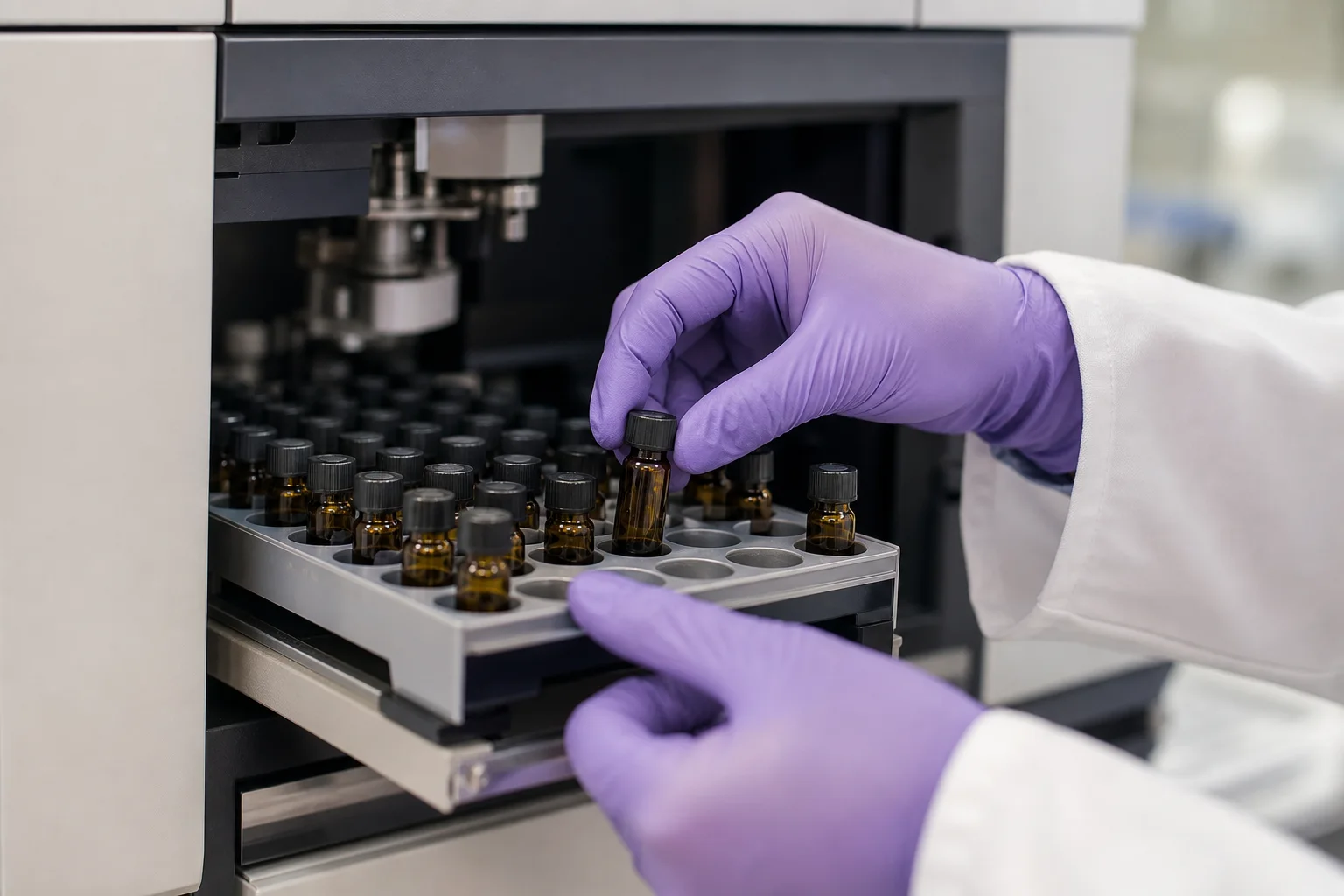
Laboratory context photograph that explains the role of testing. It visually links COAs to the lab work that produced them while highlighting that sampling and method matter. Image must not show readable sample identifiers or any lab reports.
Research context: Office of Cannabis Policy Consumer ResourcesCheck 5 — Reading chemistry: what changes with age and storage?
Understand a few consistent patterns documented in the scientific literature: (1) THCA (the acidic precursor) decarboxylates over time and with heat into Delta‑9‑THC and can oxidize further under air/light exposure; (2) terpenes—responsible for aroma—are volatile and decline with time, heat, and air; and (3) different matrices behave differently (flower, resin, and extracts have distinct kinetics). Recent studies used HPLC and GC‑MS to quantify these shifts across storage temperatures and containers, and they model kinetics that can predict transformation rates under repeatable conditions. Models perform best when starting concentrations, storage history, and container details are known; unknown histories or mixed lots greatly increase uncertainty. (pubmed.ncbi.nlm.nih.gov)
Chemistry changes are not uniform across compounds or cultivars. Some terpenes are more volatile than others; some cannabinoids decarboxylate faster at moderate temperatures. The resulting sensory and chemical profile of a given jar thus depends on initial composition, post‑harvest handling, storage conditions, and elapsed time. Where quantitative precision matters, recent testing relative to harvest provides the most directly relevant information.
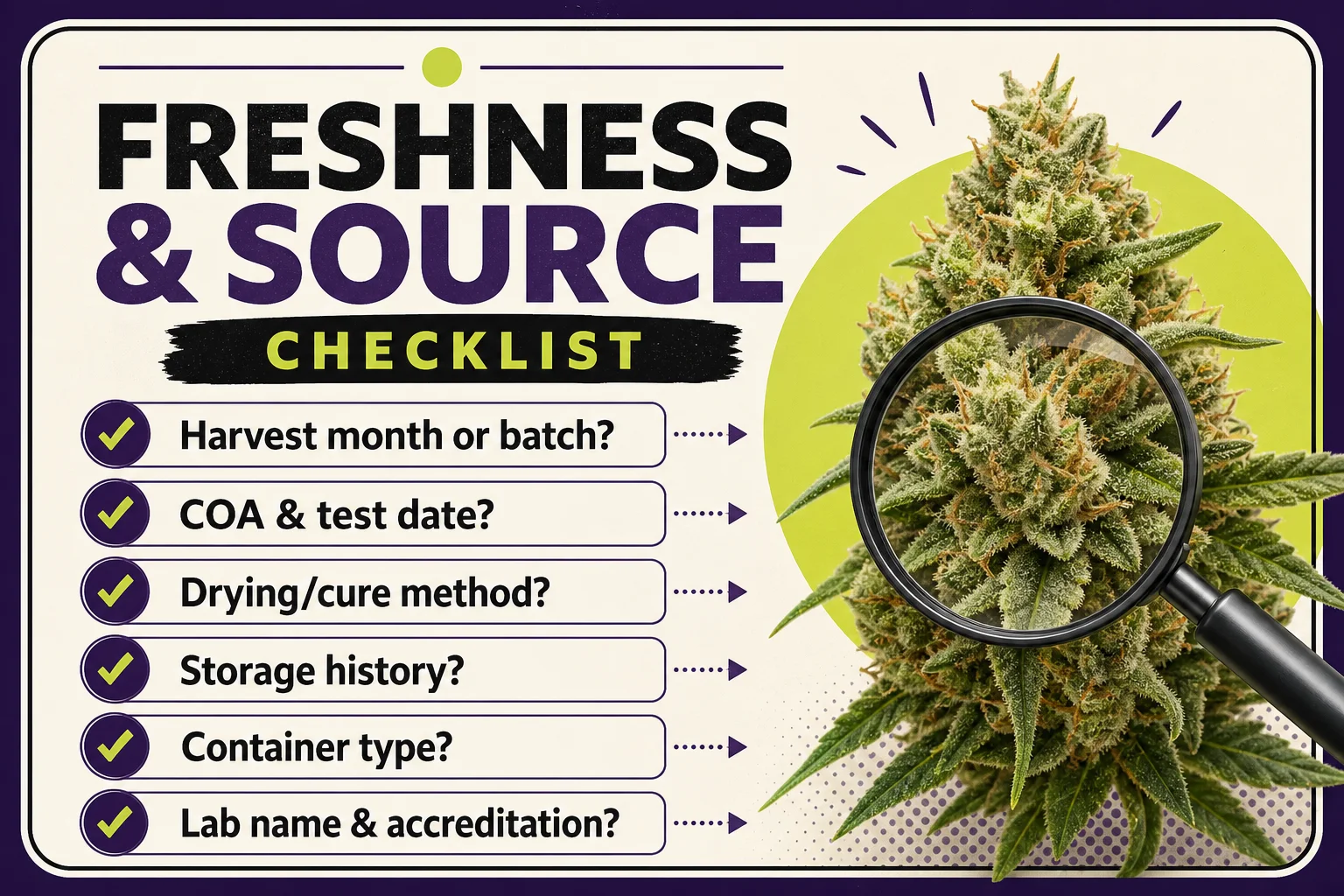
A one-page visual checklist for in-person or online conversations with growers/dispensaries—mirrors the article’s checklist. Designed for adults and caregivers. Does not contain legal advice or suggest actions for minors. Use as a memory aid alongside COAs and records.
Research context: Title 28-B, §701: Labeling and packagingCheck 6 — Uncertainty and the limits of COAs and labels
Regulatory labels and COAs reduce, but do not eliminate, uncertainty. Maine regulations require labels not to be false or deceptive and set rules for packaging and labeling; however, regulators cannot freeze a product’s chemistry at a moment in time. A COA describes the tested sample on its analysis date; different labs may report different analyte sets and use different reporting thresholds; and conversion of acid cannabinoids to neutral forms can occur before or after sampling. For patients in the Maine Medical Use of Cannabis Program, the regulated supply chain provides stronger traceability than unregulated sources, while still leaving post‑sale storage and age as sources of variability. When precise chemistry is relevant, recent COAs (ideally those with analysis dates close to harvest) and labs with documented analytical methods narrow the range of plausible chemical states. (legislature.maine.gov)
Chain‑of‑custody records and clear batch labeling improve the value of a COA by tying the test results to a known lot. Without clear linkage between COA and product, the COA provides only partial information.
Practical checklist you can use at purchase or when asking a caregiver
This checklist is phrased as information items that adults and Maine Medical Use of Cannabis Program participants can review, request, or verify before accepting or purchasing a batch. It is focused on records and observable handling rather than on promised effects.
- Harvest month or batch date and licensee/grower name: check the label or accompanying documentation. (maine.gov)
- Batch‑specific COA: verify the lot number, analysis date, and testing laboratory. Note whether the COA includes a terpene profile and separate acid/neutral cannabinoid reporting. (maine.gov)
- Drying and curing notes: review whether freeze‑drying, rack drying, or other methods were used and any stated curing duration or container type; these details affect stability. (pubmed.ncbi.nlm.nih.gov)
- Storage history: look for records of storage duration, temperature control, container material (glass vs clear plastic vs opaque pouches), and light exposure between drying and sale. (pubmed.ncbi.nlm.nih.gov)
- Recency of testing: for concerns about freshness, give more weight to COAs issued closer to harvest and to documented cold or opaque storage. (pubmed.ncbi.nlm.nih.gov)
- Edibles and infusions: check manufacturing date, ‘‘best by’’ guidance if provided, and COA testing for potency and contaminants. Confirm that label claims are supported by a COA tied to the batch. (legislature.maine.gov)
Each line item above is a type of record or observation that reduces uncertainty when combined with others. If a single piece of information is missing (for example, terpene data), the overall picture is less complete but other records can still be informative.
Safety note: storage at home and accidental exposure
Store adult products out of reach and sight of children and pets. The CDC and poison control resources emphasize that edible products and attractive packaging are associated with higher risk of unintentional ingestion; jurisdictional data show increases in accidental exposures following rollouts of adult‑use markets. Child‑resistant containers, clear labeling of transferred home storage, and separating adult products from ordinary food containers reduce the likelihood of confusion. Do not rely on packaging alone as a safety control.
In the event of a suspected unintentional ingestion by a child or pet, Poison Control is an available resource: Poison Control’s national number is 1‑800‑222‑1222 and webPOISONCONTROL provides immediate guidance. Local emergency services and veterinary emergency services are additional resources for urgent situations. (cdc.gov)
Evidence limits — what we do and don’t know
The literature consistently documents that cannabinoids and terpenes change with time, light, heat, oxygen, and drying method, but there is heterogeneity in experimental methods and in product matrices (flower vs resin vs extract). Many controlled studies use laboratory conditions that may not capture every real‑world practice encountered in small‑batch cultivation and retail storage. COAs reflect the sample tested, and chain‑of‑custody and sampling procedures vary between labs and operators. Maine’s regulatory framework provides higher traceability in licensed supply chains than unregulated sources, but it cannot guarantee chemical stability after sale.
Uncertainty increases in situations where products are combined from multiple harvests, when products are sold without batch identifiers, or when storage histories are incomplete. When the precise chemical make‑up of a given jar matters for personal reasons, prioritize batches with complete documentation: linked COAs, clear harvest dates, and transparent storage and processing logs. Even then, remember that COAs report the state at analysis; post‑analysis handling or prolonged retail shelf time will alter chemistry.
Final practical notes (short)
This article provides information items and record checks adults and Maine medical program participants can use to evaluate source and likely freshness. Favor products with clear batch IDs, linked COAs, harvest dates, and documented post‑harvest handling and storage. Opaque, sealed containers and COAs dated near harvest reduce, but do not eliminate, uncertainty. For Maine‑specific consumer resources and regulatory details, consult the Office of Cannabis Policy resource pages and Maine statute on labeling and packaging. (maine.gov)
Questions this guide answers
Is a Certificate of Analysis (COA) proof of freshness?
A COA is a snapshot of the sample that was tested; it documents what the lab measured on that sample and when. It does not guarantee the product’s chemistry after that test or during long storage—so check the COA date and match it to the batch or harvest date. ([maine.gov](https://www.maine.gov/dafs/ocp/resources/library))
What storage conditions slow cannabinoid and terpene loss?
Dark, cool, and airtight storage slows loss. Glass (opaque or stored in opaque containers), low oxygen exposure, and stable cool temperatures preserve terpenes and slow cannabinoid conversion compared with clear jars and warm, light-exposed conditions. Lab studies show temperature, light, and air are primary drivers. ([pubmed.ncbi.nlm.nih.gov](https://pubmed.ncbi.nlm.nih.gov/30901710/))
How do Maine’s medical and adult-use systems differ for consumer records?
Both systems operate within Maine’s regulatory framework, but medical program participants often interact with caregivers or designated providers that keep more direct patient records. Maine’s OCP resource pages outline consumer rights and the kinds of records and labeling that licensed operators must maintain. Ask your supplier which program and licensee produced the batch. ([maine.gov](https://www.maine.gov/dafs/ocp/resources/library))
What should I do if a child ingests a cannabis product?
Contact Poison Control immediately at 1-800-222-1222 or use webPOISONCONTROL. Serious responses occur more often in young children after edible ingestion; keep products secured and labeled. ([cdc.gov](https://www.cdc.gov/cannabis/health-effects/poisoning.html))
If a COA lacks terpene data, does that matter?
Yes. Terpenes shape aroma and may affect product experience; they are also the most volatile components and indicators of freshness. A missing terpene profile limits what you can infer about aroma preservation and aging. Ask for a COA that lists both cannabinoids and terpenes. ([pubmed.ncbi.nlm.nih.gov](https://pubmed.ncbi.nlm.nih.gov/33178249/))
Educational information only. Cannabis affects people differently and this is not medical advice.