
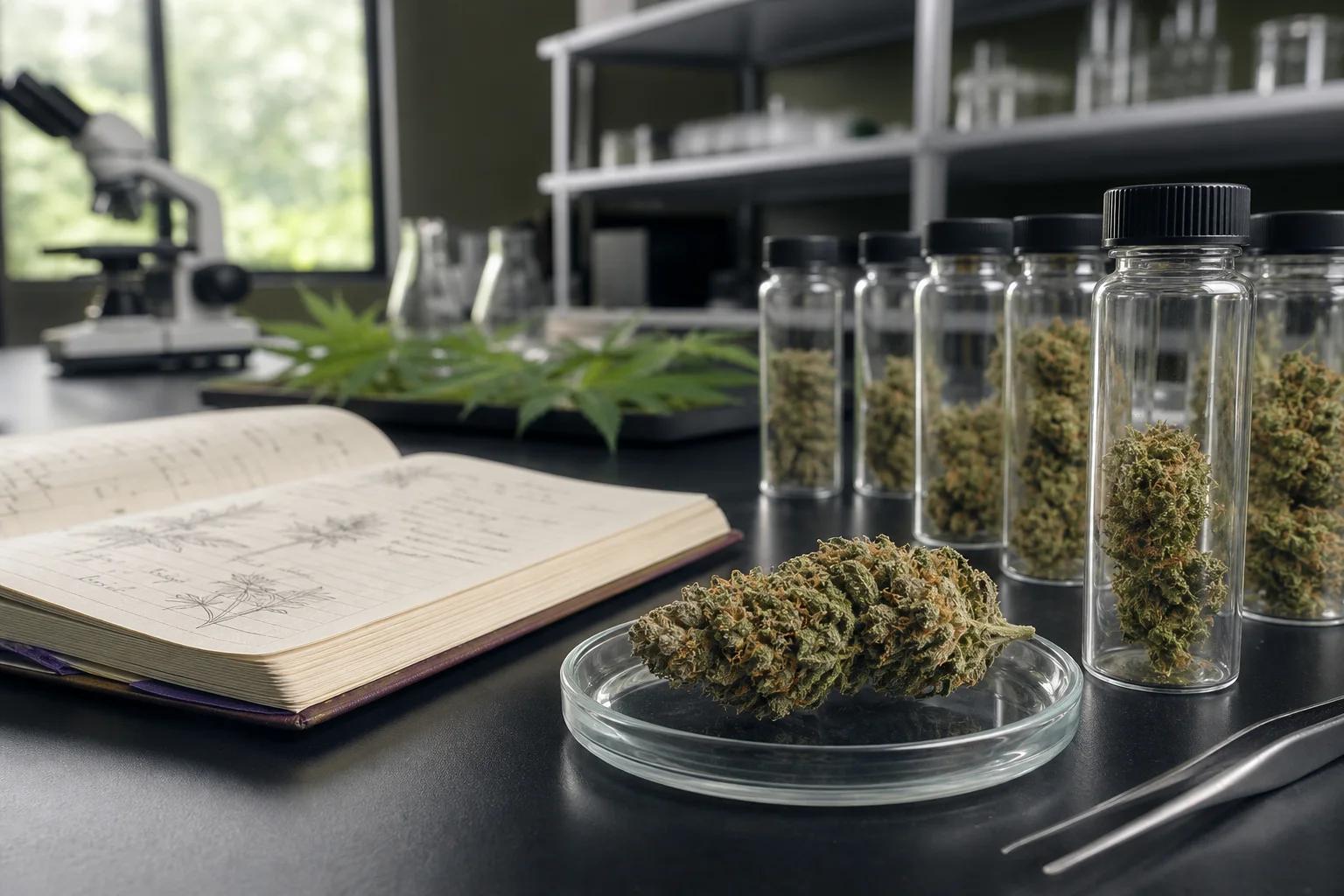
A documentary-style hero image linking bench science, plant material, and grow records—visualizing the article’s theme: multiple evidence streams must be read together. Limits: this image is illustrative and not a lab report or clinical record.
Why ranking evidence matters for adults
Cannabis conversations often collapse into two camps: purely anecdotal lived experience on one side and a demand for "hard science" on the other. That framing is a false trade-off. Adults who use, grow, or advise people about cannabis benefit from learning how different kinds of evidence answer different questions. Mechanism studies explain how cannabinoids act on cells; surveys tell us how people actually use products; randomized controlled trials (RCTs) measure effects under controlled conditions; and personal notes capture context and texture that no trial can replicate. Understanding the strengths and limits of each source helps you judge which evidence should shape a decision today and which should prompt caution or further inquiry. (cdc.gov)
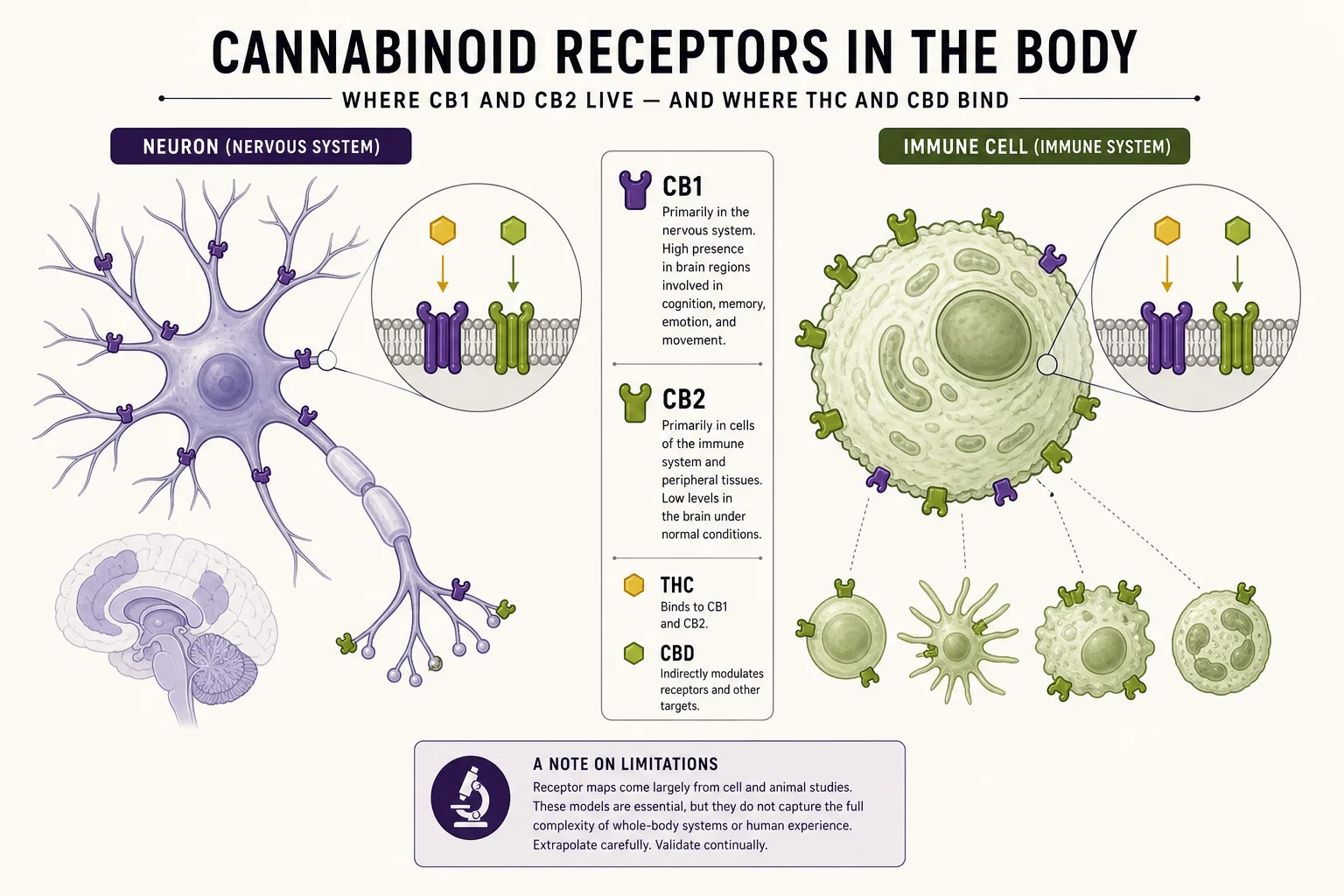
An explanatory illustration of cannabinoid receptor action and a boxed note explaining that receptor binding in cells doesn’t equal clinical effect in humans—useful when reading mechanism papers. Limits: schematic only; it cannot show clinical outcomes or dosages.
Research context: The Health Effects of Cannabis and Cannabinoids (National Academies review)Mechanism and basic-science studies: why they’re useful and why they don’t finish the story
Mechanism work—cell culture, receptor pharmacology, and biochemical pathway mapping—gives first principles. These studies reveal which receptors bind THC, CBD, or novel cannabinoids and how signaling cascades change. That’s valuable when researchers are trying to design pharmaceutical agents or to explain why a compound might have an effect in humans. But these studies are rarely predictive of clinical outcomes on their own: cells in a dish aren’t a human brain, liver, or lung, and concentrations used in the lab often differ from real-world exposures. Framing mechanism studies as definitive clinical proof misunderstands their role: they’re hypothesis engines, not finish lines. (ncbi.nlm.nih.gov)
Mechanistic work is also where growers, cultivators, and botanical scientists can contribute directly: careful chemotype profiling, reproducible extraction methods, and plant physiology studies reduce variability that later human studies will need to address. Conversely, an elegant receptor paper can't tell you whether a tincture from a particular farm will produce a given outcome in a person who takes it with other medications. That translational gap is a recurring theme in cannabis research. (ncbi.nlm.nih.gov)
When you read mechanism papers, ask: what concentration did they use? Is the preparation synthetic or plant-derived? What organism or tissue did they study? If the answer includes ultra‑high concentrations, nonhuman cells, or synthetic analogs, interpret the results as plausible mechanisms that require human data to test relevance. (ncbi.nlm.nih.gov)
Animal research: signals, safety screens, and the translation problem
Animal studies fill a practical need: they allow controlled dosing, repeated tissue sampling, and long-term observation impossible in early human trials. They can reveal toxicity signals, developmental concerns, and physiologic effects that merit attention before wider human exposure. But species differences in metabolism, brain structure, and behavior mean that positive findings in rodents don't automatically predict human outcomes—and negative findings don't guarantee safety either. Historically in cannabinoid research, animal models have generated important safety warnings while overstating or understating likely human outcomes. (ncbi.nlm.nih.gov)
For adults reading animal work, focus on study design details: was dosing scaled for body-surface area? Were exposure windows comparable to human use patterns (e.g., adolescence vs adulthood)? Were behavioral measures validated? When animal data highlight potential harms (for example, reproductive or developmental signals), they are red flags that justify caution, further study in humans, and targeted public-health messaging—particularly for vulnerable groups. (fda.gov)
Finally, animal work is where contamination risks often first show up. Pesticides, solvents, and microbial contamination can produce adverse outcomes in preclinical models; that same contamination risk is real in poorly regulated consumer products. Maine’s testing rules and lab certification aim to reduce that hazard, but lab-to-lab variability remains important to track. (maine.gov)
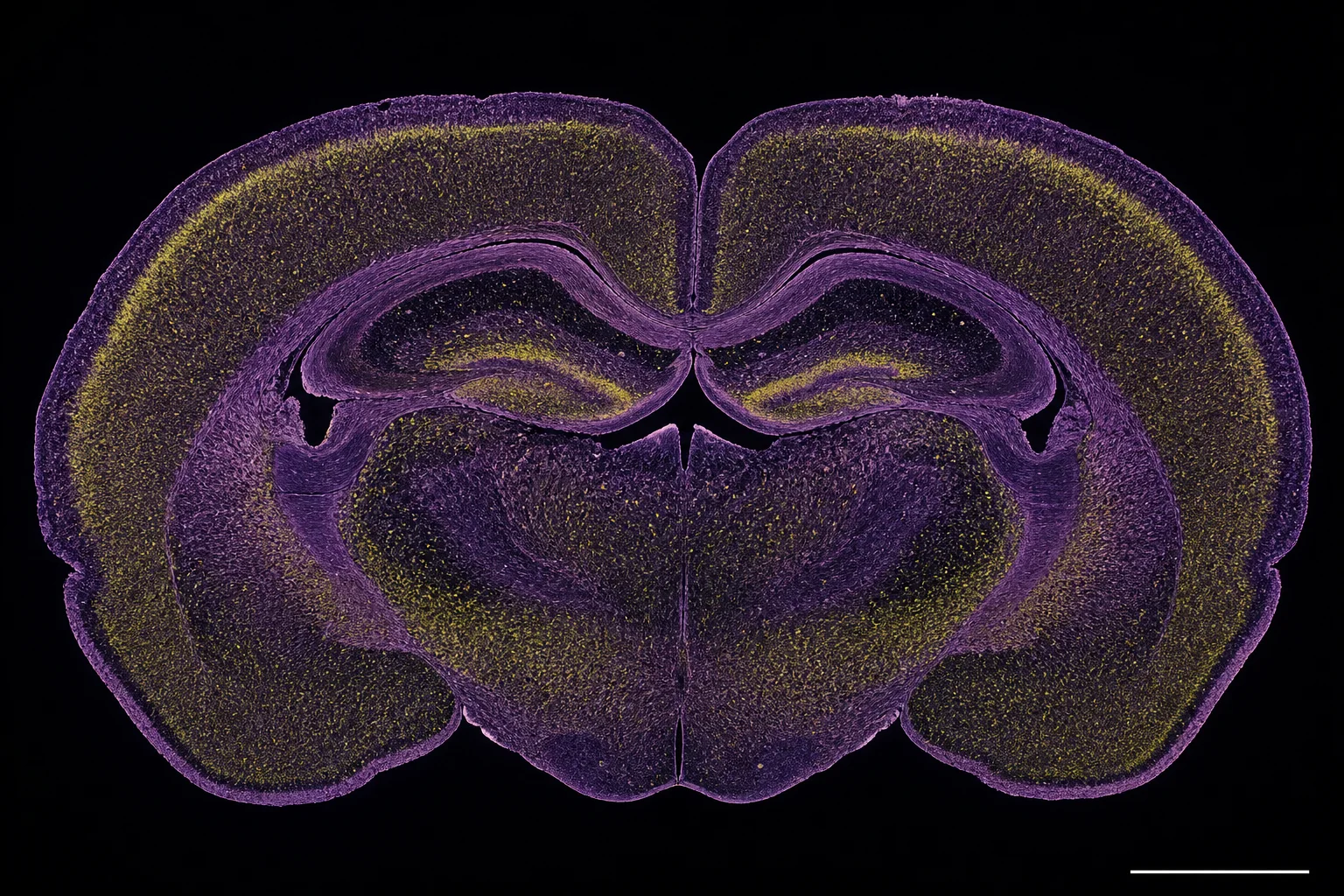
A botanical/biomedical macro showing a brain-preparation context where many animal studies probe cannabinoid effects; caption reminds viewers about species differences and translational limits.
Research context: The Health Effects of Cannabis and Cannabinoids (National Academies review) · NIH-supported Research on Cannabis, Cannabinoids, and Related Compounds (NCCIH / NIH)Surveys and observational studies: the view from real life (and why lived experience matters)
Surveys and observational research are the empirical home of lived experience. They tell us who uses what, how they dose, combining behaviors (alcohol, meds), and what users report about effects and harms. For adults making decisions now—when definitive trials are limited—these studies are essential. They capture heterogeneity in usage patterns (edibles vs inhalation), user priorities, and why people choose particular products. But observational work can’t by itself disentangle cause and effect. Reported improvements after starting a product could reflect placebo effects, regression to the mean, or concurrent changes in other treatments. That means these studies are valuable for signal, context, and hypothesis generation—not as final proof. (cdc.gov)
Lived experience also contains practical safety intelligence: an experienced caregiver or grower can report a specific batch that caused adverse reactions, household storage problems, or unanticipated interactions with prescription drugs. Those reports can prompt formal surveillance—poison center calls, lab retesting, or local regulatory review—rather than being dismissed. Poison Control datasets, for example, have been an early-warning system for pediatric exposures after edible commercialization. That blend of anecdote leading to surveillance is a constructive way lived experience improves public safety. (poison.org)
To make effective use of observational work, look for transparency about sampling, question wording, and confounder control. Large, repeatable surveys with clear definitions (e.g., what counts as a cannabis edible) are more useful than small online polls that lack demographic context. When individuals offer experience, ask for specifics: product form, concentration, co‑medications, and timing. Those details make lived reports more scientifically actionable. (cdc.gov)
Randomized trials and controlled human studies: high internal validity, persistent limits
Well-designed RCTs are widely regarded as a study design with high internal validity for answering narrow causal questions in humans because randomization reduces confounding and blinding limits expectation effects. For those asking whether a defined cannabis product produces a specific, measurable change in a pre-specified outcome under controlled conditions, RCTs can offer clearer causal evidence than many observational designs. But RCTs in cannabis face practical challenges: product standardization, blinding when psychoactive effects betray assignment, regulatory hurdles for supply, and often small sample sizes. Those practical realities mean many cannabis RCTs are short, focused on narrow endpoints, and may use formulations that don’t reflect typical commercial products. (pubmed.ncbi.nlm.nih.gov)
Interpret RCTs by asking: was the product standardized and independently tested? Was blinding assessed? How long did the trial run? Were outcomes patient-centered and relevant, or just laboratory measures? An RCT that uses a single, carefully produced extract over eight weeks answers a narrower question than a long-term, pragmatic trial of retail products. Both are useful; they just answer different questions. (pubmed.ncbi.nlm.nih.gov)
Because RCTs are expensive and often slow, the absence of a large RCT does not necessarily indicate absence of an effect. It may reflect funding, regulatory barriers, or the difficulty of standardizing complex plant products. That’s where evidence synthesis and careful triangulation with other evidence types helps. (pubmed.ncbi.nlm.nih.gov)
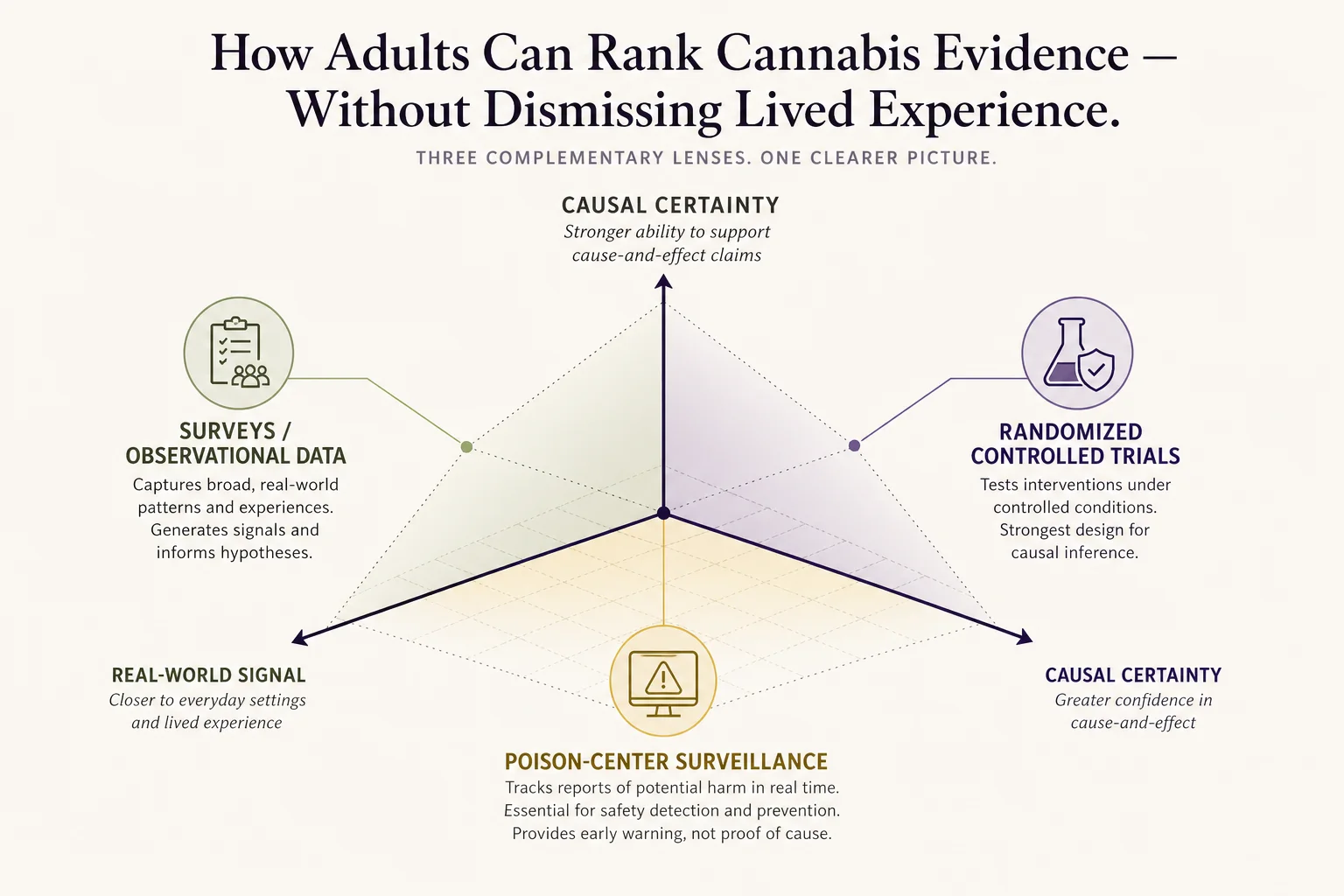
An evidence-diagram teaching tool: it maps surveillance (poison center data), population surveys, and RCTs onto 'signal' vs 'causal certainty' axes. Limits: diagrammatic—doesn’t assign numeric weight or claim definitive causation.
Research context: Cannabis Health Effects · Medical marijuana poisoning in kidsSystematic reviews and meta-analyses: synthesis that can hide nuance
Systematic reviews and meta-analyses aim to summarize the totality of evidence on a question and are powerful tools—when the included studies are similar enough to combine. Well‑executed reviews identify bias risks, heterogeneity, and gaps, and can show whether results are robust across populations and settings. But in cannabis research, heterogeneity is the rule: different products, doses, populations, and outcome measures make meta-analysis challenging and sometimes misleading if pooled inappropriately. The National Academies’ comprehensive review emphasized both where evidence is substantial and where it remains limited, and it flagged the need for standard research benchmarks to improve future syntheses. (ncbi.nlm.nih.gov)
When reading a review, check the inclusion criteria, heterogeneity statistics, and risk-of-bias assessments. A confident-sounding conclusion that glosses over widely varying study designs or mixes high‑quality trials with poor observational data should raise skepticism. Reviews are useful as roadmaps: they show where evidence clusters, where it thins, and which questions deserve new primary studies. (ncbi.nlm.nih.gov)
Individual notes, case reports, and diaries: how to honor experience without overgeneralizing
A single, detailed case study or a patient diary can be powerfully informative. It may point researchers to unrecognized side effects, document complex interactions, or reveal novel product problems (contamination, dosing errors). These reports are particularly important in the early detection of harms: poison centers, clinicians, and regulators often act based on such signals. But single-case reports can't tell us how common an effect is or whether it generalizes across populations. They are hypothesis generators and safety alarms—not population-level evidence. (poison.org)
The appropriate response to a persuasive personal note is verification rather than dismissal: can other sources confirm similar patterns? Was the product independently lab-tested? Were there co‑founding factors such as other medications or underlying conditions? In Maine, practical responses can include reporting suspicious batches to the Office of Cannabis Policy and consulting poison center resources; those steps respect lived experience while moving toward verification. (maine.gov)

A combined archival plus product-context image showing where local regulation, lab testing, and individual reports intersect in Maine. Limits: the sample tag is non-readable and not a certificate; regulatory guidance changes—check OCP for updates.
Research context: Office of Cannabis Policy — Home · Adult Use Cannabis Program Rules — Office of Cannabis PolicyA practical framework for ranking cannabis evidence (a checklist adults can use)
- Define the question you care about: safety? expected short-term outcome? long-term risk? Different questions favor different evidence types.
- Start with systematic reviews for broad synthesis, then inspect the primary studies for heterogeneity and applicability.
- Use RCTs as a persuasive source of human causal evidence when available; inspect blinding, product standardization, and outcome relevance.
- Regard observational studies and surveys as sources of real-world context and hypotheses. If many independent observational datasets point in the same direction, that strengthens a practical inference.
- Use mechanism and animal data to explain signals and prioritize safety surveillance—but don’t extend them into clinical certainty.
- Respect individual notes and case reports—verify them, report them to local authorities if they indicate contamination or acute harms, and use them to guide cautious, personalized discussion.
This checklist is not a rubric that converts anecdote into certainty. It’s a practical workflow that helps adults move from story to evidence without throwing away either. When evidence is uncertain, documented options include independent product testing, contacting poison control for acute concerns, and involving local regulators for suspected product-safety events. (fda.gov)
How Maine’s medical and adult-use systems shape what evidence matters locally
Maine’s Office of Cannabis Policy (OCP) regulates both the Medical Use of Cannabis Program and the adult-use framework, and its rules affect which evidence is actionable on the ground: required testing protocols, labeling standards, and certification of testing labs all influence product consistency and safety. For Mainers, the distinction between medical program records (which may provide clinical context) and adult-use sales data (which capture broader consumer patterns) matters when evaluating evidence from local sources. (maine.gov)
If a caregiver reports unexpected reactions to a medical product, OCP routing and testing requirements can help determine whether a batch was contaminated or mislabeled. Likewise, poison-control trends after the proliferation of edibles have prompted public messaging and packaging rule changes in many states; in Maine, that interplay between lived experience, surveillance, and regulation is exactly how local safety improves. Understanding OCP guidance and lab rules helps adults know when to escalate a report and when a study’s product conditions match the items on a store shelf. (maine.gov)
Conclusion: a respectful, evidence-literate middle path
Respect for lived experience and respect for scientific rigor are not mutually exclusive. Mechanistic science, animal studies, observational data, controlled trials, reviews, and personal reports each carry information of different kinds. A thoughtful adult weighing cannabis evidence will (1) match the evidence type to the question, (2) check for product and population relevance, (3) use lived reports as signals that merit verification, and (4) lean on local systems—poison control and Maine’s OCP—when safety is at stake. This approach keeps individual stories in the conversation without elevating them beyond what the totality of evidence supports. (ncbi.nlm.nih.gov)
Key takeaways
- Different study types answer different questions—match evidence to your question. (ncbi.nlm.nih.gov)
- Mechanism and animal work generate hypotheses; human trials and observational studies examine those hypotheses. (ncbi.nlm.nih.gov)
- Lived experience is essential; reports can be verified and, if needed, escalated to poison control and regulators. (poison.org)
- Systematic reviews help but watch for heterogeneity when studies differ in products or outcomes. (ncbi.nlm.nih.gov)
- In Maine, OCP rules and testing standards shape which evidence applies locally—know the difference between medical and adult-use contexts. (maine.gov)
Questions this guide answers
How should I weigh a single patient’s report about a product?
Treat detailed individual reports as signals, not proof. Verify product identity and testing, check for other factors (co‑meds, alcohol), and report suspected safety problems to Poison Control or Maine’s Office of Cannabis Policy for investigation. ([poison.org](https://www.poison.org/need-immediate-assistance))
Are randomized trials always the most useful cannabis evidence?
They’re the strongest for narrow causal questions in humans, but practical limits—short durations, small samples, and standardized formulations—mean RCTs often answer specific, not general, questions. Combine RCTs with observational data for broader context. ([pubmed.ncbi.nlm.nih.gov](https://pubmed.ncbi.nlm.nih.gov/28182367/))
Can animal or mechanism studies tell me if a product is safe for me?
They identify biological plausibility and early safety signals but can’t reliably predict individual human outcomes. Use them to prioritize caution and to guide further human research. ([ncbi.nlm.nih.gov](https://www.ncbi.nlm.nih.gov/books/NBK423845/))
What local resources should Mainers use when evaluating cannabis safety?
Maine’s Office of Cannabis Policy provides rules, testing guidance, and program data; Poison Control (1‑800‑222‑1222 or webPOISONCONTROL) handles acute exposures and surveillance. Use both when a product causes concern. ([maine.gov](https://www.maine.gov/dafs/ocp/home))
How do reviews and meta-analyses fail in cannabis research?
They can obscure variation when studies use different products, doses, or outcomes. Check inclusion criteria and heterogeneity measures; use reviews as roadmaps, not final verdicts. ([ncbi.nlm.nih.gov](https://www.ncbi.nlm.nih.gov/books/NBK425741/))
Educational information only. Cannabis affects people differently and this is not medical advice.