

A visual pairing of laboratory measurement, grower notes, and research literature — illustrating how lab data, lived records, and peer-reviewed work intersect. This image is documentary: it links the article’s themes but is not evidence itself and does not display readable lab numbers or patient data.
Why ranking evidence matters (and why experience still counts)
If you spend time around plants, patients, or people who use cannabis, the tension is obvious: scientific studies and a neighbor’s careful notes both matter, but they play different roles. Scientific studies aim to reduce uncertainty by isolating variables and measuring outcomes; lived experience supplies context, practical detail, and signal about what real people notice in day-to-day life. Learning to read both together helps adults make safer, better-informed choices without dismissing either side.
Public agencies and research institutions emphasize different limitations of the evidence base — uncertainties about long-term effects, gaps in mechanistic understanding, and the uneven quality of product testing. That’s why the CDC and FDA offer cautious, evidence-forward summaries rather than simple endorsements, and why major reviews stress where questions remain. (cdc.gov)
In Maine, regulatory and measurement work adds another practical layer: the Office of Cannabis Policy (OCP) sets program rules for both medical and adult-use systems, and labs rely on reference materials and methods that are still evolving. Those state-level rules and lab-quality efforts affect how reliable any single product label or report will be for an adult consumer. (maine.gov)
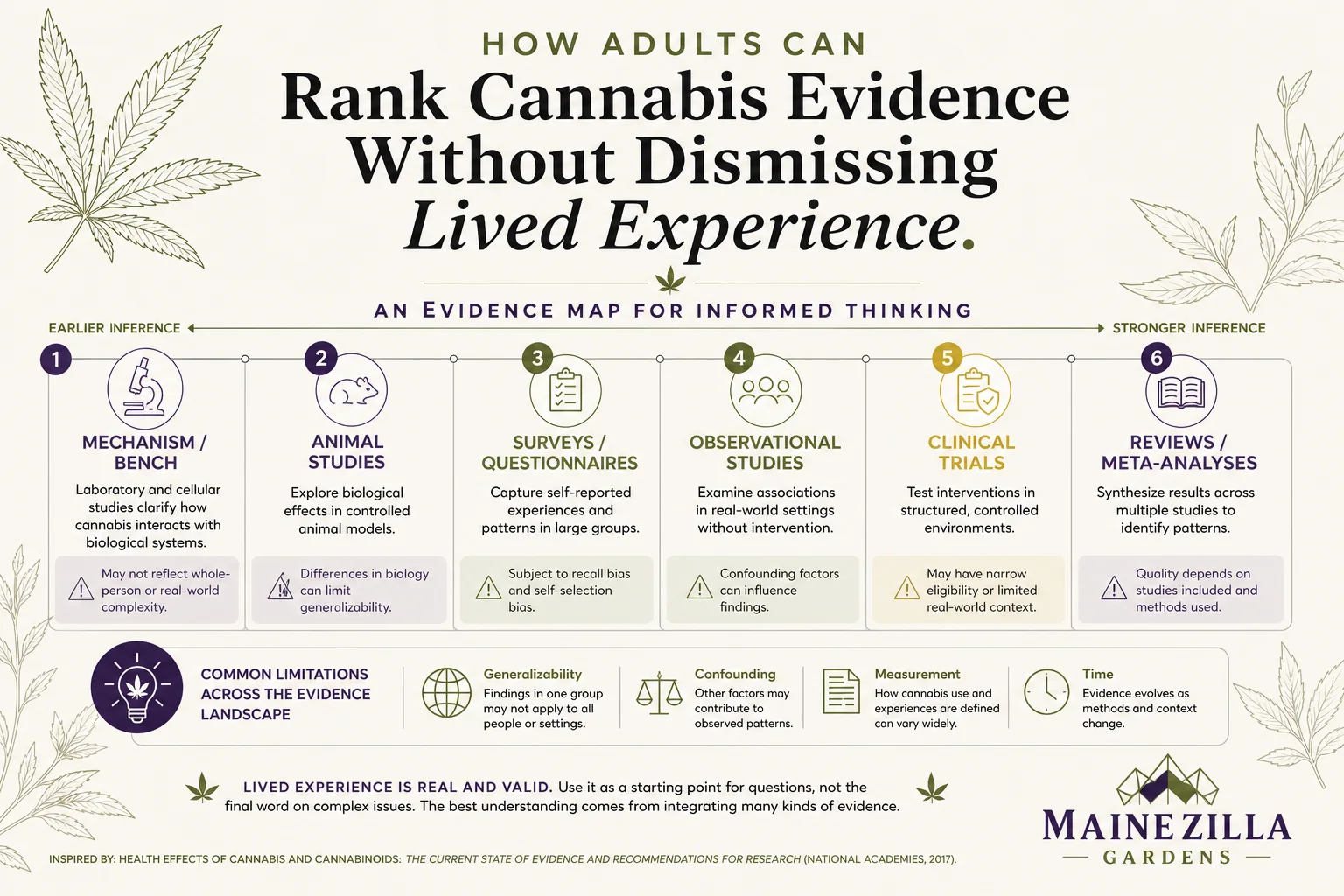
An evidence-map diagram that teaches how different study types contribute distinct information. The illustration should make no causal claims; it is explanatory only and highlights limits (e.g., generalizability).
Research context: The Health Effects of Cannabis and Cannabinoids: The Current State of Evidence and Recommendations for Research (National Academies review, 2017)A short map: the kinds of studies you'll run into
- Mechanism (bench) studies: cell culture, receptor binding, pharmacology. They aim to show how compounds interact with biology, often using isolated systems.
- Animal research: controlled experiments in rodents or other mammals that explore dose–response, mechanisms, and sometimes safety signals.
- Surveys: structured questionnaires of people — often large but subject to self-report biases and sampling limits.
- Observational research: cohort or case–control studies that examine associations in real-world populations.
- Clinical trials: randomized controlled trials (RCTs) or other interventional studies that compare outcomes under specified conditions.
- Reviews and meta-analyses: syntheses that pool and weigh multiple studies; their strength depends on the quality of included work.
- Individual notes and case reports: clinician or patient observations, diaries, and community reports — high on context, low on generalizability.
Each study type answers different questions. Mechanism work tells you what might be possible inside the cell; clinical trials tell you what happened when real people were studied under a protocol; lived notes tell you how people actually use products and what they notice. Good judgment regards them as complementary rather than as a strict ladder where only one rung matters. Where evidence is unclear, transparency about limits is the key principle. (ncbi.nlm.nih.gov)

Laboratory context: chromatography and reference materials underpin potency and contaminant testing. The image demonstrates the role of lab methods in translating research and product claims; it intentionally hides numeric readouts and brand marks.
Research context: NIST Tools for Cannabis Laboratory Quality AssuranceMechanism and animal studies: why they matter — and what they don’t
Mechanistic experiments and animal models are the laboratories’ first pass. They can reveal receptor interactions, metabolic pathways, and plausible biological effects under controlled conditions. That makes them extremely valuable when formulating hypotheses and flagging potential safety issues to study in people. However, cells and rodents are not people: differences in dosing, route of administration, metabolism, and brain development mean that findings often need careful translation to human contexts.
For example, receptor-binding work can show that a cannabinoid interacts with CB1 or CB2 receptors; this explains how psychoactive effects might occur. Animal toxicology can highlight organ systems to monitor in human studies. But these data cannot, by themselves, predict the full range of human experiences or real-world risks. Overreliance on animal work without human data is a common misstep when ranking evidence.
Because mechanism and animal work often use higher relative doses and simplified exposure models, they are best used as signposts: they tell researchers what to watch for in clinical trials and observational studies, not what will definitively happen in everyday adult use. The National Academies’ synthesis of evidence also emphasizes that mechanistic data are one piece of a larger puzzle. (ncbi.nlm.nih.gov)
Surveys and observational research: big-picture signals with important caveats
Large surveys and observational cohort studies give us population-level patterns: who uses cannabis, how often, what product forms they choose, and correlations with other outcomes like mental-health complaints or driving incidents. The CDC, for example, uses surveillance and survey data to summarize population trends and public-health signals. These datasets are invaluable for spotting trends and informing policy. (cdc.gov)
But correlation is not causation. Observational research may control for known confounders, but unmeasured variables (socioeconomic status, concurrent substance use, or health-seeking behavior) can bias results. Self-reporting — how people recall dose, frequency, or product type — introduces additional uncertainty. Surveys are also time-dependent: product markets, potency, and common modes of use have changed rapidly over the last decade, so older surveys may be less relevant to today's concentrates or gummies.
When you read a survey or cohort study, look for sample size, how exposure was measured, and which confounders were adjusted for. Where possible, prefer observational work that triangulates with other study types (e.g., consistent findings across surveys, medical-record cohorts, and controlled studies), because repeated signals across methods strengthen confidence. (pubmed.ncbi.nlm.nih.gov)
Clinical trials and systematic reviews: where evidence is strongest — and still limited
Randomized controlled trials (RCTs) are the standard for testing an intervention’s effect under specified conditions: they reduce confounding by randomly assigning participants and, when blinded, limit expectation bias. Systematic reviews and meta-analyses synthesize RCTs and other designs, grading consistency and quality across studies. The National Academies review is a good model of a careful synthesis that lays out where evidence is substantial, limited, or absent. (ncbi.nlm.nih.gov)
That said, clinical trials in the cannabis literature have important constraints. Sample sizes are often small; products tested may not match what’s available in state markets; formulations differ in cannabinoid profile and route of administration; and many trials measure short-term outcomes rather than long-term effects. Regulatory hurdles and the federal scheduling status of cannabis have historically limited large-scale, multisite trials in the U.S., though this landscape is gradually changing.
When you encounter a trial or review, check whether the population studied, the product, and the outcome measured match the question you care about. A well-run small RCT that tests a pharmaceutical cannabinoid in a narrowly selected group is strong evidence for that context — but it is not a catch-all endorsement for all products or patterns of use. Government summaries (FDA, CDC) and major reviews can help you translate the differences between trial conditions and everyday settings. (fda.gov)

This composite explains why local program rules and dashboards matter for interpreting evidence in Maine. It is archival and documentary: numbers and dashboard readouts are intentionally blurred to avoid implying current stats.
Research context: Office of Cannabis Policy ·Individual notes, clinician observations, and lived experience: what they add
Personal reports and case notes are where nuance lives. A patient, caregiver, or grower can observe timing, onset, relative effects of cultivars, and product handling details that don’t show up in a lab protocol. These observations can identify new questions, highlight safety problems in the supply chain (like contamination or inconsistent potency), and suggest how product labeling or packaging interacts with real use.
But individual reports are subject to many biases: attribution (assuming an effect is due to cannabis when it might be due to something else), recall error, and selective reporting. Still, they are essential for hypothesis generation and safety surveillance. Public health systems and poison-control centers routinely use aggregated case reports to identify emerging issues, such as increases in pediatric edible exposures. Those reports can trigger more rigorous study and policy responses. (poison.org)
The practical way forward is not to dismiss lived experience but to triangulate it: check whether individual notes align with observational data, mechanistic plausibility, and controlled trials. When a cluster of lived reports points to an unexpected problem (contamination, an adverse effect in a specific product type), regulators and labs are the next stop for verification. In Maine, OCP testing rules and lab guidance tie these threads together for regulated products. (maine.gov)
A simple framework adults can use to rank evidence
-
Define the question precisely: Are you asking about short-term effects, long-term risks, product comparability, or dosing patterns? Different questions need different evidence types.
-
Start with synthesis: look for recent systematic reviews or government summaries (e.g., NASEM, CDC, FDA) that describe the consensus and the gaps. These documents save you time and clarify where single studies fit. (ncbi.nlm.nih.gov)
-
Match context: does the study population, product form, and outcome resemble your situation? If not, downgrade how directly the finding applies.
-
Triangulate: give higher weight to findings that appear across different study types (mechanistic plausibility + observational signal + controlled trial). Single-case notes are useful signals, not endpoints.
-
Check measurement quality: reliable lab methods, certified reference materials, and transparent testing are essential for trusting product-level claims. NIST’s measurement program and reference materials help labs produce comparable results. (nist.gov)
-
Watch for conflicts of interest and methodological limitations: small sample size, lack of blinding, or industry funding are reasons to read more skeptically.
This approach gives adults a structured way to rank evidence while still valuing community knowledge.
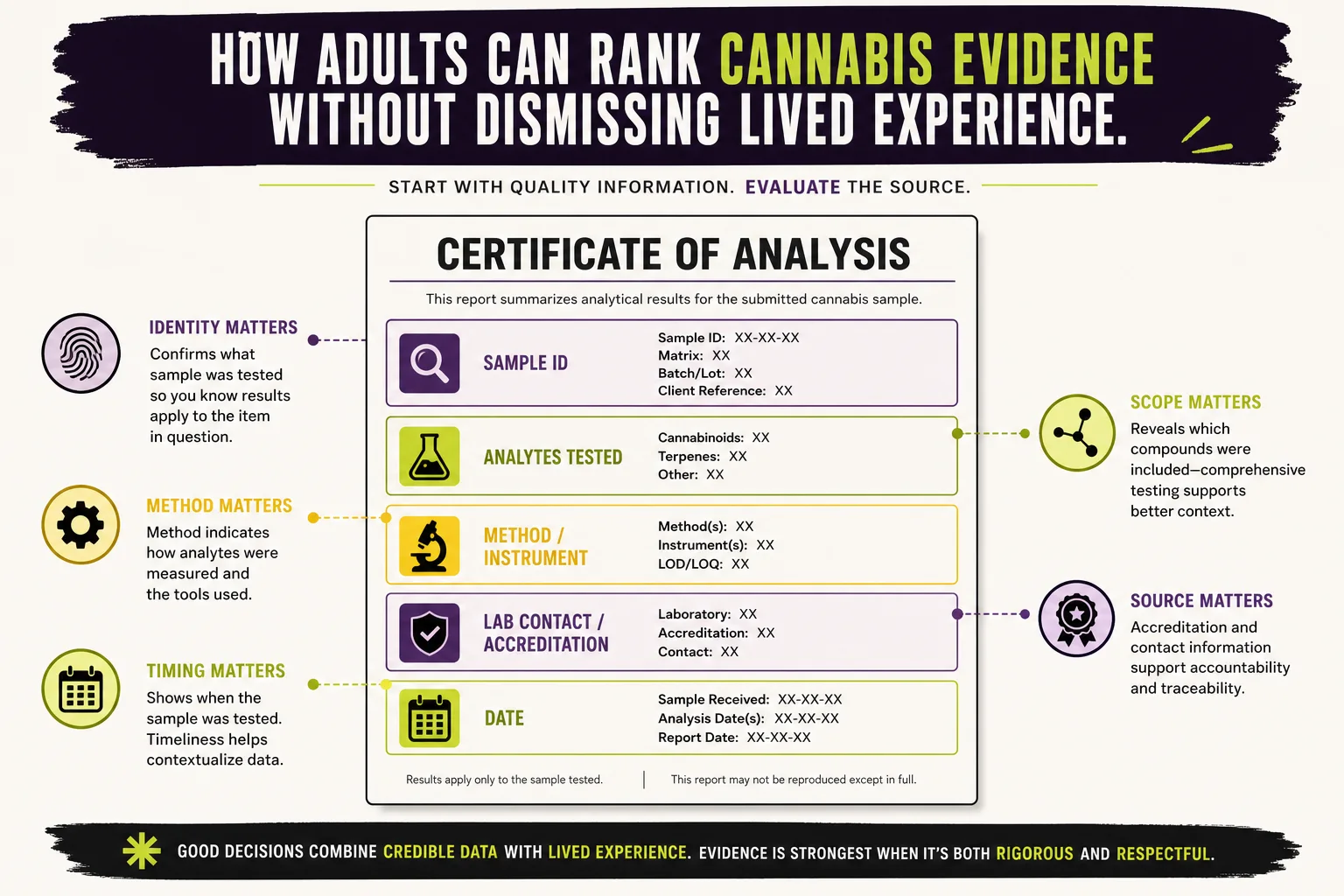
A step-by-step explanatory graphic showing the elements to check on a lab Certificate of Analysis. It teaches interpretation without presenting real product results or medical advice.
Research context: NIST Tools for Cannabis Laboratory Quality Assurance · Office of Cannabis PolicyHow Maine’s rules and lab work shape what evidence means locally
Maine’s Office of Cannabis Policy manages both an adult-use program and a medical-use program; those systems have distinct rules and registries, and OCP publishes guidance and testing standards for licensed products. Knowing which program a product or dataset comes from matters when you try to apply findings to everyday decisions. (maine.gov)
Laboratory measurement matters just as much as study design. NIST’s Cannabis Laboratory Quality Assurance Program, reference materials, and method development work address a core problem: if labs measure potency and contaminants differently, then product-level claims become unreliable. NIST’s tools and reference materials make it easier to compare results across labs and over time. That work reduces noise when translating research and lived reports into practical conclusions. (nist.gov)
For adults in Maine: combine the statewide rules and lab-report context with study-level evidence and lived experience. If a product carries a lab certificate that references recognized methods or a state-required test, it is more informative than an untested home-batch label — but certificates themselves should be read critically (date, lab accreditation, analytes tested). OCP publishes guidance and data dashboards that can help citizens check program-level information. (www1.maine.gov)
Practical next steps for adults who want to weigh evidence day to day
- Clarify your question before you look for data.
- Start with trusted syntheses (CDC, NASEM, FDA) to understand the landscape. (cdc.gov)
- Use the framework above to judge whether a new study or anecdote changes your conclusion.
- When product safety is the question (contaminants, inconsistent potency), look for test reports tied to accredited methods or labs that use recognized reference materials. NIST guidance can help you interpret what “measured” actually means. (nist.gov)
- View single reports as valuable signals that may deserve verification, but not as definitive proof.
Key takeaways
- Different study types answer different questions; regard them as complementary rather than hierarchical.
- Mechanistic and animal data are useful for hypotheses, not direct predictions about humans. (ncbi.nlm.nih.gov)
- Surveys and observational work show population patterns but can’t by themselves prove causation. (pubmed.ncbi.nlm.nih.gov)
- Clinical trials and systematic reviews are strongest for causal claims in the studied context, but trials are limited by sample, product, and regulatory constraints. (ncbi.nlm.nih.gov)
- Lived experience points to real-world complexity and can surface safety issues; triangulate with formal studies and lab data. (poison.org)
- Maine’s OCP rules and evolving lab standards matter: look at program context and lab methods when judging product claims. (maine.gov)
FAQ
Q: How can I tell if a study applies to the kind of product I use? A: Check the population, product form (flower, concentrate, edible), route of administration, and measured outcomes. If the trial used a specific pharmaceutical formulation or an older product type, its relevance to a modern retail edible or concentrate may be limited. Look to reviews and government summaries for translation. (ncbi.nlm.nih.gov)
Q: Are individual reports useful when evidence is thin? A: Yes — they’re valuable signals that can identify safety or supply-chain issues. Use them to form hypotheses and seek corroboration from surveillance data, poison-control reports, and laboratory testing. (poison.org)
Q: Should I trust product certificates of analysis (CoAs)? A: CoAs matter, but read them critically: check the lab name, the test date, analytes reported, and whether the lab references validated methods or reference materials. NIST’s measurement resources help improve trust in lab outputs. (nist.gov)
Q: Where can I find trustworthy summaries of the evidence? A: Government reviews and major independent syntheses (CDC, FDA, National Academies) are good starting points because they explicitly list limitations and research gaps. (cdc.gov)
Q: Does Maine’s program apply the same rules to medical and adult-use products? A: No. Maine operates separate medical and adult-use programs with different registries and some different rules. Check OCP’s guidance documents to understand specific requirements. (maine.gov)
Questions this guide answers
How can I tell if a study applies to the kind of product I use?
Check population, product form, route, and outcomes. Trials using pharmaceutical formulations or older products may not generalize to modern retail items; use reviews and government summaries to bridge the gap. ([ncbi.nlm.nih.gov](https://www.ncbi.nlm.nih.gov/books/n/nap24625/pdf/))
Are individual reports useful when evidence is thin?
Yes. Individual notes are hypothesis generators and early-warning signals for safety or supply-chain concerns; verify them with surveillance, poison-control reports, and lab testing. ([poison.org](https://www.poison.org/articles/my-child-ate-a-cannabis-edible))
Should I trust CoAs (Certificates of Analysis)?
CoAs are useful but require critical reading: confirm lab accreditation, test date, analytes measured, and methods. Reference materials and programs (like NIST’s CannaQAP) improve comparability across labs. ([nist.gov](https://www.nist.gov/programs-projects/nist-tools-cannabis-laboratory-quality-assurance))
Where are good places to start reading about cannabis evidence?
Government syntheses and major independent reviews — CDC, FDA, and the National Academies — summarize evidence, note gaps, and are good first stops. ([cdc.gov](https://www.cdc.gov/cannabis/health-effects/index.html))
Do Maine’s medical and adult-use programs differ?
Yes. Maine runs distinct programs with separate registries and rules; OCP publishes guidance and data dashboards that explain program differences and testing requirements. ([maine.gov](https://www.maine.gov/dafs/ocp/home))
Educational information only. Cannabis affects people differently and this is not medical advice.