
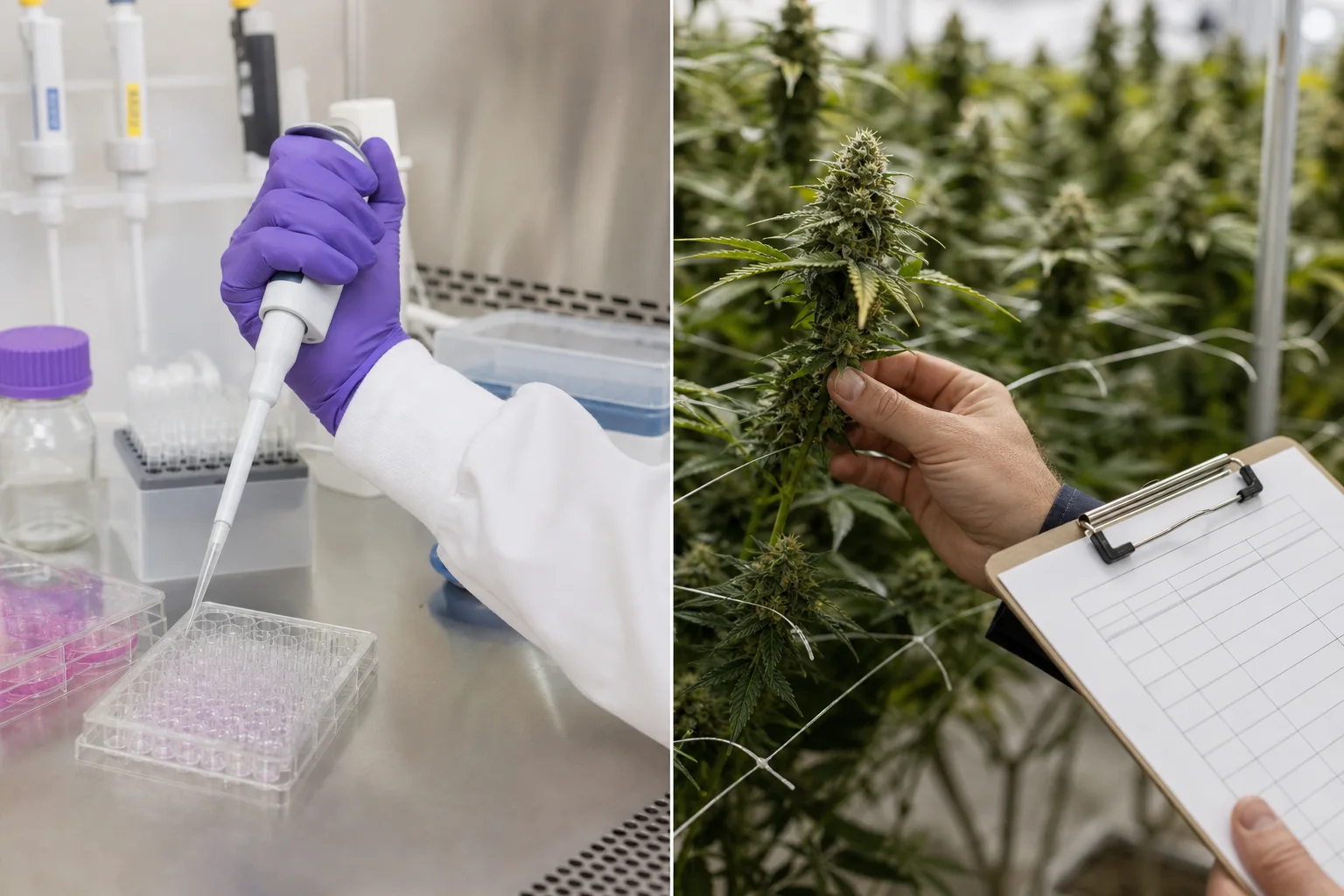
A teaching juxtaposition: laboratory mechanism work next to a grower’s batch record. This visual frames the article’s main point—both lab evidence and careful lived records matter, but they answer different questions. Limit: the image is illustrative and not evidence of a specific product’s safety or effects.
Why an evidence hierarchy matters — and why experience still counts
In the fog of claims, labels, and strong opinions, a clear way to read evidence helps adults make safer, more sensible decisions about cannabis. Evidence hierarchies don’t exist to dismiss people who swear a particular cultivar helps them; they exist to show how different kinds of information answer different questions. Mechanistic lab work asks "how could it work?" Surveys and observational studies ask "what happened in real life?" Randomized trials ask "what changed when we compared groups under controlled conditions?" Each has strengths and limits, and learning to read those limits is a practical skill.
Lived experience—patient notes, grower logs, caregiver observations—are essential. They generate hypotheses, point researchers to real problems, and help people choose among products when solid trial data aren't available. But anecdote is also vulnerable to placebo effects, recall bias, changes over time, and selection bias (people who benefit tend to speak up, those who don't, often do not). Using lived experience as a primary driver of policy or universal claims can lead to missteps; viewing it as a vital, hypothesis-generating input keeps it where it belongs: useful, respected, and contextualized.
This piece shows how to read seven evidence types and offers a compact, practical ranking framework you can use next time a study, label, or neighbor's story crosses your path. Where relevant I point to official guidance—what public health and regulatory bodies emphasize about safety, product claims, and program differences in Maine. (cdc.gov)
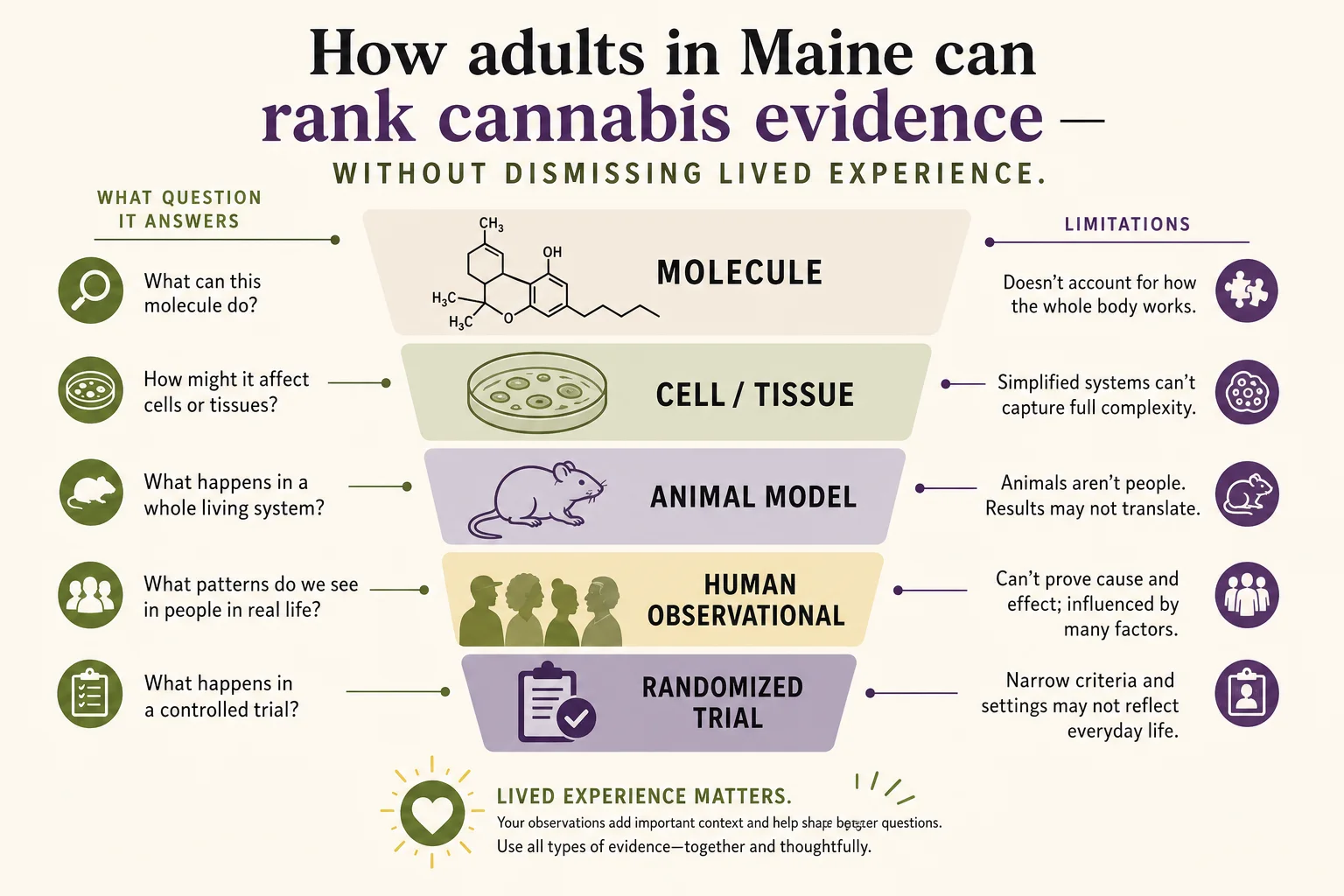
An evidence cascade diagram: mechanism studies and animal work show plausibility but need human trials for causal claims. Caption explains the translational gaps and where lived experience fits. Limit: diagram is conceptual and does not display experimental data or numeric outcomes.
Research context: Therapeutic use of cannabis and cannabinoids: an evidence mapping and appraisal of systematic reviewsMechanism studies and laboratory work: promise with caveats
Mechanistic studies explore how cannabinoids and other compounds interact with cells, receptors, and metabolic pathways. They are the first step when a scientist asks whether a compound could plausibly change biology. These papers are invaluable because they can identify targets, pathways, and potential risks—information growers and clinicians use to design safer products and experiments. However, a mechanism alone never proves that a real person will notice a benefit or that it will be safe at the dose used in the lab.
Most mechanism work is done in cells or tissue preparations and sometimes in controlled animal models. Results can point to both helpful and harmful effects (for instance, how cannabinoids influence neuronal signaling or cardiovascular responses), but scaling from petri dish concentrations to human use is not straightforward. Mechanistic signals are reasons to study further, not reasons to make or accept broad claims about outcomes in people. (pubmed.ncbi.nlm.nih.gov)
If you read a flashy headline about a “mechanism discovered,” ask: Was this done in human tissue or in cell culture? What concentrations were used? Does the study discuss possible toxicities? Those are clues about how far—or how little—this paper can justify changing practice.
Animal research: controlled experiments that still aren’t people
Animal models give researchers a chance to run controlled experiments that answer causal questions not possible in humans for ethical or practical reasons. They can show dose–response patterns, organ-level effects, and developmental windows of vulnerability. That makes them powerful for safety signals and for generating ideas about what to test next in people.
But species differences matter. Rodent metabolisms, brain development timelines, and behavioral readouts are not human experiences. A cannabinoid dose that alters rodent behavior might be irrelevant or even unsafe in people. Animal results are best regarded as strong reasoning evidence—again, hypothesis-generating—rather than proof of human benefit or harm. When animal studies show a clear, reproducible safety concern, regulators and clinicians pay close attention; when they show a possible benefit, human trials typically follow before claims are widely embraced. (pubmed.ncbi.nlm.nih.gov)
For adults deciding about product choices, the useful move is to note animal evidence and watch whether clinical research follows. If many animal studies of a particular compound point to a reproducible safety risk, that’s a red flag—especially for pregnant people, young adults, or people on interacting medications. Poison Control and public health authorities track real-world harms and can translate animal warnings into practical advice. (poison.org)
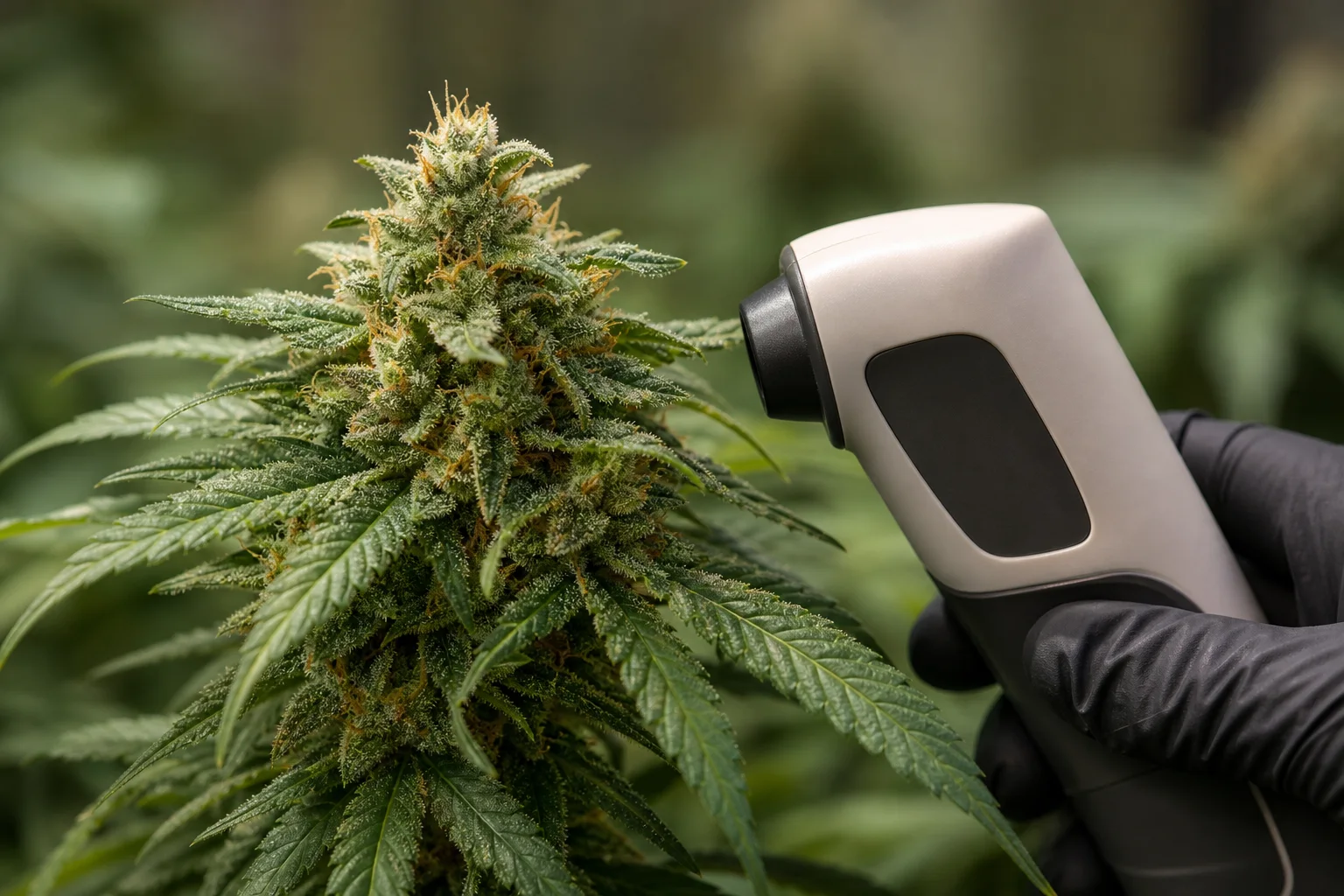
Close botanical macro showing trichome structure and a non-invasive lab instrument used for chemotype assessment. This teaches the difference between raw material and analytical characterization. Limit: image does not claim specific potency or batch values.
Research context: Office of Cannabis Policy (Maine)Surveys and observational studies: rich context, careful interpretation
Surveys and observational cohorts tell you what people actually do with cannabis and what they report happening. These studies capture variability—who uses high-potency products, how long effects last, what adverse events are reported, and what co-use patterns (alcohol, prescription meds) look like in the community. Observational research is often the best source of early safety signals and helps regulators set priorities.
But observation can’t fully separate cause and effect. Confounding is a major issue: people who choose a product might differ in many ways from those who do not. Recall bias, selective reporting, and variable product labeling make it hard to be certain whether an outcome was caused by cannabis or by other factors. Still, a consistent observational pattern across different cohorts—especially when paired with mechanistic plausibility—makes a stronger case than an isolated survey.
In Maine, observational work and program data inform policy choices at the Office of Cannabis Policy and spotlight lab-testing gaps and contamination concerns that matter to growers and patients. Observational evidence that identifies contaminants or inconsistent potency has practical regulatory consequences for product testing and labeling. (www11.maine.gov)
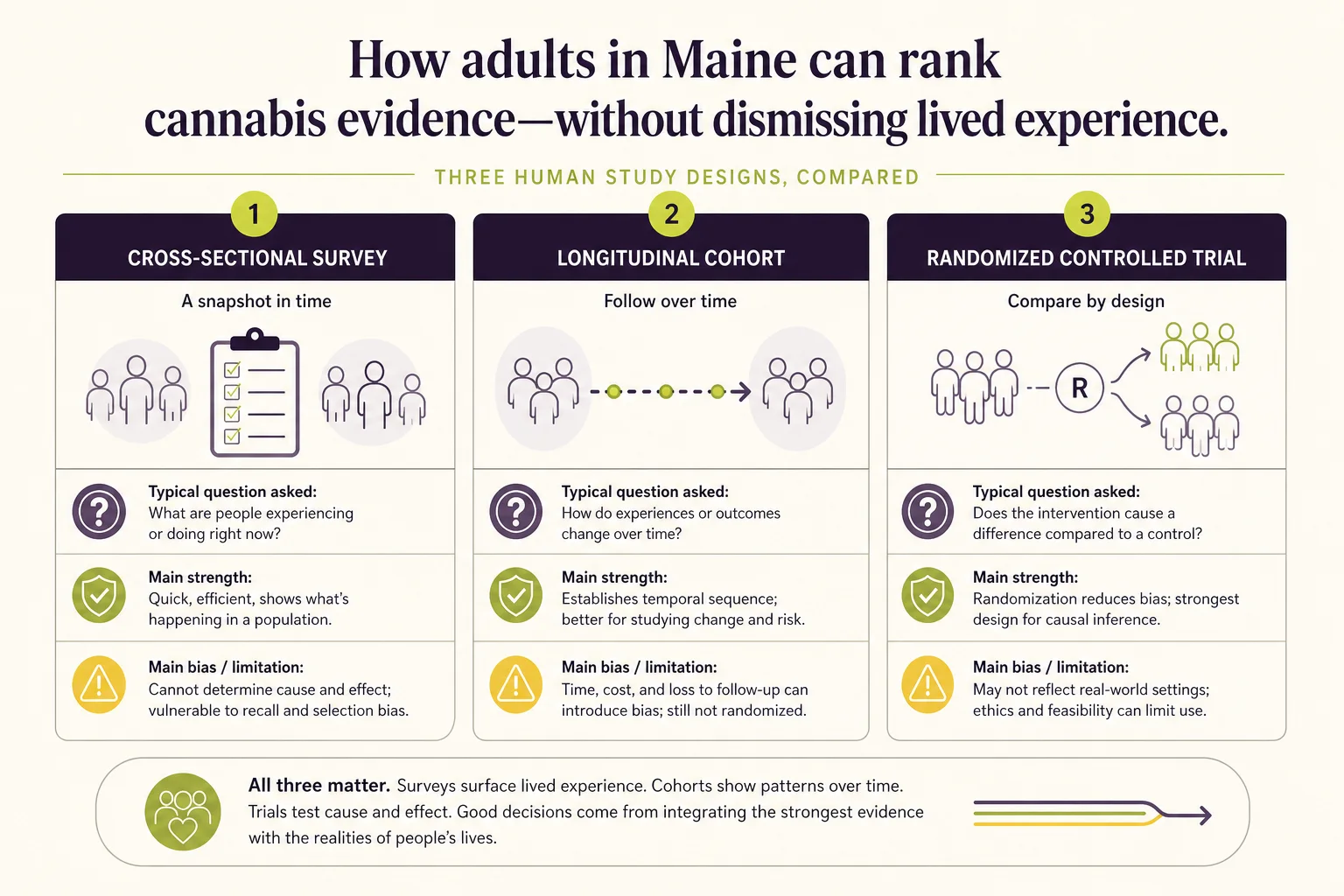
A compact study-design cheat sheet: what each human study type can and cannot tell you, plus common biases to watch for. Limit: schematic is didactic and does not present real study results.
Research context: What You Need to Know (And What We’re Working to Find Out) About Products Containing Cannabis or Cannabis-derived Compounds, Including CBDRandomized trials and systematic reviews: strengths and boundaries
Randomized controlled trials (RCTs) are designed to reduce bias by randomly assigning participants to interventions and controls. They are the clearest way to test whether a compound or product produces a consistent effect in people under specified conditions. Systematic reviews and meta-analyses synthesize that trial evidence and can give a better overall picture of consistency and magnitude of effects.
However, RCTs in cannabis face unique challenges: product heterogeneity (different strains, chemotypes, delivery methods), blinding difficulties (people detect psychoactive effects), dose-standardization problems, and legal/regulatory barriers that have historically limited large-scale trials. Systematic reviews often highlight how few high-quality trials exist for many questions and how small sample sizes and inconsistent outcomes hamper firm conclusions. That does not mean trials are irrelevant—quite the opposite—but it means we must read them for what they test (specific product, dose, population) and not generalize beyond that context. (pubmed.ncbi.nlm.nih.gov)
When you see an RCT showing a small, measurable effect, consider who was studied (age, prior cannabis exposure), what product and dose were used, and how long the follow-up lasted. A trial in a narrowly defined group under strict conditions may have high internal validity but limited generalizability to everyday use in Maine adults.
Systematic reviews and guideline-type syntheses: big-picture value
Systematic reviews collect, appraise, and sometimes combine results from multiple primary studies. They are especially valuable because they make bias assessment and study quality explicit. High-quality reviews often highlight where evidence is robust, where it is conflicting, and where gaps remain. They are the best single resource for a balanced, literature-wide perspective—when they exist and are current.
But reviews inherit the limitations of included studies. If most primary studies are small, variable, or biased, even a careful review will conclude that evidence is low or inconsistent. That’s an honest and useful result: it tells you not that "nothing works" but that more rigorous, standardized research is needed before broad claims are justified. Reviews, like trials, should be read for scope: which products, outcomes, and populations were included? (pubmed.ncbi.nlm.nih.gov)
For adults who want to rely on summaries rather than individual papers, systematic reviews—paired with official public-health syntheses—are the most efficient, defensible sources to consult first.

A practical scene: consulting Maine OCP guidance while taking notes in a cultivation area. This teaches the article’s local application and the importance of consulting state guidance when interpreting evidence. Limit: image does not show any confidential records or product labels.
Research context: Maine Medical Use of Cannabis ProgramCase reports and lived experience: how to keep them central without mistaking them for proof
A well-documented case note or patient’s log can illuminate unusual effects, rare adverse events, or unexpected product–medication interactions. Case material is where clinical creativity and lived reality often originate. Growers’ batch notes and patients’ consumption journals can show dosing patterns, onset timing for edibles, or consistent product observations across multiple users.
But single-case observations cannot rule out placebo effects, regression to the mean, or coincidental timing. The most valuable role for case notes is to prompt better study designs—surveys, cohort studies, or small trials—that test whether the anecdote is reproducible. In a world with limited large trials for many cannabis products, thoughtful aggregation of lived experience (standardized diaries, time-stamped observations, consistent outcome measures) raises the signal quality of anecdote.
Those relying on lived experience can document details such as dates, product batch numbers, method of use, and concurrent substances or conditions. This is the kind of data that can be aggregated responsibly and can inform local practice without being mistaken for generalizable proof.
A practical ranking framework adults can use today
When you see a claim or study, use three quick checks: (1) Relevance—does the study population, product, and dose match the question you have? (2) Reliability—what study type is this, and what are its main biases? (3) Triangulation—do multiple evidence types (mechanism, animal, observational, trial, and lived experience) point the same way? Rank evidence like this in practice:
- High-quality systematic reviews and large, well-conducted RCTs on the same product/population.
- Multiple independent RCTs or a single well-powered RCT with transparent methods.
- Observational cohorts with good confounder control and consistent findings.
- Mechanistic and animal studies showing plausible pathways (support but don’t prove human effects).
- Case series and aggregated lived experience with consistent, documented patterns.
- Single anecdotes and isolated claims.
This ranking helps you weigh evidence without dismissing lived experience. If lived experience suggests something important and higher-tier evidence is absent, consider the lived signal a research priority and a practical caution—useful for forming cautious choices, not for broad endorsement. Consulting public-health resources and regulators can help interpret safety signals. (cdc.gov)
How this matters in Maine: program differences and safety resources
Maine runs two separate programs: the Maine Medical Use of Cannabis Program and the Adult Use Cannabis Program. They differ in who they serve, registration rules, and some operational details; for instance, medical registrants and adult-use consumers follow different possession limits, and medical dispensaries operate under a separate registration structure. Product testing standards have historically differed between programs, which is why state audits and OCP guidance matter to growers and patients alike. If you’re using evidence to make choices, understand the program context of the products you access. (www11.maine.gov)
Public health and consumer-safety agencies emphasize unknowns and safety limits. The CDC documents health-effect areas where evidence is incomplete and flags risks such as cannabis use disorder and impacts on brain function and cardiovascular responses. The FDA reminds consumers that only a narrow set of cannabinoid-containing products are FDA-approved and that product quality and marketing claims vary widely—important when a product’s label is being used as evidence. Poison Control provides practical, immediate guidance on adverse reactions and interactions, and is a resource for acute events. When evidence is thin, many people rely on conservative safety resources and program guidance. (cdc.gov)
Final practical advice: how to act, not just read
Be curious but skeptical. Respect a neighbor’s experience and consider keeping a personal log. A useful step is to look for systematic reviews or RCTs relevant to the exact product and population before placing weight on a broad claim. When only mechanism, animal, or anecdotal evidence exists, regard the claim as provisional: interesting and worth monitoring, not a settled fact.
Those prioritizing safety often consult official resources (CDC, FDA, Poison Control) and check Maine OCP guidance about product labeling, testing, and program differences. Growers can maintain accurate batch records; patients and consumers may keep consumption notes; clinicians and caregivers can document consistently—good records help convert experience into useful evidence.
Both rigorous research and honest lived reports are needed. Read each for what it is, not for what you wish it were. Growers and Mainers who combine careful observation with attention to study quality tend to build the clearest, most useful knowledge over time.
Questions this guide answers
How should I weigh a single-person success story?
Respect it, document it, and treat it as a hypothesis. One person’s note can point to a useful study, but on its own it cannot prove causation.
Are randomized trials always better than observational studies?
RCTs reduce many biases and are strongest for causal claims, but they have limits—product variability, blinding challenges, and narrow populations—so both RCTs and well-conducted observational studies are useful.
Where can I find trusted safety guidance about cannabis?
Use federal and state public-health resources such as the CDC and FDA for health-effect summaries and Poison Control for acute events; Maine’s Office of Cannabis Policy explains program differences and guidance.
If no trials exist for a product, can I rely on mechanistic or animal studies?
Use them as reason to be cautious and curious. Mechanistic or animal results justify further study and careful observation, not broad confidence in human outcomes.
How can growers help improve evidence quality?
Keep accurate batch records, document terpene and cannabinoid profiles, record cultivation conditions and any consumer feedback; standardized, consistent notes raise the value of lived data for research.
Educational information only. Cannabis affects people differently and this is not medical advice.