
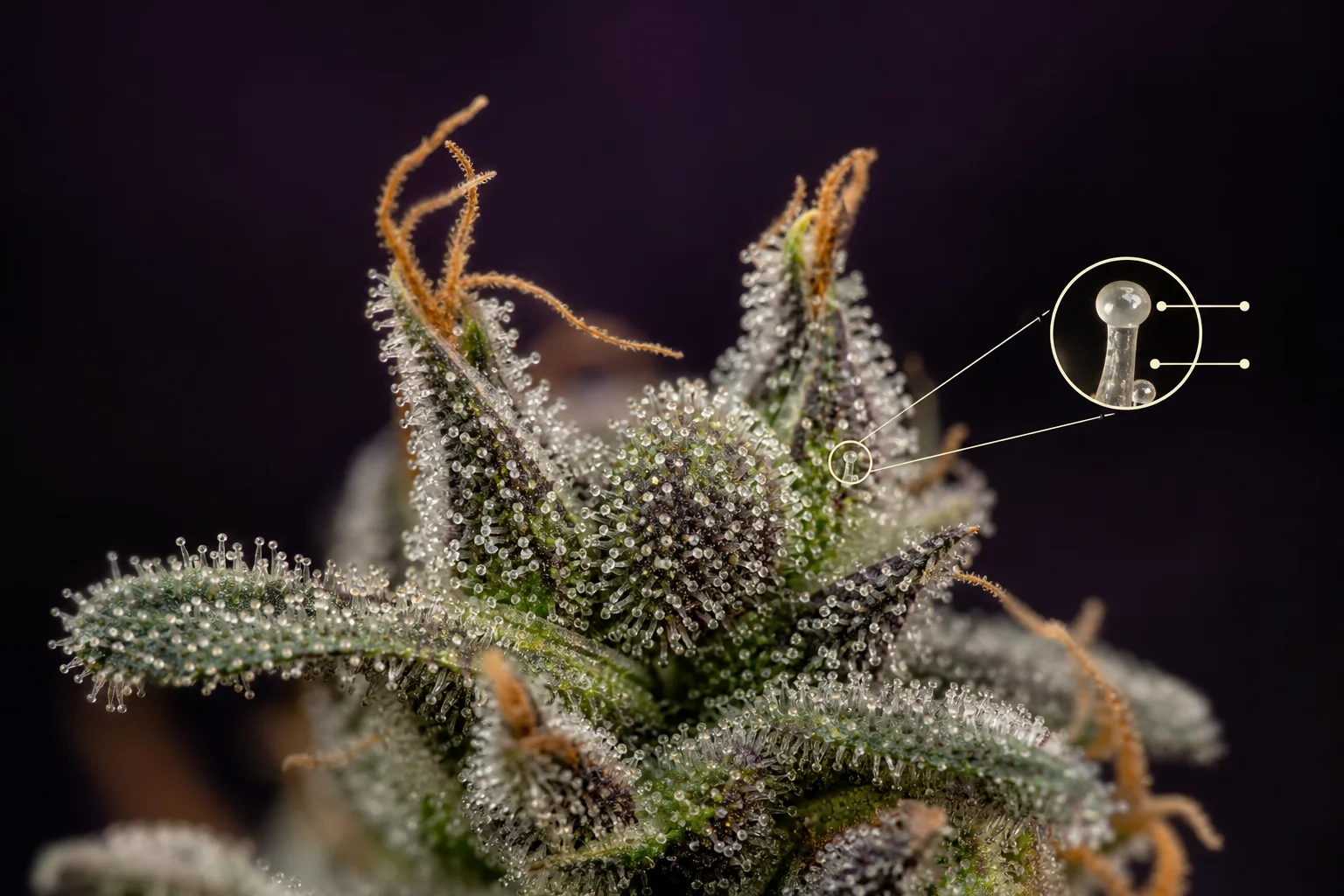
Macro trichome image showing the glandular structures where cannabinoids and terpenoids concentrate. This visual ties the lab chemistry back to plant anatomy and reminds readers that terpene production is localized and variable. The image teaches that COAs are snapshots of sampled trichomes, not whole-plant constants. Limit: a photo cannot show genetic expression or the COA method used for a sample.
Why a terpene panel deserves a calm, curious read
A printed or PDF certificate of analysis (COA) with a terpene table can look like an oracle: lists of names, numbers in mg/g or % and phrases like “top terpenes.” They are useful scientific snapshots — but snapshots, not prophecies. Terpenes are the volatile molecules that give cannabis its citrus, pine, floral, or peppery notes. Plant biochemistry determines which terpenes a cultivar can make, but environmental conditions, which trichomes are sampled, drying and storage, and the lab method used all shape the numerical profile you see on a report. Reading the panel well means keeping those limits front and center. (pmc.ncbi.nlm.nih.gov)
Terpenes are real molecules: limonene smells lemony, myrcene is often described as earthy or clove-like, and linalool smells floral. Those sensory connections are useful shorthand, but they don’t translate into consistent, predictable subjective effects across people. The scientific literature shows a complex picture: biosynthetic genes make sets of terpenes, and different cultivars express different suites of these genes — which helps explain recurring aroma patterns across strains — but the link from an individual terpene percentage to a particular psychoactive or mood outcome is weak or unproven. Regard the lab numbers as chemistry, and the aroma descriptors as sensory cues and storytelling, not definitive claims about effects. (pmc.ncbi.nlm.nih.gov)
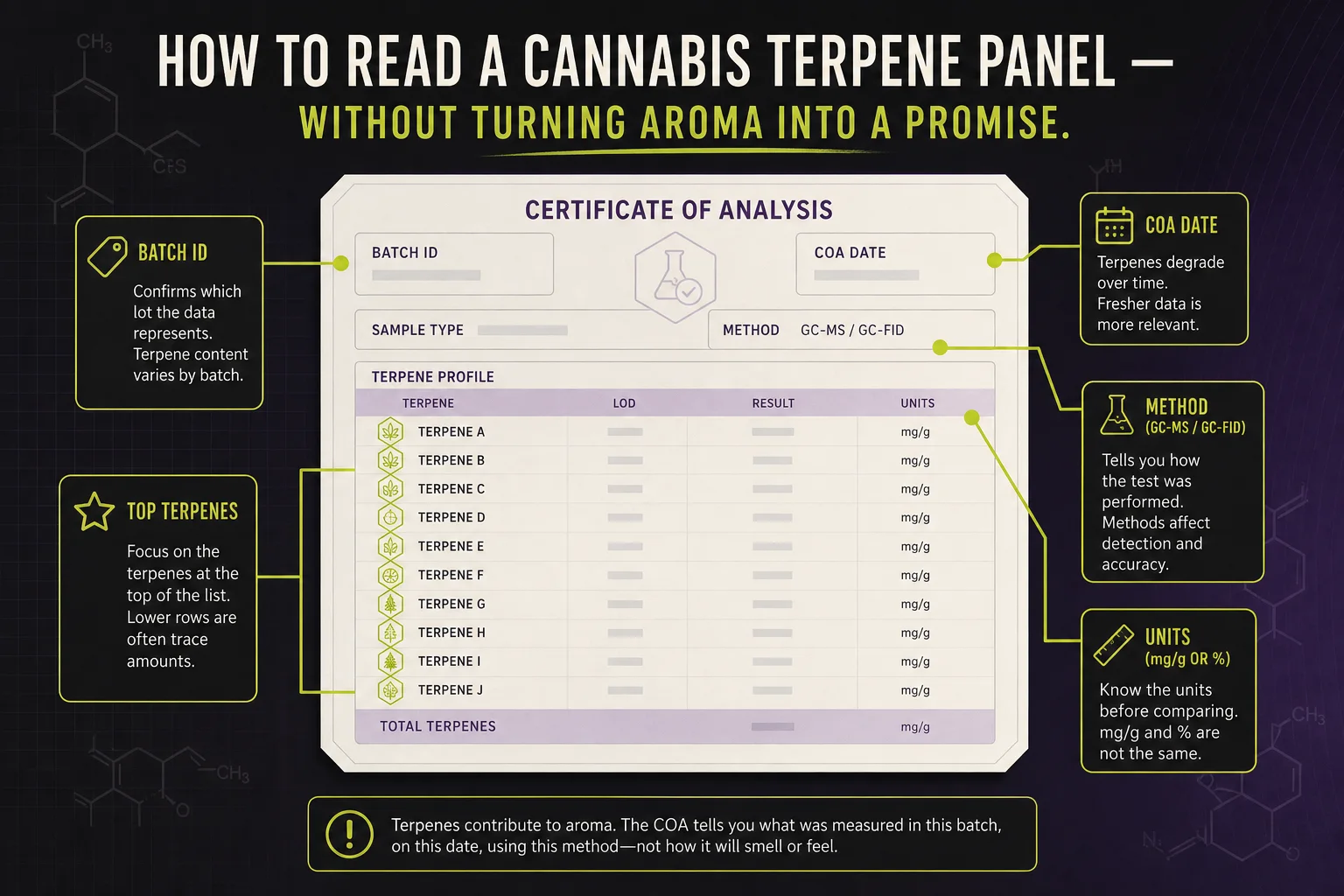
A neutral, annotated diagram of a COA terpene table pointing out batch ID, COA date, method, units, and top terpenes. This teaches readers what fields to check before interpreting numbers. Limit: the diagram does not show any real product name, prices, or readable proprietary branding.
Research context: Presentation: Dana McMurchy — Example COA graphicsWhat the lab measured (and how to read units)
Most cannabis labs report terpenes as mass per mass (mg/g) or as a percentage (% w/w). A value of 5 mg/g equals 0.5% by weight. Some labels show "sum of terpenes" and then list the most abundant individual terpenes. Labs usually report only the terpenes they validated in their method — so an absent compound may mean “below the lab’s reporting limit” rather than “not present.” Review the COA’s method section for the analytical technique (typically GC-MS or GC-FID) and the reportable limits. Methods and detection limits vary between labs. (fda.gov)
Gas chromatography with mass spectrometry (GC-MS) or flame ionization detection (GC-FID) are the usual tools. These techniques separate volatile compounds and quantify them against standards. A well-documented COA will say which terpenes were included, the units, the calibration approach, and whether results are from headspace (volatile fraction) or solvent extract. These technical details matter: headspace methods emphasize the volatiles a consumer will smell immediately; solvent extracts may capture a broader chemical picture but can shift relative proportions. It's a good practice to read the method note before comparing two different COAs. (pmc.ncbi.nlm.nih.gov)
Sensory descriptors vs. chemical names: bridging aroma and words
The scent vocabulary on dispensary menus is shorthand built from chemistry and human language. Limonene becomes “citrus,” pinene becomes “pine/needle,” and β‑caryophyllene becomes “peppery” or “woody.” Those connections come from decades of flavor and fragrance science and are helpful for communicating expectations. However, aroma perception is individual — influenced by prior experience, storage, the state of the sample, and paired compounds that shift a note’s salience. One person’s “lemon” can be another’s “overripe fruit.” Use the descriptors as human-friendly cues, not technical certainties. (pmc.ncbi.nlm.nih.gov)
Even within the plant, terpenes interact. The biosynthetic pathways that produce monoterpenes and sesquiterpenes are co-regulated with cannabinoids in glandular trichomes, meaning certain terpenes often co-occur with certain cannabinoid patterns. That co-occurrence explains why some aroma-and-cannabinoid pairings recur across cultivars, but it does not prove a direct cause-and-effect relationship between one terpene and a particular psychological state. Look for pattern and provenance, not single-compound answers. (pmc.ncbi.nlm.nih.gov)
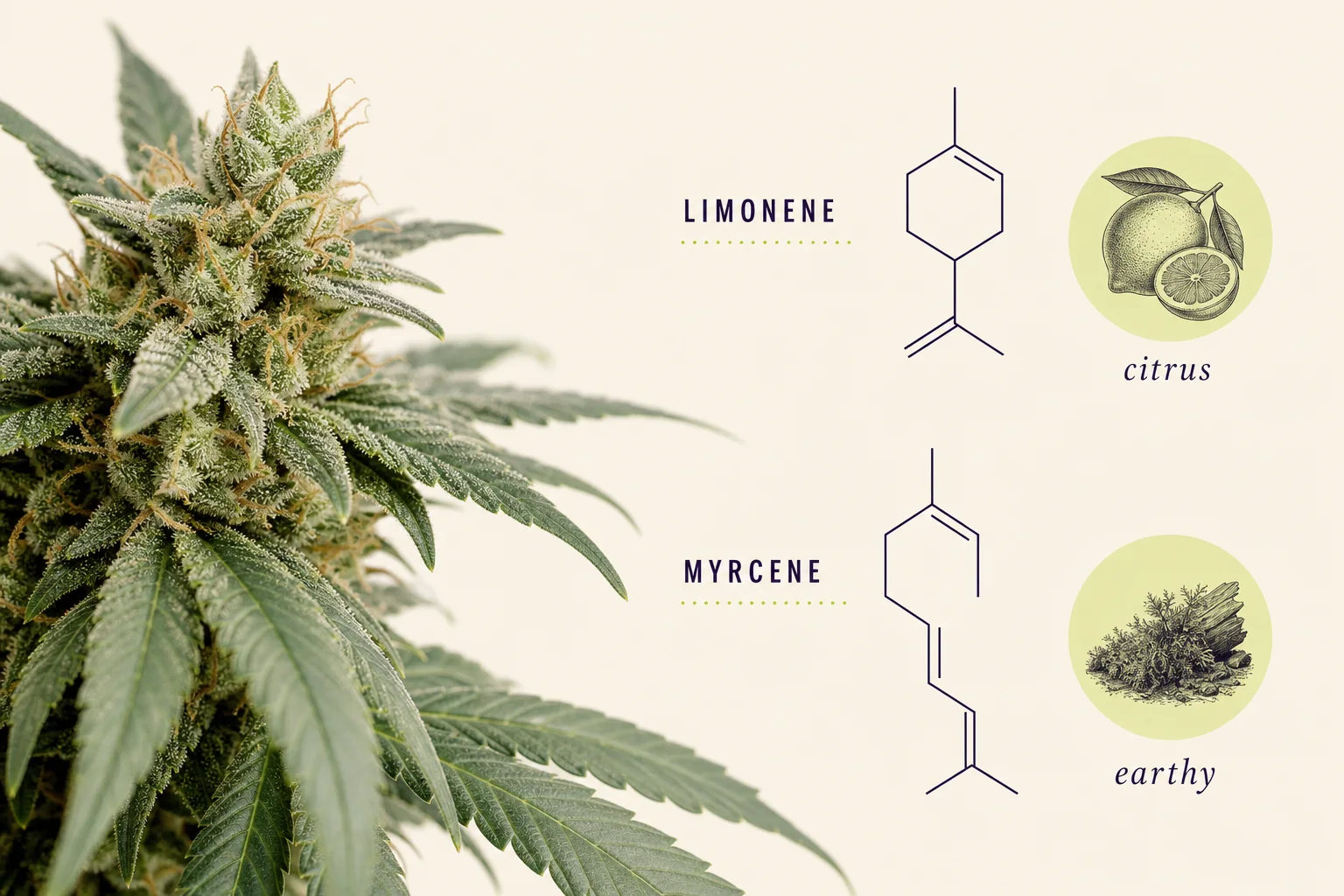
An explanatory illustration showing the molecular structures of limonene and myrcene next to photographs of the plant parts and common sensory descriptors. This connects chemical identity to common aroma words while underscoring that scent labels are interpretive. Limit: does not claim specific human effects.
Research context: The Cannabis TerpenesBatch context: why provenance, sampling, and timing matter
A COA is a test on a sample from a single batch. The plant is not a homogeneous chemical factory; different flowers on the same plant, different harvest days, and different drying or trimming approaches produce different terpene fingerprints. Post-harvest handling has outsized influence: drying too fast can drive off monoterpenes, long storage and heat can shift ratios toward heavier sesquiterpenes, and grinding exposes volatiles to air. That means a terpene panel tied to a specific harvest date applies to that batch, not every jar that might later carry the same name. (pmc.ncbi.nlm.nih.gov)
Maine’s medical program requires certification and testing rules that make COAs part of the regulated track; however, a COA still represents a sampled and time‑bounded measurement. For products sold under Maine rules, look for the COA date, testing facility name, and whether the report corresponds to a certified batch or a retained sample. Those administrative details tell you how directly a report maps onto the product you are holding. (maine.gov)
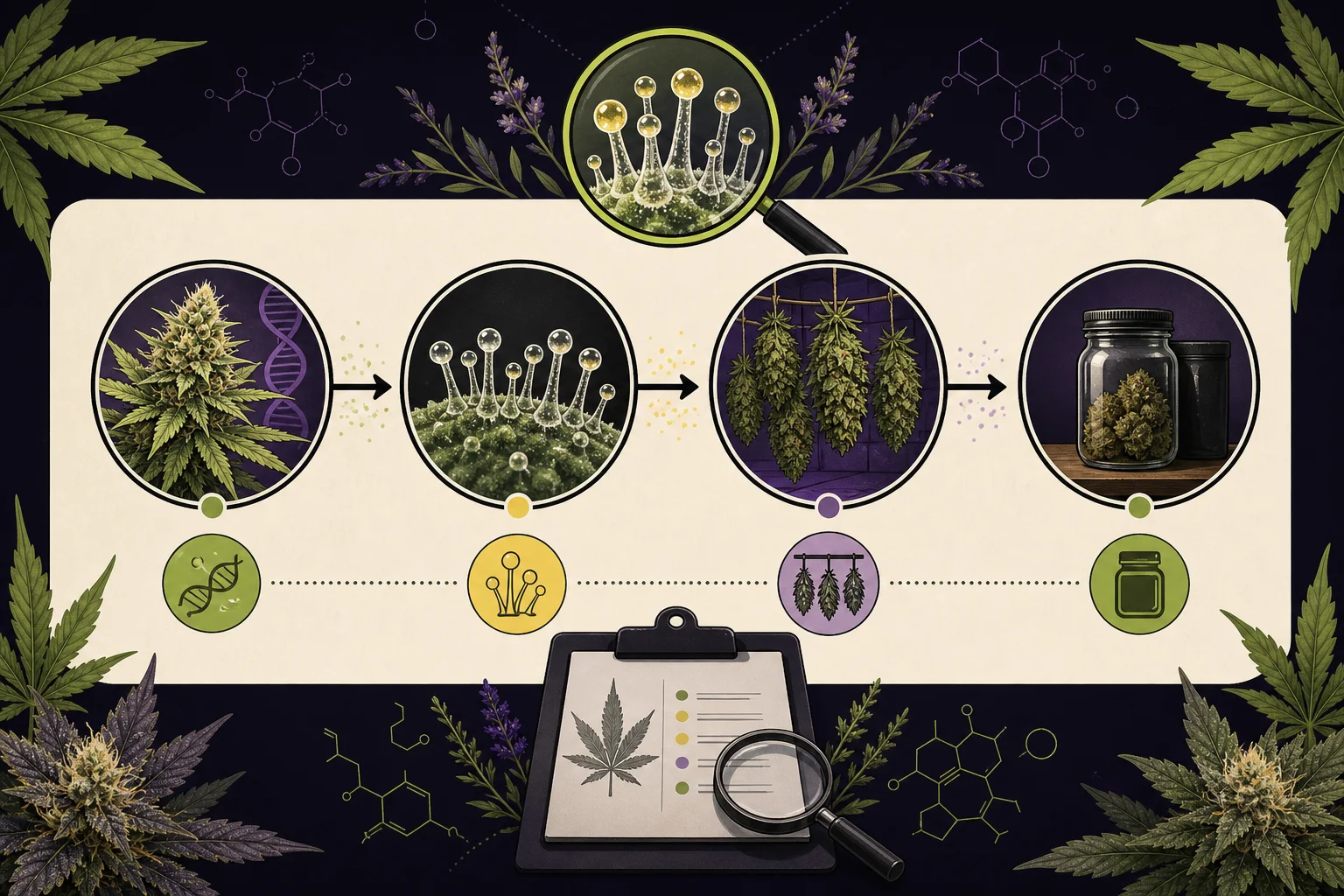
A clear flow diagram that maps variables — genetics, harvest timing, drying, curing, storage, and sampling location — to shifts in terpene profiles. This visual teaches how post-harvest handling and sampling cause COA variability. Limit: diagrammatic only; no causal-effect clinical claims.
Research context: Terpenes/Terpenoids in Cannabis: Are They Important?Step-by-step: how to read a terpene panel sensibly
-
Confirm the sample: find the batch or harvest ID and COA date. If the sample date is months before purchase, expect changes from storage and handling. If the test references "initial" vs "retest" results, read both notes to understand lab QC. (maine.gov)
-
Check the method and units: GC-MS or GC-FID are common, units should be mg/g or % w/w, and there should be a list of which terpenes the lab reports. If the COA lacks a methods section, approach comparisons cautiously. (fda.gov)
-
Look at the top terpenes, not a single number: the bouquet — the top three to five terpenes — tells the sensory direction. Two products with the same top terpene but different secondaries will likely smell and taste different. Chemistry creates families of aroma. (pmc.ncbi.nlm.nih.gov)
-
Contextualize total terpene content: a higher “sum of terpenes” can signal a more pronounced aroma, but it may also reflect concentration differences from processing (e.g., trim vs. flower). Don’t assume higher = better; assume different. (pmc.ncbi.nlm.nih.gov)
What a terpene panel does not tell you (and common overreads to avoid)
Terpene percentages do not guarantee subjective effects. The popular “this terpene causes relaxation” or “that terpene reduces anxiety” statements oversimplify complex neurochemistry and person-to-person variability. Clinical evidence linking single terpenes at the concentrations found in smoked or vaped cannabis to consistent mood or cognitive changes in humans is limited or inconclusive. Use the panel to inform expectation and selection, not as a prescription. (ncbi.nlm.nih.gov)
Similarly, a high terpene number is not a safety or potency rating. Terpenes contribute aroma and flavor and can influence the sensory experience, but psychoactive intensity is largely driven by cannabinoids such as Δ9‑THC. Moreover, some terpenes are irritants at high concentrations — the COA won’t tell you how your airways will respond — and terpenes in extracts or concentrates may concentrate differently than in flower. Read safety-related sections of COAs (residual solvents, pesticides, microbiology) separately; a terpene table is only one part of product safety information. (fda.gov)

A redacted, accessible checklist-style visual illustrating the Maine OCP testing and COA requirements (batch linkage, testing lab name, and test date). This connects the article’s advice to state rules and teaches readers which administrative COA details to inspect. Limit: redacted to remove any enforcement or legal counsel language and does not provide legal advice.
Research context: Medical Use Rules and StatutesPractical reading guide for Maine patients and adult learners
If you’re learning to read panels as a patient, caregiver, or curious grower, start local: compare COAs from products you’ve smelled and used, and keep a simple journal (batch ID, COA date, top 3 terpenes, sensory notes). Over time you’ll see patterns where certain terpene bouquets tend to align with the aromas you prefer. Remember that Maine’s regulatory materials require clear COA documentation for certified batches — use those procedural cues (testing lab, date, batch ID) when you evaluate a report. (maine.gov)
For growers and small-batch producers, standardized sampling and clear COA linkage to retained samples will increase buyer trust. If you send multiple samples from the same strain across harvests, you’ll also learn how cultivation, harvest timing, and drying shift terpene expression. Peer-reviewed work shows terpene production is genetically and environmentally modulated, so careful records matter. (pmc.ncbi.nlm.nih.gov)
Evidence limits and what science still needs to answer
There is robust botanical and analytical chemistry describing what terpenes are and how to measure them, but the translation from a terpene percentage on a COA to consistent human outcomes is not established. Reviews and controlled studies highlight plausible biochemical interactions between cannabinoids and terpenes, yet clinical trials demonstrating reproducible human effects linked to individual terpenes at concentrations present in inhaled or oral cannabis remain sparse. That means reasonable, evidence‑aware interpretation is still the best practice: rely on chemistry and sensory description for guidance; avoid definitive effect claims that outstrip the evidence. (pmc.ncbi.nlm.nih.gov)
Short, practical checklist before you trust a terpene panel
- Is there a clear batch/harvest ID and COA date? (If no, question applicability.)
- Does the COA list method, units, and reportable limits? (If no, compare cautiously.)
- What are the top three terpenes, and do their sensory notes match your nose? (Use this to set expectations.)
- Are safety panels present (pesticides, solvents, microbiology) on the COA? (Terpenes don’t cover safety.)
- Is the testing lab named and is the COA linked to the product label or batch? (This is important under Maine rules.)
Closing note from a grower’s perspective
If you grow, test, or buy in Maine, consider the terpene panel as field notes from the plant’s chemical life — precise and useful, but time‑bound and context-dependent. Taste and smell remain indispensable: nothing replaces smelling a jar. Use the COA to understand the chemistry behind the aroma, lean on sensory description for purchase decisions, and avoid translating terpene percentages into fixed promises about how any person will respond. Science will keep clarifying the connections; until then, combine lab evidence, sensory observation, and good batch records. (pmc.ncbi.nlm.nih.gov)
Questions this guide answers
Does a high terpene percentage mean stronger effects?
No. High terpene content often means a stronger aroma but does not reliably predict psychoactive intensity, which is driven mainly by cannabinoids such as Δ9‑THC. Terpenes affect scent and flavor and may modulate perception, but they aren’t a direct, consistent measure of effect across people.
Why does one batch smell different from another with the same strain name?
Terpene expression varies with genetics, harvest timing, drying, cure, storage, and sampling location on the plant. A COA represents one sample from one batch; different harvests or post-harvest handling create different profiles.
Are terpene panels required in Maine?
Maine’s medical program includes rules for testing and COA documentation; certified facilities must follow testing and labeling requirements so that COAs accompany batches and show testing information. Always check the COA for batch ID and testing lab details. ([maine.gov](https://www.maine.gov/dafs/ocp/sites/maine.gov.dafs.ocp/files/inline-files/Proposed%20Rule%2018-691%20CMR%20ch5%20-%20Rules%20for%20the%20Certification%20of%20CTFs.pdf))
Can I compare COAs from different labs directly?
Compare cautiously. Labs use different validated methods, reference standards, and reporting limits. Look for method notes (GC-MS vs GC-FID), units (mg/g vs %), and a consistent set of reported terpenes before making direct comparisons.
Do specific terpenes cause certain mood effects?
Current evidence does not support definitive claims that individual terpenes at levels found in cannabis consistently cause specific mood effects in people. Research suggests interactions and co-occurrence patterns, but clinical proof linking single terpenes to specific outcomes is limited. ([pmc.ncbi.nlm.nih.gov](https://pmc.ncbi.nlm.nih.gov/articles/PMC11870048/))
Educational information only. Cannabis affects people differently and this is not medical advice.