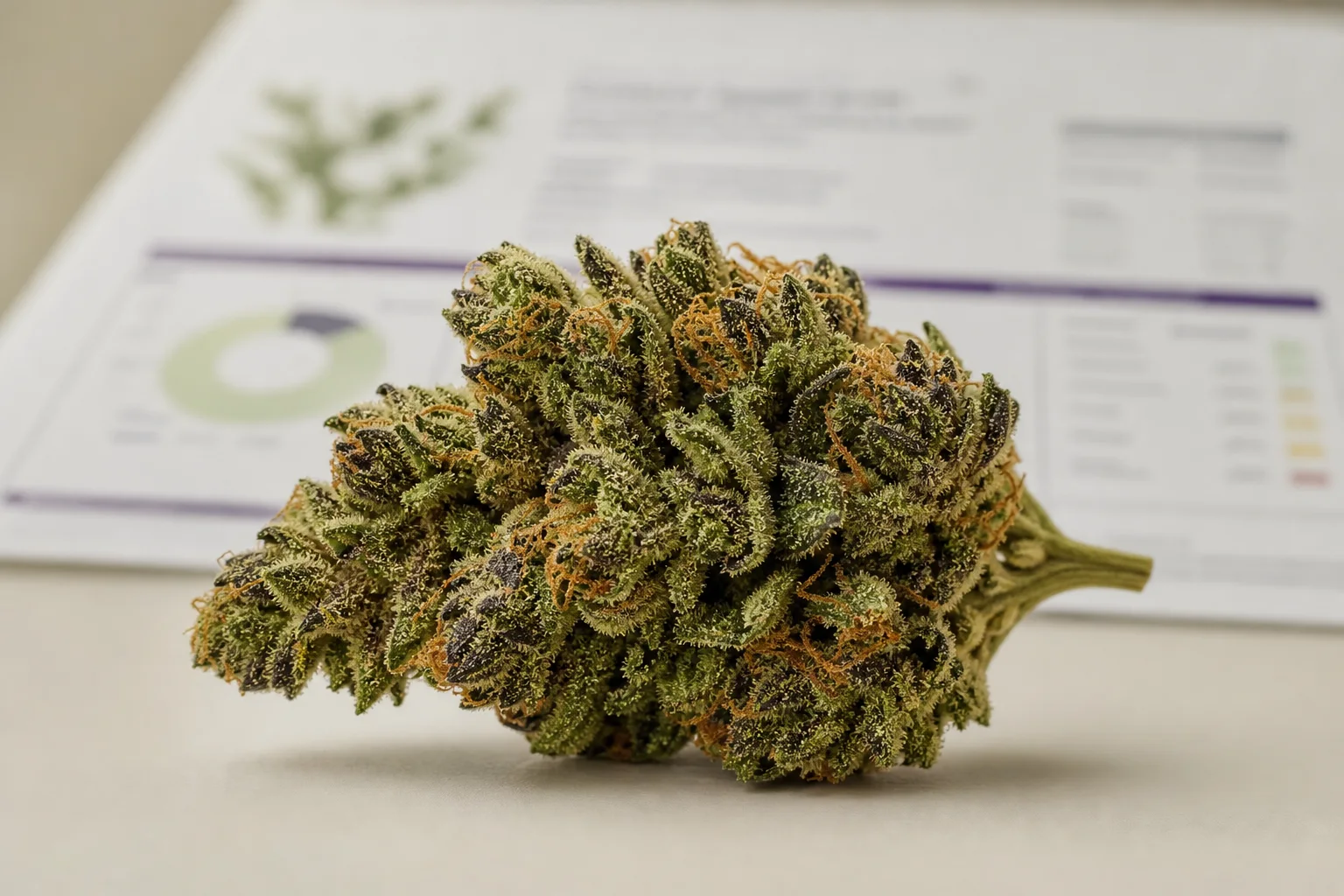
Hero documentary image showing the relationship between a physical sample and its lab record. The photograph supports the article’s point that a CoA documents one tested sample; it does not show every flower from the harvest. This image is illustrative and does not display readable lab numbers. Source: Maine Office of Cannabis Policy resources on testing and labeling. Limit: photograph cannot substitute for method details on an official CoA.
Why a single lab result matters — and why it’s only a snapshot
A Certificate of Analysis (CoA) can be one of the clearest pieces of evidence you’ll see when choosing or storing adult-use or medical cannabis. It lists measured cannabinoids, sometimes terpenes, and results for contaminants such as pesticides, microbiology, heavy metals, and residual solvents. That information is real, technical, and—for the batch it represents—actionable: it tells you what a laboratory found in the sample that was tested. (maine.gov)
But it’s also a single sample from a single batch. Plant chemistry varies across flowers on the same plant, between plants in the same room, and from one harvest to the next. A CoA is a documented measurement of one sampled portion under one lab’s method on a specific day. Consider it a photograph of a single moment—not a yearbook profile of an entire crop. The law in Maine requires testing and sets what analytes are mandatory, but it doesn’t make every batch identical. (legislature.maine.gov)
Understanding what the lab measured, how that measurement was made, and how representative the sample was will help you use the CoA without overreading it.
What labs actually measure (and what those numbers mean)
Most regulated CoAs break results into a few familiar categories: cannabinoid potency (THC, THCA, CBD, etc.), terpenes (when tested), and safety panels (pesticides, residual solvents, microbials, and heavy metals). States including Maine list required analytes and testing categories that licensed testing facilities are required to cover for adult-use products. These categories define the minimum data you should expect to see on a CoA. (maine.gov)
'Total THC' or 'Total CBD' figures are calculated from measured acidic and neutral cannabinoid forms (for example, THCA + converted THC) according to established formulas; labs typically report both the measured forms and the combined totals. Terpene panels report volatile aroma compounds by name and concentration when included, but terpenes are often reported only when the lab or producer chooses to test them. Contaminant panels tell a different kind of story: they are pass/fail against limits or simply measured concentrations that you can compare to regulatory or action levels. Maine’s rules and labeling requirements mean that packaging and labelling must not be false or deceptive; a CoA is the most direct way to back up those claims. (legislature.maine.gov)
Those numbers have meaning, but they are not perfect. Method differences, sample size, and laboratory uncertainty (the lab’s calculated error around a number) all affect the final values shown on a CoA.
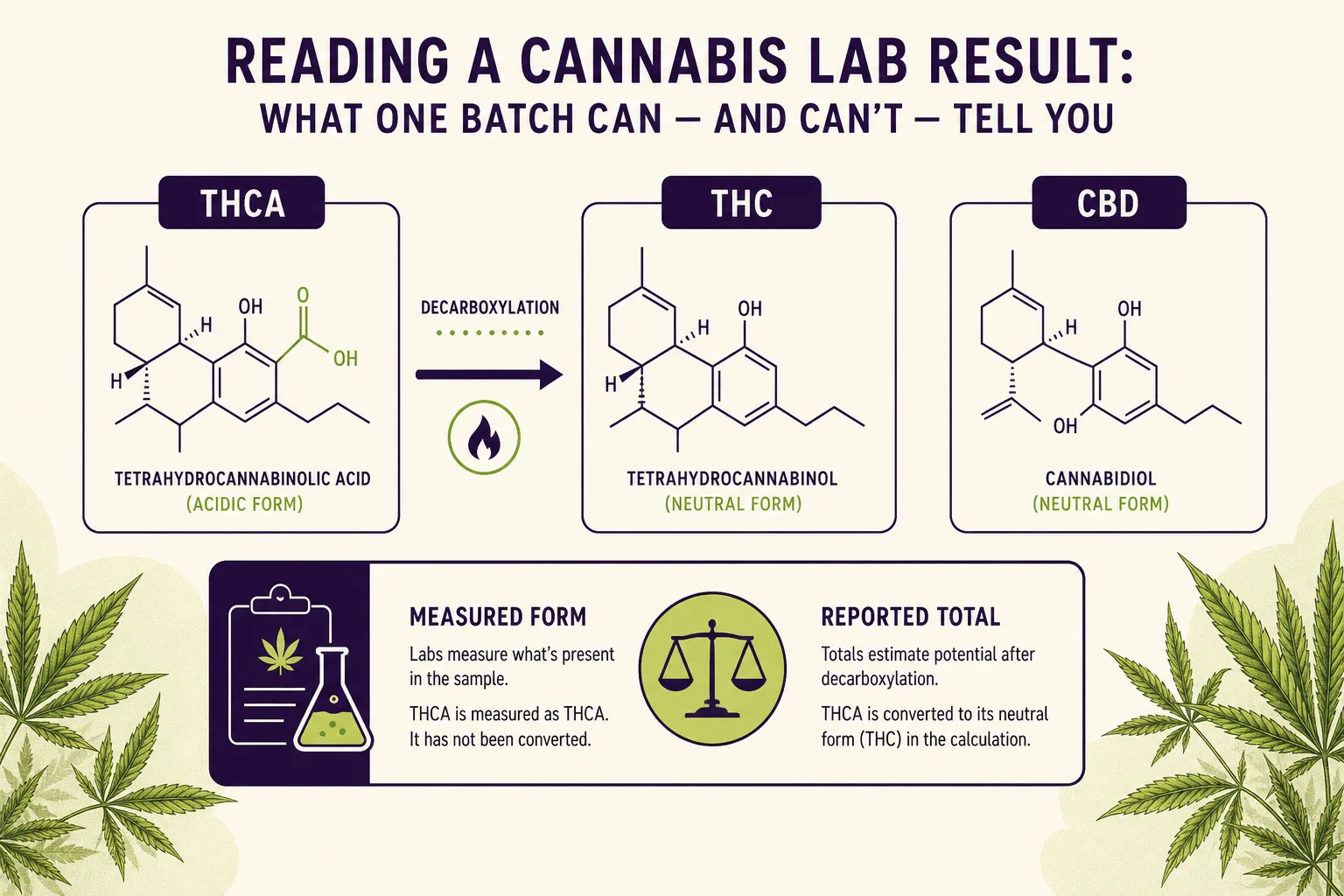
An explanatory illustration that clarifies the chemical distinction between acidic and neutral cannabinoids and why labs report 'total' values. It connects to the article section on what labs measure and notes that calculations and conversions matter. Limit: do not display any real product values or clinical dose guidance.
Research context: Required Analyte Types for Mandatory TestingSampling, batch variability, and why ‘one jar’ isn’t the whole crop
Science and horticulture both tell the same story: cannabis flowers are heterogeneous. Cannabinoid and terpene concentrations vary by flower maturity, lighting, position on the plant, drying and curing, and even which trimming crew handled the batch. When a lab tests a sample, the representativeness of that sample matters more than most consumers realize. A poor sampling plan can make a safe lot look unsafe and a robust lot look weak. Peer-reviewed work shows that differences in sampling and chromatographic method choice produce measurable shifts in reported concentrations. (pubmed.ncbi.nlm.nih.gov)
Regulatory frameworks usually require specific sampling protocols or allow testing facilities to describe their procedures so buyers can judge how representative a CoA is. Even with good sampling, a single CoA doesn’t capture within-batch variation or changes that happen after packaging: moisture loss, volatile terpene evaporation, and chemical degradation all change the product over weeks and months. Producers and consumers who track batch and harvest records will have a stronger basis for comparison than someone relying on a lone CoA.
In short: it is useful to look for a statement about how the sample was collected. Growers who maintain sampling records and consumers who consider CoAs together with traceability information have a stronger context for interpreting results than someone relying on a lone report.
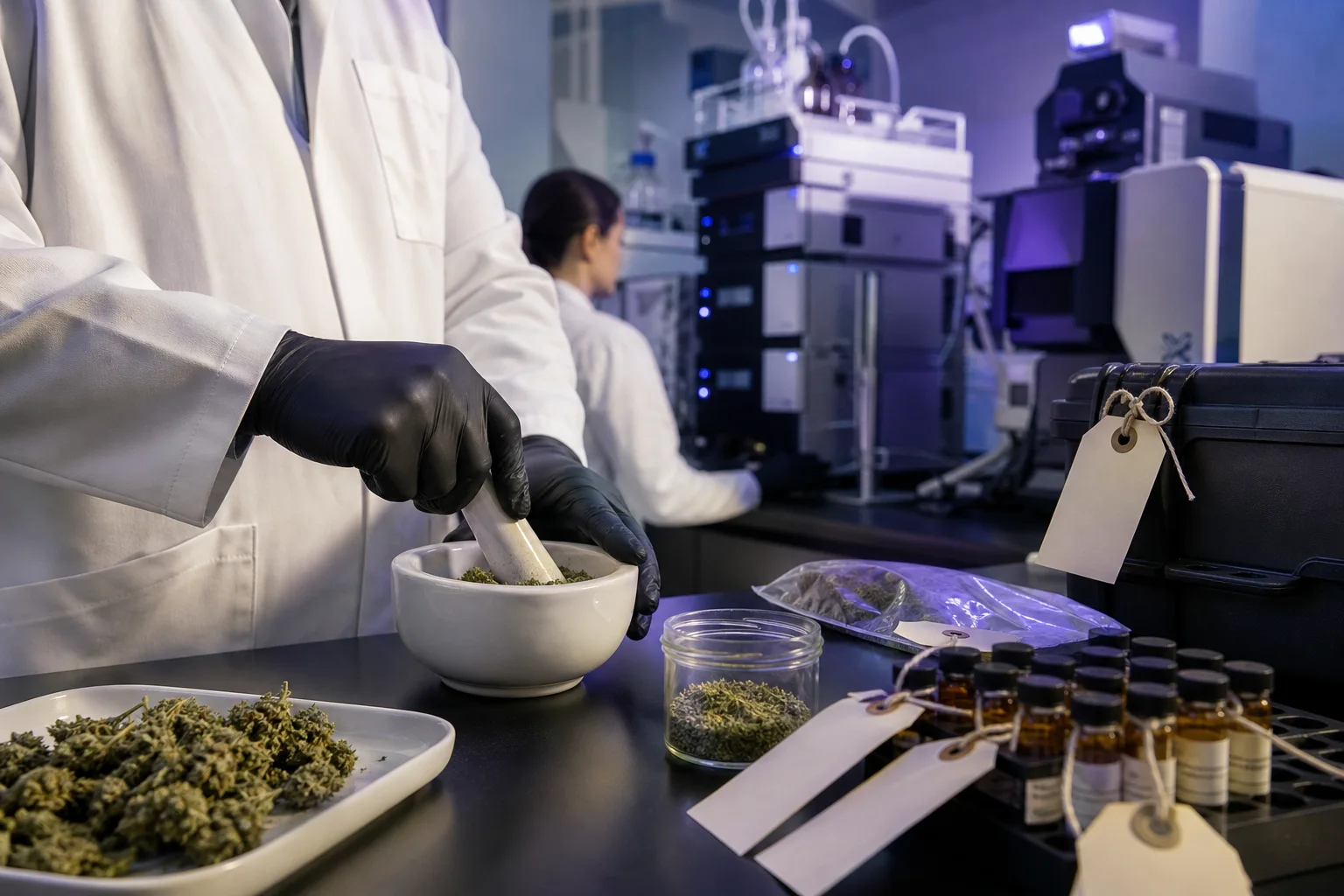
A laboratory process photo illustrating sample preparation and how heterogeneous plant material is reduced to a testable sample. This visual supports the article’s point that sampling and preparation drive CoA numbers. Limit: do not show readable lab reports, patient info, or brand identifiers.
Research context: NIST Tools for Cannabis Laboratory Quality AssuranceLaboratory methods, uncertainty, and inter-lab differences
Analytical chemistry isn’t one-size-fits-all. Labs use different validated methods—GC, HPLC, LC-MS, UPLC-MS/MS, or supercritical fluid chromatography—to measure cannabinoids and contaminants. Each method has strengths and weaknesses for particular analytes, and method validation is how a lab proves a method performs acceptably for its intended use. National standards efforts, reference materials, and interlaboratory programs exist precisely because methods and instruments produce different numeric answers unless laboratories align their practices. NIST’s Cannabis Laboratory Quality Assurance efforts and interlaboratory exercises document both the progress and the limits of comparability across labs. (nist.gov)
Laboratories also report a measurement uncertainty or a limit of detection/quantitation for each analyte. That uncertainty is not a weasel word; it’s a quantitative expression of how much the lab’s result might reasonably differ from the ‘true’ value because of sampling preparation, instrument performance, and method variability. A difference of 1–2 percentage points in reported THC between two labs doesn’t necessarily mean one sample was mislabeled—often it reflects typical analytical uncertainty or method bias. Peer-reviewed comparisons demonstrate how different chromatographic choices and sample prep steps can shift results in systematic ways. (pubmed.ncbi.nlm.nih.gov)
Because of these realities, reputable CoAs include method descriptions, analyst initials or lab identifiers, and uncertainty or detection-limit figures. If a report lacks that context, it becomes harder to interpret the numbers responsibly.
Maine rules, labeling, and what must appear on packaging
Maine’s Adult-Use rules and statutory labeling requirements set the regulatory context for testing and what consumers can rely on. The Office of Cannabis Policy’s testing rules specify analyte categories required for mandatory testing in adult‑use cannabis; testing facilities are required to be certified, and their operation falls under state oversight. Meanwhile Title 28-B requires labels and packaging avoid false or deceptive statements and meet statutory content requirements. Those laws create the backbone that makes CoAs meaningful in commerce: testing is not optional and labels are expected to match what’s represented. (www1.maine.gov)
The OCP has published guidance about which analytes must be tested and reported; producers and testing labs use those lists when preparing and reviewing CoAs. In practice, that means a Maine consumer can expect, at minimum, to see cannabinoid potency and safety-panel data for licensed adult‑use products; specific details about sampling and methods are increasingly common as transparency improves. The OCP has also highlighted audits and compliance testing to monitor program integrity—these underscore why comparing CoAs and requesting traceability information can be a reasonable approach for consumers. (maine.gov)
If labeling or a CoA seems inconsistent, the statute and the OCP rules outline where to file a complaint or request clarification from the licensee and the regulator.
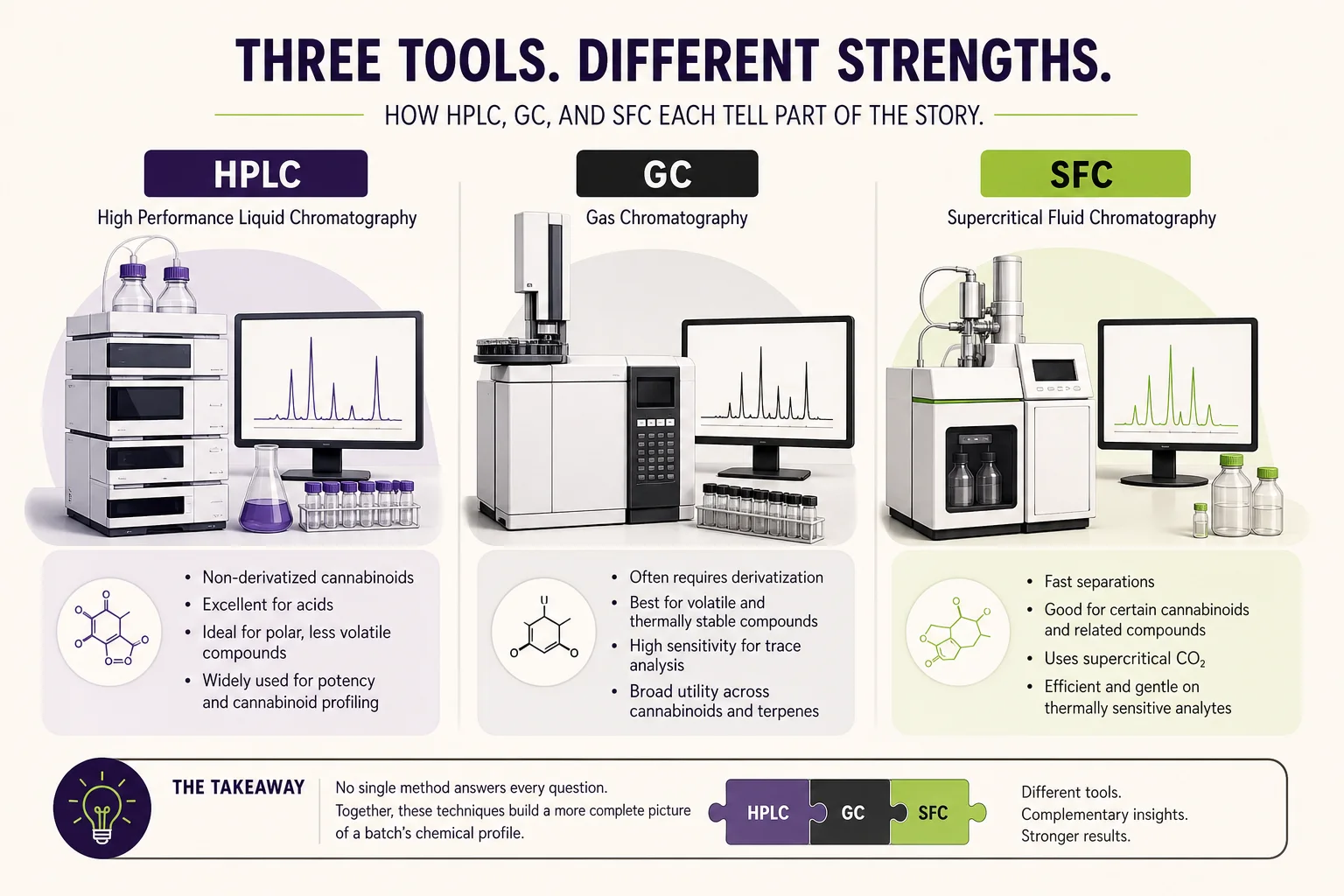
An evidence diagram that explains why method choice (HPLC vs GC vs SFC) changes which compounds are detected and how results can vary. It supports the section on laboratory methods and inter-lab differences. Limit: avoid showing any fake measurements or causal claims about effects.
Research context: Cannabis Quality Assurance Program: Exercise 1 Final ReportWhat a CoA can help you judge — and what it cannot
A CoA can reliably show what the testing laboratory measured in that sample: which cannabinoids were present and at what lab‑reported concentration, and whether the sample passed or failed contaminant screens based on regulatory limits or the lab’s reporting thresholds. That’s valuable for safety (e.g., confirming an absence of prohibited pesticides or high solvent residues) and for factual claims (e.g., whether a labeled THC percentage is supported by lab data). (maine.gov)
What a CoA cannot tell you includes user effects, impairment, or how a particular person will respond. It can’t predict onset timing for an edible, subjective psychoactive intensity across individuals, or whether the next jar from the same batch will be identical. Nor can a single CoA fully rule out post‑test contamination introduced during handling, packaging, or storage. CoAs also don’t capture all possible contaminants—testing panels are finite and defined by regulation and lab capacity. For those reasons, a single report is not a guarantee of uniformity or of an individual experience. (cdc.gov)
Many safety risks—child access to edibles, improper storage, mixing with other drugs or alcohol—are behavioral and environmental, not chemical labeling problems. Poison control and public health guidance are essential complements to reading a CoA when safety questions arise. (poison.org)
Practical steps for adults and growers who want better evidence
Consumers seeking more confidence from a CoA may look for clear batch identifiers, an explicit sampling statement, the lab method and accreditation or certification, and the lab’s uncertainty or detection limits. Those items indicate whether the CoA is likely to represent the bottle in hand and how precise the numbers are. If questions remain, consumers can request the sampling protocol and previous harvest/CoA records for the same strain or lot. Transparency matters. (maine.gov)
Growers and processors benefit from maintaining meticulous harvest and sampling records, working with accredited labs that clearly report method validation and uncertainty, and documenting chain of custody and storage. Participation in interlaboratory comparison programs or use of standard reference materials reduces the risk of misleading results and helps identify method bias. National programs at NIST are intended to improve comparability across labs for exactly these reasons. (nist.gov)
All adults: safety panels warrant careful consideration. A CoA reporting a failed contaminant screen generally indicates a need for clarification, and a single unclear number is insufficient to infer safe levels. In cases of potential exposure of a child or pet to an edible, Poison Control is the appropriate resource for immediate guidance. (poison.org)
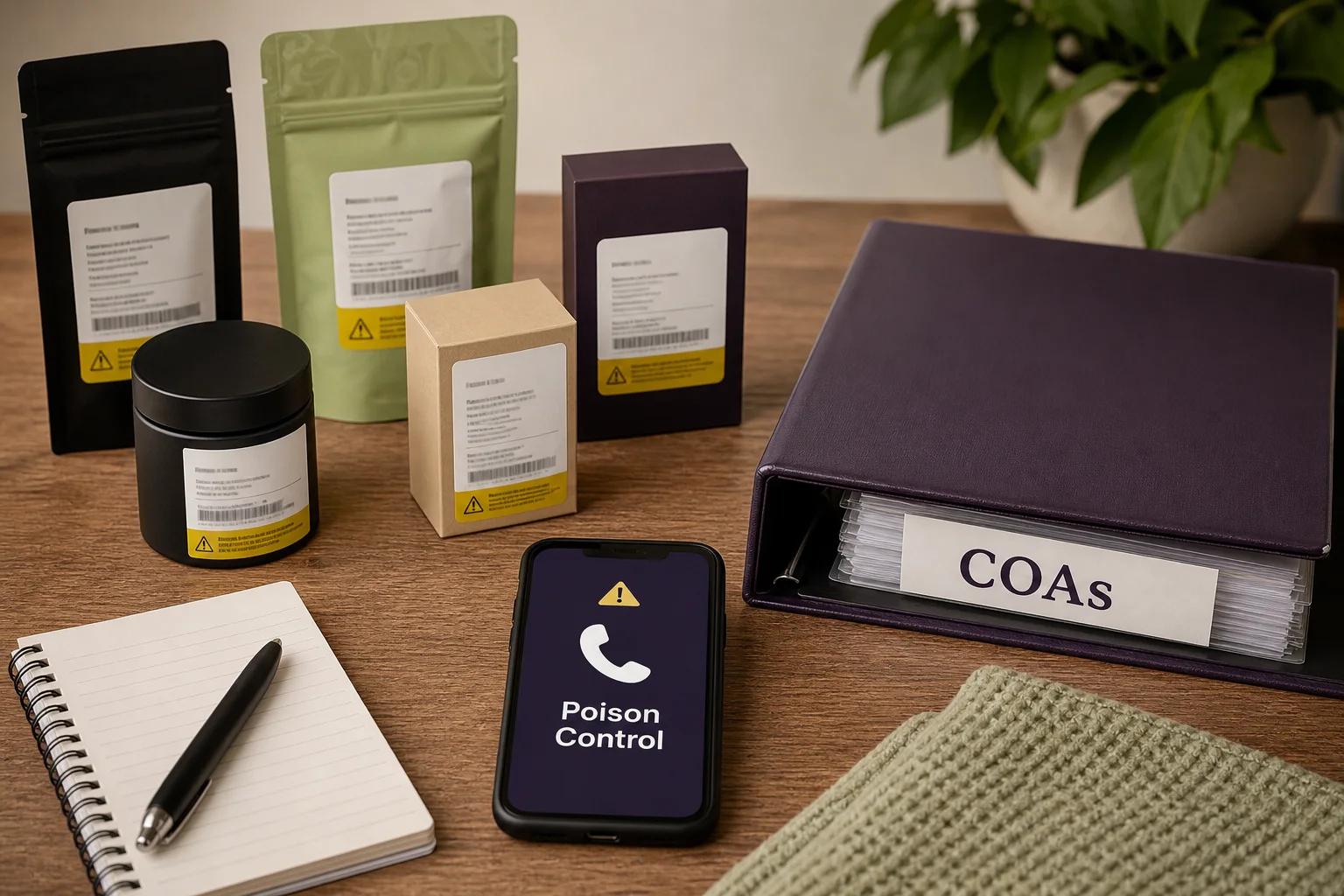
A practical evidence photo emphasizing record-keeping, traceability, and what to do in a possible exposure. It links to the article’s practical steps and the recommendation to contact poison control for ingestion incidents. Limit: do not display any readable CoA numeric values or solicit purchases.
Research context: My child ate a cannabis edibleBottom line: How to use one CoA — and when to call it evidence
A single CoA is best used as a reproducible piece of evidence: it answers the question “what did the lab find in this sample?” It does not, on its own, answer “how will this product act in my body?” or “will every jar be the same?” Consider a CoA one element within a system that includes harvest records, transparent sampling, reputable lab methods, and sensible storage. When those elements align, the CoA becomes a more reliable snapshot rather than an ambiguous number.
If broader context is desired, request multiple batches’ CoAs, harvest dates, sampling protocols, and a lab’s method and accreditation details. Those documents together provide a much stronger evidentiary basis than any single report.
Key takeaways
- A CoA reports what a lab measured in a specific sample; it’s a snapshot, not a guarantee. (maine.gov)
- Cannabinoid and contaminant numbers depend on sampling and analytical method; labs typically report methods and uncertainty to aid interpretation. (nist.gov)
- State rules define required testing and labeling; Maine’s OCP and Title 28-B are the legal frame that make CoAs meaningful. (www1.maine.gov)
- A CoA cannot predict individual effects, impairment, or within-batch variation. Use it with traceability and storage context. (cdc.gov)
- For safety incidents (e.g., a child ingesting an edible), Poison Control is the resource to contact for guidance immediately. (poison.org)
Frequently asked questions
Q: Is a higher THC percentage always better? A: No. Percentage shows what a lab measured in that sample, not how a person will feel or whether the lot is well handled. Use potency data as one fact among many rather than the whole story. (maine.gov)
Q: If a CoA shows no pesticides, does that mean the whole harvest is pesticide-free? A: It means the tested sample had no pesticides above the lab’s reporting levels or regulatory limits. It doesn’t prove every flower from the harvest is identical—sampling and lot control matter. (maine.gov)
Q: If a CoA seems inconsistent with the package label, what options are available? A: Consumers can request the batch’s sampling protocol and lab report details from the retailer or licensee. If concerns persist, Maine’s regulatory rules and complaint processes provide a formal avenue to seek clarification. ()
Questions this guide answers
What does 'total THC' on a CoA mean?
Total THC combines measured acidic and neutral forms (like THCA and THC) using standard conversion formulas; labs usually report both forms and the combined total so you can see how the figure was calculated. ([maine.gov](https://www.maine.gov/dafs/ocp/resources/guidance-documents/mandatory-testing))
Can I trust a CoA from a third‑party lab?
Third‑party labs can be trustworthy, but check for certification, a clear method description, and reporting of measurement uncertainty. Participation in interlaboratory programs increases confidence. ([nist.gov](https://www.nist.gov/programs-projects/nist-tools-cannabis-laboratory-quality-assurance))
If a CoA passes, is the product safe for everyone?
Passing required contaminant screens reduces certain risks but cannot guarantee safety for all individuals. Personal health, interactions with other substances, and improper storage all influence safety. For acute exposures, contact Poison Control. ([poison.org](https://www.poison.org/articles/my-child-ate-a-cannabis-edible))
How can growers reduce CoA variability?
Use standardized harvest and sampling procedures, choose accredited labs, run frequent internal checks using reference materials, and participate in interlaboratory exercises to spot method bias. ([nist.gov](https://www.nist.gov/programs-projects/nist-tools-cannabis-laboratory-quality-assurance))
Educational information only. Cannabis affects people differently and this is not medical advice.