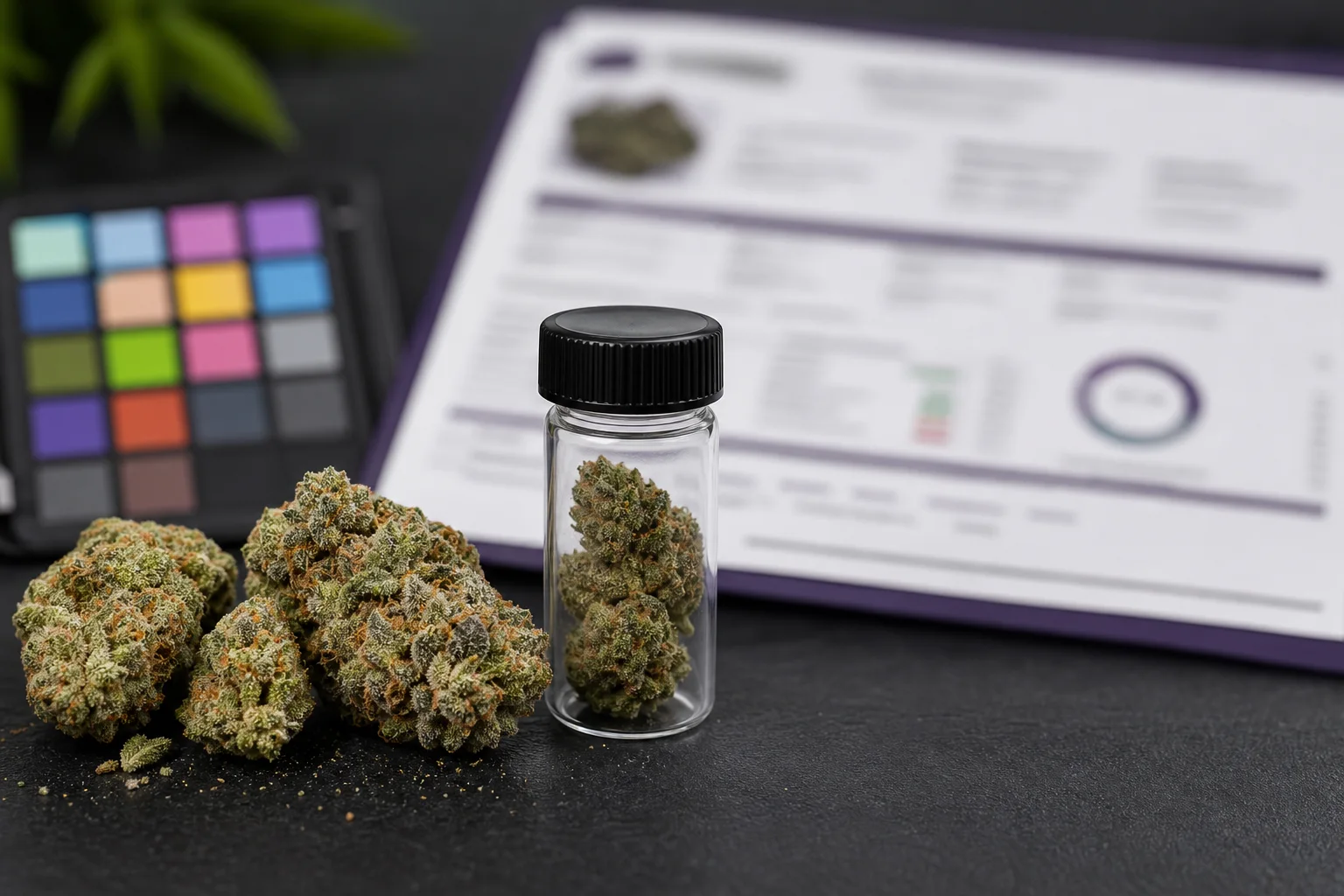
Macro documentary: cured flower and a deliberately blurred COA side‑by‑side to teach what a COA is and what it documents. The image connects the plant to the lab record but does not show readable numbers or logos; it illustrates the article’s central point that a COA is a snapshot of a tested sample. Source: Maine OCP guidance on understanding results; limits: a photo cannot convey sampling statistics or method validation details.
What exactly is a batch test result (COA)?
A Certificate of Analysis (COA) is the laboratory document that shows what tests were run on a single sample taken from a particular harvested lot or finished product. In Maine’s adult‑use program, the COA will list measured cannabinoids (THC, CBD, and other cannabinoids), required contaminant screens (pesticides, heavy metals, microbial indicators, solvents, filth), and pass/fail outcomes for mandatory safety limits. The Office of Cannabis Policy (OCP) publishes guidance describing required analytes and the role of certified testing facilities. (maine.gov)
A COA is tied to a sample ID and usually includes the date of sampling, the testing laboratory’s name, and notes about the analytical method and limits of quantification. That metadata isn’t decorative: the method and the lab’s certification status influence how much confidence you can place in any reported number. Maine’s certification rules and sampling guidance explain what labs must document and what the state requires for adult‑use testing. (maine.gov)
Important framing: a COA reports what was in the particular sample the lab received and analyzed. It does not directly speak to individual experiences, impairment, nor to broader claims about how a product will affect any one person. Use it to check safety and to compare products, not to predict personal outcome. (maine.gov)
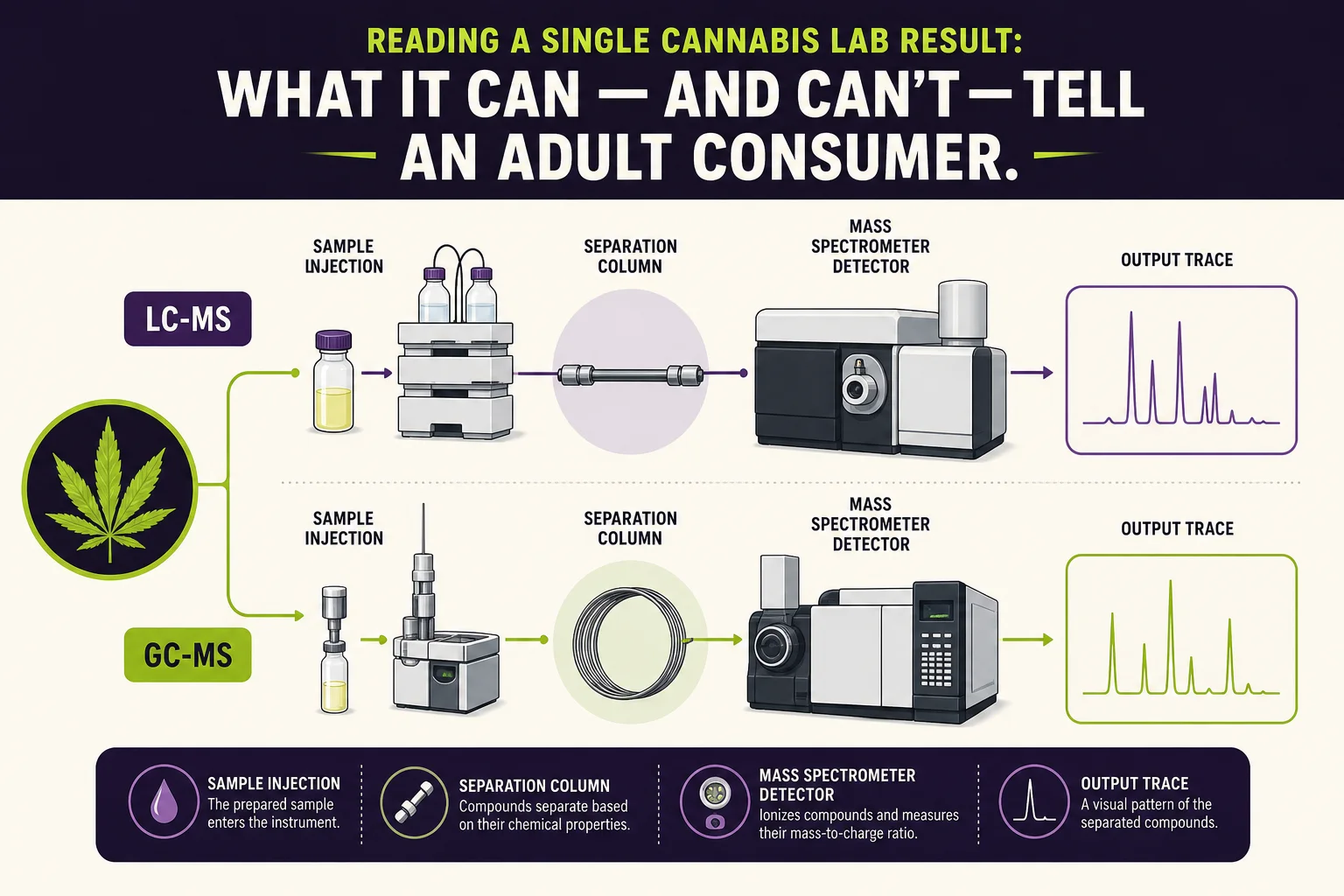
Explainer schematic showing how common analytical instruments (LC‑MS, GC‑MS) separate and detect cannabinoids; useful to show methodological differences that affect potency results. Source: scientific literature on fit‑for‑purpose analytics and NIST measurement guidance; limits: schematic does not replace method validation details.
Research context: Fit‑for‑purpose analytics for cannabis: identification, quantification, and standardization of cannabinoids, flavonoids and terpenes.Core components you’ll usually find (and why they matter)
Most Maine adult‑use COAs will include three categories of information: potency (the cannabinoid profile), contaminant screens (pass/fail and numeric results), and sample or batch identifiers with testing metadata. Potency shows concentrations (usually milligrams per gram or percent by weight) for delta‑9‑THC and other cannabinoids; contaminant screens report whether measured levels exceed the state’s maximums or detection limits. The OCP guidance lays out which contaminant groups are mandatory for adult‑use testing. (maine.gov)
Potency numbers can help you compare products by cannabinoid profile and estimate total cannabinoids in a package, but they are not a precise personal dosing guide — they are lab measurements on a sample. Contaminant pass/fail results are more binary in practice: they indicate whether the lot met Maine’s safety thresholds at the time of testing. That matters for consumer safety because contaminants like certain pesticides or microbes are regulated to protect public health. (maine.gov)
Finally, look for methodological notes: what analytical technique was used (e.g., LC‑MS/MS, GC‑MS), the lab’s limit of quantification (LOQ), and whether the sample was a homogenized composite or a grab sub‑sample. Those details shape how comparable and how precise the numbers are. Maine’s certification rules require documentation of many of these elements for certified labs. (maine.gov)
Potency numbers: what they tell you — and the lab‑to‑lab and sample limits
A reported THC or CBD percentage is the lab’s measurement of that analyte in the tested sample, using whatever validated method the lab applied. But cannabinoid numbers vary for two related reasons: sampling heterogeneity and analytical variability. Plant material is not uniform; cannabinoids can concentrate differently across flowers, between top buds and smaller material, and by depth below the trichome canopy. That makes the representativeness of the sample crucial. (pubmed.ncbi.nlm.nih.gov)
Analytically, differences in extraction protocols, instrument calibration, and validated method performance mean two competent labs can report slightly different values for the same bulk batch. Interlaboratory studies in the scientific literature document this variability and recommend validated, fit‑for‑purpose assays and standardized reporting to improve comparability. NIST also underscores the importance of metrology and clear weight/measures standards for consistency across marketplaces. (pubmed.ncbi.nlm.nih.gov)
Practically: if two products list different THC percentages, the COA tells you the measured difference for the provided sample — not a promise that every bag or joint of that lot will match the number exactly. Look for the COA’s sampling description and note whether the product lot was homogenized and how many sub‑samples were combined; more extensive composite sampling improves representativeness. (maine.gov)
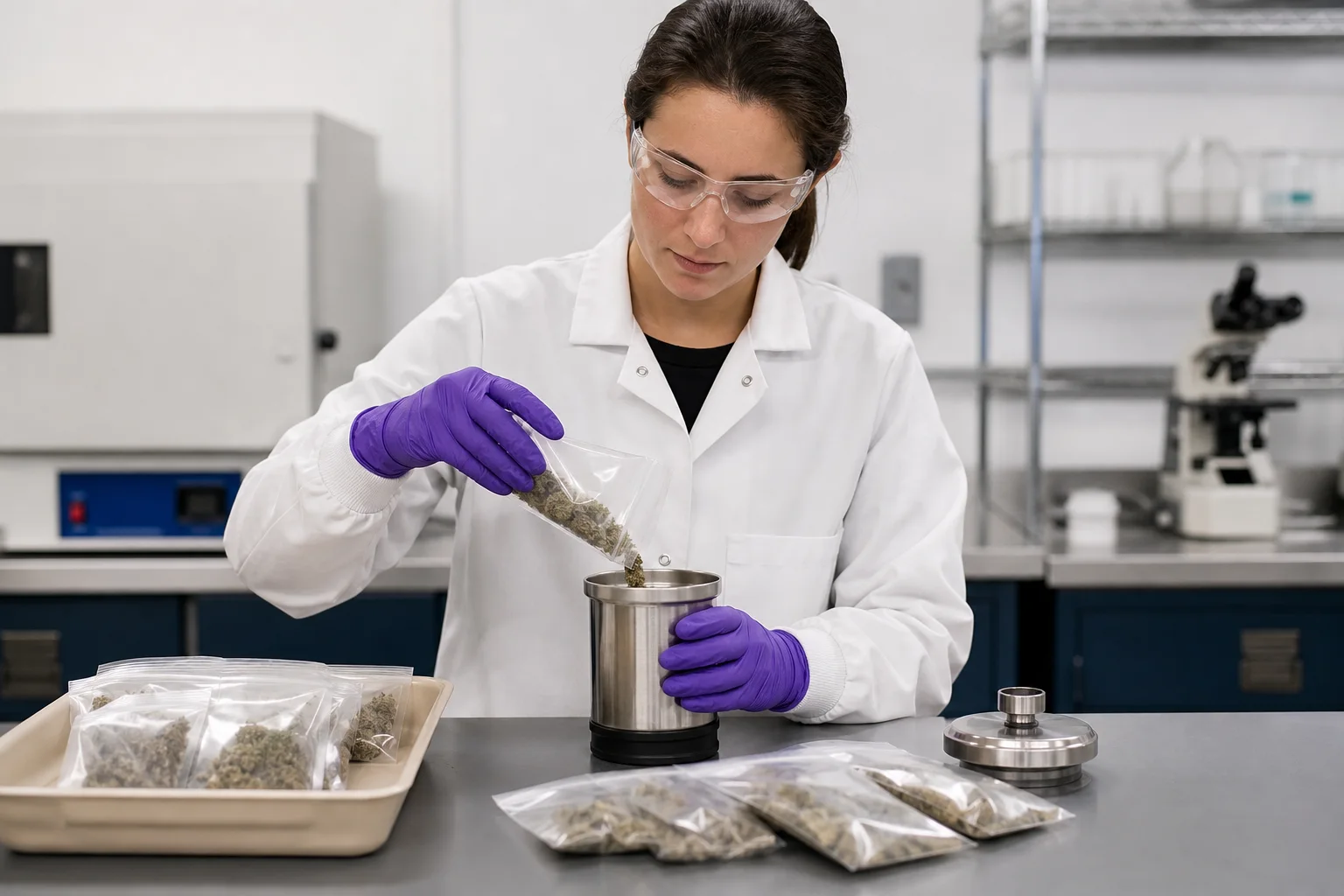
Field‑to‑lab sampling photo: a technician creating a homogenized composite from several sub‑samples to illustrate why sampling plan matters for representativeness. Source: Maine OCP rules and sampling guidance; limits: photography cannot show exact statistical sampling plan or lab LOQs.
Research context: RULES FOR THE CERTIFICATION OF CANNABIS TESTING FACILITIES (18‑691 C.M.R. Ch. 5)Contaminants and pass/fail outcomes: safety focus and remediation paths
Adult‑use testing in Maine mandates screens for pesticides, heavy metals, solvents, microbial contaminants and filth. A COA will often show measured levels, limits of detection, and a pass/fail determination versus state maximums. A “pass” indicates that, for that tested sample, measured concentrations did not exceed Maine’s regulatory caps at testing time. (maine.gov)
If a sample fails a mandatory contaminant test, Maine’s rules outline remediation and retesting workflows, and labs must report failures to OCP and Maine CDC as required by statute and rule. That pathway is part of how the program provides oversight: the lab may document remediation options and the state oversees corrective steps. But a COA’s pass does not eliminate future risk if storage or handling later introduces contamination. (maine.gov)
Note also that methods and LOQs matter. A lab might report “non‑detect” because a contaminant is below the method’s LOQ; that is not the same as absolute absence. Scientific work underscores that transparent reporting of detection limits and methods is essential so consumers and regulators can understand dataset limits. (pubmed.ncbi.nlm.nih.gov)
Sampling and representativeness: the single biggest limitation of one COA
The single largest constraint of a COA is sampling. A COA documents what was in the specific sample submitted to the lab; it is not a census of every unit in a harvest or package. Variability between plants, within plants, and between manufactured units (for edibles or tinctures) means a single sample can miss outliers or pockets of higher/lower potency or a localized contaminant. OCP publishes guidance on best practice sampling to reduce that uncertainty. (maine.gov)
For pre‑rolls and product blends, homogeneity testing and sampling plans matter more. The more a product is blended and mixed, and the more the sampling protocol composites multiple sub‑samples, the more the COA will reflect a lot’s average. Conversely, single grab samples from a heterogeneous lot tell you less about the whole. International and academic literature on cannabis analytics repeatedly emphasizes the need for statistically governed fingerprinting and robust sampling to make potency claims defensible. (pubmed.ncbi.nlm.nih.gov)
So: consider a single COA a snapshot of a sample, not an exhaustive inventory. If consistent values across product lots matter to you, repeated COAs, batch numbers, and evidence of standardized sampling and production controls provide stronger context for comparison. Maine’s rules and guidance documents encourage traceability and metadata so that comparisons are meaningful. (maine.gov)

Microscopy and culture context: imagery to explain microbial screening and why labs test for harmful molds and mildews. Source: Maine OCP contaminant testing rules; limits: images show presence/absence testing context only, not exposure dose or clinical outcomes.
Research context: Understanding Cannabis Testing Requirements & Results in MaineReading method notes, LOQs, and lab accreditation — practical checks anyone can do
When you read a COA, confirm these items: the lab’s name and certification; the sample ID and date; the method used (GC, LC, MS, etc.); and the reported limit of quantification. Maine requires testing labs to be certified and to document methods and limits; those details indicate how sensitive and validated the measurements are. (maine.gov)
If a COA lacks method documentation or a clear chain of custody, regard it as lower‑confidence. NIST and peer‑reviewed literature recommend that laboratories publish methodological validation or adhere to recognized standards to improve consumer confidence and enable cross‑lab comparability. Look for statements like “method validated,” clear LOQs, and whether the product was homogenized prior to analysis. (nist.gov)
Also note the date of testing. Cannabinoid profiles and volatile terpenes can change with time and storage conditions, so an old COA may not reflect current chemistry. Maine’s labeling statute requires honest, non‑deceptive packaging, and dates (testing and packaging) help you judge how fresh the analytical snapshot is. (legislature.maine.gov)
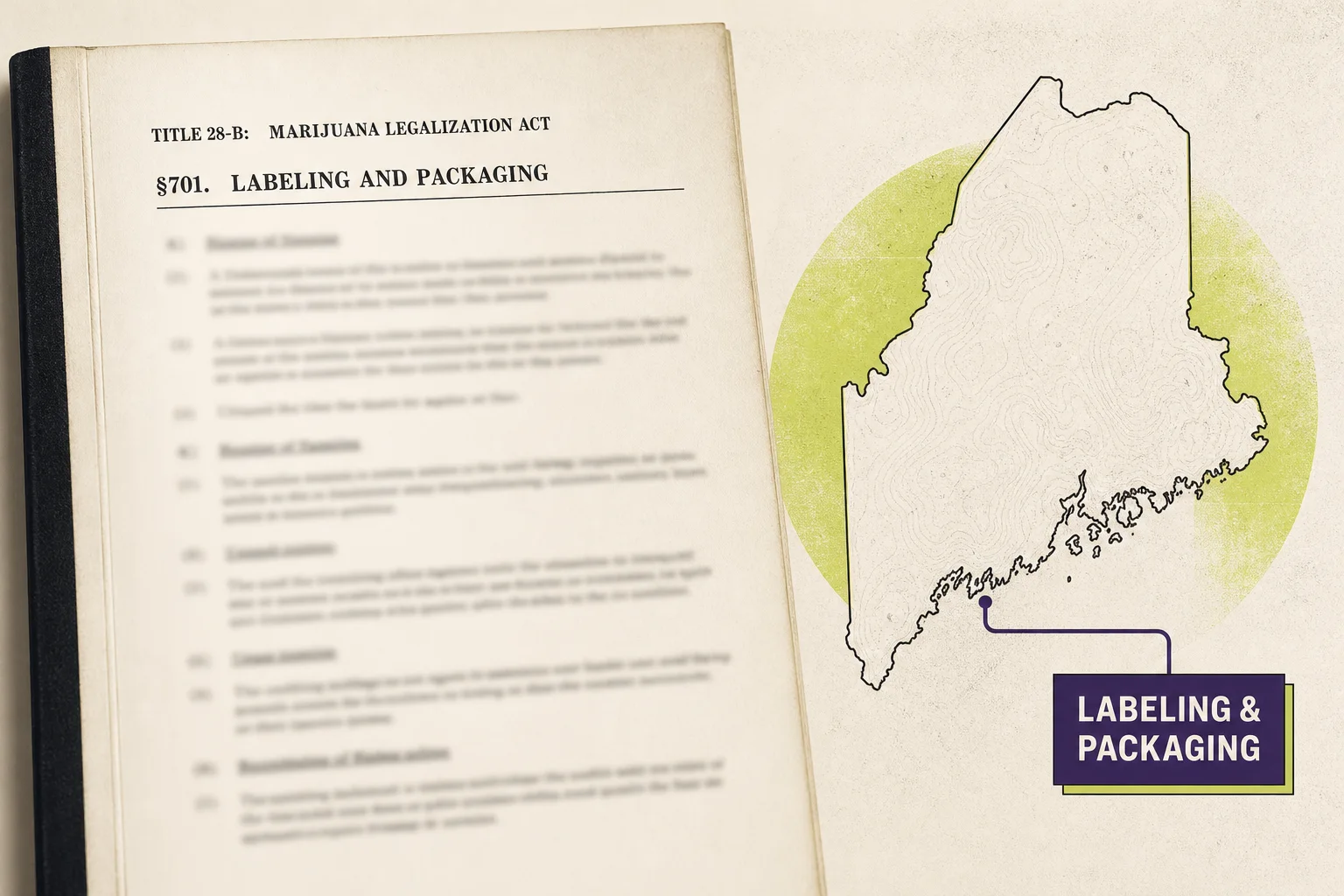
Statute + map: an archival image of Title 28‑B labeling and packaging statute page paired with a simple map of Maine to emphasize state regulatory scope. Source: Maine Legislature statute on labeling; limits: image shows law text but not rule interpretations or guidance.
Research context: MRS Title 28‑B, §701: Labeling and Packaging (PDF)How Maine’s adult‑use rules differ from the medical context — what that means for COAs
Maine’s adult‑use program mandates testing and specific analytes for safety and potency; the medical program historically has different testing practices and, in some cases, has not required mandatory testing for every medical product. OCP guidance explicitly notes this contrast and advises consumers to inquire about voluntary testing when buying medical cannabis. That difference affects how you read a COA: an adult‑use COA typically reflects regulated, mandatory analytes, while a medical product’s testing may be voluntary and variable. (maine.gov)
Labeling statute reinforces accuracy in labeling and packaging for both programs; product labels must not be false or deceptive, and OCP’s rules and guidance aim to improve traceability so consumers can match a product to its COA. If you rely on COAs for safety information, verify the COA’s traceability to the package via batch numbers and testing dates. (legislature.maine.gov)
When a medical caregiver or dispensary voluntarily tests products, seek the COA and the sampling notes. Voluntary testing can be informative, but it should be evaluated with the same scrutiny as regulated COAs — look for lab certification, method details, and sample representativeness. (maine.gov)
Putting a single COA to practical use as an adult consumer
Use a COA to answer three practical questions: (1) Did this sample meet Maine’s safety thresholds at testing time? (2) What cannabinoids were measured and does the profile match your information needs? (3) Was the COA produced by a certified lab with clear methods and sampling notes? If the answer to any is uncertain, ask the retailer for more documentation or a different batch COA. (maine.gov)
For comparing products, prefer COAs that show methods, LOQs, and sampling descriptions; repeated COAs across batches give stronger evidence of consistency than a single snapshot. For safety concerns, focus on contaminant pass/fails and remediation notes — a pass in Maine’s adult‑use system means the tested sample met the state’s limits at that moment. (maine.gov)
Remember: COAs are useful records of laboratory testing, not endorsements or personalized advice. They are one piece of evidence — an important, science‑based piece — that is strongest when paired with reliable chain‑of‑custody information, transparent lab methods, and consistent batch data. (pubmed.ncbi.nlm.nih.gov)
Key takeaways
- A COA is a lab snapshot of a single submitted sample and documents measured cannabinoids and contaminant screens. (maine.gov)
- Potency numbers vary with sampling and lab methods; they help comparison but don’t predict individual effects. (pubmed.ncbi.nlm.nih.gov)
- Contaminant pass/fail is a safety check tied to state limits; methods and LOQs matter. (maine.gov)
- Sampling is the main limit — one COA may not represent every unit in a lot. (maine.gov)
- Check lab certification, methods, LOQs, dates, and sample IDs to judge a COA’s trustworthiness. (maine.gov)
Frequently asked questions
Q: If a COA shows “non‑detect” for a pesticide, is the product free of that pesticide?
A: No. “Non‑detect” means the pesticide was below the test method’s limit of quantification. It is not the same as absolute absence; LOQs and methods matter. (pubmed.ncbi.nlm.nih.gov)
Q: Can two labs produce different THC percentages for the same batch?
A: Yes. Differences in sampling, extraction, instrumentation, and validation can produce measurable differences; look for method documentation and repeated data when possible. (pubmed.ncbi.nlm.nih.gov)
Q: Are medical cannabis products in Maine always tested like adult‑use products?
A: No. Maine’s adult‑use program requires mandatory testing for many analytes; medical products are not universally subject to the same mandatory tests and may be voluntarily tested. Ask for COAs when in doubt. (maine.gov)
Q: What should I check first on a COA?
A: Confirm the lab’s certification, the sample/batch ID, the testing date, the analytical method, and the limit of quantification. These items indicate how reliable and current the measurement is. (maine.gov)
Q: If a product failed a contaminant test, what happens?
A: Maine’s rules outline remediation options, retesting, and reporting pathways; failed lots are subject to corrective action under OCP rules. (maine.gov)
Q: How often do COA values change after packaging?
A: Cannabinoids and terpenes can shift with time and storage; a COA shows chemistry at testing time, so dates and storage matter for assessing current composition. (pubmed.ncbi.nlm.nih.gov)
Questions this guide answers
If a COA shows “non‑detect” for a pesticide, is the product guaranteed free of that pesticide?
“Non‑detect” means the pesticide was below the method’s limit of quantification. It is not identical to absolute absence; LOQs and methods matter.
Can two labs report different THC percentages for the same batch?
Yes. Sampling, extraction, instrument calibration, and validation differences can produce measurable variation; look for method notes and repeated COAs to assess consistency.
Are Maine medical cannabis products always tested the same as adult‑use ones?
No. Adult‑use testing is mandatory for many analytes; medical products may be voluntarily tested. Ask sellers for COAs and sampling details when you need confirmation.
What should I check first on a COA?
Confirm lab certification, sample/batch ID, testing date, analytical method, and the limit of quantification — these indicate whether a COA is current and methodologically transparent.
If a product fails a contaminant test, what happens?
Maine rules require remediation options, retesting, and reporting. Failed lots are subject to corrective action under OCP rules.
Educational information only. Cannabis affects people differently and this is not medical advice.