

Documentary-style photograph showing a small-batch grower displaying both a product jar and its certificate-of-analysis (COA) on a smartphone. This image teaches the connection between product packaging and lab provenance; it does not show any readable statistics or claims. Limit: a single COA preview is fine, but do not display legible numeric test results. Source documents illustrate provenance practices but not outcomes.
Introduction: two conversations about the same plant
There are two overlaps in the cannabis world right now: marketing that wants to sell a product, and education that wants people to make informed choices. Marketing often promises a simple answer—an effect, an experience, a single line on a package. Education, by contrast, views messy facts like cannabinoid ranges, lab variability, and incomplete evidence as useful signals, not obstacles. That difference matters for people who grow, sell, advise, or use cannabis in Maine and beyond.
Responsible education adds context: where a lab number came from, what we still don’t know, and how state rules shape what a label can and cannot say. Those details help people make better-informed choices and help growers show -- honestly -- what’s in the jar. In Maine, the law already draws a line between advertising and health claims; businesses may not use misleading or false marketing, and rules can restrict health or physical benefit claims. (legislature.maine.gov)
This article explains why source labels and explicit uncertainty are strengths for education, not liabilities. I’ll walk through Maine’s rules, what laboratories actually measure, why measurement uncertainty matters, how advertising can mislead, and how small-batch growers can use transparent education as a trust-building tool.
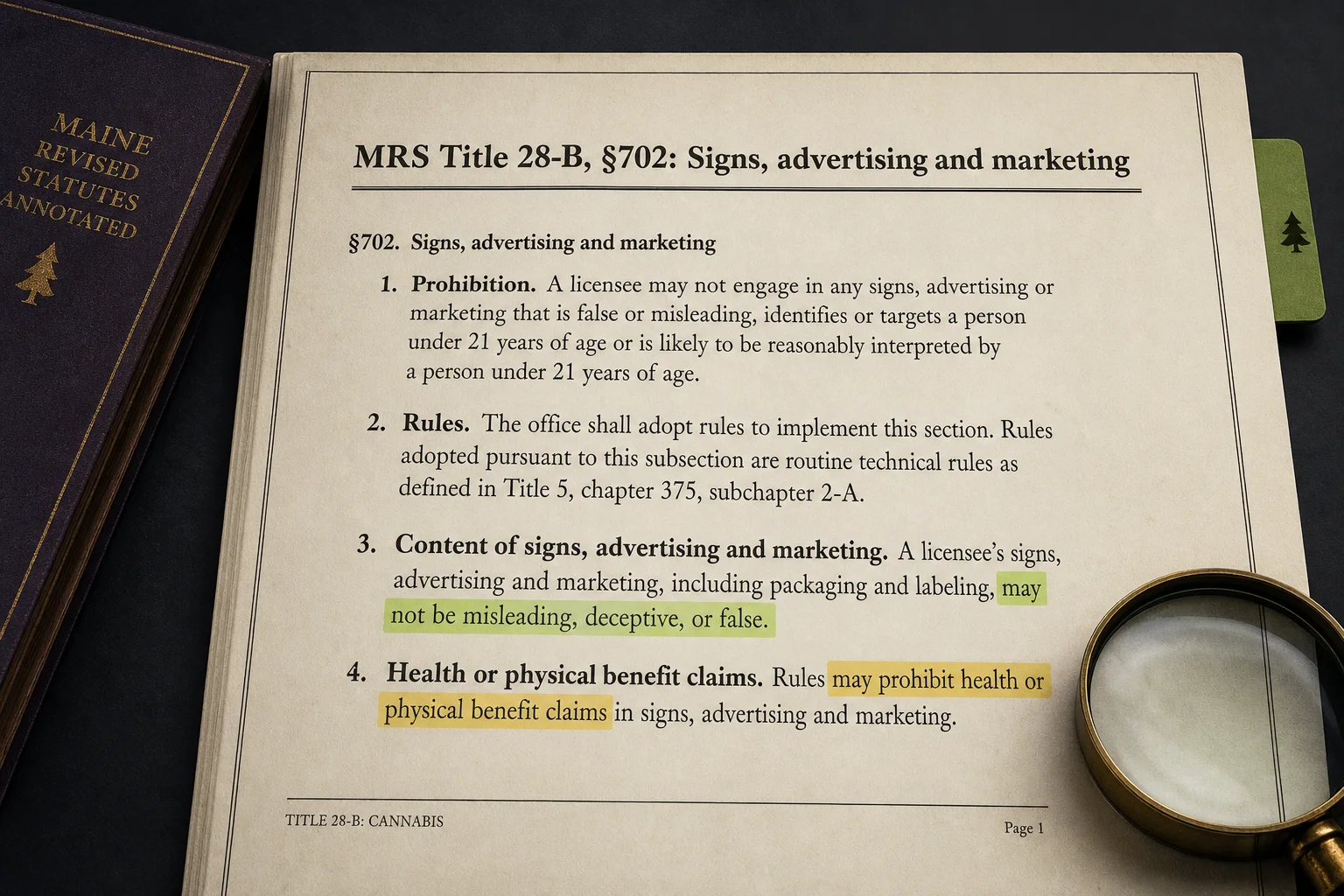
An archival-style image of the Maine statute page (section on signs and advertising) with highlighted phrases. This visual teaches readers which statutory phrases are most relevant for advertising and label claims; it is illustrative and not legal advice. Do not include any added legal interpretations or unofficial annotations that contradict the statute.
Research context: Maine Title 28-B §702: Signs, advertising and marketing1) What Maine law says about advertising and health claims
Maine’s cannabis statutes and the Office of Cannabis Policy (OCP) have clear guardrails. Signs, advertising, and marketing used by a licensee must not be misleading, deceptive, or false; the law also permits rules that prohibit health or physical benefit claims and restrict targeting of minors. These statutory limits are the baseline: they stop overtly false statements and let rulemaking address specifics. (legislature.maine.gov)
The OCP publishes program rules that cover administration, licensing, compliance, and testing. Those rules require testing for contaminants and set expectations for packaging, labeling, and voluntary review of advertisements and labels—creating a framework where accurate, verifiable information can be shared with consumers. Operators in Maine may review these rules regularly because they are updated through rulemaking. (maine.gov)
Why that matters: advertising that asserts a direct link between use of a product and a particular health-related outcome may run afoul of Maine rules, and the federal landscape (FDA) also restricts certain claims for CBD and other cannabis-derived ingredients. That regulatory backdrop is why education that emphasizes evidence and limits is both lawful and practical. (fda.gov)
2) Labels, numbers, and the role of the testing lab
A label that reads “22% THC” looks precise, but each lab result is an estimate with a range of possible error. Laboratories follow methods and calibrations—and they report a number derived from those methods, not an absolute truth. Measurement science is explicit about uncertainty: agencies like NIST provide technical guidance for characterizing and reporting measurement uncertainty so labs and consumers understand how confident they should be in a reported value. (nist.gov)
In practice, Maine’s program requires testing for cannabinoid content and contaminants, and the OCP’s rules and guidance documents direct acceptable testing practices, record-keeping, and reporting. That system is intended to reduce risk, but it does not make every lab result interchangeable: methods, equipment, and QA practices influence reported concentrations. Knowing which lab tested a product, which method they used, and when the sample was taken helps readers interpret the label. (maine.gov)
For small-batch growers, a useful label does more than list a single number: labels that indicate the lab name, test date, and a short note on measurement variability provide helpful context. Where feasible, linking to a certificate of analysis or providing a QR code on packaging ties a number to a verifiable record. That context shifts a label from a marketing assertion into a documented measurement and helps consumers compare products realistically.
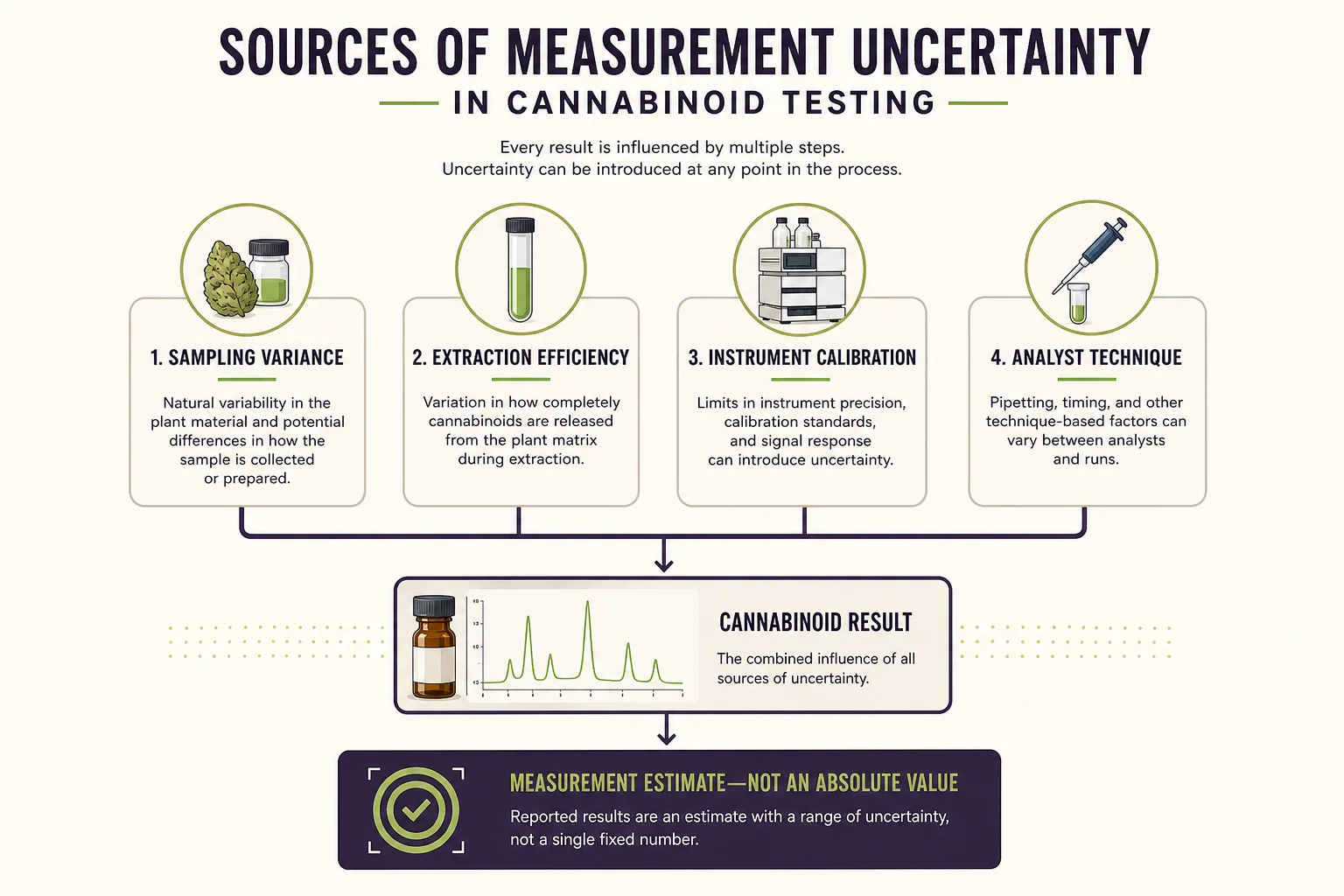
A clear educational diagram showing how sampling, instrument calibration, and analyst steps contribute to measurement uncertainty. This teaches why reported cannabinoid percentages are estimates; it should not display fabricated numeric outcomes or claim medical effects.
Research context: Cannabis Laboratory Quality Assurance Program: Exercise 2 Cannabinoid Final Report3) Measurement uncertainty: why the decimal point isn’t the point
Measurement uncertainty is a formal concept: every analytical method produces an estimated value plus an uncertainty budget that accounts for sampling, instrument calibration, analyst technique, and reference materials. NIST’s work on cannabis laboratory quality assurance shows laboratories can improve comparability, but variation remains—especially across methods for cannabinoids and minor constituents. In short: a reported THC percentage is useful, but it’s also partial information. (nist.gov)
That matters to consumers because tiny percentage differences (for example, 18.4% vs 19.1%) may not be meaningful in real-world outcomes and may fall within a lab’s uncertainty range. Education that flags uncertainty helps avoid false precision and reduces the chance that a consumer picks one product over another based on an illusory advantage.
For growers, practical implications include documenting consistent sampling, recording testing dates, and, when possible, using labs participating in QA programs. Noting a lab’s participation in interlaboratory comparisons is an educational signal that a grower values reliable data, not just catchy numbers.
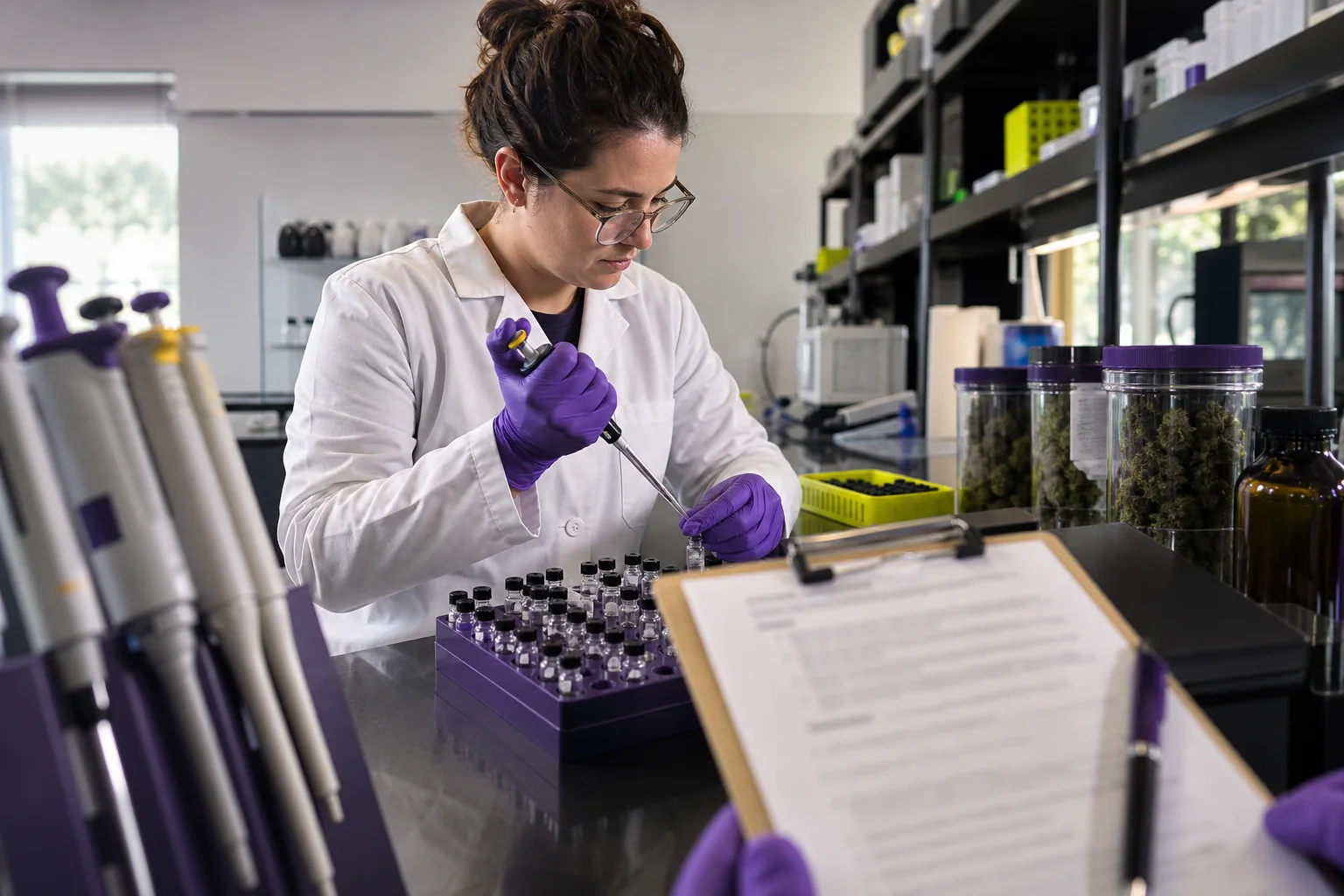
A laboratory-context photograph showing a technician preparing cannabis samples with quality assurance checklists visible but unreadable. This teaches the link between lab QA activities and reliable results; do not show any legible test results or branded equipment logos.
Research context: Cannabis Laboratory Quality Assurance Program: Exercise 2 Cannabinoid Final Report4) Evidence limits: what public health and research say
Public health bodies and peer-reviewed reviews emphasize that evidence about cannabis-related outcomes is complex and evolving. The CDC lays out known risks associated with some cannabis products (including issues with vaping and the emergence of products like delta‑8 THC that can cause unexpected effects), and notes that many hemp/CBD products lack robust safety data or clear labels. That uncertainty supports an evidence-focused approach rather than broad assertions about positive effects. (cdc.gov)
Academic reviews show that advertising often overstates or misrepresents the science. Studies of cannabis advertising and point-of-sale claims have documented widespread unsupported assertions and marketing that can mislead consumers, including claims about CBD that run counter to federal guidance. Those research findings underline why educators should highlight what is known, what is plausible, and what remains uncertain. (pubmed.ncbi.nlm.nih.gov)
For Maine operators, this context supports keeping medically framed assertions off labels and promotional materials and, instead, focusing on verifiable facts—strain lineage, lab results, production practices, and clear cautions—so that information remains accurate and usable. (legislature.maine.gov)
5) Advertising tactics and common red flags
Marketing is designed to persuade; education is designed to inform. Common advertising tactics to watch for include: cherry-picking anecdotal stories, citing unpublished or non-peer-reviewed claims, using emotive imagery, and making broad outcome promises without scientific backing. Reviews of U.S. cannabis advertising find that these tactics can increase youth appeal and mislead adult consumers about likely outcomes. Spotting these patterns helps readers separate promotional copy from factual content. (pubmed.ncbi.nlm.nih.gov)
Practical red flags: absolute claims about specific outcomes, lack of lab-test references, reliance on single testimonials as evidence, or use of language that mimics clinical certainty. If a label or ad asserts a connection between product use and a particular health-related outcome, that is a signal to request the underlying evidence. In Maine, rules already constrain overt health claims on licensed materials; outside those materials, the same skeptical lens helps people evaluate claims. (legislature.maine.gov)
Good education explicitly points out the limits of the evidence. Rather than hiding doubt, it leans into it: “here’s what we know from labs and where the science is thin.” That approach builds credibility—especially for growers who work in small batches and rely on repeat customers.
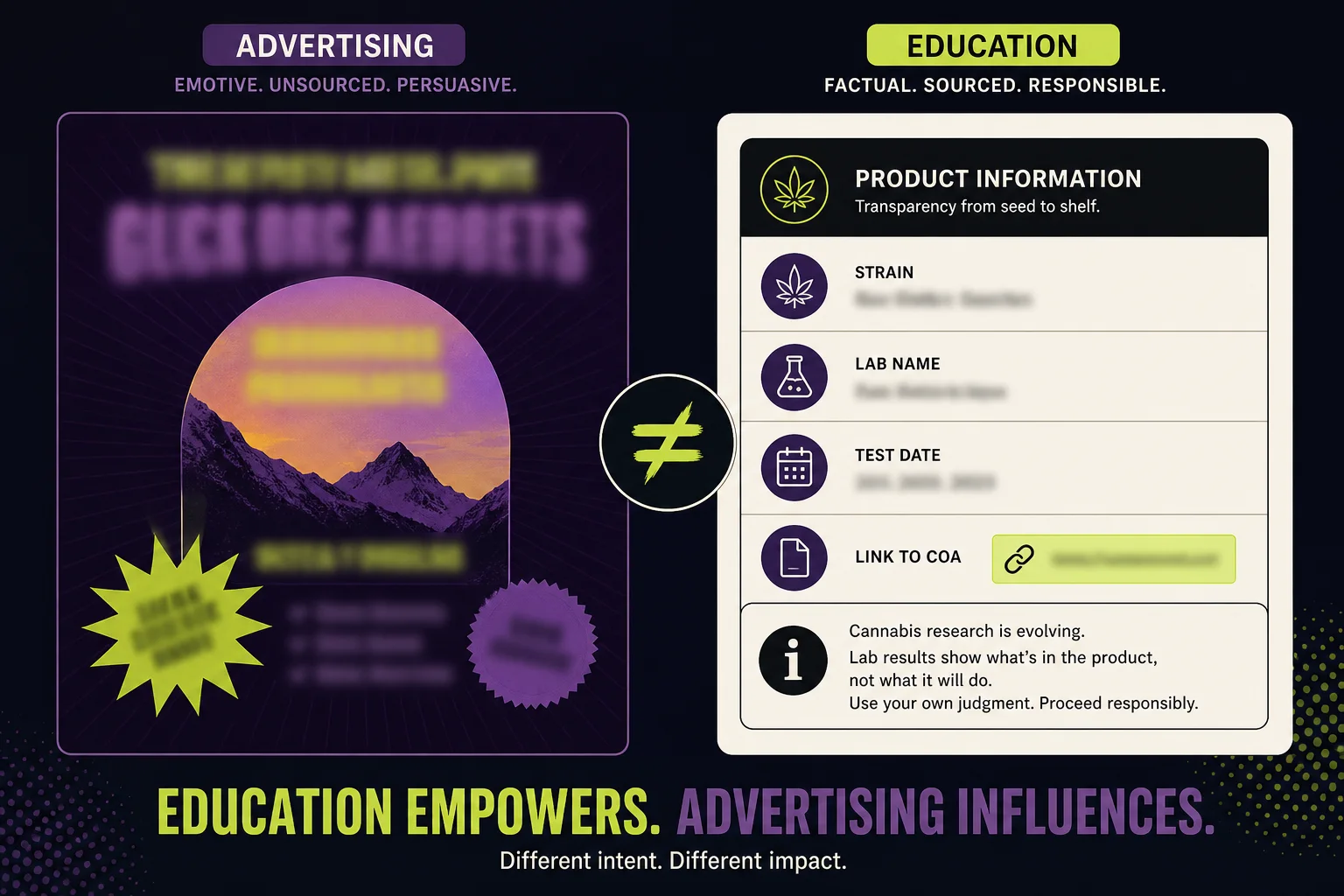
A comparative illustration showing a hypothetical advertising poster (emotive, claim-heavy) beside a product information card that lists lab provenance, test date, and evidence notes. This visual teaches how education reframes information without making medical promises. Do not depict real brands, logos, or readable clinical claims.
Research context: A Narrative Review of Research on Cannabis Advertising in the United States6) How growers and educators can do better (practical steps)
Options and practices that tend to improve transparency include:
-
Publish lab provenance: provide the testing lab, test date, and a short note about method or uncertainty when feasible. Linking to the certificate of analysis on a website or providing a QR code on packaging ties a label number to a verifiable record. This transparency aligns with OCP expectations around testing and labeling. (maine.gov)
-
Use plain explanations about what lab numbers mean: explain that cannabinoid percentages are estimates, describe batch variability, and acknowledge that outcomes vary by person. Avoid medically framed assertions; focus on observable, verifiable details like terpene presence, cultivation methods, and post-harvest handling. This kind of education reduces the gap between consumer expectation and reality.
-
Develop staff guidance for source citation: training that emphasizes saying where a claim came from—lab reports, peer-reviewed studies, or regulatory guidance—helps customers hear provenance instead of marketing spin. When staff acknowledge uncertainty, they often gain trust rather than lose it.
These approaches are not anti‑marketing; they refine messaging. Transparent growers who provide clear, sourced information can stand out in a market where unsupported claims are common. Engaging with OCP’s voluntary packaging, labeling, and advertising review is an option for licensees seeking compliance clarity and feedback on materials. (maine.gov)
7) Reading labels and ads like a scientist (a short checklist)
- Is there a lab name and test date? If not, regard potency numbers as unverified.
- Are specific outcomes or links to health framed without citation? That’s a red flag and may run afoul of Maine rules. (legislature.maine.gov)
- Does the language acknowledge uncertainty (e.g., ranges, test methods) or present single numbers as absolute truth? Prefer the former.
- Are claims tied to peer-reviewed evidence or public health guidance when they refer to safety or risk? If not, ask for sources and keep a skeptical perspective. (pubmed.ncbi.nlm.nih.gov)
Using this checklist turns passive consumption of advertising into active evaluation, which is precisely the skill that public education should build.
Conclusion: Education’s quiet power
Responsible cannabis education doesn’t try to out-promise advertising. It out-informs it. By anchoring statements to tested results, naming sources, and honestly communicating uncertainty and evidence limits, educators and growers give people the tools to weigh options more realistically. In Maine’s regulated environment, those choices are reinforced by statutory limits on misleading advertising and an evolving set of OCP rules for testing and labeling. Together, law and measurement create a space where honest, source-labeled education is both more useful and more verifiable than a catchy claim.
Options for operators include approaching labels and leaflets like lab notebooks: name your sources, show your dates, and explain what a lab number actually means. Those records and explanations help customers evaluate information on its merits rather than rely on slogans. Clear provenance and candid discussion of uncertainty build credibility and align communications with both regulatory expectations and a more scientific approach to product information.
Questions this guide answers
Can a Maine cannabis business make health claims about a product?
No—Maine law prohibits misleading advertising and allows rules that bar health or physical benefit claims on cannabis marketing. OCP rules also set labeling and testing expectations, so operators should avoid medical-sounding promises and cite verifiable facts instead. ([legislature.maine.gov](https://legislature.maine.gov/statutes/28-B/title28-Bsec702.pdf))
If a label lists THC as a single percentage, how accurate is that number?
A THC percentage is an analytical estimate. Laboratories follow methods with inherent measurement uncertainty; differences in sampling, instruments, and methods can change reported values. Look for the lab name and test date to assess provenance. ([nist.gov](https://www.nist.gov/publications/cannabis-laboratory-quality-assurance-program-exercise-2-cannabinoid-final-report))
What are common red flags in cannabis advertising?
Watch for absolute promises of specific outcomes, lack of lab-test references, heavy reliance on testimonials, or claims that mimic clinical certitude. Peer-reviewed reviews show such tactics are common and can mislead. ([pubmed.ncbi.nlm.nih.gov](https://pubmed.ncbi.nlm.nih.gov/41467048/))
How can small-batch growers use education to build trust?
Share lab certificates, test dates, and simple explanations about what numbers mean. Train staff to cite sources and acknowledge evidence limits; transparency tends to strengthen customer confidence. ([maine.gov](https://www.maine.gov/dafs/ocp/adult-use))
Are hemp-derived CBD products regulated the same as adult-use cannabis in Maine?
No. Hemp and CBD markets operate under different federal and state frameworks, and many CBD products lack the same testing or label requirements as Maine’s licensed adult-use products. Consumers should be cautious and check sourcing and safety information. ([cdc.gov](https://www.cdc.gov/cannabis/about/about-cbd.html))
Educational information only. Cannabis affects people differently and this is not medical advice.