

Hero image tying Maine statute to on‑farm practice: shows the legal frame (Title 28‑B) beside cultivation tools to emphasize that advertising and labeling rules affect growers and educators. This is documentary in intent and does not show readable legal text or lab results. Source: Maine Legislature statute page for Title 28‑B. Limit: photograph is illustrative and not a legal document; consult the statute for exact wording.
Introduction: why this distinction matters to growers and adults
Advertising and education look similar at first glance: both use words, pictures, and short claims to influence what a person thinks, feels, or does. But they have different jobs. Marketing wants a purchase, a conversion, or to shape brand preference. Responsible education wants understanding — including the messy parts: limits, tradeoffs, and evidence gaps.
That difference is practical for people who grow and use cannabis. Maine law and Maine’s Office of Cannabis Policy (OCP) put real limits on what marketing may say and how labels must be handled — in part because a product with hundreds of chemical compounds, varied dosing routes, and variable lab results cannot reliably promise a single outcome for every user. Clear source labels and explicit uncertainty in educational materials turn otherwise confusing data into usable information that reduces harm and supports informed choices. (legislature.maine.gov)
In this article I’ll explain the legal frame in Maine, why source labels matter, how uncertainty shows up in the science, what certificates of analysis (COAs) can — and cannot — claim, and concrete reading strategies to separate useful education from persuasive advertising. The emphasis is practical: help readers make better decisions without making individual medical recommendations.
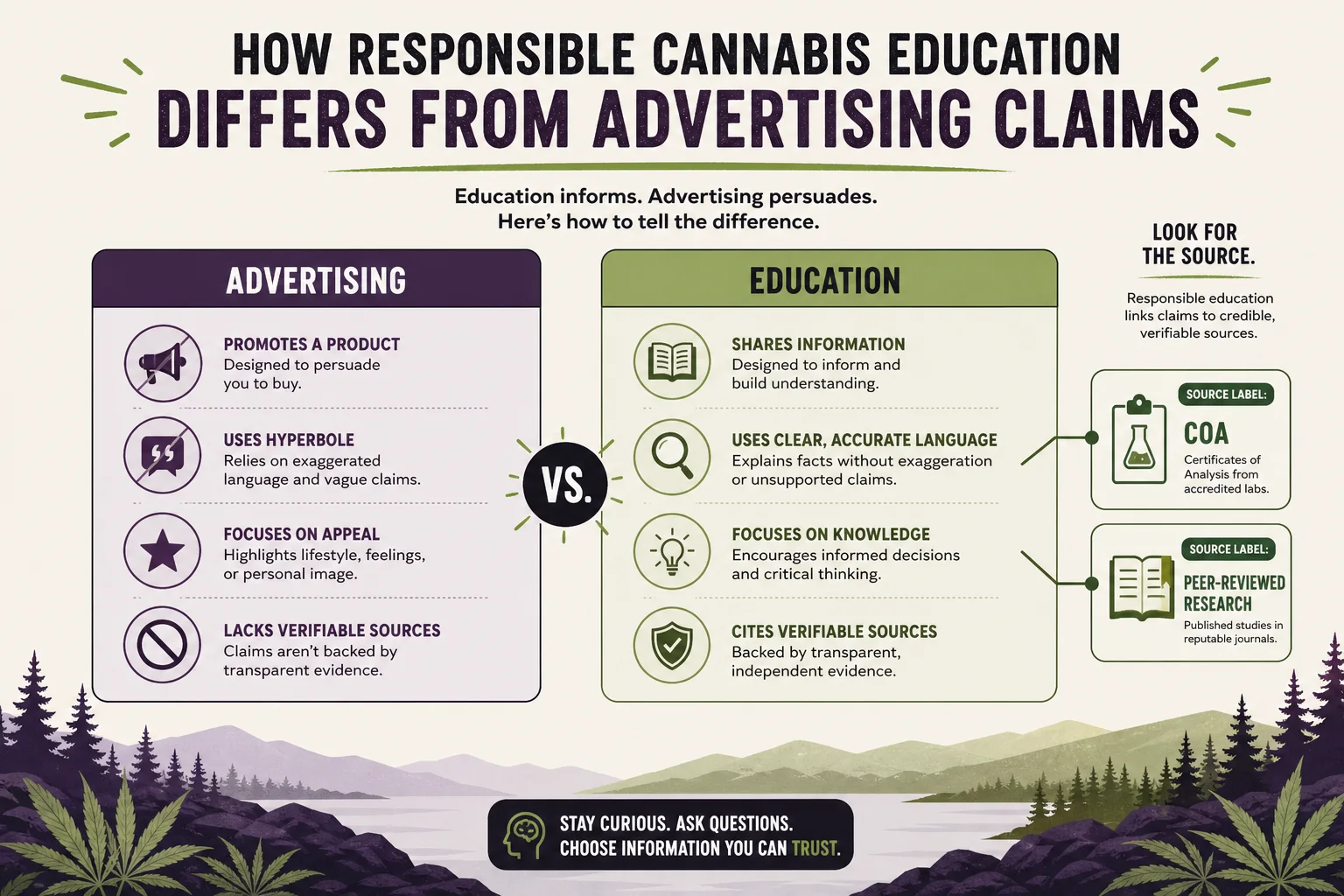
Explanatory diagram illustrating how an advertising claim differs from an educational statement and where source labels (COAs, peer‑review) belong. Useful for teaching critical reading; not an actual ad. Source: OCP rules overview and guidance pages. Limit: conceptual illustration only — not legal advice or a reproduction of rule text.
Research context: Adult Use Cannabis Program RulesAdvertising versus education: definitions, goals, and the law
At its core, advertising is persuasive. That’s its point. States including Maine limit persuasive or misleading statements in cannabis advertising and may restrict health or physical benefit claims outright. In short: ads cannot cross into deceptive or medical claim territory. Maine’s Title 28‑B specifically regulates signs, advertising, and marketing for cannabis businesses and gives OCP authority to deny marketing that fails to comply. (legislature.maine.gov)
Education, by contrast, aims to inform. Good educational material explains sources of information, cites the limits of evidence, and communicates uncertainty — for example, by saying “small trials report X effect” rather than “this product fixes Y.” Those qualifiers aren’t marketing hedges; they’re the point. They help people weigh evidence in context, decide what additional questions to ask, and make more informed choices when trying a new product or method.
Maine’s OCP rules and guidance set out operational expectations for labels, testing, and public materials. The rules require testing, reporting, and standardized labeling in the adult‑use program and note differences in some testing practices between program tracks; program participants may consult statutes and rules for current requirements. That regulatory context affects both what a seller may advertise and what educators may report as reliable. (maine.gov)

Botanical macro and lab context: shows how a sampled flower is linked to laboratory measurement, underscoring why COA sampling technique matters to result interpretation. Limit: image demonstrates process, not lab values or certification details. Source: Maine OCP testing data and guidance.
Research context: Adult Use Testing DataWhy “source” labels are not trivia — they are the foundation of trust
A source label is the short statement that tells you where a claim came from: a peer‑reviewed trial, a lab report, an internal grower note, or a vendor’s marketing deck. Good educators foreground the source for every claim of fact. That transparency helps you test the claim: does the cited lab actually analyze the measured component? Is the clinical result replicable? Was the sample size tiny or were there methodological issues?
For cannabis that matters for two reasons. First, the cannabis plant has dozens of cannabinoids and hundreds of terpenes; the way those compounds interact is complex, and a single certificate or small human study rarely captures that complexity. Second, testing regimes and label claims vary between medical and adult‑use systems; OCP testing requirements for adult‑use products and the medical program’s approach are related but not identical, and guidance documents show how testing results are communicated to both regulators and the public. Knowing the source lets a reader judge whether the evidence supporting a claim matches the question they care about. (maine.gov)
Source labels also reveal incentives. A product page that cites manufacturer‑generated data only, with no independent lab COA or peer‑reviewed study, is different from a page that links to an independent certificate and an independent systematic review. Responsible education makes that distinction obvious; advertising often buries it.
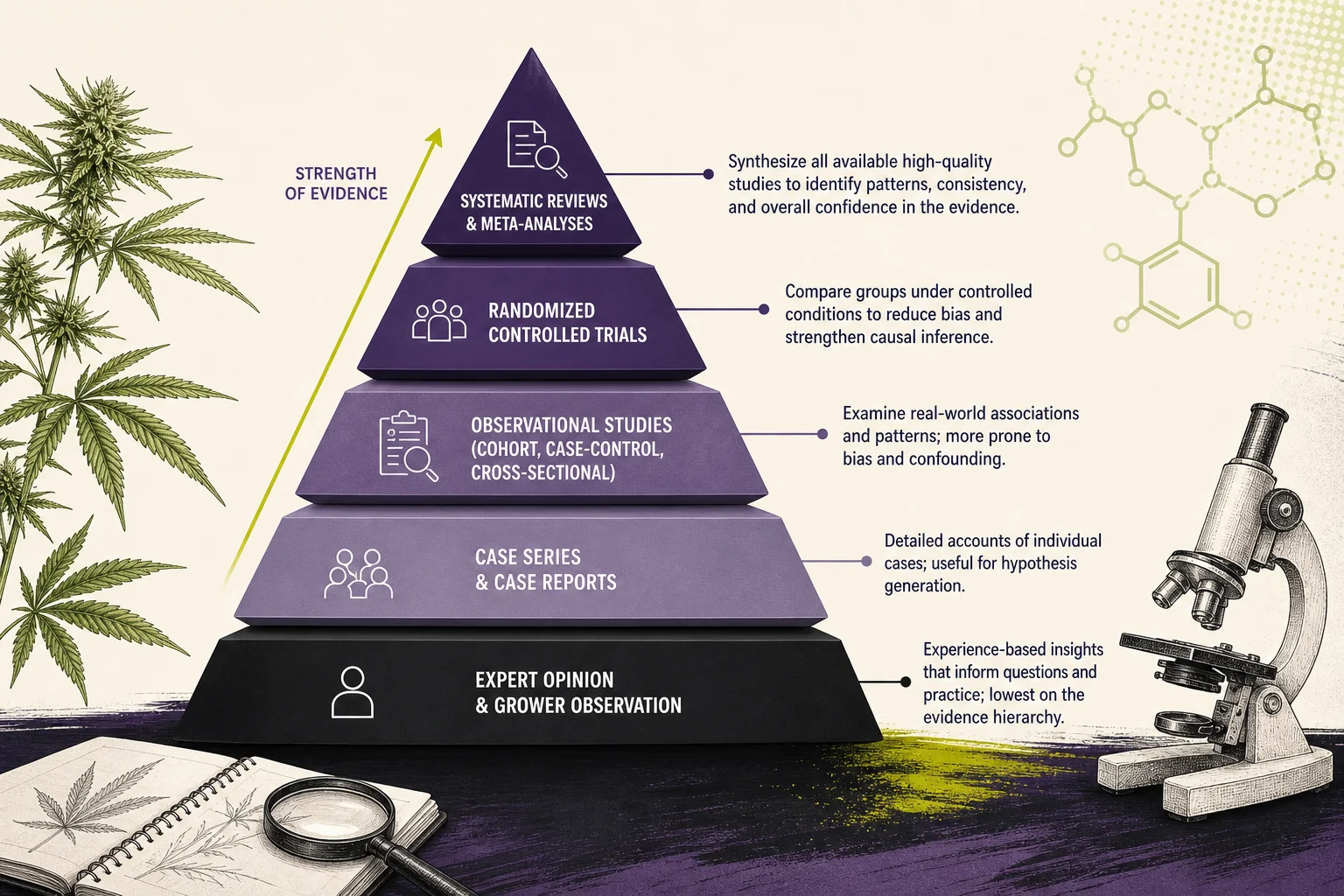
Evidence hierarchy diagram connecting peer‑review summaries to individual studies and grower observations. Useful to teach how to weigh different sources; it cites a representative systematic review rather than presenting findings as definitive. Limit: schematic only — does not report specific clinical outcomes. Source: JAMA systematic review on cannabinoids for medical use.
Research context: Cannabinoids for Medical Use: A Systematic Review and Meta-analysis (JAMA)Uncertainty: how honest educators handle what researchers don’t yet know
Science speaks in probability, not promises. Systematic reviews and evidence maps repeatedly conclude that some outcomes show moderate evidence while many others remain uncertain or of low quality. For example, influential systematic reviews have found moderate‑quality evidence for some symptom outcomes but emphasize study limitations and inconsistent results across conditions and formulations. That’s not a reason to ignore the science — it’s a reason to report it with caveats. (pubmed.ncbi.nlm.nih.gov)
An educational approach explains: what kind of study produced the result (randomized trial, observational study, case report), the size of the effect relative to placebo, and the risks reported. It also highlights population boundaries: results in older adults or in controlled clinical settings don’t necessarily transfer to an unregulated retail product used by a young adult. The Centers for Disease Control and Prevention (CDC) emphasizes that cannabis carries a range of health effects and that many relationships remain incompletely understood — a point educators should state plainly. (cdc.gov)
Finally, uncertainty is actionable. Saying “we don’t know X” can be paired with practical next steps: where to find COAs, how to compare batch results, and when to consult a clinician for clinical or health questions. That makes uncertainty useful instead of paralyzing.
Certificates of Analysis and testing data: what they show — and what they don’t
Certificates of Analysis (COAs) are the single most useful technical document a reader can access about a batch: they list measured cannabinoids, contaminant screens, solvent residuals, microbial checks, and more. Maine’s OCP requires testing and reporting for adult‑use products, and publishes testing data and guidance so regulators and participants can track results. COAs give a snapshot of a batch under specific testing conditions, but they are not an all‑purpose assurance. (maine.gov)
Why not a definitive assurance? A COA represents the sampled portion of a batch at a point in time under specific lab methods. Variability in plant chemistry, sampling technique, lab method differences, and even storage after testing can change a consumer’s eventual experience. COAs also do not measure every possible risk: they test for a defined list of analytes and contaminants set by statute and rule; they do not provide individualized guidance on how a person will respond.
Responsible education explains how to read a COA, including method notes (for example, how THC was measured), the test date, lab accreditation information, and how tested values compare with the label. Maine’s rules and guidance documents explain mandatory analytes and reporting expectations for testing facilities, and those administrative resources are the primary reference for technical definitions. (maine.gov)

Practical screenshot‑style photo showing a consumer interacting with OCP testing data and a COA link. Demonstrates where to find official testing records while noting that COAs are snapshots with methodological limits. Limit: screen content is intentionally non‑readable to avoid reproducing live data; this is demonstrative only. Source: Maine OCP testing data page.
Research context: Adult Use Testing DataReading claims and labels: practical red flags and good signs
When you read product pages or social posts, look for simple signals. Red flags include: sweeping health claims with no sources; single testimonials presented as evidence; or a lack of independent lab data. Advertising that asserts broad, certain benefits without a clear source is exactly the kind of claim Maine law empowers regulators to limit. (legislature.maine.gov)
Good signs are specific source labels (a COA link plus lab accreditation), clear date stamps on tests, and educational language that separates findings (what the data show) from inference (what might possibly follow). Also look for distinctions between medical and adult‑use context — Maine’s OCP guidance discusses testing and reporting expectations that differ in implementation from the older medical program frameworks; labeling that ignores those program differences is less trustworthy. (maine.gov)
Finally, be alert to inappropriate claims about vulnerable groups. Federal and public health agencies note potential harms associated with use during pregnancy, adolescence, or among people with certain mental‑health risks; advertisements that ignore these constraints and present products as universally harmless or universally beneficial are making the type of claims regulators prohibit. The FDA similarly cautions about unproven health claims for CBD and cannabis products and highlights that regulatory review is limited for many retail products. (fda.gov)
How growers, educators, and clinicians can make content more useful
Growers and educators share a practical ethic: accurate records, clear labels, and a willingness to explain tradeoffs. Practical steps that make educational materials trustworthy include linking to the COA for each batch; describing sampling and testing methods in plain language; and explicitly noting where scientific evidence is limited or absent. Those practices align with Maine’s testing and labeling expectations, and make it easier for buyers to compare products objectively. (maine.gov)
Second, use source hierarchies. Put peer‑reviewed systematic reviews and independent lab data at the top, followed by controlled trials, then observational data, and lastly manufacturer or grower observations. When presenting grower observations, label them as experiential and describe their limits: single‑farm notes don’t substitute for controlled data, but they can be helpful starting points for future study.
Third, avoid promises. Education that lists possible outcomes along with frequencies, risks, and alternative explanations is more useful than marketing that asserts a single expected effect. When an educator summarizes a clinical study, noting the study type, the population, and the measured outcomes — with a link to the original report — helps readers verify the account and dig deeper if they wish. That habit reduces the chance of misunderstanding and aligns with public‑health guidance about clear communication. (pubmed.ncbi.nlm.nih.gov)
Conclusion: useful information is honest about limits
Advertising works by simplifying and persuading. Education works by clarifying and qualifying. For a product as chemically and biologically complex as cannabis, clarity about sources, explicit statements of uncertainty, and careful presentation of COAs make the difference between a convenient purchase and an informed choice. Maine’s statutes and OCP rules give the regulatory scaffolding for those expectations — and public health sources remind us why restraint and accuracy matter.
If you want to put this into practice: adults can request COAs, look for materials that show their sources, and regard advertisements as starting points for questions rather than definitive evidence. That approach keeps growers, educators, and consumers working from the same playbook: honesty first, hype last.
Key takeaways
- Maine law and OCP rules limit misleading advertising and require testing and disclosure; those rules shape what claims are permitted. (legislature.maine.gov)
- Source labels (COAs and study citations) let consumers judge whether a claim rests on independent tests or vendor statements. (maine.gov)
- Science reports probabilities and bounds; responsible education explains uncertainty instead of promising outcomes. (pubmed.ncbi.nlm.nih.gov)
- COAs are snapshots with limits — they document a batch under specific methods, not a definitive assurance of how any individual will respond. (maine.gov)
- Prefer materials that link to primary sources, explain sampling/testing methods, and clearly separate observation from inference. (maine.gov)
FAQs
-
Q: Are product labels required to list COA links in Maine? A: Maine requires testing for adult‑use products and OCP publishes testing data; labels and marketing are regulated, and guidance documents explain how test results should be reported. Consult OCP resources for current technical requirements. (maine.gov)
-
Q: If a product advertises a benefit, should I trust it? A: Regard advertising claims as starting points. Trust is higher when the claim cites an independent COA or peer‑reviewed evidence and when the ad clearly states the study type and population. Ads that lack sources or rely on testimonials are less reliable. (legislature.maine.gov)
-
Q: Do COAs tell me how the product will affect me personally? A: No. COAs report measured components and contaminant screens for a batch under specific lab methods. Individual responses depend on dose, route, tolerance, health status, and other variables. (maine.gov)
-
Q: How do medical and adult‑use systems in Maine differ for testing and labeling? A: OCP guidance shows that testing requirements for the adult‑use program are codified in recent rules; medical program testing may be used differently and OCP notes when consistency is required. Consult OCP rule pages and guidance for the precise differences. (maine.gov)
-
Q: Where can I learn more about the evidence base for specific outcomes? A: Systematic reviews and evidence maps summarize clinical trial data and its limits; several large reviews emphasize moderate evidence for some outcomes and insufficient data for others. Reading those reviews alongside public health guidance is a good next step. (pubmed.ncbi.nlm.nih.gov)
Questions this guide answers
Are product labels required to list COA links in Maine?
Maine requires testing for adult‑use products and OCP publishes testing data; labels and marketing are regulated, and guidance documents explain how test results should be reported. Check OCP resources for current requirements. ([maine.gov](https://www.maine.gov/dafs/ocp/adult-use/rules-statutes/rules))
If a product advertises a benefit, should I trust it?
Treat advertising claims as starting points. Trust increases if the claim cites an independent COA or peer‑reviewed evidence and if the advert clearly states the study type and population. Ads that lack sources or rely on testimonials are less reliable. ([pubmed.ncbi.nlm.nih.gov](https://pubmed.ncbi.nlm.nih.gov/26103030/))
Do COAs tell me how the product will affect me personally?
No. COAs report measured components and contaminant screens for a batch under specific lab methods. Individual responses depend on dose, route, tolerance, health status, and other variables. ([maine.gov](https://www.maine.gov/dafs/ocp/open-data/adult-use/testing-data))
How do medical and adult‑use systems in Maine differ for testing and labeling?
OCP guidance shows that testing requirements for the adult‑use program are codified in recent rules; the medical program has related but distinct procedures. Consult OCP rule pages and guidance for precise differences. ([maine.gov](https://www.maine.gov/dafs/ocp/adult-use/rules-statutes/rules))
Where can I learn more about the evidence base for specific outcomes?
Systematic reviews and evidence maps summarize clinical trial data and its limits; several large reviews emphasize moderate evidence for some outcomes and insufficient data for others. Reading those reviews alongside CDC guidance is a good next step. ([pubmed.ncbi.nlm.nih.gov](https://pubmed.ncbi.nlm.nih.gov/26103030/))
Educational information only. Cannabis affects people differently and this is not medical advice.