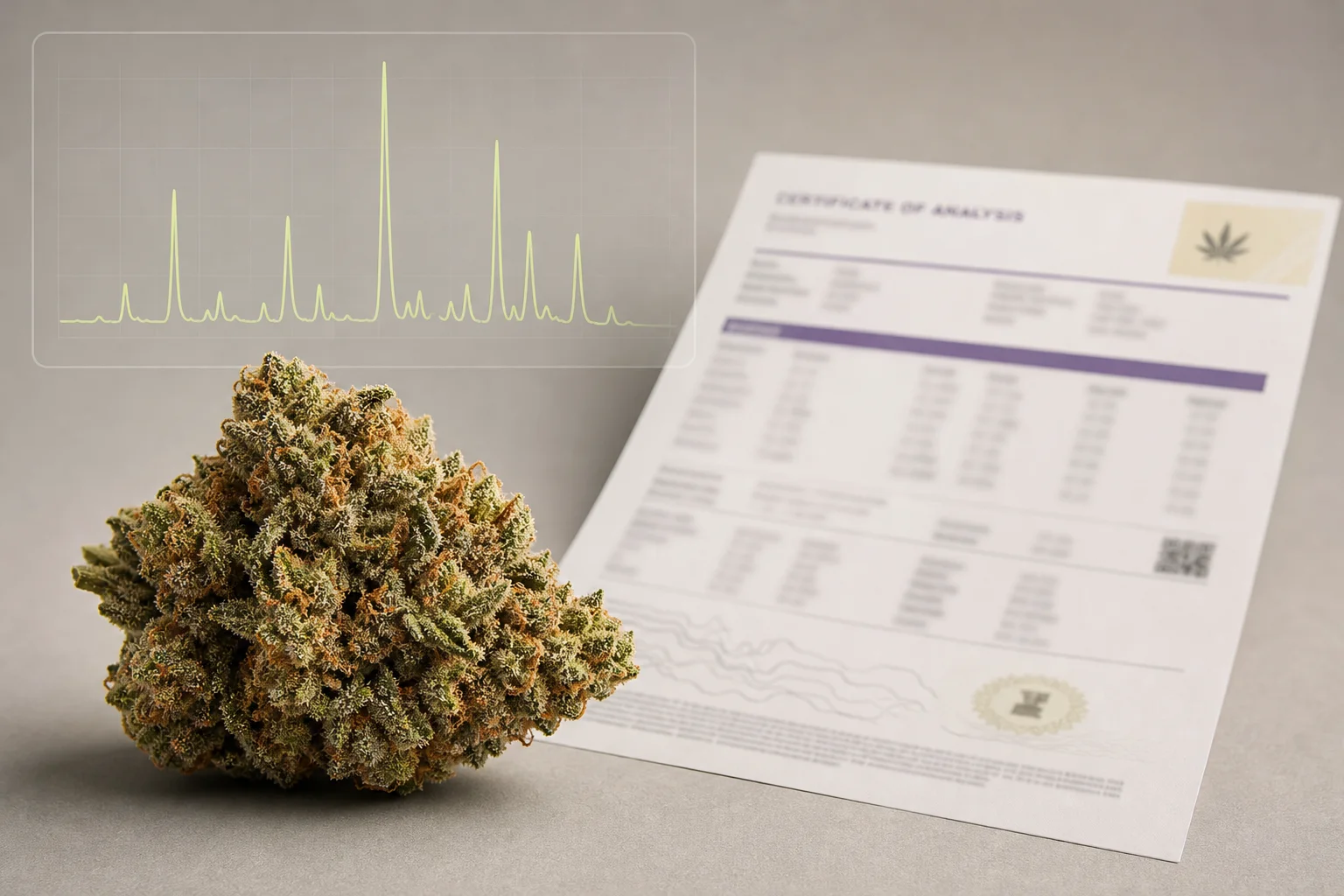
Hero visual: a close botanical macro of a tested bud next to an anonymized, blurred Certificate of Analysis and a stylized chromatogram. This image teaches that COAs are tied to specific samples and analytical traces; the report is intentionally unreadable to emphasize the concept of verification without implying specific values. Limit: it’s an illustrative composition, not a real COA for any product. Source: Maine OCP guidance on testing and labeling.
Why test results matter — and why they aren’t the whole story
Lab reports are the nearest thing we have to an objective snapshot of what’s in one harvest lot at the moment it was tested. They can confirm the presence and approximate amounts of cannabinoids, show a profile of volatile compounds (terpenes), and report on some classes of contaminants that regulators require labs to check before a product reaches shelves. In Maine, licensed testing facilities and adult‑use labeling are governed by state rules that set the required panels and the way results are reported. (maine.gov)
That said, a single Certificate of Analysis (COA) describes one sample. Cannabis is a biological product: potencies shift with cultivar genetics, post‑harvest handling, extraction or infusion processes, and time in storage. Measurement methods and laboratory practices also vary, so numbers on one COA are not a universal “truth” for every bag or batch with the same name. Metrology and interlaboratory studies show method, sampling, and matrix effects can create real, measurable differences between results. (pubmed.ncbi.nlm.nih.gov)
For an adult consumer, the value of a COA is practical: it reduces uncertainty about what’s in a labeled lot and flags whether a product met the state’s minimum screening for pesticides, solvents, metals, and microbes. Use that evidence, but keep its limits in view: it’s one piece of information about one lot, not a full product history or a prediction of individual response. (maine.gov)
What a standard batch report usually shows
Most COAs for flower and finished products include a potency panel that lists major cannabinoids (THC, often reported as total THC; CBD; and several minor cannabinoids), sometimes a terpene panel, moisture or water activity, and results for contaminants (pesticides, residual solvents for extracts, heavy metals, and microbiological screens). States like Maine set which analytes are required for adult‑use sales and require reporting formats so labels aren’t deceptive. (maine.gov)
A potency panel is typically produced by chromatography (HPLC, LC‑MS/MS, GC methods for certain volatile analytes) and reports mass fraction (for example, percentage by dry weight for flower). Terpene reports show relative abundances of volatile aroma compounds but are often limited to a dozen or two common terpenes. Contaminant screens are designed to catch categories regulators consider risky for consumers: pesticide residues, solvent residues from extraction, microbial growth or mycotoxins, and metal contaminants. (pubmed.ncbi.nlm.nih.gov)
COAs commonly include metadata: the lab name, a batch or sample ID, the test date, the methods or accreditation status (for example, ISO/IEC 17025), and whether the sample passed state acceptance criteria. Those metadata items matter because they help you trace where testing happened and when — two details crucial to interpreting the rest of the report. (maine.gov)
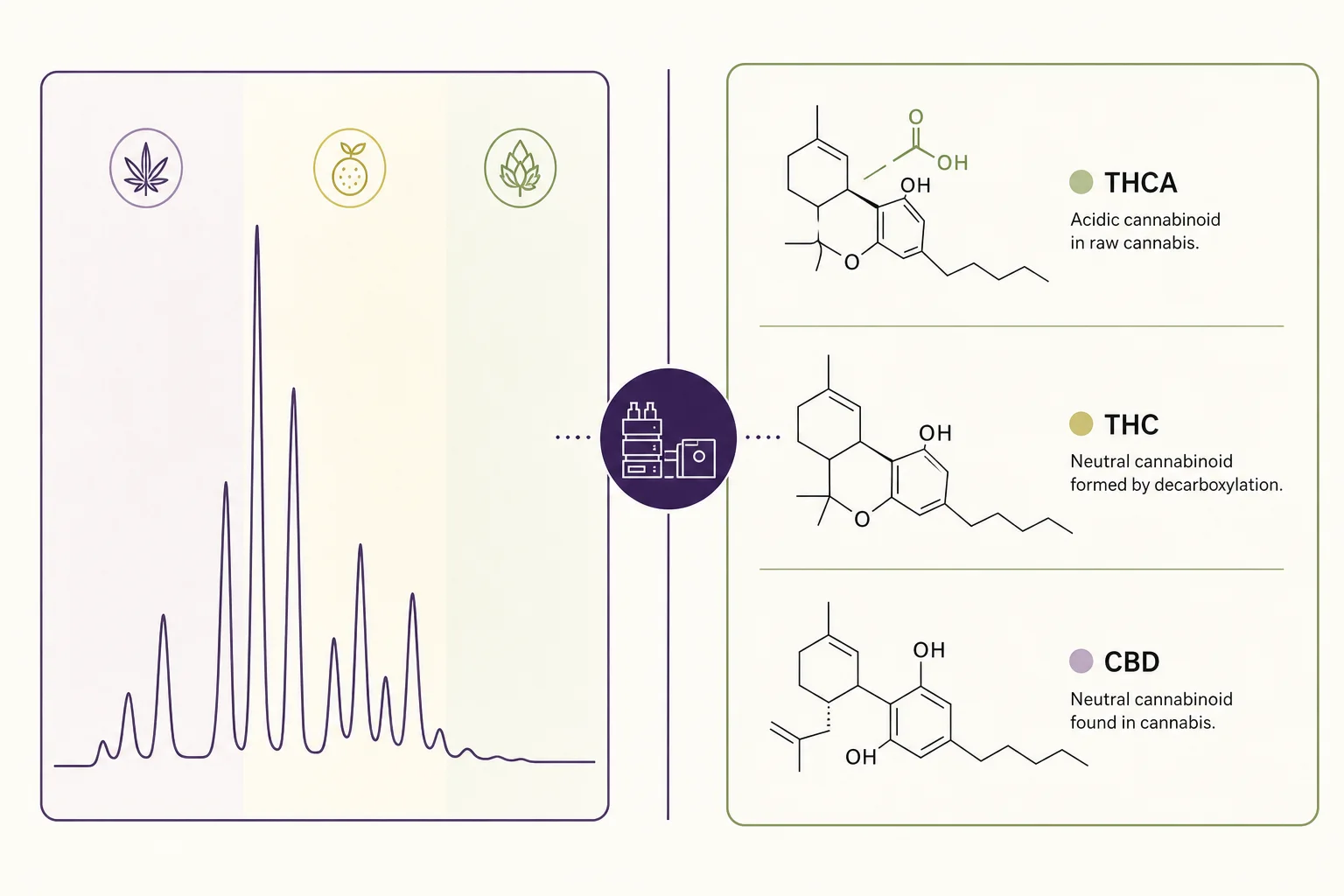
This explanatory diagram pairs a generic chromatogram shape with labeled cannabinoid peaks (THCA, THC, CBD) to show how potency panels are produced. It teaches how labs identify components while avoiding real numeric claims. Limit: educational schematic only, not a lab readout. Source: analytical review of cannabis measurement methods.
Research context: Fit-for-purpose analytics for cannabis: identification, quantification, and standardization of cannabinoids, flavonoids and terpenes.The limits of a single‑batch result: sampling, variability, and method differences
A COA reflects the sample that reached the lab, not every nug in a package. Cannabis flower is heterogeneous: cannabinoid distribution can vary from bud to bud and within a single bud. How a product was sampled (who took the sub‑samples, how many, and what parts of the lot were used) can change the reported concentration. Many laboratory errors and real differences trace back to sampling, not to the analytical instrument. (pubmed.ncbi.nlm.nih.gov)
Methods matter. There are multiple validated analytical techniques for cannabinoids and terpenes, and each has tradeoffs (sensitivity, susceptibility to matrix effects, whether it detects acidic cannabinoids like THCA or only neutral THC). Interlaboratory comparison work and standard reference materials help, but standards and methods aren’t completely harmonized across all labs. That means two reputable labs can report slightly different numbers for the same lot. (pubmed.ncbi.nlm.nih.gov)
Time and storage change chemistry. Acidic cannabinoids decarboxylate with heat and time; volatile terpenes evaporate. A COA dated weeks after harvest may not reflect the profile in a package after months on a shelf or in a warm car. That’s why look‑back dates on a report and the sample’s test date are helpful for interpreting potency and aroma claims. (pubmed.ncbi.nlm.nih.gov)
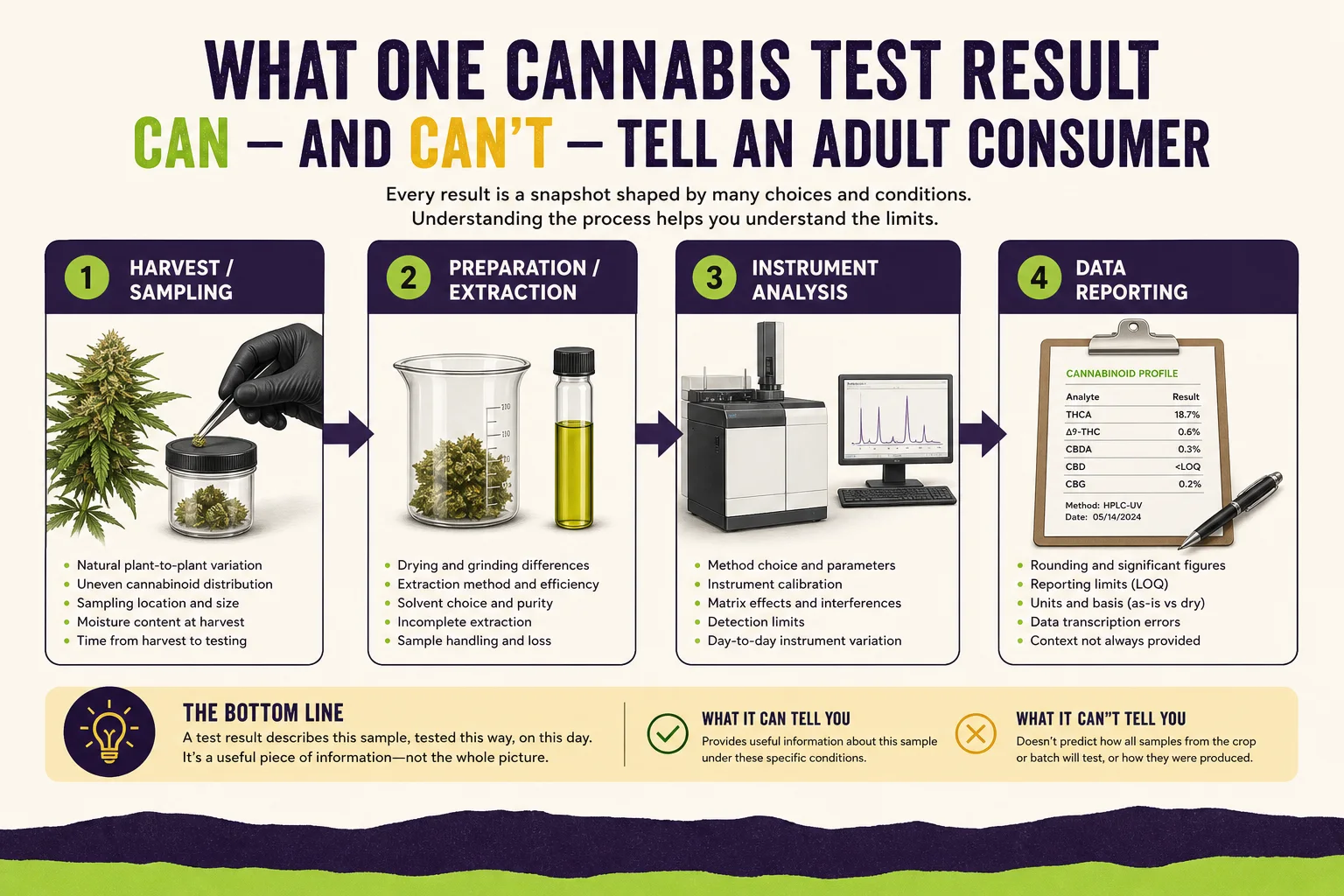
A clear flow diagram from field/sample to lab result highlighting sampling, extraction, method, and storage as variability sources. It teaches why one sample may not represent a whole lot. Limit: conceptual, not an audited quality control flowchart. Source: NIST laboratory quality assurance resources.
Research context: NIST Tools for Cannabis Laboratory Quality AssuranceHow testing and accreditation work in Maine (what to look for on the COA)
Maine requires that testing facilities be certified and, in many cases, accredited to recognized standards. The state rule set describes certification, provisional certifications, and the expectations labs are expected to meet to be authorized to run adult‑use testing. That framework is intended to ensure competence in measurement and to require labs to follow defined methods for required analytes. Checking the lab’s accreditation and certification statement on the COA is a quick way to verify whether the report aligns with Maine’s regulatory expectations. (maine.gov)
Documentation that a lab follows ISO/IEC 17025 or participates in measurement quality programs (for example, NIST’s cannabis reference materials and CannaQAP) is meaningful because it shows the lab engages with interlaboratory comparisons and traceable standards. Those practices don’t eliminate variability, but they reduce avoidable error and make a COA more trustworthy. (nist.gov)
Maine’s guidance also asks platforms to be transparent about methods, limits of detection, and whether a test was out of scope or rejected. If a COA lacks a clear method statement, sample identifiers, or an accredited signature, approach it with caution: the paperwork matters. (maine.gov)
Reading potency numbers: what ‘THC’ and ‘total THC’ actually mean
When a COA lists “THC,” it often reports neutral Δ9‑tetrahydrocannabinol (the form that’s active when inhaled) and may also report acidic precursors like Δ9‑tetrahydrocannabinolic acid (THCA). Many labs report “total THC,” a calculated number that attempts to account for THCA that will convert to THC on heating (decarboxylation). Different labs apply slightly different conversion factors or report components separately; that produces variation in the headline percentage. (pubmed.ncbi.nlm.nih.gov)
For consumers, the practical point is straightforward: a higher percent total THC on paper usually indicates a more concentrated lot under the conditions tested, but it’s not a precise predictor of how a product will affect any particular person. Individual response varies with tolerance, route of administration, prior exposure, and concurrent substances. A COA does not and cannot predict an individual’s experience. (cdc.gov)
Because “total THC” is a calculation, some states mandate specific reporting language and methods to avoid misleading labels. Maine’s labeling and packaging statute requires accuracy and prohibits deceptive claims; a COA tied to a batch is part of how regulators and consumers can verify that labeling. It is useful to match the label’s batch code to the COA’s sample ID and test date. (legislature.maine.gov)
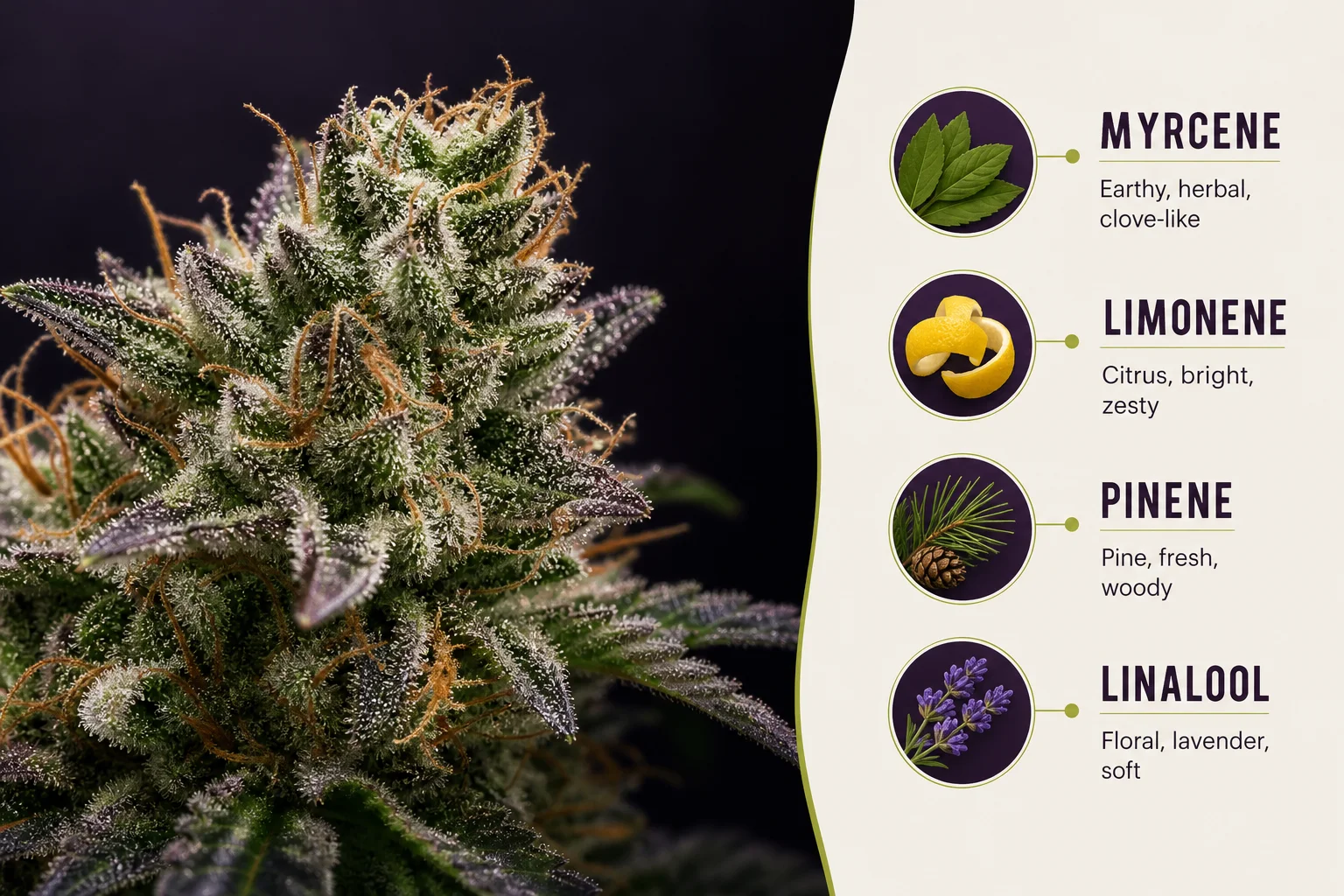
Split visual showing a bud macro on one side and a column of common terpenes with aroma descriptors on the other. It teaches that terpene panels are volatile fingerprints that change with handling. Limit: avoids implying health effects or potency. Source: PubMed review on cannabinoid and terpene analysis.
Research context: Fit-for-purpose analytics for cannabis: identification, quantification, and standardization of cannabinoids, flavonoids and terpenes.Contaminant results: what they tell you — and what they don’t
Contaminant panels are safety‑oriented screens. Their presence on a COA indicates whether a specific tested sample had detectable levels of pesticides, residual solvents, microbial organisms, or heavy metals above the regulatory action limits used by the lab at that time. Passing those screens is a requirement for regulated sale, but it is not an absolute guarantee of safety in every sense: some contaminants are not routinely tested, detection limits vary, and adulterants can be introduced after testing. (maine.gov)
Laboratory detection limits and the list of regulated analytes matter. Not every possible chemical is screened; regulators prioritize classes that are of known concern. Analytical chemistry also has detection thresholds below which a lab cannot reliably report presence. A “non‑detect” does not always mean zero; it means “below the lab’s reporting threshold.” That nuance is critical for interpreting a negative result. (pubmed.ncbi.nlm.nih.gov)
From a public‑health view, agencies like the CDC and poison control emphasize that adulterated or misbranded products, accidental ingestion (especially by children), and concentrated modern formats (edibles, extracts) carry distinct risks that testing reduces but does not eliminate. For suspected adverse reactions or accidental ingestion, local poison control centers can provide guidance. (cdc.gov)
Practical steps — what to check on a COA and on the package
When you review a COA, look for these minimum items: the lab name and accreditation status, sample or batch ID that matches the package, the test date, which analytes were run and by what method, and pass/fail statements for regulated contaminants. If a COA is behind a QR code or a link, scanning it lets you confirm sample IDs and dates align with what’s in your hands. A transparent COA builds trust; missing metadata is a red flag. (maine.gov)
Consider whether the COA is for the same matrix (flower vs. extract vs. edible) as the product you hold. Labs validate methods for specific product types; an assay validated for oil may not be appropriate for a baked good without additional method work. Also check the COA’s test date relative to harvest and packaging: older test dates increase the chance the product’s profile has shifted. (pubmed.ncbi.nlm.nih.gov)
Finally, the COA can serve as evidence when reporting concerns to your retailer or to the Office of Cannabis Policy. Maine’s rules require truthful labeling and provide a regulatory pathway when labels and test results conflict. Keeping notes — sample codes, purchase date, and any issues you observe — supports an investigation if there is suspected mislabeling or contamination. (legislature.maine.gov)
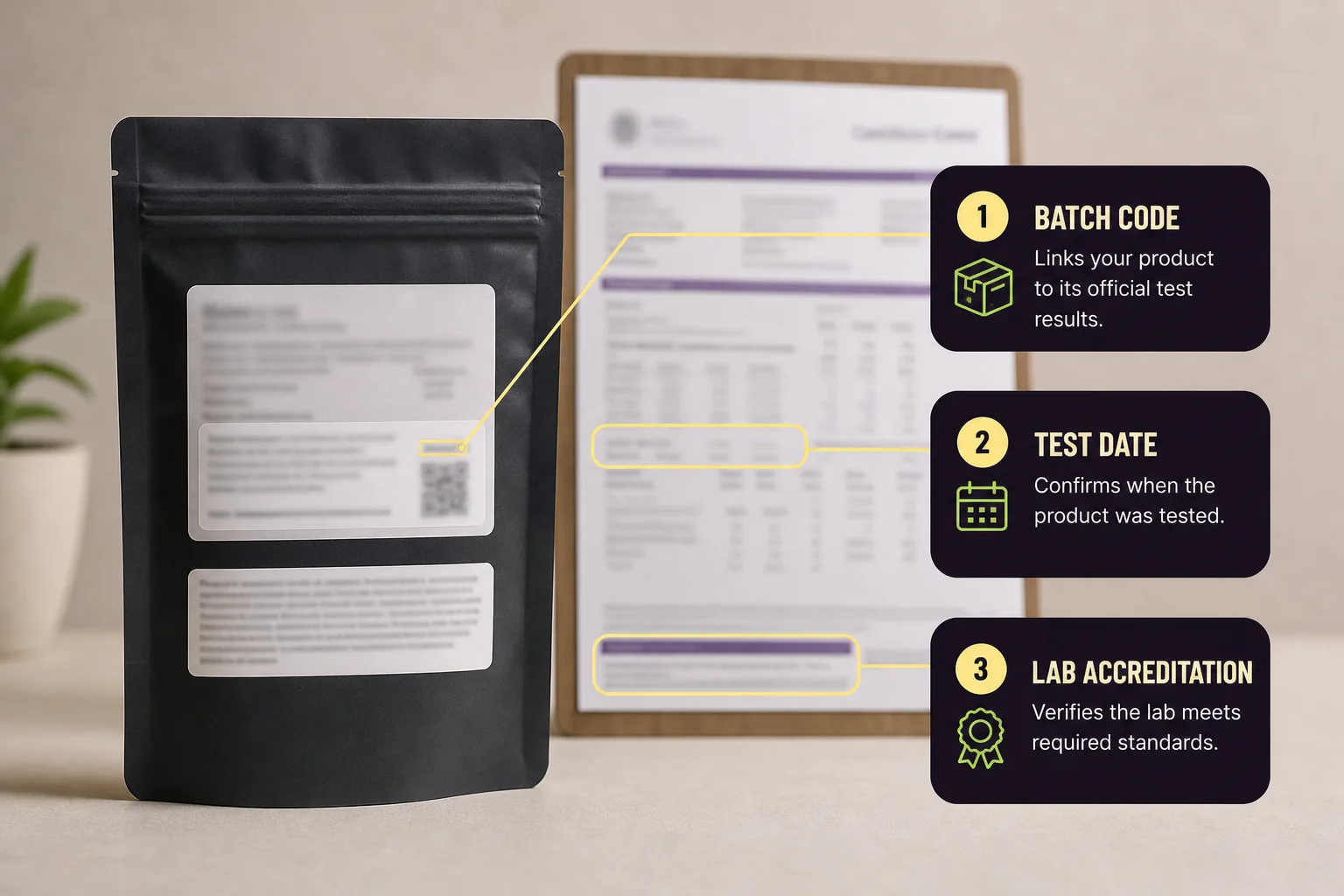
A photographed checklist overlay showing how to match a package to its COA: batch number, test date, lab accreditation. It teaches practical verification steps consumers can take under Maine labeling rules. Limit: anonymized to avoid showing real regulatory enforcement actions. Source: Maine labeling statute and OCP rules.
Research context: Title 28-B, §701: Labeling and packaging · FINAL AUCP Rule Ch 1 (18-691-CMR-Ch1) (pdf)Bottom line: how an adult consumer can use a single COA
Consider a COA useful, verifiable evidence about one lot at one point in time. It reduces uncertainty about composition and basic safety screening, and it is a key tool for traceability and accountability in regulated markets. But remember: biological variability, sampling practice, method differences, and storage effects mean a COA is not a universal guarantee about how every package of a product will perform or how any individual will respond. (pubmed.ncbi.nlm.nih.gov)
Good use of a COA is practical and skeptical at once: check batch IDs and dates, note lab accreditation, and view contaminant panels as safety checks — while accepting that one result is only one slice of the product’s lifecycle. Resources for interpreting a lab report or reporting suspected mislabeling or safety concerns include the Office of Cannabis Policy and local poison control centers. (maine.gov)
Key takeaways
- A Certificate of Analysis (COA) documents a specific tested sample: useful for composition and some safety checks, but not a promise about every package or every user.
- Sampling, lab methods, and storage change results; look at sample ID, test date, and lab accreditation to judge a COA’s relevance.
- “Total THC” is a calculated figure that depends on how a lab reports neutral and acidic cannabinoids; methods vary across labs.
- Passing contaminant screens matters but isn’t an absolute guarantee; "non‑detect" means below lab reporting limits, not necessarily zero.
- If something seems off — mismatched batch IDs, missing methods, or observed adverse effects — consider keeping the COA and reporting the concern to Maine’s Office of Cannabis Policy. For acute reactions or suspected poisoning, local poison control centers are a point of contact. (maine.gov)
FAQ
Q: Can a COA tell me how strong a product will feel for me? A: No. A COA reports chemical content in a tested sample, not individual response. Strength for an individual depends on tolerance, route of use, metabolism, and other factors. (cdc.gov)
Q: If a COA says “non‑detect” for a pesticide, is that pesticide definitely absent? A: "Non‑detect" means levels were below the lab’s reporting threshold. It does not always equal absolute absence. Reporting limits and which analytes were tested matter. (pubmed.ncbi.nlm.nih.gov)
Q: How can I verify a COA is legitimate? A: Check the lab’s name and accreditation (ISO/IEC 17025 is commonly used), confirm the sample or batch ID matches your package, and verify the test date and methods on the report. Maine rules require truthful labeling and lab certification information. (maine.gov)
Q: Who can I contact if I suspect a mislabeled or unsafe product? A: Consider keeping the COA and packaging, and contact Maine’s Office of Cannabis Policy for regulatory follow‑up. For acute reactions or suspected poisoning, your local poison control center can offer immediate guidance (U.S. poison control: 1‑800‑222‑1222). (www1.maine.gov)
Q: Why do two labs report different THC numbers for the same cultivar? A: Differences can come from sampling (different subsamples), analytical method choice, calibration approaches, and how labs calculate "total THC." Interlaboratory variability is a known issue in cannabis analytics. (nist.gov)
Sources
- Rules for the Certification of Cannabis Testing Facilities (Guidance Documents page). Office of Cannabis Policy. https://www.maine.gov/dafs/ocp/resources/guidance-documents. Publisher: Maine Office of Cannabis Policy. (maine.gov)
- Title 28‑B, §701: Labeling and packaging. Maine Legislature. https://legislature.maine.gov/legis/statutes/28-B/title28-Bsec701.html. Publisher: Maine Legislature. (legislature.maine.gov)
- Final AUCP Rule Ch 1 (18‑691‑CMR‑Ch1) (pdf). Office of Cannabis Policy. https://www.maine.gov/dafs/ocp/sites/maine.gov.dafs.ocp/files/inline-files/18-691-CMR-Ch1%2009-08-22_0.pdf. Publisher: Maine Office of Cannabis Policy. (maine.gov)
- Fit‑for‑purpose analytics for cannabis: identification, quantification, and standardization (review). PubMed / NCBI. https://pubmed.ncbi.nlm.nih.gov/42565826/. Publisher: PubMed (NCBI). (pubmed.ncbi.nlm.nih.gov)
- NIST: Tools for Cannabis Laboratory Quality Assurance (CannaQAP and reference materials). https://www.nist.gov/programs-projects/nist-tools-cannabis-laboratory-quality-assurance. Publisher: NIST. (nist.gov)
- FDA: FDA and Cannabis — Research and Drug Approval Process. https://www.fda.gov/news-events/public-health-focus/fda-and-cannabis-research-and-drug-approval-process. Publisher: U.S. Food & Drug Administration. (fda.gov)
- CDC: Cannabis Health Effects. https://www.cdc.gov/cannabis/health-effects/. Publisher: Centers for Disease Control and Prevention. (cdc.gov)
- Poison Control: Cannabis: Risks and effects. https://www.poison.org/articles/marijuana. Publisher: American Association of Poison Control Centers / poison.org. ()
Questions this guide answers
Can a COA predict how a product will affect me?
No. A COA reports chemical concentrations in a tested sample. Individual effects depend on tolerance, route of use, metabolism, and other factors; COAs don’t predict personal responses. ([cdc.gov](https://www.cdc.gov/cannabis/health-effects/))
What does ‘non‑detect’ mean on a contaminant screen?
“Non‑detect” means the analyte was below the lab’s reporting limit; it does not always mean absolute absence. Detection limits and the list of tested analytes matter. ([pubmed.ncbi.nlm.nih.gov](https://pubmed.ncbi.nlm.nih.gov/42565826/))
How do I verify a COA is legitimate?
Confirm the lab name and accreditation (ISO/IEC 17025 or equivalent), check that the COA sample/batch ID matches your package, and compare test dates and method statements. Maine rules require truthful labeling. ([maine.gov](https://www.maine.gov/dafs/ocp/sites/maine.gov.dafs.ocp/files/inline-files/18-691-CMR-Ch1%2009-08-22_0.pdf))
Who do I contact about suspected mislabeling or a bad reaction?
Save the COA and packaging and contact Maine’s Office of Cannabis Policy. For urgent reactions or suspected poisoning, call Poison Control at 1‑800‑222‑1222. ([www1.maine.gov](https://www1.maine.gov/dafs/ocp/adult-use/rules-statutes/rulemaking/proposed-rules))
Educational information only. Cannabis affects people differently and this is not medical advice.