
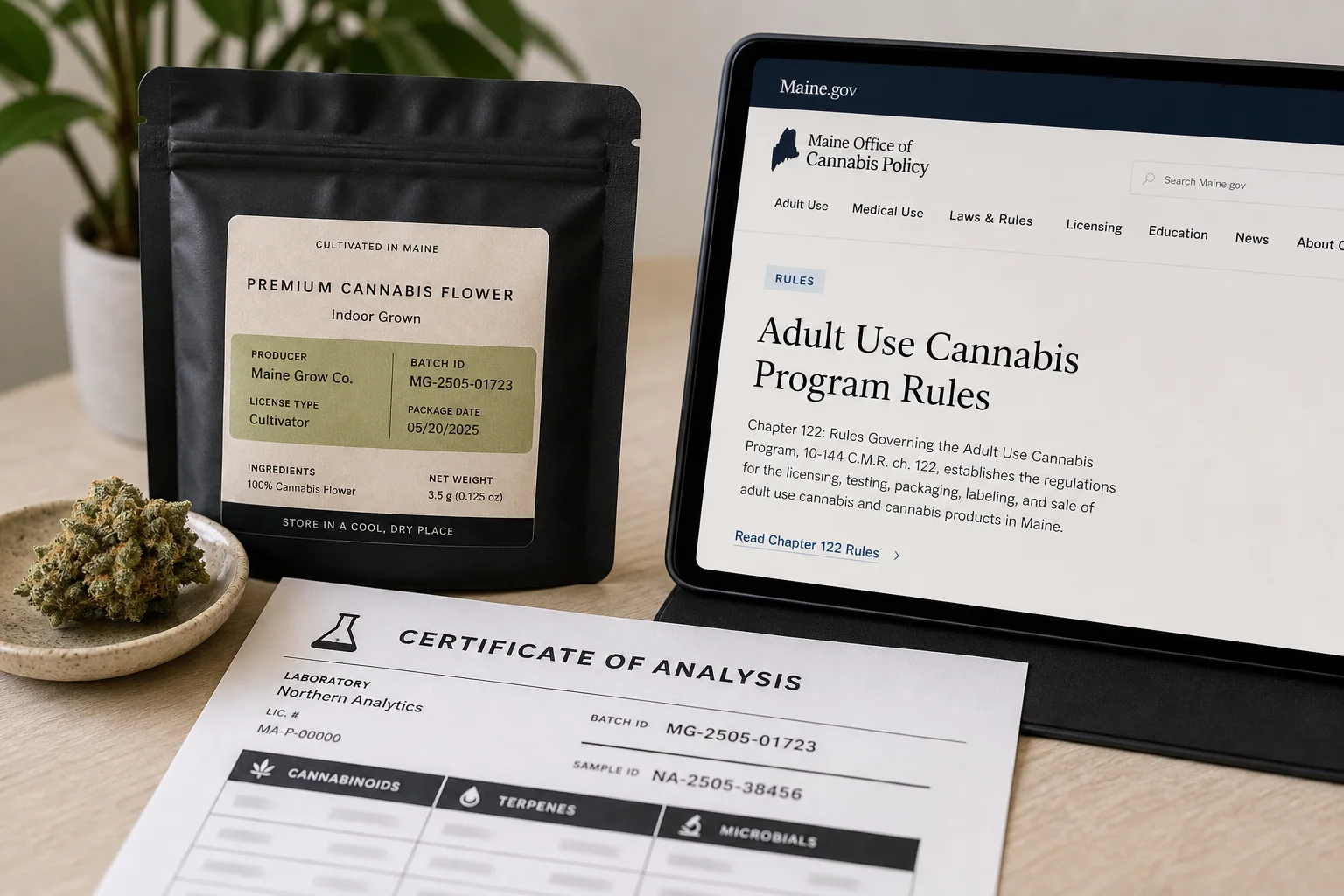
Hero documentary-style image showing the connection between a retail label, the lab report, and state program resources. Useful to demonstrate what to check; does not imply any specific health outcome or lab value.
Why careful cannabis education matters
Cannabis is a complex plant and a complex social topic: chemistry, cultivation, human differences, and shifting law all collide in everyday decisions people make about use, storage, and safety. That complexity makes bright, simple advertising tempting — a single promise, a picture of calm, a short tagline — but those formats trade nuance for persuasion. Good educational content does the opposite: it foregrounds source labels, explains uncertainty, and points out what a claim does — and does not — mean for a real person browsing a shelf or a website.
Responsible education isn’t neutral or boring. It is explicit about limits, cites where evidence comes from, and helps adults make choices that match their values and risks. In Maine, those guardrails are partly written into statute and state rules: advertising may not be misleading or deceptive, and health or physical benefit claims can be restricted by rule. Regulators also publish testing and labeling standards that affect what consumers can verify on a product label. (legislature.maine.gov)
This article explains why labeling sources, naming uncertainty, and avoiding promises about individual results improves usefulness for adults — whether they’re enrolled in the medical program, participating in the adult-use program, or caregivers concerned about accidental exposure.
How advertising and education aim at different outcomes
Advertising works by reducing friction: it creates a quick, memorable association so an adult will choose one product over another. That’s useful in many markets, but it also privileges speed and emotion over accuracy. Advertising copy is designed to land in a short attention span; it is not designed to teach someone how to weigh evidence or to document the provenance of a product.
Education, by contrast, aims to expand a reader’s ability to judge claims and act safely. Rather than promising that a product will produce a particular result, educational content points to what data exist, where the data are weak, and what practical steps are available to reduce avoidable harms. That shift — from persuasion to deliberation — matters for cannabis because the underlying science is still developing and individual responses vary widely. The federal and state regulatory frameworks reflect that tension by limiting some health and physical benefit claims in cannabis advertising and by requiring testing and labeling standards that support verification. (legislature.maine.gov)
As a result, an educational page that explains what a lab report measures will be more practically useful than an ad asserting a product will help with a specific outcome without specifying which evidence supports that assertion — or whether the statement applies to a particular product batch.
What a source label actually tells you (and what it doesn’t)
When you read a cannabis label or a lab test result, the most useful pieces of information are the ones that let you check the chain of custody and testing. A good label will list the producer or processor, the testing laboratory or a batch/test ID, and the date of testing or packaging. Those data allow a curious adult to find the test report and confirm what was measured and how. Maine’s adult-use program rules and testing standards are intended to make those kinds of verifications possible for licensed products. (maine.gov)
But a label rarely tells you everything someone wants to know. For example, a potency number (THC percentage) is a lab measurement for that test sample and that batch, not an assurance about how any one person will respond. Terpene panels indicate which volatile compounds were detected, but the relationship between terpene profiles and user experience is still an active area of research and not a simple cause-and-effect map. Saying why a label matters therefore requires two clarifications: (1) where the measurement came from (which lab and batch), and (2) what the measurement can and cannot predict for an individual.
Labels are also limited by testing scope. Maine’s rules list what testing laboratories must analyze; they do not — and realistically cannot — measure every possible contaminant or predict every interaction with someone’s medications. When advertising cites a physical benefit without pointing to a testable mechanism or reliable clinical evidence, regulators and public-health organizations commonly advise viewing that claim with skepticism and seeking verification from named sources. (maine.gov)
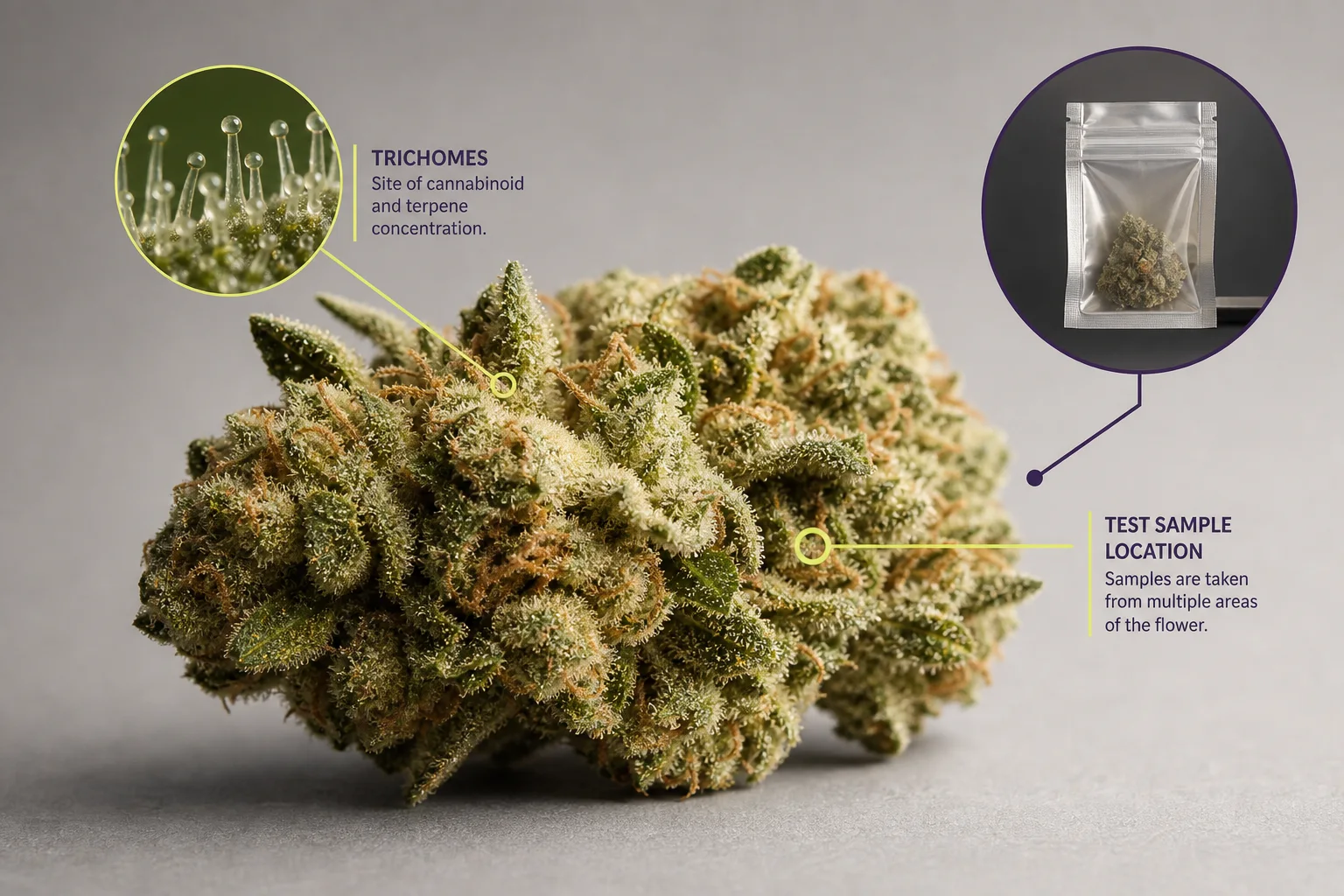
Botanical macro with explanatory callouts connects plant parts to laboratory sampling. It shows why a measured sample may not equal every bud in a harvest and why batch IDs matter. Does not imply effects or outcomes.
Research context: Adult Use Cannabis Program RulesUncertainty in the evidence: what reviews say and why that matters
One reason educational content benefits from explicit uncertainty statements is that the research base for many cannabis-related outcomes remains mixed. Systematic reviews of cannabinoids have found modest effects for some outcomes and limited or mixed evidence for others; the studies themselves vary in quality, population, and the cannabis formulations tested. That variation makes it hard to translate a clinical trial result into a shelf-ready statement a vendor can apply to every product. A high-quality review can summarize the state of knowledge and the strength of evidence, but it will often conclude with caveats about sample size, population differences, and formulation heterogeneity. (pubmed.ncbi.nlm.nih.gov)
Public health agencies therefore encourage cautious wording. The FDA has commented repeatedly that most cannabis- or CBD-containing products lack robust evidence supporting broad claims, and that only a very small set of cannabis-derived products have received formal approval for specific indications. The agency also warns about product quality variability and unverified claims circulating in consumer markets. Clear educational materials reflect those regulatory observations: they explain what is known, what is unknown, and what risks are documented. (fda.gov)
Similarly, the CDC frames cannabis information as a public-health conversation with tradeoffs; the agency lists known short-term and longer-term risks (for example, effects on heart rate or the brain) and points out where evidence remains incomplete. Education that includes those perspectives helps adults weigh potential benefits and harms relevant to them, rather than rely on a one-line claim. (cdc.gov)

Archival-style composition linking statutory text to consumer-facing practice: shows the relevant Maine statute language about advertising and marketing and highlights the prohibition on misleading claims. It supports discussion of regulatory limits while noting it is not legal advice.
Research context:Why not promising specific outcomes makes content more useful
A promise of a specific, assured result produces two predictable consequences: it narrows thinking and it discourages follow-up verification. If a label or ad asserts a single outcome for everyone, the reader is less likely to examine the test report, check for interactions with other drugs, or consider differences in personal history. In contrast, educational material that avoids assurances about individual results invites readers to ask questions: What evidence supports this? Is this product from a tested batch? How might my medications or health status change likely responses?
That inquisitive posture supports safer decisions. For example, clear education encourages adults to check for batch numbers and lab reports, to store products securely away from children (a repeated public-health concern), and to avoid mixing substances that increase sedation. Poison control centers document frequent accidental ingestions — particularly of edibles — and the harms that follow when packaging or advertising resembles familiar foods. Education that emphasizes limits and safe practices is therefore directly practical. (poison.org)
Finally, avoiding promises about individual results also reduces legal and ethical exposure for growers, sellers, and educators. Maine statutes and rules already allow and in some cases require restrictions on health claims; educational materials that align with those legal guardrails reduce the risk of misleading the public or triggering enforcement actions. (legislature.maine.gov)
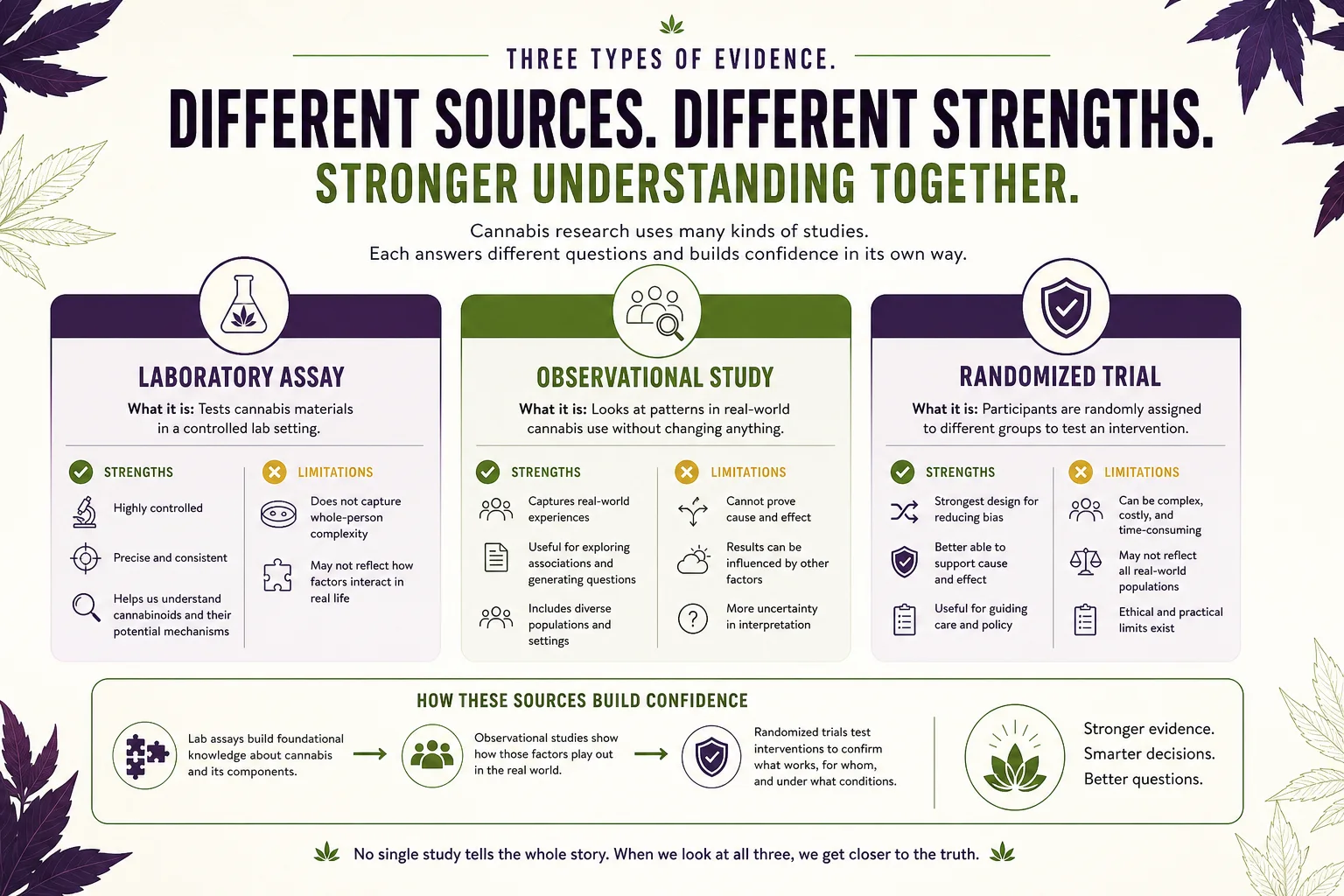
An explanatory diagram that teaches readers why a single trial or a lab assay is not the same as broad, high-quality clinical evidence. Useful for understanding uncertainty; it does not display or invent study results.
Research context: Cannabinoids for Medical Use: A Systematic Review and Meta-analysisPractical skills: spot‑checking claims and labels on product and online
Here are steps adults can use when evaluating a product claim or marketing message:
-
Locate the batch/test ID and lab name on the label. If a product lists a lab and batch, search the testing lab’s report portal or the licensee’s public batch record. If the information is missing, the product is harder to verify. (Maine rules emphasize testing transparency for licensed adult-use products.) (maine.gov)
-
Consider whether the claim cites a specific study or guideline. Advertising language that references an outcome without a source is weaker than language that links to peer-reviewed work or official guidance. When studies are cited, verify whether they tested similar formulations, delivery methods, and populations. Systematic reviews are especially helpful because they summarize evidence quality and consistency. (pubmed.ncbi.nlm.nih.gov)
-
Look for safety-oriented information: storage instructions, child-resistant packaging statements, and explicit warnings about impairment and drug interactions. If the marketing copy avoids these topics entirely, consider the message incomplete. Poison control pages and public-health guidance emphasize secure storage and clear warning language for a reason. (poison.org)
These checks turn a passive shopper into an informed verifier — someone who uses labels and source data to reduce risk and match product choice to personal goals.
How Maine’s medical and adult‑use systems differ — and why it matters for education
Maine runs separate medical and adult-use programs with distinct enrollment, labeling, and sometimes testing pathways. Medical patients may access different product forms or program-specific guidance, while adult-use products follow the labeling, testing, and marketing rules described in Title 28-B and the Office of Cannabis Policy materials. When educational content addresses potential medical uses or interactions, it helps to explicitly note which program context applies and whether the cited evidence derives from clinical trials, observational studies, or general population data. That clarity helps patients and adult consumers determine which information actually applies to their situation. (legislature.maine.gov)
For educators, a practical implication is to include the program context. Where dosing scenarios, drug interactions, or clinical evidence are discussed, indicate whether examples refer to the medical registry, licensed dispensary products, or general-market items. The regulatory distinctions aren’t merely bureaucratic — they change labeling, permissible claims, and sometimes the product formulations available to adults in Maine. (maine.gov)
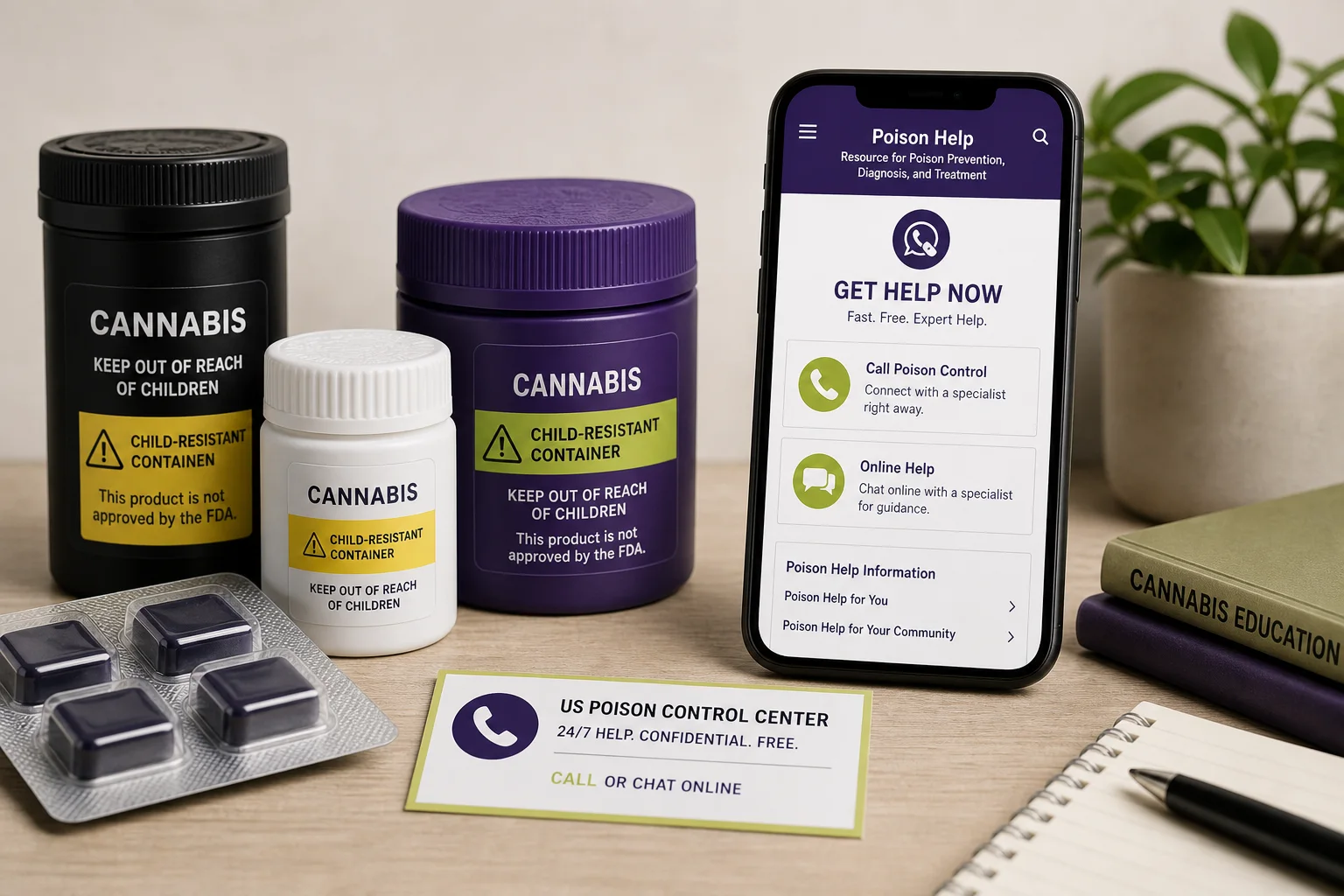
Safety-focused visual showing secure packaging and the poison center contact; this emphasizes practical risk mitigation tied to public-health guidance. The image should not display consumption, product branding, or imply a medical benefit.
Research context: MarijuanaPutting it together: a short checklist for critical consumers
Use this checklist when you read a claim or consider a product:
- Who is the source? (producer, lab, regulator?) — can you find their report? (maine.gov)
- Does the claim cite evidence or a named study? If yes, is the study population and product type similar to the product in front of you? (pubmed.ncbi.nlm.nih.gov)
- Are obvious safety issues addressed (child-resistant packaging, storage, impairment warnings)? If not, regard the marketing as incomplete. (poison.org)
- Does the marketing promise a specific health outcome? If so, consult the regulator (OCP) materials to determine whether such claims are restricted for the program the product belongs to. (legislature.maine.gov)
This approach doesn’t require being an expert — it asks for curiosity, a few minutes of checking, and attention to source labels. That small investment supports safer decisions and reduces the chances of being misled by an attractive but unsupported claim.
Evidence limits and honesty about what we don’t know
Good education must say where evidence stops. Research on cannabinoids and whole-plant products is ongoing, and systematic reviews show heterogeneity in trial design, formulations, and outcomes. That means some promising findings exist alongside real uncertainty; a responsible educator will say so plainly and point readers to the original work rather than spin an oversimple takeaway. (pubmed.ncbi.nlm.nih.gov)
At the same time, public-health agencies document concrete risks — accidental ingestion by children, impairment while driving, and potential adverse interactions — which are topics an education program must address even while scientific debates continue. Clear, sourced communication about those risks helps adults make decisions that reflect both values and evidence. (poison.org)
If you want to dig deeper, reliable starting points include state program pages and public-health reviews, followed by peer-reviewed systematic reviews that evaluate study quality. The references below are a good starting point.
Key takeaways
- Labels that name producers, labs, and batch IDs let adults verify what was tested and when. (maine.gov)
- Advertising shortens complexity into persuasion; education lengthens it into verification and safety. (legislature.maine.gov)
- Systematic reviews show mixed and variable evidence; educators who state uncertainty help adults make more informed choices. (pubmed.ncbi.nlm.nih.gov)
- Public-health guidance emphasizes known risks (accidental ingestion, impairment) that education must cover even when outcomes are uncertain. (poison.org)
- In Maine, program context matters — medical vs adult-use rules change what can be claimed and how products are labeled. (maine.gov)
Reviewed sources
- Maine Title 28-B §702: Signs, advertising and marketing. Maine Legislature. https://legislature.maine.gov/statutes/28-b/title28-Bsec702.html. (legislature.maine.gov)
- Adult Use Cannabis Program Rules. Office of Cannabis Policy, Maine. https://www.maine.gov/dafs/ocp/adult-use/rules-statutes/rules. (maine.gov)
- Cannabis Health Effects. Centers for Disease Control and Prevention. https://www.cdc.gov/cannabis/health-effects/. (cdc.gov)
- What You Need to Know (and What We’re Working to Find Out) About Products Containing Cannabis or Cannabis-derived Compounds, Including CBD. U.S. Food and Drug Administration. https://www.fda.gov/consumers/consumer-updates/what-you-need-know-and-what-were-working-find-out-about-products-containing-cannabis-or-cannabis. (fda.gov)
- Cannabinoids for Medical Use: A Systematic Review and Meta-analysis. PubMed. https://pubmed.ncbi.nlm.nih.gov/26103030/. (pubmed.ncbi.nlm.nih.gov)
- Marijuana. Poison Control (American Association of Poison Control Centers). https://www.poison.org/poison-prevention-by-substances/marijuana. (poison.org)
FAQs
Q: How can I tell whether an ad’s health claim is supported? A: Helpful signs include a specific citation, a named study, or a link to a lab or regulator. Ads that make health-related statements without a source or a way to verify the tested batch are unverified. It can also be useful to note program context — medical vs adult-use — since rules differ. (legislature.maine.gov)
Q: Are lab potency numbers an assurance of effect? A: No. Potency measures a tested sample’s chemical content; those lab values do not predict how an individual will respond. Labels that include batch IDs and lab names make it possible to read the test report and its methods. (maine.gov)
Q: Where should I look for trustworthy summaries of cannabis research? A: Start with public-health or regulator pages (CDC, FDA, state OCP) and peer-reviewed systematic reviews that assess study quality. These sources emphasize evidence limits rather than marketing claims. (cdc.gov)
Q: Where can I get help if a child ingests a product? A: Contact your regional poison center immediately (in the U.S. call 1-800-222-1222) or use webPOISONCONTROL for guidance. Children are more likely to need medical attention after edible ingestion. (poison.org)
Q: Is all advertising regulated the same in Maine? A: No. Title 28-B sets baseline prohibitions (no misleading or deceptive advertising) and allows the Office of Cannabis Policy to adopt rules, including prohibitions on health or physical benefit claims and limits on marketing to minors. Always check which program the product is in and applicable OCP rules. (legislature.maine.gov)
Q: Why not just trust reviews or social recommendations? A: Lived experience and reviews can be informative, but they’re subjective and often tied to particular batches or personal tolerance. Use them as one input alongside source-verified lab reports, program-context checks, and public-health guidance. Systematic reviews offer a complementary, evidence-based perspective. (pubmed.ncbi.nlm.nih.gov)
Disclaimer
Educational information only. Cannabis affects people differently and this is not medical advice.
Questions this guide answers
How can I tell whether an ad’s health claim is supported?
Look for a specific citation, a named study, or a link to a lab or regulator. If an ad makes a health claim without a source or a way to verify the tested batch, treat it as unverified. Check program context — medical vs adult-use — since rules differ. ([legislature.maine.gov](https://legislature.maine.gov/statutes/28-b/title28-Bsec702.html))
Are lab potency numbers guarantees of effect?
No. Potency measures a tested sample’s chemical content; they do not predict how an individual will respond. Labels should show batch IDs and lab names so you can read the test report and its methods. ([maine.gov](https://www.maine.gov/dafs/ocp/adult-use/rules-statutes/rules))
Where should I look for trustworthy summaries of cannabis research?
Start with public-health or regulator pages (CDC, FDA, state OCP) and peer-reviewed systematic reviews that assess study quality. These sources emphasize evidence limits rather than marketing claims. ([cdc.gov](https://www.cdc.gov/cannabis/health-effects/))
What should I do if a child ingests a product?
Contact your regional poison center immediately (in the U.S. call 1-800-222-1222) or use webPOISONCONTROL for guidance. Children are more likely to need medical attention after edible ingestion. ([poison.org](https://www.poison.org/poison-prevention-by-substances/marijuana))
Educational information only. Cannabis affects people differently and this is not medical advice.