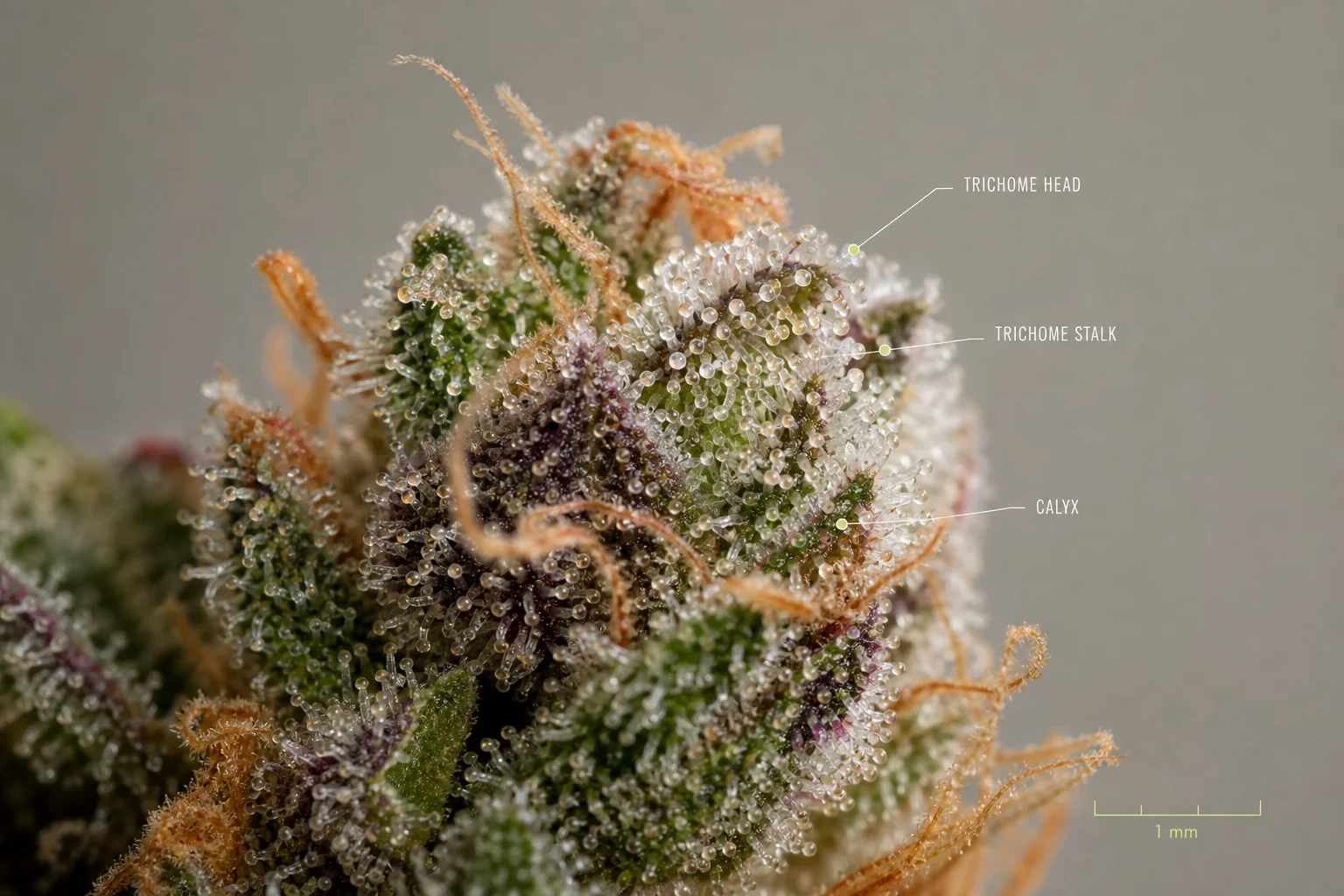
Macro botanical image showing trichome structures that produce cannabinoids and terpenes. This visual teaches where chemical compounds originate on the plant and why harvest timing and trichome maturity matter. It does not show lab results or quantify compounds.
The short answer: names point, data predict
A strain name — Blue Dream, Granddaddy Purple, or any of the newer boutique monikers — is a label created by breeders, sellers, and communities. It signals lineage, a set of expected traits, or even a marketing identity. But a name alone is a poor predictor of what you will find inside a jar or in your body. Names are starting points: a map legend, not the terrain itself.
Why? Because the chemistry of cannabis is shaped by genetics, environment, harvest and post-harvest handling, and individual human biology. Each of these layers can change what a named cultivar actually contains on any given day, in any given batch, and for any given person. This is a pattern supported by peer-reviewed analyses of commercial cannabis chemotypes and by laboratory standardization efforts that document real variability between samples with the same name. (pubmed.ncbi.nlm.nih.gov)
What a strain name actually tells you
Breeders and growers use names to communicate ancestry, horticultural decisions, or a sensory expectation. A name may indicate a cross (A x B), a phenotypic selection out of a larger population, or a stabilized line. In some cases the same name is licensed or shared, and in others it emerges from grower folklore; there is no single naming authority that guarantees uniform genetics across every farm.
Because naming practices are cultural and commercial, they often mix accurate lineage information with shorthand, regional conventions, and sometimes deliberate rebranding. A single name can therefore represent several related but non-identical genetic lines or even unrelated plants that converged on similar appearance. For these reasons, reliable information beyond the name — seed or clone source, breeder notes, and verified lineage — matters for understanding what to expect.
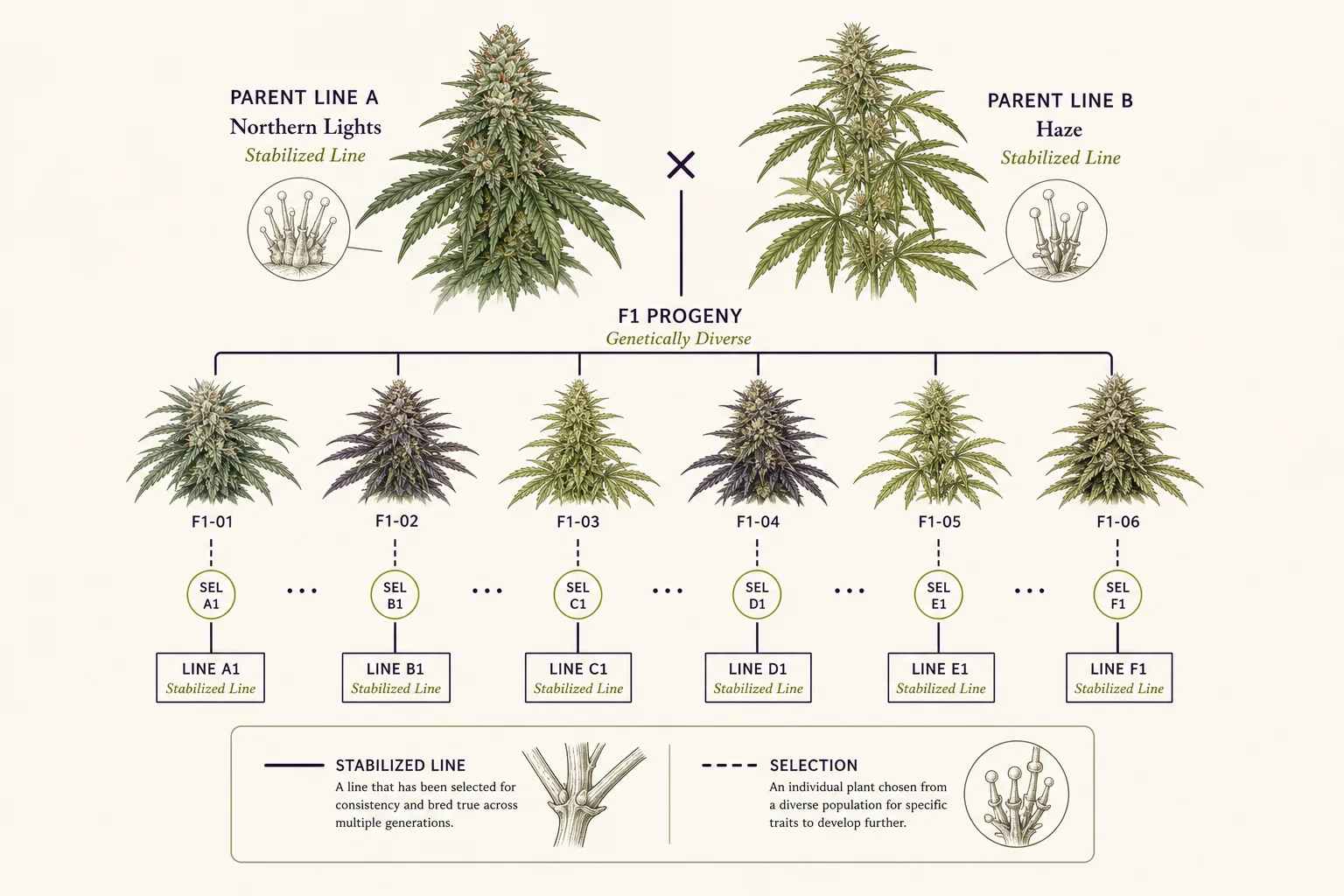
An accurate breeder-style pedigree diagram that demonstrates how a named cultivar can arise from multiple crosses and selections. This helps readers see why a name may cover several related but non-identical lines. Diagram is schematic and not a genetic test result.
Research context: The phytochemical diversity of commercial Cannabis in the United StatesBreeder lineage vs. lab-verified genetics
Lineage (who crossed what, and when) is the closest thing to an honest genetic story, but it is not the same as a lab fingerprint. Breeders keep records that tell you parentage, selection history, and whether a cultivar was inbred or stabilized. Those records are invaluable because they explain the intended breeding goals and help other growers reproduce similar plants.
Genetic testing (DNA-based assays) can confirm relationships and detect mislabeling or hybridization events. However, most consumer-facing labs report chemical profiles (cannabinoids and terpenes) rather than DNA barcodes. DNA work is growing, but routine chemotype and terpene analysis remain the main tools consumers and dispensaries use to compare lots. NIST’s recent work to provide hemp reference material and interlaboratory studies reflects that the field is actively trying to tighten measurement consistency. That work helps labs produce comparable cannabinoid measurements across testing programs. (nist.gov)

A lab-context photo showing chromatography instruments and a COA document (numbers blurred to avoid implying real values). This emphasizes that lab COAs are dated, method-dependent records of a specific batch and not universal guarantees for a strain name.
Research context: NIST’s New Hemp Reference Material Will Help Ensure Accurate Cannabis MeasurementsBatch data: lab reports are the real, dated evidence
A lab Certificate of Analysis (COA) or batch test is the single most useful document you’ll find after a name. It records what was measured in a specific harvest or manufactured lot: cannabinoid concentrations, prevalent terpenes, and sometimes contaminants. Unlike a name, a COA is date- and sample-specific. It tells you exactly what that jar or vape cart contained at the time of testing.
But read COAs carefully. There are differences between labs in methods, limits of detection, and how they report results (e.g., total THC vs. delta-9 THC). The NIST reference material push and multi-lab studies highlight why you should prefer labs that participate in interlaboratory comparisons or that reference standard materials — these practices reduce measurement uncertainty and increase trust in numbers on COAs. Also remember that post-test handling, such as long storage or heat exposure, can change chemical profiles between test time and consumption. (nist.gov)
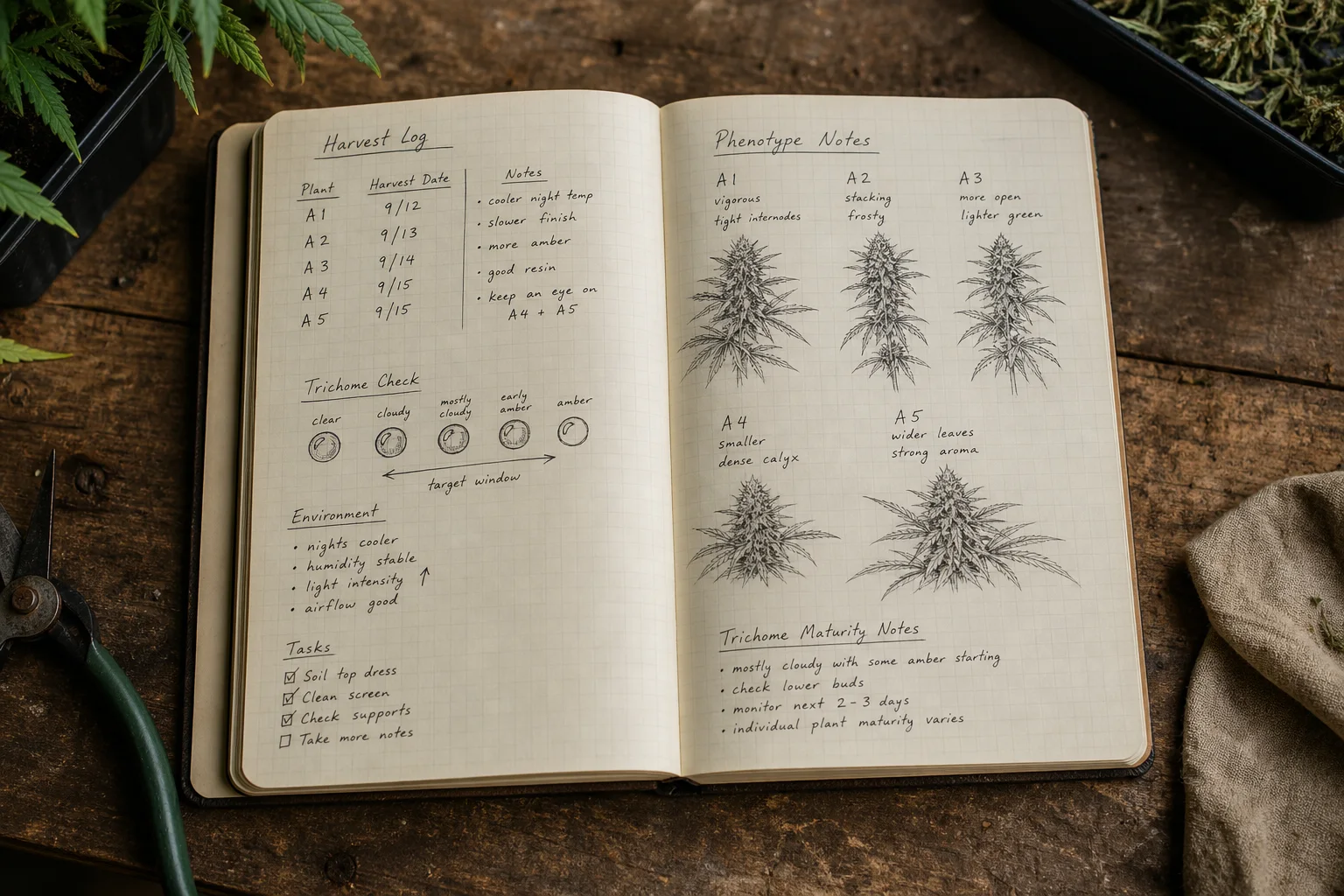
Photograph of an annotated field notebook page illustrating how garden observations (harvest date, phenotype differences, trichome maturity) are recorded. This visual teaches why such notes are necessary to interpret how a single name can produce different batch results. The notebook is archival and not tied to any specific producer.
Research context: Cannabis: from crop to shop—some insights about stability to access quality controlGarden observation: the grower’s field notes matter
What happened on the farm affects chemistry. Light spectrum and intensity, day/night temperature swings, soil or substrate inputs, irrigation, nutrient timing, and pest pressures all shape cannabinoid and terpene production during flowering and ripening. Trichome density and maturity, which a grower can observe and record, are tightly linked to the chemical payloads that labs measure.
Field notes — including harvest date, phenotype selection, trichome ripeness, and drying/curing protocol — are the bridge between genetics and the COA. They explain why two batches with the same name might test differently: one harvested earlier, another cured differently, a third stressed by drought. Good growers keep and share these observations, because they help clinicians, dispensaries, and patients interpret lab numbers in context. Peer-reviewed reviews on cannabis stability and chemodiversity map this link between cultivation, post-harvest handling, and final chemical profile. (pubmed.ncbi.nlm.nih.gov)
Individual experience: human biology shapes the endpoint
Even when you have a verified COA and trustworthy grower notes, your experience may differ from another person’s. Pharmacokinetics (how your body absorbs and metabolizes cannabinoids), tolerance, prior exposure, other medications, and even mood and setting influence effects. Terpenes, minor cannabinoids, and your own endocannabinoid system all interact in complex ways that science is still disentangling.
This is why the same batch can produce different subjective reports across people. Personal journals, controlled titration, and conservative, incremental approaches are tools people use to learn how a given batch behaves for them — but these are personal strategies, not clinical guidance. Scientific studies that analyze chemotype clusters show consistent chemical categories across commercial samples, yet they also document within-cluster variability that maps to personal variation in response. (pubmed.ncbi.nlm.nih.gov)
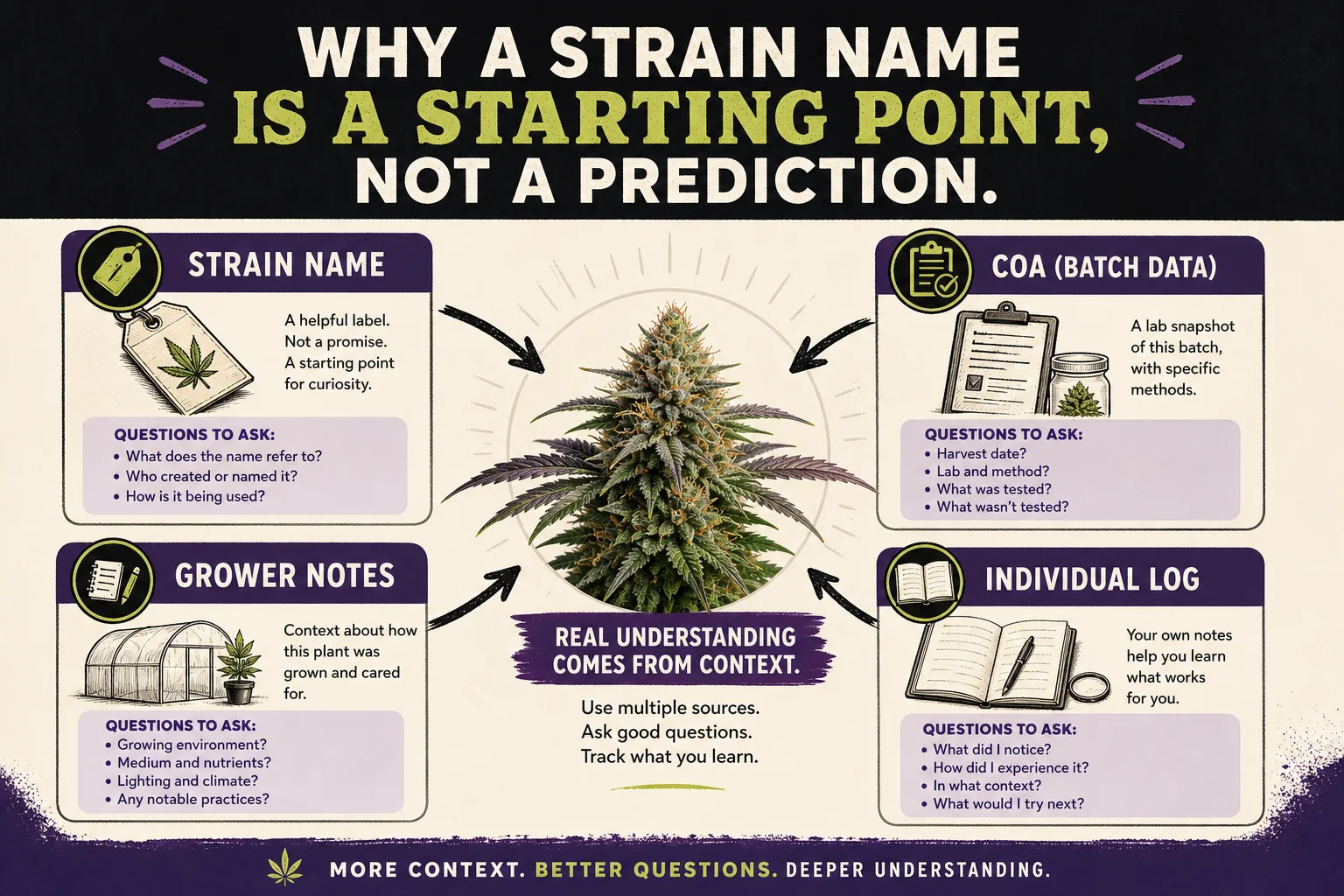
An explanatory infographic that maps how a strain name, COA (batch data), grower garden notes, and an individual's experience combine to form an evidence-based understanding. The diagram clarifies relationships without implying causation or specific outcomes.
Research context: The phytochemical diversity of commercial Cannabis in the United StatesPractical steps: how to use name + data together
-
Start with the COA and the harvest/batch date. Those tell you what was actually measured and when. Prefer products whose testing dates align with recent harvests and that use labs with clear methods or NIST-aligned reference practice. For Maine program participants, be aware that testing practices differ between adult-use licensed products and medical program items; some medical registrants test voluntarily, while adult-use licensees are subject to more prescriptive testing and labeling rules. Check OCP resources for program distinctions. (maine.gov)
-
Ask for breeder notes or source info. If a name matters to you because you value a particular lineage, request seed or clone certificates, breeder statements, or at least a consistent supplier history. Genetic verification is rarer but growing in availability.
-
Combine garden observation with the COA. If a grower reports late harvest or extended hang-drying, expect a possible shift in monoterpene content versus a quick-dry profile. Those production notes explain chemical shifts that a name cannot. See the stability–chemodiversity framework for how post-harvest steps influence final chemistry. (pubmed.ncbi.nlm.nih.gov)
-
Keep a personal log. Record lot numbers and COA IDs next to your subjective notes. Over time you’ll notice patterns tied to specific batches rather than names alone.
Evidence limits and what we still don’t know
The literature shows clear patterns — chemotypes cluster, and cultivation/post-harvest decisions predictably shift terpene and cannabinoid ratios — but the field is not finished. Many studies rely on commercially available samples, which can reflect sampling biases (urban dispensary inventories, regional cultivar popularity). Genetic reference databases are expanding, yet no universal naming authority links every name to a single validated genotype.
Measurement uncertainty is real. Labs differ in extraction methods, chromatography conditions, and calibration standards; that’s why national efforts like NIST’s hemp reference material and interlaboratory comparisons are important for raising the baseline confidence in reported numbers. Even so, sampling heterogeneity within a plant and between buds in a single harvest mean that any COA should be interpreted as representing that tested sample, not every flower from that cultivar. (nist.gov)
How Maine’s programs shape what you can expect
Maine’s Office of Cannabis Policy maintains separate program rules and resources for medical and adult-use participants. The Adult Use Cannabis Program has labeling requirements including the statewide universal symbol; OCP encourages but does not require the universal symbol in the medical program. Testing and recordkeeping expectations are more prescriptive for licensed adult-use businesses, while the medical program still allows more voluntary practices in some areas. If you are navigating the state system — as a patient, caregiver, or adult consumer — OCP’s MMCP page and universal symbol guidance are the official place to confirm current program rules. (maine.gov)
Final note: use the name as a conversation starter
Think of a strain name as a conversation starter that invites you to ask the right questions: Which breeder? What was the harvest date? Do you have a COA? How was it cured? Who tested it and when? Being curious about provenance and data turns a label into practical meaning.
Names remain useful — they carry culture, history, and often real horticultural clues — but they are not promises. Read the science, read the COA, read the grower notes, and then combine that documentation with respectful self-observation. That layered approach turns a name from an assumption into an informed hypothesis you can test in the real world.
Questions this guide answers
Does Maine require testing for medical cannabis flower?
Maine’s Office of Cannabis Policy registers medical caregivers and dispensaries but medical cannabis is not universally subject to mandatory contaminant testing statewide; some medical providers test voluntarily while adult-use licensees face more prescriptive testing rules. Check OCP for current program distinctions. ([maine.gov](https://www.maine.gov/dafs/ocp/medical-use))
If two jars share the same strain name, will they test the same?
Not necessarily. The same name can cover different genetic lines or phenotypes, and cultivation, harvest timing, and post-harvest handling will change measured cannabinoid and terpene profiles. Lab COAs for each batch are the reliable reference. ([pubmed.ncbi.nlm.nih.gov](https://pubmed.ncbi.nlm.nih.gov/35588111/))
What makes a COA trustworthy?
Trustworthy COAs come from labs with transparent methods, traceable calibration standards, and participation in interlaboratory comparisons. NIST reference materials and multi-lab studies improve cross-lab consistency. ([nist.gov](https://www.nist.gov/news-events/news/2024/07/nists-new-hemp-reference-material-will-help-ensure-accurate-cannabis))
How should I track personal effects across batches?
Record lot numbers and COA identifiers alongside subjective notes in a private log. Over time you’ll see patterns tied to batches, not just names — that helps you make more informed choices.
Where can I read Maine’s labeling rules such as the universal symbol?
Maine’s Office of Cannabis Policy provides official guidance and downloadable universal symbol files and a guidance document that explains size, color, and placement requirements for adult-use packaging. ([maine.gov](https://www.maine.gov/dafs/ocp/resources/universal-symbol/))
Educational information only. Cannabis affects people differently and this is not medical advice.