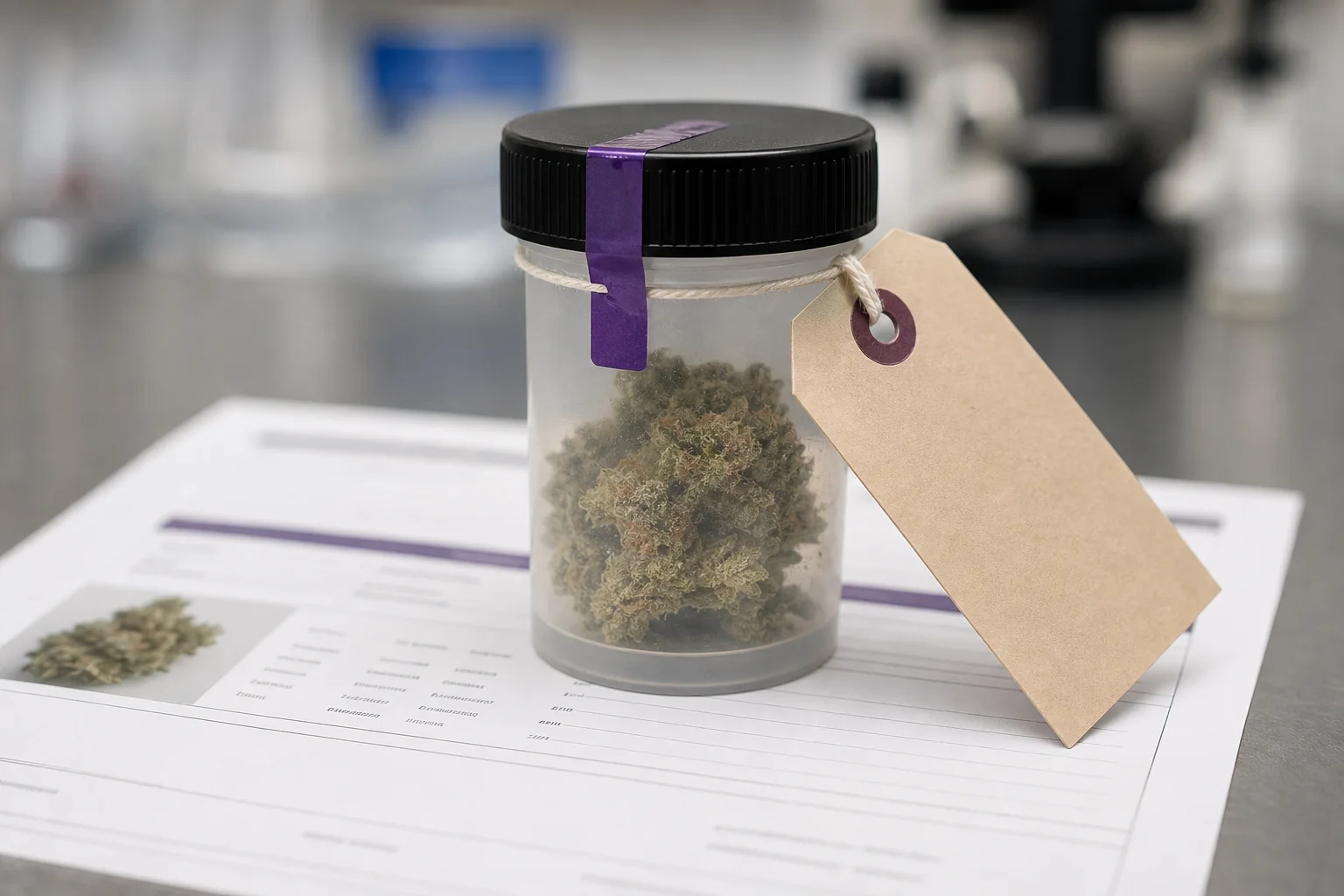
Documentary-style close-up of a sealed sample vial beside a chain-of-custody form and a lab report. This image illustrates what a testing ‘snapshot’ looks like in practice: a single sealed sample, a recorded chain-of-custody, and a laboratory certificate of analysis (COA). It teaches that testing documents are tied to one sample at one time and do not by themselves prove uniformity across a whole harvest. Limit: do not assume the COA in the photo represents every package of a product.
Why one lab report matters — and why it doesn’t tell the whole story
Laboratory testing is one of the most useful pieces of evidence available to an adult consumer: it documents what a certified lab measured in a particular sample from a particular batch at a particular time. In Maine, testing facilities and testing rules govern which analyses are required and how samples should be handled before a product is sold; those requirements are set out by the Office of Cannabis Policy and by statute for labeling and packaging. (See the OCP testing rules and Maine statute on labeling and packaging for details: https://www.maine.gov/dafs/ocp/sites/maine.gov.dafs.ocp/files/inline-files/18-691%20CMR%20Ch%205%20Final.pdf; https://legislature.maine.gov/statutes/28-B/title28-Bsec701.html.)
That specificity is both a strength and a limit. A single test result is powerful for answering narrow questions (Did this batch exceed the pesticide action level? What cannabinoids were present in this sample?) but weak for answering broader ones (Will the product produce a predictable subjective effect? Is this batch identical to other batches sold under the same name?). Later sections explain why in technical and practical terms — and how Maine’s rules try to reduce, but cannot entirely remove, uncertainty.
Finally: testing is a snapshot. Between harvest, drying, curing, packaging, transport, shelf life, and how someone consumes a product, chemistry and risk can change. Expect a lab result to describe what it measured, not to function as a definitive statement about an individual’s experience.
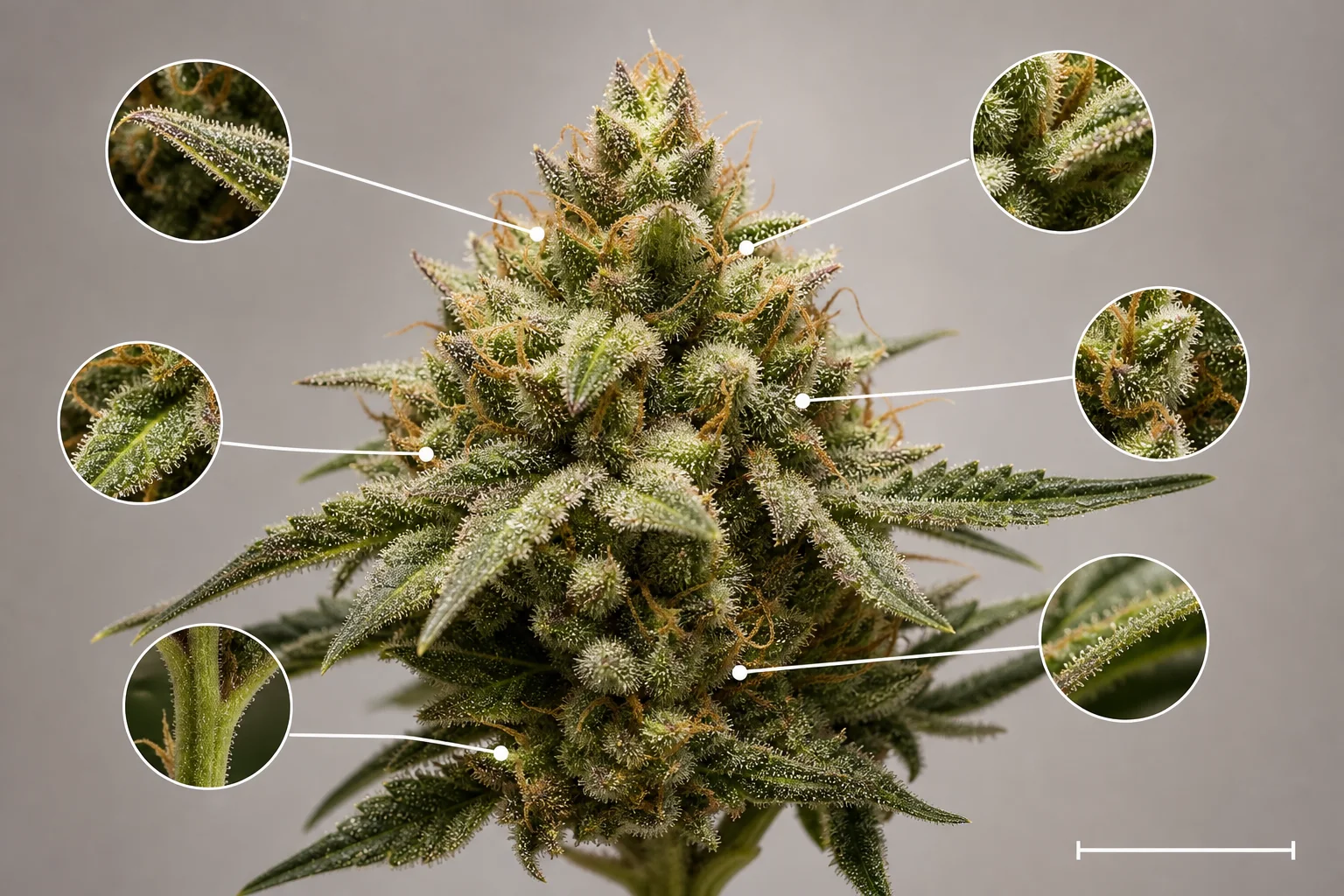
Botanical macro that shows trichome density and annotated sampling points on multiple parts of a single plant. This teaches how cannabinoid concentration can vary within a single plant and why sampling location affects reported potency. Limit: visualizes heterogeneity but does not quantify concentrations.
Research context: Cannabis Laboratory Quality Assurance Program: Exercise 2 Cannabinoid Final Report (NIST IR 8519)What a typical Maine lab report will (usually) include
Most lab reports for regulated Maine products contain several recurring parts: identification and chain-of-custody records, a potency (cannabinoid) panel, contaminant screens (pesticides, heavy metals, residual solvents, microbial contaminants), sometimes terpenes, and method or accreditation notes that explain how the test was performed. The OCP’s certification rules set expectations for what licensed testing facilities are required to document and retain, including sample handling and reporting standards (https://www.maine.gov/dafs/ocp/sites/maine.gov.dafs.ocp/files/inline-files/18-691%20CMR%20Ch%205%20Final.pdf).
A potency panel usually reports measured concentrations of major cannabinoids (for example, Δ9‑THC, THCA, CBD, CBDA) and often a “total THC” number that combines acidic and neutral forms after an assumed decarboxylation calculation. Contaminant sections will report measured amounts against action limits or detection limits; a passing result indicates the batch met the regulatory standard at the time of testing. Some reports include lab comments about sample integrity, retests, or whether a subsample failed acceptance criteria.
Reports may also include limitations statements — for example, describing the sampling point (single bud, homogenized composite, extract aliquot), detection limits, measurement uncertainty, and whether the lab is accredited for particular methods. Those notes explain how much confidence to place in the numbers.
Potency numbers: what they reflect (and what they don’t)
When a label lists a THC percentage, it usually reflects an analytical measurement made on the sample the lab received. Laboratories employ chromatography (HPLC, GC) to quantify cannabinoids; the result is an analytical concentration in the sample material, reported as a percent by weight or milligrams per serving. Method details and calibration practices matter deeply — a single percent point change in reported THC can depend on how the lab defines “total THC” and on the analytical procedure used (https://pubmed.ncbi.nlm.nih.gov/40592871/; https://nvlpubs.nist.gov/nistpubs/ir/2024/NIST.IR.8519.pdf).
Importantly, cannabinoids degrade and transform. THCA converts to Δ9‑THC with heat (decarboxylation), and storage conditions (light, temperature, oxygen) change measured values over time. A potency value measured the day a lab receives the sample will not be identical months later on a retail shelf or once a consumer opens the package. Even within a single harvested lot, different flowers can show measurable variation in cannabinoid content (intra-batch variability) — multiple peer-reviewed studies show both within-plant and between-lab variation for potency results, which is why NIST and independent researchers emphasize measurement uncertainty and interlaboratory comparisons (https://pubmed.ncbi.nlm.nih.gov/40651988/; https://nvlpubs.nist.gov/nistpubs/ir/2024/NIST.IR.8519.pdf).
Thus, potency numbers are best interpreted as the laboratory’s measured concentration for that tested sample, not as a universal truth about the entire product line or as a precise predictor of personal experience.
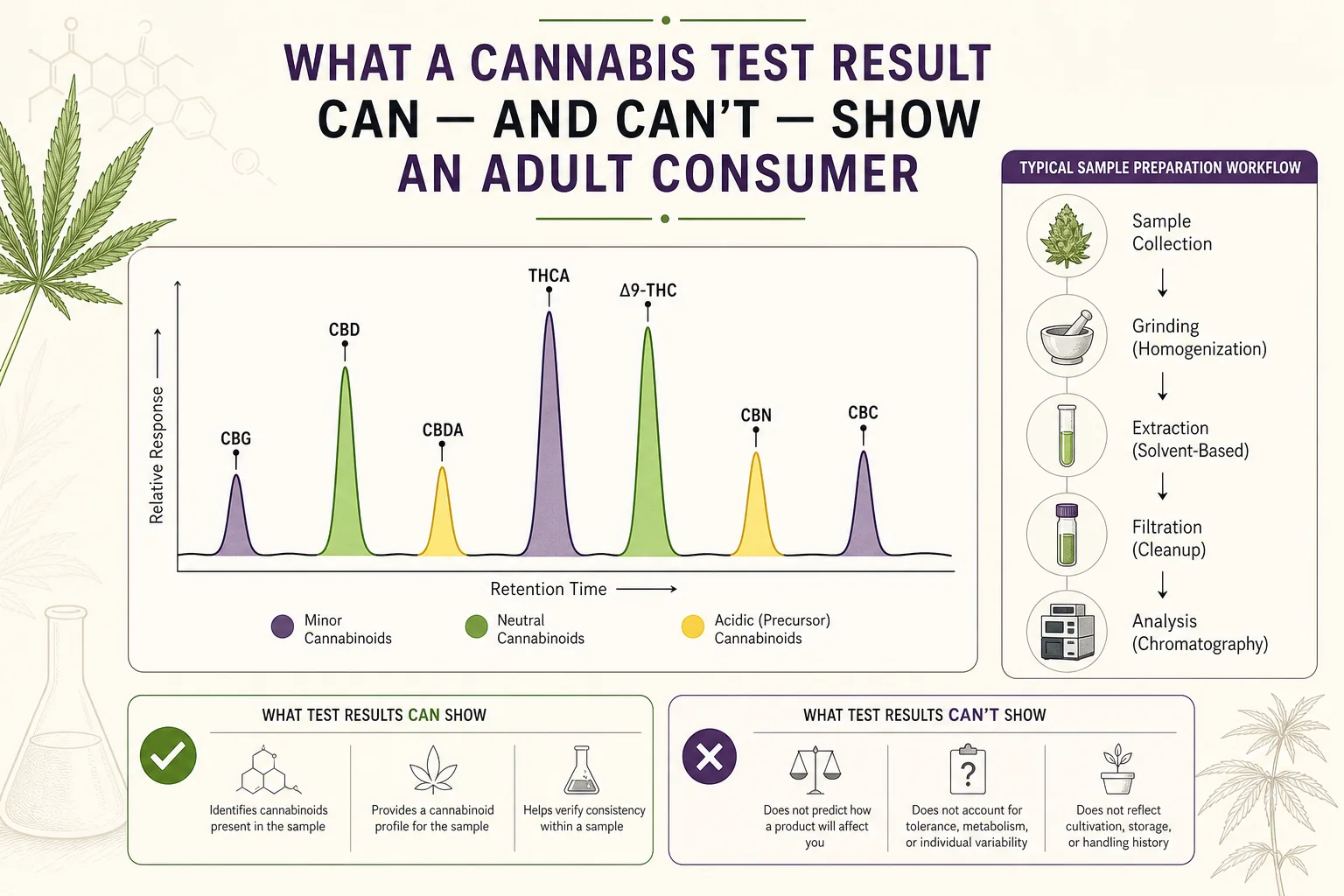
A clear explanatory diagram of an HPLC/GC chromatogram with labeled peak shapes and a legend describing cannabinoid identities (no readable concentrations). This image teaches how labs separate and identify cannabinoids and why method details matter. Limit: schematic only — it does not display real sample values or imply lab performance.
Research context: Accuracy of labeled THC potency across flower and concentrate cannabis products (peer‑reviewed study)Contaminants: safety screens — strong on detection, limited on context
Regulatory testing targets contaminants that pose public-health risks: pesticides, heavy metals, mycotoxins, certain microbes, and residual solvents in extracts. Maine’s testing rules describe required analytes and acceptable limits (for details see the OCP rules and the OCP proposed rules pages: https://www.maine.gov/dafs/ocp/sites/maine.gov.dafs.ocp/files/inline-files/18-691%20CMR%20Ch%205%20Final.pdf; https://www1.maine.gov/dafs/ocp/adult-use/rules-statutes/rulemaking/proposed-rules). When a lab reports non-detects below validated limits, that provides a meaningful safety signal for the sampled material on that date: the target analytes were not found above the lab’s detection threshold in that sample.
Limits of this evidence arise from sampling and testing scope. Not every possible chemical is screened; most labs test a required list of pesticides and solvents, not every chemical imaginable. A negative report therefore means “not detected among the screened items at or above the lab’s detection limits,” not “absolutely free of any foreign chemicals.” Sampling strategy matters too: a contaminated bud can be missed by sampling a different bud, particularly when contamination is uneven.
Moreover, some contaminants pose risk only at certain concentrations or via specific routes of exposure. A lab report provides measured concentrations but does not interpret individualized health risk; for questions about exposures or a suspected adverse reaction, Poison Control and public-health authorities offer resources and guidance (see Poison Control on cannabis risks: https://www.poison.org/articles/marijuana; CDC cannabis FAQ: https://www.cdc.gov/cannabis/faq/).
Sampling, batch heterogeneity, and laboratory variability
One of the single biggest reasons a lab report can mislead is sampling. Cannabis is a biological product: trichome density, cannabinoid concentration, and contaminant deposition can vary between plants, branches, and individual flowers. How a sample is taken — a single bud, a pooled composite of many buds, or a homogenized subsample — changes the measured outcome. Maine’s testing rules specify sampling and chain-of-custody procedures to reduce this problem; still, a single sample cannot capture every micro-variation present in a harvest (https://www.maine.gov/dafs/ocp/sites/maine.gov.dafs.ocp/files/inline-files/18-691%20CMR%20Ch%205%20Final.pdf).
Interlaboratory variability is another reality. Different labs use different instruments, preparation methods, and calibrations. NIST’s interlaboratory exercises and recent peer-reviewed studies show between-lab relative standard deviations for cannabinoids that can be material (NIST IR report and peer-reviewed comparisons: https://nvlpubs.nist.gov/nistpubs/ir/2024/NIST.IR.8519.pdf; https://pubmed.ncbi.nlm.nih.gov/40592871/). That’s one reason regulatory programs emphasize certified labs, clear methods, and periodic proficiency testing.
A practical implication is that surprising or outlying results may prompt inquiry into whether the product was retested, whether the lab noted a sample rejection or reanalysis, and whether the batch label identifies a unique lot. Maine’s rules and ongoing rulemaking also address retest procedures and sample acceptance criteria to help ensure results reflect the sampled batch accurately (https://www1.maine.gov/dafs/ocp/adult-use/rules-statutes/rulemaking/proposed-rules).
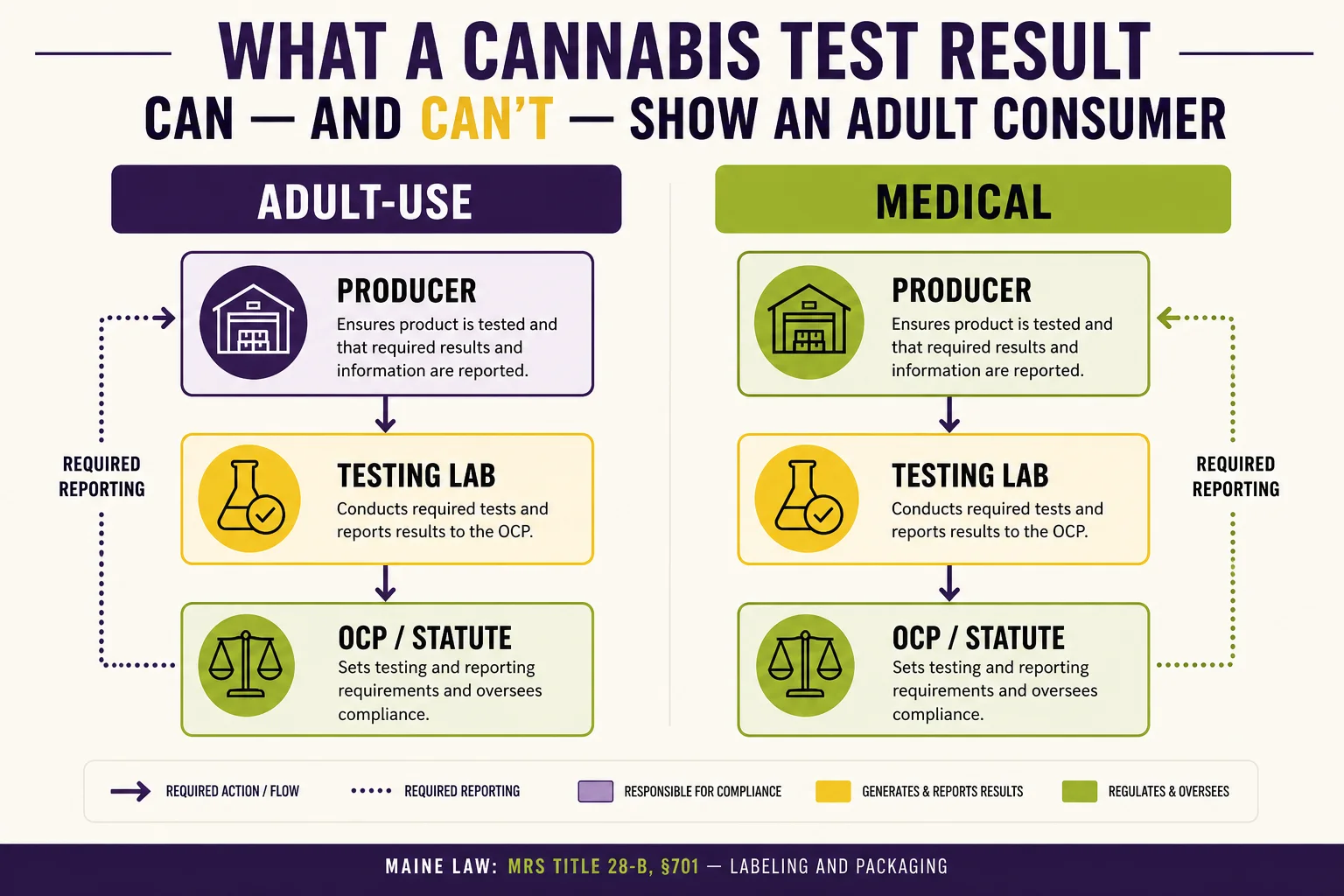
A simplified, plain-language regulatory map contrasting Maine’s adult-use labeling rules and the testing/certification responsibilities of producers and testing labs. This teaches how statute and implementing rules fit together and why statutes (labels) and lab reports are complementary. Limit: schematic only; legal nuance requires consulting the cited statutes and rules.
Research context:How Maine’s medical and adult-use lanes approach testing and labeling differently
Maine law sets the high-level labeling and packaging standards for adult-use products (Title 28-B §701), including prohibitions against false or deceptive labeling and items that target minors (https://legislature.maine.gov/statutes/28-B/title28-Bsec701.html). The Office of Cannabis Policy issues detailed rules for testing, certification, and reporting that apply to adult-use licensed testing facilities and product testing processes. The medical program and adult-use program may have differences in how products are permitted, but both rely on certified laboratory reporting to meet the state’s safety and labeling requirements (https://www.maine.gov/dafs/ocp/sites/maine.gov.dafs.ocp/files/inline-files/18-691%20CMR%20Ch%205%20Final.pdf).
The lab report and the label function as complementary documents: the label provides a consumer-facing summary (and is subject to statutory prohibitions on deceptive labeling), while the lab report provides measurement detail and method notes. Individuals in Maine’s medical program who track effects carefully may find detailed record-keeping and batch-identification practices useful — but the same chemistry and sampling limits described above apply across programs.
Because rules evolve, Maine’s OCP posts rule changes and proposed amendments; these documents show how the state is trying to tighten sample acceptance, clarify retest rules, and update edible product testing — improvements that lower uncertainty but do not eliminate every measurement challenge (https://www1.maine.gov/dafs/ocp/adult-use/rules-statutes/rulemaking/proposed-rules).
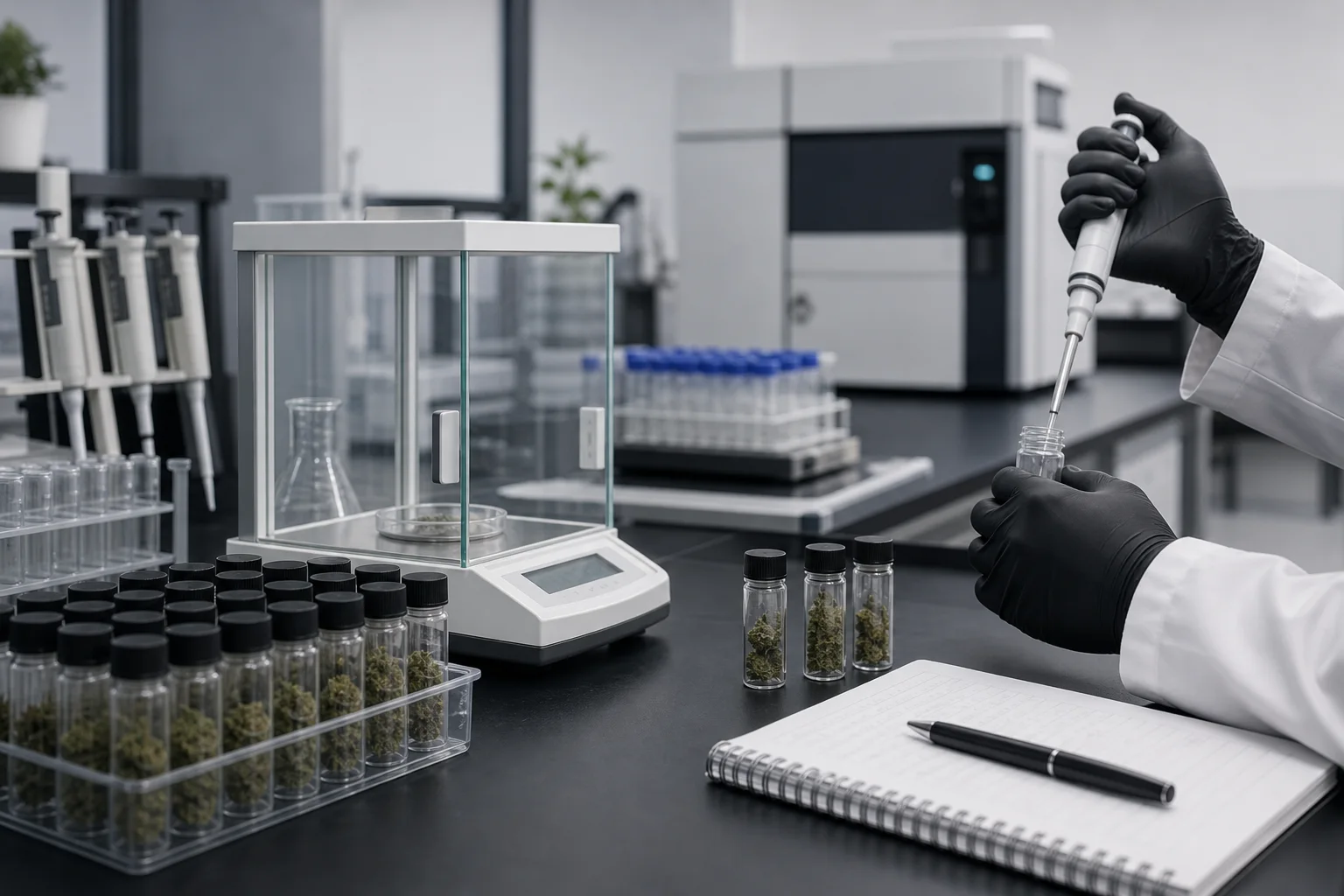
Documentary photograph of a testing bench equipped for potency and contaminant analysis: sample aliquots in sealed vials, pipettes, analytical balances, and a blank bench notebook. This teaches that testing is a technical process requiring traceability and documented methods; it also visually reinforces that lab accreditation and method transparency matter. Limit: no lab names, no readable results, and no suggestion this image shows a particular accredited lab.
Research context:Using a single lab result responsibly as an adult consumer
Useful report elements include the method notes and the chain-of-custody. Indicators of representativeness include whether the sample was a composite, whether the lab is accredited for the requested methods, and whether any retests or rejections are recorded. Those items are among the clearest signals of how representative and reliable the numbers are (https://www.maine.gov/dafs/ocp/sites/maine.gov.dafs.ocp/files/inline-files/18-691%20CMR%20Ch%205%20Final.pdf).
Potency percentages represent measured concentrations in that tested subsample rather than precise predictors of effect. For safety concerns — for example, potential contamination or a suspected adverse reaction — trusted public-health resources such as Poison Control and CDC guidance provide contact information and background; retaining the lab report and product batch information can assist when contacting those services or a health professional.
For greater confidence across time or many packages, products that include transparent batch numbers, traceable sampling notes, and labs that publish methods or hold recognized accreditations provide more verifiable evidence. Producer or retailer postings of batch test reports tied to each product and laboratory participation in proficiency testing or inter-lab comparisons add context for evaluation (NIST’s lab QA guidance explains why those programs matter: https://nvlpubs.nist.gov/nistpubs/ir/2024/NIST.IR.8519.pdf).
Limits of the evidence and where measurement science is headed
Measurement science recognizes that analytical chemistry is powerful but not omniscient. Interlab comparisons, method standardization, and proficiency testing reduce disagreement between labs, and organizations like NIST run exercises to characterize variability and improve methods (https://nvlpubs.nist.gov/nistpubs/ir/2024/NIST.IR.8519.pdf). Peer-reviewed studies repeatedly show that label accuracy and inter-lab variability are ongoing issues across jurisdictions (https://pubmed.ncbi.nlm.nih.gov/40592871/; https://pubmed.ncbi.nlm.nih.gov/40651988/).
Policy changes and technical updates in Maine — for example, clearer sample acceptance criteria, retesting rules, and required recordkeeping — represent steps toward reducing uncertainty, but no regulatory system can convert a single sample into proof that every unit with the same name will be identical. The appropriate consumer expectation is evidence, not certainty.
If the interest is scientific or archival — for example, tracking how a producer’s batches change over time — maintaining a collection of batch reports, recording storage conditions, and documenting labs’ published methods and proficiency testing participation support longitudinal comparison. Over time, repeated, well-documented measurements are what move questions from uncertainty toward useful confidence.
Key takeaways
- A lab report documents what a certified lab measured in a specific sample from a specific batch, not a universal truth about every package of that product. (See Maine OCP rules: https://www.maine.gov/dafs/ocp/sites/maine.gov.dafs.ocp/files/inline-files/18-691%20CMR%20Ch%205%20Final.pdf)
- Potency values depend on sampling, analytical method, and storage; inter-lab and intra-batch variability are established realities. (Measurement science: https://nvlpubs.nist.gov/nistpubs/ir/2024/NIST.IR.8519.pdf)
- Contaminant non-detects are meaningful but limited to the analytes and detection limits used in the test. (Maine rules and public health resources: https://www.poison.org/articles/marijuana; https://www.cdc.gov/cannabis/faq/)
- Maine statute requires truthful labeling and packaging; the label and the lab report are complementary sources of information (https://legislature.maine.gov/statutes/28-B/title28-Bsec701.html).
- For persistent questions, look for batch numbers, repeat reports, accredited labs, and published methods; repeat, well-documented measurements build confidence.
Frequently asked questions
Q: If a lab report shows “non-detect” for a pesticide, is the product safe? A: “Non-detect” means the pesticide was not found above the lab’s validated detection limit for that sample. It does not prove the product is free of every possible contaminant or that contamination could not exist elsewhere in the batch. For urgent exposure concerns, Poison Control (1-800-222-1222) and CDC guidance are contact points. (https://www.poison.org/articles/marijuana)
Q: Why do THC percentages differ between packages with the same strain name? A: Biological variation, differing sample points, drying/curing, storage, and lab methods can all shift measured THC. A single label reflects one measurement, not an immutable property of the cultivar. (https://nvlpubs.nist.gov/nistpubs/ir/2024/NIST.IR.8519.pdf)
Q: How much trust is warranted if an independent study found mislabeling in the market? A: Independent studies show that accuracy varies across markets and labs. Traceable batch numbers, transparent reporting, accredited labs, and repeated testing across batches provide more context for assessing how representative a label or report may be. (https://pubmed.ncbi.nlm.nih.gov/40592871/)
Q: What to check first on a lab report? A: Sample identification, chain-of-custody, the sampling method (composite vs single bud), the lab’s accreditation or method notes, and any comments about retests or sample rejection indicate how representative the result is likely to be. (https://www.maine.gov/dafs/ocp/sites/maine.gov.dafs.ocp/files/inline-files/18-691%20CMR%20Ch%205%20Final.pdf)
Q: Can lab testing detect every harmful chemical? A: No. Labs screen for specified lists of contaminants. A negative report applies to that screened list and the lab’s detection limits, not to every possible chemical. (https://www.maine.gov/dafs/ocp/sites/maine.gov.dafs.ocp/files/inline-files/18-691%20CMR%20Ch%205%20Final.pdf)
Q: Where can I learn more about how testing is improving? A: Maine OCP rule updates and proposed rules describe planned changes to testing and certification, and measurement science work from NIST and peer-reviewed publications document technical progress and interlaboratory comparisons. (https://www1.maine.gov/dafs/ocp/adult-use/rules-statutes/rulemaking/proposed-rules; https://nvlpubs.nist.gov/nistpubs/ir/2024/NIST.IR.8519.pdf)
Questions this guide answers
What if I find a surprising value on a batch test?
If a result looks unexpected, check the report’s sample ID and method notes, ask the retailer or producer for batch traceability, and check whether the lab recorded a retest or sample rejection. If safety is a concern, contact Poison Control or public health resources.
Do Maine labels have to show lab results?
Maine statute requires truthful, non-deceptive labeling; licensed products must follow OCP rules on testing and batch reporting. Labels generally summarize potency but detailed lab certificates (COAs) may be supplied or made available by producers or retailers.
Can testing detect bacterial or fungal contamination?
Yes, regulated testing panels usually include microbial screens for certain pathogens and total yeast/mold counts. A negative result applies to the tested sample at the lab’s detection limits and for the analytes included in the panel.
Why do labs sometimes report different THC values for the same product?
Differences can come from sampling point, sample prep, instrument calibration, analytical method (HPLC vs GC), and natural product variability. Interlaboratory variation is a known issue studied by NIST and researchers.
Where should I go in Maine for rules and recent testing guidance?
Primary sources are the Office of Cannabis Policy rules and Maine statutes (OCP testing rules and the Title 28‑B labeling section); OCP posts proposed rule changes and final adopted rules for testing facilities.
Educational information only. Cannabis affects people differently and this is not medical advice.