
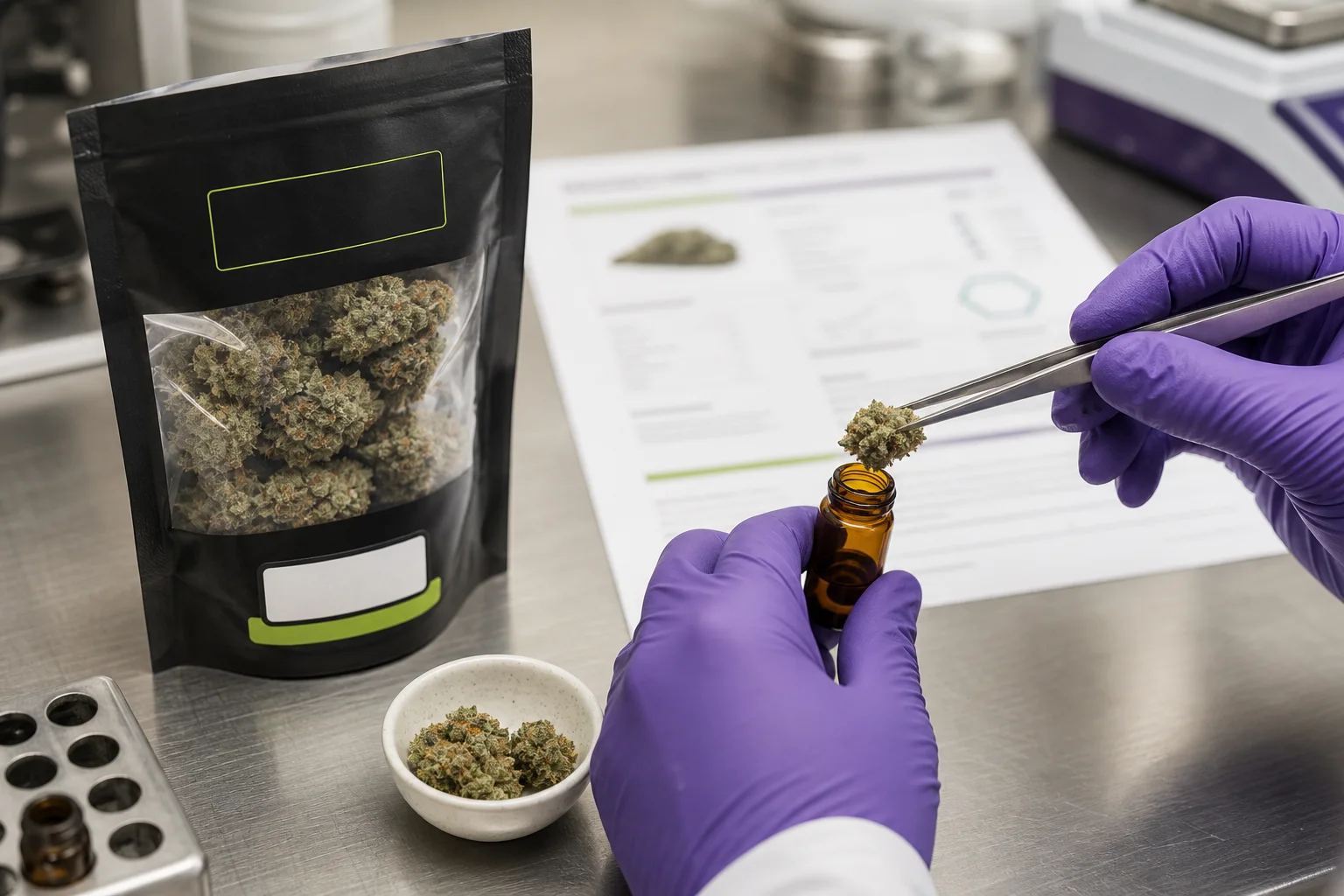
Hero image: documentary macro linking a retail package’s batch label to its COA. The visual reinforces that a COA documents one sampled portion and that batch and test dates matter. It intentionally avoids showing readable statistics so the image illustrates process, not specific results. Source documents for labeling and testing policy frame that connection in Maine law and agency rules.
Why test results matter — and why one report is only a piece of the story
Lab testing is how producers and regulators turn a plant into information: potency numbers, contaminant screens, moisture, and more. In Maine, labeling and packaging rules require that batch numbers and potency appear on adult‑use packaging, and the Office of Cannabis Policy maintains rules for certification and testing of laboratories. These public safeguards make test reports useful, but they don’t make any single Certificate of Analysis (COA) flawless or complete. (legislature.maine.gov)
A realistic consumer view regards each COA as a photograph — it captures a moment and an angle. A COA that contains clear method notes and sampling records tells you what was measured, which methods were used, who did the measuring, and when. It does not, by itself, indicate how a whole harvest behaved, how a product will affect an individual person, or how numbers will change over time on a shelf.
Understanding the strengths and limits of a single lab report helps readers interpret labels without over‑trusting a single data point. That’s the practical aim here: explain what to read on a COA and why the numbers can shift between batches, labs, and storage conditions. (nvlpubs.nist.gov)
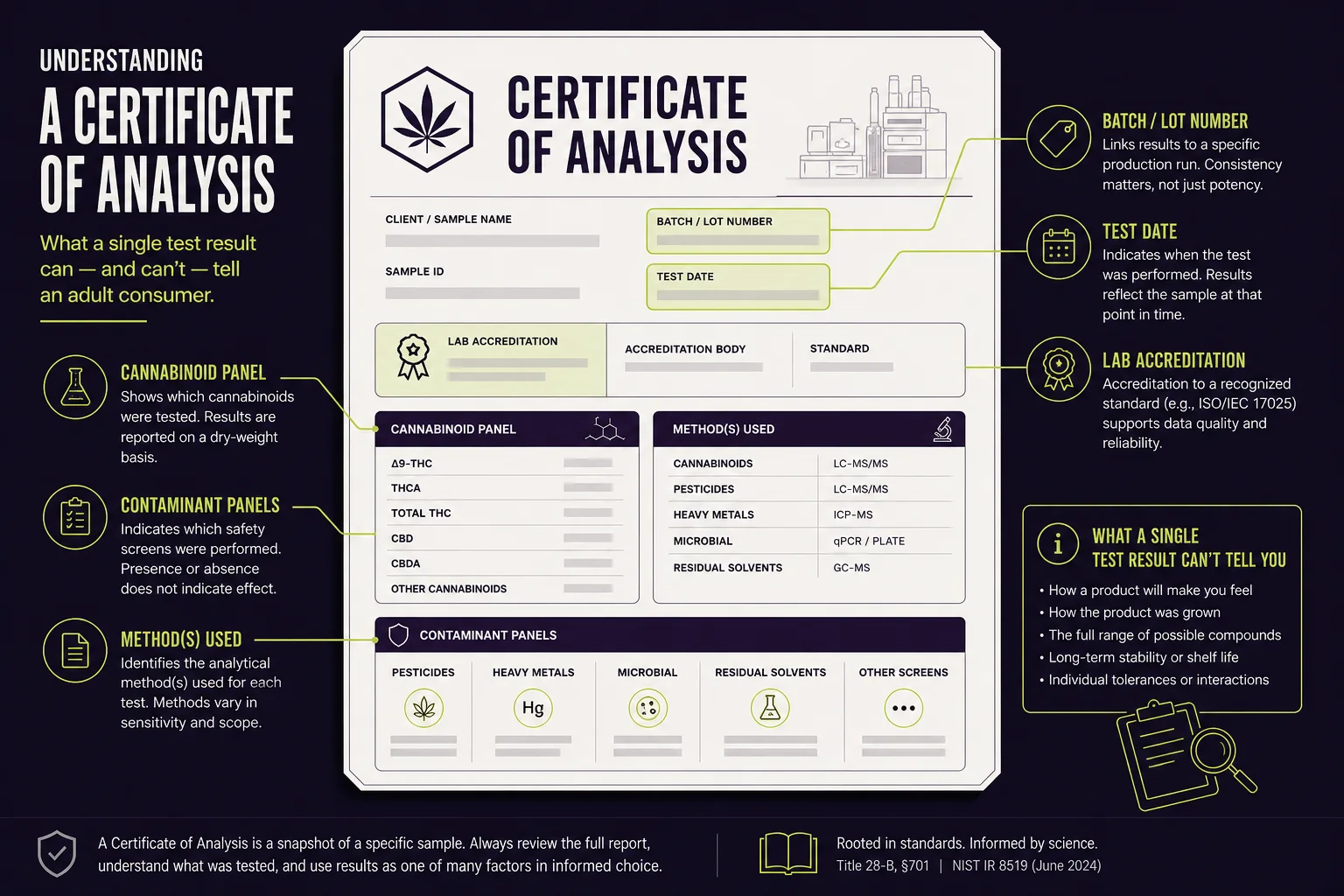
An explanatory diagram showing the parts of a COA that matter for consumer interpretation: batch, dates, methods, LOD/LOQ, and analyte lists. This diagram is educational and does not show real values; it reflects labeling mandates and testing expectations from Maine guidance and NIST laboratory quality recommendations.
Research context: Title 28‑B, §701: Labeling and packaging · Cannabis Laboratory Quality Assurance Program: Exercise 2 Cannabinoid Final Report (NIST IR 8519, June 2024)What you will typically find on a COA (and what those entries mean)
Most consumer COAs include: a batch or lot number, test date, laboratory name and certification, cannabinoid panel (THC, THCA, CBD and sometimes 10–20 other cannabinoids), and screens for contaminants — microbial, mycotoxins, heavy metals, pesticides, and residual solvents when appropriate. Maine rules require potency and batch identification on label packaging for adult‑use products. Knowing which item on the COA corresponds to the label is the essential first step. (legislature.maine.gov)
Cannabinoid values are commonly reported as mass fractions (percent of dry weight for flower, mg per serving for edibles), and many COAs will show “total THC” (a calculated value that includes THCA after conversion) alongside measured Δ9‑THC and THCA. Other cannabinoids — CBG, CBC, CBN and variants such as Δ8‑THC — may appear depending on the lab’s panel. A COA will often list methodology (e.g., LC‑MS/MS, HPLC, GC) and limits of detection/quantitation (LOD/LOQ), which are crucial for meaningfully interpreting low‑level results. (nvlpubs.nist.gov)
Contaminant sections are not all created equal: heavy metals, some pesticides, and certain solvents require specific validated methods and reporting thresholds. The presence or absence line on a COA does not always mean the same thing across labs unless methods, LODs, and accreditation are comparable. That’s where program rules and lab quality matter. (nvlpubs.nist.gov)
How laboratories measure cannabinoids — and why methods matter
Analytical chemistry underpins potency testing. Modern labs use different instrument families (LC‑PDA, LC‑MS/MS, GC‑MS, etc.), extraction solvents, and sample preparation steps. These choices change how well a method separates similar molecules, what interferences appear, and the numerical results you’ll see on the page. NIST’s Cannabis Laboratory Quality Assurance Program (CannaQAP) documents within‑ and between‑laboratory precision and recommends candidate methods because method choice is a major source of variability. (nvlpubs.nist.gov)
Matrix effects — the influence of plant oils, sugars in edibles, or binders in concentrates — can suppress or inflate instrument response. Recent peer‑reviewed work has documented chromatographic interferences that can artificially increase measured Δ9‑THC in some conditions, which is one reason labs and state programs prefer validated separation methods and interlaboratory comparisons. Put bluntly: a number is only as good as the method that produced it. (pubmed.ncbi.nlm.nih.gov)
Proficiency testing and interlaboratory exercises reduce these gaps. NIST’s CannaQAP shows labs how their results compare to community consensus and to characterized control materials; improving comparability is an ongoing process across the industry. When a lab participates in such programs and documents method validation, the COA’s reported precision and stated uncertainties become easier to interpret. (nvlpubs.nist.gov)
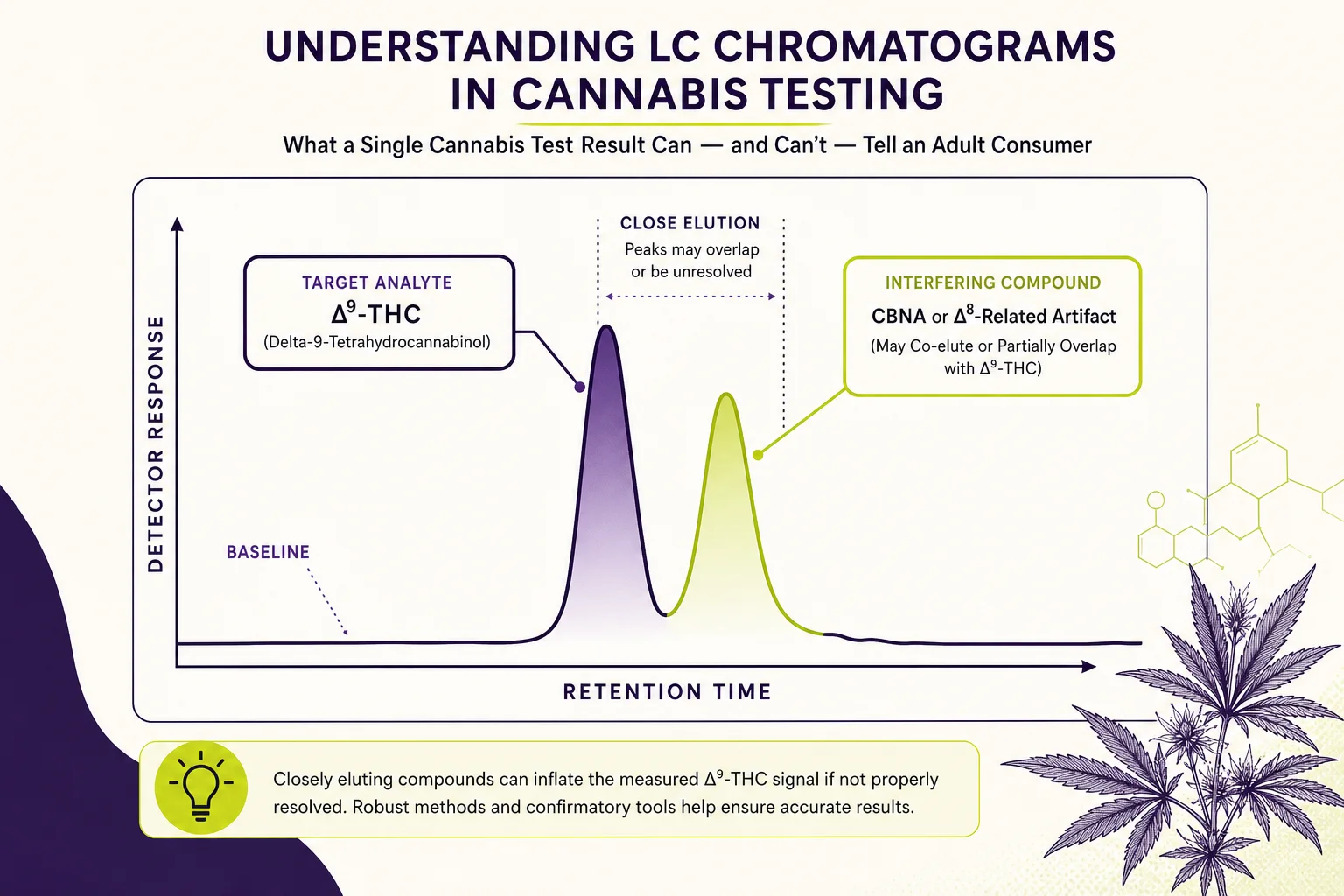
Illustration of chromatographic separation challenges: two adjacent peaks and a labeled interference show why method choice and chromatography conditions can affect reported cannabinoid values. The image is schematic and not a reproduction of any real lab chromatogram; it reflects issues documented in peer‑reviewed studies and NIST interlaboratory findings.
Research context: Chromatographic interferences potentially inflating the levels of Δ9‑THC in Cannabis Sativa plant samples and possible solutions ·The limits of a single batch COA: sampling, plant heterogeneity, and time
A single COA measures the sample that was submitted — not the whole harvest. Plant material is naturally variable: cannabinoids and terpenes vary between colas on the same plant and between plants in the same room. A recent study measured meaningful natural variation in total THC across greenhouse‑grown dried flower even when a single cultivation practice was used, reminding us that a COA for “Batch X” is a snapshot, not a guarantee for every bud that came from the same tent. (pubmed.ncbi.nlm.nih.gov)
Sampling strategy matters. A finely homogenized, well‑subsampled composite of many plants will produce a COA that better reflects the whole batch. A single small sample taken from the edge of the drying rack or a single cola will produce numbers that might not represent the lot. Lab reports sometimes list the sampled weight and homogenization method — those are the lines that indicate whether the sample was likely representative. NIST’s exercises emphasize the importance of homogenization and sample size. (nvlpubs.nist.gov)
Finally, time and storage change numbers. THCA decarboxylates to Δ9‑THC with heat and age; some terpenes evaporate; solvents or volatile contaminants can dissipate or concentrate depending on packaging. A COA’s test date and the product’s production/pack date are relevant: numbers on a label may differ from numbers months later in your storage cabinet. Maine law requires certain labeling fields and allows retest reporting in specified cases. Check dates on the COA and packaging. (legislature.maine.gov)
Safety screens: what a clean or failing result tells you — and what it doesn’t
A COA that passes a pesticide or heavy metal screen indicates the tested sample did not exceed the lab’s reporting thresholds for that analyte at the time of testing. That’s important for consumer safety and for regulatory compliance. But screening is only as thorough as the analytes the lab was instructed to test for and the limits that were required. Different programs may require different lists of pesticides or action limits; some contaminants require very specific sample prep and instrumentation. (nvlpubs.nist.gov)
Maine’s program rules and labeling statute expect licensees to provide potency and to follow testing procedures; enforcement and specifics on required contaminant panels come from rule and guidance adopted by the Office of Cannabis Policy. Consumers can check whether a COA lists the pesticides and metals they care about, and whether the lab shows method LODs/LOQs. A blank column for a given pesticide does not mean the lab looked for it. (maine.gov)
Poison control and public health agencies remind readers that product form and potency matter for risk (for instance, edible products can pose ingestion risks to children). A COA does not replace safe storage, clear serving information, or awareness of drug–drug interactions. When a product’s COA flags an unexpected contaminant, state guidance and recall mechanisms are in place; otherwise, consult the documented testing scope to judge what was screened. (poison.org)
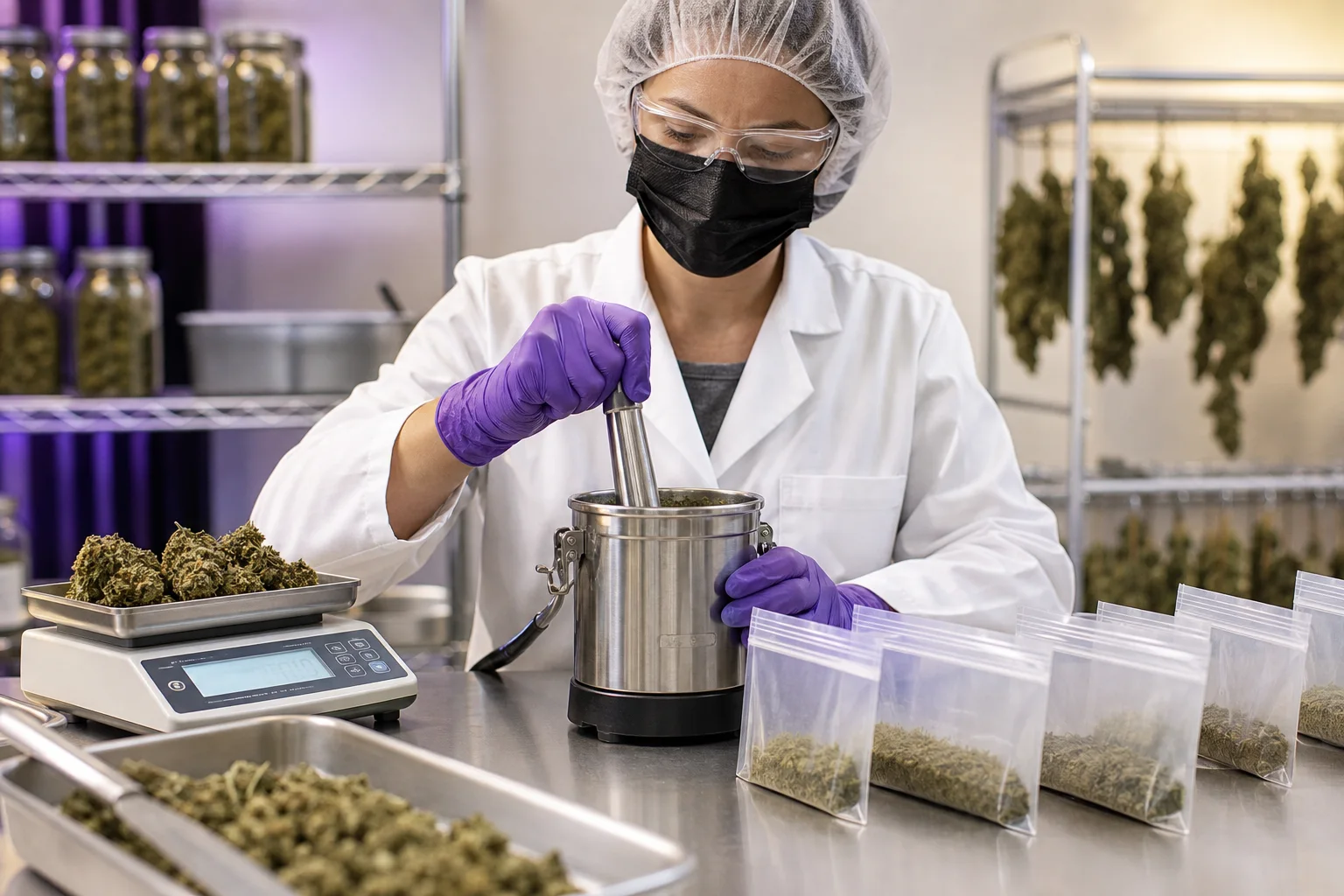
Documentary photograph showing proper homogenization and subsampling technique for plant material, demonstrating how representative sampling reduces variability. The image supports the article’s explanation of sampling error vs. true batch variability; it does not show identifiable lab names or report data.
Research context: Cannabis Laboratory Quality Assurance Program: Exercise 2 Cannabinoid Final Report (NIST IR 8519, June 2024) ·Reading potency: total THC, decarboxylation, and what the percent number really means
When you see a potency number, look for two linked pieces: how the lab measured Δ9‑THC and whether the COA reports “total THC.” Total THC usually means measured Δ9‑THC plus the calculated contribution from THCA after theoretical decarboxylation — a chemist’s conversion, not a lab‑measured future state. This distinction matters for legal classification and for understanding the COA’s assumptions. NIST and scientific studies show that differences in how labs calculate and report total THC can lead to divergent numbers between otherwise similar tests. (nvlpubs.nist.gov)
Percentage precision can be misleading if not considered alongside the lab’s stated uncertainty. High‑quality COAs include method validation or an uncertainty statement; NIST’s interlaboratory work documents realistic within‑ and between‑lab uncertainties so consumers and regulators can interpret reported values in context. A 20% difference between two nearby lab reports can be method‑ or sample‑related; it is not, by itself, proof of fraud. (nvlpubs.nist.gov)
Practical checklist: what to look for on a COA as a careful adult consumer
- Batch/lot number and match to product packaging (required by Maine law). (legislature.maine.gov)
- Test date and production/pack date. Numbers age — check both.
- Laboratory name, certification or accreditation statement, and any participation in interlaboratory programs (e.g., NIST CannaQAP). Labs that are accredited or that participate in proficiency testing are often preferred. (nvlpubs.nist.gov)
- Panel scope (which pesticides, which metals, which mycotoxins) and method LOD/LOQ. A missing analyte list means you don’t know what they didn’t test for.
- Potency details: Δ9‑THC, THCA, total THC, CBD, and whether minor cannabinoids were measured. Watch for method descriptions. (nvlpubs.nist.gov)
This checklist helps with basic interrogation of a COA without needing to become a chemist. If items on the COA are missing or unclear, the testing facility or the licensee can often explain the methods and sampling. Maine’s rules and forms provide a framework for what should appear; producers and labs are held to those public rules. (maine.gov)
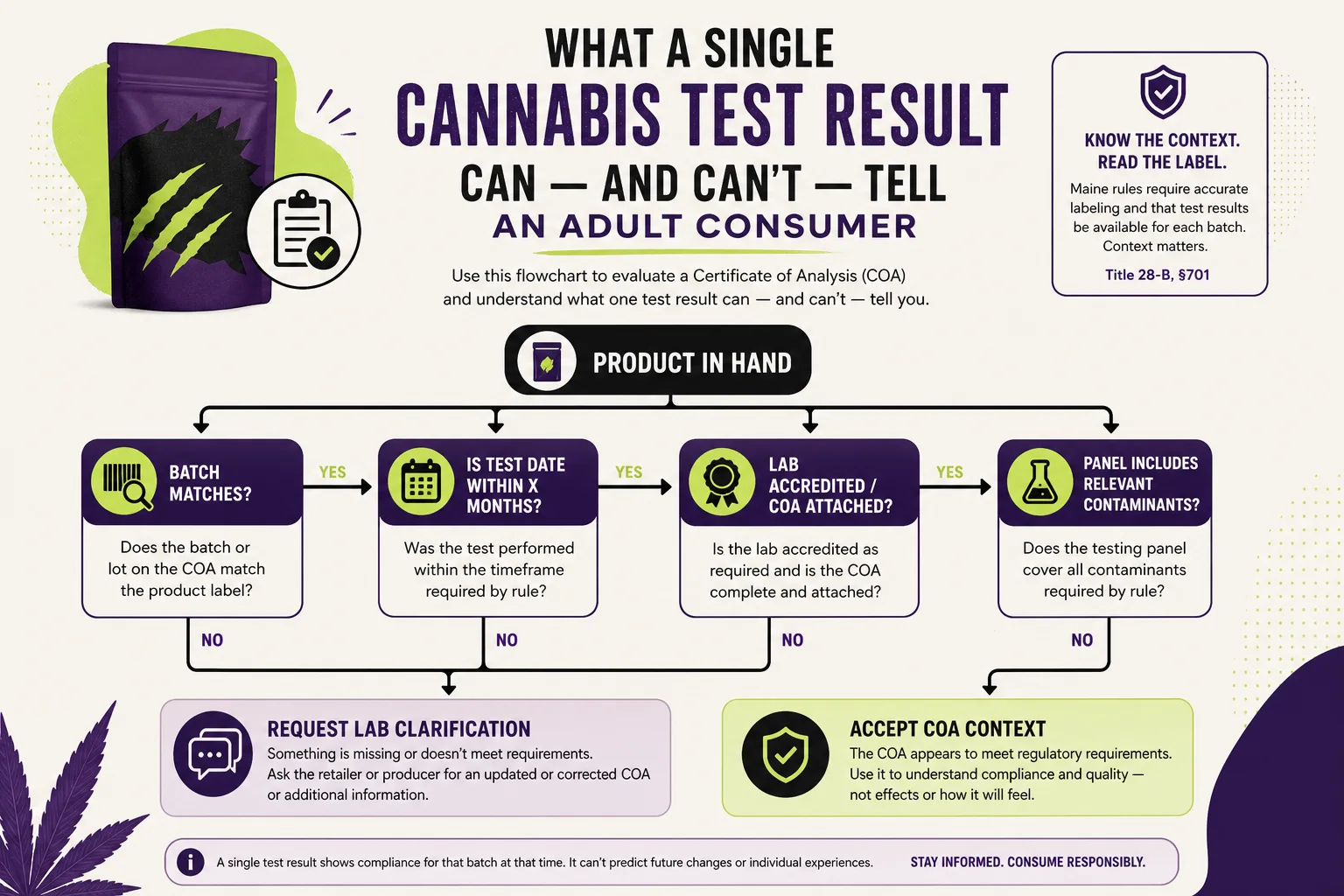
A consumer-facing decision flowchart that turns the article’s checklist into action steps. It teaches which COA signals matter most and when to ask follow‑up questions of a licensee or laboratory. The flowchart is informational only and does not include medical or dosing guidance.
Research context: Adult Use Cannabis Program Rules · Title 28‑B, §701: Labeling and packagingHow Maine’s adult‑use and medical systems differ — and why that can matter for COAs
Maine separates adult‑use program rules (Title 28‑B and associated adult‑use rules) from parts of its medical program; both systems involve testing, but statutory labels, allowed claims, and reporting requirements can differ. For example, Title 28‑B sets out labelling requirements for adult‑use packaging that specifically call for batch numbers and potency fields, and rules for testing facilities provide certification requirements for laboratories serving adult‑use markets. Where the medical program has parallel or distinct rules, producers and patients may consult the appropriate medical‑use guidance. (legislature.maine.gov)
The practical effect is this: COAs that accompany medical products may be produced under different program guidance; confirm which program (adult‑use vs medical) a label or COA was intended to satisfy and whether the lab was certified for that program. State resources list program‑specific rules and forms that explain scope and expectations for both systems. (maine.gov)
Bottom line: use COAs smartly — they’re informative but not absolute
A single batch COA is an important, evidence‑based piece of information: it documents measured content and screened contaminants for one sampled portion under specific laboratory methods. It becomes far more useful when paired with clear sampling records, method descriptions, lab accreditation, and the context of the product’s production and storage. NIST, state programs, and peer‑reviewed studies all show the same overall lesson — measurements improve with standardized methods, interlaboratory comparison, and transparent reporting. Reading a COA carefully moves the process from guesswork toward more informed decisions.
If you want help reading a COA for a particular product in hand, we can walk through it together — line by line — and point out the method notes and the sampling signals that matter most. (No product or dose recommendations — just reading and interpretation.)
Questions this guide answers
Does a COA guarantee safety or consistent effects?
No. A COA reports measured results for the submitted sample at test time using the lab’s methods. It does not guarantee identical results across a whole harvest, nor predict individual reactions.
If a COA shows no pesticides, does that mean the product is pesticide‑free?
Only for the pesticides the lab tested for and above the lab’s limits of detection. If an analyte or a class of pesticides isn’t on the panel, it won’t appear on the report.
Why do potency numbers from two labs sometimes disagree?
Differences in sampling, extraction, instrumentation (LC vs GC), calibration, and reporting (e.g., how total THC is calculated) explain most variation. Interlaboratory programs aim to reduce these gaps. ([nvlpubs.nist.gov](https://nvlpubs.nist.gov/nistpubs/ir/2024/NIST.IR.8519.pdf))
What should I check first on a COA?
Confirm the batch/lot number matches packaging, note the test date, verify the laboratory’s certification or accreditation, and look for method/LOD details and the analyte list for contaminants. ([legislature.maine.gov](https://legislature.maine.gov/statutes/28-b/title28-Bsec701.html))
How do storage and age affect COA numbers?
THCA can convert to Δ9‑THC over time or with heat; terpenes evaporate; some volatile residues may change. Test dates and pack dates help judge likely shifts.
Educational information only. Cannabis affects people differently and this is not medical advice.