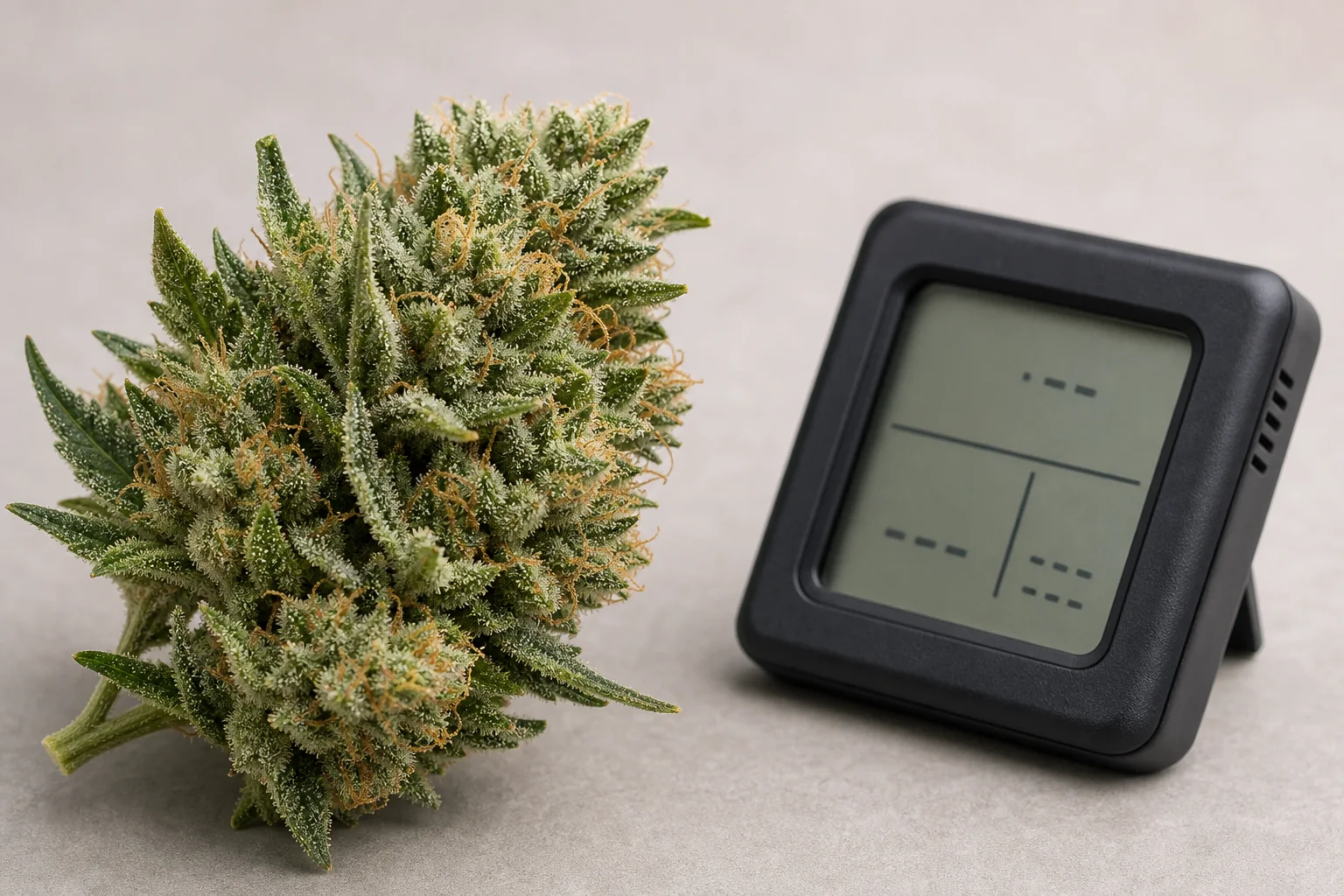
Documentary-style botanical macro: pairs a high-resolution macro of glandular trichomes with a visible temp/RH data-logger to illustrate how microscopic volatile- and trichome-level changes relate to measurable environmental logs. This image teaches why combining sensory inspection with environmental data is necessary; it cannot substitute for lab tests. Source connections: drying/terpene preservation and the need for environmental logging.
Introduction
Harvest is when the visible work stops and a hidden set of physical and chemical changes begins. Moisture moves out of the plant, volatiles (terpenes and some fragile cannabinoids) evaporate or oxidize, and the post-harvest environment writes the next chapter in product quality and safety. For Maine small-batch growers, those chapters determine whether a lot passes required adult-use safety testing, how long product holds its character, and what goes into a responsible batch record. This article explains the science behind those changes, how records and sampling connect to Maine rules, and why good-looking flower is not the same as a safe, tested product. (pubmed.ncbi.nlm.nih.gov)
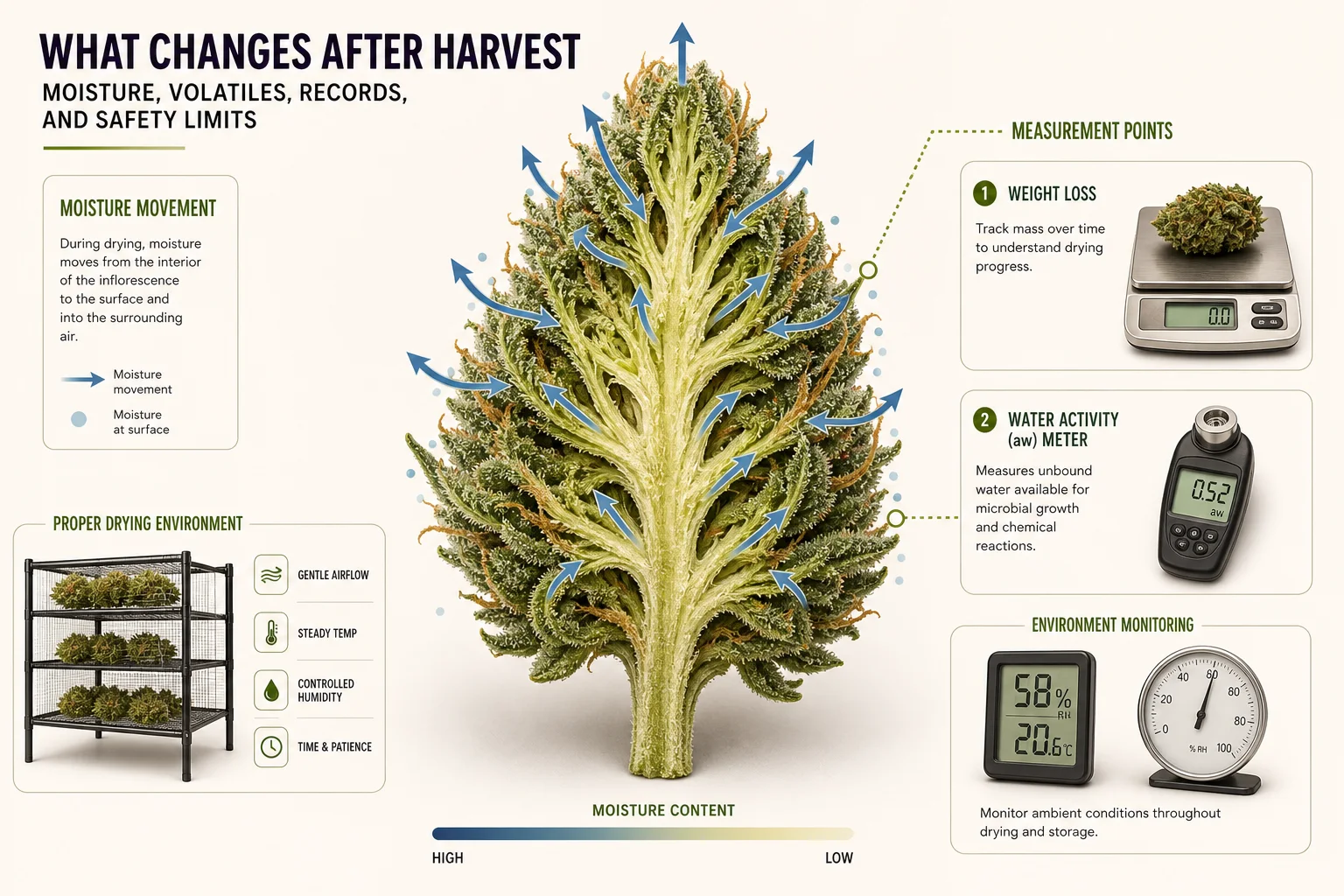
Explanatory diagram: water movement from interior cells to the surface during drying and measurement points (weight loss, aw meter). This visual supports the section on moisture movement and the difference between percent moisture and water activity. Limitations: schematic representation—does not display real lab data.
Research context: The influence of drying and storage conditions on the volatilome and cannabinoid content of Cannabis sativa L. inflorescences.How moisture moves after harvest (and why it matters)
Moisture movement is a simple physical process with complex consequences. Fresh flower contains living cells and internal water. Once cut, that water begins moving from the inner tissues to the surface and into the surrounding air. The rate depends on surface area, bud density, ambient relative humidity (RH), temperature, and air movement. Rapid, uncontrolled drying can lock the plant into stresses (collapsed trichomes, brittle trichome heads) and drive internal gradients that encourage case-hardening—dry outer layers and wetter interiors—that later foster microbial growth. Slow, very high-humidity conditions can leave too much water available for molds to grow. Both extremes change the product’s measured water activity, an important metric for microbial risk. (pubmed.ncbi.nlm.nih.gov)
Water activity (aw), not just percent moisture by weight, predicts whether microbes will grow. Many microbes that make flower unsafe—Aspergillus species, other molds, and bacteria—need a minimum aw to reproduce. Measuring aw and recording drying curves provides defensible evidence that a lot left the grow room at stable, acceptably low microbial risk. The Maine Office of Cannabis Policy (OCP) emphasizes water activity in discussion of mandatory testing and product safety; adult-use testing includes harmful microbes and mycotoxins among analytes. Growers often monitor both weight loss over time and aw during conditioning and before packaging. (maine.gov)
Practically: use hygrometers, a dry-bulb thermometer, and an aw meter for batch records. Log the date/time/cabinet or rack ID, drying-room RH and temperature, targeted equilibrium relative humidity for conditioning, and the time to target aw or stable weight. Those entries turn a subjective “it feels dry” into a reproducible process step.
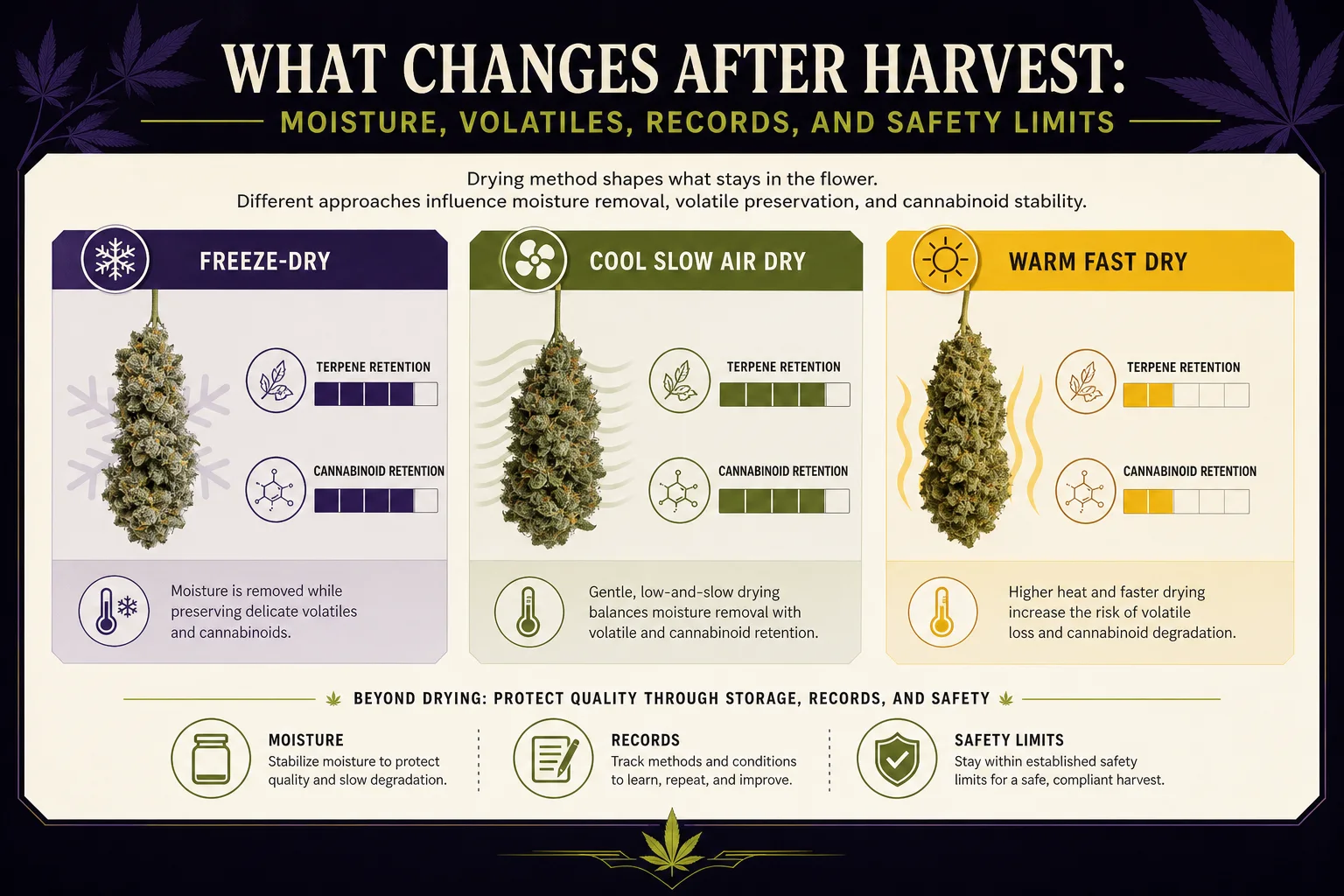
Comparative schematic of relative volatile retention across common drying methods (freeze-dry, controlled cool air, warm rapid drying). The image teaches relative trade-offs—freeze-drying can retain cannabinoids but reduce VOCs—without implying precise numeric retention values. Limitations: qualitative comparison only; not a substitute for method-specific data.
What drying and conditioning do to volatiles and cannabinoids
Terpenes — the volatile, aroma-bearing molecules — are the most sensitive post-harvest. They evaporate or oxidize readily during drying and with heat or light. Harsh, warm drying will shift an aroma profile: some desirable monoterpenes are lost first because of higher vapor pressure. Slower, cooler drying preserves more of the volatile fraction but can extend the window of microbial risk if not controlled. Several recent studies compare drying methods (air drying, controlled low-temperature drying, freeze-drying) and show trade-offs: freeze-drying can better preserve acidic cannabinoids and total cannabinoid mass but often reduces volatile terpenes that contribute to aroma. (pubmed.ncbi.nlm.nih.gov)
Cannabinoids themselves are relatively robust but not inert. Acidic forms (e.g., THCA) decarboxylate to neutral forms (THC) with heat and time; oxidation and light can convert cannabinoids into other molecules (e.g., CBN from oxidation of THC) or cause losses detectable on potency panels. Storage conditions after conditioning—temperature, light exposure, oxygen—control those chemical trajectories. Reviews looking across storage and matrix studies report that light exposure and oxygen accelerate cannabinoid loss and that cooler, dark, low-oxygen conditions slow changes. (pubmed.ncbi.nlm.nih.gov)
For sensory and potency goals, conditioning is a controlled equilibration step: it lets internal moisture redistribute, some enzymatic processes proceed slowly, and small losses of volatile compounds can actually stabilize the profile so it won't change dramatically in the package. Logging temperature, RH, jar type, jar fill (headspace), and jar-turning schedule during conditioning creates a reproducible path from harvest to final product.
Packaging: moisture equilibrium, headspace, and barrier choices
Packaging begins the new equilibrium between product and environment. A sealed jar isolates flower from ambient RH and oxygen; the internal microclimate will move toward an equilibrium dictated by the quantity of plant material, its residual moisture, the container volume (headspace), and any desiccants or humidity packets used. Packaging that traps slightly too much moisture can raise aw over time and invite mold. Conversely, packaging that’s too dry can desiccate terpene-rich trichome heads and accelerate cannabinoid loss.
Material matters: glass is generally inert and offers good barrier properties to gases and volatiles, whereas some plastics (especially lower-density polyethylenes) can allow slow volatile exchange and may sorb terpenes. Studies note that storage in glass better retains initial volatile organic compound (VOC) profiles compared with open trays or some plastics. For small-batch growers, standardized jar fill (grams per jar), limiting headspace, minimal oxygen exposure at seal, and known humidity-buffer packets are practical tools for repeatable outcomes. Packaging lot numbers and seal dates belong in the batch record. (pubmed.ncbi.nlm.nih.gov)
Packaging also begins legal traceability: for Maine’s adult-use program, tested lots must be accompanied by Certificates of Analysis and tracked through transfers; packaging information and sample IDs tie a retail item back to the tested sample. A clear linking table in records can map: harvest batch → drying/conditioning log → packaged lot → sample ID → COA. (maine.gov)
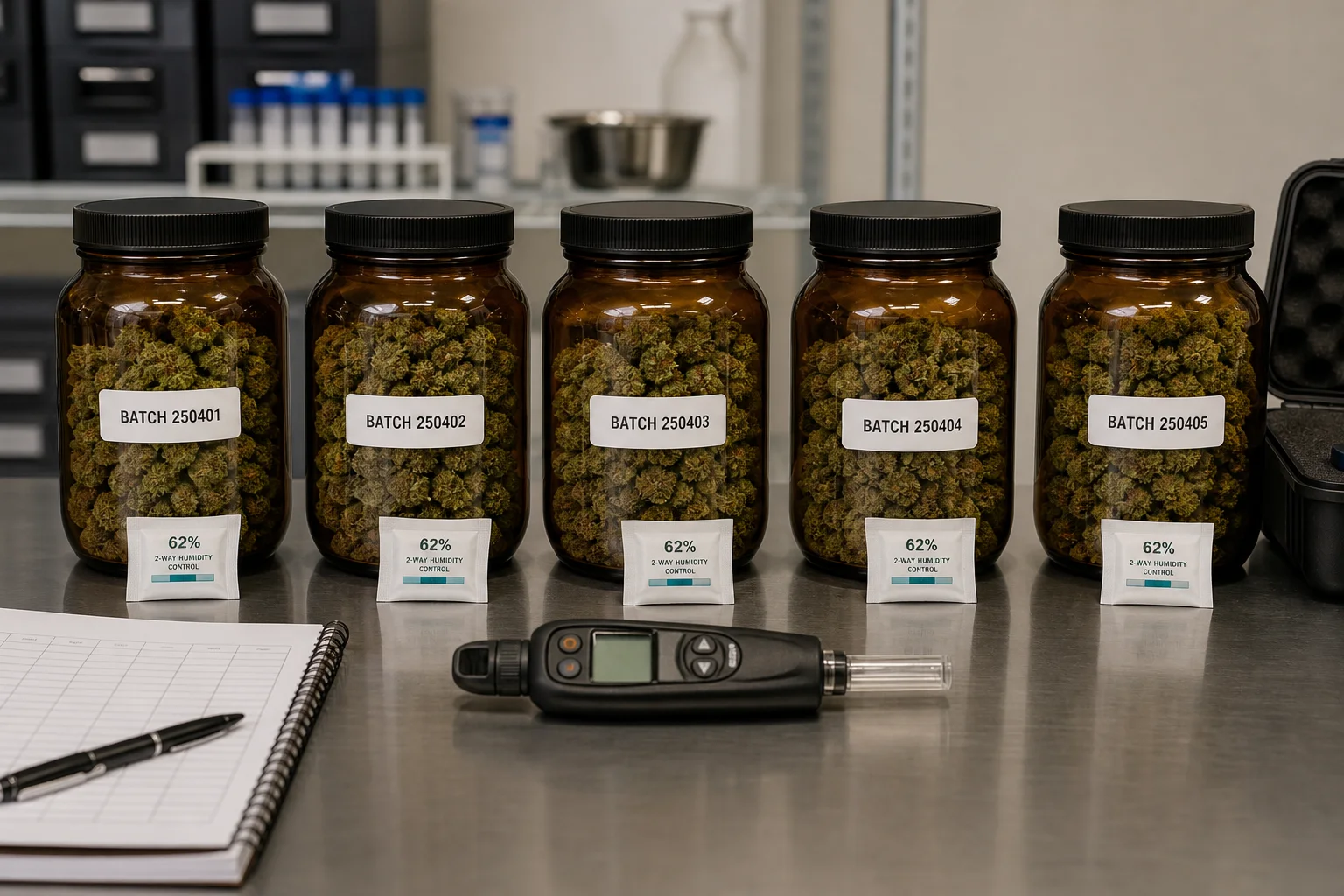
Operational photo showing packaging variables: consistent jar fills, visible headspace, humidity-buffer packets labeled to show target RH, and batch labels for traceability. This teaches which packaging features to standardize in records. Limitations: photo cannot show COA data or test results and doesn’t prove microbial safety.
Research context: Adult Use Testing DataStorage: temperature, light, oxygen, and time
Storage conditions after packaging are the long game. Lower temperature and absence of light slow most chemical processes, including oxidation and decarboxylation. Oxygen in headspace or permeating through the package promotes oxidative reactions and can contribute to the formation of oxidation products. Practical storage recommendations supported by stability studies are simple in principle: dark, cool, stable-temperature storage with limited oxygen exposure preserves potency and aroma best. Vacuum sealing or nitrogen-flushed headspace can slow changes but add cost and require verification in your own validation trials. (pubmed.ncbi.nlm.nih.gov)
Time is a factor: studies show measurable declines in certain terpene and cannabinoid concentrations over months, sometimes accelerated by warm or light-exposed conditions. That’s why process records that include packaging and storage start and end dates allow interpretation of a COA against the product’s time-in-storage. For regulatory or consumer transparency, include a packaged-on date and a recommended ‘best by’ window based on your in-house stability data.
Process records, batch traceability, and Maine’s testing context
Good records are defensible records. For Maine adult-use products, mandatory testing categories include residual solvents, metals, harmful molds and mycotoxins, harmful microbes, pesticides, and potency/homogeneity. Testing facilities issue COAs and electronic data deliverables to OCP within two business days; OCP aggregates initial mandatory test outcomes in public datasets. The adult-use program requires documented sampling, and when a sample fails for a health-injurious contaminant it is typically quarantined and usually destroyed unless remediation and retesting are allowed. The medical program does not have the same mandatory testing requirements, though voluntary testing happens. That regulatory distinction affects what a batch record needs to document if planning to move product into the adult-use chain. (maine.gov)
A practical batch record can include: harvest date, plant IDs, drying cabinet or rack ID and environmental logs, aw/weight logs during conditioning, conditioning jar IDs and microclimate logs, packaging lot and material, sample ID sent to the lab, COA number and date, and final storage location and conditions. Photographs of samples at sampling time and chain-of-custody entries for sample transfers to the lab make the record more robust. Those pieces let an operation and regulators reconstruct whether a failed test could link to sampling or handling rather than the original field practice.
Maine OCP materials and guidance documents emphasize accurate sampling and documentation; OCP found notable differences when auditing medical program samples that were not subject to mandatory testing, highlighting how untested product can differ from adult-use standards. Clear labels and cross-references help retail items be traced back to their COAs and storage history. (maine.gov)
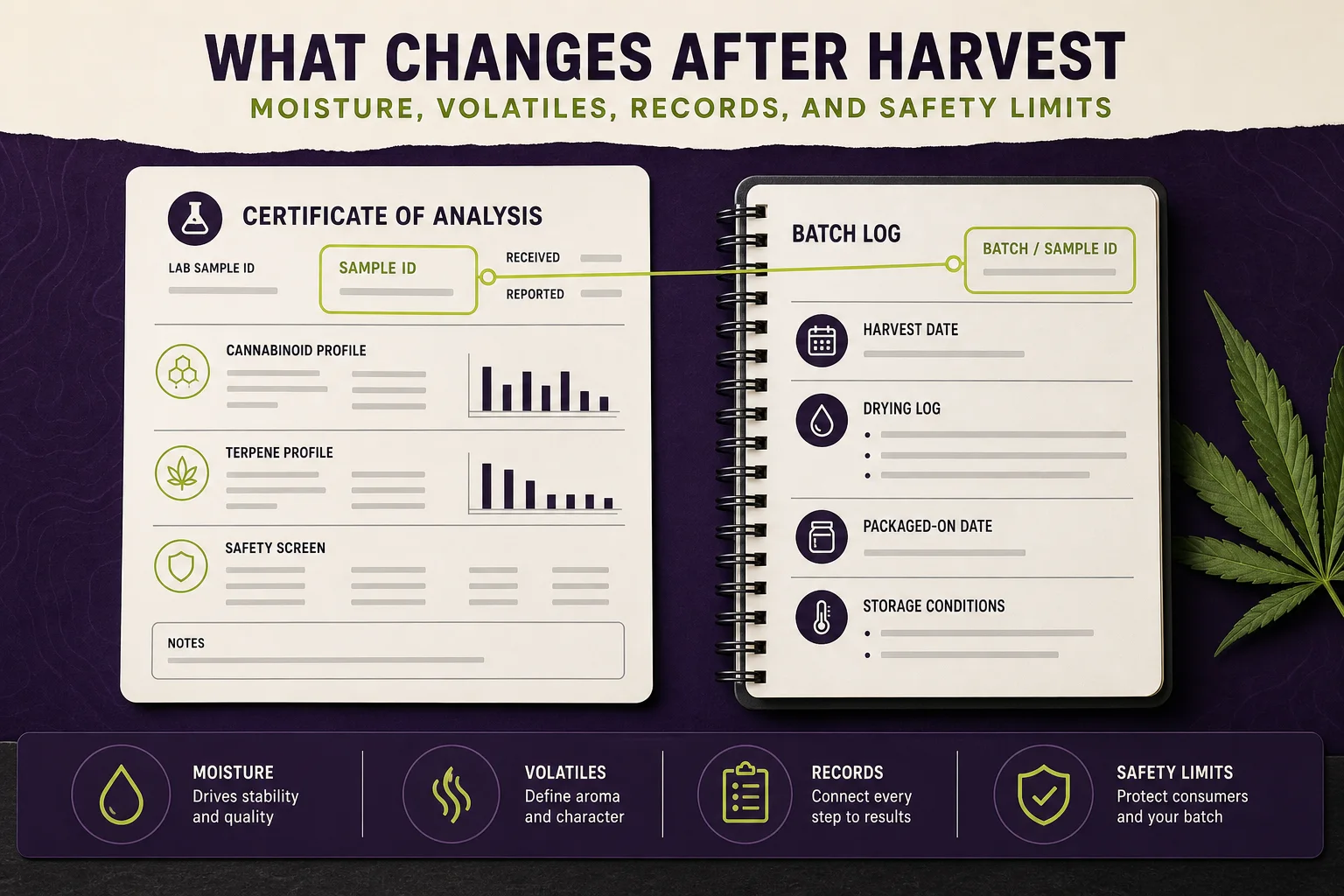
Educational mockup showing the relationship between a Certificate of Analysis and an internal batch record: sample ID, test categories, packaged-on date, storage conditions. This visual demonstrates how COAs and records must be linked for traceability. Limitations: do not display real COA values or readable lab numbers—this is illustrative only.
Why appearance cannot certify safety
Shiny trichomes and a perfect bud may indicate good horticulture and sensory appeal, but appearance alone cannot reveal microbes, pesticide residues, residual solvents, or metals. Many contaminants are invisible or microscopic. OCP’s audit of medical samples found a meaningful proportion contained contaminants that would have failed adult-use mandatory testing, exactly because visual inspection misses chemical and microbial hazards. Safety is a lab measurement plus defensible process controls, not a visual stamp. (legislature.maine.gov)
That is why adult-use law requires specific tests and COAs. Relying on sight or smell alone is especially risky for people with compromised immune systems—who may be more likely to seek out medical cannabis—because opportunistic pathogens and mycotoxins can be present even when a bud looks clean. Visual checks remain a useful QC step (e.g., note visible mold, foreign matter, or mispackaging), but they are only the first gate. (maine.gov)
Practical, small-batch grower checklist (what to log and measure)
- Harvest: record plant IDs, date/time, and pre-harvest environmental summary.
- Drying: log drying-room temp and RH hourly (or at least every shift), cabinet or rack ID, initial and target weight loss, and aw checks. Photograph representative samples at start and finish. (pubmed.ncbi.nlm.nih.gov)
- Conditioning: record jar type, fill weight, packet type if used, conditioning environment (temp/RH), jar-opening schedule, and aw before packaging.
- Packaging: record package material, seal method, headspace volume, package lot numbers, packaged-on date, and sample ID sent to testing lab. Include COA reference when available. (maine.gov)
- Storage: record room temp, lighting (none preferred), and inventory movements; timestamp any transfers and retail pulls.
These logs both protect an operation and make it possible to interpret COAs in the context of time and handling. When an unexpected COA result appears, detailed records are what allow operators and regulators to find where the process deviated.
Evidence limits and research gaps
The literature shows clear patterns: terpenes are labile, light and oxygen accelerate cannabinoid changes, and water activity predicts microbial risk better than absolute moisture percentage. Still, studies vary widely in materials, drying protocols, and analytical methods, so specific numbers for “how much terpene is lost after X days at Y°C” are not universal. Many studies focus on hemp or lab-prepared samples under controlled conditions—real-world small-batch systems with varied genetics and microclimates can behave differently. Use published work as a guide and validate recommendations within an individual operation. (pubmed.ncbi.nlm.nih.gov)
Maine’s regulatory records and the OCP guidance documents provide the programmatic context: adult-use testing rules apply when product moves into that chain, and documentation protects both producers and consumers. But the medical program’s lack of mandatory testing creates a sampling and evidence gap: voluntary testing varies by caregiver, so unlabeled or untested product may not have been evaluated for the same analytes required in the adult-use program. (maine.gov)
Key takeaways
- Moisture movement, not just percent weight loss, controls microbial risk; measure water activity and log drying curves. (pubmed.ncbi.nlm.nih.gov)
- Terpenes are fragile; cooler, slower drying preserves aroma but requires tight microbial control. (pubmed.ncbi.nlm.nih.gov)
- Packaging material, headspace, and oxygen affect long-term aroma and potency; glass usually outperforms some plastics. (pubmed.ncbi.nlm.nih.gov)
- Maine adult-use products are subject to mandatory testing (COAs and EDDs); medical products are not held to the same mandatory testing rules. Keep clear batch links to COAs. (maine.gov)
- Appearance is insufficient for safety; lab testing and records are the reliable evidence. (legislature.maine.gov)
FAQs
Q: Does dry-looking flower mean it’s safe? A: No. Visual dryness can hide internal high aw and microbes. Only appropriate lab tests (or aw and microbial assays) and process records can provide evidence about microbial risk. (maine.gov)
Q: How long should conditioned flower be stored before sale? A: There’s no single answer—stability depends on storage conditions and genetics. Record packaged-on dates and use in-house stability logs or conservative ‘best by’ guidance tied to internal data. Cooler, dark storage slows changes. (pubmed.ncbi.nlm.nih.gov)
Q: Will freezing preserve terpenes and cannabinoids? A: Freezing can preserve cannabinoids but can damage trichome structure and sometimes reduce certain volatiles; validate on small test lots before adopting.
Q: If a COA fails, what happens in Maine? A: For adult-use items, failing analytes that are injurious to health generally trigger quarantine and destruction unless remediation and retesting are allowed and successful. OCP rules and statute describe notification and disposal requirements. (legis.maine.gov)
Q: Are medical cannabis products tested in Maine the same way as adult-use? A: No. Maine’s adult-use program requires mandatory testing across analyte categories; the medical program does not have the same mandatory testing, though some medical suppliers test voluntarily. Ask caregivers about testing if documentation is needed. (maine.gov)
Q: What records should I keep for 1 year? A: Harvest logs, drying/conditioning environmental logs, aw/weight records, packaging lot details, sample IDs sent to labs, COAs, and storage movement records. These allow traceability and help investigate any COA anomalies. (maine.gov)
Closing note
For small-batch Maine growers, post-harvest practices are where horticulture meets chemistry and public health. Investing in clear monitoring, reproducible packaging, and careful records increases control over product character and provides documented steps aligned with Maine’s adult-use program. Where testing is required by the rules, testing and documentation are part of compliance; where testing is not required, documentation can still be a voluntary safeguard. Consider visual inspection as a first filter—not the final word.
Questions this guide answers
Does dry-looking flower mean it’s safe?
No. Visual dryness can hide internal high water activity and microbes. Only appropriate lab tests or validated aw and microbial assays plus records can confirm safety. ([maine.gov](https://www.maine.gov/dafs/ocp/sites/maine.gov.dafs.ocp/files/2023-10/Understanding%20Maine%20Cannabis%20Testing%20Requirements%20%26%20Results.pdf))
How long should cured flower be stored before sale?
There’s no universal period—stability depends on genetics and storage. Use packaged-on dates, cooler/dark storage, and in-house stability logs to set conservative best-by windows. ([pubmed.ncbi.nlm.nih.gov](https://pubmed.ncbi.nlm.nih.gov/41724995/))
Will freezing preserve terpenes and cannabinoids?
Freezing can preserve some cannabinoids but can damage trichomes and may reduce certain volatiles. Validate with small test lots before adopting as a routine. ([pubmed.ncbi.nlm.nih.gov](https://pubmed.ncbi.nlm.nih.gov/38702447/))
If a COA fails in Maine what happens?
Failing analytes injurious to health generally trigger quarantine and destruction unless remediation and retesting are allowed and successful under OCP rules. ([legis.maine.gov](https://legis.maine.gov/statutes/28-B/title28-Bsec603.html))
Are Maine medical products tested the same as adult-use?
No. Adult-use items in Maine are subject to mandatory testing across several analyte categories; medical items are not mandated but may be voluntarily tested—ask your supplier. ([maine.gov](https://www.maine.gov/dafs/ocp/sites/maine.gov.dafs.ocp/files/2023-10/Understanding%20Maine%20Cannabis%20Testing%20Requirements%20%26%20Results.pdf))
Educational information only. Cannabis affects people differently and this is not medical advice.