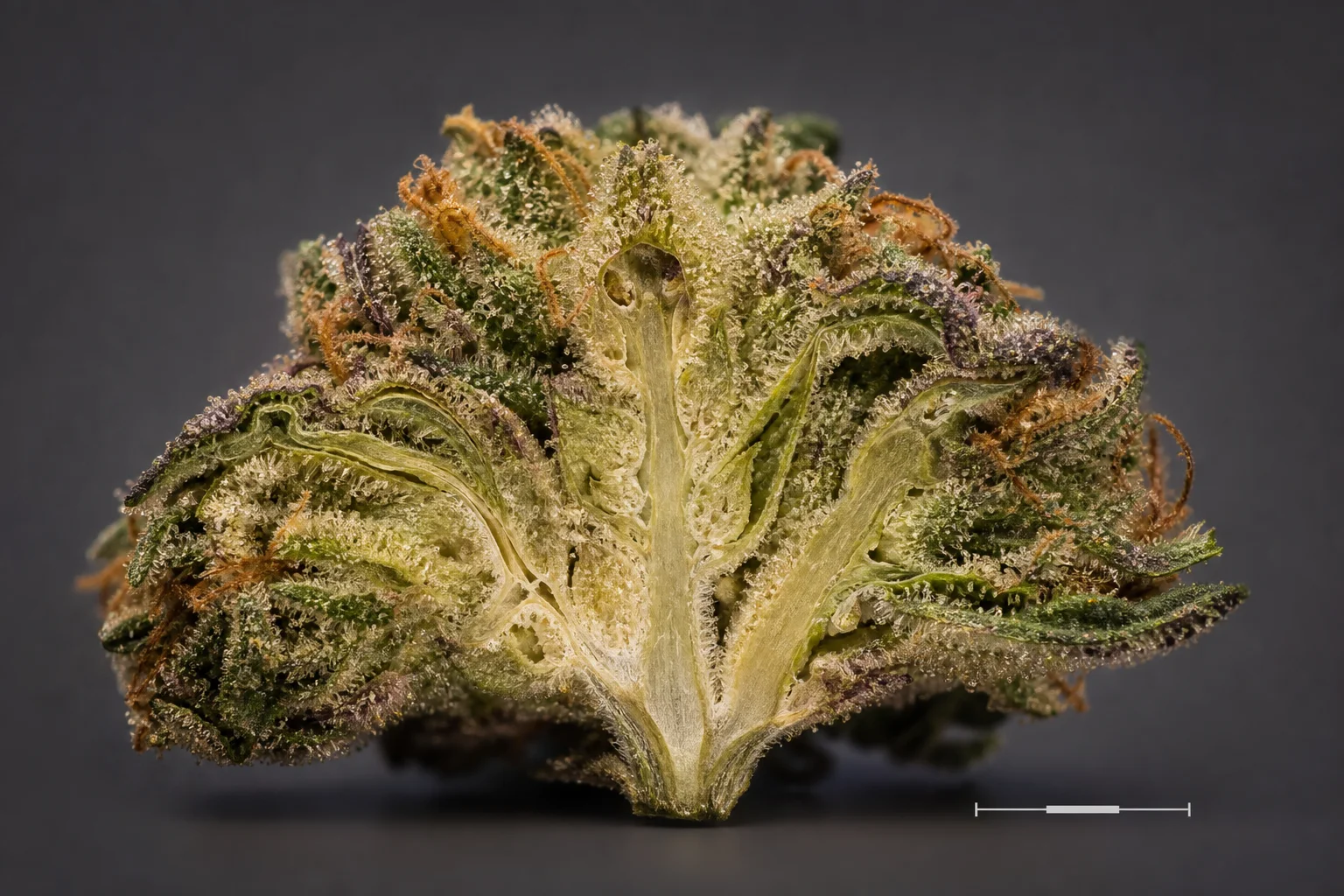
Documentary macro image showing moisture gradients inside a cured cannabis flower. This visual teaches how outer tissues can feel dry while inner tissues retain water — a key concept for drying, curing, and microbial risk. The image should be illustrative and not show any readable or real lab numbers.
Why post‑harvest matters: moisture, volatiles, and the record you should keep
Harvest is only the first chapter. Once a flowering stem is cut, water moves, enzymes keep working, and fragile volatiles — the terpenes that give aroma — begin to change. Those molecular shifts determine aroma, texture, and the laboratory numbers that appear on a Certificate of Analysis. Drying and curing set the trajectory for all that follows: the plant moves toward a stable equilibrium with its environment (an equilibrium defined by moisture content and water activity), and the choices you make during the following days and weeks steer whether the product ages gracefully or becomes a microbiological or chemical risk. (pubmed.ncbi.nlm.nih.gov)
For growers and small batch operators, that means two things: control and records. Track ambient temperature, relative humidity, drying duration, and when you change containers or add humidity buffers. Records let you connect a COA — or a failed microbial test — back to a harvest, a room, a drying rack, and a decision. Regulatory programs in Maine require mandatory testing categories for adult‑use products and make testing data available; those rules and the aggregated outcomes show why traceability matters for public safety and program integrity. (www1.maine.gov)
Finally: appearance is a signal, not a certificate. A glossy, well‑trimmed bud can still have elevated yeast and mold counts, pesticide residues concentrated by drying, or a depleted volatile profile. Visual inspection is a useful step in handling, but it cannot replace moisture measurements, COAs, or good post‑harvest recordkeeping. (maine.gov)
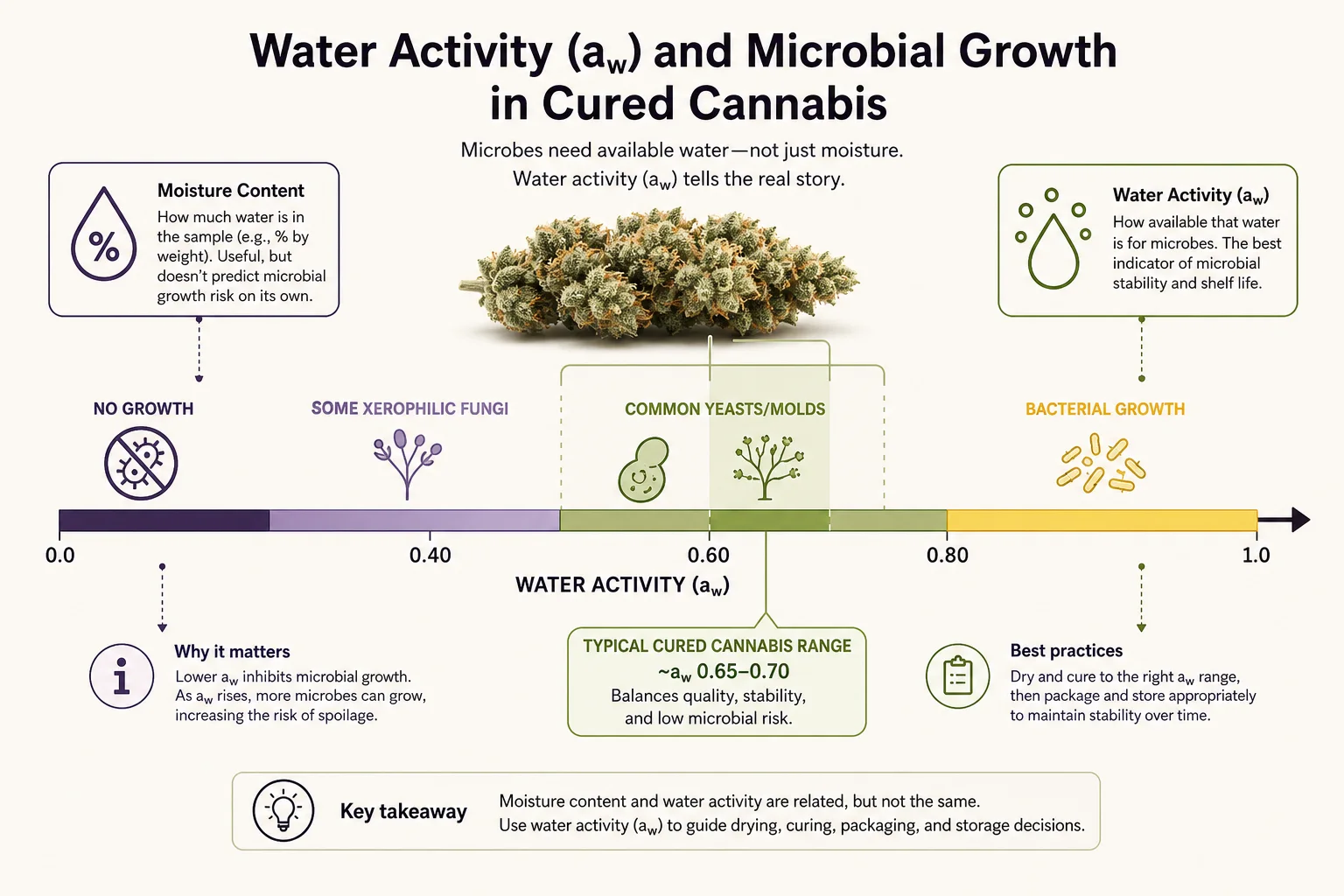
An evidence‑based diagram explaining water activity (a_w) ranges and associated microbial growth likelihood, annotated with the approximate cured‑flower moisture band (12–14%). This teaches why a_w, not just % weight, predicts microbial risk.
Research context: Total yeast and mold levels in high THC-containing cannabis (Cannabis sativa L.) inflorescences are influenced by genotype, environment, and pre-and post-harvest handling practices.How moisture moves after harvest: water content, water activity, and microbial risk
Plant tissue contains free and bound water. After harvest, that water seeks equilibrium with the air. Drying reduces total moisture content and water activity; both matter, but water activity (a_w) is the practical predictor for microbial growth. Lower a_w makes it harder for yeasts, molds, and bacteria to multiply. Studies of commercial cannabis show that drying to a moisture content roughly equivalent to a_w around 0.65–0.70 (often achieved when cured flower is ~12–14% moisture by weight) corresponds with much lower total yeast and mold counts. But how you reach that number — slow hang drying, tray drying, or freeze drying — changes more than moisture alone. (pubmed.ncbi.nlm.nih.gov)
Drying rate matters because it alters the microclimate inside the bud. Rapid drying can preserve some volatiles but risks case‑hardening (when outer tissues dry too fast and trap moisture inside), while very slow drying at high humidity gives a favorable window for molds. Airflow, temperature, and RH all interact: fans that circulate air through the canopy reduce boundary layer humidity and help even drying; too much heat will push volatiles out and can accelerate decarboxylation of acid cannabinoids. Good records capture those parameters for each batch so you can learn which settings deliver consistent target moisture and safe microbial counts. (pubmed.ncbi.nlm.nih.gov)
Because drying concentrates everything that remains, residues such as pesticides or heavy metals become more concentrated on a dry‑weight basis. That’s one reason testing programs rely on defensible, regulated sampling and why producers must avoid assuming visual dryness equals chemical safety. Maine’s testing program includes mandatory analyte categories such as pesticides, mycotoxins and microbial contaminants — all analytes that can be affected by post‑harvest handling. (www1.maine.gov)
Volatile chemistry: terpene loss, conversion, and the role of light, heat, and oxygen
Volatiles (terpenes, and related aroma compounds) are small and make up a tiny fraction of flower mass — which makes them fragile. Monoterpenes (lighter, more volatile) vaporize or oxidize faster than sesquiterpenes. Drying temperature, exposure to oxygen, and time all shift the “volatilome”; for example, tray drying and storage in glass or air‑permeable containers can cause both loss of desirable terpenes and oxidative changes that generate new, less characteristic smells. Comparative analytical work shows that different drying and storage regimes produce distinct volatile fingerprints. (pubmed.ncbi.nlm.nih.gov)
Light speeds some degradative reactions (photooxidation), and warm storage accelerates both volatile loss and cannabinoid transformations (for example, THC to CBN is promoted by heat and light). Older, long‑term storage studies model how temperature and light exposure change the ratio of cannabinoids with time; the implication is simple: keep flower cool, dark, and oxygen‑limited if preserving original aroma and cannabinoid ratios is the goal. But limits exist — mechanical trimming, trimming speed, and how densely buds are packed in jars each change microenvironments and therefore the volatilome. (pubmed.ncbi.nlm.nih.gov)
Curing — the slow equilibration of moisture between stem, inner core, and outer tissues inside a semi‑sealed container — is a pragmatic middle ground. Well executed curing allows enzymatic processes to finish, helps stabilize moisture gradients, and reduces harshness in the smoke/aerosol (if relevant to the product). However, ‘‘curing’’ is not a single recipe; it’s a monitored process defined by RH targets, periodic burping, and time. Changes should be recorded: dates, container type, RH buffering packs used, and COA identifiers for that batch. (pubmed.ncbi.nlm.nih.gov)
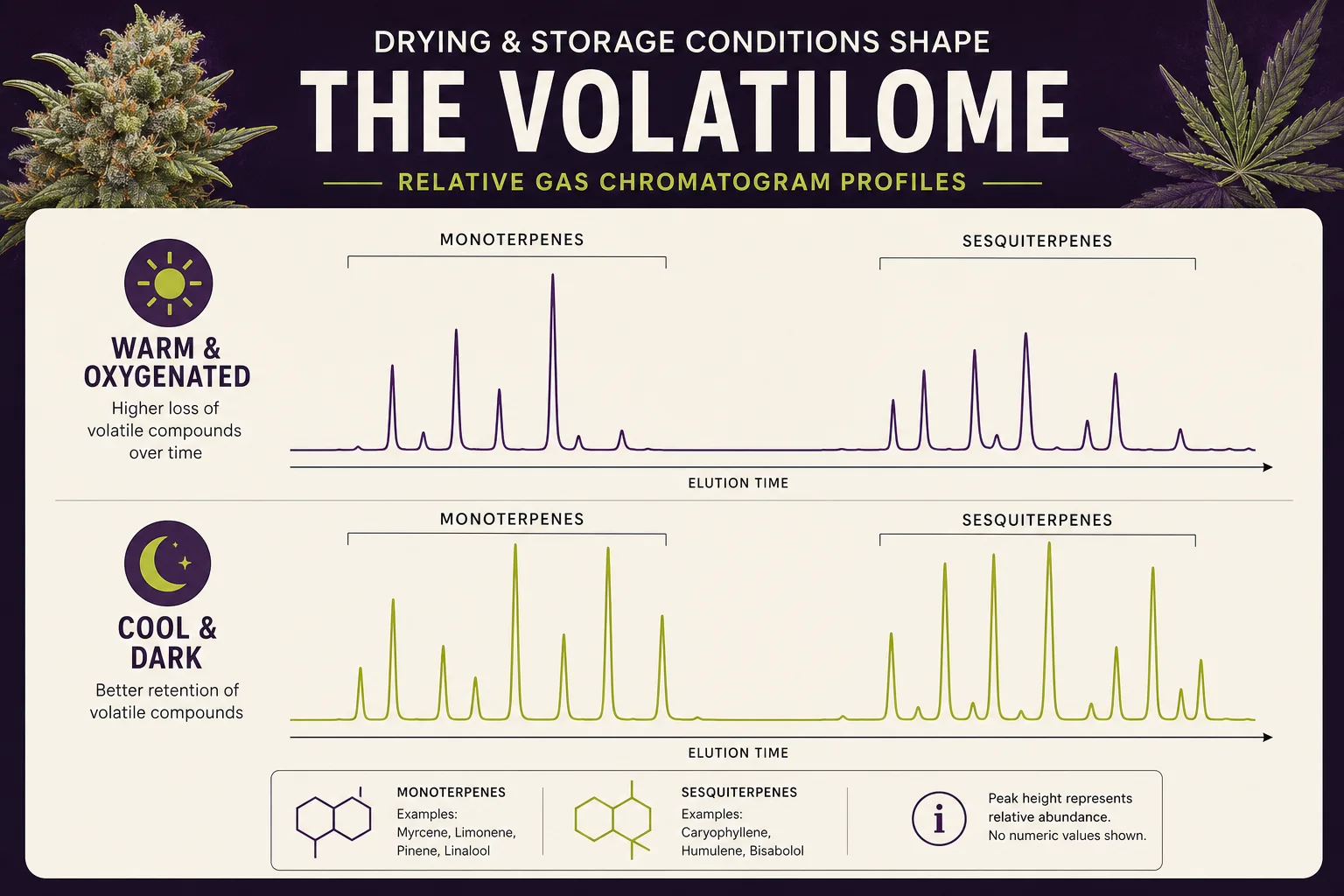
An explanatory GC schematic that teaches how storage conditions change the volatilome: monoterpene peaks shrink faster under warm/oxygenated conditions. This clarifies why scent loss is a measurable chemical change.
Research context: The influence of drying and storage conditions on the volatilome and cannabinoid content of Cannabis sativa L. inflorescences.Packaging decisions: permeability, headspace, humidity buffers, and MAP
Packaging is where you control the product’s environment for the weeks and months after curing. Permeable bags let oxygen and external humidity through; glass jars are low‑permeability and preserve aroma better; vacuum sealing limits oxygen but can crush fragile trichomes and change appearance. Modified atmosphere packaging (MAP) — replacing headspace with inert gases such as nitrogen — is used in other foods to inhibit oxidation, and the principle applies here: less oxygen slows volatile loss and cannabinoid oxidation. But MAP changes regulatory sampling logistics and isn’t a substitute for validated microbial control during drying. (pubmed.ncbi.nlm.nih.gov)
Humidity buffers (commonly available as fixed‑RH packs) help keep product RH stable inside jars; they reduce swelling/desiccation cycles that break trichomes and promote volatilization. Use them with records: which buffer (target %RH), when added, and from what lot. For small producers, consistent packaging procedures — container type, headspace volume, seal technique, and whether a desiccant or RH buffer was used — are among the most valuable notes you can keep when matching lab results to production steps. (pubmed.ncbi.nlm.nih.gov)
Remember: packaging also affects sampling representativeness. If a COA is taken from a single jar or from material re‑homogenized after storage, those choices influence whether a lab’s result accurately reflects what a consumer sees on the shelf. Maine’s rules require certain analyte testing and data reporting; consistent sampling tied to container/lot records reduces ambiguity when issues arise. (www1.maine.gov)
Records and traceability: what to log (and why it matters)
At a minimum, your harvest record should link cultivar, harvest date, drying room ID, drying method and conditions (temperature, RH, airflow), date moved to curing, container type, and dates of container changes. Add humidity buffer lot numbers and COA identifiers for any mandatory tests. These aren’t bureaucratic exercises; they are the factual trail that connects a lab failure to a root cause and helps operators adjust human, mechanical, or environmental variables for the next run. Studies emphasize that genotype, environment, and post‑harvest handling combine to determine microbial and chemical outcomes — you need data from each axis to learn. (pubmed.ncbi.nlm.nih.gov)
Good records also help during regulatory review. Maine’s Office of Cannabis Policy publishes adult‑use testing datasets and has used audits to compare medical and adult program outcomes; when questions about a sample arise, traceability reduces ambiguity and supports corrective action. For small growers focused on quality, a few standard forms — digital or paper — dramatically reduce the time it takes to identify patterns and fix problems. (www1.maine.gov)
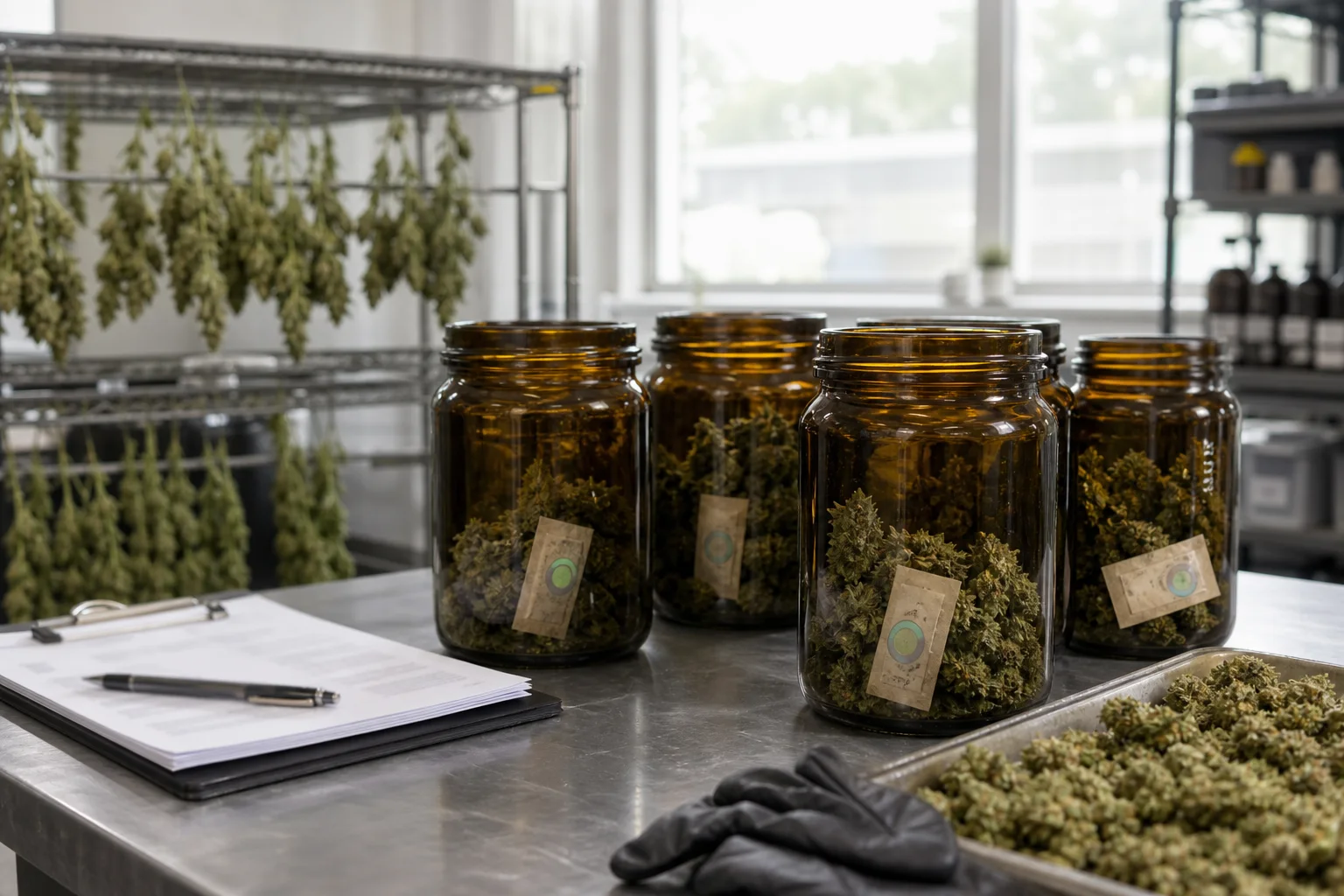
A documentary photo showing the practice of linking production logs to packaged lots: jars with humidity buffers next to a notebook. The text fields on the log should be intentionally non‑readable to avoid sharing private data. This brief connects recordkeeping to traceability and testing.
Research context: Adult Use Testing DataWhy appearance cannot certify safety (and what does)
A bright green, trichome‑heavy bud can still carry elevated yeast and mold counts or pesticide residues. Visual assessment cannot quantify water activity, measure mycotoxins, or detect low‑level pesticide residues that may have been concentrated during drying. Maine’s mandatory testing program exists precisely because sight and smell are poor proxies for the analytes that matter to public health and compliance. Trust COAs and tied trace records; use appearance as an initial quality screen, not a clearance. (www1.maine.gov)
Microbial testing (yeast/mold enumeration, pathogen screens) and chemically targeted tests for pesticides, heavy metals, and residual solvents are the safety triage. These tests have limits — a single sample may miss a hot spot in a batch — which is why good sampling design and transparent records are essential. When a sample fails in Maine’s system, retesting rules and remediation pathways are defined; that’s another reason why explicitly linking samples to lot records is important. (www1.maine.gov)
Finally, don’t equate odor with safety. A musty or sour smell may indicate spoilage, but some molds produce no overt smell; conversely, some desirable aged notes arise from benign oxidative chemistry. Measurement — moisture, a_w, microbial counts, analyte testing — is the only reliable way to know. (pubmed.ncbi.nlm.nih.gov)
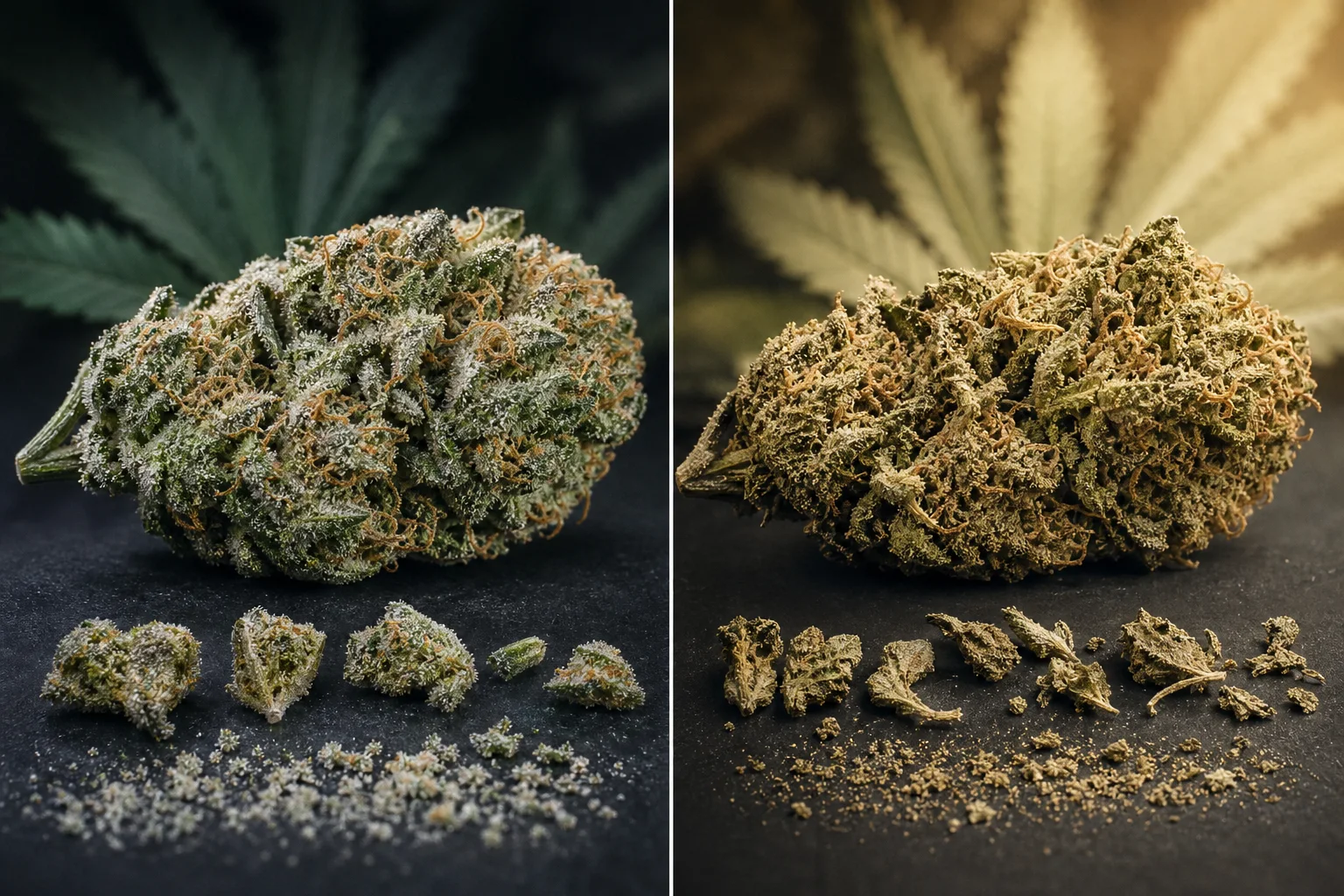
A controlled comparative image set showing the visual effects of light/heat exposure over time on trichome integrity and bud color. This illustrates but does not prove safety changes — chemical analysis is necessary to confirm oxidation or cannabinoid shifts.
Research context: The role of time and storage conditions on the composition of hashish and marijuana samples: A four-year studyPractical checklist: a minimum post‑harvest SOP for small batches
-
Log harvest: cultivar, date, room, worker initials. Move immediately to a controlled drying space. Record starting wet weight. (pubmed.ncbi.nlm.nih.gov)
-
Dry with measured T/RH and airflow. Aim for slow, even drying — target final moisture roughly equivalent to 12–14% by weight (a_w ~0.65–0.7) depending on method and product goals. Take and log daily weight checks until equilibrium. (pubmed.ncbi.nlm.nih.gov)
-
Transfer to curing containers once outer tissues and stems are no longer exuding water. Use low‑permeability containers, add an RH buffer if needed, and date each jar. Burp for the first 1–2 weeks on a schedule and record burps. (pubmed.ncbi.nlm.nih.gov)
-
Package for shelf life: choose jar or MAP depending on your goals; record headspace and packing density; avoid strong sunlight and keep product cool. Maintain a batch checklist for each packaged lot. (pubmed.ncbi.nlm.nih.gov)
-
Link each lab sample to a lot and include the harvest and post‑harvest records. Store COAs with the production log. If a sample fails, the record is how you find the probable root cause. (www1.maine.gov)
Evidence limits and what the literature does — and doesn’t — say
The recent literature documents consistent patterns: drying and storage change volatiles and cannabinoids; water activity predicts microbial risk; and storage light/temperature drive oxidation and cannabinoid conversions. But studies vary in methods (freeze vs tray drying, model systems vs commercial rooms), and the cannabis matrix is chemically diverse across cultivars. That means the precise numbers from one study won’t map perfectly onto your farm. Use published results as principles, not a one‑size‑fits‑all recipe. (pubmed.ncbi.nlm.nih.gov)
Regulatory data reported by Maine's OCP give real‑world insight into how mandatory testing catches analytes in commercial samples; that data is a powerful complement to laboratory experiments because it shows where real supply chains are challenged. Still, public datasets are aggregate and cannot replace batch‑level traceability. When making changes to process, run controlled comparisons and keep an open, auditable log. (www1.maine.gov)
Finally, laboratory testing is powerful but not infallible. Sample selection, handling, and lab methods all influence results. When in doubt, work with your testing provider and regulator to clarify sampling expectations and, if needed, retest following the program’s rules. (www1.maine.gov)
Key takeaways
- Drying and curing control moisture gradients and water activity, the chief drivers of microbial risk. (pubmed.ncbi.nlm.nih.gov)
- Terpenes and other volatiles are fragile; temperature, light, oxygen, and packaging all reshape aroma and measured profiles. (pubmed.ncbi.nlm.nih.gov)
- Packaging choices (glass, MAP, RH buffers) influence shelf life and laboratory outcomes; match packaging to the stability goal and record everything. (pubmed.ncbi.nlm.nih.gov)
- Appearance cannot certify safety. Rely on defensible sampling, COAs, and trace records to confirm safety analytes. (www1.maine.gov)
Frequently asked questions
Q: Does a dry feel mean a product is safe?
A: No. A dry feel indicates moisture loss but not necessarily safe water activity or absence of concentrated residues. Microbial testing and analyte testing are needed to confirm safety. (pubmed.ncbi.nlm.nih.gov)
Q: How long should curing take?
A: Curing timelines vary with starting moisture, container type, and target RH. Typically, 2–6 weeks of monitored equilibration gives meaningful stabilization; record burping and RH to guide your timing. (pubmed.ncbi.nlm.nih.gov)
Q: Will vacuum sealing always preserve aroma?
A: Vacuum sealing limits oxygen but can depress fragile trichomes and alter appearance. It helps slow oxidation but is one tool among others (RH buffers, cool dark storage) and should be selected based on product goals. (pubmed.ncbi.nlm.nih.gov)
Q: Can I rely on visual mold checks?
A: Visual checks catch obvious spoilage but miss invisible contamination and mycotoxins. Laboratory microbial testing is the reliable way to detect problematic microbial loads. (pubmed.ncbi.nlm.nih.gov)
Q: What’s the difference between Maine’s adult‑use and medical testing approach I should know about?
A: Maine’s adult‑use program requires mandatory testing categories and public reporting of aggregated results; the medical supply historically had different sampling/testing practices but has been compared against adult‑use standards in OCP audits. Traceability and following the adult‑use analyte list is the practical way to be compliant when selling under that program. (www1.maine.gov)
Sources
- The influence of drying and storage conditions on the volatilome and cannabinoid content of Cannabis sativa L. inflorescences. PubMed. https://pubmed.ncbi.nlm.nih.gov/38702447/ (Publisher: PubMed).
- Postharvest Operations of Cannabis and Their Effect on Cannabinoid Content: A Review. PubMed. https://pubmed.ncbi.nlm.nih.gov/36004888/ (Publisher: PubMed).
- Total yeast and mold levels in high THC-containing cannabis (Cannabis sativa L.) inflorescences are influenced by genotype, environment, and pre-and post-harvest handling practices. PubMed. https://pubmed.ncbi.nlm.nih.gov/37383630/ (Publisher: PubMed).
- Adult Use Testing Data. Office of Cannabis Policy, State of Maine. https://www1.maine.gov/dafs/ocp/open-data/adult-use/testing-data (Publisher: Maine Office of Cannabis Policy).
- OCP Fall 2023 Medical Testing Report. Office of Cannabis Policy, State of Maine. https://www.maine.gov/dafs/ocp/sites/maine.gov.dafs.ocp/files/inline-files/OCP%20Fall%202023%20Medical%20Testing%20Report.pdf (Publisher: Maine Office of Cannabis Policy).
- The role of time and storage conditions on the composition of hashish and marijuana samples: A four-year study. PubMed. https://pubmed.ncbi.nlm.nih.gov/30901710/ (Publisher: PubMed).
- My child ate a cannabis edible. Poison Control. https://www.poison.org/articles/my-child-ate-a-cannabis-edible (Publisher: Poison Control).
Questions this guide answers
Does visual inspection confirm a bud is safe?
No. Appearance is a quick quality signal but cannot detect microbes, mycotoxins, or low‑level chemical residues. Lab testing and traceable records are required to confirm safety.
What moisture target reduces mold risk?
Research commonly cites cured flower moisture roughly equivalent to 12–14% by weight (water activity near 0.65–0.7) as associated with lower yeast and mold counts, but drying method and environment change outcomes and should be logged and validated by testing.
How do packaging choices affect shelf life?
Container material, headspace oxygen, and humidity buffers determine the product's microclimate. Glass jars with RH buffers and cool, dark storage tend to preserve aroma and slow oxidation compared with permeable bags.
Why keep detailed post‑harvest records?
Records link lab results to a harvest and process: they’re how you find root causes for failures, demonstrate compliance, and iterate toward consistent product stability and safety.
Are there Maine‑specific testing requirements I should know?
Yes. Maine’s adult‑use program mandates testing categories including pesticides, heavy metals, microbes, mycotoxins, residual solvents, and potency, and reports aggregate results publicly. Consult OCP guidance for sampling and reporting details.
Educational information only. Cannabis affects people differently and this is not medical advice.