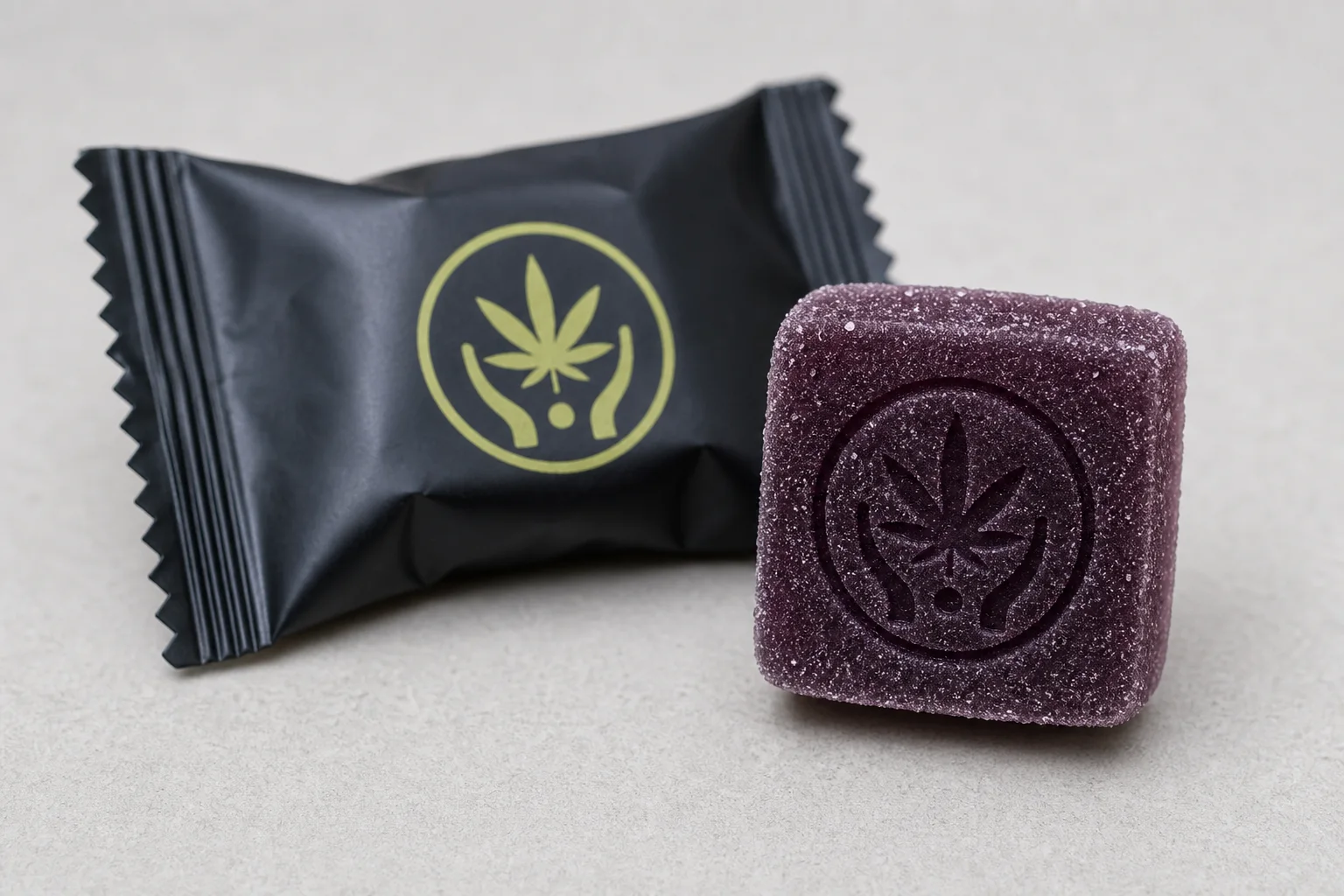
Hero image showing a single standardized edible serving with the Maine universal symbol imprinted. This visual supports the article’s point about reading both package and serving, but it does not convey potency, lab values, or clinical outcomes. Source images are used as documentary evidence of marking practice only.
Start with time: why edibles take longer and vary more
Edible cannabis is absorbed through the digestive tract, not the lungs. That difference matters: an edible’s effects can begin anywhere from about 30 minutes up to several hours after ingestion, and peak even later. The liver’s metabolic processing (including conversion of THC to the metabolite 11‑OH‑THC) and variable absorption in the gut create slower, often stronger, and more unpredictable subjective effects compared with inhalation. This pharmacokinetic behavior is well documented in systematic reviews and human PK studies of oral THC and edible products. (pmc.ncbi.nlm.nih.gov)
Because the time course is slow and variable, a common behavioral risk is “stacking” — taking more because the first portion didn’t feel like it had an effect yet. Stacking is the main way people end up with stronger‑than‑intended effects. Public health guidance stresses the 30‑minute to multi‑hour window for onset and the long tail of effects for many edible formats. (cdc.gov)
Finally, the type of edible matters. A beverage or thin liquid can act faster than a dense cookie; sugary gummies may be absorbed differently when eaten on a full stomach than on an empty one. Expect that onset and peak will shift with food in the stomach, the edible’s matrix (fat, sugar, liquid), and individual biology. Several clinical studies have measured large interindividual variability in Tmax and Cmax after oral THC. (pubmed.ncbi.nlm.nih.gov)
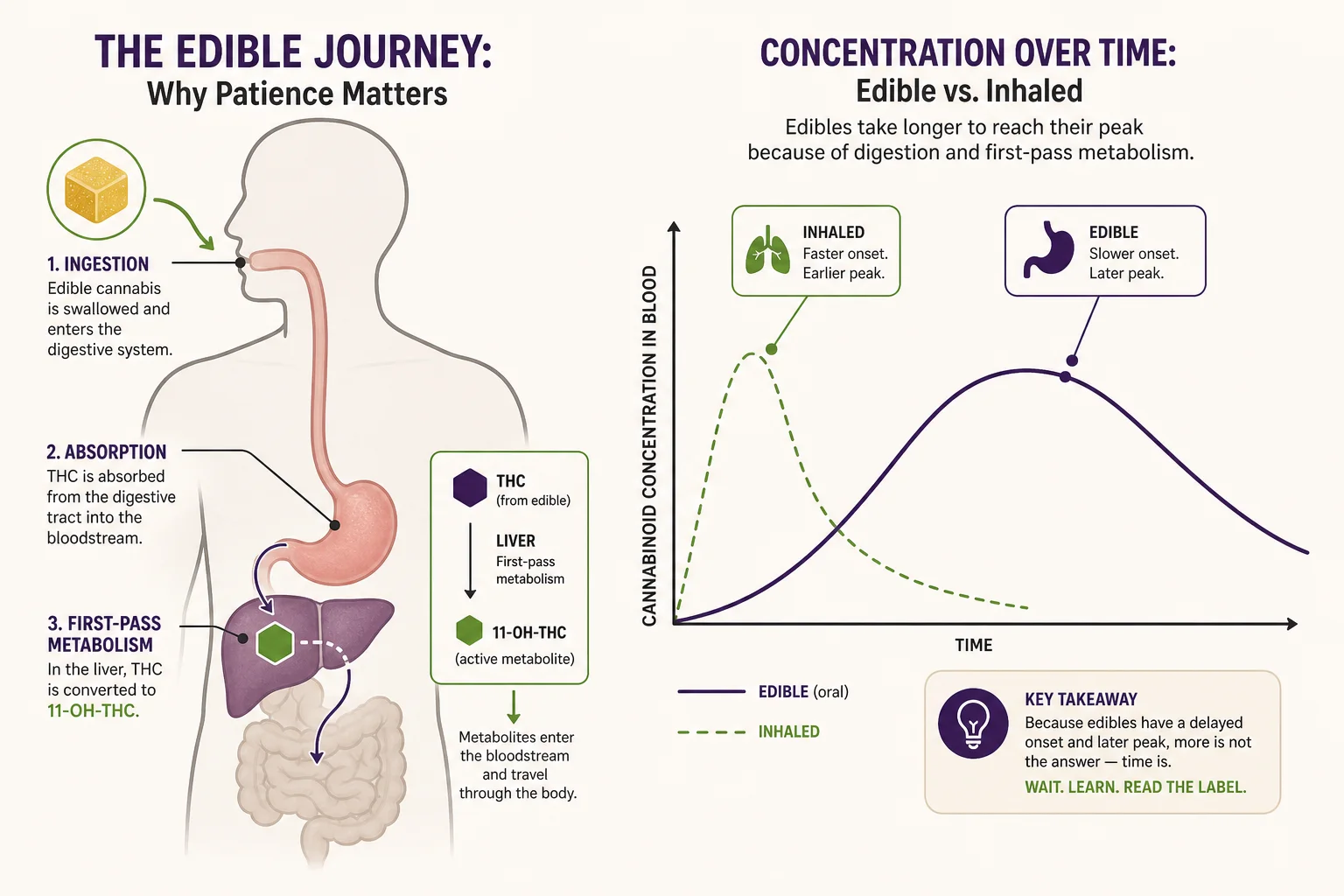
Diagram linking ingestion to liver metabolism and a delayed concentration–time curve, illustrating why edibles have slower, variable onsets. The figure is simplified and based on clinical pharmacokinetic reviews; it does not provide patient‑level dosing guidance.
Research context: Oral Administration of Cannabis and Δ-9-tetrahydrocannabinol (THC) Preparations: A Systematic Review - PMCServing labels vs. package labels: read both, and read them slowly
Maine’s adult‑use and medical labeling rules require certain information on product packaging and on single serving units — for example, a universal symbol and standardized serving markings for edibles — but how potency is presented on the retail label and on a product’s single‑serving wrapper can differ. State statute and OCP rules point to labeling obligations and to how single standardized servings should be marked. Reading both the outer package and the individual serving wrapper is a best practice. (legislature.maine.gov)
Labels commonly show a total‑package potency and a per‑serving potency. If a package contains multiple servings, consumers need to calculate how many servings they actually consume. Errors happen when people eat “one piece” without checking whether that piece is one full serving or half a serving. Maine’s regulations require that single standardized servings of edible cannabis be marked, stamped, or otherwise imprinted with the universal symbol directly on the product or wrapper. Still, manufacturing practices and potency variance allowances mean the label number is a best estimate, not a laboratory bill of rights. (maine.gov)
Label reading also means reading the ancillary information: allergen statements, storage instructions, and the presence of other active substances (e.g., caffeine, alcohol in some preparations). If you are in Maine’s medical program, the medical labeling and packaging rules are slightly different in some respects (for example, signifiers at point of sale and medical program packaging expectations). Know which program your product came from and read according to that standard. (legislature.maine.gov)
Why measured potency on a label isn’t an exact promise
Laboratory testing and sampling reduce uncertainty but don’t eliminate it. OCP guidance documents acknowledge assay‑to‑assay and batch variability and explicitly allow small statutory potency variance when reporting test results. That means a labeled potency is an informed, regulated estimate. Factors such as uneven mixing in a batch, sampling technique, degradation of cannabinoids over time, and lab method variance all contribute to test result spread. Maine’s guidance on potency variance and the OCP’s rules help manage this uncertainty but do not remove it. (maine.gov)
From a consumer perspective, that uncertainty argues for conservative behavior: regard label numbers as a structured starting point rather than precise predictors of effect. In regulated markets, testing and labeling provide far more reliable information than unregulated products, but even in a regulated product there can be meaningful variance between the number on the wrapper and the effect you feel. (maine.gov)
Finally, potency is just one piece of the potency–effect equation. The edible matrix, co‑ingested food and alcohol, medications, and individual factors (body weight, prior exposure, metabolism) interact with the labeled THC amount to influence subjective response. Clinical pharmacology literature has repeatedly documented wide interperson differences in oral cannabinoid PK/PD. (pmc.ncbi.nlm.nih.gov)
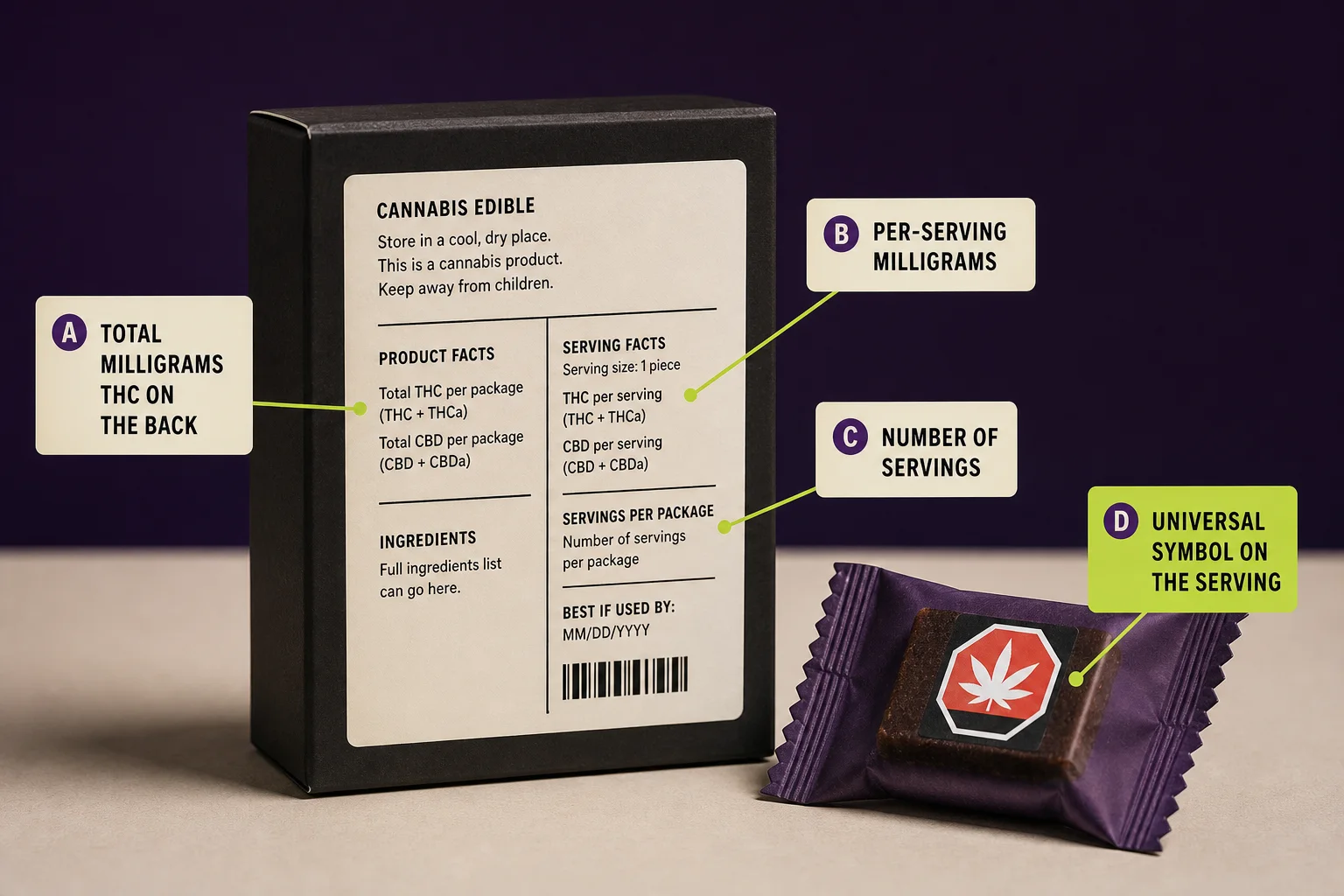
Retail package image annotated to show where to find total package potency, per‑serving potency, serving count, and the universal symbol. Uses a non‑branded, mock package layout that follows Maine OCP guidance—no real logos or numbers. This teaches label literacy, not product endorsement.
Research context: Maine Cannabis 101Accidental exposure: children, pets, and look‑alike foods
Edible cannabis products are often attractive to children and pets because they look and smell like ordinary snacks. Poison Control data and guidance show that unintentional pediatric exposures have increased as edible availability has grown; clinical outcomes in small children can be severe and, in some cases, require hospitalization. Keeping all cannabis products out of reach and in child‑resistant, opaque packaging is essential. If an ingestion occurs, contact your poison center immediately. (poison.org)
Maine law requires child‑resistant and opaque packaging for many products sold in medical and adult markets, and labeling that avoids marketing to youth. Still, no packaging is foolproof, and products removed from original packaging — or homemade items — represent the biggest risk. If you have children or pets in the home, separate storage (locked, opaque, out of sight) is the responsible choice. (legislature.maine.gov)
If someone — child or adult — has a bad or unexpected reaction after eating an edible, Poison Control recommends calling 1‑800‑222‑1222 or using webPOISONCONTROL for immediate triage. Because edible effects can take hours to develop, monitor exposed people and do not assume the absence of early symptoms means everything will be fine. (poison.org)
Why we can’t and won’t prescribe a single dose
There is no universal edible “dose” that fits everyone. Scientific studies show dose‑dependent effects but also large individual variability in pharmacokinetics and pharmacodynamics after oral dosing. That variability, plus differences in tolerance, concurrent medicines, and goals, makes one‑size dosing advice unsafe and scientifically unsupported. Clinical trials and pharmacology reviews document that two people taking the same labeled milligram amount may have very different plasma levels and subjective responses. (pmc.ncbi.nlm.nih.gov)
As growers and educators, we can point to reliable practices that reduce harm (start low, wait long, read the label, avoid mixing with alcohol or sedatives, and secure storage). But those practices are behavior and risk‑management tools, not individualized prescriptions. Any discussion about changing a dose in the context of medical symptom management is a topic for a clinical conversation with a licensed clinician and, if relevant, a pharmacist — not a how‑to list here. (maine.gov)
Regulated labeling and consistent serving formats are steps toward safer use because they make it easier to reason about exposure. However, even in fully regulated contexts, the available evidence supports conservative, individualized experimentation (with patience and observation), not a single fixed rule. (maine.gov)
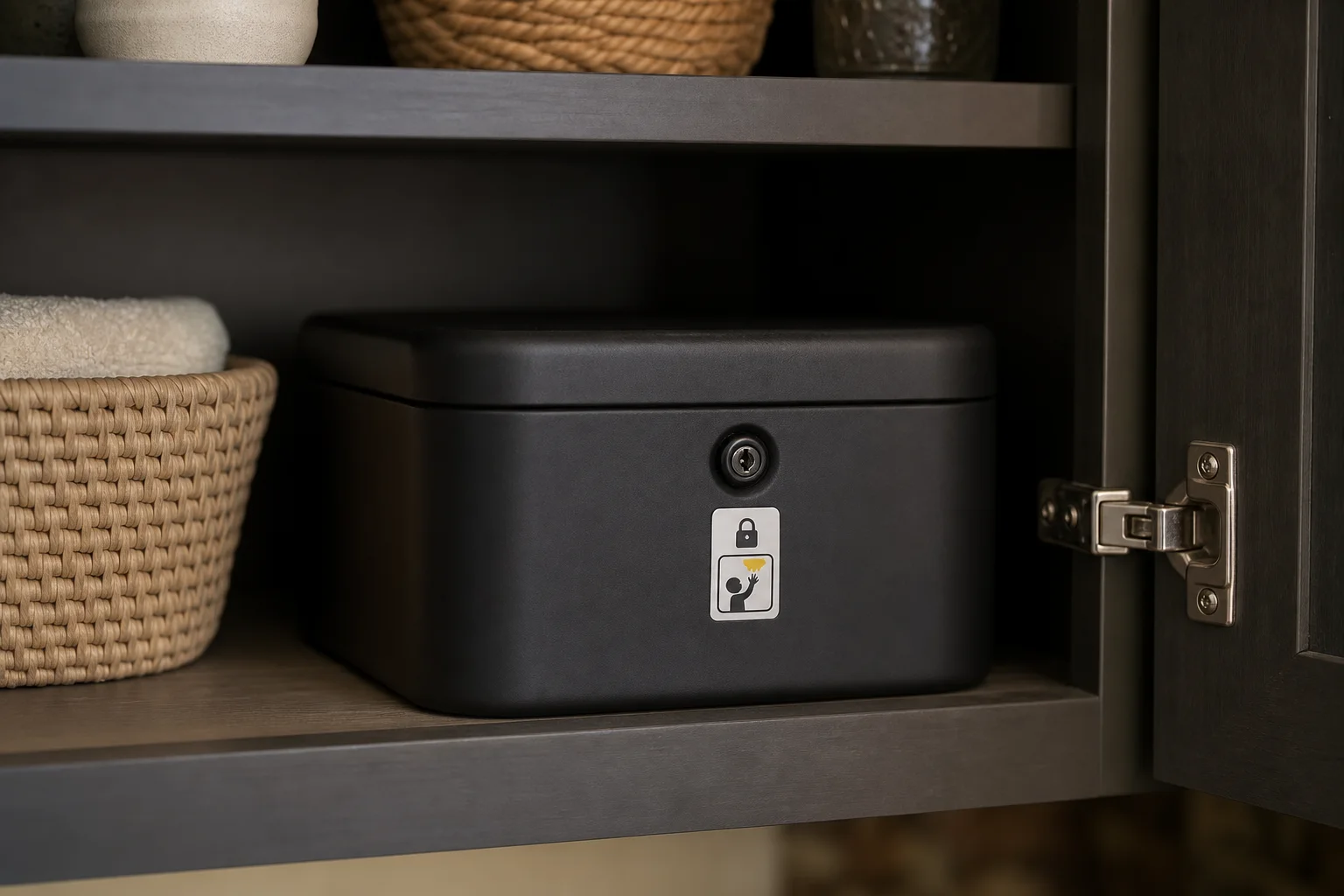
Demonstrates recommended safe storage practice — opaque, child‑resistant, locked storage away from food preparation areas. The image emphasizes storage behavior; it is not a guarantee of safety and does not replace legal packaging requirements.
Research context: Title 28-B, §701: Labeling and packagingPractical rules for safer edible use (behavioral not prescriptive)
-
Read both the package and the single‑serving wrapper every time. If the piece you plan to eat is not clearly marked as a single serving, pause and do the math. Look for the universal symbol on the serving itself. (maine.gov)
-
Wait patiently. Because effects can take 30 minutes to several hours to appear and to peak, avoid taking a second portion until you’re confident the first portion has reached its full effect for you. Be especially conservative with slow‑release or high‑fat items. (cdc.gov)
-
Store away from kids and animals in locked or high, opaque storage. Keep original child‑resistant packaging when possible. Call Poison Control at 1‑800‑222‑1222 if you suspect an unintentional ingestion. (poison.org)
-
Keep a log. If you’re experimenting, note product name, labeled per‑serving potency, what you ate it with (empty or full stomach), time, and how you felt at 1, 2, 4, and 8 hours. Over a few trials this will help you learn your own response window without escalating exposure. This is a harm‑reduction tool, not a dosing regimen. (pmc.ncbi.nlm.nih.gov)
Visual reminder that Poison Control is the first line for suspected ingestions. This mockup is for educational direction only and is not a substitute for calling in an emergency.
Research context: My child ate a cannabis edibleEvidence limits and what we still don’t know
Clinical and toxicology literature clearly shows that oral cannabis PK/PD are more variable than those for inhalation, but the literature also has limits. Many studies use small sample sizes, vary in product type (synthetic dronabinol vs. whole‑plant extract vs. commercial edibles), and historically excluded frequent cannabis consumers or people with certain health conditions. These differences limit how precisely research results generalize to every edible on a dispensary shelf. (pmc.ncbi.nlm.nih.gov)
Additionally, real‑world products are complex: multi‑ingredient recipes, uneven distribution of cannabinoid in a batch, and post‑manufacture cannabinoid degradation complicate the match between lab conditions and consumer experience. Maine’s testing and potency variance guidance help bridge the gap but cannot make every package identical to its label. (maine.gov)
Finally, the interaction of edible cannabis with commonly prescribed drugs, with alcohol, and with differing nutritional states remains a partially charted territory. Ongoing clinical and public‑health surveillance — including poison center data — continues to improve our understanding, but uncertainty remains. This scientific uncertainty is the main reason we avoid blanket dose prescriptions and encourage careful, conservative dose‑finding behavior. (poison.org)
Where to find accurate help right now
- Maine Office of Cannabis Policy: for program rules, the universal symbol guidance, and consumer education materials. (maine.gov)
- Maine statutes for labeling and packaging requirements (Titles 28‑B and 22): reference statutory language if you need to check legal text. (legislature.maine.gov)
- CDC pages on edible effects and poisoning: public‑health framing of delayed onset and accidental ingestion risk. (cdc.gov)
- Poison Control (webPOISONCONTROL and 1‑800‑222‑1222) for suspected ingestions and immediate triage. (poison.org)
If you want to dig into the clinical literature on oral THC pharmacokinetics and the variability of edible effects, the NIH/PubMed/PMC literature is the reliable place to start. (pmc.ncbi.nlm.nih.gov)
Key takeaways:
- Edible onset is slower and more variable than inhalation; effects can peak hours after ingestion. (pmc.ncbi.nlm.nih.gov)
- Read both the outer package and the single serving wrapper; Maine requires a universal symbol on single servings. (maine.gov)
- Labeled potency is a regulated estimate; batch and testing variance exist. (maine.gov)
- Keep edibles secured from children and pets; call Poison Control for exposures. (poison.org)
- We cannot prescribe a single dose — variability and evidence limits make individualized clinical advice necessary.
Questions this guide answers
How long should I wait after eating an edible before considering more?
Because onset and peak vary by product and person, public health guidance recommends waiting at least 2 hours and recognizing effects can continue to develop for several more. Faster‑acting beverages may appear earlier, while dense foods can take longer. Be conservative and patient.
Do Maine labels show how many milligrams of THC are in a single serving?
Yes — regulated Maine packaging presents per‑serving and per‑package potency information and requires single servings of edibles to be marked with a universal symbol; however, state guidance allows small potency variance between lab tests and the label. ([www1.maine.gov](https://www1.maine.gov/dafs/ocp/resources/universal-symbol))
What should I do if a child eats an edible?
Call Poison Control at 1‑800‑222‑1222 or use webPOISONCONTROL immediately for triage. Because children can have serious reactions and symptoms may be delayed, seek professional guidance even if the child seems fine initially. ([poison.org](https://www.poison.org/articles/my-child-ate-a-cannabis-edible))
Are edible potency labels reliable?
Labels in regulated markets like Maine are supported by testing, but laboratories, sampling, batch mixing, and cannabinoid degradation introduce variance. Labels are regulated best estimates, not exact guarantees. ([maine.gov](https://www.maine.gov/dafs/ocp/sites/maine.gov.dafs.ocp/files/inline-files/Potency%20Variance%20Guidance%20Final%2008-08-2022.pdf))
Can this article tell me exactly what dose to take?
No. Because of large individual differences and evidence limits in oral cannabis research, precise dose prescriptions belong in a clinical context with a licensed provider. This article offers harm‑reduction guidance and practical steps for safer use.
Educational information only. Cannabis affects people differently and this is not medical advice.