
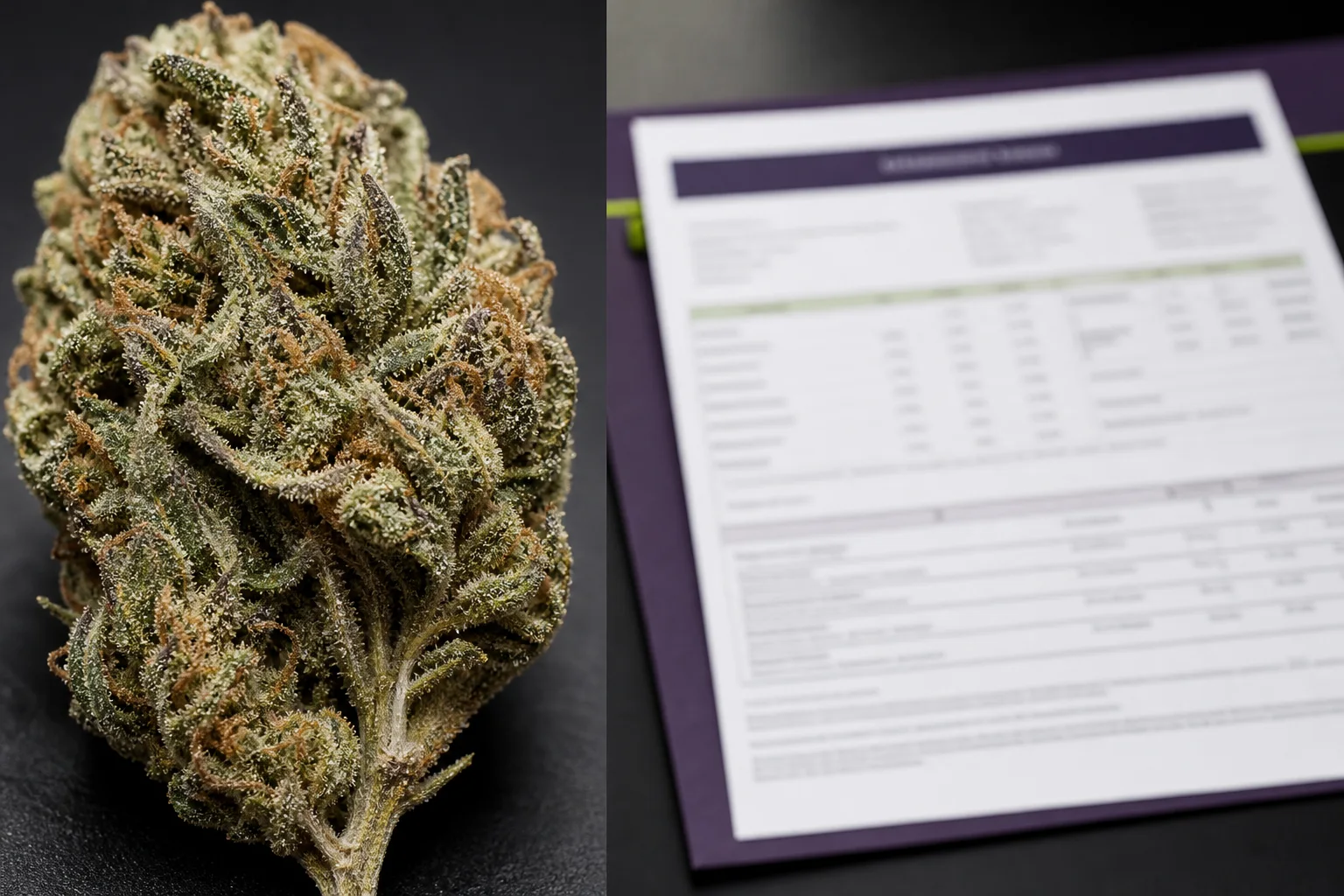
A close macro of a bud next to a CoA highlights the connection between plant material and its laboratory record. This brief should show texture and non-readable lab headings (blur values) to teach traceability while avoiding disclosure of private or exact numeric data. It illustrates why a batch-linked CoA is more useful than a marketing headline. Limit: do not show readable report values, personal data, brand logos, or promotional imagery.
How education is different from advertising
Advertising is built to persuade: short messages, bold claims, and a tidy takeaway that asks you to choose a product. Responsible cannabis education is different by design. Education prioritizes the how and why — where a product came from, what evidence supports a claim, and what we do not yet know. That difference matters because cannabis products are chemically complex, state rules curb certain kinds of claims, and laboratory numbers carry uncertainty that affects interpretation. For adults who grow, buy, or use cannabis in Maine, knowing how to read source labels and scientific limits makes purchasing and use decisions clearer and safer.
Educational content explains provenance, test methods, and assumptions, rather than promoting a single outcome. Where advertising often leans into a single selling point (a strain name, a THC percentage, or a lifestyle image), education breaks that claim into testable pieces: batch ID, lab report availability, testing scope, and the confidence interval around any measurement. These pieces help an adult weigh whether a product matches their priorities and tolerate the remaining unknowns.
When state rules forbid health claims in advertising, the marketplace still contains promotional language that looks scientific. Spotting the difference between a marketing-friendly headline and actual evidence is a central skill this article aims to teach.
What Maine law and program rules require — and how that shapes messages you see
Maine statute requires that cannabis advertising not be misleading, deceptive, or false, and gives the Office of Cannabis Policy authority to adopt rules that can prohibit health or physical benefit claims in advertising or on labels. Those limits shape what sellers can legally say and force some clarity into commercial messaging, but they do not eliminate ambiguity for buyers. Labels and ads still vary in how much traceability and evidence they present.(legislature.maine.gov)
The Office of Cannabis Policy publishes the Adult Use Cannabis Program rules and guidance documents that implement statute and govern testing, packaging, and advertising practices. These rules are a starting place for anyone who wants to know what a label is required to show—and what it is not allowed to claim. Rules evolve, so checking the OCP site for the current rule text is a useful habit.(maine.gov)
Even with rules in place, enforcement focuses on whether messaging is false or targeted to minors; it does not create clinical evidence for any product. In practice, a compliant label may still omit lab details that matter to a particular decision. That practical gap is why education that explains how to read a certificate of analysis (CoA) and how to follow a chain of custody is typically more useful than marketing verbiage.
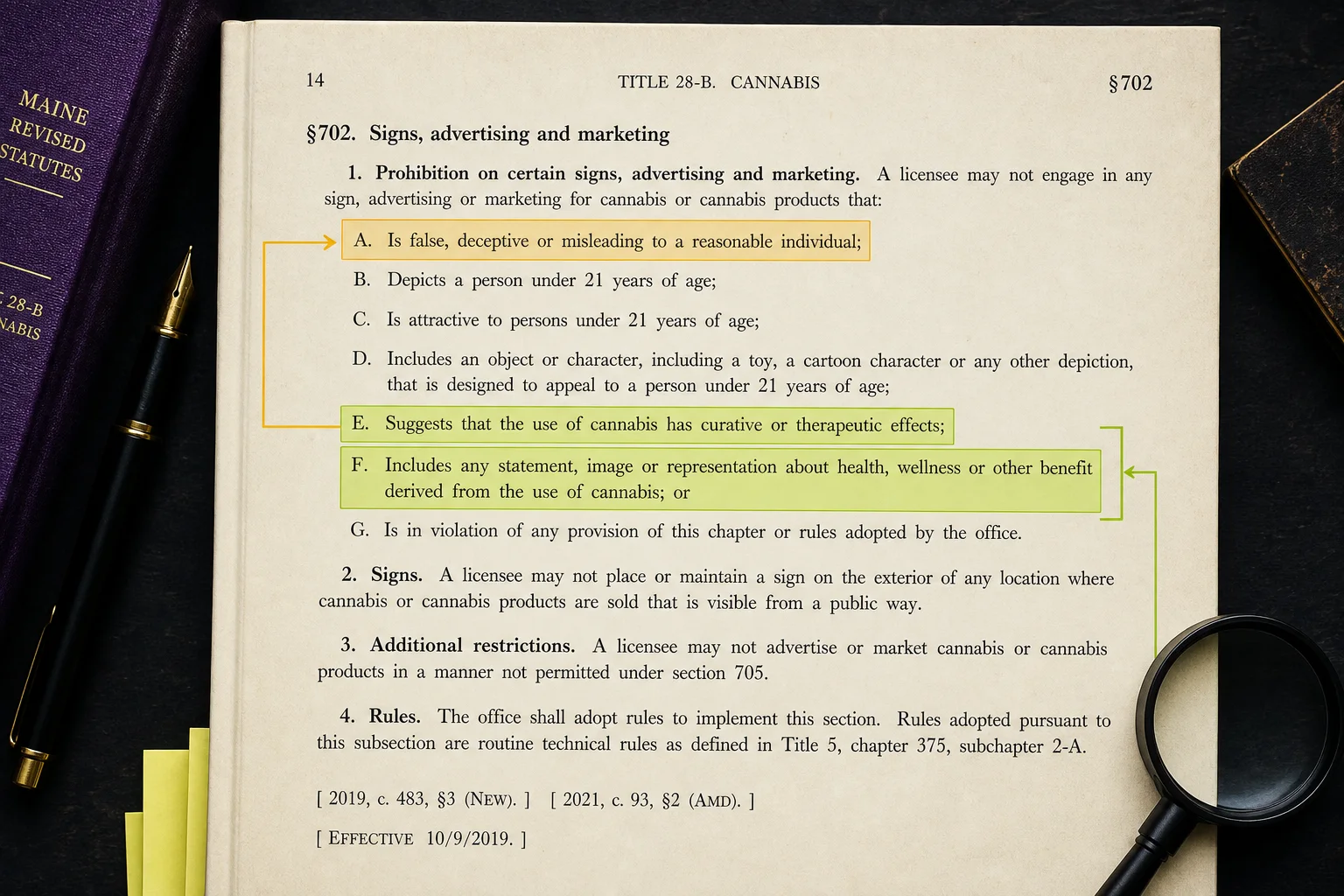
A focused, annotated image of the statute section about advertising shows the legal boundary that forbids misleading claims. Use callouts to highlight the phrase about prohibiting health claims and targeting minors, but do not present legal advice. This visual connects the reader to the regulatory foundation for labeling rules. Source: Maine Legislature.([legislature.maine.gov](https://legislature.maine.gov/statutes/28-b/title28-Bsec702.html))
Research context: Title 28-B, §702: Signs, advertising and marketingWhat a label and a lab report can — and can’t — tell you
A retail label and its accompanying CoA (when available) are related but not identical. A retail label lists what the seller must disclose under state rules—often potency ranges, batch ID, and required warnings—while the CoA is the laboratory’s record of what it measured in a specific sample from that batch. Together they form the evidence chain; alone, each is incomplete.
Multiple peer-reviewed studies and inter-laboratory comparisons have found that label claims are not always perfectly faithful to lab measurements. Testing programs in different states and independent audits show variability across labs and products, and buyers sometimes choose a product based on a prominently displayed single-number THC value that may not reflect the batch they actually receive. That mismatch is why source labels that point to a verifiable CoA and clear batch information are valuable.(pubmed.ncbi.nlm.nih.gov)
A label or a CoA can quantify cannabinoids and screen for contaminants in a tested sample; it does not predict how any one adult will respond to the product, how it will interact with other medications, or how an individual’s prior use history might change effects. Those are individual outcomes, and the evidence base for predicting them from a single lab report is limited. Laboratory data provide pieces of evidence to combine with personal context, official guidance, and professional consultation when appropriate.
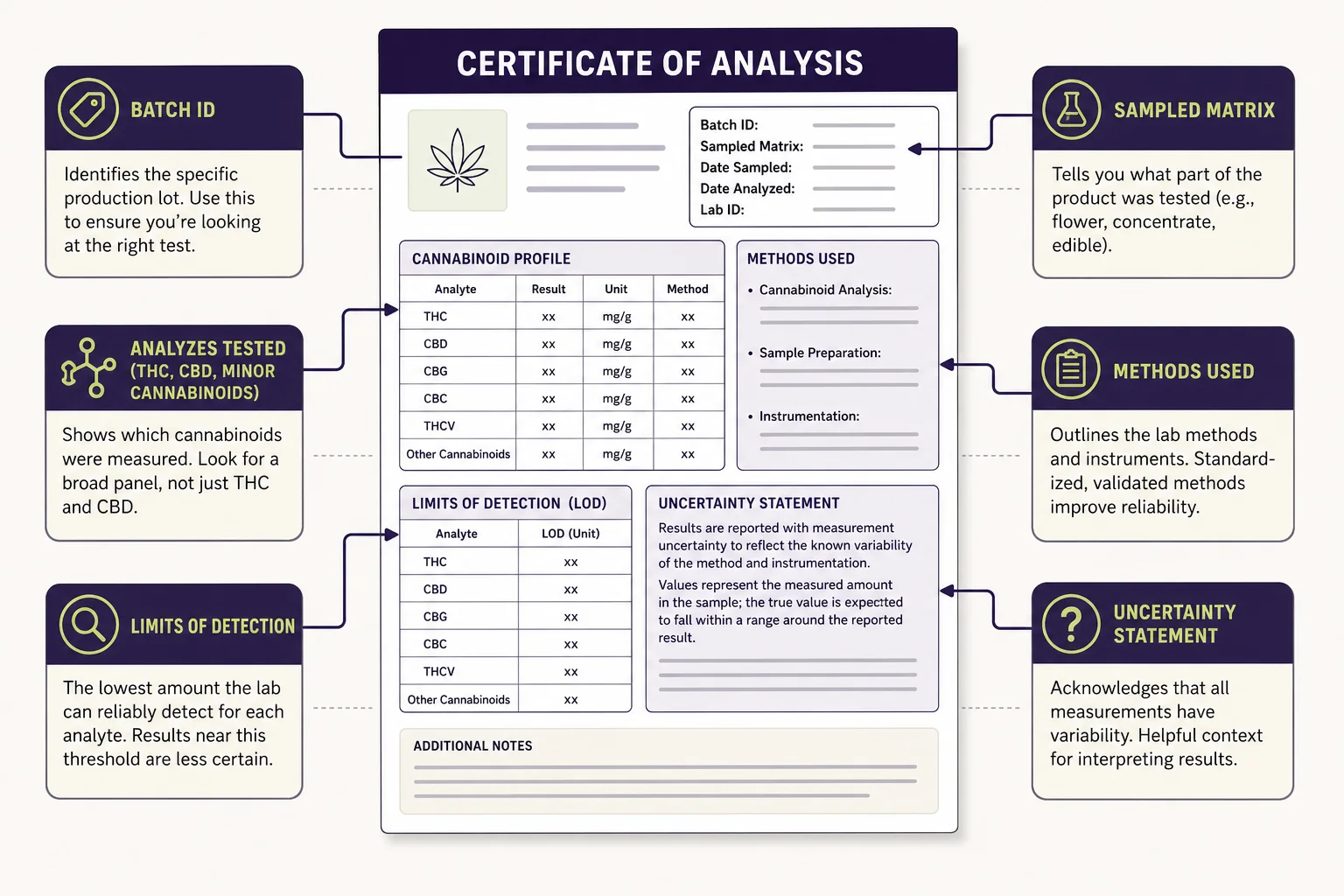
An explanatory diagram of a CoA showing the common sections (batch ID, analytes tested, methods, detection limits) with placeholders instead of real values. This teaches which parts of a lab report to read and why. Limit: do not display real numbers or lab names; the diagram is schematic and educational. Source: lessons from lab-fidelity research.([pubmed.ncbi.nlm.nih.gov](https://pubmed.ncbi.nlm.nih.gov/41984762/))
Research context: Commercial cannabis product testing: Fidelity to labels and regulations - PubMedMeasurement uncertainty: why a lab number is a range, not a fixed value
All measurements come with uncertainty. This is not a rhetorical point—metrology (the science of measurement) makes this explicit. National metrology guidance explains how laboratories should evaluate and report uncertainty so that decision makers understand how much confidence to place in a reported value. In practical terms, that THC percentage on a CoA has an analytical uncertainty that reflects sampling, instrument precision, method bias, and other factors. The result is properly expressed as a measured value plus or minus an uncertainty interval.(nist.gov)
For cannabis testing specifically, laboratories use methods that vary by analyte and matrix (flower, edible, extract). Each method contributes different sources of uncertainty. When reading a CoA, useful source information will point to: the batch sampled, the analytes measured, the method used, limits of detection, and ideally an expanded uncertainty or confidence statement. Without that context, a single percentage is easy to over-interpret.
Understanding uncertainty also helps explain why different laboratories sometimes report different cannabinoid levels for ostensibly the same product: different methods, calibrations, sampling techniques, and the way the sample was taken from a non-homogeneous product produce legitimate variation. That variation is why education emphasizes comparative evidence (multiple batches, reproducible lab methods) rather than brand slogans.
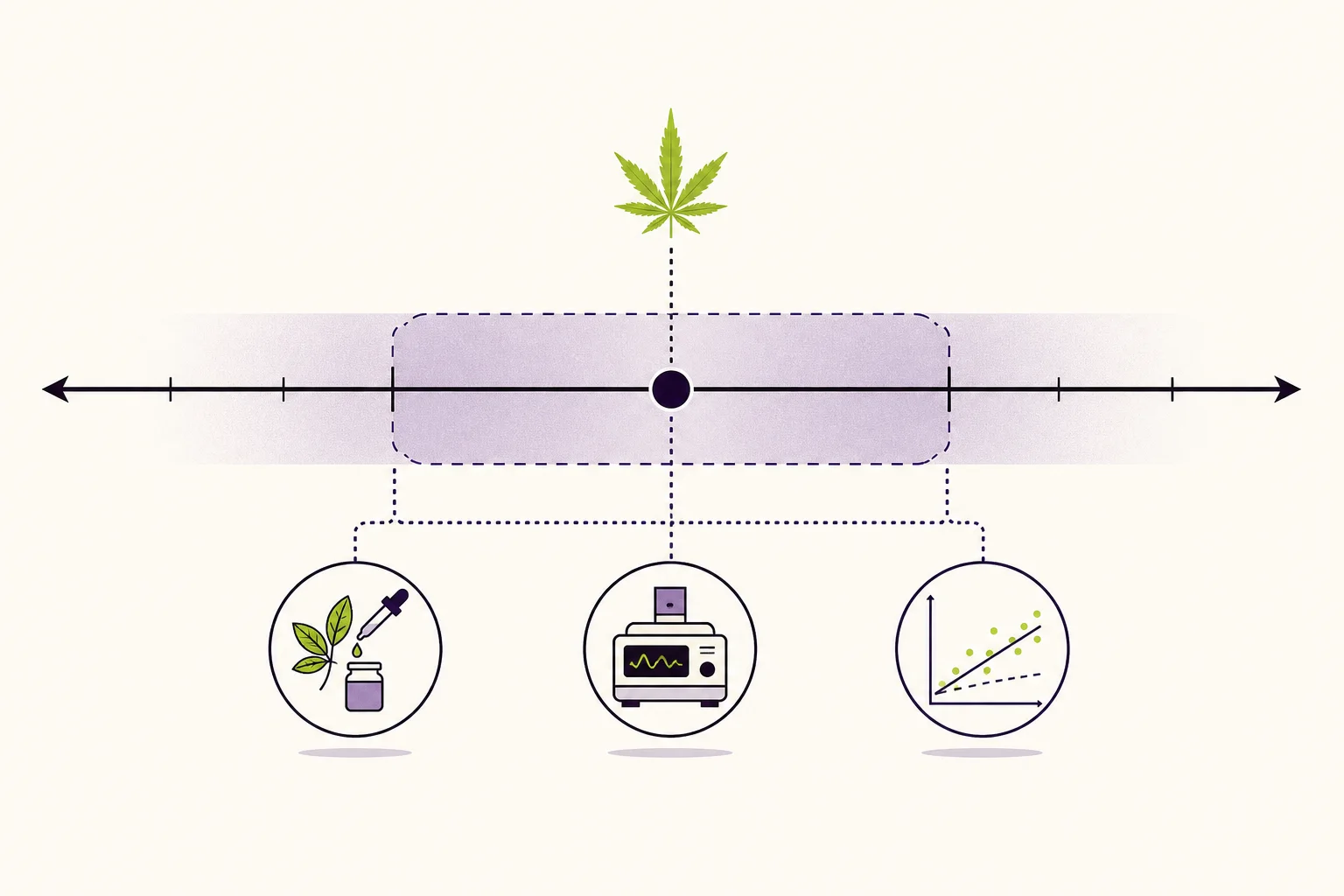
A technical-but-clear illustration shows a measured cannabinoid value as a point with an uncertainty band, and a short legend about sources of uncertainty (sampling, method bias, instrument precision). This visual teaches why a lab number should be read as a range. Source: NIST guidance on expressing uncertainty.([nist.gov](https://www.nist.gov/publications/interpretation-guide-expression-uncertainty-measurement))
Research context: An Interpretation of the Guide to the Expression of Uncertainty in MeasurementWhy evidence limits and the lack of predictable outcomes matter for adults making decisions
Public-health agencies highlight that cannabis use carries risks and that scientific evidence for many outcomes remains incomplete. The Centers for Disease Control and Prevention summarizes both known risks and areas needing more research; these summaries show why sellers are limited in what they can claim on labels or in ads. For adults in Maine, the distinction is important: a product may be legal and tested, but legal status and testing do not equate to a reliable prediction about how it will affect any particular person.(cdc.gov)
Because clinical outcomes depend on dose, route, individual physiology, and context, an educational approach focuses on translating evidence limits into practical options: how to read what was measured, how to judge the relevancy of a study cited in marketing, and when it may be appropriate to consult a health professional. That approach reduces the risk of over-relying on promotional language and helps adults make decisions aligned with their own tolerance for uncertainty.
Finally, accidental exposures—especially in children—remain a documented hazard of edible and beverage products. Poison Control resources explain why accurate labeling, child-resistant packaging, and clear source traceability are not just regulatory checkboxes; they function as public-safety measures. Educational materials that explain packaging limits and how to respond to exposures complement label reading.(poison.org)
Why source labels and traceability increase the usefulness of education
A source label that links a product to a specific batch and a verifiable CoA provides a testable chain of custody. That chain lets an adult check whether the laboratory results apply to the product in hand. Source information also supports follow-up: if a grower or buyer detects off-odors, unexpected outcomes, or packaging problems, batch-level traceability enables investigation and reporting to regulators when warranted.
Education that describes how to look for batch IDs, lab accession numbers, testing dates, and a lab’s accreditation status raises the quality of decision-making in ways advertising cannot. Rather than asserting a particular outcome, that kind of education points to evidence that can be checked. It also outlines practical steps for when evidence is missing—for example, locating a recent CoA, asking which part of a batch was sampled, or noting that some laboratories test for potency but not for certain pesticides or solvents.
Source labels and accessible CoAs also allow growers and regulators to close the loop on quality problems. When the chain of evidence is present, it is feasible to compare results across batches, detect systematic laboratory bias, and identify manufacturing or post-harvest issues that can be addressed. Framing labeling as an investigatory tool encourages people to approach product claims the way a careful grower documents a harvest record: as part of continuous quality assessment rather than as a final verdict.

A staged photograph showing child-resistant packaging (closed container) next to a neutral poison-control reference card. The image teaches why packaging and access control matter for accidental exposures and where to get emergency help. Do not display brands or product names. Source: Poison Control guidance on edibles and accidental ingestion.([poison.org](https://www.poison.org/articles/my-child-ate-a-cannabis-edible))
Research context: My child ate a cannabis ediblePractical steps: what to look for and questions to consider when labels don’t tell the whole story
-
Look for batch numbers and a clear reference to a CoA. When a label lists a batch number but no verifiable CoA is available, one reasonable option is to request a lab report that matches that batch ID. A CoA tied to a batch provides stronger evidence than a generic lab summary.
-
Read the CoA method notes and uncertainty statements. If a report lacks test methods or an uncertainty statement, that absence is informative. Helpful questions include: which cannabinoids were measured, what methods were used, and did the laboratory screen for contaminants relevant to your concerns?
-
Check the lab’s accreditation and the sample date. Accredited laboratories and recent test dates increase the relevance of a report. Accreditation does not eliminate uncertainty, but it signals that the laboratory follows recognized practices for measurement and quality control.
-
Interpret measured values as ranges rather than absolute targets. When a CoA shows a measured cannabinoid value with an associated uncertainty, it is useful to regard the number as informative but not determinative of any particular person’s experience. Many people combine that evidence with personal records, commonly discussed public communication points about gradual adjustment of use, and household safety practices to make choices aligned with their own circumstances.
-
Keep records. Some growers and regular buyers maintain a small notebook or digital folder with batch IDs, CoA links, and personal notes about how a product behaved. Those individual records create personalized evidence that marketing cannot substitute.
-
Ask clarifying questions of the seller or testing laboratory. Examples of neutral, evidence-focused questions include: Was this CoA produced from the same batch as the product on the shelf? What sampling method did the lab use? Which analytes and contaminants were included in the panel? Answering these questions improves traceability and the interpretability of results.
-
Consider variability across form factors. Testing a single sample from one part of a batch may not reflect variability within a heterogeneous product (for example, hand-trimmed flower versus homogenized extracts). When variability matters for a decision, look for evidence across multiple batches or multiple labs.
-
Use chain-of-custody information when available. Knowing when and how a sample was collected, transferred, and analyzed helps establish whether the CoA is directly tied to the product in hand.
Examples and common scenarios (illustrative, not exhaustive)
-
A dispensary label lists a THC percentage and a batch ID, but the shelf tag provides no CoA link. A consumer who values verifiable data might seek a CoA that matches the batch ID and check whether the lab measured both potency and contaminants relevant to them. If no CoA is available, that absence is a piece of information about how much can be inferred from the on-package number.
-
A grower receives a CoA showing a cannabinoid profile for a sample taken during early curing. If later samples from other parts of the same harvest show different values, comparing batch-level CoAs helps the grower understand within-harvest variability and decide whether further process controls are warranted.
-
A product’s CoA lists a measured concentration with an uncertainty interval. A buyer who prefers quantitative clarity can view the measured value as the best estimate from that laboratory and use the uncertainty interval to assess the range of plausible values, instead of relying on a single rounded percentage printed on the package.
These scenarios show how source labels, CoAs, and chain-of-custody details function together as tools for inquiry rather than as guarantees about outcomes.
Key takeaways
- Maine law forbids misleading advertising and authorizes rules that can limit health and physical benefit claims; see the statute and OCP rules for current requirements.(legislature.maine.gov)
- A retail label and a verifiable CoA form the evidence chain that makes product claims testable; a single on-package number is often insufficient.(pubmed.ncbi.nlm.nih.gov)
- Laboratory numbers carry uncertainty: readers can regard them as measured values with a confidence range rather than as absolute assurances.(nist.gov)
- Public-health authorities note both known risks and substantial evidence gaps; educational resources typically highlight those limits and practical safety steps.(cdc.gov)
Education that emphasizes provenance, testing methods, and transparent limits equips adults in Maine to regard product claims as verifiable assertions to be checked, not as final answers. That orientation makes educational content practically useful in ways that advertising cannot match.
Questions this guide answers
If a product label lists THC percentage, does that predict my experience?
No. THC percentage is a useful measurement of potency in a sampled product, but individual responses depend on dose, route, tolerance, and context. Lab numbers also carry analytical uncertainty and may vary by batch and lab.
What is a CoA and why should I ask for it?
A certificate of analysis (CoA) is a lab report for a sampled batch. It shows which analytes were measured, the methods used, limits of detection, and sometimes uncertainty. A CoA tied to a batch is the only way to check that a label’s claims were measured in that specific product.
Are health claims allowed on Maine cannabis labels or ads?
Maine statute and OCP rules forbid misleading advertising and can prohibit health or physical benefit claims in advertising or on adult-use packaging. Always check current OCP rules for details.([legislature.maine.gov](https://legislature.maine.gov/statutes/28-b/title28-Bsec702.html))
How do laboratories express uncertainty in results?
Metrology guidance recommends reporting a measured value with an uncertainty statement or expanded uncertainty. This acknowledges sampling variation, method precision, and other errors so readers understand confidence limits.([nist.gov](https://www.nist.gov/publications/interpretation-guide-expression-uncertainty-measurement))
What should I do if a child consumes an edible?
Contact Poison Control immediately via webPOISONCONTROL online or call 1-800-222-1222. Poison Control offers free, confidential, expert guidance and recommends medical follow-up for many pediatric exposures.([poison.org](https://www.poison.org/articles/my-child-ate-a-cannabis-edible))
Educational information only. Cannabis affects people differently and this is not medical advice.