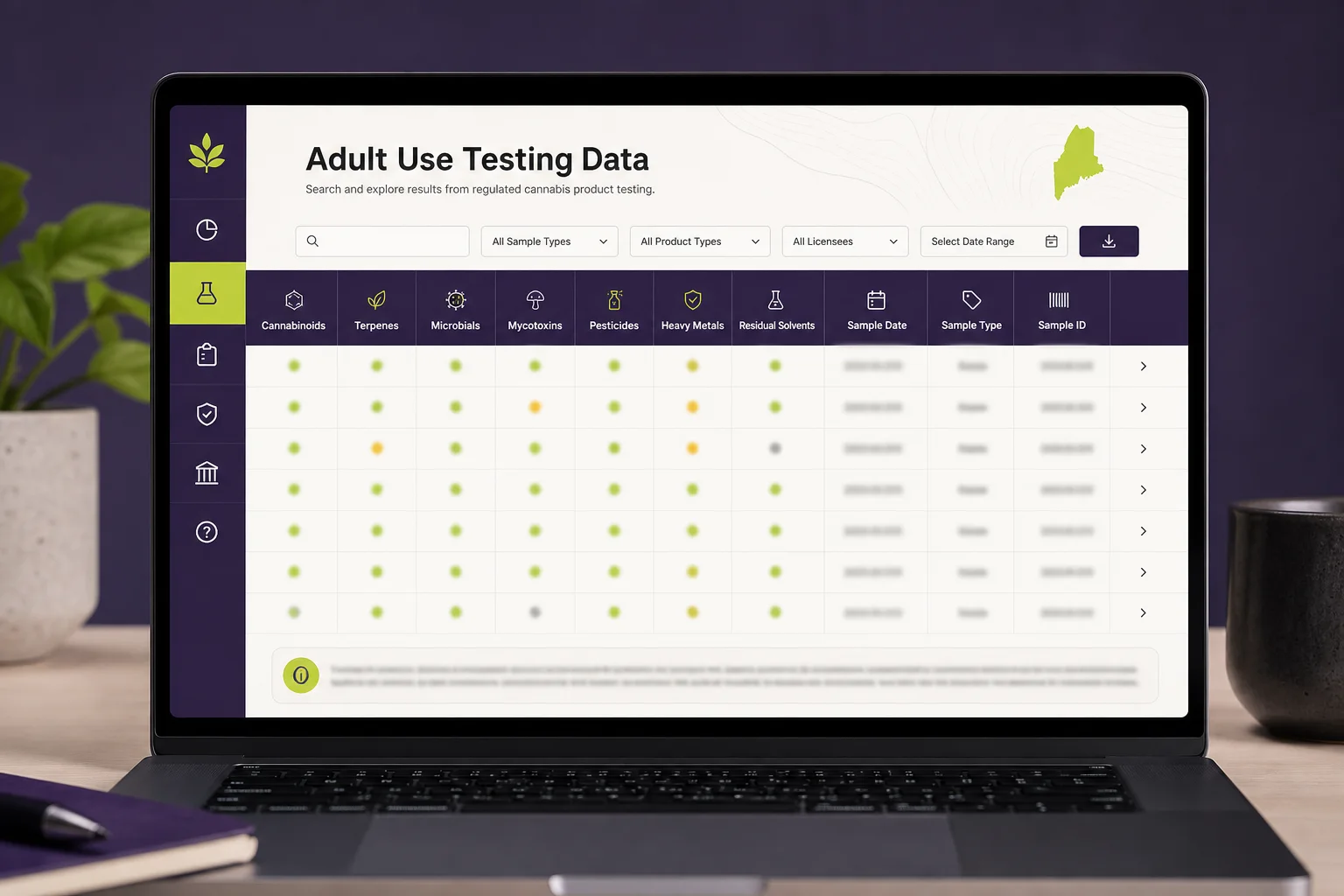
Documentary screenshot of Maine’s Adult‑Use Testing Data page used to illustrate the public reporting framework and the multiple analyte categories (potency, contaminants, homogeneity). The image emphasizes metadata and table structure rather than numeric values to avoid misreading single sample results. Source: Maine OCP adult-use testing data; this image is illustrative of publicly available dashboards and has the limitation that aggregate dashboards do not replace reading an individual COA.
Why do people fixate on a single "THC%" number on a jar or menu? Because it’s short, simple, and — when measured well — reliable enough to compare batches. But short and simple are also exactly why that number can mislead. This article walks through what potency numbers measure, how they’re produced in Maine and elsewhere, the chemistry and uncertainty behind them, and the practical questions a percentage can’t answer.
What “THC percentage” actually measures
When a lab reports “THC%” on a Certificate of Analysis (COA), it’s reporting the concentration of particular measured cannabinoids in the tested sample — usually expressed as percent weight of the dried flower (percent w/w) or as milligrams per gram. In Maine’s adult-use program, potency is a required analyte category in the mandatory testing set; potency, homogeneity, and cannabinoid profiles are listed as part of the adult-use mandatory panel. (maine.gov)
That means the number on the label is a lab result derived from the specific sample submitted — not a guarantee about every bud in the entire harvest or about how a given individual will experience it. A COA typically lists which cannabinoids were measured, the test date, and the testing facility — the basic metadata needed to interpret the result. Maine’s OCP guidance explains how COAs identify the test date, item type, and other useful details. (maine.gov)
Because the reported THC% is tied to the sample and the method, two labs (or two subsamples) from the same harvest can report different numbers. That variability doesn’t necessarily indicate an error: it can stem from sampling choices, analytical method differences, or legitimate uncertainty around the measurement.
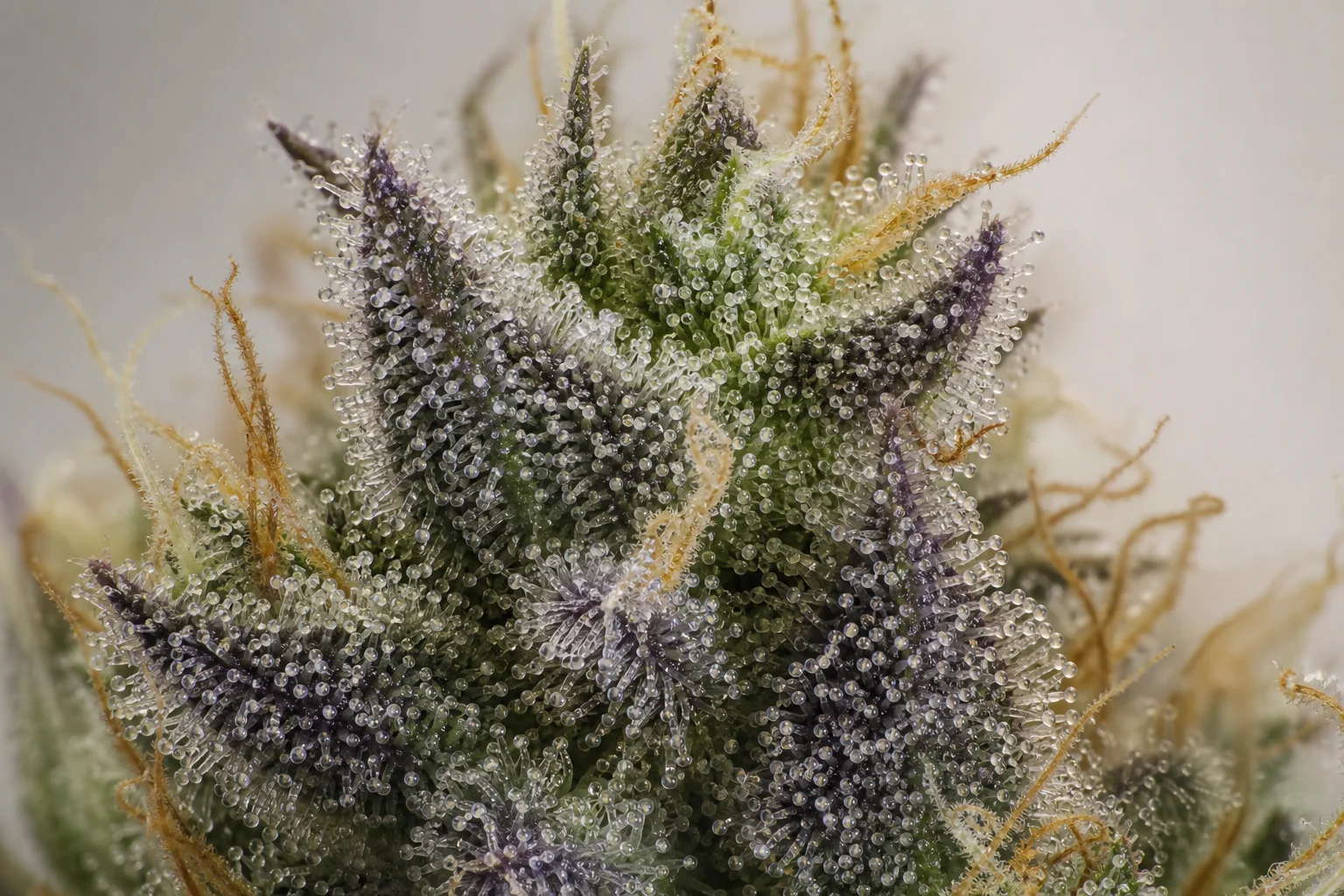
Macro botanical image showing glandular trichomes where THCA and other cannabinoids concentrate. This illustrates the plant‑level heterogeneity that makes sampling critical. Limit: close-ups show structure but not internal cannabinoid concentrations or COA data. Source: Maine OCP "Understanding Cannabis Testing Requirements & Results" and related OCP materials.
Research context: Understanding Cannabis Testing Requirements & Results in Maine (PDF)Units, “total THC,” and the chemistry behind the number
Cannabinoids in the living plant mostly occur as acidic precursors: THCA and CBDA are the common acid forms that predominate in fresh flower. The lab-reported “total THC” number usually accounts for both Δ9‑THC and the THCA that becomes Δ9‑THC when heated (for example, by smoking or baking). To reflect that chemistry, labs use a molecular correction factor (about 0.877) when they report “total THC” — total THC = Δ9‑THC + (THCA × 0.877). This adjusts for the mass lost when THCA converts (decarboxylates) to Δ9‑THC. (pmc.ncbi.nlm.nih.gov)
Different labs and jurisdictions may report raw Δ9‑THC, THCA, or the calculated total THC. That’s why reading the COA and its units matters: percent weight (% w/w), milligrams per gram (mg/g), and whether the COA lists total THC versus Δ9‑THC and THCA separately are all meaningful choices. The underlying chemistry — and how labs correct for it — is well-documented in peer-reviewed and technical work. (pmc.ncbi.nlm.nih.gov)
Sampling: why where and how a sample was taken matters more than most people expect
Cannabis flower is heterogeneous. Trichome density, moisture, and cannabinoid distribution vary across a plant, across branches, and even within a single cola. The number on a COA reflects the sample the lab received: a handful of small bud pieces, a homogenized ground sample, or a single trimmed bud all yield different analytic starting points. In Maine’s adult-use program, homogeneity is part of the mandatory testing panel — regulators want to know whether a tested unit is uniform enough so that a single sample represents the whole lot. (maine.gov)
Sampling protocols and chain-of-custody matter. Rules and guidance govern how and when samples are collected, how they’re packaged, and how quickly they reach the lab. These steps reduce, but don’t eliminate, the real-world variability introduced before the instrument ever measures anything. Retesting is allowed under limited conditions in Maine, but it’s for specific situations (remediation, suspected error, or verification), not a routine fix for every label discrepancy. (maine.gov)
For growers and consumers alike, a practical implication is that whether the COA corresponds to the same matrix (flower versus extract) and the same lot being evaluated — and whether the lab assessed homogeneity — materially affects how well the reported THC% reflects what’s in a given package.
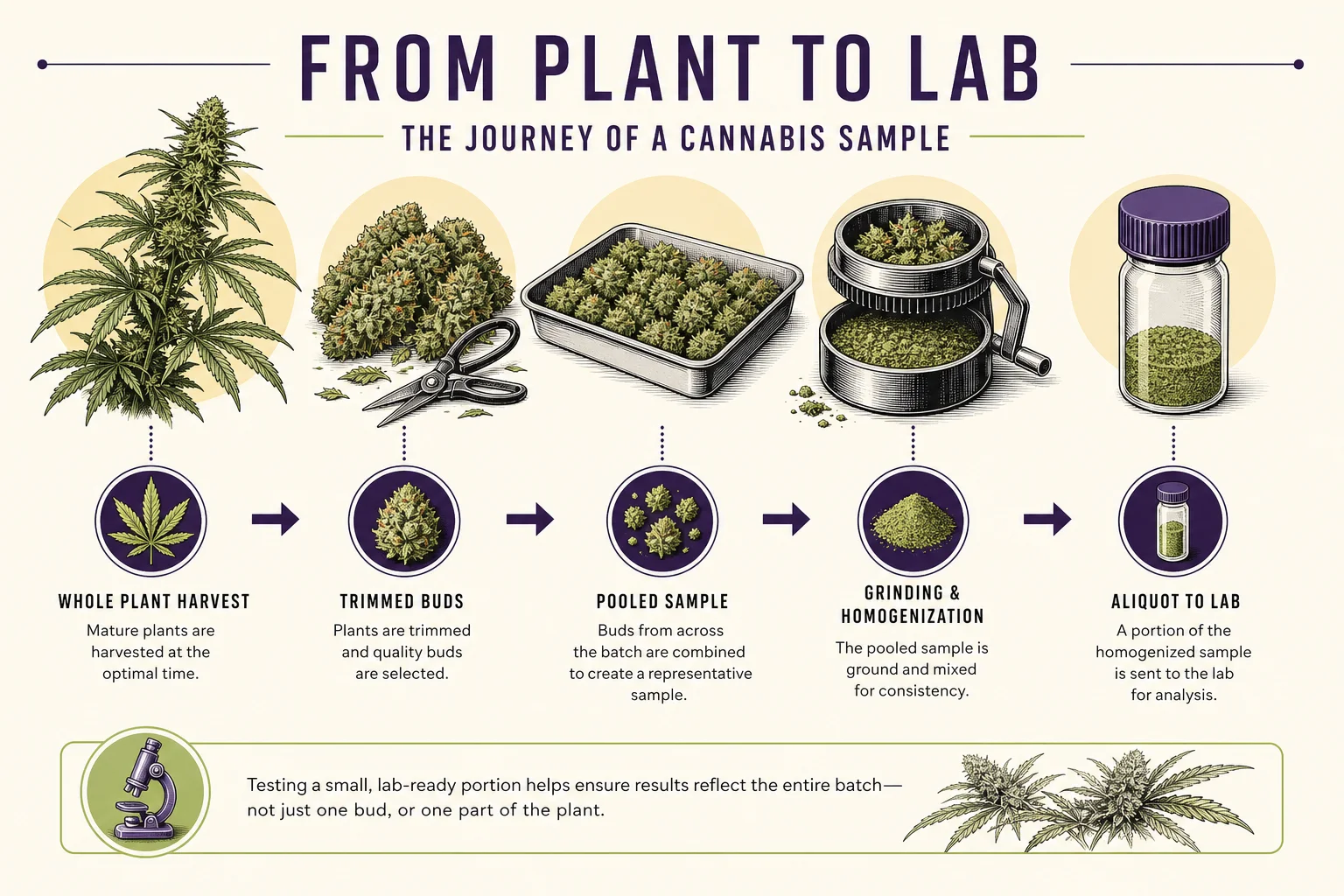
A clear, labeled diagram tracing how a bulk lot becomes the lab sample: where subsampling and homogenization occur, and where sampling error can be introduced. This visual teaches the practical chain between farm and COA. Limitation: schematic only — does not imply legal sampling steps for any one jurisdiction. Source: Maine OCP adult-use testing data and guidance.
Research context: Adult Use Testing DataLaboratory methods, reference materials, and measurement uncertainty
Analytical methods differ: gas chromatography (GC), liquid chromatography (LC) with UV or mass spectrometry detectors, and near-infrared (NIR) approaches are all in use. Each method has strengths and method-specific biases — for example, GC inlet temperatures can drive decarboxylation in the injector, altering measured ratios if a method doesn’t correct for that. NIST’s measurement services and the Cannabis Laboratory Quality Assurance Program (CannaQAP) were created to help labs harmonize methods and compare performance across instruments and operators. NIST provides reference materials and interlaboratory studies (without pass/fail grading) so labs can see how they align with community benchmarks. (nist.gov)
The NIST CannaQAP Exercise 2 report examined cannabinoids (Δ9‑THC, THCA, total THC, CBD, CBDA, and others), moisture, and selected toxic elements, highlighting variation across participant laboratories and the value of shared reference materials and exercises to improve comparability. These interlaboratory data are the best field-level resource for quantifying how much measurement variability to expect and where it originates. (nvlpubs.nist.gov)
Because every measurement has uncertainty — a quantified range around the reported result — a single-pair-of-digits THC value should be interpreted the same way one interprets any laboratory chemistry result: as a central estimate plus an uncertainty interval. Good COAs will either list uncertainty or report method-performance metrics; when those elements are absent, that omission represents an information gap that can be clarified with the testing lab or vendor. (nist.gov)
A brief technical note: reference materials and calibration standards anchor the numeric output of an instrument to a community reference. Labs that participate in interlaboratory comparisons and use traceable standards typically show narrower inter-lab differences for the analytes covered by those standards. That doesn’t eliminate uncertainty, but it helps place any single COA in the context of lab-to-lab agreement.
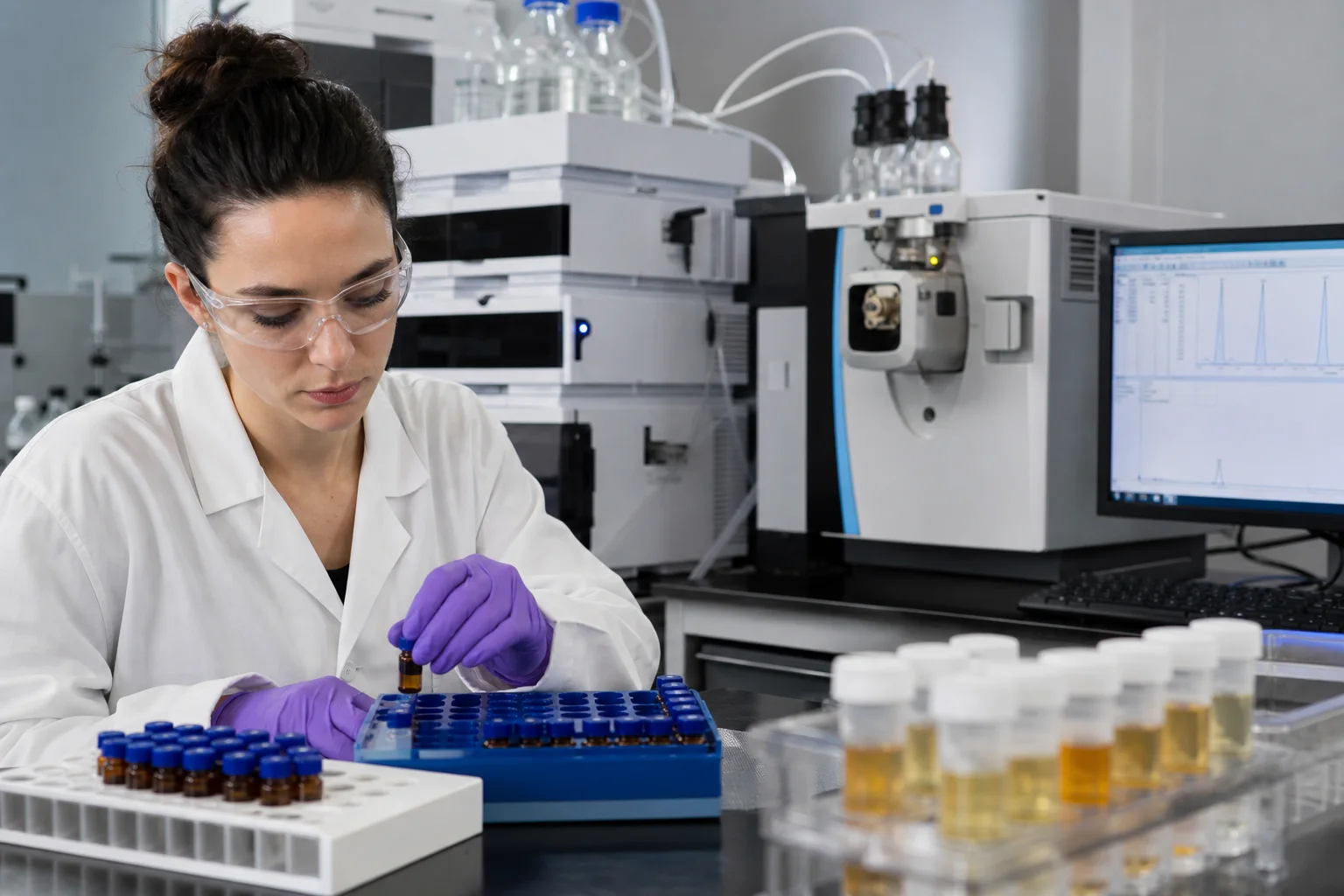
Laboratory documentary image showing the type of instruments (LC-MS) commonly used for cannabinoid quantitation and the sample‑preparation stage where method choices and instrument settings affect results. Limitation: generic lab scene — it cannot show a COA or claim specific accuracy for any lab. Source: NIST Tools for Cannabis Laboratory Quality Assurance and NIST IR work on CannaQAP.
Route of administration and decarboxylation: how “active” THC depends on use
Not all THC in a sample is immediately psychoactive: THCA is not intoxicating until it is decarboxylated (converted into Δ9‑THC) by heat. The fraction of THCA that becomes Δ9‑THC depends on the route (smoking, vaping, baking), temperature, time, and even the food matrix for edibles. That means the same "total THC" number can correspond to different delivered quantities depending on how a product is consumed. Peer‑reviewed work outlines the decarboxylation conversion and explains why labs use a correction factor when reporting total THC. (pmc.ncbi.nlm.nih.gov)
Edibles and vaporized concentrates introduce additional variables: extraction efficiency, formulation stability, and baking temperatures alter how much THCA converts to Δ9‑THC and the rate at which effects appear. For that reason, potency numbers reported for flower do not translate mechanically or predictably into equivalent potency measures for finished edible products without product‑specific lab data.
What THC% does not reveal: contaminants, moisture, smell, or effect
A THC percentage tells you little or nothing about:
-
Contaminants: Pesticides, heavy metals, mycotoxins, and microbes are tested separately. Maine’s adult-use testing program mandates contaminant panels in addition to potency; those are different analyte categories in the OCP data. A high-THC result does not indicate whether the sample passed or failed those contaminant tests. (maine.gov)
-
Moisture and storage stability: Moisture influences weight and concentrates; drying, curing, and storage conditions change measured potency and terpene aroma over time. Moisture itself is part of testing programs and affects both measurement and sensory characteristics. NIST exercises include moisture to highlight this point. (nvlpubs.nist.gov)
-
Flavor and terpene profile: Terpenes are measured separately and are not captured by a single THC% number. Aroma and subjective effects are shaped by the terpene and minor-cannabinoid mixture as much as by THC concentration. The COA is where those data — if measured — appear.
-
User response and impairment: THC% is not a reliable predictor of subjective intensity or functional ability for an individual. Metabolism, tolerance, body size, and prior exposure all mediate response.
These gaps are why regulators require multi-analyte testing and why readers of COAs look beyond a single percentage when comparing products. Maine’s open adult-use testing data are organized around multiple categories for a reason: potency is mandatory, but it’s only one category among several public‑health-focused analytes. (maine.gov)
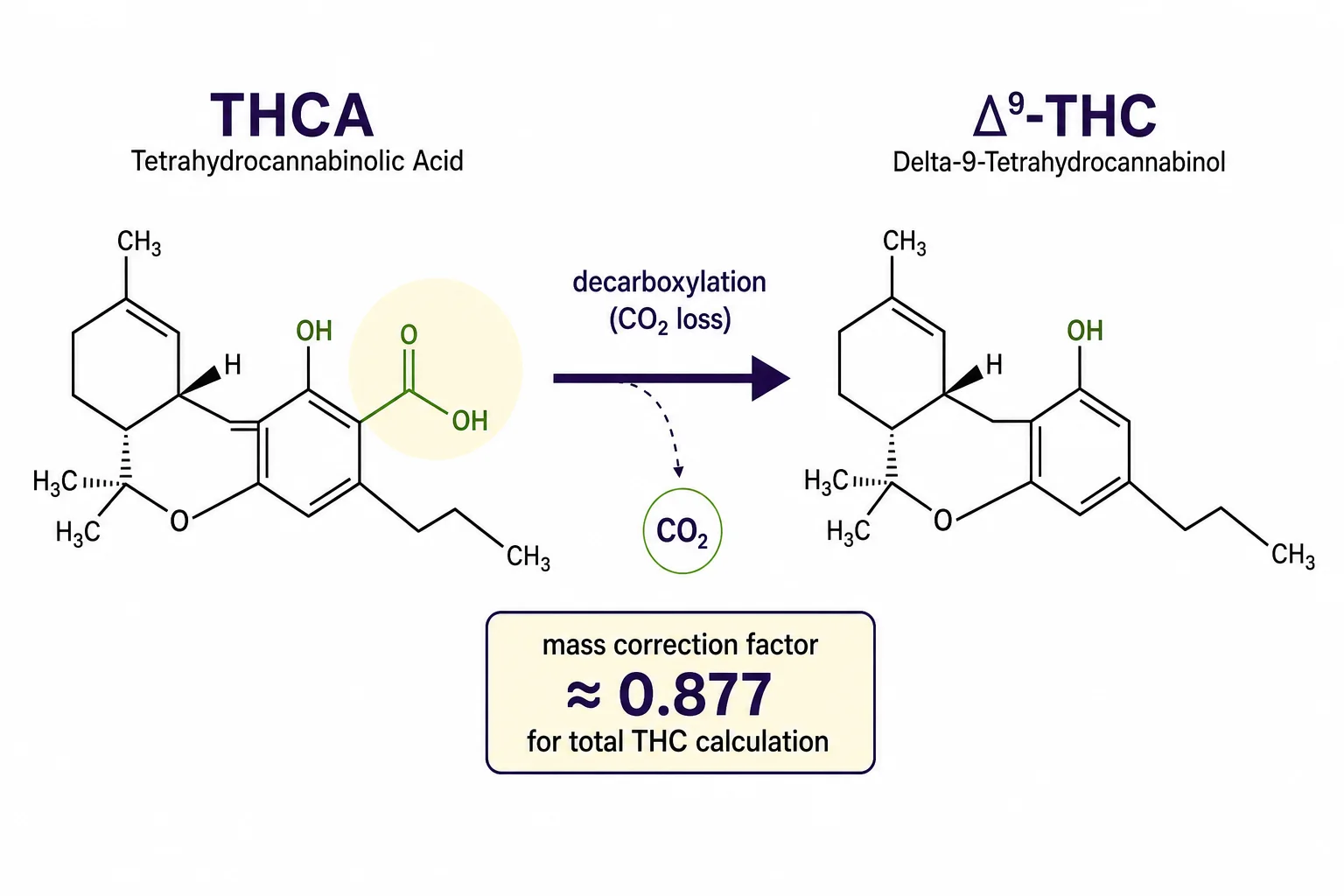
A chemistry diagram showing THCA converting to Δ9‑THC with CO2 loss and the 0.877 correction factor applied when labs compute total THC. This links the label number to the underlying molecular basis. Limit: schematic chemistry only; it does not predict user effects or dosing. Source: NIST reports and peer-reviewed decarboxylation literature.
Research context:Medical vs. adult‑use in Maine: a practical distinction
Maine’s adult-use program requires mandatory testing (potency, homogeneity, contaminants) and public reporting of aggregate testing results; the OCP publishes the adult-use testing data and maintains open-data dashboards and COA reporting rules. Medical cannabis in Maine, by contrast, is not subject to mandatory testing under state rules — though some medical caregivers and dispensaries voluntarily obtain testing and COAs. That legal distinction matters for people who rely on consistent lab-verified information. If a medical product was tested voluntarily, OCP guidance recommends requesting the COA and noting which laboratory performed the testing. (maine.gov)
For medical-use products, relevant information includes whether testing was performed, which analytes were measured, and whether the COA corresponds to the specific product and lot under consideration. In other words, the presence of a COA and the scope of its analyses can differ depending on whether testing was mandated or done voluntarily.
Reading a COA and the questions to ask
When a COA is available, a few practical items of information let a reader move from a single number to a fuller understanding of a product:
- Does the COA list Δ9‑THC, THCA, and the calculated total THC (and the formula used)? Different reporting choices change interpretation; if those fields are missing, that absence is a point of clarification to pursue. (pmc.ncbi.nlm.nih.gov)
- Which laboratory performed the test? The COA typically identifies the testing lab; Maine’s CDC and OCP list certified testing facilities and the state requires accredited facilities for adult‑use testing. (maine.gov)
- Was homogeneity assessed? For packaged product, a homogeneity result indicates whether the tested unit is likely representative of the whole lot. (maine.gov)
- Are contaminants reported separately? The COA will show pesticides, heavy metals, microbial panels, and results for each analyte when those tests were performed. A THC value alone is not a proxy for these safety-related analytes. (maine.gov)
- Does the COA include method details or uncertainty estimates? When a COA omits method or uncertainty information, that omission is an information gap that can be addressed by contacting the lab or vendor. NIST emphasizes method transparency and shared reference materials as ways to improve comparability. (nist.gov)
These entries help a COA reader interpret the document as a compact lab report: a set of measured analytes, methods, qualifiers, and metadata that together support more informed comparisons than a single percentage can.
A short practical note: COAs vary in layout and terminology. Some list mg/g and % w/w side-by-side; others present only one unit. Some COAs list LOQs (limits of quantitation) or LODs (limits of detection) for lower-concentration analytes. Being familiar with common fields can speed interpretation, but when a COA uses unfamiliar terms, the lab report or the testing facility can usually explain the specific language used.
Final thoughts: numbers are necessary — never sufficient
THC percentage is a practical, measurable, and legally important quantity. But it’s one measurement among many that define product identity, safety, and expected characteristics. In Maine’s adult-use system, potency is mandatory and publicly reported, yet potency measurement is embedded in a testing regime that also addresses contaminants, homogeneity, and labeling accuracy. NIST’s work shows how labs can improve comparability and how interlaboratory programs reveal real, sometimes substantial, variation between methods and labs. (maine.gov)
For anyone evaluating cannabis products — whether a grower, a purchaser from a medical program, or someone who prefers informed selection — a single percent sign is a useful starting point, not the whole answer. Read the COA, note sampling and homogeneity information, and check whether contaminants and moisture were included in the testing panel. Those steps provide a broader, more reliable picture than any solitary THC number can offer.
Key citations
Selected primary sources and official guidance used in this article: Maine OCP adult-use testing data and guidance, NIST cannabis quality-assurance programs and reports, and peer-reviewed analyses of THCA decarboxylation and total THC calculation. Full source list is below.
Questions this guide answers
Is a higher THC percentage always "stronger"?
No. Higher THC% indicates more measured cannabinoid mass in the tested sample, but it doesn’t predict individual response, impairment, or safety. Route of administration, tolerance, terpene and minor-cannabinoid mix, and contaminants all shape effects.
What does "total THC" mean on a COA?
Total THC usually equals measured Δ9‑THC plus THCA multiplied by a decarboxylation factor (~0.877) to account for mass lost when THCA converts to Δ9‑THC. The COA should say which formula was used.
Why do two labs sometimes report different THC values for the same product?
Differences can come from sampling methods, whether the sample was homogenized, the analytical technique (GC vs. LC, detectors), instrument settings, and each lab’s calibration and reference materials. Interlaboratory programs show this variability and aim to reduce it.
Does Maine require testing for medical cannabis?
No. Maine’s adult-use program requires mandatory testing, but medical cannabis is not subject to mandatory testing. Some medical providers choose voluntary testing; ask to see the COA if testing was performed.
What should I look for on a COA?
Check that the COA lists test date, tested matrix (flower, concentrate, edible), Δ9‑THC and THCA (or total THC), homogeneity assessment, contaminant panels (pesticides, metals, microbes), and the testing lab’s name and accreditation status.
Educational information only. Cannabis affects people differently and this is not medical advice.