
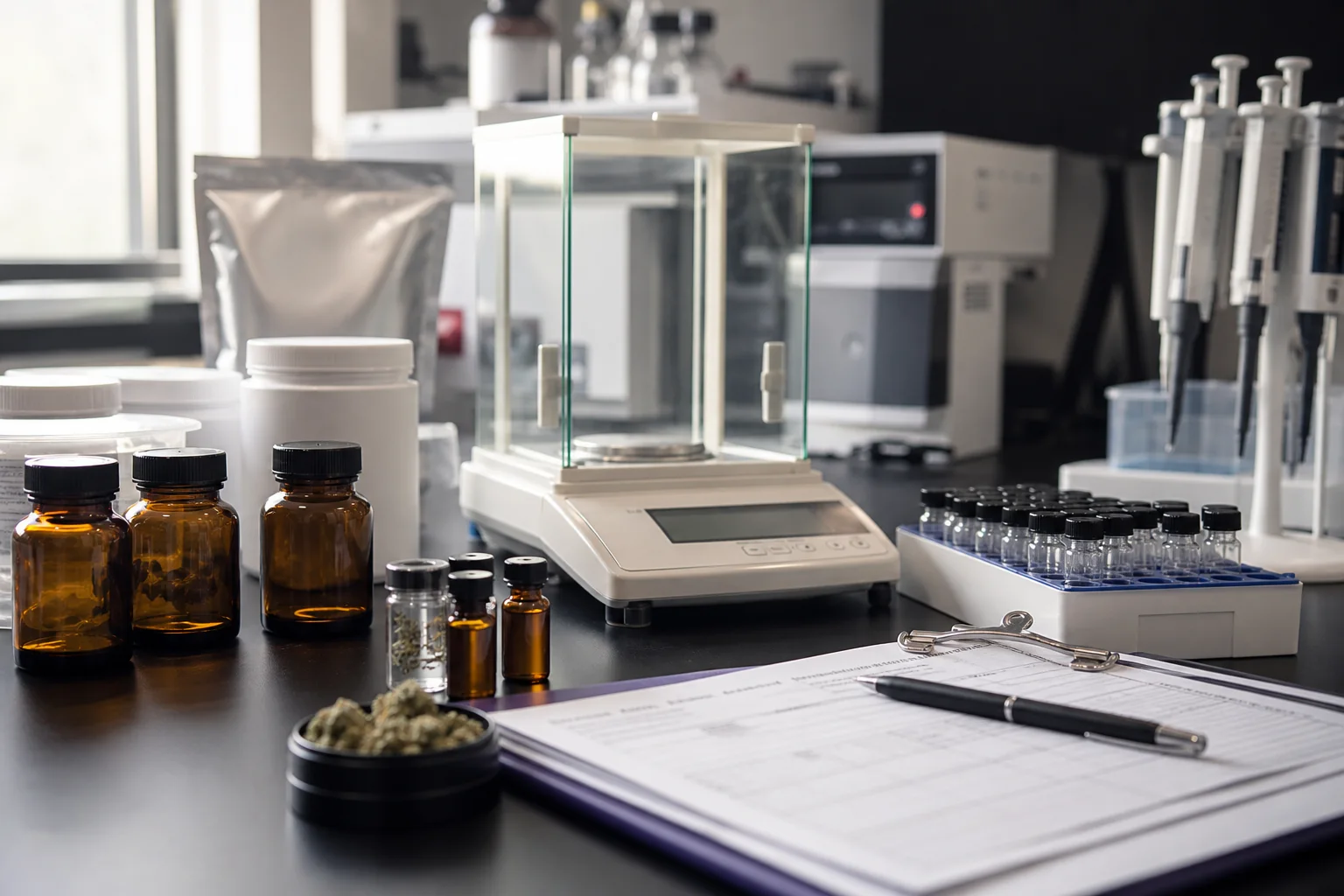
Documentary lab bench showing reference materials and sample vials—illustrates how labs anchor potency measurements to standard materials and controlled procedures. This image represents the testing infrastructure that underlies potency claims; it does not show any specific COA, numbers, or identifiable lab logos. Source: NIST resources on cannabis laboratory quality assurance.
A clear first step: what “THC percentage” actually measures
When you read “THC 22%” on a label or Certificate of Analysis (COA), that number is a concentration measured by a lab: mass of THC per mass of product, usually reported as percent by dry weight for flower or milligrams per serving for edibles. Labs usually report Δ9‑THC (the neutral form), THCA (the acidic, non‑volatile precursor in plant material), and a calculated “total THC” that accounts for the conversion of THCA to Δ9‑THC during heating. That calculation is standardized in laboratory guidance: Total THC is commonly calculated as %Δ9‑THC + (0.877 × %THCA), a correction that reflects the mass change when THCA loses a carboxyl group on decarboxylation. (nvlpubs.nist.gov)
What that percent tells you is straightforward: for the tested sample, how much of the active molecule (or its precursor) is present by mass. It is a useful number for labeling and compliance, and Maine’s testing rules list potency and homogeneity as mandatory analyte categories submitted to the Office of Cannabis Policy (OCP). But it is not a single “quality score.” The number depends on the sample, the method used to measure it, and a chain of choices before the assay starts. (maine.gov)
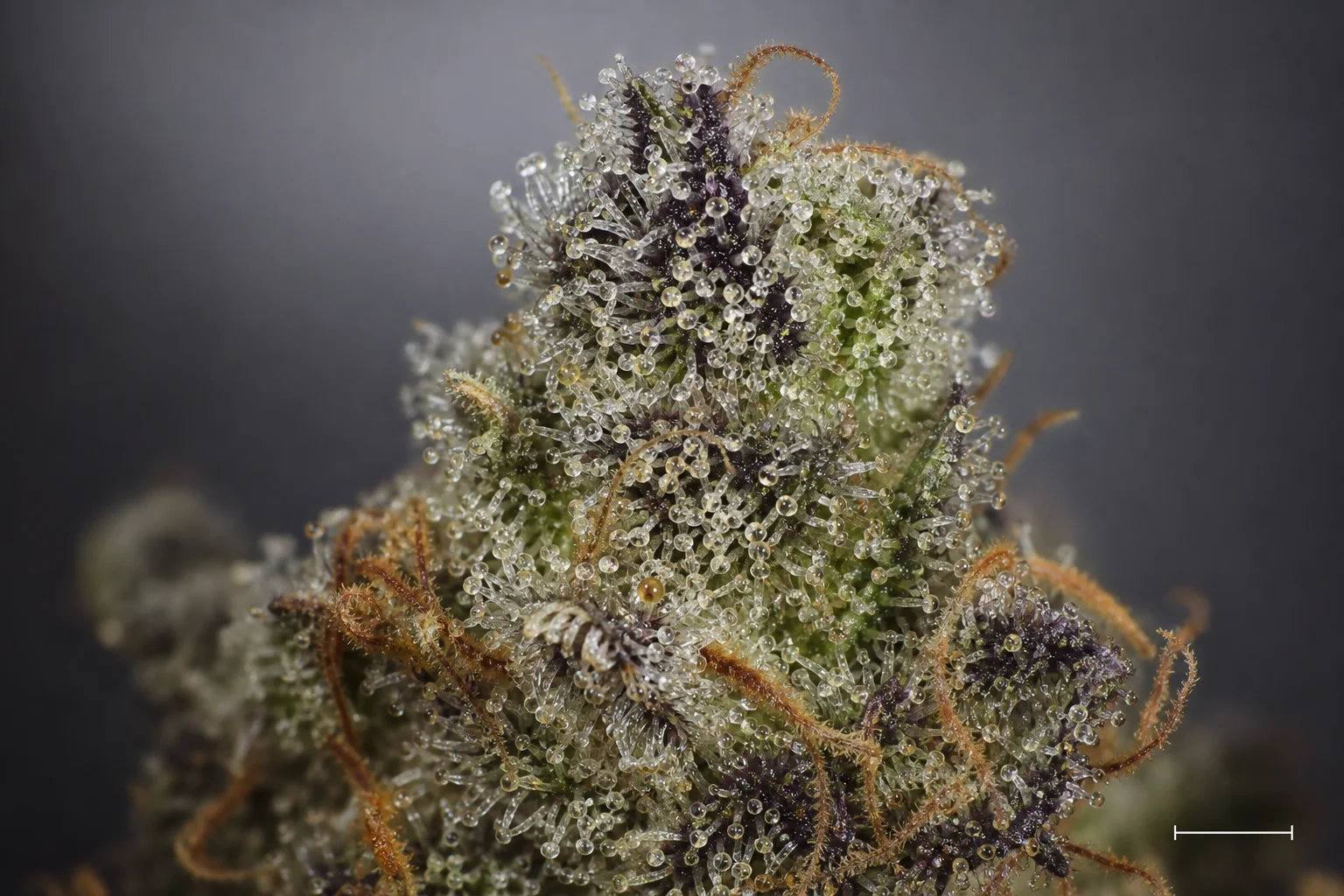
Botanical macro: trichomes are the plant sites where cannabinoids accumulate. Visualizes why one small sample may differ from another and why THCA (plant precursor) and Δ9‑THC (after heating) matter for measurement. Image supports the discussion of percent by dry weight and total THC calculation. Source: NIST hemp reference material announcement.
Research context: NIST’s New Hemp Reference Material Will Help Ensure Accurate Cannabis MeasurementsHow labs actually measure potency: methods, reference materials, and limits
Laboratories typically measure cannabinoids using chromatography: liquid chromatography (LC) with detectors such as photodiode arrays or mass spectrometers, and sometimes gas chromatography with specific sample prep. The method matters: LC methods can quantify THCA and Δ9‑THC without forcing chemical change, while some GC methods require derivatization or forced decarboxylation and therefore must account carefully for conversion. NIST and other analytical bodies recommend method validation, use of calibration standards, and reference materials to anchor accuracy. (nist.gov)
NIST’s Cannabis Laboratory Quality Assurance Program (CannaQAP) runs interlaboratory exercises and provides reference materials (including a hemp plant reference material) so labs can check that their methods produce comparable numbers. These tools reduce—but do not eliminate—inter‑laboratory differences, because measurement quality also depends on sample prep, analyst experience, and instrument upkeep. If a lab participates in organized QA exercises, you should see better comparability; if not, the uncertainty around a reported percent widens. (nist.gov)
Finally, every analytical result has uncertainty. Good COAs report limits of quantitation, method used, and sometimes uncertainty bands. That information is a direct window into how confident the lab is in a particular percentage; reading a % without those contextual notes is like reading a thermometer without knowing if it’s in Celsius or Fahrenheit.
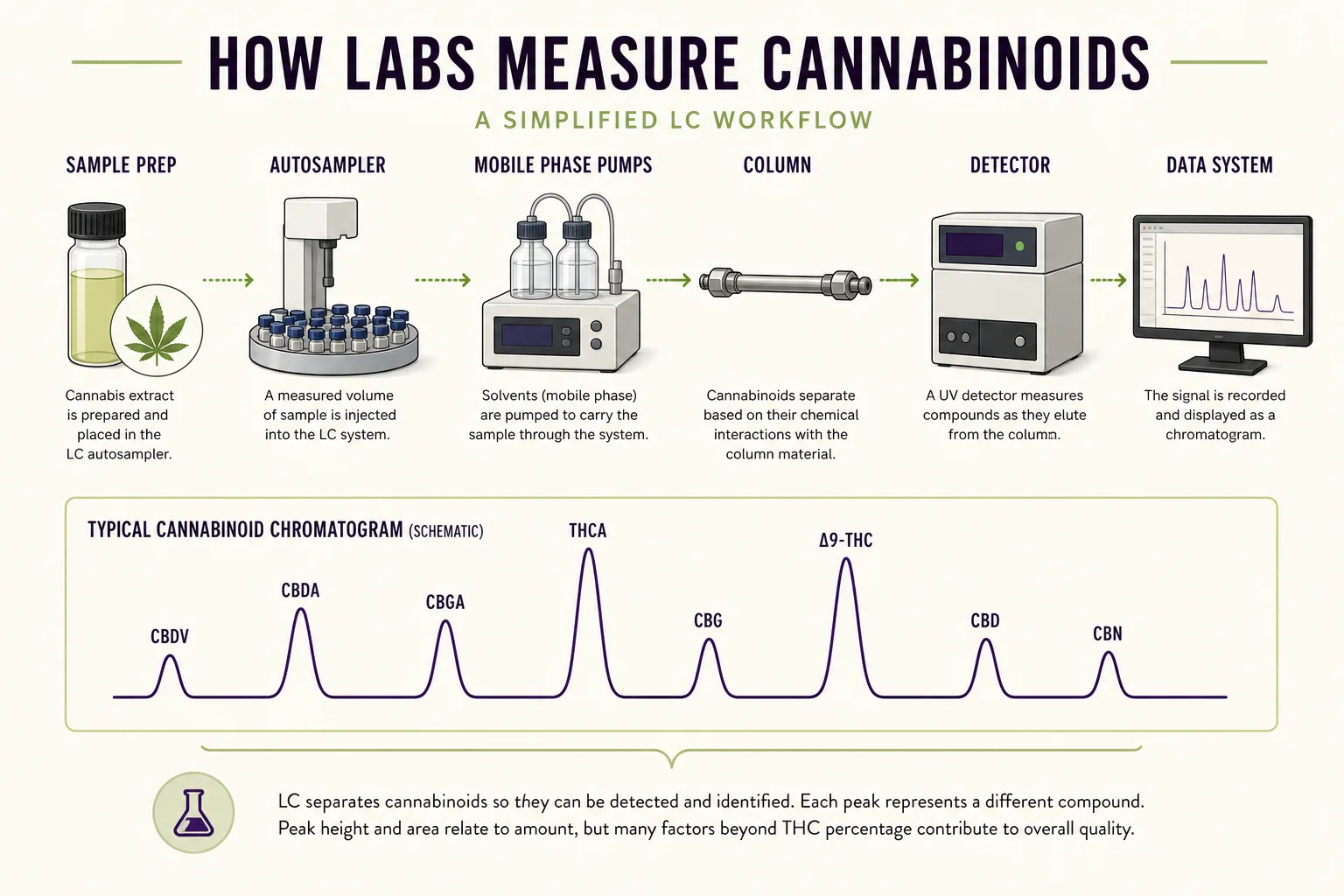
Explanatory illustration of chromatographic separation and peak identification used in cannabinoid quantitation. The image teaches why method choice (LC vs. GC) and peak confirmation matter for accurate potency numbers. It avoids showing any specific test values. Source: NIST CannaQAP report on interlaboratory cannabinoid exercises.
Research context: Cannabis Laboratory Quality Assurance Program: Exercise 2 Cannabinoid Final ReportWhy sampling and homogeneity matter: the sample may not be the product
A COA is the test result for a specific sample; a cannabis plant or jar is a heterogeneous biological product. Trichome density, moisture pockets, and microclimates on the same plant can produce meaningful variation in cannabinoids between buds, and within a single bud. Maine’s adult‑use mandatory testing explicitly requires attention to potency and homogeneity so that labels reflect what consumers are likely to encounter, and OCP collects initial mandatory testing results submitted by licensed testing facilities. But the sampling protocol—how many grams were pulled, from which plants and which parts—determines whether that COA is representative of the whole batch. (maine.gov)
In practice that means a producer with good sampling, mixing, and batch records will give you a more trustworthy number than a single ‘spot sample’ grabbed from a mixed container. Maine’s rules also allow limited retesting in specific circumstances (for example, after remediation or when a licensee suspects an error), which acknowledges that single results can sometimes miss the larger picture. (www1.maine.gov)
Measurement uncertainty and inter‑laboratory variability: the number isn’t absolute
If two labs run the same jar of flower, they may report different THC percentages. Interlaboratory studies — including exercises run by NIST’s CannaQAP — show real variation across labs, even when everyone follows reasonable procedures. These exercises focus labs on calibration, peak identification, and method control so differences shrink, but they do not vanish entirely. That variability is why NIST provides reference materials and publishes interlab reports: to document where differences occur and to help labs improve. (nist.gov)
A peer‑reviewed study that examined labeled THC accuracy across product types found discrepancies between label claims and measured potency, particularly in concentrates and some edibles. That research underlines the practical consequences of method, sampling, and lab competence differences—meaning the percent on a label is only as meaningful as the system that produced it. (pubmed.ncbi.nlm.nih.gov)
From a consumer perspective, look for COAs that list the method used, the lab accreditation or certification, and any reported uncertainty or LOQ/LOD values. Those details tell you whether the percent is a precise, well‑controlled measurement or a more approximate number.
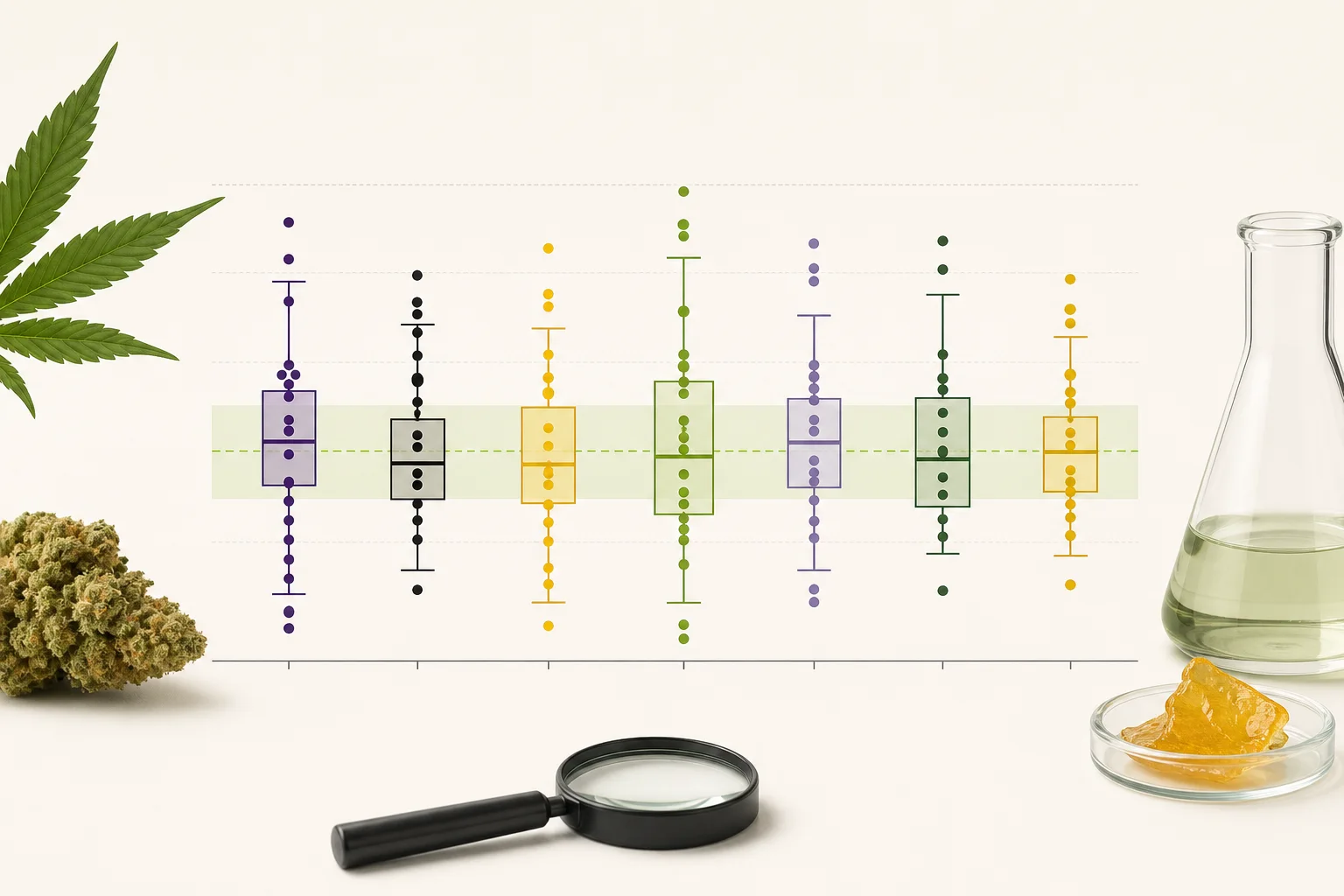
Anonymized inter‑laboratory comparison graphic: conveys measurement variability between labs without showing actual values. This visual teaches why two labs can report different THC percentages and why proficiency testing matters. Source: peer-reviewed study on label accuracy and NIST interlab findings.
Research context: Accuracy of labeled THC potency across flower and concentrate cannabis productsRoute of administration: a percent is not a prediction of effect
THC concentration is an ingredient amount, but user experience depends heavily on how the product is used. Inhaled THC reaches peak blood levels within minutes; oral THC (edibles) has delayed onset, variable absorption, and longer duration because of first‑pass metabolism and generation of active metabolites like 11‑hydroxy‑THC. The same milligram quantity will feel different inhaled than eaten—sometimes substantially so—and edibles are widely reported to be the most unpredictable for onset and duration. CDC and pharmacokinetics reviews underscore the difference in onset and duration by route of administration. (cdc.gov)
This is why a single percent number on a label does not tell you how quickly a product will act, how long it will last, or how intense a given person’s experience will be. Factors such as body mass, metabolic differences, co‑consumed food or alcohol, and individual tolerance all shape the outcome. A potency number is a necessary input for decision making, but it’s only one input.
What a THC percentage can’t tell you (but a COA can help you check)
A lone THC percent cannot answer several important questions: Was the batch contaminated with pesticides, heavy metals, or microbial growth? Is the product chemically homogeneous? Which cannabinoids are present at meaningful levels beyond THC (CBD, minor cannabinoids)? How old is the sample and how was it stored? Are terpene profiles present that contribute to aroma or interplay with cannabinoids? Maine’s testing program lists contamination categories separately for a reason: potency is only one axis of safety and identity. The OCP’s audits and reporting have repeatedly shown contamination and other analyte failures in samples — a reminder that potency alone doesn’t guarantee safety or quality. (maine.gov)
A COA that includes potency plus the other mandated analytes (microbial, pesticides, heavy metals, residual solvents where applicable) gives you a fuller picture. Even then, COAs are limited to what was tested. They can’t tell you consumer experience, nor can they speak to long‑term storage or the oral bioavailability of cannabinoids in a particular edible formulation.
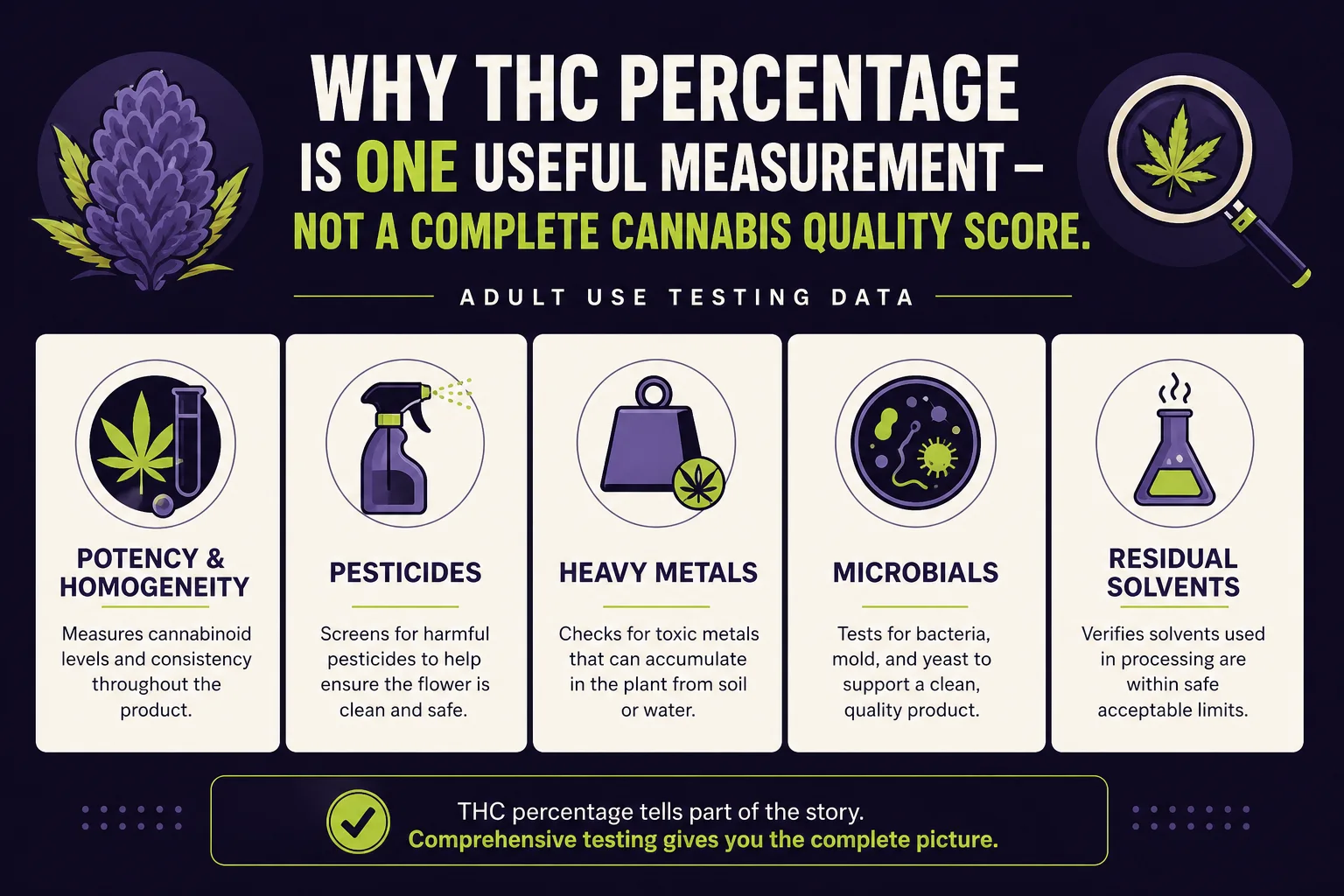
Dashboard-style diagram representing Maine OCP testing categories and how potency sits alongside contaminants and microbial screens. Teaches that mandatory testing covers multiple analyte groups and why checking the full COA matters. This mockup intentionally contains no readable numbers or real COA images. Source: Maine OCP adult-use testing data and guidance.
Research context: Adult Use Testing DataHow to read a COA and questions to consider about producers or labs
-
Check what was measured. Does the COA list Δ9‑THC, THCA, total THC, and other cannabinoids? Does it include contaminant screens relevant to the product matrix (flower vs. edible)? Maine’s mandatory categories and data portals make those requirements visible. (maine.gov)
-
Look for method details and lab credentials. Does the lab name a validated method (LC‑PDA, LC‑MS/MS), report limits of detection/quantitation, and show accreditation or participation in proficiency testing or QA programs such as NIST’s CannaQAP? Those signals tell you whether the percent is backed by documented method control or not. (nist.gov)
-
Consider sampling and batch records. How many samples were pulled to represent the batch? Who collected them, and does the producer keep chain‑of‑custody and mixing records to show homogeneity? Maine’s rules and guidance already require attention to homogeneity, and good producers will make sampling notes available. (maine.gov)
-
Consider the whole COA, not just the percent. If the COA shows low contaminants, clear cannabinoid identity, and reasonable uncertainty, that percent is more trustworthy as a piece of information about the product. If the COA omits method details or lacks contaminant testing where relevant, consider the percentage provisional rather than definitive. (maine.gov)
Bottom line for growers, people in medical programs, and curious adults
THC percentage is a measured ingredient amount and an essential label element, but it is not a stand‑alone quality score. A responsible reading of potency numbers requires attention to sampling, lab method and competence, measurement uncertainty, route of use, and the presence (or absence) of contaminant screening. Use the COA as a map with many layers rather than a single compass needle: the percent points you in a useful direction, but the rest of the map shows the terrain.
Key takeaways
- THC percentage is a lab measurement (mass per mass) and often presented as % by dry weight or mg/serving. (nist.gov)
- Total THC is commonly calculated as %Δ9‑THC + (0.877 × %THCA); that algebraic correction is a chemical reality, not marketing. (nvlpubs.nist.gov)
- Sampling, homogeneity, and lab method matter; the COA represents a tested sample, not every bud. (maine.gov)
- Inter‑lab variability exists; NIST’s CannaQAP and reference materials improve comparability but don’t erase uncertainty. (nist.gov)
- Route of administration changes onset, intensity, and duration—percent alone doesn’t predict experience. (cdc.gov)
FAQs
Q: Does a higher THC percent always mean a stronger experience?
A: No. Higher percent means more THC by mass in the tested sample, but experience also depends on route of use, individual biology, other cannabinoids, and the formulation; percent is one factor among many. (pubmed.ncbi.nlm.nih.gov)
Q: Should I trust a COA without method details or lab accreditation?
A: COAs that omit method, LOQ/LOD, or lab participation in QA programs give less context. Look for method names, limits, and lab QA signals for greater confidence. (nist.gov)
Q: What does “total THC” mean on a label?
A: Total THC combines measured Δ9‑THC and the THCA precursor adjusted for decarboxylation (commonly %Δ9‑THC + 0.877×%THCA) to estimate the maximum Δ9‑THC present after heating. (nvlpubs.nist.gov)
Q: If a lab reports 22% THC, how sure is that number?
A: That depends on the lab’s method, the COA’s reported uncertainty or LOQ, sampling protocol, and whether the lab participates in QA programs. The OCP requires reporting and keeps aggregate testing data; check the COA for method and uncertainty info. (maine.gov)
Q: Can testing detect pesticides and microbes in the same COA that reports potency?
A: Yes—Maine’s mandatory testing program separates potency from contaminant screens and reports them together as part of comprehensive COAs when applicable. That’s why seeing more than one analyte on a COA matters. (maine.gov)
Questions this guide answers
Does a higher THC percent always mean a stronger experience?
No. Higher percent means more THC by mass in the tested sample, but experience depends on route of use, individual biology, other cannabinoids, and formulation; percent is one factor among many.
Should I trust a COA that lacks method details or accreditation?
COAs missing method information, limits, or lab QA signals provide less context. Prefer COAs showing the analytical method, LOQ/LOD, and lab participation in quality programs.
What does “total THC” mean on a label?
Total THC is an estimate of the Δ9‑THC that results from converting the acidic precursor THCA to neutral THC, commonly calculated as %Δ9‑THC + (0.877 × %THCA).
Can a single COA show both potency and contaminant screens?
Yes. Maine’s mandatory testing includes potency plus other analyte categories; a complete COA commonly reports both potency and contaminant results when the matrix requires those tests.
Why do labs sometimes report different percentages for the same product?
Differences arise from sampling, method choice, analyst technique, instrument calibration, and lab quality control. Interlaboratory programs and reference materials improve comparability but do not eliminate variation.
Educational information only. Cannabis affects people differently and this is not medical advice.