
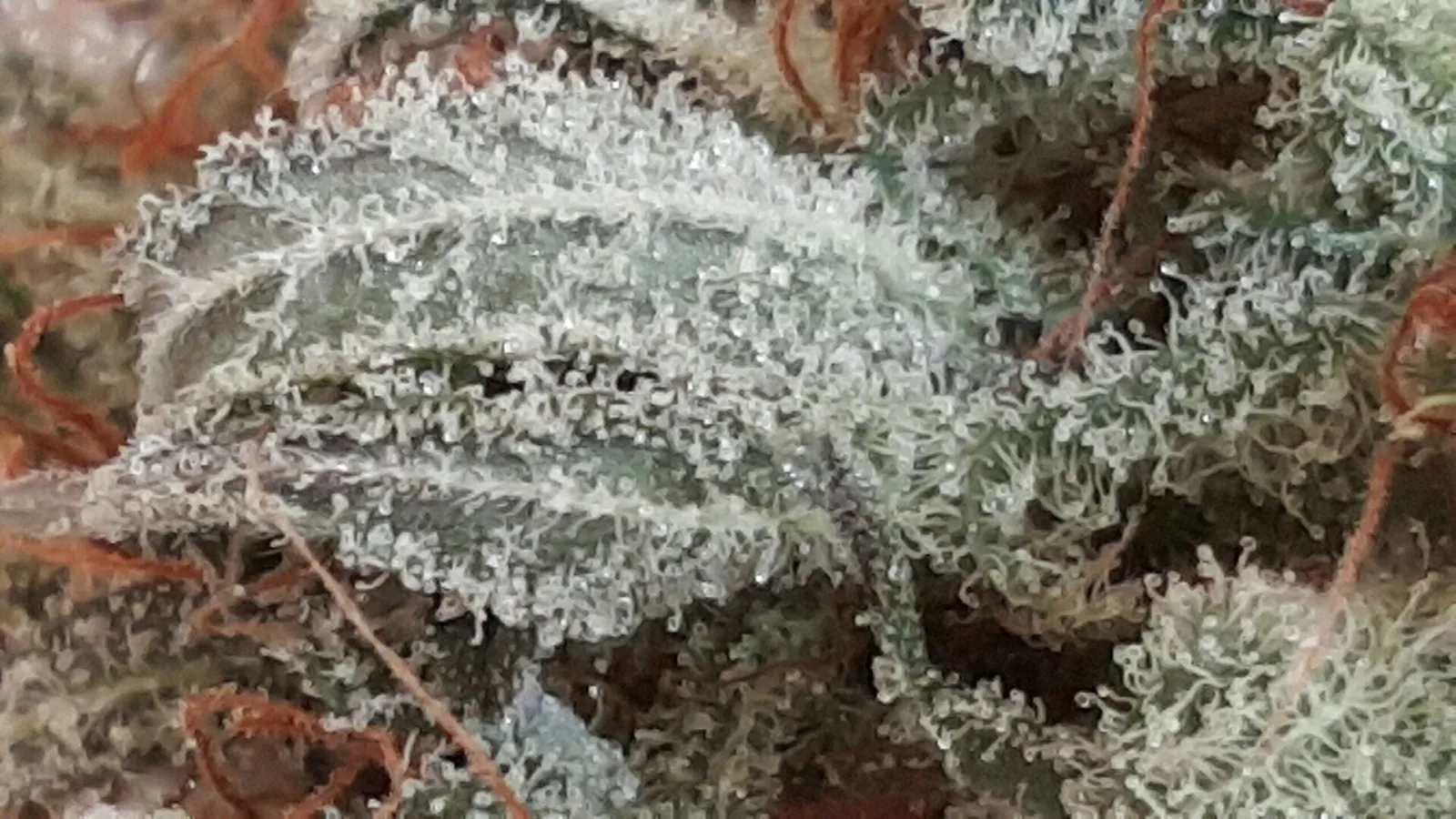
Glandular trichomes are visible plant structures associated with resin production. Appearance alone cannot establish potency or safety.
Image: Cannabis Pictures · CC BY 2.0Start with the most important fact: a strain name is a label
A familiar name can be useful shorthand, but it is not a chemical guarantee. Researchers comparing commercial cannabis found that labels such as “indica,” “sativa,” and specific strain names did not consistently map to a single chemical composition. Different growers may preserve different selections under the same name, and the same plant can express differently as environment, harvest timing, drying, storage, and laboratory methods change.
That does not make the name meaningless. It makes provenance essential. A useful profile tells you who supplied the genetics, which parent claims can be sourced, whether more than one origin story exists, and which statements come from a breeder, a grower, a laboratory, or a community report.
Read the profile in layers
1. Identity and lineage
Look for a breeder or original developer, not simply a lineage repeated across catalog sites. When two credible sources disagree, both claims should remain visible. An honest “not reliably attributed” is more useful than false certainty.
Aliases matter too. Similar names may refer to the same genetic line, a renamed selection, or completely different plants. A good record dates each claim and identifies its source.
2. The actual batch
The name describes a family story; the batch is the material in front of you. Ask for the harvest or package date, producer, format, and—when available—a certificate of analysis tied to that batch. Potency alone is not a complete quality score. A laboratory record may include cannabinoid results and, depending on the program and test, contaminant or terpene information.
Maine’s Office of Cannabis Policy notes an important program distinction: adult-use cannabis has mandatory testing requirements, while medical-use products do not have the same blanket testing requirement. For medical products, ask whether the batch was tested, what was tested, when it was tested, and whether the result belongs to the exact batch.
3. Sensory observations
Color, structure, resin appearance, aroma, moisture, and cure are observations—not diagnoses. They can help you compare one harvest with another, especially when the observer, date, and storage context are recorded. They cannot establish potency, cleanliness, or a likely medical outcome by sight or smell alone.
4. Reported experiences
Words such as “relaxed,” “focused,” or “euphoric” usually come from self-reports. Research using hundreds of commercial varieties found relationships among flavor descriptions, chemical composition, and reported experiences, but those data remain subjective and do not turn a strain name into a prediction for an individual.
Treat effect tags as questions to investigate, not promised results. Personal response can vary with dose, route, tolerance, other substances, medications, physiology, and setting. A popular vote is not clinical evidence.
A confidence ladder you can actually use
- Verified: a narrow claim has direct supporting evidence, such as a Mainezilla garden record or a clearly identified primary source.
- Supported: credible sources point in the same direction, but the claim may not be complete.
- Developing: the profile is useful for discovery, while identity or evidence gaps remain visible.
- Community report: a dated personal observation. Valuable context, never universal fact.
Confidence should attach to an individual claim—not give the entire plant a gold star.
Five questions before you save a strain
- Who grew this batch, and can I identify the producer?
- Is the lineage sourced, disputed, or simply repeated?
- Is the chemistry tied to this batch and date?
- Are effect words measured findings or adult self-reports?
- What do I want to remember privately after I discuss options with a qualified professional?
The Mainezilla approach
Mainezilla strain files keep breeder history, garden observation, laboratory records, and community language in separate lanes. When we grew or photographed a specific selection, we say so. When the Internet disagrees, we preserve the disagreement. When we have not evaluated a cultivar in the Mainezilla garden, we do not manufacture a house opinion.
That makes a profile less like a scorecard and more like a living research file: useful now, correctable later, and honest about what is still unknown.
Educational information only. It is not medical advice and does not establish that a cultivar or product is safe, effective, or appropriate for an individual.