
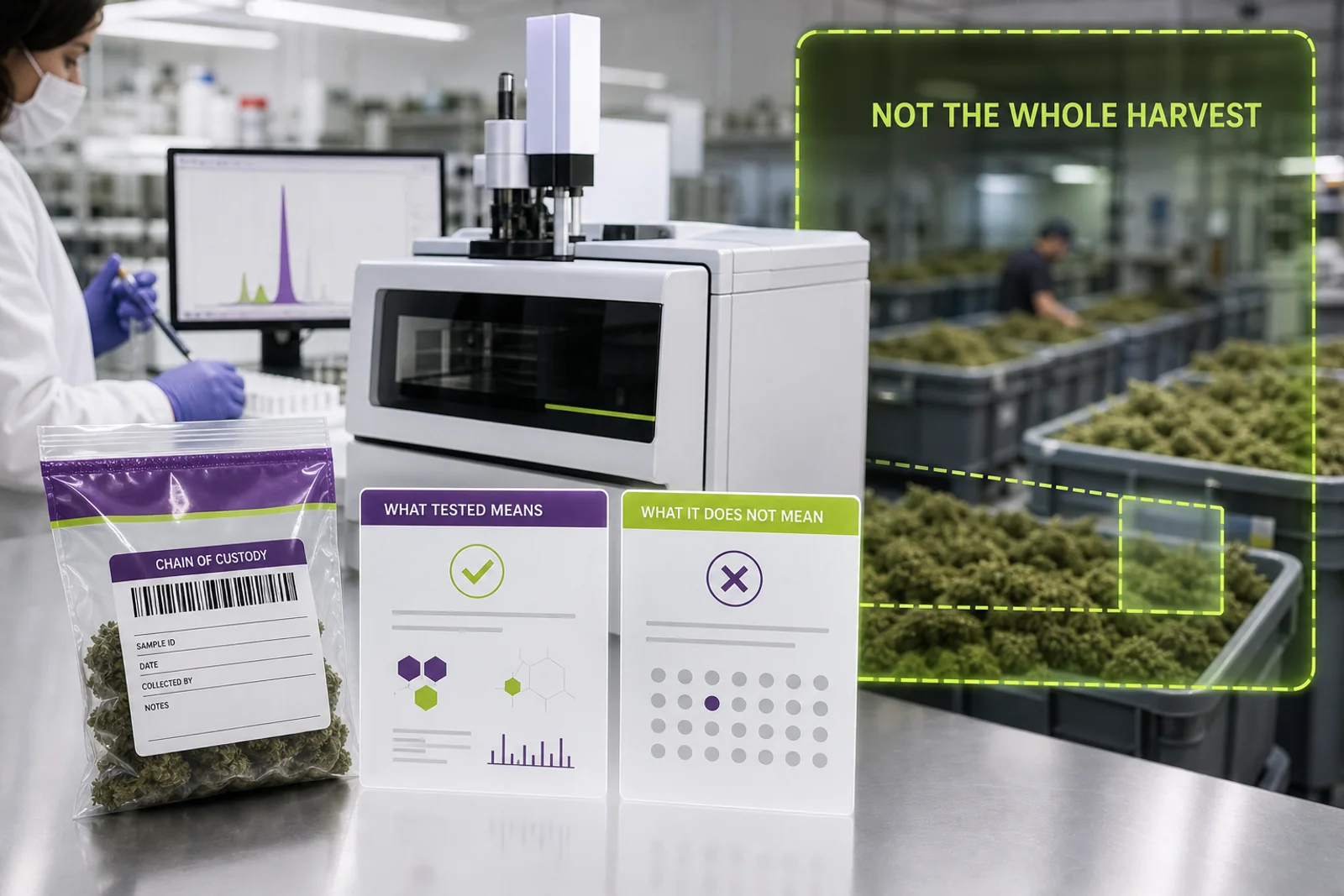
A tested sample, laboratory workflow, and larger harvest distinguish what a report actually measures from conclusions it cannot support.
Mainezilla original editorial visual · AI-assisted art directionWhy “tested” isn’t a complete sentence
When you see the word tested on a label or at a counter, your first thought should be: tested for what, by whom, and when? In Maine, testing is not a single universal trophy—it’s a defined set of analyses applied to a specific sample collected under a program’s rules. The Office of Cannabis Policy (OCP) sets which analyte categories are mandatory for adult-use transfers and how results must be reported; those rules, and the administrative guides that explain them, are the starting point for every Certificate of Analysis (COA). Evidence: 1, 2.
A COA is a record of an analytical event. It documents what the laboratory received, which methods they ran, what results they measured, and what pass/fail thresholds—if any—applied for the program under which the sample was submitted. The same plant or extract could be “tested” for cannabinoids in one report, and in a separate test for mold or metals; a cannabinoid panel does not imply an absence of contaminants. Evidence: 1, 2, 4.
That’s why “tested” by itself is marketing shorthand. When we say “tested,” we mean a product was evaluated against particular analytes under a particular program on a particular date. A Maine COA should be read as the answer to a narrow question: what did this lab find, in this sample, on this date, using these methods—and what rules governed whether those findings counted as a pass? Evidence: 1, 4.
- Ask: which program (adult-use or medical), which lab, which batch, what date, which analytes, and which action levels?
- A single COA covers the submitted sample, not every unit in a lot.
- Look for the COA version, the chain-of-custody, and any amendments.
What Maine requires—and what it doesn’t
Maine’s adult-use mandatory testing categories are specific. OCP lists filth/foreign material; dangerous molds and mycotoxins; harmful microbes (such as E. coli and Salmonella); THC potency, homogeneity and cannabinoid profiles; water activity and moisture; metals (cadmium, lead, arsenic, mercury); and—since October 2021—residual solvents where applicable. Pesticides and other chemical residues are included in the broader contaminant requirements and have been phased in by OCP. Those categories determine what a mandatory adult-use COA must cover before a transfer or retail sale. Evidence: 1, 2, 16.
Adult-use testing carries legal pass/fail thresholds: items that exceed action levels for a given analyte fail mandatory testing and cannot be sold without remediation or destruction in accordance with the rules. Not all analytes are remediable; for example, metals and certain pesticides have limited remediation pathways under OCP guidance. The testing data reported to OCP are the initial mandatory-test results unless a retest is requested under narrow conditions. Evidence: 1, 2, 17.
Medical program testing and oversight have a different history and audit profile. OCP has reported findings from audits of the medical cannabis program that show differences in sampling outcomes and that merit operational attention. That is to say: program labels and pass/fail criteria can differ, and program context matters for how to interpret any one COA. Evidence: 17, 16.
- Adult-use mandatory analyte categories are defined by OCP and enforced with pass/fail limits.
- Some contaminant failures allow remediation and retesting; others require destruction.
- A COA for one program (adult-use) does not automatically apply to medical program rules.
Sampling is part of the result—always
A lab analyzes what it receives. It does not analyze your whole room, your whole harvest, or every jar in a batch. The sample collector’s choices—where they pulled material from, how many units they pooled, and how they handled the material before it reached the lab—change what the COA actually represents. OCP’s adult-use best practices and sample-collection guidance spell out chain-of-custody, minimum sample weights, tools to use, and documentation to attach. If that paperwork is missing, the COA’s representativeness is weaker. Evidence: 3, 12.
Sampling is not just a bureaucratic step: it is an analytical precondition. Poor sampling can miss hot spots for contaminants (a single moldy bud in a box, a chronically contaminated trimming station) or produce variability in potency readings. That’s why OCP requires specific collection practices and why the adult-use data OCP receives include metadata about samples. As a grower, your sampling practice is part of your quality control. Evidence: 3, 13.
When you read a COA, check the sample description, the sample collector’s name or ID, and the chain-of-custody record. If a COA lacks that information (or if the lab’s report is missing method identifiers, detection limits, or an EDD submission stamp), treat the result as incomplete for regulatory or clinical decisions. Keep the exact COA version tied to your internal batch record; OCP accepts electronic data deliverables (EDDs) and certificates, and those electronic footprints matter when disputes arise. Evidence: 3, 2.
- A lab analyzes the submitted sample—not the whole batch.
- Look for the sample collector, chain-of-custody, sample size, and COA version.
- Follow OCP sampling best practices to make your COA representative.
How to read panels: cannabinoids, contaminants, and the gaps between
COAs are organized into panels. You’ll commonly see a cannabinoid panel (THC, THCA, CBD, etc.), a microbial/mold panel (colony counts, targeted pathogens, mycotoxin screens), a heavy metals panel, solvents, and pesticides. If a COA lists only cannabinoids, it does not say anything about mycotoxins or metals unless those sections also appear. Read the headings: a pass in cannabinoids is not a pass for contaminants. Evidence: 2, 1.
Not all analytes use the same units or the same decision rules. Potency is typically reported as percent by weight (or mg/g) with homogeneity checks where required; contaminants may be reported as parts per million (ppm) or parts per billion (ppb) and evaluated against action levels. A COA will often include limits of detection (LOD) or limits of quantitation (LOQ) and sometimes a statement of uncertainty; those numbers help you judge whether a non-detect is a true absence or simply below the method’s capability. Evidence: 2, 5.
Finally, consider what is not on the COA. Some compounds and classes—novel synthetic cannabinoids, trace solvent byproducts, unlisted pesticides—may not be assessed unless specifically requested or included in mandatory panels. The safer reading is conservative: a clean COA reduces uncertainty for the tested items; it does not guarantee the sample is free of every conceivable risk. Keep that limitation in mind when you advise a patient, a customer, or a friend. Evidence: 2, 1, 6.
- Match the COA’s panels to the risks you care about: potency ≠ contaminant clearance.
- Check units, LOD/LOQ, and any stated uncertainty.
- A clean COA covers only the analytes that were actually tested.
Measurement uncertainty, limits, and what 'not detected' means
Every measurement has uncertainty. The National Institute of Standards and Technology (NIST) defines measurement uncertainty as the parameter that characterizes dispersion in values attributed to a measurand. In lab practice, that means one number reported on a COA is an estimate with a range of plausible values around it. Good labs will document method performance and, where appropriate, measurement uncertainty or confidence intervals. Evidence: 5.
Why care? Because regulation often compares a measured value to a fixed action level. If a value is close to the action limit, small measurement uncertainties can change whether the result is above or below the threshold. That is one reason OCP allows limited retests or remediation in specific cases and why chain-of-custody and method validation matter: the fewer uncontrolled variables, the smaller the uncertainty. Evidence: 1, 5, 17.
“Not detected” is not the same as “zero.” It generally means the analyte concentration is below the method’s LOD or LOQ. Labs should report those limits on the COA. When a COA shows non-detects across a panel, ask which methods and detection limits were used—particularly for low-concentration toxicants like some pesticides or mycotoxins. If a public-health decision is at stake, err on the side of documented sensitivity: lower LOD/LOQ gives you more confidence. Evidence: 2, 5, 6.
- Ask for LOD/LOQ and any stated measurement uncertainty on a COA.
- Values near action levels should prompt a review of methods and retest options.
- Non-detect ≠ absolute absence; it means below the method’s capability.
Medical vs adult-use testing—and why the difference matters
Maine’s adult-use program has a defined set of mandatory analytes and reporting procedures; those rules govern transfers and retail sales. The medical program has historically operated under different rules and patterns of oversight; OCP’s audit reports and historical summaries show distinct outcomes and emphasize why you shouldn’t assume equivalence. For patients or caregivers, the program context matters when interpreting a COA or when deciding whether an item is appropriate for a particular health situation. Evidence: 1, 17, 16.
OCP publishes testing data and summary reports to highlight trends and compliance issues; the public adult-use testing dataset is updated regularly and shows how labs report initial mandatory tests. Those datasets and audit reports are a resource for growers who want to benchmark their results and for dispensary staff who must match COAs to inventory before transfer or sale. Evidence: 2, 17.
If an item fails mandatory testing, OCP rules and guidance explain remediation options, retesting windows, and destruction requirements. For some analyte failures, remediation is permitted and the remediated batch must be retested for the offending analyte; for other analytes, remediation is not allowed and the licensee may submit only limited retests. Understand the difference before you invest in a remediation pathway. Evidence: 1, 17.
- Adult-use and medical programs have different requirements and enforcement histories.
- OCP publishes adult-use testing data and medical testing audit findings—use them for benchmarking.
- Know remediation vs destruction rules for different analyte failures.
A practical checklist for growers, dispensaries, and curious consumers
Recordkeeping is the low-effort, high-return habit. Tie each COA to a batch number, harvest date, sample ID, chain-of-custody form, and the lab’s EDD stamp. Keep the COA version and any amended or reissued reports with the product’s record; OCP requires timeliness in reporting and keeps adult-use EDDs on file. Evidence: 3, 2.
When you receive a COA, run through this quick checklist: Is the program and date clear? Does the COA list the analyte panels you expect? Are LOD/LOQ and method identifiers present? Does the chain-of-custody and sample-collector info match your internal record? If a lab result sits close to an action limit or shows an unexpected contaminant, request the EDD and method validation data and, if appropriate, retest per OCP guidance. Evidence: 3, 5, 2.
For patients and people with health concerns: a COA can reduce uncertainty about specific contaminants, but testing cannot guarantee suitability for every person or eliminate all risk. CDC case reports link contaminated cannabis to invasive fungal infections in immunocompromised people—an important reminder that even an overall low-risk COA should be considered in the full clinical context. If immediate safety concerns arise (e.g., an adverse reaction or accidental ingestion), contact your regional poison center or webPOISONCONTROL for urgent guidance. Evidence: 6, 8.
- Keep COAs linked to batch numbers, sample IDs, and chain-of-custody forms.
- Verify program, panels, LOD/LOQ, and method details on every COA.
- If a health concern exists, consult clinical care and poison-control resources rather than relying on a COA alone.
Questions this guide answers
Does a COA prove a product is safe for everyone?
No. A COA documents results for specific analytes in a specific sample on a specific date. It reduces uncertainty for the tested items but cannot guarantee safety for every person or for untested contaminants.
If a COA lists 'non-detect' for a pesticide, is it safe to assume none is present?
Non-detect means the analyte was below the method’s limit of detection or quantitation. Check the COA’s LOD/LOQ and methods; lower detection limits give greater confidence but do not prove absolute absence.
How should growers handle a failed test?
Follow OCP remediation and retesting guidance. Some failures allow remediation and retest; others require destruction. Keep thorough records of sampling, chain-of-custody, test results, and any remediation steps.
Are medical and adult-use COAs interchangeable?
Not automatically. The two programs can have different testing histories, reporting expectations, and regulatory contexts. Match the COA to the program rules for a correct interpretation.
Who can I call if I suspect a product made someone sick?
For immediate concerns or poisoning, use the webPOISONCONTROL online tool or call your regional poison center. For questions about test results, contact the lab that issued the COA and OCP for program-related questions.
Educational information only. This guide is not medical or legal advice and does not recommend a product, dose, treatment, or outcome.