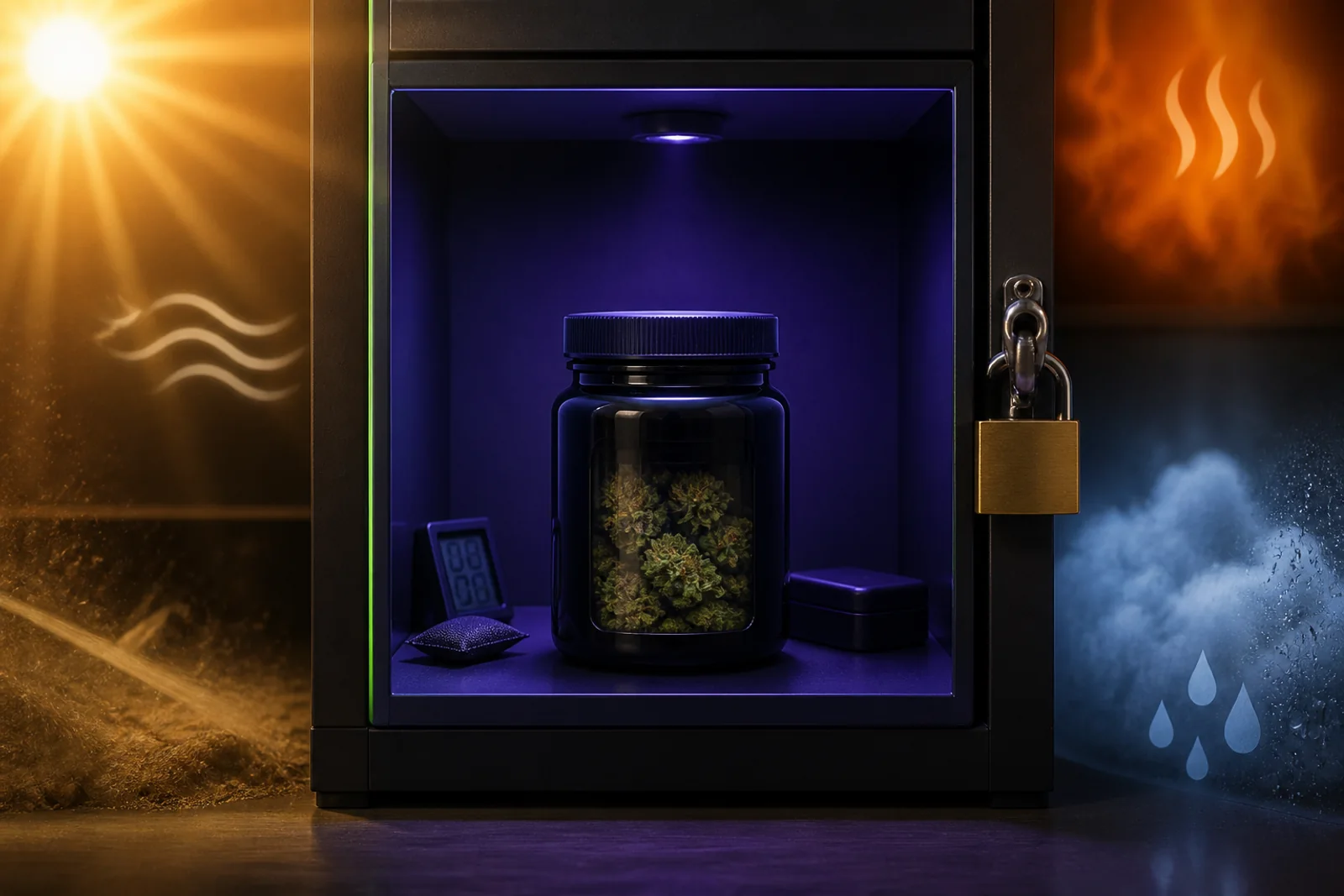
Light, heat, moisture, air exposure, and secure access are represented as the practical storage variables discussed in the guide.
Mainezilla original editorial visual · AI-assisted art directionIntroduction: Why storing cannabis matters
If you grow, buy, or steward cannabis for medical or adult-use purposes, storage is not a trivial afterthought. How you keep the plant and its products determines sensory quality, chemical stability, legal traceability and—most importantly—household safety. The practical goal is simple: preserve the material you want and prevent access or confusion for people and pets that shouldn’t have it.
This guide uses plain language and evidence-forward references so you can make consistent decisions in the field, at home, or in small-batch facilities. The advice that follows balances horticultural common sense (cool, dark, dry-ish) with public-health guidance about accidental ingestion and the regulatory realities that Maine growers and consumers face.
We lean on Maine Office of Cannabis Policy materials for state rules and basic record expectations, public-health resources for safety and poisoning response, and primary literature where it exists about how cannabinoids and aromas change with light, heat, air and moisture. When the science is thin or dated, we explain the uncertainty rather than invent exact outcomes.
Protect people first: lock, label, and act fast on exposures
Top priority: keep cannabis out of reach and out of mind for children, visitors and pets. Lockboxes, high cabinets, or a clearly designated locked drawer are better than leaving edibles or jars on countertops. Treat edibles and unmarked packaged products the same way you would household medicines—clearly label them and avoid storing them where they can be mistaken for snacks.
If someone—especially a child—may have consumed a THC-containing product, call Poison Control at 1-800-222-1222 or use webPOISONCONTROL immediately for guidance. For life‑threatening emergencies (severe breathing trouble, unresponsiveness), call 911. These steps are the same whether the product came from a licensed Maine source or elsewhere; quick, expert triage reduces risk.
Maine’s Office of Cannabis Policy materials emphasize that regulated systems require clear labeling and recordkeeping; even in home settings, preserving original labels when practical reduces confusion during an accidental exposure or a later quality question. Don’t assume a shaped gummy or candy is non‑potent; store and label accordingly.
Protect the material: what degrades and why it matters
Heat, light and oxygen are the three main drivers of chemical and sensory change. Over time they encourage oxidation and photochemical reactions that reduce THC and other cannabinoids, alter terpene profiles, and can make buds taste 'flat' or harsh. That’s not only a quality issue; changing chemistry complicates dosing predictability in processed products and undermines meaningful records about a batch.
Moisture is the second axis to manage. Excess relative humidity invites mold and microbial growth; too little humidity dries out delicate trichomes and ruins texture and aroma. A stable, moderate environment — cool, dark, and with humidity control — is the best default. Avoid windowsills, glove boxes of cars, bathrooms, and any place with frequent temperature or humidity swings.
Do not use improvised chemical preservatives or household additives to 'improve' storage. These introduce contamination risks and can violate Maine regulatory expectations for product safety in licensed contexts. If you need long-term shelf life for a finished, commercially sold product, follow validated stability practices used in regulated products instead of home hacks.
Containers and packaging: glass, plastic, and the limits of vacuum
For dried flower, inert, airtight containers are the simplest effective choice. Thick-walled amber glass jars with tight lids block light and limit air exchange; they’re widely used because glass is inert and doesn’t off‑gas like some plastics. Plastic bags and thin jars increase the rate of oxygen exchange and static cling that can break trichomes; they are pragmatic only for very short-term transport.
Vacuum sealing reduces oxygen exposure but also compresses delicate flower, which can damage trichomes and change mouthfeel. For small-batch growers, controlled humidity packs (properly chosen and used) inside a glass jar can be a better compromise: they buffer relative humidity without removing oxygen entirely. For processed products (tinctures, oils), use the manufacturer’s recommended container and follow any labeled storage directions.
Whatever you use, label the container with batch, producer, package date and opening date. Preserve the original label from licensed products whenever practical; it’s the simplest way to link the material to lab testing and other provenance records if questions arise later.
Humidity and moisture control: keep it steady, not extreme
Relative humidity (RH) is the single most important variable for dried flower after temperature and light. High RH (above ~65% for flower) raises the risk of mold and microbial growth; very low RH (below ~45%) can make buds brittle and accelerate loss of fragile terpenes. Because drying and curing history matters, match storage RH to the product’s finished moisture state rather than guessing.
Use small, purpose-built humidity control packs when you need precise buffering in a jar. These are calibrated for a target RH and are less intrusive than repeated rehydration attempts. Avoid soaking or adding fresh plant material to 'rehydrate' a dried product — that invites contamination. If you’re storing extracts and edibles, follow product-specific guidance; water activity rather than RH often determines microbial safety in foods.
If a product shows visible signs of mold, off-odors, or unexpected texture changes, don’t use it and follow local guidance for disposal. For licensed operators in Maine, retain records and follow OCP guidance on disposition; for home users, double-bag and render inaccessible during disposal to prevent accidental ingestion.
Light and heat: slow the clock with darkness and cool
Light (especially UV) accelerates chemical changes in cannabinoids and terpenes; heat speeds many of those same reactions. Together they shorten useful shelf life and erode the sensory and chemical profile you worked to produce. Keep stored products in a dark cabinet or an opaque container; avoid leaving jars in sunlight or on windowsills.
Temperature swings matter more than a single absolute number. A stable, cool environment—away from appliances, hot pipes, and cars—minimizes repeated expansion and contraction that moves air and moisture through packaging and stress the material. Refrigeration is not always appropriate for dried flower because it can create condensation during removal; a consistently cool room or dedicated cabinet is usually sufficient for most small-batch needs.
For finished formulations and commercial products, follow labeled storage instructions. In regulated manufacturing, stability testing establishes appropriate temperature and light limits; for home or small-batch use, conservatism (cool + dark + steady) is a reliable rule of thumb rather than specific temperature guarantees.
Edibles and packaging: rules for food-like products
Edibles are a special storage case because they look like food and carry a higher risk of unintentional ingestion. Keep edibles in child‑resistant, clearly labeled containers and never store them near snacks or children’s food. For commercially licensed items in Maine, keep original packaging when possible; it contains required labeling and serving information.
Because edibles are often perishable foods, follow their packaging instructions for refrigeration and shelf life. If you prepare homemade edibles, treat them like any home-cooked product: note the date, store perishable recipes in the refrigerator or freezer as appropriate, and discard them when spoiled or past sensible use-by times.
If a child or pet consumes an edible, contact Poison Control at 1-800-222-1222 as the first step. Children can become ill at much lower doses than adults; early expert advice improves outcomes. Do not attempt to 'wait and see' if you suspect ingestion without consulting a poison expert.
Protect your memory: labels, batch records, and disposal
A short record preserves your ability to learn from a batch. At minimum note package date, batch or lot number, producer, cultivar or product name, and the date you opened the container. If you notice a sensory change (moldy odor, unusual dryness, visual discoloration), record the change alongside storage conditions and the date rather than assuming the cultivar itself varied.
For licensed Maine operators, OCP guidance includes document retention and transport manifest expectations; those materials are the right place to find official timelines and records requirements. Home cultivators will not be subject to the same rules, but following the same basic record habits makes troubleshooting and household safety easier.
Dispose of unwanted or spoiled cannabis safely and in line with local guidance. For regulated product returns or recalls, preserve original labeling and contact the seller or OCP per state rules. For home disposal, double-bag and secure the material until it’s in a trash stream where children and animals can’t access it; never flush products or share them with others without explicit authorization.
Field checklist: a practical storage protocol
Use this short checklist when you finish harvest, receive a package, or put away a purchased product: 1) Confirm container is secure and child‑resistant if required; 2) Label with batch, producer, package date and your opening date; 3) Place in a cool, dark, stable location and add a humidity control packet if needed; 4) Note condition in your log and check again in 30–90 days.
For small-batch growers: keep one central log (physical or digital) that ties sample jars to test certificates when available. If a sample’s aroma or appearance changes unexpectedly, compare storage conditions across similar batches before concluding the genetic material shifted—often storage explains perceived drift.
When in doubt, apply the conservative option: lock it, label it, and call Poison Control for possible exposures. For anything being sold or transferred under Maine rules, follow OCP guidance about labeling, manifests and records rather than improvising; regulators and consumers both rely on the trail you keep.
- Lock or store products out of reach
- Use airtight, light-blocking jars; prefer glass for flower
- Control RH with purpose-made packs; avoid extreme dryness or wetness
- Label batch, producer, package and open dates
- Call Poison Control (1-800-222-1222) for suspected ingestion
Questions this guide answers
Can I put cannabis in the refrigerator or freezer?
A consistently cool, dark environment is usually best for short-to-medium term storage. Refrigeration can be useful for some extracts or edibles but may cause condensation and quality loss for dried flower on removal; freezing can work for long-term storage of extracts but is not always appropriate for cured flower. Consider product type and avoid temperature swings. (See stability and FDA guidance.)
Are humidity packs safe to use with flower?
Purpose-built humidity control packs calibrated for target relative humidity are a practical way to buffer jar RH without adding liquid. Used correctly they reduce risk of over‑drying and can help maintain aroma and texture. Do not use homemade or untested moisture methods.
How long does cannabis keep its potency and aroma?
There is no single expiration date: light, heat, oxygen and moisture drive change, so shelf life depends on initial processing, packaging and storage. Conservatively, cool, dark, airtight storage preserves sensory and chemical quality longer than exposure to sun, heat or humidity. Licensed products with stability data may have labeled guidance.
What should I do if I find mold on stored cannabis?
Do not use moldy cannabis. For consumer or non‑licensed home situations, double‑bag and render inaccessible during disposal. If the material was from a licensed source, retain packaging and contact the seller or follow Maine OCP guidance for return/disposition and recordkeeping.
Do Maine regulations require specific storage for home users?
Maine’s Office of Cannabis Policy provides guidance and rules that apply to licensed operators; home users are still expected to keep cannabis away from children and use reasonable precautions. For licensed businesses, OCP materials outline labeling, packaging, and record retention expectations—follow those for commercial transfers.
Educational information only. This guide is not medical or legal advice and does not recommend a product, dose, treatment, or outcome.