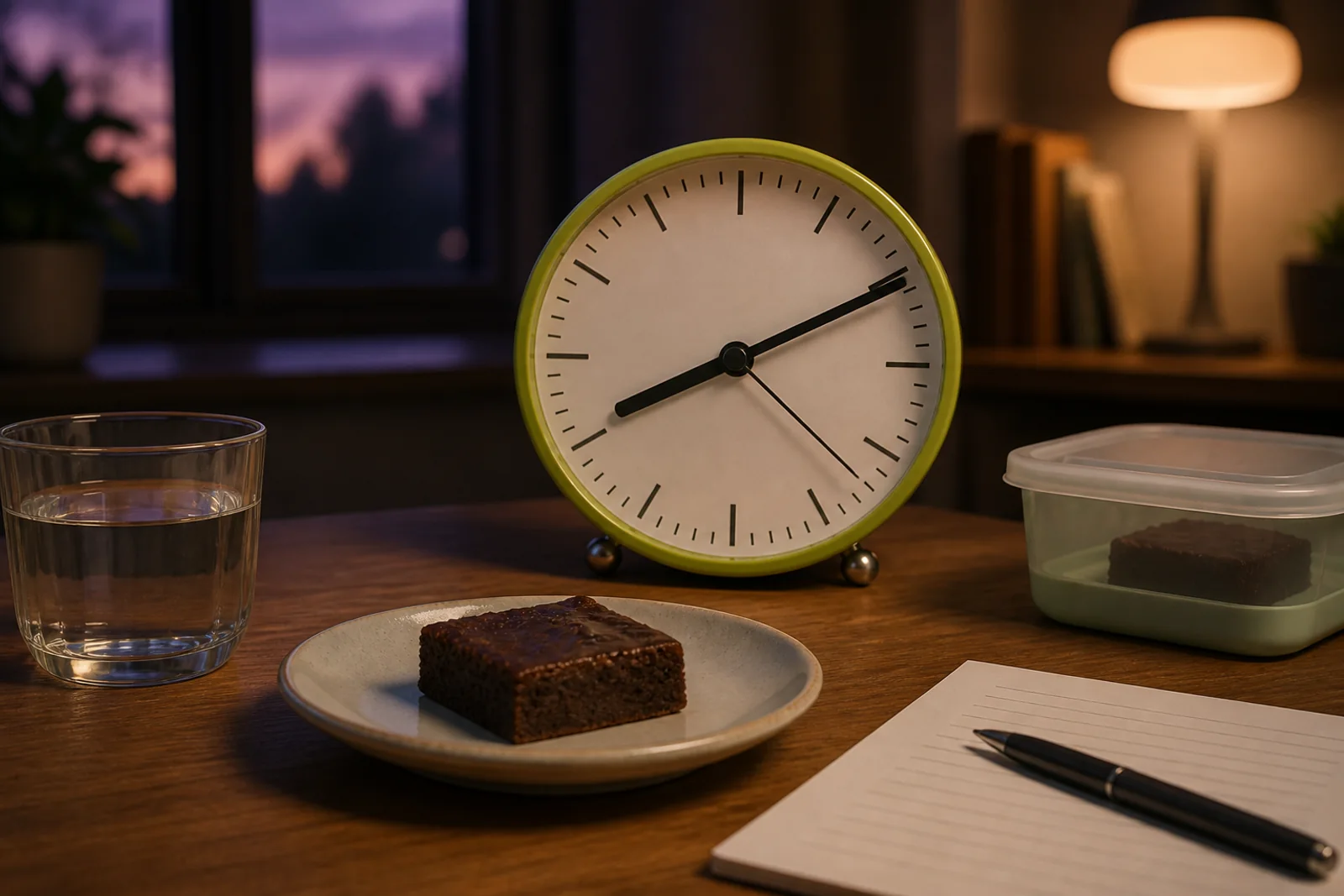
The clock and long visual timeline emphasize delayed onset and the need to wait rather than treating an edible like an immediate-response product.
Mainezilla original editorial visual · AI-assisted art directionA different clock: why eaten cannabis behaves unlike a puff
If you’ve used cannabis mostly by smoking or vaping, edibles can feel like they’re on a different schedule. When cannabis is swallowed, the cannabinoids travel through the digestive system and are changed by the liver before much of the active material reaches the bloodstream. That pathway can delay when effects are first felt and extend how long they last compared with inhalation.
Researchers and federal health agencies agree the oral route produces a more variable and often slower onset of effects than inhalation. That variability is not a nuisance detail — it’s the single biggest reason people unintentionally consume too much. Because the first serving may still be absorbed and transformed hours later, adding a second serving “on top” can compound the amount of active metabolite in circulation.
Practical implication: expect a wait, respect the uncertainty, and treat timing as part of the product itself rather than a minor nuisance. This field guide explains what drives that wait and how growers, caregivers, and consumers in Maine can make it safer and more predictable.
- Oral cannabis is metabolized differently — the liver converts some THC to active metabolites which can change onset and intensity.
- Onset and duration are variable across people and products.
- Repeated dosing before you feel effects is the common pathway to accidental overconsumption.
How the body processes an edible: the physiology in plain language
When you eat a cannabis-infused cookie, gummy, or oil, the cannabinoids first pass through the stomach and intestines, where some dissolve into digestive fats and are absorbed into the bloodstream. Unlike inhalation, much of what’s absorbed then goes straight to the liver — a process called “first-pass metabolism.” In the liver, delta-9-THC (the primary psychoactive compound) is converted into metabolites; one of those, 11-hydroxy-THC, is active and may cross into the brain with different timing and potency than inhaled THC.
That liver work explains two practical patterns clinicians and pharmacologists see: a longer time to “start” (time to reach detectable effect or blood concentration) and a different time course for peak effects. Because metabolites are produced as the product is slowly absorbed, effects can build gradually and sometimes surge later than you expect.
Scientific reviews of oral THC pharmacokinetics emphasize high variability between individuals and formulations. The bottom line: the same labeled amount of THC can behave differently depending on how it was made and who is eating it — that’s why edible dosing is inherently less precise than weighing an inhaled dose.
- First-pass metabolism creates different active metabolites (notably 11-hydroxy-THC) that affect timing and intensity.
- Blood levels and subjective effects from edibles can rise later and last longer than inhaled cannabis.
- Formulation and the eater’s physiology both matter for how much reaches the brain.
Why onset and duration vary so much — product and person matter
Not all edibles are the same. Baked goods, chocolates, gummies, beverages, tinctures, and oil capsules all present cannabinoids to the digestive system differently. For example, cannabinoids dissolved in oil or embedded in a high-fat matrix may be absorbed more readily than those in a dry cookie, and novel delivery systems (nanoemulsions, self‑nanoemulsifying formulations) are being developed to speed uptake and reduce variability.
Meals and body state influence the result. Taking an edible on a full stomach — particularly a meal with fat — can change how much and how quickly cannabinoids are absorbed. Individual differences — weight, gender, genetics, liver function, use of other medications, and prior tolerance — further widen the range of likely responses.
Clinical and pharmacokinetic studies repeatedly find higher variability with homemade or poorly mixed products, and baked goods and oils tend to show more uneven absorption than standardized formulations. That instability is why product form and manufacturing control matter for both safety and predictability.
- Product form (oil vs baked good vs gummy vs beverage) changes absorption characteristics.
- Eating with or without food — especially fats — meaningfully alters absorption speed and extent.
- People differ biologically; tolerance and concurrent medications change effects.
Stacking and the timing trap: how impatience leads to accidental overconsumption
A common pattern in poison center and clinical reports is the stacking scenario: a consumer takes an initial serving, feels little or nothing within 20–40 minutes, assumes the product is weak, and takes more. The first dose keeps being absorbed and metabolized while the second dose begins its own timetable — the combined effect can produce a much stronger and longer-lasting intoxication than anticipated.
Because edible onset can be delayed and subjective early signals may be subtle, it’s simple to misjudge whether the first serving is ‘working.’ This is also why claims about very short onset times on some commercial products deserve scrutiny: while some fast-acting formats can shorten T max (time to peak concentration), they are not universally interchangeable with standard edibles and should be treated as distinct formulations.
From a harm-reduction perspective, patience and a written record of what you took and when—particularly when you try a new product or a new maker—are the most reliable ways to avoid stacking. If you feel unexpectedly impaired, seek a calm, safe environment and, if needed, medical advice; avoid driving or operating machinery until you are confident the effects have resolved.
- Stacking occurs when a second serving is taken before the first has finished being absorbed or metabolized.
- Fast-acting marketing exists, but formulation differences matter — don’t assume all edibles behave the same.
- Keep a private time-and-product log when experimenting with a new product.
Labels and Maine rules: what a serving and package actually mean
Reading the label is essential, but labeling is only useful if you know the conventions. In Maine the law and state Office of Cannabis Policy (OCP) rules set specific packaging and labeling expectations: adult-use edible products must include information like total THC per serving and per package, nutrition panels for edibles, and child-resistant, tamper-evident packaging. Maine also requires a universal 'CONTAINS THC' symbol on product packaging and, for many products, on each serving or its wrapper.
Not all packages are single servings even when the item looks like one. A bar, box, or multi-piece gummy pack may contain multiple standardized servings; the serving count and the milligrams of THC per serving should be clearly marked. For liquid multi‑serving products, Maine rules often require an integral measuring component or other means to measure a single serving.
Homemade products and informal sharing are where uncertainty grows fastest. Without laboratory testing and consistent mixing, concentration can be uneven across pieces or batches. For regulated Maine products, the OCP posts guidance, and the statutes require packaging measures designed to reduce accidental ingestion and consumer confusion — but those protections apply to licensed products, not homemade goods.
- Maine requires child‑resistant packaging, clear serving and package THC information, and the universal 'CONTAINS THC' symbol on adult-use edibles.
- A single-looking item can contain multiple servings — always verify mg THC per serving and per package.
- Homemade edibles carry extra uncertainty because dose distribution can be uneven and untested.
Keep them locked, separate, and labeled: preventing accidental exposure
Edibles are often attractive to children and pets because they look and smell like ordinary snacks. Emergency medicine, poison center reports, and public health guidance all highlight rising reports of unintentional pediatric exposures to cannabis edibles, some requiring hospital care. Young children can be more severely affected and may need medical evaluation and monitoring after ingestion.
Maine’s OCP runs a Safe Storage initiative encouraging consumers to treat cannabis like other age-restricted or prescription products: locked containers, out of sight and reach, with clear labeling. Dispensaries in Maine often offer lockable storage bags at point of sale. Packaging standards and the universal symbol are additional safeguards, but they don’t replace locked storage and responsible placement like you would use for medications.
If a child or pet ingests an edible, contact Poison Control right away for location-specific guidance; clinical teams rely on the time of ingestion, product type, and amount to decide on monitoring and whether in-person care is needed. Keep product packaging or a photo of it handy when you call, because it helps clinicians and poison specialists triage and give accurate advice.
- Poison centers and CDC report increasing accidental ingestion cases — kids and pets are vulnerable.
- Maine OCP recommends lockable storage and provides resources and free safe-storage bags at retailers.
- If exposure occurs, call your local poison control center and have product details available.
Keeping a field record and talking with clinicians: useful, not prescriptive
A short, private log — product name and maker, mg THC per serving, how many servings, the time you took it, what you ate, and how you felt over the next several hours — can be a valuable tool. Over time that record becomes the practical evidence you bring to conversations with a clinician or a dispensary team when you need to describe what happened. But it’s a personal learning record, not a prescription: what worked for one person is not a safe recommendation for another.
Tell clinicians about other medicines you take. The FDA emphasizes that cannabinoids can interact with other drugs metabolized by liver enzymes and that many safety questions remain unanswered, especially for special populations (pregnant or breastfeeding people, children, people with liver disease). Honest, specific notes about timing and potential interactions help clinicians interpret events and offer safer guidance.
When handing product information to a clinician, include the product label or the Certificate of Analysis if available (from licensed retailers or the producer). Clear, time-stamped information is far more useful than vague recollections — and it helps clinicians separate what is likely pharmacology from what might be anxiety, sleep interruption, or other concurrent issues.
- Keep a private log of product, serving mg, time, meal context, and observed effects.
- Share product labels and timing with clinicians — medication interactions and liver effects are reasons clinicians need specifics.
- A personal record is a learning tool, not medical advice to others.
Field‑guide checklist and next steps
Before you try an edible: confirm mg THC per serving and per package; note whether the product is a single- or multi‑serving item; store the packaging or a photo for reference; plan for at least several quiet hours and avoid driving or operating machinery.
When you take an edible: start with a single labeled serving from a tested product, wait a full 2–3 hours before considering anything else (the exact time will vary — use your record to track what happened), and avoid mixing with alcohol or sedating medicines until you understand how that combination affects you.
If something goes wrong: don’t guess — call Poison Control, seek medical attention if advised, and bring the product packaging. For caregivers and retailers, follow Maine’s packaging and storage guidance and participate in the state’s Safe Storage efforts to reduce pediatric and pet exposures.
- Check the label: mg THC per serving and per package, and whether the serving is clearly marked.
- Wait before re-dosing: variability means effects may appear well after the first serving.
- Store securely, and call Poison Control for any accidental ingestion.
Questions this guide answers
Why do edibles take longer than smoking or vaping?
Edibles go through digestion and liver metabolism (first‑pass effect), which delays and changes how much active compound reaches the brain. Liver metabolites can also be active, so timing and intensity differ from inhalation.
If I don’t feel anything after 30 minutes, can I take more?
Because onset is variable, waiting is the safest choice. Many clinical and poison‑center reports show that taking extra servings before the first dose has fully absorbed is the main cause of accidental overconsumption.
Are homemade edibles less safe than regulated ones?
Homemade edibles are more likely to have uneven concentrations and no lab‑verified potency, which increases uncertainty. Licensed products in Maine must follow packaging and labeling rules that are designed to reduce accidental exposure and dosing errors.
What should I do if a child eats an edible?
Contact your local poison control center right away and follow their instructions. Have the product packaging or a photo available; young children are more likely to experience severe symptoms and sometimes require hospital monitoring.
Do Maine labels always show mg THC per serving?
Yes — Maine statutes and OCP rules require adult‑use edible packaging to show total THC per serving and per package, and to use child‑resistant and tamper‑evident packaging, along with the universal 'CONTAINS THC' symbol on marketing materials and often on individual servings.
Educational information only. This guide is not medical or legal advice and does not recommend a product, dose, treatment, or outcome.