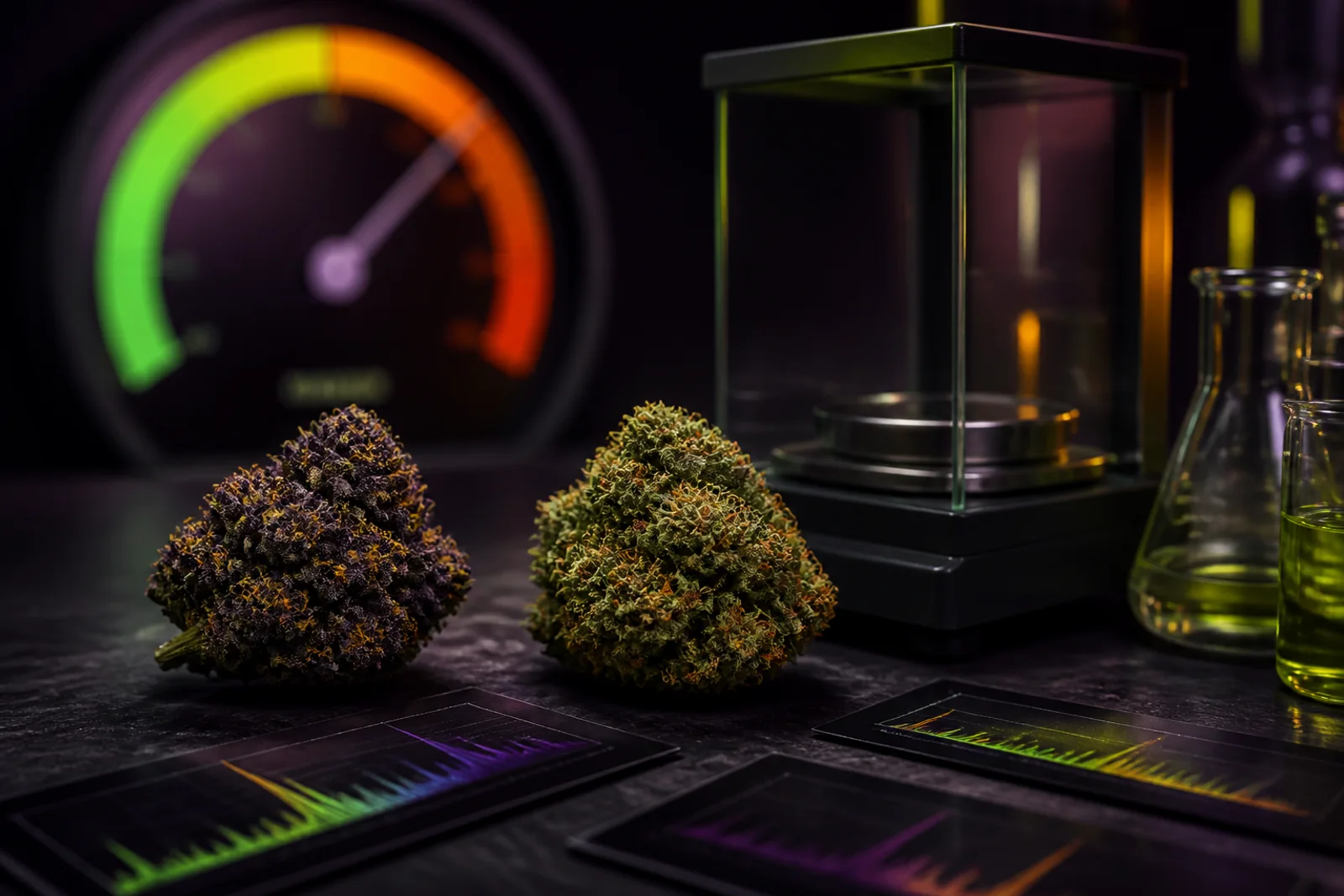
THC is shown as one measurement within a much larger quality picture—not a stand-alone score for the plant or a promised experience.
Mainezilla original editorial visual · AI-assisted art directionField-note introduction: what we mean by “THC percentage”
When you see “25% THC” on a jar, that number is a laboratory estimate of how much delta-9‑tetrahydrocannabinol is present in the sample that was submitted for testing. It’s an analytic result — not a quality grade, not a promise of effects, and not a farm report card. Think of it as one data point in a record rather than the definition of the product.
In Maine’s adult-use market, products must follow the program’s testing rules and results are documented through Certificates of Analysis (COAs). Medical-use cannabis operates under a different program and does not share the same universal mandatory-testing framework. Adult-use COAs report potency along with required contaminant screening, but that regulatory backbone does not remove the biological, sampling, and statistical reasons a number can mislead.
Throughout this guide we’ll use plain language and field-tested examples from growers and consumers. We’ll also point to primary sources so you can follow the rules, the lab science, and the public-health context. If you are in Maine, the Office of Cannabis Policy materials explain what testing means in the state and what results are required to be reported.
What the lab number actually represents
A potency result is the measured concentration of THC (or ‘total THC’) in a particular test sample. Labs typically measure delta‑9‑THC and its precursor acids and then report a converted total THC number by weight. That arithmetic and the lab’s analytic method (chromatography, sample preparation, calibration) matter for the final percentage you read on a label. Different labs, methods, and reference standards produce slightly different results.
Reference materials and validated methods reduce but do not eliminate measurement uncertainty. For example, NIST’s hemp reference material helps laboratories check their instruments and estimate uncertainty so potency numbers are more comparable across labs; that kind of standardization improves confidence but does not make every measurement identical. Even with good standards, a numeric result carries an uncertainty range.
Put simply: the percentage is the lab’s best estimate for the tested sample. It’s not a cultivar’s immutable property. The plant, the sample chosen, how the sample was ground and sub-sampled, and the instrument calibration all influence the reported percentage. If your goal is predictable effects, what you want is a repeatable delivery (dose and route) plus a reliable record — the COA helps with the latter, not the former.
Sampling, batch variation, and label accuracy — the hard truths
Cannabis is biologically variable. THC concentration varies between flowers on the same plant, between plants in the same room, and between harvests. Studies that randomly sample multiple flowers from batches show measurable within-batch variation, meaning one bud may test higher or lower than another even though they came from the same harvest. That’s why lab sampling protocols and sample size calculations exist — to capture a representative estimate.
Several independent studies have also documented mismatches between labeled potency and observed lab results: retail labels are sometimes inflated or imprecise. In some markets, a meaningful fraction of products tested below their stated label potency by more than acceptable tolerances. Those findings underscore two practical points: check the COA and prefer vendors who publish batch-level results; and expect some variation even when the label looks precise.
Maine’s rules and reporting requirements set expectations for testing and COA delivery to regulators and licensees, and the Office of Cannabis Policy also publishes testing data. That transparency is a tool: use it to compare the lab used, the batch date, and whether the exact lot you’re buying was the actual tested sample. The data won’t erase biological variation, but it shrinks the unknowns.
- Biological variation exists at plant, bud, and batch levels.
- Label–to–lab mismatches have been measured in some studies; a COA is your best check.
- Maine’s testing and reporting rules require COAs and public reporting for many adult-use items.
Why experience doesn’t follow a single dial
A single THC percentage cannot predict how any one person will feel. Route of administration (smoking, vaping, edible, tincture), the actual dose consumed, your personal tolerance, other medications or substances, sleep, food, and the environment all change the timing and intensity of effects. Two people using the same product at two different times may report very different outcomes. The CDC summarizes the range of health effects and risk factors associated with cannabis use, which is why we avoid claiming that a percentage equals intensity.
Tolerance is particularly important: frequent users often need larger doses to reach the same subjective effect, and concentrated products may accelerate tolerance development for some people. Public-health resources note associations (for example, higher potency product use and increased risk of cannabis use disorder symptoms), but those are population-level observations rather than deterministic predictions for individuals. Respect both the patterns and the uncertainty.
Potency can help estimate the active ingredient per gram, but experience also reflects delivery, context, and the person using the product. A personal record becomes more useful when it captures the exact batch, amount, route, setting, and observations in neutral language.
Freshness, handling, and what the label does not tell you
THC numbers say nothing about freshness, aroma, or whether the product was well-cured and stored. Terpenes — the small aromatic molecules that shape smell and part of the subjective profile — evaporate with time and heat; a two-year-old jar that tests high for potency might smell flat and taste dull because volatile terpenes are gone. Certificate of Analysis typically reports cannabinoids and contaminants, not terpene loss over time.
Handling between harvest and test matters. Light, heat, oxygen, and moisture change both cannabinoids and the risk profile (for example, mold growth when moisture is too high). Maine guidance materials and testing rules are intended to reduce safety risks by requiring contaminant screening and COAs, but they don’t substitute for common-sense storage and honest vendor practices. Ask when it was harvested or packaged. If a retailer can’t or won’t answer basic provenance and storage questions, treat that as information.
For growers and retailers: maintain a simple harvest log (harvest date, dry/cure schedule, storage conditions, lot number) and make batch COAs available. For consumers: a freshness-aware buyer is a more satisfied buyer. Fresh, well-cured flower at 18% THC may deliver a better, more predictable experience than stale flower labeled 28% that’s been sitting improperly stored. That’s not a claim about potency — it’s about the whole record.
Practical shopping and field-record checklist
We recommend a short checklist you can use in the dispensary, at the counter, or on the website. Ask: who produced it (licensed cultivator), what is the batch or lot number, what’s the harvest or packaging date, which accredited lab tested it, and can I see the COA for the exact lot? Maine’s OCP materials explain what a COA contains and how testing data are reported, and many licensees publish COAs alongside products. If the COA exists, confirm the tested batch matches the lot you’ll receive.
Other practical checks: smell the flower (if allowed), ask about storage since harvest, and note the format you plan to use. If you use medications or have health concerns, check with a clinician or pharmacist; public-health resources emphasize that higher-potency products can be associated with different risk profiles at the population level. This is educational guidance, not medical advice.
Finally, keep a short personal record: product name, batch or lot, grams used, route, time, and subjective notes at one hour, three hours, and 24 hours. Over a few repeats you’ll build your own “COA + effect” library that’s far more useful than percentile bragging. If you’re a grower, share a simple harvest and cure summary with purchasers — transparency reduces surprises for everyone.
- Confirm batch-level COA and lab identity.
- Ask harvest/packaging date and storage conditions.
- Record: batch, dose, route, timing, and subjective effect. Repeat under similar conditions.
Field guide closing: what THC percentage should do for you
THC percentage should be the first line in a short dossier, not the headline that drowns out everything else. Use it to estimate potential active ingredient per gram, to compare batches where everything else is equal, and to check that a vendor’s lab and testing practices meet the expectations set by Maine’s program. It’s a useful number — not the whole story.
When you combine the COA with provenance (who grew it), harvest and packaging dates, storage handling, and your own controlled records, you convert a single lab number into usable, repeatable knowledge. That’s the point of evidence-first adult learning: build records, test assumptions, and iterate. Growers and consumers who do that find they make better choices and fewer mistakes.
If you want to go deeper, read Maine’s testing guidance, inspect COAs, and follow the primary literature on lab variability and label accuracy. We’ve linked the key primary and regulatory sources below so you can follow up, and we’ve included related Mainezilla guides on testing, COAs, and building a personal record. Stay curious, keep a log, and don’t let a single percentage be the judge of a plant’s worth.
- Make THC percentage part of a dossier: COA + provenance + storage + personal record.
- Use Maine OCP public data to verify labs and reported results.
Questions this guide answers
If a label says 30% THC, will it always feel stronger than 20%?
Not necessarily. The label reflects the lab’s measurement for that tested sample; actual experience depends on dose, route, tolerance, and context. Population-level data link higher-potency product use with increased risk of cannabis-related problems, but potency alone does not determine an individual’s response. Check the COA and track your personal record for repeatability.
How can I verify a product’s COA in Maine?
Ask the retailer for the batch-level COA or check whether the vendor publishes it. Maine’s Office of Cannabis Policy requires testing and reporting; the OCP provides guidance on what COAs include and also publishes testing data for regulated products. Confirm the COA’s lab name and the tested lot number match the product you’ll receive.
Do labs always report the same THC number for the same sample?
No. Different accredited labs, methods, calibration standards, and sample preparation techniques produce slightly different results. Reference materials (for example NIST’s hemp reference material) and rigorous method validation reduce differences, but some measurement uncertainty remains.
Is higher percent THC a health risk?
Higher potency products are associated at the population level with certain increased risks, such as stronger dependence symptoms in some users and greater risk of acute adverse reactions with inappropriate dosing (notably with edibles). That association does not translate into a universal rule for every individual. Consult a clinician for personalized health questions.
What should growers record to make their product more predictable for buyers?
A minimal grower log includes cultivar name, harvest date, drying and curing notes (times, temperatures, RH), lot number, packaging date, and COA link. Sharing that simple provenance information with buyers helps match expectations and reduces surprises at the point of use. Maine guidance emphasizes the value of transparent testing and reporting.
Educational information only. This guide is not medical or legal advice and does not recommend a product, dose, treatment, or outcome.