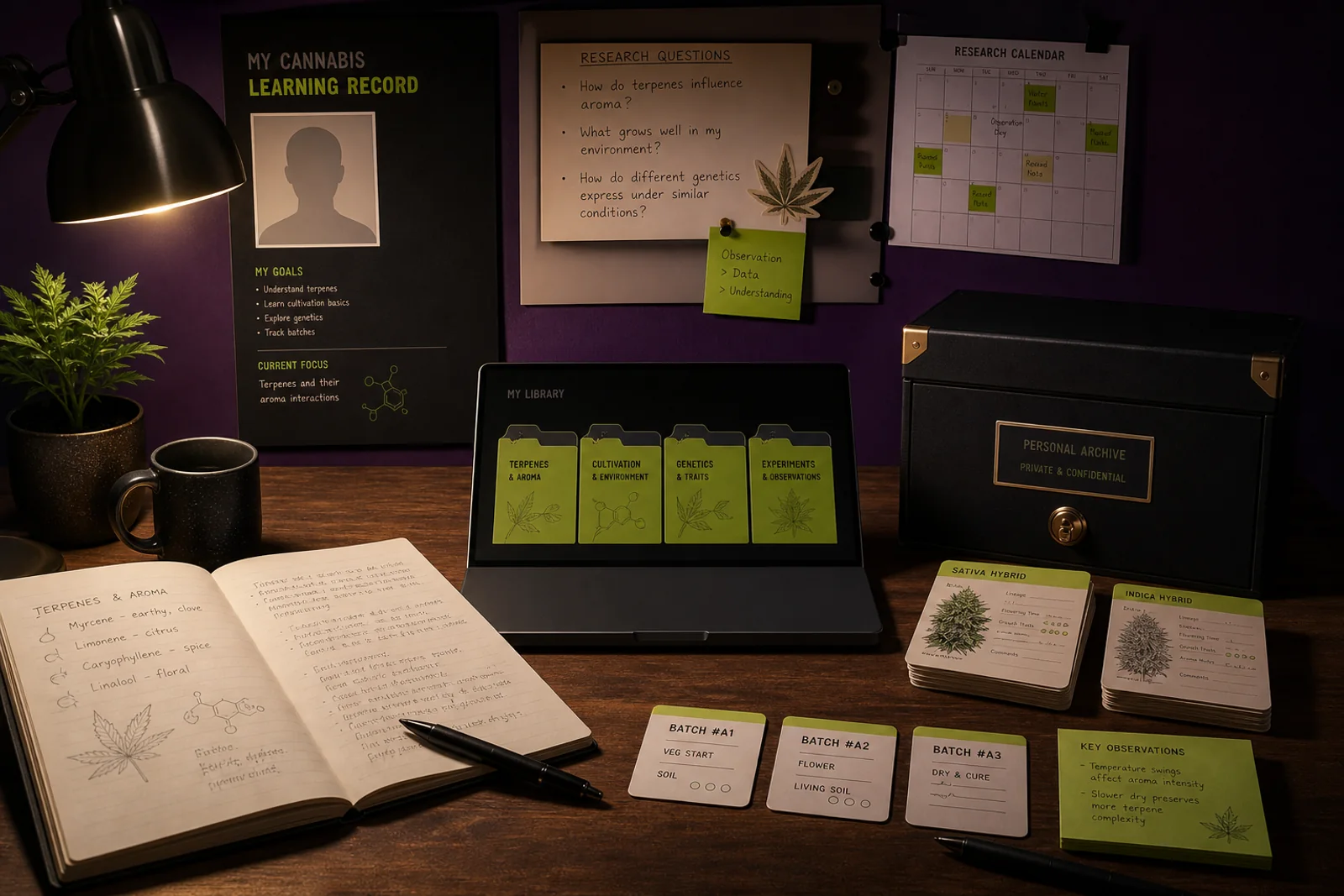
A private, organized research workspace reflects the article’s purpose: preserving questions, observations, sources, and learning over time.
Mainezilla original editorial visual · AI-assisted art directionWhy keep a Personal Cannabis Learning Record?
If you grow, buy, test, or use cannabis, you already have data scattered across phones, jars, receipts, and memory. A personal cannabis learning record (PCLR) brings those things together with intention. The goal isn’t to catalogue every purchase forever; it’s to create an organized, private archive that helps you answer a question—did this batch behave differently, is this product consistently tested, or what should I bring to my clinician next time?
Good records turn noise into decisions. They let you compare batches (not just names), keep track of certificates of analysis (COAs), and separate a one-off experience from a repeatable pattern. That habit reduces guesswork when you need to make a safety choice or describe what actually happened, rather than what you think happened.
This guide stays squarely practical and evidence-aware. It draws on Maine program materials about testing and labeling, public-health overviews of risks and effects, and clinical evidence maps to remind you where the science is strong and where it is not. Preserve uncertainty in your notes: record what you saw and when, and avoid turning anecdote into clinical certainty. (Sources: Maine OCP; CDC; systematic reviews.)
- Purpose-first: keep one collection per learning goal.
- Record documented facts (COA, batch, date) separately from personal observations.
- Use your record to support safe conversations, not to substitute for medical or legal advice.
Start every collection with a clear question
A useful collection has a purpose. Before you start saving screenshots and photos, write one clear question on the collection header: “Compare two concentrate batches for solvent flavor,” “Prepare notes for a clinician about sleep changes,” or “Track Maine-tested gummies for labeling consistency.” A compact question prevents an archive from becoming a digital hoard.
Name the collection in plain language you will understand six months from now. Avoid cute strain puns that made sense at 2 a.m.; use dates, batch IDs, and a short goal phrase. Example: “Gummies — Vendor A — May–Aug 2026 — dosing onset” is more useful than “Friday Night Snacks.”
Keep each learning goal in its own folder or tag. If you want to study edibles’ timing, don’t mix those notes with inhalable concentrates. When you review later, the focused collection makes patterns visible and keeps context intact. (Sources: Maine OCP; clinical evidence guidance emphasizing focused questions.)
- One collection = one learning question.
- Use a durable naming convention: product/vendor — batch — date range — short goal.
- Separate administration routes and product types into different collections.
Capture product and batch context—what to record
If you’re saving product information, capture the producer, format (such as flower, vaporizer cartridge, edible, or tincture), batch or lot number, label photo, certificate of analysis link or PDF, purchase date, and source. Maine’s adult-use system requires testing and certificates of analysis; attaching the report to the correct batch makes it possible to revisit potency and contaminant results without relying on a brand name alone. Maine’s medical program has different testing rules, so identify which market the product came from before interpreting the record.
When you save an article or claim, save the author, publisher, and review or publication date, and write one sentence about the claim you want to revisit. That prevents a saved article from becoming an unexamined authority in your head. Keep the article metadata and the succinct claim together so you can find it fast when you want to re-evaluate the evidence.
For personal observations, capture timing (clock time and days since product opened), administration route, the exact product and batch ID, and context (alone or with alcohol, with other medications, before or after a meal, before bedtime). Record observed effects as plain-language observations—what you experienced, when, and how long—separately from your interpretation of why it occurred. This makes later pattern-finding and clinician conversations much clearer.
- Product facts: producer, format, batch/lot, COA, purchase date, source.
- Article facts: author, publisher, review date, one-line claim to revisit.
- Observation facts: clock time, context, route, and exact product batch.
Design the record: separate fields and a simple template
A PCLR is most useful when fields are consistent. At minimum, use three separate fields or sections for: (A) documented facts (COA, label text, batch number), (B) other adults’ reports or product reviews (noted as second‑hand), and (C) your personal observations. Label each field clearly—don’t mix a COA excerpt with ‘I felt relaxed’ in the same line. That discipline prevents a subjective memory from quietly overwriting a documented lab result.
Templates keep data clean and searchable. A compact template might include: Product name, Producer, Batch/Lot, Purchase date, COA link, Route (smoke/vape/edible), Start time, Duration, Immediate observations, Later observations (2–6 hours), Other substances, and Confidence level (low/medium/high). Use tags like #edible, #gummies, or #COA-fail to filter later.
If you like paper, print a one‑page sheet and photograph it into your record. If you prefer digital, a simple spreadsheet or private note app with consistent column headings works fine. The technology matters less than using consistent fields—later queries and exports are exponentially easier when data is structured.
- Keep three separate fields: facts, others’ reports, personal observations.
- Use a repeatable template—product metadata, administration context, timed observations.
- Tag and date every entry so you can filter and export later.
Review, revise, and export—treat the record as a living tool
Schedule a periodic review—every three to six months is a useful rhythm. During review, correct broken assumptions, check that links still work, and refresh COAs or vendor labeling if you have newer batches. Program rules and testing cutoffs change over time, and what a label said last year might not match today’s standards. Keep a short changelog header in each collection that records major edits so you know which conclusions are new.
Export and back up in formats you control. A private CSV or encrypted PDF export ensures the record remains yours if an app disappears or an account is lost. If you ever plan to move a collection to share with a researcher, clinician, or legal advisor, having a clean, time‑stamped export simplifies the process and reduces the chance of accidental data leaks.
When you revise conclusions, annotate why you changed your view. If you once believed a strain name predicted effects but later saw inconsistent COAs across batches, note that correction. The most useful records are the ones that document how your beliefs evolved—those notes are often the clearest evidence for others and for your future self.
- Review collections every 3–6 months; update broken links and COAs.
- Export private backups (CSV or encrypted PDF) so the record remains yours.
- Annotate corrections—record how and why conclusions changed.
Use the record to prepare for conversations—with clinicians, retailers, and yourself
A clean PCLR makes conversations far easier. For clinicians, bring the facts: product name, batch/lot, COA, administration route, timing, and concise, time‑stamped observations. Avoid offering long, unstructured stories—clinicians want short, verifiable facts plus the symptom or question you want help with. An organized record means you spend appointment time on interpretation, not reconstruction.
For dispensary or retail conversations (reports of labeling mismatch or suspected contaminant issues), the COA, batch ID, purchase date, and a concise observation timeline are the primary proof points. Maine’s testing program requires COAs and reporting of results; having those documents speeds any remediation or reporting processes.
Finally, use the record for your own learning. Over months, you may notice route-specific timing differences, or see that batches from the same producer show varying potency or contaminants. Use the record to form hypotheses—then test them with the same disciplined notes rather than moving straight from impression to purchase decision.
- Bring COA and batch ID to clinician or retailer discussions.
- Use the record to ask focused questions instead of telling a long story.
- Form hypotheses from patterns you observe, then test them with structured notes.
Questions this guide answers
Do I need to save the full certificate of analysis (COA) for every purchase?
Save the COA or at least a screenshot that includes the batch/lot number, testing lab, and key results (cannabinoid profile and any pass/fail contaminants). In Maine’s adult‑use program, COAs are required and are the best objective record for potency and contaminant results.
Can I trust product names or strain labels to predict effects?
No single name reliably predicts effect. Strain names drift and batches vary; record batch IDs and COAs instead of relying on a name alone. Use your observations over multiple batches to look for patterns rather than assuming name→effect.
How do I share sensitive health information from my record safely?
Export only the relevant pages or entries and share them directly with a trusted clinician—do not post diagnoses or medication lists in public forums. Consider encrypting exports or using secure patient portals when possible.
What if a product looks or smells wrong after purchase?
Preserve the product and packaging, record the batch/lot and purchase date, and contact the retailer. If you suspect contamination or have an adverse reaction, contact Poison Control or emergency services as appropriate. Keep COAs available for reporting.
Is any of this medical advice?
No. This guide helps you organize facts and observations so you can have clearer conversations with clinicians and vendors. It is not a substitute for medical or legal advice.
Educational information only. This guide is not medical or legal advice and does not recommend a product, dose, treatment, or outcome.