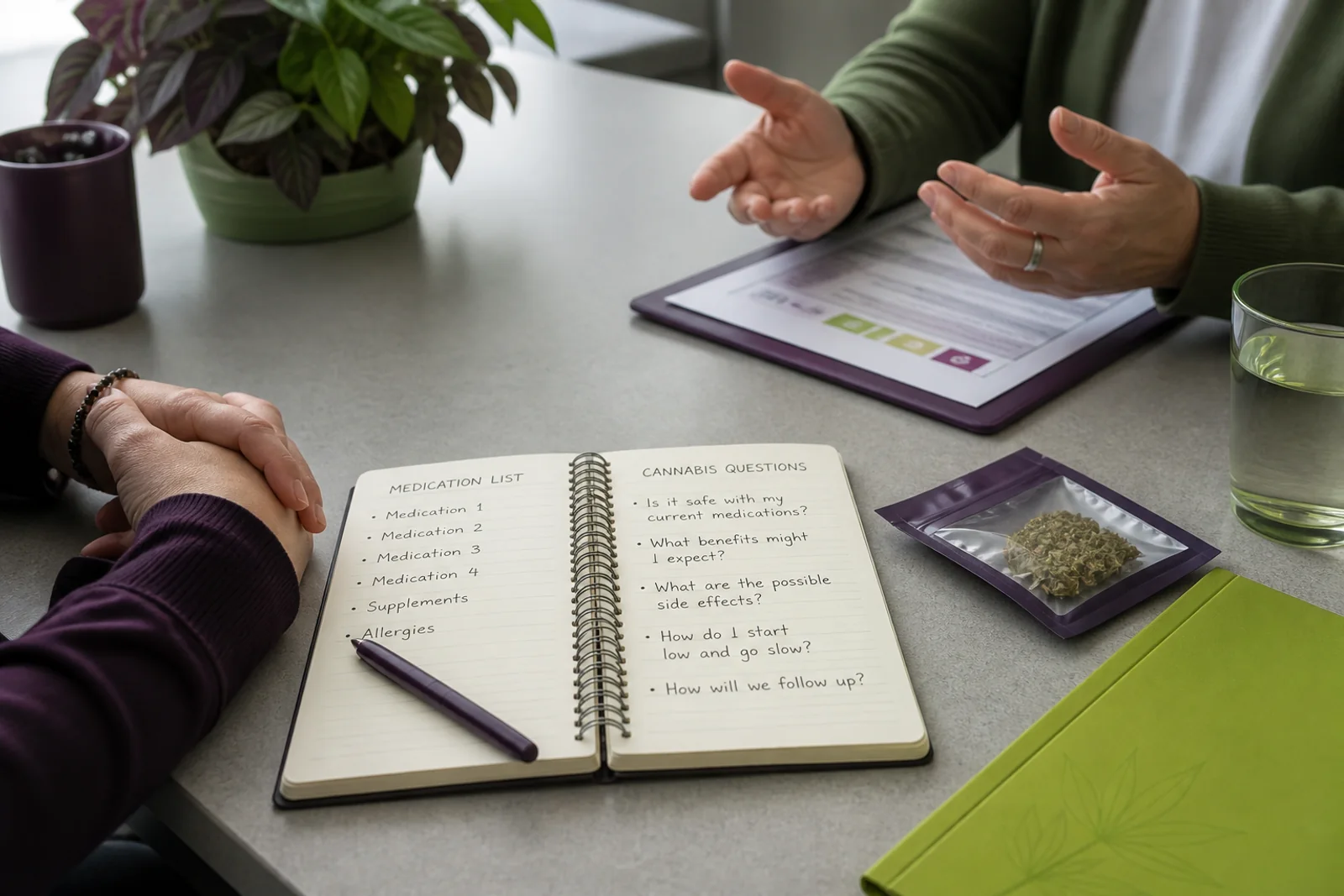
A prepared patient-clinician conversation shows the guide’s practical goal: bring organized questions, products, timing, and medication context.
Mainezilla original editorial visual · AI-assisted art directionWhy a one-page field record beats a foggy memory
Appointments are short and clinicians are busy; bringing a compact record—one page, written or printed—turns vague intentions into a usable clinical tool. A clear list of what you use and why helps a provider rapidly orient to the issue, spot potential interactions or harms, and document a plan. Public health reviews underline that cannabis can have a range of effects on body and brain, and precise use information helps place those risks in context. Evidence: CDC’s summaries of health effects and risk factors reinforce that clinicians need clear histories to assess possible harms and benefits.
In Maine, the Office of Cannabis Policy runs the state medical program and expects a bona fide provider–patient relationship for medical certification; clinicians will want specifics to support that conversation. State materials also make the practical point that medical and adult-use systems are separate and that not every product is tested in the same way—so knowing the product source matters.
Think of the page as a flashlight for the visit: it reveals timing, pattern, formulations, and concerns. That makes it easier for the clinician to say what is known, what is uncertain, and what kind of follow-up would be reasonable rather than guessing from a strain name or a vague “I use edibles sometimes.”
What to put on the one-page history (a practical template)
Head the page with your name, date of birth, and the date you prepared the note. Under that, give a short statement of your goals (for example: ‘nighttime sleep aid,’ ‘muscle spasm relief,’ or ‘exploring options for anxiety’). A goal frames whether an effect is helpful, unwanted, or neutral, and helps the clinician measure success or harm over time.
For each product list: product name exactly as on the label, format (flower, edible, tincture, topical, concentrate), labeled concentrations (THC% and CBD% or mg), approximate amount per use (for edibles: mg THC per serving; for flower: estimated grams or number of inhalations), frequency and timing (how many times per day, when relative to sleep/meds). If you have a batch number or Certificate of Analysis (COA), note it; bring a photo of the label or the COA if you can. State law and OCP materials make clear that testing and labeling practices vary in Maine, so documentation helps a clinician interpret a product.
Finally, add a short line about unwanted experiences: e.g., ‘lightheaded after edibles,’ ‘more anxious at high doses,’ ‘heart palpitations once.’ Honest, specific notes make safety checks possible. Even if you’re not sure about causation, documenting the pattern supports safer care and clearer follow-up.
- Header: name, DOB, date
- Goal statement: 1 line
- Per product: exact label name, format, THC/CBD on label, amount, frequency, timing, source/batch/COA
- Short line on benefits and unwanted effects
Make interactions visible: list everything you take
Write a separate list of prescription medications, over-the-counter drugs, supplements, herbal products, alcohol use, nicotine use, and recreational substances. Even products marketed as “natural” can alter how your body handles prescription drugs. Reviews of cannabinoid pharmacology show that THC and CBD are metabolized by major cytochrome P450 enzymes and can inhibit or induce pathways shared with many medications. That biochemical overlap is the mechanistic reason clinicians worry about interactions.
Systematic and narrative reviews identify real-world interaction signals with some narrow-therapeutic-index drugs—examples reported in the literature include interactions with warfarin, clobazam, tacrolimus, and certain antiepileptics—so telling your clinician about blood thinners, seizure medicines, or transplant meds is especially important. The existence of interaction reports does not prove harm in every individual, but knowing the medication list lets clinicians decide about monitoring and temporary adjustments.
If you’re on psychiatric medications, note that cannabis can affect mood and cognition in some people; your mental-health history is relevant. And if you inhale cannabis and also smoke tobacco, that affects lung and cardiovascular risks. A full substance list gives the clinician the data needed to weigh probabilities and recommend monitoring steps, rather than leaving the interaction question unspoken.
- Include dose and timing for each prescription and OTC drug
- Mark meds with narrow therapeutic windows (e.g., warfarin, tacrolimus, antiepileptics)
- Note alcohol, nicotine, and other recreational drugs
Special populations and safety flags to mention up front
Pregnancy and breastfeeding: tell your clinician if you are pregnant, trying to conceive, or breastfeeding. CDC guidance is explicit that THC crosses the placenta and concentrates in breast milk, and current public health advice recommends against use during pregnancy and breastfeeding because of potential harms to fetal and infant development. Even topical products are discussed in guidance because systemic exposure sometimes occurs.
Heart, lung, and mental-health history: note any heart disease, arrhythmia, high blood pressure, asthma, COPD, panic disorder, schizophrenia, or prior psychosis. The CDC’s health-effects summaries and clinical reviews emphasize that cannabis use is associated with increased heart rate and, in some populations, worsened psychiatric outcomes. These background diagnoses change the risk–benefit conversation.
Children, household safety, and edibles: if there are children or pets in the home, document secure storage and whether children have had access to edibles in the past. Poison control centers report that unintentional pediatric ingestion of edibles often causes significant symptoms and can require medical attention; if your child has already consumed a product, contact Poison Control immediately for assessment. Mentioning household risks at the visit helps clinicians provide timely safety counseling.
- Pregnant, planning pregnancy, or breastfeeding? Always tell your clinician.
- List cardiac, pulmonary, and psychiatric diagnoses.
- If children are in the home, note storage practices and prior exposures.
Bring the product evidence: labels, COAs, and where you bought it
A strain name alone is rarely enough. ‘Blue Dream’ might be useful for storytellers, but clinicians need quantified concentrations and the product format to evaluate exposure. If you bought from a Maine medical dispensary, bring the product label and batch number. If you bought an edible or an extract, a picture of the packaging and the nutrition/fact-style label helps. The Maine Office of Cannabis Policy notes variability in testing and labeling practices across supply channels, so product documentation reduces guesswork.
Certificates of Analysis (COAs) are ideal when available. A COA shows the lab’s measured cannabinoid profile (THC/CBD), and may include contaminants screening. State efforts have been evolving toward lab certification and clearer testing rules, but not all medical products in Maine are uniformly tested yet; the presence or absence of testing is important context for a clinician.
If you used an out-of-state or over-the-counter CBD product, bring that label too—FDA guidance stresses the variability and regulatory gaps for many cannabis-derived products, and clinicians will weigh that when advising monitoring or adjustments.
- Photo of the product label (include batch numbers if present)
- Bring any available Certificate of Analysis (COA)
- Note whether product came from Maine medical program, adult-use retailer, online, or informal source
Ask the right questions: what to say, and what to expect
Prepare three to five short questions to steer the visit toward safety and follow-up. Useful options: “Given my goals and meds, what do we know and not know about risks?” “Which new symptoms should prompt stopping the product or urgent contact?” “What monitoring (blood tests, blood pressure checks, symptom diary) would you recommend?” These are questions that invite useful uncertainty—clinicians may not have definitive answers, but they can set measurable checkpoints.
Because cannabinoid effects and interactions are still an active area of research, expect a conversation of probabilities rather than guarantees. Systematic reviews point out where interaction evidence is stronger (certain antiepileptics, warfarin, tacrolimus) and where evidence is sparse or mixed; a clinician can use that information to recommend monitoring or specialist referral.
If your clinician is unfamiliar or uncomfortable, ask whether a pharmacist, a specialist, or the medical program can add perspective. In Maine the medical program requires a bona fide provider relationship for certification, so a clinician may feel compelled to document the conversation and, if appropriate, refer you or schedule a follow-up visit to reassess after a trial period.
- Example question: 'Which of my medications could interact with this product, and how would we monitor?'
- Ask for specific red flags that should prompt immediate contact or stopping use
- Request a follow-up plan: who will review results and when
Keep the record and the learning loop going
Treat your one-page record as a living document. After you try a change, add short notes: date, what you used, what happened (benefit, side effect), and whether you missed doses of other meds or changed sleep/alcohol patterns. This makes future visits far more informative than a memory-based report. If you use an app or MyZilla to archive observations, make sure the clinician knows how to access or that you bring a printed summary—digital archives are helpful but still need context from a clinician to be clinically actionable.
Documented observations are valuable even when they raise more questions than answers. They allow clinicians to look for trends (improvement, tolerance, withdrawal, or adverse signals) and to decide on lab monitoring if relevant. If you see worrisome signs—difficulty breathing, severe confusion, fainting, seizures, or prolonged unresponsiveness—seek emergency care and call Poison Control for immediate guidance in pediatric exposures.
Finally, preserve uncertainty: good care often means checking back. Ask your clinician when to return for reassessment and what measurable goals (sleep hours, pain scale, functional outcomes) will indicate whether the plan is working. That way the next visit is not a repetition of the unknown but a data-driven conversation about trade-offs.
- After a change, note date, product, dose, and outcome in one line
- Keep a short symptom diary for the first two weeks of any new product
- For pediatric or severe acute exposures, contact Poison Control immediately
Questions this guide answers
Do I have to show a clinician the product packaging?
No legal requirement forces you to show packaging, but bringing a photo or the label saves time and reduces guesswork. Clinicians rely on concentrations and formats more than strain names to assess exposure and risk.
Should I stop all cannabis before a medical appointment?
Do not stop or change medications without a clinician’s guidance. For cannabis, tell your clinician what you are actually using; they will advise whether a pause or monitoring is appropriate based on your medications and health history.
What medications are most likely to interact with cannabis?
Evidence and reviews identify potential interactions with drugs metabolized by CYP enzymes—reports highlight warfarin, certain antiepileptics, clobazam, and tacrolimus among others. The relevance for any individual depends on doses and formulations, so share your med list for tailored advice.
If I bought my product online or out of state, does that change the conversation?
Yes. FDA and state guidance note variability across products and regulation gaps. Tell your clinician the source—products from different channels can have different labeling, testing, and contaminant risks.
Who can I call for immediate help if a child eats an edible?
Contact your regional Poison Control center immediately; Poison Control provides free, confidential, 24/7 guidance for suspected pediatric exposures and will advise whether emergency evaluation is needed.
Educational information only. This guide is not medical or legal advice and does not recommend a product, dose, treatment, or outcome.