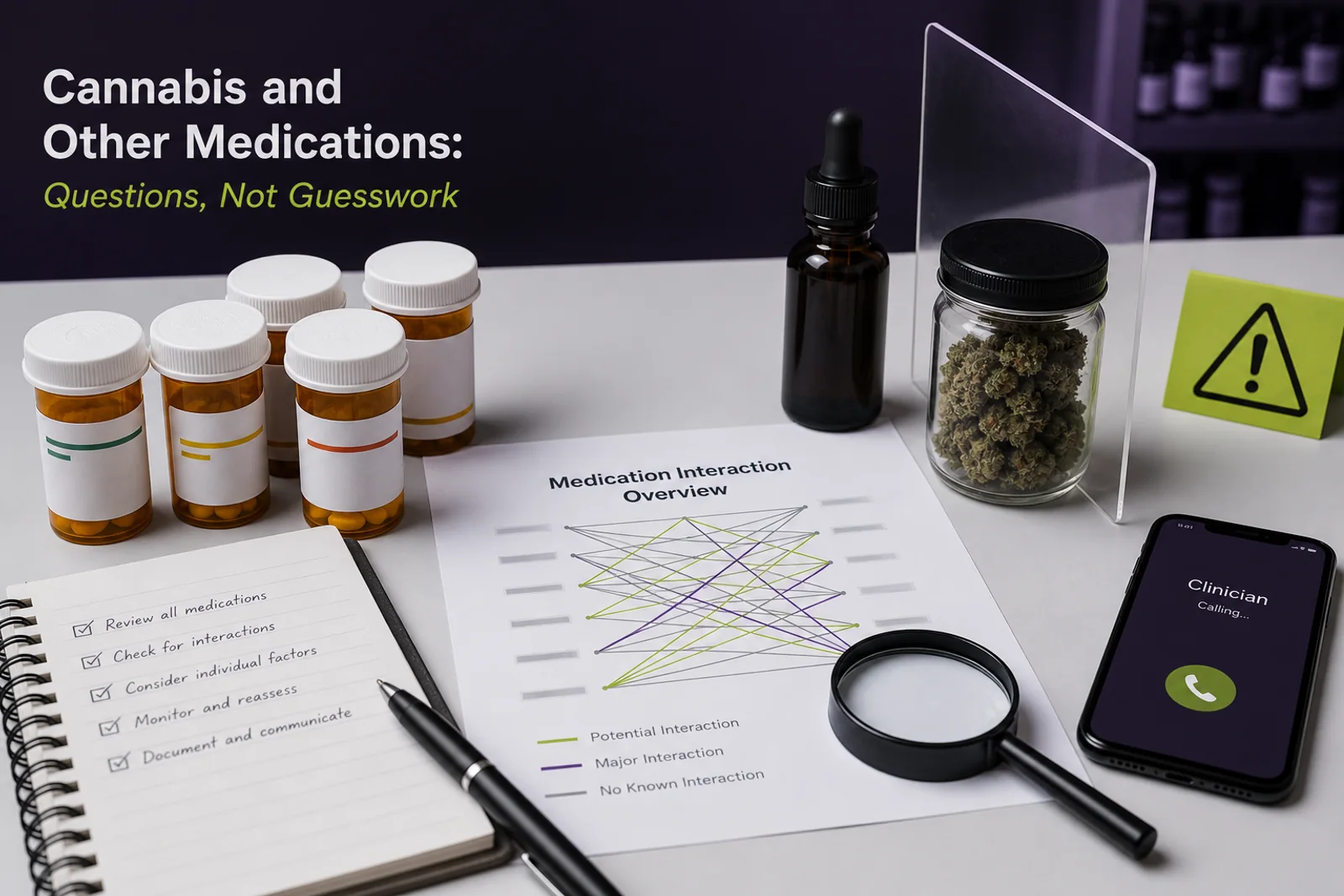
Medication and cannabis information meet at an interaction diagram, reinforcing the article’s advice to ask a qualified clinician rather than guess.
Mainezilla original editorial visual · AI-assisted art directionA practical field guide: why 'cannabis and medications' is not a yes/no question
If you want a quick answer about cannabis and your other medicines, you won’t always find one — and that’s because the question isn’t a single binary. The risk when people talk about cannabis and medications depends on what compounds are present (THC, CBD, other cannabinoids), the route (smoked, vaped, edible, topical), the amount and timing, and the person’s health and other drugs — not whether a product ‘feels’ natural or comes from a plant.
Official public-health pages and federal consumer guidance emphasize this variability: cannabis can affect heart rate, cause sedation, and interact with how other drugs are processed in the body, and evidence varies by product and circumstance. The plain fact is: two products labeled similarly can behave differently in the body, and the same product can behave differently in two people. That uncertainty is a reason to ask targeted questions, not to stop medication without professional advice.
This guide is written for adults who grow, use, or recommend cannabis in Maine and want practical, evidence-based steps to reduce guesswork. We’ll map the most useful science to field practice: what to document, what to bring to a pharmacist, how to think about mechanisms of interaction, and which situations should prompt immediate professional help. Where the science is uncertain, we’ll say so — and point you to primary sources so you can follow up.
Products, labels, and real exposures: why the same name can mean different risks
Start by acknowledging that 'product' is an umbrella term. Flower, concentrates, tinctures, topicals, and edibles expose the body very differently. Inhaled THC delivers rapid blood levels and short peak exposure; edibles produce delayed, often stronger subjective effects because of liver metabolism. Labels—especially outside regulated medical products—may be incomplete or inaccurate. The FDA has repeatedly warned consumers that many commercial CBD and hemp products do not contain the labeled amount of cannabinoids and may contain contaminants.
Certificates of analysis (COAs) from a testing lab can help, but they’re not a panacea. A COA tells you what was detected at the moment of testing in that batch; it won’t tell you how your liver will process the compounds or whether a minor cannabinoid will matter clinically. In Maine’s regulated systems, testing and labeling standards exist, and the Office of Cannabis Policy provides resources explaining program differences and what testing covers. Still, product variability and user behavior (how much, how often, whether food is present) are major determinants of interaction risk.
Bottom line for a grower, buyer, or clinician: don’t rely on strain names or vague labels to predict interactions. Treat product information as one piece of the puzzle; exposure route, dose, frequency, and the presence of other sedatives or liver-metabolized medicines are equally important.
How interactions happen: the major mechanisms to watch for
There are a few recurring mechanisms by which cannabis components can affect other medicines. One is altered drug metabolism, particularly via the cytochrome P450 (CYP) enzyme family in the liver. Cannabinoids (notably CBD, and to a lesser extent other compounds) can inhibit or, in some contexts, induce CYP enzymes, which may increase or decrease blood levels of co‑administered medicines. Systematic reviews and experimental studies show interactions at the enzyme level, though the clinical significance depends on dose and context and remains an active area of research.
Sedation and additive central nervous system depression are another predictable risk. Cannabis (especially THC and higher-CBD doses combined with other sedatives) can increase drowsiness or cognitive impairment when mixed with benzodiazepines, some sleep aids, opioids, and alcohol. Poison-control and clinical guidance consistently recommend caution when combining sedative agents because effects can be greater than expected.
Cardiovascular effects — such as transient increases in heart rate and changes in blood pressure — and bleeding risks have also been reported in population and clinical data. Some case reports and pharmacology studies suggest cannabis exposure can alter the effect of anticoagulants (for example, warfarin), making monitoring important when cannabinoids and blood thinners are used together. These mechanisms are biologically plausible and documented enough to justify careful monitoring rather than casual assumptions of safety.
A field checklist: what to bring to a pharmacist or clinician (and what to ask)
Think like a data collector. Bring the product label and the Certificate of Analysis (COA) if one is available, and write down exact doses and the route you use (for example: 5 mg edible at 8 p.m., 1 inhalation of a vape cart at 7 a.m.). Include frequency and how long you have been using the product. If the product is homemade or shared, describe the recipe or amount used rather than rely on a strain name alone. This makes your exposure legible to clinicians and pharmacists, and preserves useful details for follow-up.
Bring a complete medication list: every prescription, over‑the‑counter drug, vitamin, herb, and supplement. Pharmacists and poison‑control experts use the whole list to spot overlap (for example, multiple sedatives) and to flag medicines with narrow therapeutic windows like anticoagulants, certain antiepileptics, or immunosuppressants. If a clinician recommends blood testing or closer monitoring, having a baseline helps prevent misattribution of effects later.
Ask these specific, concrete questions: Does timing matter (separate by hours)? Should I watch for increased drowsiness, bleeding, or other particular symptoms? Is additional monitoring or dose adjustment recommended? If you’re told to stop or change a prescribed medication, ask the clinician for a documented plan that explains why and what replacement or monitoring will occur — and don’t stop medications on your own based on internet advice.
- Product label + COA (if available), exact dose, route, timing
- A full list of prescriptions, OTCs, supplements, and herbs
- Questions to ask: timing, symptoms to watch for, monitoring plan
Safer use practices and red flags that require immediate attention
There are practical ways to reduce uncertainty. Start low and go slow when you try a new product or change the route of administration so any unexpected effects are easier to spot. Avoid mixing cannabis with alcohol or other sedatives until you understand how you respond — additive sedation is one of the most common and avoidable harms. Federal guidance and poison‑control resources highlight that combined sedatives increase risk of falls, accidents, and overdose‑like presentations.
Pay special attention if you’re taking medicines with narrow therapeutic windows (warfarin, some anticonvulsants, certain immunosuppressants). Case reports and pharmacology studies show that cannabinoid exposure can change blood levels of drugs like warfarin; in those situations, clinicians often recommend closer laboratory monitoring (e.g., INR for warfarin) rather than abrupt discontinuation. If you or your clinician change a dose, document the rationale and the monitoring plan.
Know the red flags that require urgent help: severe lightheadedness or fainting after use, sudden or severe chest pain, difficulty breathing, signs of major bleeding (for example, unexpected bruising or bloody stools if on an anticoagulant), or profound confusion and unresponsiveness. If you suspect a severe reaction, call your local poison center or emergency services — the national poison number is available through poison-control resources and is staffed 24/7.
- Try one variable at a time (route, dose, product).
- Avoid alcohol and other sedatives until you know your response.
- Seek urgent care for severe chest pain, trouble breathing, major bleeding, or unresponsiveness.
Build a personal learning record: what to capture and why privacy matters
A short private log turns anecdote into usable data. For each new product or change, note the product name, batch or COA ID, route, exact amount, time of use, co‑medications, and any symptoms over the next 24–72 hours. Over weeks you’ll build a personal pattern of responses that helps you and your clinicians make safer choices. Avoid posting personal medication lists in public community threads — instead, summarize findings without identifying medication details if you want community input.
Use private notes in your phone or a paper notebook, and include clinician recommendations verbatim if they give you monitoring advice or an explicit plan. That record is also where you document any agreed dose changes, the date they began, and planned follow‑up tests. Treat the record as a clinical tool: legible, dated, and concise, so it’s useful in a future clinic visit or emergency.
If you share your log with a clinician or pharmacist, request that they document their recommendations in your medical record when appropriate. That leaves a clearer trail if a change is later needed and reduces the risk that differing advice will create confusion. Keep privacy in mind: Maine’s medical and adult‑use systems are separate, and you can ask clinics how they protect the information you share.
- What to record: product and batch ID, dose, route, timing, co‑meds, symptoms, clinician advice
- Keep the record private; summarize (not list) meds in public forums
- Ask clinicians to document monitoring or dose adjustments in your chart
Maine context: testing, program differences, and where to look next
If you live or work in Maine, the Office of Cannabis Policy (OCP) publishes consumer and program guidance that explains testing standards, labeling expectations for regulated products, and the differences between Maine’s medical and adult‑use systems. Knowing which program provided your product helps you understand what testing and labeling you can reasonably expect. OCP resources are practical starting points for Maine‑specific questions about product provenance and testing.
Federal agencies like the FDA and public‑health bodies like the CDC remain primary sources for how cannabinoids can interact with medicines and for safety signals (for example, risks in pregnancy, sedation, and laboratory‑documented drug interactions). For mechanistic detail on how cannabinoids affect liver enzymes and the potential for drug–drug interactions, recent experimental and review literature on CYP interactions is the best place to look next. These are the sources clinicians consult when deciding whether to monitor blood levels or adjust a drug dose.
We’ve tried to keep this guide actionable for growers, patients, and clinicians who want to reduce guesswork. If you need help right now because of a bad reaction, contact your local poison center or emergency services. For non‑urgent planning, bring this checklist and your learning record to a pharmacist or clinician and use the specific questions in the checklist as your agenda.
- Use Maine OCP materials to verify testing and labeling for Maine products.
- Consult CDC/FDA for safety signals and poison-control for acute problems.
- For metabolism and interaction mechanisms, deferred to primary pharmacology literature.
Questions this guide answers
Should I stop my prescription if I start using cannabis?
No. Do not stop or change prescribed medication based solely on an article or community post. Bring the medication list and product details to a clinician or pharmacist; they can advise whether monitoring or dose adjustment is appropriate.
Does CBD interact with other drugs?
Yes—CBD can affect liver enzymes that process many drugs, and can increase sedation when combined with other central nervous system depressants. Talk with a clinician before combining CBD with medications that have narrow therapeutic windows.
Are edible products safer than inhaled ones when thinking about interactions?
Not automatically. Edibles and inhaled products produce different exposure profiles that change interaction risk: edibles have delayed but sometimes stronger metabolite exposure, while inhalation produces rapid peaks. Each route carries different practical risks and monitoring needs.
Who can I call right now if someone has a bad reaction?
For immediate concerns about a potential poisoning or severe reaction, contact your local poison center or emergency services. Poison‑control resources are available 24/7 and can give stepwise guidance.
Where can I find Maine‑specific rules and testing information?
Maine’s Office of Cannabis Policy publishes program guidance, testing and labeling expectations, and consumer resources. Use OCP materials when you need Maine‑specific procedural or regulatory details.
Educational information only. This guide is not medical or legal advice and does not recommend a product, dose, treatment, or outcome.