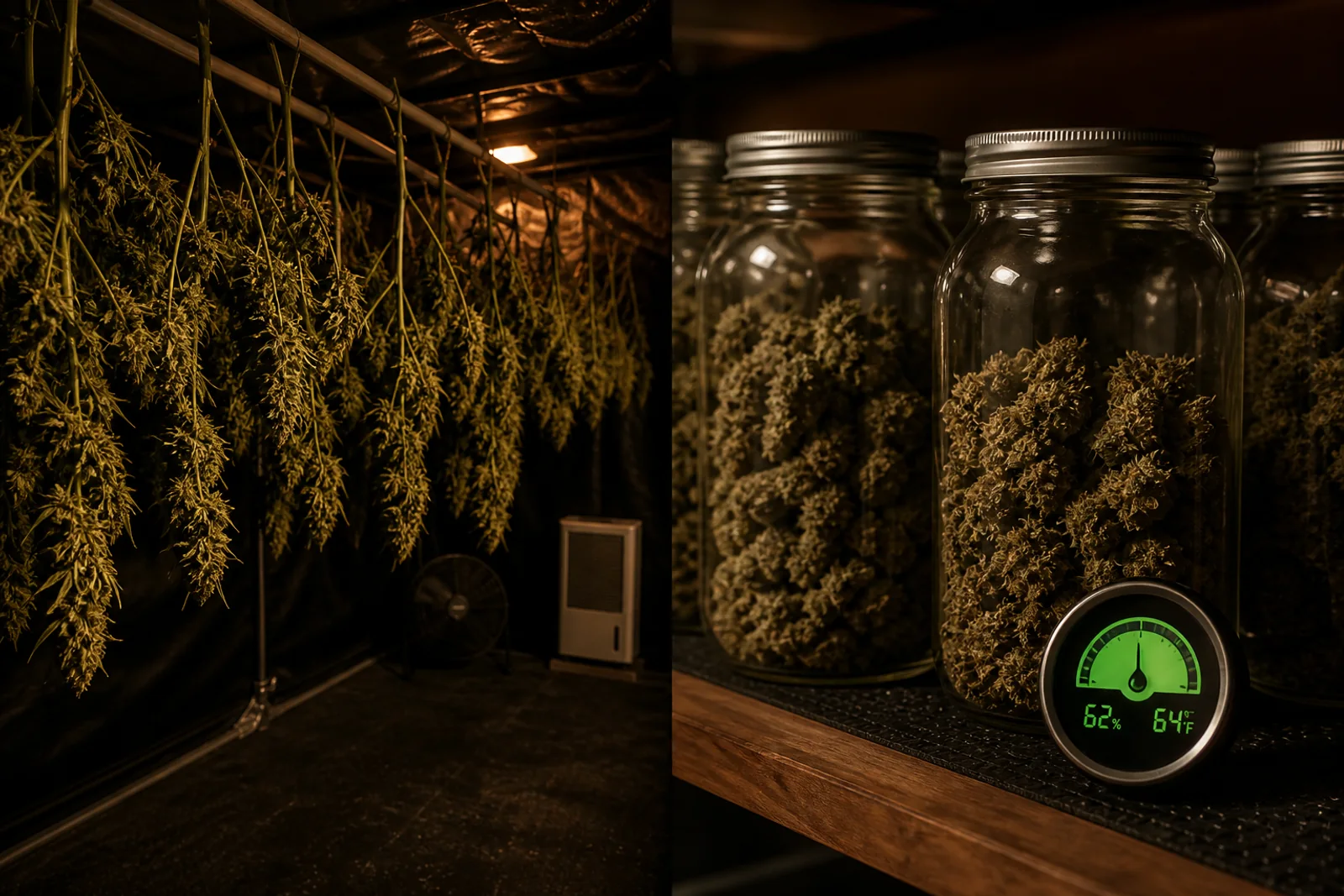
The visual follows the real post-harvest sequence from hanging branches through environmental monitoring and sealed curing containers.
Mainezilla original editorial visual · AI-assisted art directionIntroduction: Harvest is a beginning, not an ending
You cut the plant, you breathe easier, but the chemistry and biology keep working. Fresh cannabis inflorescences hold a lot of water; that water moves, concentrates, and interacts with plant enzymes and microbes after the shears. Getting from wet harvest to stable product is a controlled run of decisions—about airflow, humidity, temperature, time, and recordkeeping—that determine safety, aroma, and shelf life. These are not theatrical choices; they’re process control decisions backed by measurable outcomes.
Call it drying, call it curing, call it post-harvest stabilization—the practical difference matters. 'Drying' is the intentional removal of free moisture from the plant to get it out of the danger zone for microbes; 'curing' is the slower period where remaining moisture equilibrates, acids decarboxylate gradually, and volatiles (terpenes) and other compounds find a new balance. Each step is an opportunity: handled well, it preserves chemical diversity and reduces risk; handled poorly, it creates brittle flower, flattened aroma, or worse, an unsafe product. Evidence from controlled studies shows that drying and storage conditions measurably change both the volatilome (aroma compounds) and cannabinoid profiles.
This guide reframes the original short article into a research-grade field manual for Maine growers and patients. It focuses on measurable variables, how Maine’s regulatory signals fit into good practice, and what to document and ask as a buyer or patient. We will not promise therapeutic outcomes; instead, we’ll describe what changes, why it matters, and how to reduce uncertainty. When guidance points to regulation or health risks, we cite primary sources from Maine OCP, CDC, PubMed, and Poison Control so you can follow the paper trail.
Drying basics: goals, variables, and common methods
Goal number one for drying is simple: move free water out of the tissue until the product is stable enough to resist rapid microbial growth. Stability here is functional, not aesthetic—you're aiming for a moisture environment where bacteria and mold are far less likely to take hold, while still avoiding over-desiccation that destroys fragile terpenes. The scientific literature shows that drying method (tray, freeze, or slow-hang), temperature, and humidity produce distinct outcomes in both volatile profiles and the balance of cannabinoid acids vs. neutral cannabinoids.
Temperature and relative humidity (RH) are your primary process levers. Higher temperatures speed water loss but extract or volatize aroma compounds and may accelerate the conversion of cannabinoid acids. Too low humidity and aggressive air exchange desiccate the tissue—flower becomes brittle, trichomes break, and volatile loss accelerates. In contrast, very high humidity or stagnant air increases the risk that spores already present on the flower will germinate during drying. The ideal target depends on your equipment and batch size; the point is to measure and control rather than depend on a fixed calendar.
Common industry approaches — slow hang-drying in a controlled room, tray drying, or freeze-drying for research-grade products — each have tradeoffs. Slow hanging with 50–60% RH and moderate air exchange tends to preserve terpenes and structure but takes longer and requires good airflow management. Tray or kiln drying speeds the process but requires careful temperature control to avoid volatilizing desirable compounds. Peer-reviewed work demonstrates these tradeoffs: different drying and storage regimens change the 'volatilome' and cannabinoid ratios in measurable ways. Plan your drying intent (preserve aromatics, stabilize for long-term storage, or process for extraction) and choose the method that aligns with that intent.
- Primary drying variables: temperature, relative humidity, and airflow.
- Method matters—slow hang vs. tray vs. freeze have measurable chemical outcomes.
- Control and record environmental conditions; don’t rely on a fixed number of days.
Evidence trail: [1]
Curing and moisture equilibration: the slow stabilization phase
Curing is the period after primary drying when remaining bound and free water migrates within the flower and equilibrates with its container environment. During curing, volatile terpenes may be retained or lost depending on headspace volume and container permeability; acid cannabinoids may slowly convert to their neutral forms under heat or storage conditions. Controlled curing reduces harshness and can allow for more complex aroma development, but it also requires monitoring to avoid pockets of elevated moisture that could support mold. A recent study shows that both drying and subsequent storage conditions alter the balance of volatile compounds and cannabinoids.
Practically, curing is a managed containment step. Many small-batch growers use food-grade glass jars with limited headspace and periodically burp jars to exchange air and check moisture. Larger operations may use dedicated humidified cabinets or monitored rooms with data-logging. The common thread: active observation plus measurement. Hygrometers in the jar headspace, or direct moisture content sampling of representative flowers, tell you more than how the buds 'feel' to a gloved finger. Replicable curing depends on sampling plans and fixed acceptance criteria, not lore.
Finally, curing is not immune to microbial risks. If you seal product with even small areas of elevated moisture, low-oxygen microenvironments can favor certain molds. That’s why curing protocols typically pair with testing regimes: a batch should be tested and released only after meeting microbial and contaminant limits defined by regulation. In Maine, mandatory testing rules and guidance documents define analytes and sampling practices that affect when and how cured product can move into commerce. See the testing and sampling guidance from Maine’s Office of Cannabis Policy.
- Curing = moisture equilibration + slow chemical shifts (aroma, cannabinoid conversions).
- Use data (headspace RH, representative moisture measures) not just touch or smell.
- Curing protocols should tie into documented sampling and testing before sale.
Measurement, documentation, and quality control (QC)
If growers want to move from artisanal intuition to reproducible quality, the shift is measurement and documentation. Record drying-room temperature and RH, airflow rates (or fan settings), batch size and mass, time to target moisture (by percent moisture or water activity), and any post-dry interventions. For curing, record container type and headspace, burp schedule, and any headspace RH readings. These aren’t vanity metrics: regulatory sampling, laboratory test results, and recalls all hinge on traceable records. Maine’s regulatory framework expects testing facilities to report mandatory results and licensees to maintain traceability for batches.
Two measurement approaches are common: direct moisture content (gravimetric or moisture analyzers) and water activity (aw). Water activity is a functional predictor for microbial activity because it measures the availability of water for biological processes; moisture percent alone doesn’t describe how tightly that water is bound. Where possible, pair a moisture percent target with water-activity limits to better predict microbial risk. The peer-reviewed literature and food safety practice support water activity as a useful control for stored plant products.
Testing and sampling are not optional in a regulated market. Maine’s Office of Cannabis Policy has defined required analyte types for mandatory testing and published best-practice guidance on sample collection and certificate-of-analysis reporting. Follow the OCP sampling rules and ensure your in-house QC matches the testing lab’s sampling plan so that the lab’s Certificate of Analysis (COA) represents the same material you sell. Regulatory rules and guidance documents also set out how and when the office may sample or inspect licensed premises.
- Record environment and batch-level metrics: temperature, RH, airflow, mass, and timing.
- Measure both moisture percent and water activity when possible; they tell different things.
- Align QC sampling with certified lab sampling and Maine OCP guidance to ensure traceability.
Microbial safety, contaminants, and what testing tells you
Visible appearance, aromatic strength, or a ‘clean sniff’ are poor proxies for microbial safety. Some molds and bacteria do not produce obvious visual or olfactory signals but can still pose health risks. That’s why regulated testing looks for microbial organisms and other contaminants, not just sensory acceptability. The CDC’s public-health guidance underlines the real risks of unintentional poisonings and harms when products are contaminated or improperly stored.
Maine’s mandatory testing scheme includes analytes intended to detect agents of risk—from microbial contaminants to residual solvents and heavy metals—and the state publishes guidance on analyte lists and sampling. Producers should assume that testing is the authority on microbial status: if a batch fails, remediate or remove it, and document actions. The statute also explicitly authorizes inspections and sampling by the Office of Cannabis Policy. That regulatory muscle exists because sensory checks alone won’t keep patients or consumers safe.
For growers, prevention beats remediation. Manage the drying curve so the product doesn’t sit long in an RH and temperature window that fosters mold. Implement sanitation practices in drying and curing rooms, control airflow to avoid pockets of stagnant air, and treat any unexpected events (power loss, water intrusion, contamination events) as triggers for quarantine and testing. If test results are out of spec, OCP guidance documents describe retesting and remediation pathways; keep those documents handy and follow their procedures rather than improvising.
- Don’t rely on smell or look to declare microbial safety—use testing.
- Maine requires specific analytes and reporting; failed tests have defined remediation paths.
- Sanitation, controlled drying curves, and prompt testing/quarantine are core prevention steps.
Storage and packaging after curing: preserve chemistry and reduce risk
Once the batch is cured and tested, storage choices determine how the product ages. Light, heat, oxygen, and container permeability drive the loss of terpenes and the conversion or degradation of cannabinoids. Glass with tight seals and low headspace better stabilizes volatiles than permeable plastics; cool, dark storage slows chemical change. Studies document measurable shifts in volatilome and cannabinoid content under different storage regimens. Plan storage based on intended shelf life: shorter-term retail display has different tradeoffs than long-term banked product.
Maine’s rules and statutes address packaging and labeling as part of consumer safety: packaging must meet labeling requirements and, in some contexts, content claims (like cannabinoid data) must be verified by a testing facility. Licensees are expected to maintain storage conditions and records consistent with rules for traceability and safety. If you offer patients or customers product that has been stored for weeks to months, keep documentation of storage conditions paired with the COA. That preserves both safety and trust.
From a risk perspective, storage is also about child-and-pet safety. Unintentional ingestion of THC-containing products is a documented public-health concern. Use child-resistant containers, clear labeling, and explicit storage instructions for patients and adult consumers. Poison Control resources and CDC materials emphasize the frequency and seriousness of accidental ingestion incidents, especially with edibles and poorly secured products. That’s a practical safety step that protects both your customers and your operation.
- Choose packaging and storage that minimize light, heat, oxygen, and headspace.
- Keep COAs with batch records and record storage conditions for traceability.
- Use child-resistant, clearly labeled containers and provide explicit storage instructions.
What patients and buyers can reasonably ask (and expect)
If you’re buying medical cannabis from a dispensary or caregiver, reasonable questions are simple and backed by documentation: When was this batch harvested? When and how was it dried and cured? Has the batch been tested, and can I see the Certificate of Analysis? Those answers tell you whether the product you hold had an appropriate post-harvest program and whether the testing aligns with Maine OCP reporting. A COA and basic batch history aren’t marketing copy—they’re traceability and safety tools.
At home, store cannabis in a cool, dark, secure place, in a clearly labeled, child-resistant container away from children and pets. If the product’s aroma, texture, or appearance changes rapidly after opening, pause and consult the dispensary or testing lab rather than trying to guess safety by eye or smell. If a patient suspects illness after use, Poison Control and medical channels exist to triage exposures; don’t treat sensory impressions as a substitute for professional assessment.
Some questions have regulatory answers: whether a product is 'tested' and what that testing covered are matters defined by Maine law and OCP rules. If a label claims potency or contaminant status, the relevant record is a batch-matched COA from the testing facility. Dates, batch identifiers, and the actual testing report reduce uncertainty more effectively than a broad transparency claim.
- Ask for harvest date, drying/curing notes, batch ID, and the Certificate of Analysis.
- Store product safely at home—cool, dark, labeled, child-resistant, and out of reach.
- If a product changes unexpectedly, pause use and consult the seller or Poison Control as needed.
Questions this guide answers
How long should I dry cannabis before curing?
There is no universal calendar. Drying time depends on bud density, room temperature, relative humidity, airflow, and method. Measure and target water activity or final moisture percent rather than relying on a fixed number of days. Controlled studies show different drying methods yield different chemical outcomes; aim for documented environmental controls and sampling to confirm the batch is ready.
Can I tell if a product is safe just by smelling or looking at it?
No. Visual appearance or a strong smell cannot reliably establish microbial or chemical safety. Some contaminants and microbes don’t produce obvious sensory cues. Rely on appropriately sampled lab testing and a Certificate of Analysis to confirm safety in a regulated market.
What should I do if my purchased cannabis changes smell or texture suddenly?
Pause using it and contact the dispensary or testing lab. Don’t try to diagnose safety by sight or smell. If ingestion or adverse effects occur, contact Poison Control or medical services. Keep the product and packaging for potential testing.
Does curing increase potency?
Curing affects the balance of chemical forms (for example, gradual decarboxylation under heat), and storage conditions can change measured potency over time, but curing is not a guaranteed way to increase active cannabinoid concentrations. It’s better to describe curing as a stabilizing and aroma-preserving phase that can lead to different measured cannabinoid profiles depending on conditions. Lab testing before and after curing is the only way to verify changes for a specific batch.
What documentation should a Maine dispensary provide about a batch?
Ask for the batch ID, harvest date, COA from a certified testing facility, and basic storage/handling notes. Maine OCP rules require mandatory testing and reporting of results; labels that make potency or contaminant claims should be verifiable by the COA and the accompanying reporting that OCP requires.
Educational information only. This guide is not medical or legal advice and does not recommend a product, dose, treatment, or outcome.