What is present?
A laboratory chemistry question. Which compounds were included in the method, detected in this sample, and reported in which units?
 Growing the next page…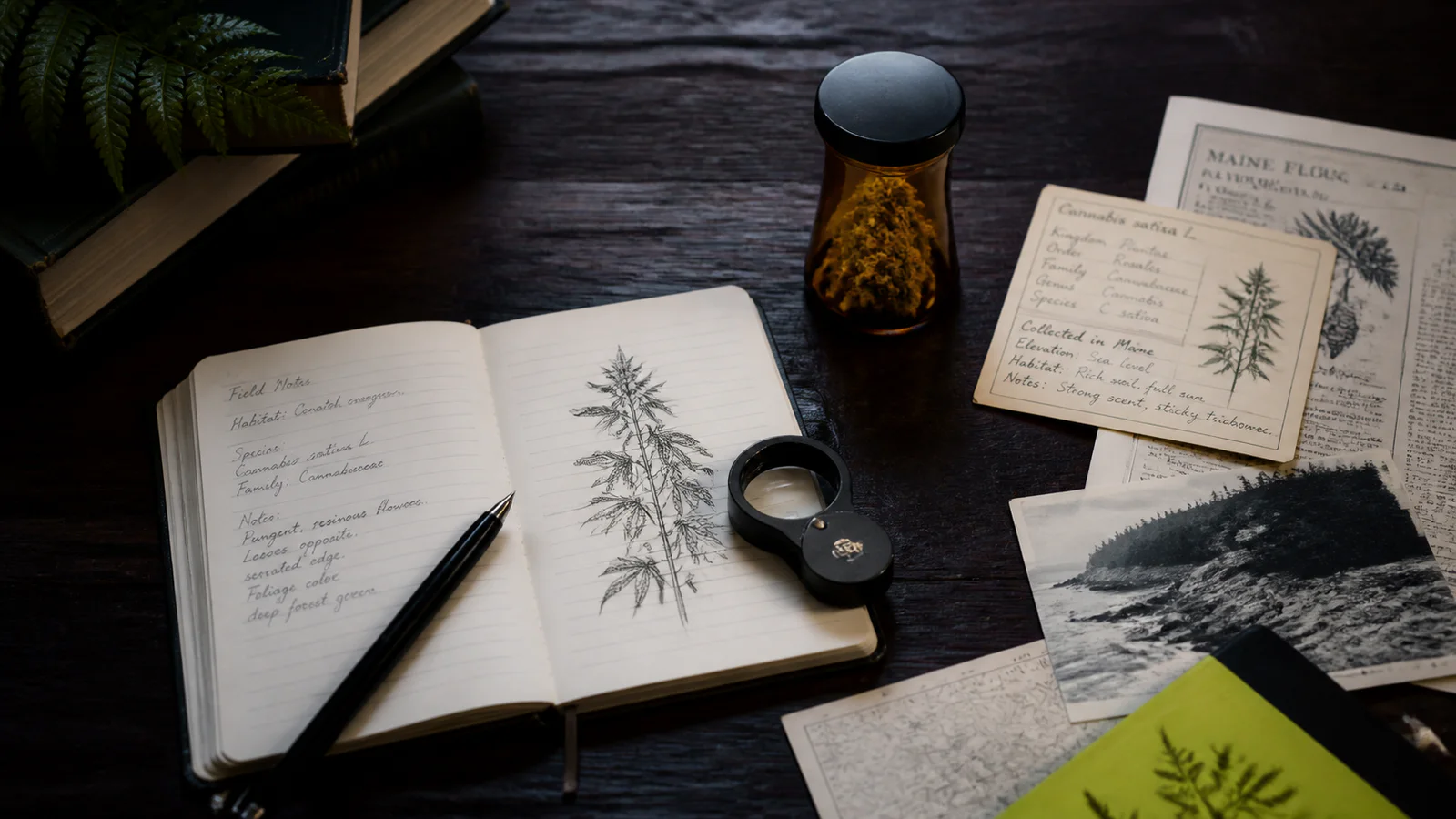
The Mainezilla Field Guide · Cannabis Science
A rigorous, plain-language guide to what cannabis terpenes are, what a laboratory panel actually measures, what the evidence can—and cannot—support, and how Maine patients can ask better questions.
Terpenes are a broad family of volatile compounds made by plants and other organisms. In cannabis, many are produced and stored in glandular trichomes alongside cannabinoids. They contribute to aroma, participate in plant biology, and can be measured in a sample. None of that makes a terpene panel a prescription.
A laboratory chemistry question. Which compounds were included in the method, detected in this sample, and reported in which units?
A sensory question. What aromas do you notice, under what conditions, and how do your words compare with another person’s?
A clinical or experiential question. This requires far more evidence and context than the presence of one aromatic molecule.
“Terpene” is often used casually for the whole family. More narrowly, terpenoids are terpene-related compounds modified through oxidation or other chemical change. Retail reports and research papers do not always use the terms consistently, so read the method—not only the heading.
How the plant and the report connect
Every number is the endpoint of a chain. Changes anywhere in that chain can change what reaches the page.
Genetics, phenotype, plant development, and cultivation environment shape the volatile profile.
Harvest timing, drying, curing, grinding, temperature, oxygen, and time can alter volatile compounds.
The laboratory receives a portion of a batch. How representative it is matters.
The instrument, preparation, calibration, analyte list, and reporting limit shape the result.
The COA describes that tested sample at that time—not every product sharing its strain name.
Research on cannabis inflorescences has shown that drying and storage conditions can materially change volatile profiles. “Same strain” does not erase post-harvest history.
Six compounds you will see often
Aroma descriptors are vocabulary, not universal perceptions. These cards distinguish what a compound can help describe from what marketing commonly overstates.
Evidence reality: Frequently marketed as a sedation or “couch-lock” signal. A myrcene result does not establish that outcome in a person, and the human evidence needed for that prediction is not there.
Evidence reality: A 2024 controlled study in healthy adults found that higher doses of vaporized D-limonene reduced some acute anxiety ratings caused by THC. That is an interesting specific result—not proof that limonene-rich flower treats anxiety.
Evidence reality: Often promoted as a focus aid or as protection against THC-related memory effects. Those retail promises have not been established by adequate human clinical evidence.
Evidence reality: Preclinical research has explored biological activity, but smelling linalool or seeing it on a panel does not prove sedation, anxiety relief, or a clinical effect from a cannabis product.
Evidence reality: It can interact with CB2 receptors in experimental settings, which makes it scientifically interesting. Receptor activity alone does not demonstrate that a retail product will relieve inflammation or pain in a patient.
Evidence reality: Common effect charts disagree about whether it is calming or energizing. That contradiction is the lesson: aroma classification is more defensible than an outcome prediction.
Important: cannabis aroma is not made of terpenes alone. Researchers have identified sulfur compounds that can contribute strongly to characteristic “skunky” aromas even at very low concentrations.
Evidence literacy
A petri dish, an animal model, a survey, and a randomized human trial answer different questions. A strong education tool tells you which rung of the ladder supports a claim.
It is a hypothesis that cannabis compounds may interact in ways that change an overall response. The idea is scientifically testable, but it is not a license to assign a benefit to any terpene combination. Reviews continue to find limited and uneven clinical evidence, while receptor studies have produced results that do not support some common assumptions.
Defined preparation, appropriate comparison, meaningful outcome, adequate sample, and reproducible results.
Can identify a signal or association. It may not generalize to other doses, products, populations, or outcomes.
Helps form hypotheses. It cannot by itself establish a medical benefit in people.
Valuable for questions and personal records. Vulnerable to expectation, selection, dose, setting, and labeling differences.
A clean icon beside “sleep” or “focus” does not reveal the study design because there may not be one.
Laboratory literacy
Treat the certificate of analysis as a record with an identity, scope, and method—not a menu of promised moods.
| Analyte | % w/w | mg/g |
|---|---|---|
| β-Myrcene | 0.42% | 4.2 |
| D-Limonene | 0.21% | 2.1 |
| β-Caryophyllene | 0.17% | 1.7 |
| α-Pinene | 0.08% | 0.8 |
| Other reported analytes | 0.26% | 2.6 |
| Reported total* | 1.14% | 11.4 |
*Illustration only. A “total” depends on what the method measured and how the laboratory calculated it.
Producer, product type, sample or batch number, and dates should connect the report to the item in front of you.
For mass concentration, 1.00% w/w is approximately 10 mg/g. Do not compare a percentage with mg/g as though the numbers use the same scale.
Which compounds were tested? “Not detected,” “not tested,” and “below the reporting limit” do not mean the same thing.
Look for the laboratory, analytical method, limits, and any notes. Different methods can complicate cross-lab comparisons.
A precise chemistry number does not automatically create a precise forecast of mood, symptom response, or safety.
For Maine medical patients
Maine’s Office of Cannabis Policy states that medical cannabis is not currently subject to mandatory contaminant testing, although some caregivers and dispensaries test voluntarily. Adult-use cannabis operates under mandatory testing rules. A terpene panel is not a contaminant-safety panel.
Read Maine OCP testing guidanceA good answer can include “we do not know.” Certainty without a matching record is not transparency.
Quick myth check
“Myrcene was measured in this batch. Sedation is not predictable from that result alone.”
“The reported total describes measured compounds in one sample; quality and safety require more context.”
“Compound interactions remain an active research question; specific clinical claims need specific human evidence.”
Frequently asked
These answers are deliberately narrower than most consumer terpene charts. That is a feature, not a missing promise.
Terpenes are not generally treated as the primary intoxicating compounds in cannabis; THC is chiefly responsible for cannabis intoxication. That does not make concentrated terpenes automatically harmless, and it does not establish what a terpene will do in a finished product.
Not reliably. Research found that commercial indica–sativa labels poorly captured overall genomic and chemical variation, although a small number of aroma-associated terpenes helped explain how people applied those labels.
No universal quality threshold exists. A total can only reflect the compounds included in that laboratory’s panel and the sample it received. Freshness, contaminants, identity, cure, storage, personal preference, and the completeness of the report all matter.
Use caution. Confirm the sample type, units, analytical method, analyte list, reporting limits, and dates. A shorter panel can produce a lower total simply because fewer compounds were measured.
Terpenes are only part of cannabis aroma. Other volatile compounds—including sulfur compounds—can matter at very low concentrations, and the product may have changed between testing, packaging, storage, and opening.
No. A terpene name, aroma, preclinical mechanism, or association is not proof that a cannabis product prevents, treats, or cures a condition. Discuss medical decisions, symptoms, interactions, and risk factors with a qualified clinician.
Research trail
We prioritize government guidance, peer-reviewed human research, analytical studies, and primary plant-science research. Sources are reviewed for what they actually establish—not borrowed as decoration for a stronger claim.
Editorial review: August 9, 2026. We update this guide when stronger evidence or Maine program guidance changes.
Keep learning
Use the glossary for unfamiliar terms, learn how to read a strain profile, or save what you want to investigate in MyZilla.
Educational information only. This guide is not medical advice and does not establish that a cultivar, terpene, or product is safe, effective, or appropriate for an individual. Cannabis can cause impairment and other health risks. Discuss symptoms, medications, pregnancy or breastfeeding, mental-health history, cardiovascular risk, and treatment decisions with a qualified health professional. Keep cannabis away from children and pets; do not drive while impaired.