
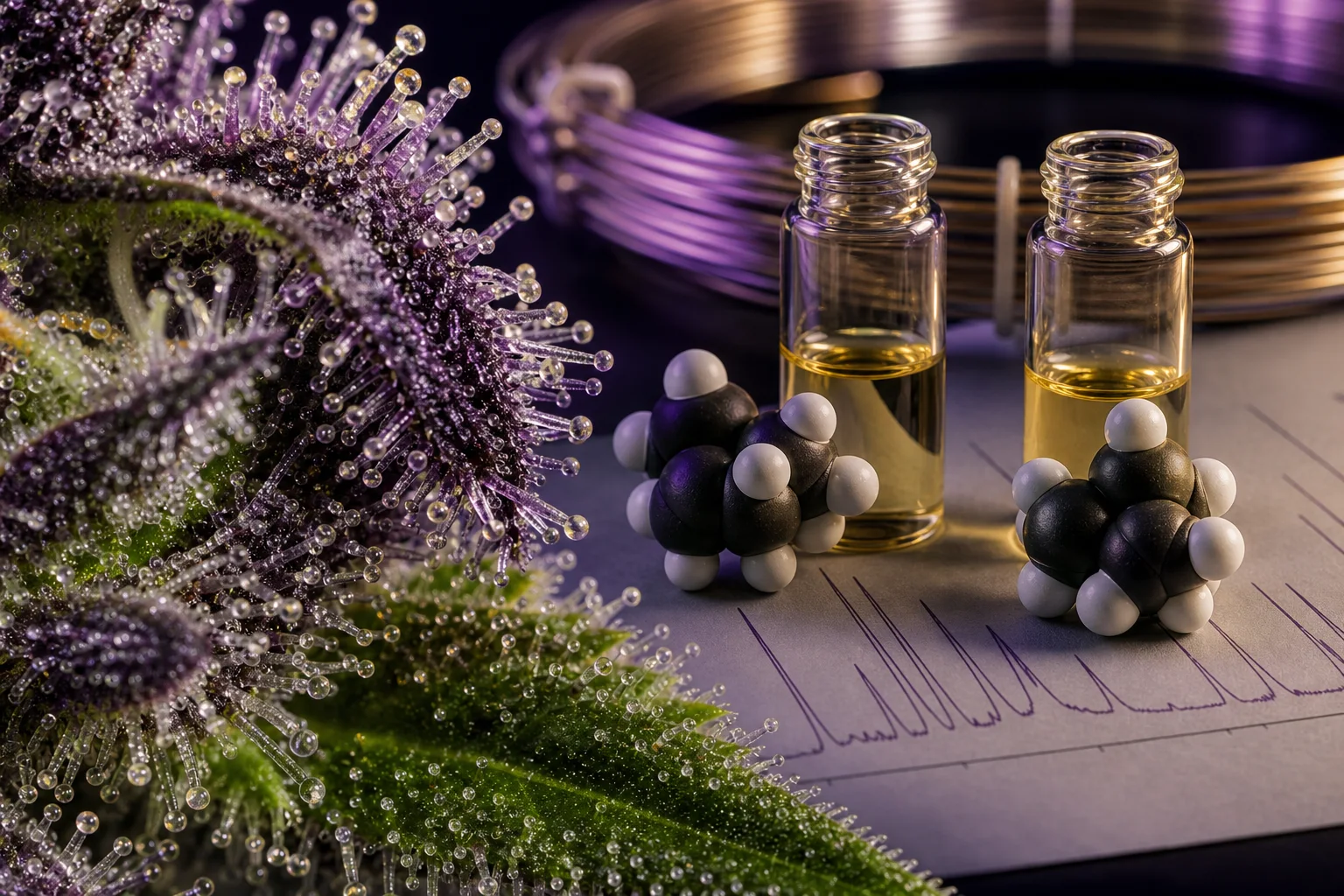
Trichomes, terpene standards, and molecular models: connecting plant microstructure to the molecules (α‑ and β‑pinene) measured in laboratories.
Mainezilla original editorial visual · AI-assisted art directionWhat α‑ and β‑Pinene are — close cousins, distinct aromas
Alpha‑pinene (α‑pinene) and beta‑pinene (β‑pinene) are constitutional isomers: both are C10 bicyclic monoterpenes but differ in how a double bond is positioned in the bicyclic ring system. That small structural change shifts physical properties, odor character, and how enzymes make them in plants. In everyday language they’re both called “pinene” and often described as piney, resinous, or forest‑like, but experienced noses can distinguish the sharper, more camphene‑like note of one isomer from the other in complex botanical matrices.
Both isomers have enantiomers (mirror‑image forms) that can smell different and are produced with stereochemical preference by specific terpene synthases. That stereochemistry can be important for scent perception and for how biological systems interact with a molecule, even when the carbon skeleton is the same.
Within cannabis, α‑pinene and β‑pinene are among the most commonly reported monoterpenes across commercial and research collections; their presence is a major reason some chemovars are described as “pine,” “conifer,” or “herbaceous.”
- α‑pinene and β‑pinene: constitutional isomers with different double‑bond placement.
- Both have chiral (enantioselective) forms that influence aroma and biological interactions.
- Frequently abundant in cannabis terpene profiles and responsible for piney notes.
Chemistry and analytical realities: structure, stereochemistry, and GC artifacts
On paper the difference between α‑ and β‑pinene is small, but chemically it matters: each isomer will undergo different reactions (ozonolysis, oxidation) and will show distinct retention and fragmentation patterns in chromatographic systems. Authoritative compilations such as the NIST WebBook summarize physical constants and mass spectra that laboratories commonly use for compound identification; however, identification by a single peak or a single mass fragment is not proof against misassignment in complex samples.
Two important analytical realities to keep in mind: many monoterpenes are volatile and labile, and gas‑chromatography injection conditions can cause thermal isomerization or rearrangement on column or in the inlet. The analytical literature documents on‑column transformations for small bicyclic monoterpenes, and modern laboratories mitigate these risks by using appropriate inlet conditions, internal standards, and orthogonal confirmation (e.g., retention index, enantioselective columns, or complementary techniques).
Finally, stereochemical resolution requires an enantioselective column or chiral analysis; routine GC‑MS terpene panels used by many testing labs quantify the total of an isomeric pair without resolving enantiomers, which is usually sufficient for aroma profiling but insufficient if stereochemistry is relevant to a specific claim.
- NIST and similar reference data are primary tools for identification but not a substitute for method validation.
- Thermal rearrangement on GC can create artifacts unless carefully controlled.
- Enantiomeric composition is rarely reported in routine cannabis terpene panels.
Biosynthesis in Cannabis sativa: where pinene comes from and how genetics matter
Terpene biosynthesis in plants starts from five‑carbon isoprenoid units assembled to geranyl diphosphate (GPP) for monoterpene production. In plastids the methylerythritol phosphate (MEP) pathway makes GPP, and terpene synthase (TPS) enzymes take GPP and fold/cyclize it into specific monoterpene products. In Cannabis sativa a family of CsTPS genes encodes enzymes that produce many of the monoterpenes observed in resin, including enzymes that produce α‑pinene and multi‑product enzymes that give mixtures including pinene alongside other monoterpenes.
Multiple genomic and transcriptomic studies have shown that a relatively small number of CsTPS genes dominate the terpene profile in a given cultivar, but genetic variation among cultivars (single nucleotide polymorphisms, presence/absence of particular TPS alleles) and tissue‑specific expression produce the chemotypic diversity growers and labs observe. In other words, whether a plant smells ‘pine’ and whether that smell is α‑ or β‑pinene‑dominated is ultimately a function of which TPS genes are present and how strongly they are expressed in trichomes.
Because many CsTPS enzymes are multi‑product (they generate a characteristic bouquet rather than a single product), co‑occurrence patterns (e.g., strong positive correlation between α‑ and β‑pinene in population surveys) likely reflect shared enzyme activity or common upstream regulation rather than independent production pathways.
- GPP is the direct precursor; CsTPS enzymes convert GPP to α‑ or β‑pinene (among other products).
- Genetic variation in CsTPS genes explains cultivar differences in pinene content.
- Multi‑product TPS enzymes create terpene co‑occurrence patterns commonly seen in datasets.
Aroma, environment, and post‑harvest: why two samples from the same cultivar differ
Terpene profiles are not fixed fingerprints. Environment (light, temperature, nutrient status), development stage (early vs. late flowering), and plant part (leaf vs. bract vs. stalk) each influence both the total terpene pool and the relative proportions of particular monoterpenes. Because monoterpenes are small and volatile, they are especially sensitive to losses during drying and curing and to chemical changes induced by heat and oxygen exposure.
Commercial surveys of U.S. cannabis samples show substantial variability in terpene content across brands and batches; α‑ and β‑pinene are common but their absolute and relative abundance varies widely, and co‑occurrence with other terpenes is consistent with underlying biosynthetic constraints rather than direct functional synergy. Post‑harvest handling — rapid drying, exposure to sunlight or heat, and long storage — can reduce monoterpene concentration and shift sensory experience even when cannabinoid content is unchanged.
From a grower’s perspective this explains a familiar result: two harvests labeled with the same strain name can smell different because the plants experienced different microclimates, were harvested at different maturities, or because curing and packaging practices differed.
- Light, temperature, and plant developmental stage change terpene expression.
- Drying, curing, and storage disproportionately affect volatile monoterpenes like pinene.
- Population studies show consistent co‑occurrence patterns attributable to biosynthesis and sample handling.
Laboratory reporting: what to read in a terpene certificate and what to question
An accurate reading of a terpene certificate requires more than the numbers. First, check the method: was the analysis GC‑MS with validated retention indices, an internal standard, and limits of detection reported? Was sample preparation described (solvent extraction vs. headspace vs. thermal desorption)? Each choice can change which monoterpenes survive to be measured and how accurately they’re quantified.
Second, look for caveats about enantiomer resolution and on‑column artifacts. Routine 1‑D GC‑MS terpene panels usually report total α‑pinene or total β‑pinene without enantioselectivity; they also frequently rely on thermal desorption and split/splitless injection, conditions under which labile monoterpenes can rearrange unless the lab documents controls. If the certificate includes retention indices or uses orthogonal confirmation (e.g., co‑injection with standards, enantioselective columns), that strengthens confidence.
Third, batch variability and sample age matter. Because monoterpenes degrade or evaporate over time (adsorbent cartridges and storage studies show measurable losses of α‑pinene), a certificate issued weeks after harvest or after extended storage may underrepresent what the consumer smelled in the jar at opening.
- Prefer labs that publish method summaries, LOD/LOQ, and use internal standards.
- Retention index + standard confirmation reduces misidentification risk.
- Pay attention to sample age and storage notes on certificates.
Evidence trail: [8]
What the experimental literature says about memory and breathing claims
A common retail and social claim is that α‑pinene counteracts THC‑related short‑term memory effects. That idea traces to preclinical pharmacology and a small but rigorous human laboratory trial that deliberately combined inhaled THC with α‑pinene. The controlled human study tested whether α‑pinene would attenuate acute THC‑induced impairments and used established cognitive tests. It found no robust, clinically meaningful memory rescue across the full dataset; any subgroup or time‑course suggestions were preliminary and underpowered for definitive conclusions.
Preclinical animal work shows biological plausibility for some central nervous system effects of pinene — including interactions with neurotransmitter systems and modulation of inflammation in models — and inhalation exposures can produce respiratory irritation at high concentrations in rodents. Those mechanistic and toxicological signals are valuable for hypothesis generation but do not by themselves demonstrate a benefit or safety profile in humans at concentrations typical of cannabis smoking or vaporizing.
Summarizing: pinene has interesting pharmacology and a plausible mechanistic basis for interactions with cannabinoids, but the human evidence is currently very limited; that means claims that a pinene‑rich cultivar will reliably reverse THC‑related memory deficits or reliably improve breathing are not supported by controlled human data at this time.
- A controlled human study specifically testing α‑pinene plus THC did not provide robust evidence of memory rescue.
- Animal inhalation studies show both CNS activity and potential respiratory irritation at high exposures — translational caution is needed.
- Mechanistic plausibility exists but controlled clinical replication is lacking.
Practical guidance for reading claims, reports, and labels
When you see marketing that links ‘piney’ terpenes to guaranteed cognitive or respiratory effects, treat the claim as a hypothesis, not an established fact. Ask whether the claim cites controlled human trials (ideally randomized, double‑blind), or whether it relies on preclinical or in vitro data. If a certificate lists α‑pinene at a modest percent of total terpene mass, remember that measured concentration is not the same as delivered dose in a given use method — delivery can vary widely with inhalation device, temperature, and user behavior.
Use certificates intelligently: compare numeric pinene percentages only between samples analyzed by the same lab and method; a 0.5% α‑pinene reported by Lab A may not be identical to a 0.5% α‑pinene reported by Lab B because of differences in extraction, calibration, and instrumentation. Prefer lab reports that include method details (sample prep, instrument model, column, internal standard) and a date of analysis so you can judge sample age.
Finally, for growers and labs: document harvest maturity, drying and curing conditions, and storage time when submitting samples. For consumers and clinicians reading reports: prioritize studies and clinical evidence rather than anecdotes, and be wary of statements that assert specific medical benefits from single terpenes without human clinical backing.
- Marketing claims ≠ controlled human evidence — ask for study details.
- Only compare terpene numbers across like‑method reports from the same lab.
- Method transparency (sample prep, column, standards) improves interpretability.
Open questions, research priorities, and what to watch for
Key uncertainties remain. We still lack wide, replicated human trials testing whether specific terpene concentrations delivered in realistic use contexts alter cognition or respiratory physiology in consistent ways. The single controlled human study of α‑pinene plus THC is important but insufficient; replication with larger samples, dose–response designs, stereochemical clarity, and attention to delivery method would materially improve confidence.
Analytically, standardization across testing laboratories — especially around thermal inlet conditions, use of internal standards, and reporting of retention indices or enantiomericity — would reduce the cross‑lab noise that now makes population datasets hard to interpret quantitatively. Interlaboratory comparisons that include stability studies (sample age, storage matrices) are especially useful for monoterpenes.
Finally, from a regulatory and program perspective (including Maine’s Office of Cannabis Policy), transparent lab methods, consistent reporting practices, and consumer education about what terpene certificates can and cannot say are practical next steps. Maine’s OCP maintains resources for program participants and public education; while state policy regulates labeling and laboratory oversight, the underlying phytochemistry is governed by biochemistry and analytical chemistry common to cannabis everywhere.
- Need for larger, replicated human trials with realistic delivery of terpenes.
- Analytical standardization and interlab comparisons for labile monoterpenes.
- Regulatory emphasis on method transparency and consumer education.
Questions this guide answers
Do α‑pinene and β‑pinene come from the same biosynthetic pathway in cannabis?
Yes. Both derive from geranyl diphosphate (GPP) produced by the plastidial MEP pathway; terpene synthase (CsTPS) enzymes convert GPP into α‑ or β‑pinene (often as part of a multi‑product bouquet). Genetic variation in CsTPS genes and their expression levels determines which pinene isomer predominates in a given cultivar.
If a lab report lists α‑pinene at 0.5%, is that reliable?
It can be informative but interpret with caution. Check the lab’s method notes (sample prep, instrument, internal standards) and the date of analysis. Monoterpenes are volatile and can degrade or evaporate during drying, curing, and storage, and different labs may report different numbers for the same sample because of methodological differences.
Can α‑pinene in cannabis reverse THC‑related short‑term memory effects?
Controlled human evidence is limited. One controlled human study testing α‑pinene with inhaled THC did not provide convincing, generalized evidence that α‑pinene rescues THC‑induced memory impairment. Preclinical data show mechanisms worth studying, but definitive clinical replication is lacking.
Are there respiratory benefits to pinene inhalation?
Animal inhalation studies show that pinene has biological activity and, at high concentrations, can irritate the respiratory tract. There is no reliable, generalizable clinical evidence that routine exposure to pinene from cannabis provides respiratory therapeutic benefit; high‑dose exposures can cause irritation in animal models.
What should growers and labs do to improve terpene reporting?
Document harvest maturity and post‑harvest handling; use validated methods with internal standards; provide retention indices or standard confirmations; and when possible, include the date of analysis and sample storage history so consumers and researchers can interpret terpene numbers appropriately.
Educational information only. This guide is not medical or legal advice and does not recommend a product, dose, treatment, or outcome.