
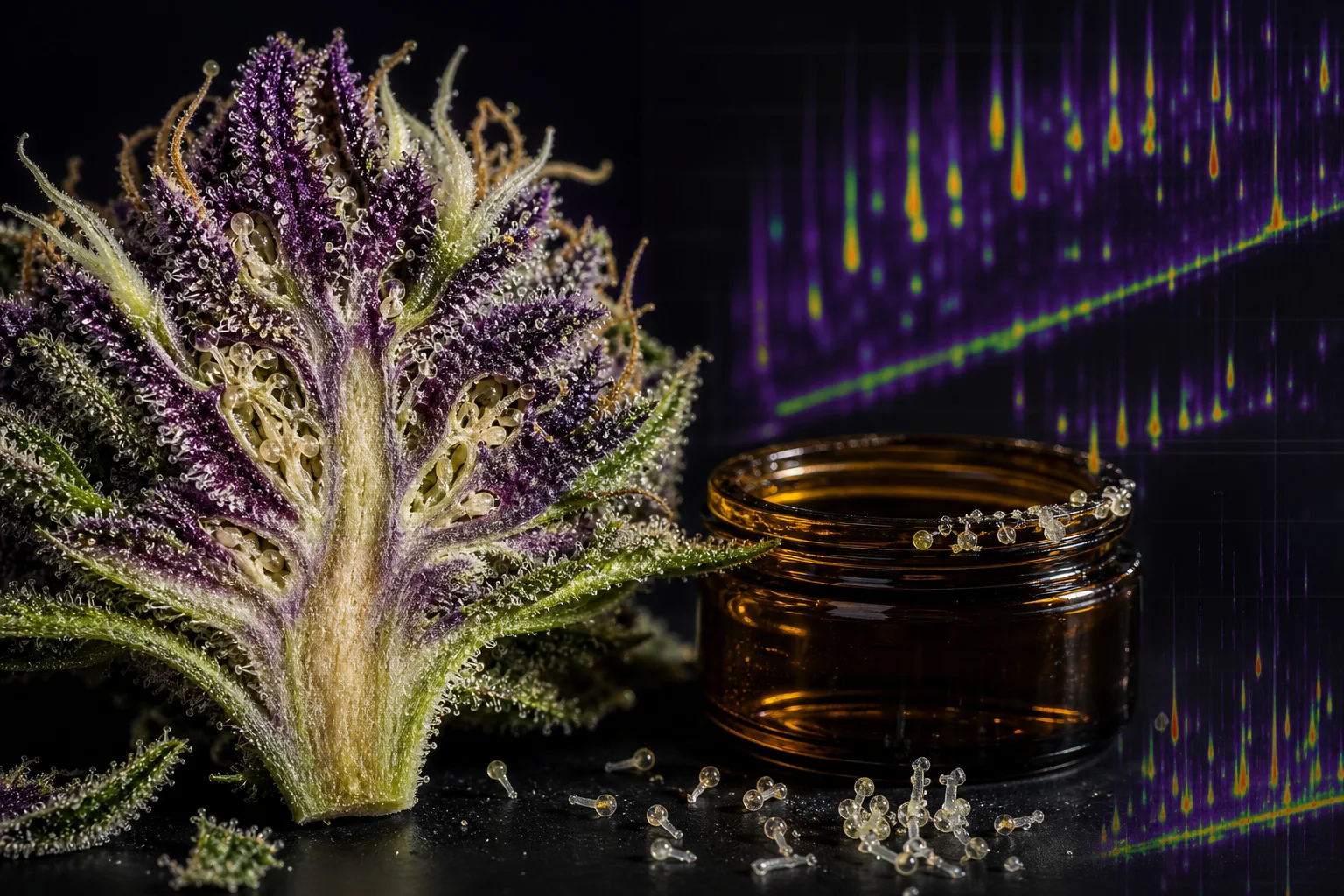
Macro view: trichomes (left) and the chromatographic fingerprint they create (right). Image concept connects plant structure to volatilome measurement without implying use.
Mainezilla original editorial visual · AI-assisted art directionWhy the volatilome is a post‑harvest conversation
When we say “aroma” for cannabis we mean an ensemble of volatile organic compounds (VOCs): monoterpenes, sesquiterpenes, oxygenated terpenoids, volatile sulfur compounds and other trace volatiles. Those molecules are small, chemically diverse, and physically volatile, so their concentrations in a jar are determined not only by the living plant but also by what happens after harvest—how the material is dried, how it is cured, how it is packaged, and how it is stored over days to months.
Primary analyses across dried flowers and processed samples show wide within‑cultivar variability in VOC profiles attributable to post‑harvest processes rather than plant genetics alone. Analytical approaches such as SPME‑GC×GC‑MS or HS‑SPME‑GC‑MS are sensitive to these differences and demonstrate that drying/curing/storage combine to reshape the relative and absolute abundances of aroma compounds.
That distinction matters: growers, lab managers, regulators, and consumers often treat a cultivar name as a reproducible aroma label. In reality, the volatilome is a moving target that requires batch tracking and metadata if you want to know why a particular jar smells the way it does.
Drying: speed, method, and the first big shifts
Drying is the first—and often the most aggressive—post‑harvest transformation for aroma. Rapid hot‑air drying can reduce moisture quickly (hours) and reduce microbial risk, but the combination of elevated temperature and airflow tends to remove highly volatile monoterpenes (for example myrcene, limonene) preferentially because of their higher vapor pressures. Slower ambient drying preserves some volatiles but increases the window for enzymatic activity and microbial growth.
Freeze‑drying (lyophilization) preserves acid cannabinoids and can limit decarboxylation, but several studies show it also causes substantial loss of VOCs responsible for “fresh” floral or citrus notes—presumably because ice sublimation and cold trapping remove volatiles differently than air drying.
Experimental comparisons using tray drying, open air, vacuum‑assisted finishes, and combined approaches find that no single method is universally superior; rather, cultivar traits (trichome density, initial terpene load), intended shelf life, and downstream processing determine tradeoffs. In practice, controlled‑atmosphere or hybrid approaches can shorten drying time while retaining more terpenes, but they require equipment and protocols that must be validated.
Curing: humidity, time, and internal equilibration
Curing (the controlled equilibration of moisture and continued slow conversion of plant chemistry in closed containers) is where aroma profiles can evolve toward stability. Curing tends to raise equilibrium moisture slightly after drying and can allow volatile pools to redistribute between plant matrices and headspace. Proper curing balances slow moisture relaxation against the risk of microbial resurgence.
Studies comparing glass jar curing to open‑air conditioning show that airtight glass jars limit losses caused by continuous airflow, allowing some less volatile oxygenated terpenoids and late‑appearing aroma notes to become proportionately more prominent. Yet curing is not a magic fix—added humidity, poor hygiene, or improper container fills can accelerate spoilage or off‑odors.
Time matters: some desirable aroma components change over days to weeks as minor oxidations and enzyme‑driven rearrangements occur; others decay over months. Reports indicate modest increases in some volatile classes after short curing (days to a few weeks), but prolonged curing at uncontrolled conditions can erode the volatilome.
Storage variables: temperature, light, oxygen, and packaging
After drying and curing, storage exerts the slow but steady effect that most determines aroma in the consumer‑facing jar. Temperature is the dominant accelerator: warmer storage (for example ~25 °C) causes larger shifts in secondary metabolites over the same interval than refrigerated or cool (4–15 °C) storage. Reactions include volatilization losses, oxidative transformations, and, for cannabinoids, decarboxylation when time and temperature combine.
Oxygen and light promote oxidation and photochemical changes in certain terpenoids and sulfur‑containing volatiles. Oxygen permeable packaging or frequent headspace exchange will drive loss of the most volatile monoterpenes and formation of oxidized derivatives that smell different. Light—especially UV and high‑energy visible—can catalyze photodegradation pathways in both terpenes and cannabinoids.
Packaging material and headspace volume matter. Airtight glass with controlled headspace humidity and minimal headspace oxygen is among the better practical choices reported in the literature for preserving volatile profiles; polymeric containers with oxygen transmission and sorptive surfaces can both remove volatiles and create off‑gassing that alters aroma. Active and barrier packaging work in other botanical industries to limit terpene loss and are being investigated in cannabis.
Sampling and measurement: why numbers can disagree
Analytical chemistry for the volatilome has many moving parts: sample prep (grind, weigh, equilibration), headspace capture method (SPME fiber type, temperature, time), and chromatographic separation (1D GC, GC×GC) all influence what a laboratory reports. Small differences in sampling protocol can produce systematically different profiles even on the same physical batch.
Compound volatility and matrix effects make truly quantitative headspace work challenging without validated reference materials and consistent internal standards. SPME is powerful and widely used but is semi‑quantitative unless carefully calibrated; GC×GC gives greater separation for coeluting terpenes and oxygenates but increases method complexity.
Inter‑laboratory exercises and reference materials are essential to interpret whether a measured change reflects the sample or the method. NIST and other metrology efforts have developed standards and round‑robin programs that show sample prep and moisture determination (drying choices) can materially change reported outcomes—so batch records must include how and when sampling was done.
Evidence trail: [5]
Why a strain‑level aroma chart is not a batch record
A cultivar or strain name describes a breeding lineage and often a repeatable plant phenotype under controlled cultivation, but the aroma that reaches a consumer is heavily conditioned by post‑harvest history. Multiple studies that profiled many dried flowers show clustering by processing and storage metadata as much as by genetic label.
Because drying, curing, packaging, and storage can each change volatile abundances by large percentages, a chart that lists a strain’s “typical” terpene fingerprint is best read as a starting hypothesis, not a guarantee. Batch‑level records—harvest date, drying method, cure duration, container type, storage temperature, and sampling method—are the necessary metadata to interpret a real jar’s aroma.
From a regulatory and quality perspective, treating a strain name as provenance is risky. Maine’s program resources emphasize traceability and batch tracking to help link a finished product back to production and post‑harvest records. That linking is what converts a vague aroma expectation into actionable quality control or consumer information.
Practical guidance for reading claims and records (without advising consumption)
When you see aroma claims or a terpene panel, ask for the batch metadata: harvest date, drying method, cure time, container material, storage temperature and how long the lab waited between opening and analysis. Those fields are the single best predictors of whether the measured volatilome matches what’s in the jar today.
Prefer labs that document sampling protocols (grind size, sample mass, SPME fiber or extraction method, equilibration conditions) and that participate in inter‑laboratory comparisons or use validated reference materials. NIST resources and cannabis QA programs promote transparency and standardization; absence of protocol details should lower confidence in direct comparisons between reports.
Look for time stamps: terpene profiles measured immediately post‑drying will differ from those measured after weeks in retail packaging. In regulated markets, batch tracking frameworks (including the inventory systems linked from Maine’s Office of Cannabis Policy resources) are the mechanism to pair a terpene panel with the precise processing history that explains it.
What remains uncertain and where research should go next
We have robust evidence that post‑harvest processing drives volatilome shifts, but precise, generalized kinetics for each compound across cultivars and matrix forms remain incomplete. Many studies are cultivar‑limited, use different sampling methods, or focus on cannabinoids rather than the full suite of volatiles—making cross‑study synthesis imperfect.
Open questions include: the mechanistic pathways of terpene oxidation in complex plant matrices (versus pure standards), the quantitative impact of low‑oxygen controlled‑atmosphere drying across many commercial cultivars, and the long‑term behavior of low‑abundance odorants (including volatile sulfur compounds) that disproportionately influence perceived aroma.
Metrology work—reference materials, round‑robins, and method harmonization—will be decisive. NIST and other programs have begun supplying hemp/cannabis reference materials and organizing inter‑laboratory exercises; continued investment in those resources will let growers and regulators convert disparate measurements into consistent quality signals.
Questions this guide answers
Does drying always reduce terpene content?
Drying typically reduces the most volatile terpenes (monoterpenes) because of their higher vapor pressures, but the effect depends on method and speed. Slow ambient drying can preserve more volatiles than high‑heat, but slows the process and raises microbial risk; freeze‑drying preserves cannabinoids but can still remove aroma volatiles. (See sources 3 and 1.)
Is curing just storing in a jar?
Curing is controlled equilibration after drying, usually in airtight containers with attention to humidity, temperature, and time. Proper curing can stabilize aroma by reducing headspace exchange and allowing minor chemical equilibrations, but improper curing can promote off‑odors or microbial growth. (See sources 3 and 1.)
What storage steps best preserve aroma?
The evidence favors cool, dark, low‑oxygen storage with barrier packaging (for example, amber glass with limited headspace) and minimal temperature fluctuation. Avoid warm storage (~25 °C or above) and exposure to light or air when the goal is long‑term aroma preservation. (See source 7.)
Can a terpene panel predict how a jar will smell on a given day?
A panel is a snapshot tied to its sampling and processing metadata. Without batch information—when the sample was taken, how the product was stored, and how sampling was done—the panel is of limited predictive value for a different jar or a later date. Batch records are necessary for such interpretation. (See sources 5 and 8.)
Are there official standards for volatilome measurement?
Standardization is nascent: NIST and other agencies are producing reference materials and inter‑laboratory programs to harmonize methods, but no single universal standard for all volatilome measurements yet exists. Labs that participate in QA programs and publish methods are more interpretable. (See sources 9 and 10.)
Educational information only. This guide is not medical or legal advice and does not recommend a product, dose, treatment, or outcome.