
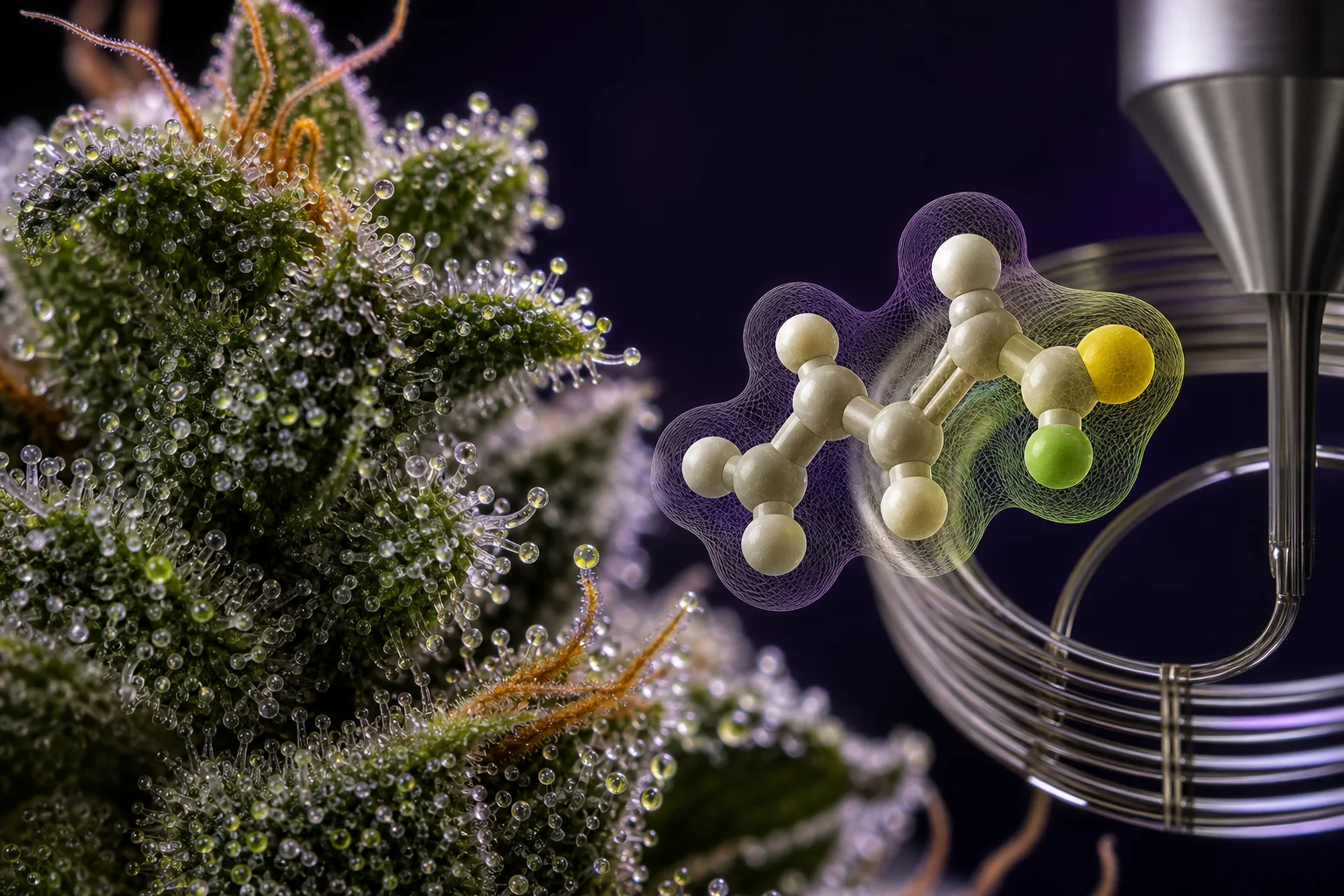
Macro botanical detail paired with a molecular model and chromatography element — a visual synthesis of plant anatomy, sulfur-based aroma chemistry, and the analytical tools used to find prenylated thiols.
Mainezilla original editorial visual · AI-assisted art directionWhy terpenes don’t tell the whole story
For decades the shorthand in grow rooms and on labels has been to blame aroma classes — “citrus,” “earthy,” “skunky” — on terpenes. That shorthand is understandable: terpenes are abundant, chemically diverse, and easy to detect with routine GC–MS panels. But aroma perception is not a simple function of abundance; it is shaped by the chemistry of odor-active molecules and their sensory thresholds. Recent analytical and review work cautions against equating every cannabis scent with a terpene, because a minority of non-terpenoid compounds can impose a dominant olfactory character even at trace levels. ([pmc.ncbi.nlm.nih.gov](https://pmc.ncbi.nlm.nih.gov/articles/PMC12251074/))
Terpenes are isoprenoid hydrocarbons or their oxygenated derivatives; they lack sulfur. Sulfur-containing volatiles — thiols (mercaptans), sulfides, disulfides, and related prenylated sulfur molecules — belong to different chemical families and interact with olfactory receptors differently. That difference is not mere taxonomy: many sulfur compounds have odor detection thresholds orders of magnitude lower than common terpenes, so nanogram or sub-nanogram amounts can dominate perception. This is why calling every aroma a terpene is chemically incomplete. ([pmc.ncbi.nlm.nih.gov](https://pmc.ncbi.nlm.nih.gov/articles/PMC9236214/))
From a practical perspective, the mismatch between what is measured on a typical terpene panel and what the nose perceives has real implications: growers, product developers, regulators, and consumers can be misled if laboratory reports are read as comprehensive aroma inventories. Laboratories and readers must recognize that volatile sulfur compounds (VSCs) are both chemically and analytically distinct from terpenes. ([pmc.ncbi.nlm.nih.gov](https://pmc.ncbi.nlm.nih.gov/articles/PMC12251074/))
What volatile sulfur compounds are important in cannabis?
Volatile sulfur compounds (VSCs) is an umbrella term that includes small molecules such as methanethiol (methyl mercaptan), dimethyl sulfide (DMS), dimethyl disulfide (DMDS), dimethyl trisulfide (DMTS), various thioesters, and thiols with larger side chains. In cannabis specifically, a striking discovery was a family of prenylated volatile sulfur compounds — molecules with a 3-methylbut-2-en-1-yl (prenyl) group attached to sulfur-bearing functional groups — that were linked to the “skunky”, gasoline-like, and tropical notes reported for some varieties. These prenylated thiols appear chemically distinct from the “common” sulfides seen in vegetables or truffles. ([pmc.ncbi.nlm.nih.gov](https://pmc.ncbi.nlm.nih.gov/articles/PMC8638000/))
Among the VSCs identified in cannabis samples, researchers have reported methanethiol, DMS, DMDS, DMTS, and several thioesters and thiols — including prenylated thiols that carry the strong skunk-like signatures. The presence and relative importance of each compound varies by cultivar, harvest stage, and post-harvest handling (drying/curing), but the consistent message is that these are real, reproducible constituents of the cannabis volatilome. ([pmc.ncbi.nlm.nih.gov](https://pmc.ncbi.nlm.nih.gov/articles/PMC8638000/))
A recent quantitation study in hemp flowers further shows researchers are beginning to target key odor-active thiols directly with sensitive analytical chemistry (derivatization plus HPLC-MS/MS), confirming that multiple thiols can be measured across cultivars and that concentrations differ by variety. This emerging body of work moves the field from tentative identification toward controlled quantitation. ([pubmed.ncbi.nlm.nih.gov](https://pubmed.ncbi.nlm.nih.gov/41451450/))
Why sulfur molecules can ‘win’ the nose at tiny concentrations
A defining property of many sulfur volatiles is extremely low olfactory thresholds. Thiols (R–SH) and certain sulfides are among the most potent odorants known in food and natural-product chemistry; they can be detected at parts-per-trillion to parts-per-billion levels in air depending on the molecule and the matrix. This psychophysical potency means that a molecule present at a millionth of the concentration of a terpene may nevertheless dominate the perceived aroma. ([pmc.ncbi.nlm.nih.gov](https://pmc.ncbi.nlm.nih.gov/articles/PMC9502545/))
The qualitative character is also different: short-chain thiols often smell skunky, garlic-like, or onion-like; certain prenylated thiols produce gasoline, skunk, or tropical fruit impressions. Sulfides and disulfides can contribute cooked, cabbagey, or marshy notes. Because human olfaction is non-linear and receptor-specific, the presence of a low-concentration thiol can overshadow higher-abundance terpenes that would, in isolation, smell citrusy or piney. ([pmc.ncbi.nlm.nih.gov](https://pmc.ncbi.nlm.nih.gov/articles/PMC8638000/))
For those interpreting sensory panels or product descriptors, the implication is simple: intensity or evocative adjectives (skunky, gasoline, tropical) are poor proxies for chemical class. Instead, one must look to analytical evidence that targets low-threshold sulfur compounds. Several recent cannabis studies explicitly report these molecules as the chemical correlates of such descriptors. ([pmc.ncbi.nlm.nih.gov](https://pmc.ncbi.nlm.nih.gov/articles/PMC10601067/))
How scientists detect and quantify sulfur volatiles in cannabis
Detecting VSCs in complex plant matrices is technically demanding because many sulfur compounds are reactive, present at trace levels, and poorly recovered by generic extraction methods. Researchers have used targeted and selective approaches: sulfur-selective detectors (e.g., pulsed flame photometric detectors, PFPD), comprehensive two-dimensional gas chromatography (GC×GC) coupled to sulfur-selective or mass detectors, and derivatization followed by HPLC–MS/MS tailored to thiols. Each approach addresses different analytical challenges: selectivity, separation, and sensitivity, respectively. ([pmc.ncbi.nlm.nih.gov](https://pmc.ncbi.nlm.nih.gov/articles/PMC12539713/))
A landmark cannabis study that discovered prenylated VSCs used GC×GC to separate complex co-eluting compounds and paired chromatographic separation with detectors able to reveal sulfur chemistry — an approach that greatly improved confidence in identifications. Other teams have used derivatizing reagents that stabilize thiols and enable very low-level quantitation on LC–MS platforms. The choice of method determines which VSCs are visible on a report and what detection limits apply. ([pmc.ncbi.nlm.nih.gov](https://pmc.ncbi.nlm.nih.gov/articles/PMC8638000/))
Because routine cannabis terpene panels are usually optimized for monoterpenes and sesquiterpenes on a single-dimension GC–MS, they can miss low-level sulfur compounds entirely or report them inaccurately if co-elution occurs. If VSCs are a concern for odor control, compliance, or product description, ask a testing laboratory whether they use sulfur-targeted methods (GC×GC, PFPD, sulfur-chemistry MS, or thiol derivatization with sensitive LC–MS) and what their limits of detection are. ([pmc.ncbi.nlm.nih.gov](https://pmc.ncbi.nlm.nih.gov/articles/PMC9236214/))
Biology and post-harvest dynamics: what we know and what we don’t
Existing studies show VSC concentrations change through plant development and post-harvest handling: certain prenylated VSCs peak in late flowering and can evolve during drying and curing. That timing matches growers’ empiric observation that skunky or tropical notes often emerge as plants mature or are cured rather than being present in early veg. But the specific biosynthetic steps inside Cannabis sativa that assemble prenylated thiols are not fully mapped. ([pmc.ncbi.nlm.nih.gov](https://pmc.ncbi.nlm.nih.gov/articles/PMC8638000/))
Hypotheses for biosynthesis include enzymatic attachments of prenyl groups to sulfur-bearing precursors, and contributions from amino-acid-derived sulfur routes (cysteine, methionine). Microbial action during drying or in the phyllosphere is also a plausible contributor for some sulfides. The current literature documents the compounds and their temporal patterns but is still sketchy on definitive enzymology and gene-level pathways. In short, chemistry has outpaced biology: we can identify the molecules and measure their time course, but the plant pathways and microbial interactions that generate them remain an open research frontier. ([pmc.ncbi.nlm.nih.gov](https://pmc.ncbi.nlm.nih.gov/articles/PMC8638000/))
That uncertainty matters to growers and processors because management decisions (harvest timing, curing humidity and temperature, sanitation) can influence VSC outcome, but there are no universal recipes yet. The evidence supports careful, empirical tracking of aroma plus targeted testing when VSC-driven odors are a concern, while researchers work toward mechanistic understanding. ([pmc.ncbi.nlm.nih.gov](https://pmc.ncbi.nlm.nih.gov/articles/PMC10601067/))
Reading laboratory reports and claims: practical guidance
When you evaluate a lab report or a marketing claim about aroma, start by asking which analytical methods were used. A standard terpene GC–MS panel tells you about monoterpenes and sesquiterpenes — useful information — but it is not proof that low-threshold sulfur odorants are absent. If a report is silent on VSCs but the product smells skunky across multiple samples, that points to a gap between measurement and perception. ([pmc.ncbi.nlm.nih.gov](https://pmc.ncbi.nlm.nih.gov/articles/PMC12251074/))
Look for explicit mention of sulfur-targeted methods: GC×GC with sulfur-selective detection, PFPD, sulfur-specific scanning on high-resolution MS, or derivatization-based LC–MS/MS for thiols. Laboratories that quantify thiols will usually report limits of detection and the derivatization chemistry used; those details matter because some thiols oxidize or bind in sample prep and can be under-reported unless stabilized. The 2026 HPLC–MS/MS method for thiol quantitation in hemp is an example of the kind of targeted assay that can produce reliable numbers. ([pmc.ncbi.nlm.nih.gov](https://pmc.ncbi.nlm.nih.gov/articles/PMC8638000/))
From a regulatory and community perspective, agencies and municipalities increasingly face odor complaints and must decide where to focus mitigation. Maine’s Office of Cannabis Policy provides program resources and guidance on labeling, packaging, and community engagement — useful context for operators — but state regulatory pages do not, and cannot, replace targeted chemistry when the question is which molecular family causes a particular scent. In short: read methods, ask about detection limits, and treat a blank terpene table as incomplete evidence. ([maine.gov](https://www.maine.gov/dafs/ocp/resources))
- Ask whether VSCs were targeted and what the limits of detection are.
- Prefer reports that describe sample prep (to show thiols were stabilized) and the detector used.
- Use sensory panels alongside chemistry: both are informative but neither substitutes for the other.
What remains uncertain — and where research is headed
Several important uncertainties remain. We still lack complete biosynthetic maps for prenylated thiols in Cannabis sativa, including the enzymes and genes responsible. That gap limits breeder-led strategies to select or suppress VSC production with confidence. It also leaves open the role of microbes in generating or transforming sulfur volatiles during drying and storage. ([pmc.ncbi.nlm.nih.gov](https://pmc.ncbi.nlm.nih.gov/articles/PMC8638000/))
On the analytical front, standardized methods and inter-laboratory proficiency for VSC measurement are nascent. Different studies use different extraction approaches and detectors; cross-comparison is complicated by co-elution, reactivity, and matrix effects. Continued method development (e.g., validated derivatization protocols, reference standards for prenylated thiols) and ring trials will be important before VSC numbers can be treated like routine terpene data. ([pubmed.ncbi.nlm.nih.gov](https://pubmed.ncbi.nlm.nih.gov/41451450/))
Finally, controlled human sensory studies that systematically link defined concentrations of identified VSCs to consumer perception and context (fresh flower, cured bud, aerosolized vapor) are still limited. The field has moved quickly from discovery to quantitation; the next step is careful psychophysics and mechanistic plant biochemistry so growers and regulators can move beyond anecdote toward predictable outcomes. ([pmc.ncbi.nlm.nih.gov](https://pmc.ncbi.nlm.nih.gov/articles/PMC10601067/))
Questions this guide answers
Are volatile sulfur compounds the same thing as terpenes?
No. Terpenes are isoprenoid hydrocarbons (and their oxygenated derivatives) and do not contain sulfur. Volatile sulfur compounds (thiols, sulfides, disulfides, thioesters) are chemically distinct and can have much lower odor thresholds, allowing them to dominate aroma at trace concentrations. This distinction is well documented in recent cannabis chemistry and broader food-aroma literature. ([pmc.ncbi.nlm.nih.gov](https://pmc.ncbi.nlm.nih.gov/articles/PMC12251074/))
Do VSCs cause the ‘skunky’ smell in cannabis?
Yes — multiple studies link skunk- or gasoline-like notes to specific sulfur-containing volatiles, including a family of prenylated thiols identified in cannabis. However, the specific molecule(s) and their concentrations vary by cultivar and post-harvest handling, so the term “skunky” can have multiple chemical origins. ([pmc.ncbi.nlm.nih.gov](https://pmc.ncbi.nlm.nih.gov/articles/PMC8638000/))
Will a standard terpene panel used by many labs show these sulfur compounds?
Often it will not. Routine terpene panels are optimized for terpenes and may miss low-level VSCs due to co-elution, lack of sulfur-selective detection, or absence of thiol-stabilizing sample prep. If VSCs are of interest, request sulfur-targeted analyses (GC×GC, sulfur-specific detectors, or derivatization plus LC–MS/MS). ([pubmed.ncbi.nlm.nih.gov](https://pubmed.ncbi.nlm.nih.gov/41451450/))
Can drying and curing change VSC levels?
Yes. Studies report that several sulfur volatiles evolve during late flowering, drying, and curing, and that concentrations can shift over time. The dynamics depend on cultivar, curing conditions, and possibly microbial activity. Those changes are why careful tracking during post-harvest processing is necessary. ([pmc.ncbi.nlm.nih.gov](https://pmc.ncbi.nlm.nih.gov/articles/PMC8638000/))
Where can I find guidance on how Maine regulates cannabis labeling and community concerns about odor?
Maine’s Office of Cannabis Policy provides resources about the adult-use and medical programs, including labeling, packaging, and municipal tools. Those pages are a program-level resource; they do not imply different molecular regulation but can help operators and municipalities with compliance and engagement. See the OCP resources page. ([maine.gov](https://www.maine.gov/dafs/ocp/resources))
Educational information only. This guide is not medical or legal advice and does not recommend a product, dose, treatment, or outcome.