
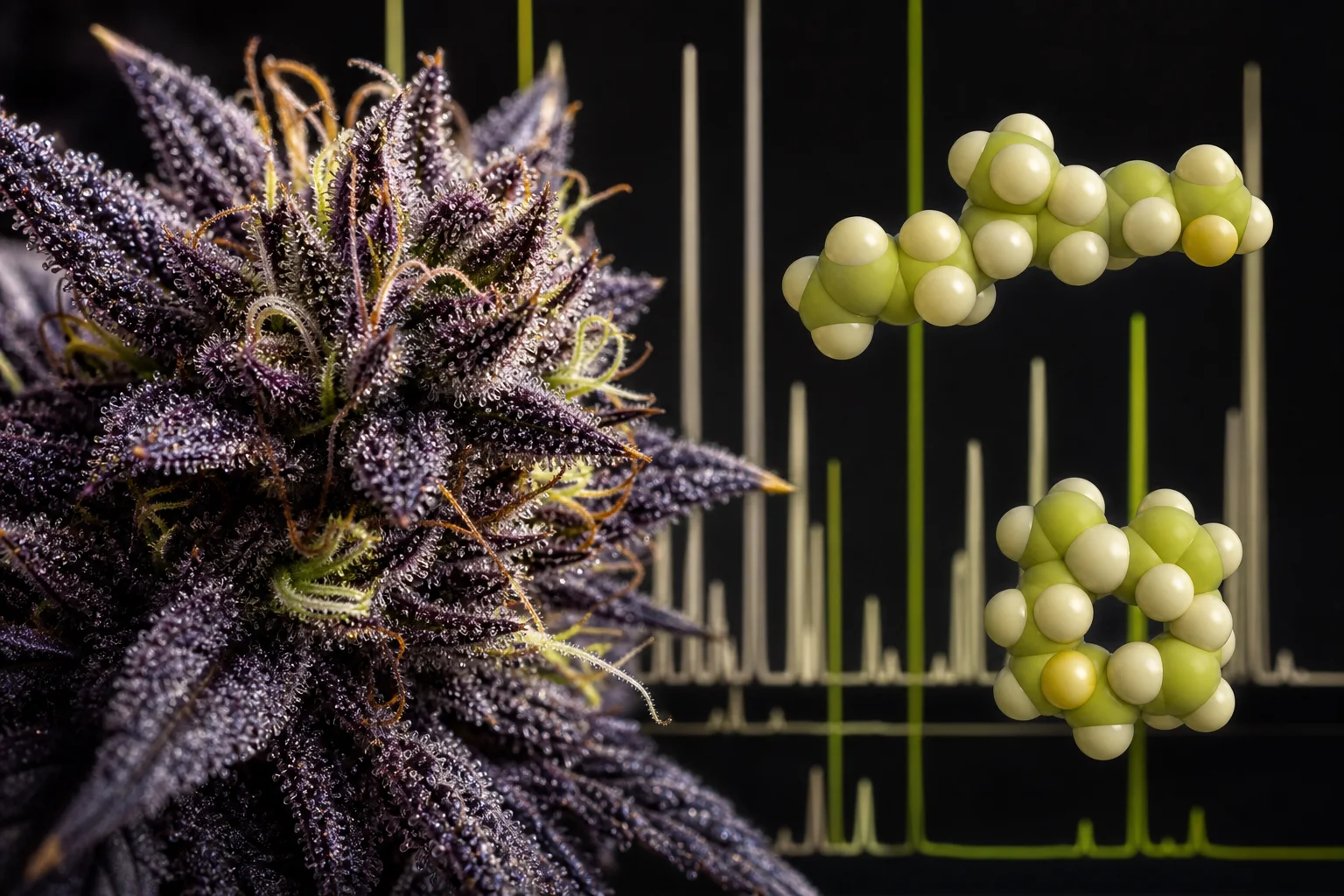
Trichomes — where terpenes are made — paired with molecular models and a schematic chromatogram to remind readers that what we see on a COA is the intersection of plant chemistry and analytical resolution.
Mainezilla original editorial visual · AI-assisted art directionWhy testing panels look the way they do
Testing panels are a pragmatic compromise. Regulators, labs, and licensees work with finite budgets, finite run time, and finite numbers of reference standards; those constraints steer laboratories toward a set of “major” terpenes that explain most aroma and variance in flower samples. Several validated methods and forensic workflows therefore focus on a dozen or so monoterpenes and sesquiterpenes that are both abundant and analytically tractable under common GC-FID or HS-GC/MS setups.
Method-development studies and multi-laboratory validations show the same pattern: a relatively small group of compounds — pinene isomers, myrcene, limonene, linalool, terpinolene, caryophyllene and humulene among them — account for much of the measurable profile in many samples and are therefore prioritized for routine panels. That prioritization reduces cost and complexity for routine compliance testing but also biases what appears on a COA: if a lab’s validated method concentrates on 10–20 analytes, anything outside that list may never be actively sought.
Regulatory guidance and resource pages keep program stakeholders aligned about what to expect on marketplace reports and how to interpret them. In Maine, the Office of Cannabis Policy (OCP) maintains resources and guidance materials for the adult-use and medical programs to help producers and consumers understand which lab outputs are standard and which are optional reporting items.
That pragmatic focus is not an indictment of laboratory science — it is a design choice. The important consequence is that absence from a routine panel is a reporting choice, not definitive botanical evidence that a compound does not exist in the plant.
- Panels are constructed to capture the most abundant, regulatory-relevant terpenes.
- Resource and guidance pages (state programs like Maine OCP) shape expectations for reporting.
- Analytical method availability and cost strongly influence which terpenes are measured.
How coelution, isomers, and column chemistry hide compounds
Gas chromatography — the workhorse for volatile profiling in cannabis — separates compounds by how they interact with a stationary phase and their volatility. But not all terpenes behave cooperatively: many exist as near‑isomeric pairs (cis/trans ocimene, multiple ocimene stereoisomers, several terpinene isomers) that elute very close together. Several method‑development papers explicitly report partial or complete coelution of ocimene isomers with other monoterpenes on common columns, which means a single unresolved peak can contain two or more analytes.
Coelution creates two practical consequences for routine reporting. First, if a method lacks certified reference standards for each coeluting species, labs may quantify the combined peak using a single standard or simply report the largest contributor; second, if the lab’s identification criteria don’t separate components, the result may be reported as “not identified” or omitted from a COA even though the compounds are present in the extract.
Method validation papers used for forensic and forensic‑style cannabis analyses often state explicitly which peaks remain only partially resolved on the chosen instrumentation. Those published method descriptions are an excellent place to look when a report’s COA omits expected terpenes: the laboratory’s validation will typically document coelution, limit of detection (LOD), and limit of quantification (LOQ) for each reported analyte.
In short, coelution is an analytical artifact with real reporting consequences: ocimene and some lesser sesquiterpenes are not inherently invisible, they can be masked by chromatographic overlap unless a lab adopts a targeted separation strategy.
- Coelution = overlapping peaks; isomer complexity makes baseline separation difficult for some terpenes.
- Labs sometimes quantify a combined peak with a single standard or omit unresolved species from reports.
- Method validation documentation usually discloses which compounds are unresolved on a given method.
Why ocimene and α‑humulene crop up inconsistently in reports
Ocimene appears in cannabis but often at lower concentrations than the top monoterpenes; it also exists in multiple stereoisomeric and cis/trans forms that require thoughtful method choice to separate. Published GC‑MS method work explicitly notes that trans‑ and cis‑β‑ocimene can be challenging to baseline‑separate from neighboring monoterpenes on some columns, making routine detection inconsistent unless the lab includes ocimene standards and a resolved method.
α‑Humulene is a sesquiterpene that is commonly reported in many chemovar surveys, but because sesquiterpenes are less volatile and often present in different relative abundances depending on cultivar and processing, their detection can be sensitive to sample preparation (headspace vs. hydrodistilled oil vs. solvent extract) and instrument configuration. When labs adopt headspace methods targeted at the highest‑volatility monoterpenes, lower‑volatility sesquiterpenes can be under‑represented on the resulting COA.
Several targeted and untargeted profiling studies show that both ocimene and humulene are produced biologically in Cannabis trichomes — their presence is supported by biochemical work on terpene synthases — but their measured concentrations and detection frequency vary between studies depending on the analytical workflow.
Put plainly: the plant makes these molecules; whether a report shows them depends on what the lab looked for, how it prepared the sample, and whether the analytical method resolves them cleanly.
- Ocimene has multiple isomers that can coelute with other monoterpenes on common columns.
- α‑Humulene detection is sensitive to sample preparation and instrument method (headspace vs. distillate).
- Biochemical studies confirm biosynthesis of these terpenes; reporting inconsistency stems from measurement choices.
Analytical choices that shape which compounds are reported
A laboratory’s validated analytical method is the single most important determinant of what will end up on a COA. Choices include whether to use headspace sampling or solvent extraction, which GC column chemistry to deploy, whether MS or FID detection is used, and which reference standards are purchased and validated. Each choice carries tradeoffs: for example, HS-GC/MS is non‑destructive and clean for highly volatile monoterpenes, while solvent extraction of oils may expose sesquiterpenes better but add matrix complexity.
Method validation literature used in the forensic and analytical chemistry communities lists coelution problems and LOD/LOQ values for each compound in a panel. When labs publish or provide those validations, they make transparent which analytes are quantified with high confidence and which are approximated or excluded. Modern multi‑analyte methods can detect dozens of terpenes, but routine compliance panels often remain smaller because adding analytes increases cost, complexity, and the burden of procuring pure external standards.
A practical consequence: two reputable labs can analyze the same cultivar and produce COAs that look quite different. One lab’s panel might explicitly list ocimene isomers because their method separates them and they validated standards; another lab might subsume ocimene in an unresolved peak or omit it entirely from its reporting list.
For anyone reading a COA, the relevant questions are therefore procedural: did the lab validate ocimene and humulene on the chosen method, what were the LOD/LOQ values, and what sample preparation pathway was used?
- Headspace vs solvent extraction affects monoterpene vs sesquiterpene representation.
- Column chemistry and detector choice influence separation and quantification accuracy.
- Validation documents (LOD/LOQ, coelution notes) are the best evidence of whether a lab reliably detects a given terpene.
Plant biology versus measurement: where each line of evidence belongs
It’s useful to separate three ideas that are often conflated: (1) biosynthesis (does the plant make the molecule?), (2) analytical detection (can current methods and the lab’s panel detect it?), and (3) pharmacology or human evidence (what it does in animals or people). For ocimene and humulene, the biosynthetic story is straightforward: terpene synthase work identifies enzyme activities that produce β-ocimene and α‑humulene within glandular trichomes, the plant’s terpene production sites.
Analytical work confirms both compounds are present in many cultivars — sometimes at low abundance — but their measurement frequency depends heavily on the study’s analytical depth and whether an untargeted or targeted approach was used. Untargeted metabolomics and HRMS workflows detect a broader volatilome and therefore pick up more low‑abundance species than narrow targeted panels used for compliance.
When it comes to biological activity, most of the evidence for terpenes is preclinical: in vitro assays and rodent behavioral models show that some terpenes (including α‑humulene) produce measurable physiological responses. Controlled human evidence for single terpenes at realistic exposure levels from flower is scarce or absent; translating preclinical findings into human effects requires controlled clinical work that is not yet widely available.
Keeping these domains distinct prevents overstating what a COA can demonstrate: a missing entry on a report is not the same as the plant not having produced a molecule, nor does detection on a COA by itself prove a functional effect in people.
- Biosynthesis: terpene synthase studies confirm ocimene and humulene production in trichomes.
- Measurement: untargeted HRMS picks up more low‑abundance terpenes than targeted panels.
- Evidence hierarchy: most terpene activity data are preclinical; controlled human data are limited.
How to read a COA like a scientist (and a careful grower)
Start with the methods block. A responsible COA will say which analytical technique and column were used (HS‑GC/MS, GC‑FID, GC×GC, etc.), which terpenes were included on the validated reporting list, and LOD/LOQ values. If ocimene or humulene are not listed among targeted analytes, their absence is a reporting omission rather than proof of absence.
Seek the validation or method summary. Many labs include or will provide validation documents that disclose coelution pairs and the degree of separation achieved for each analyte. When a lab flags unresolved peaks in validation, that is precisely the transparent language you want: it tells you where interpretation must be cautious.
Ask about sample handling. Terpenes are volatile and degrade with heat, oxygen, and time. Differences in drying, curing, storage, and sample preparation (e.g., hydrodistillation versus headspace sampling) change which compounds are most readily recovered and quantified. A COA without sample‑history context can still be useful, but interpret it through that procedural lens.
Finally, where uncertainty remains, look for complementing evidence: untargeted HRMS studies, compound‑specific literature, and program resources can clarify whether a missing terpene is likely a laboratory artifact or a true botanical absence.
- Check method type, column details, and whether ocimene/humulene are on the validated list.
- Validation documents disclose coelution and LOD/LOQ — request them if they’re not on the COA.
- Consider sample handling: processing, drying, and storage materially shift terpene recovery.
What remains uncertain — and where research is headed
Analytical coverage is expanding. Recent multi‑analyte headspace and HRMS workflows document dozens of terpenes beyond routine panels, showing a richer volatilome across cultivars. That momentum suggests laboratories can and will add more targets, but resource limits and regulatory harmonization are the gating factors for routine implementation.
We need standardized reference materials that include low‑abundance terpenes and isomeric mixtures so that laboratories can validate separation and quantitation in a way that is interoperable across programs. Without agreed‑upon standards and inter‑laboratory ring tests, panels will continue to differ among reputable labs.
On the biological‑evidence side, controlled human experiments that isolate exposure to single terpenes at concentrations realistic for inhalation or oral use are scarce. Most mechanistic work remains in animals or in vitro, which can point to potential pathways (adenosine receptors, modulation of inflammation, etc.) but not human experiential or therapeutic claims.
Practically, improved crosswalks between untargeted metabolomics studies and routine compliance datasets, along with shared validation resources and program guidance, would reduce surprise differences between COAs and the plant’s true phytochemical complexity.
- Advanced untargeted methods are revealing more low‑abundance terpenes across cultivars.
- Shared reference materials and inter‑laboratory validation are needed for consistent reporting.
- Controlled human terpene exposure studies at realistic doses are still limited.
Practical guidance for growers, regulators, and readers of reports
Growers: when you care whether ocimene or humulene is present or dominant, request a lab method that lists those compounds on the validated panel and ask for the validation sheet. If you want more complete coverage, request an untargeted or expanded panel with HRMS or a validated 40+ terpene headspace method rather than a minimal 8–12 terpene panel.
Regulators and program staff: resource pages and guidance (such as Maine OCP’s resource library) can reduce confusion by listing what a standard COA contains and what is optional. If programs want market comparability, they should specify required analytes, method performance metrics, and acceptable sample‑preparation pathways.
Consumers and product reviewers: read COAs with a method-aware lens. A “not reported” or missing terpene can mean the lab did not include it on the validated panel or that coelution prevented confident identification. Request the method summary or validation when a terpene’s presence or absence matters for labeling or quality stories.
Laboratories: publishing transparent validation data, including coelution matrices and LOD/LOQ for each analyte, reduces misinterpretation and builds trust across the supply chain. The research literature shows workable approaches to expand target lists while documenting where separation remains incomplete; sharing that detail helps everyone interpret what a COA means in chemical and botanical terms.
- Request validation sheets when a specific terpene’s presence matters.
- Programs should harmonize required analytes and method-performance expectations.
- Transparent lab reporting (coelution notes, LOD/LOQ) reduces ambiguity for consumers.
Questions this guide answers
If my lab report doesn’t list ocimene, does that mean my plant doesn’t have ocimene?
Not necessarily. A missing ocimene entry most commonly reflects the lab’s targeted panel, method limitations (coelution or lack of standards), or the sample preparation pathway. The plant can produce ocimene even if a routine COA does not list it; request the lab’s validation and method details to determine whether ocimene was actively targeted and what the LOD/LOQ were.
Why do different laboratories show very different terpene totals for the same cultivar?
Differences arise from sample handling (drying, curing, storage), extraction or headspace method choice, column and detector selection, and which compounds are included on a lab’s validated list. Each of these choices changes recovery and resolution; therefore COAs from different reputable labs can legitimately look different.
Do coeluting peaks mean the lab is wrong?
No — coelution is a known analytical limitation. Responsible labs document coelution in validation reports and either quantify the combined peak, resolve the compounds with a different method, or exclude uncertain analytes from the reporting list. Asking for the validation sheet is the right step to see how a lab handled coelution.
Are there terpenes labs never report but that are important biologically?
Research-grade and untargeted metabolomics workflows detect many low‑abundance terpenes that routine panels omit. Whether those molecules are biologically important in humans is often unknown; current biological evidence for many minor terpenes is preclinical and does not equate to established human effects.
Where can I find program guidance about lab reporting expectations in Maine?
Maine’s Office of Cannabis Policy maintains a resource library and guidance documents for the adult use and medical programs which outline standard reporting expectations and other programmatic resources. Those pages are a practical starting point for understanding how COAs are used within Maine’s regulatory framework.
Educational information only. This guide is not medical or legal advice and does not recommend a product, dose, treatment, or outcome.