
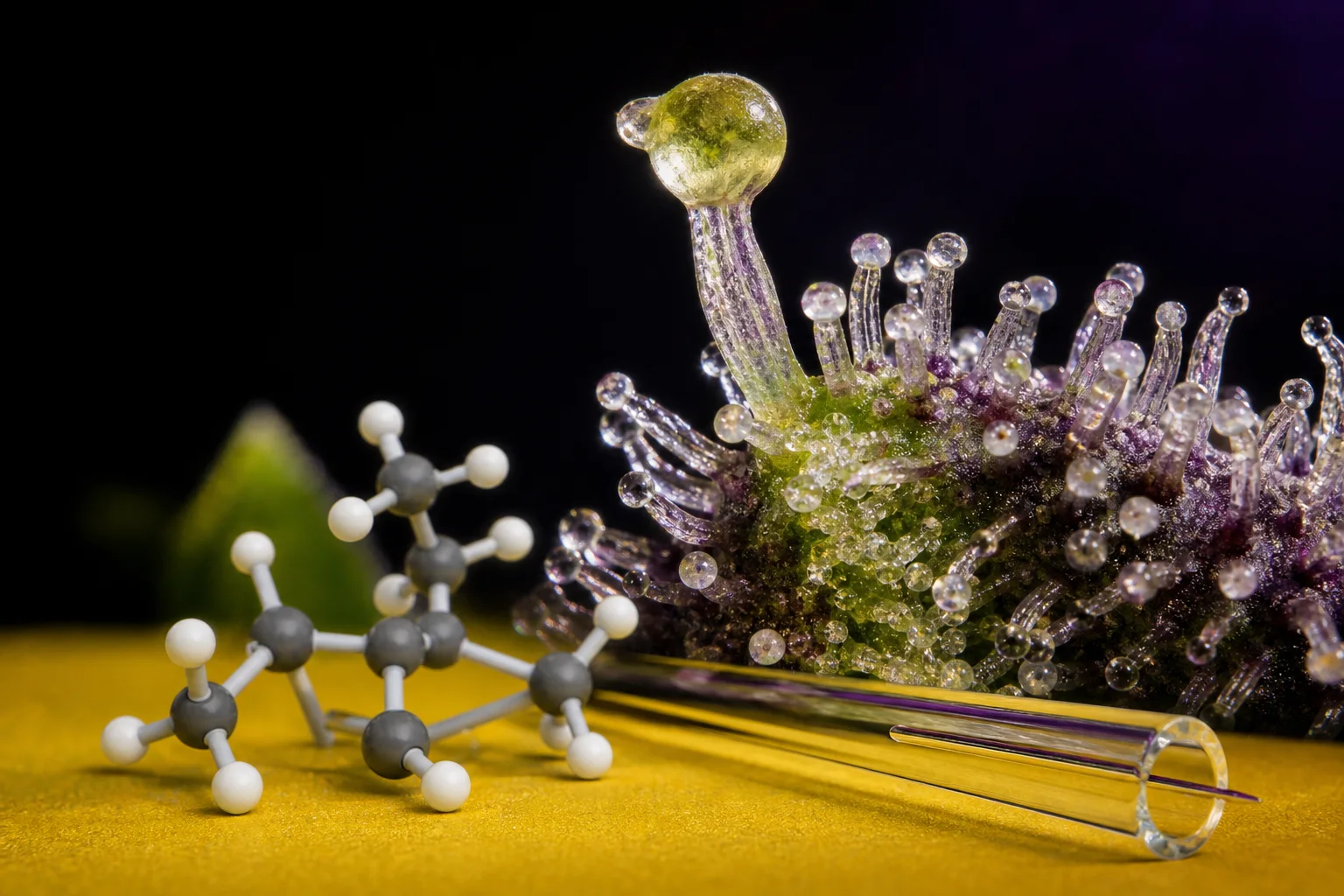
Macro trichomes meet molecular structure: terpinolene is produced in glandular trichomes and identified through chromatography and mass spectra.
Mainezilla original editorial visual · AI-assisted art directionWhat terpinolene is — chemistry in plain language
Terpinolene is a C10 monoterpene (formula C10H16) classified among the p-menthane-type hydrocarbons. It exists as several isomers (commonly referred to as α- and β-terpinolene) and is a hydrocarbon rather than an oxygenated terpenoid; that structural simplicity helps explain both its volatility and its prominence in headspace analyses of fresh plant material. NIST maintains canonical identifiers, molecular formulae, and gas‑phase properties that analytical chemists use to confirm terpinolene in chromatography and mass-spectra libraries.
Chemically, terpinolene’s few functional groups and compact cyclohexene backbone mean it has a lower boiling point and higher vapor pressure than many sesquiterpenes. Those physical properties make terpinolene relatively abundant in vapour-phase or headspace sampling compared with less volatile constituents, and they underlie its outsized role in perceived aroma even when it is not the dominant mass fraction of a resin extract.
Across plant systems, terpinolene is found in many essential oils beyond cannabis (pine‑like, citrusy, herbal sources). Odor reference literature and fragrance compendia typically list descriptors such as fresh, woody, citrus, pine, and herbal for terpinolene; but those descriptors are shorthand for a variable sensory impression that depends on concentration and mixture context.
Where terpinolene shows up in cannabis and how it smells
In cannabis flower terpinolene is one of a band of monoterpenes that frequently appear in cultivar profiles, sometimes as a dominant monoterpene and sometimes as a minor component. Survey and profiling studies of multiple cultivars show wide quantitative variation: some genetics and chemotypes are terpinolene‑rich, others barely register it. That diversity means a single label such as “terpinolene strain” is descriptive of chemistry only, not of an invariant sensory experience or functional effect.
Sensory descriptions in the essential-oils and aromatic-chemistry literature align on a cluster of notes: citrus or lemon-lime top notes, herbal or sage-like mid-notes, and a dry, resinous, slightly woody or piney finish. Because human olfaction is pattern‑driven, the same concentration of terpinolene can read as ‘citrus’ in one sample (when combined with limonene) or ‘herbal/resinous’ in another (when combined with ocimenes or terpinene).
Practical consequence: shop labels or single-number terpene reports that highlight terpinolene should be read as a chemical fact, not a guarantee of a specific aroma or experience. The perceptual character you or another person will register depends as much on the other dozens of volatiles and on freshness and storage as it does on terpinolene percent alone.
How plants make terpinolene: synthases and genetic variation
Monoterpenes in cannabis, including terpinolene, are produced in glandular trichomes via the plastidic methylerythritol phosphate (MEP) pathway that supplies the universal monoterpene precursor geranyl diphosphate (GPP). Monoterpene synthase enzymes (CsTPSs) accept GPP and—through carbocationic cyclizations and rearrangements—generate specific monoterpene scaffolds. Different CsTPS genes thus explain, in large part, cultivar-level differences in monoterpene composition.
Historically, several CsTPS enzymes have been cloned and functionally characterized for products such as myrcene, limonene, linalool and ocimene; terpinolene‑forming activity has been reported but the family of terpene synthases that produce terpinolene and its co‑products is complex. Genomic surveys find clusters of TPS genes and recurrent co‑variation between terpinolene and congeners (α‑/γ‑terpinene, carene, phellandrene). These co‑occurrences suggest either single multi‑product synthases or closely linked TPS paralogs producing similar outputs.
More recently, structural and functional work has started to resolve product specificity at atomic detail. A growing experimental literature — including crystallography and mutational studies — shows that small changes at key residues in the synthase active site can shift product ratios (for example, pushing an enzyme’s output toward limonene versus terpinolene). That plasticity explains why breeding and even single amino‑acid allelic differences can change a cultivar’s terpene fingerprint without major genomic rearrangement.
Because multiple CsTPSs can be multi‑product enzymes, the same genotype can still produce a range of terpene distributions depending on expression level, developmental stage of trichomes, and metabolic flux through precursor pathways. In short: genetics set the potential, but enzyme structure, regulation, and biochemistry set the realized volatile profile.
Measuring terpinolene: analytical methods and pitfalls
Most commercial and research labs quantify terpenes using gas chromatography—typically GC‑MS or GC‑FID—after one of several sample preparations: direct headspace sampling (HS‑GC), solid‑phase microextraction (SPME), or solvent extraction. Choice of sampling method matters: headspace or SPME preferentially samples more volatile monoterpenes such as terpinolene and limonene, potentially inflating their relative abundance compared with less volatile sesquiterpenes in solvent extracts.
Chromatographic retention indices and mass spectral libraries (for example, those curated by NIST) are the practical backbone for identifying terpinolene across instruments and laboratories. Retention index matching plus mass spectra is the standard for reliable compound ID; however, column polarity, temperature program, and carrier gas all shift retention and can change whether partially co‑eluting isomers are resolved.
Analytical artifacts are a real concern. Some workflows—especially those that use solvents or elevated temperatures—produce degradation products or solvent‑derived artifacts (acetone has been observed as an artifact in some headspace procedures), and co‑elution with structural isomers can misattribute signal to terpinolene when another similar monoterpene is present. These methodological caveats mean that lab records should include method details (column type, RI values, calibration standards) rather than only a final percent.
For readers: a lab result that lists terpinolene and also provides retention index, CAS or InChIKey, calibrated standard trace, and method (HS‑GC vs. solvent extract) is far more trustworthy than an unlabeled percentage. Where possible, look for labs that reference NIST RI or mass‑spectral matches and that report limits of detection and quantitation.
Biology and evidence: preclinical signals, human data limits
A substantial body of in vitro and in vivo preclinical work has tested terpinolene for activities such as antioxidant capacity, insecticidal or larvicidal effects, and antimicrobial action. Systematic reviews collecting these studies find promising mechanistic hints but note heterogeneous methods and superficial characterization in many primary reports. Animal and cell models can show molecular interactions or pathways engaged by terpinolene, but these do not translate directly into human outcomes.
Human clinical evidence specifically attributable to terpinolene is sparse. Where clinical or controlled human studies exist for whole cannabis or essential oil preparations, it is methodologically difficult to separate the contribution of terpinolene from co‑occurring terpenes and cannabinoids. That limitation is common across volatile phytochemical research: aroma compounds are rarely tested as single agents in controlled human trials at realistic inhalation or oral exposures.
When reading claims that terpinolene produces a particular effect in people, note whether the claim rests on (a) in vitro assays, (b) animal studies, (c) single‑compound human trials, or (d) observational or product‑label correlations. The strongest human evidence would be well‑controlled, replicated trials of terpinolene alone at relevant exposure levels; to date, the literature does not support such a level of evidence.
In short, terpinolene is biologically active in several laboratory contexts, but the jump from those findings to human effect claims is not supported by robust controlled clinical data.
Practical guidance for reading lab reports, labels, and claims
Treat a terpene percentage as a measurement artifact without context. Seek the method: was the sample analyzed by headspace or by solvent extract? Which column and what retention index standard were used? Was the lab using external standards or only library matching? Those simple metadata items materially change interpretation of a terpinolene percentage.
Regulatory programs—like the Maine Office of Cannabis Policy—require licensees to participate in testing and make guidance and recall information available; the program pages and annual reports are useful for understanding what the jurisdiction requires and the transparency of testing oversight. Where state programs publish testing protocols or findings (batch recalls, method audits), they offer practical context for how terpene records are produced and audited in the supply chain.
Be cautious with marketing shorthand such as “terpinolene strain” or aroma claims tied to a single terpene. A responsible reading prioritizes method transparency, calibration, and batch‑level information over brand adjectives. If a seller or certifier cannot provide a lab certificate with method metadata on request, treat their terpene numbers as incomplete.
Finally, remember the role of handling: drying, curing, temperature, and storage oxidize and evaporate monoterpenes faster than heavier volatiles. A terpene profile measured at harvest or immediately after curing can look very different from a profile measured after weeks of retail storage.
What remains uncertain and where research is headed
Key open questions remain. Although several CsTPS genes have been characterized, the full complement of terpinolene synthases, their allelic diversity, and their regulation in different chemotypes remain incompletely resolved. Some studies report candidate terpinolene synthases; structural biology and mutagenesis work are beginning to show how small changes alter product specificity, but more genotype‑to‑phenotype mapping is needed across the global diversity of Cannabis sativa.
On the analytical side, standardization is incomplete. Different labs and jurisdictions use different sampling and reporting conventions; harmonizing retention‑index references, reporting limits, and whether headspace or extract percentages are presented would reduce confusion for researchers and consumers alike. NIST resources provide retention indices and mass spectral standards that can help, but uptake is uneven.
Finally, controlled human exposure studies of terpinolene at realistic concentrations—separate from whole‑plant confounds—would clarify whether terpinolene has reproducible perceptual, physiological, or cognitive effects. Until then, mechanistic animal and in vitro data are valuable for hypothesis generation but not for definitive human claims.
Taken together, these gaps are not a critique of the literature so much as a road map: terpene genomics, standardized measurement, and carefully designed human trials are the triad that would move terpinolene from an interesting analytic signal to a well‑understood phytochemical in human contexts.
Questions this guide answers
Does terpinolene make a cannabis sample smell like citrus or pine?
Terpinolene can contribute citrusy, piney, or herbal notes, but its perceived aroma depends on concentration and the mixture of other volatiles. Limonene skews perception toward citrus; ocimene and terpinene congeners shift impressions toward floral or herbal. Read aroma descriptions as emergent properties of the whole volatile profile.
Are terpene labels regulated in Maine?
Maine’s Office of Cannabis Policy requires licensed businesses to follow testing and packaging rules and publishes resources and reports about testing oversight. State resources clarify what programs require, but they do not change the underlying plant chemistry; look to lab certificates and method metadata for the most precise records.
Is one lab result comparable to another?
Not necessarily. Differences in sampling (headspace vs. solvent), GC column, retention index matching, and calibration can produce systematically different numbers. Prefer results that include method details, calibration standards, and retention indices tied to recognized libraries such as NIST.
Does terpinolene cause specific effects in people?
Most human evidence is indirect and confounded by co‑occurring compounds. Preclinical studies show biological activity in vitro and in animals, but controlled human trials of terpinolene alone at realistic exposure levels are lacking—so effect claims should be read as preliminary.
Can storage reduce terpinolene on a label?
Yes. Monoterpenes evaporate and oxidize faster than larger terpenoids. Poor sealing, warmer temperature, and longer storage will reduce monoterpene abundances such as terpinolene more rapidly than more stable sesquiterpenes.
Educational information only. This guide is not medical or legal advice and does not recommend a product, dose, treatment, or outcome.