
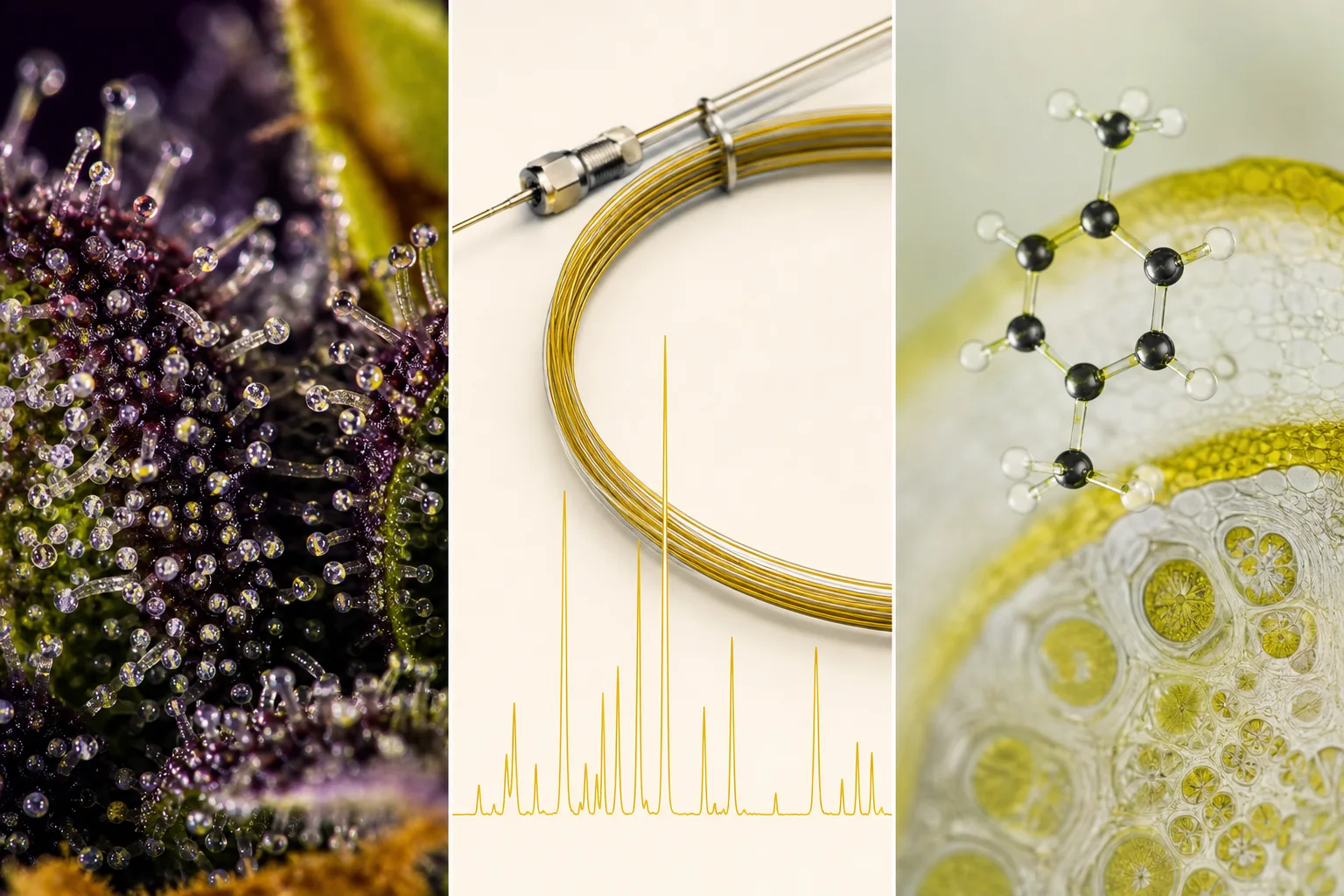
Limonene bridges plant scent and measurable chemistry: glandular trichomes produce volatile terpenes, GC methods quantify them, and the molecule’s structure explains how it fits the citrus odor category. ([nist.gov](https://www.nist.gov/programs-projects/nist-tools-cannabis-laboratory-quality-assurance))
Mainezilla original editorial visual · AI-assisted art directionAn identity card: what limonene is, and why it smells like citrus
Limonene is a simple monoterpene hydrocarbon (C10H16) commonly reported as the dominant volatile in citrus peel oils and a frequent top terpene in many cannabis chemotypes. Chemically it exists as enantiomers (d- or l- forms) that can differ in odor character and some biological interactions; the industrial and analytical literature treats the molecule by name and by mass rather than by strain lore. ([webbook.nist.gov](https://webbook.nist.gov/cgi/cbook.cgi?ID=C138863&Mask=2280&Units=CAL))
In plants, limonene originates from the plastidic MEP (2-C-methylerythritol 4-phosphate) pathway via geranyl diphosphate and specific synthases; in cannabis it is part of a broader volatile bouquet produced in glandular trichomes, not a unique “active ingredient” that acts alone in planta. Reporting of limonene on a certificate of analysis reflects its abundance among volatiles at the time of sampling and analysis, not an immutable trait of a cultivar. ([nist.gov](https://www.nist.gov/programs-projects/nist-tools-cannabis-laboratory-quality-assurance))
Two practical consequences follow: first, aroma and chemistry are related but not identical — perceived citrus depends on limonene plus complementary volatiles and the human olfactory system; second, the molecule’s pure chemical identity is straightforward to measure when labs use validated methods and reference materials. ([webbook.nist.gov](https://webbook.nist.gov/cgi/cbook.cgi?ID=C138863&Mask=2280&Units=CAL))
How labs measure limonene in cannabis — instruments, standards, and limits
Most cannabis terpene profiles are generated by gas chromatography coupled to mass spectrometry (GC‑MS) or flame ionization detection (GC‑FID) after headspace or solvent extraction; these techniques separate volatile compounds by retention time and identify them by mass spectra or detector response. The robustness of any reported limonene value depends on method validation (linearity, limit of detection, recovery) and on use of appropriate reference materials. ([nist.gov](https://www.nist.gov/programs-projects/nist-tools-cannabis-laboratory-quality-assurance))
NIST has invested in accessible measurement infrastructure for cannabis testing — providing standard reference materials, method guidance, and laboratory quality programs — because variation in sampling, sample prep, and instrument calibration produces inconsistent terpene numbers across labs. For a consumer or researcher, the practical takeaway is to favor results from labs that participate in quality programs and that report methods and units clearly. ([nist.gov](https://www.nist.gov/programs-projects/nist-tools-cannabis-laboratory-quality-assurance))
Reporting conventions differ: some labs give weight-by-weight percentages for whole flower; others report milligrams per gram or parts‑per‑million for extracts. Differences in sample type (flower vs. extract), sample handling (drying, curing), and the analytical technique (e.g., solvent extract vs. headspace SPME) will change measured limonene even for the same harvested plant. Reading a certificate of analysis therefore requires attention to method notes and the sample matrix. ([nist.gov](https://www.nist.gov/programs-projects/nist-tools-cannabis-laboratory-quality-assurance))
- Key lab checks: methods, limits of detection, calibration standards, and participation in a quality-assurance program.
- Matrix matters: flower, essential oil, and vapor condensates give different terpene distributions and concentrations.
- Sample handling (drying, curing, storage) can reduce volatile limonene before analysis.
Plant function versus human pharmacology: separating roles
Within the plant, limonene likely serves ecological roles common to many volatiles: attracting pollinators, repelling herbivores or microbes, and contributing to the olfactory signature of particular chemotypes. These are biological functions at the tissue or organism level and do not translate directly into predictable human drug effects. ([webbook.nist.gov](https://webbook.nist.gov/cgi/cbook.cgi?ID=C138863&Mask=2280&Units=CAL))
Human pharmacology treats limonene as an exogenous small molecule subject to absorption, distribution, metabolism, and excretion. Its lipophilicity and volatility mean that route of exposure (inhalation vs. ingestion) strongly shapes blood and tissue exposure; controlled measurements in animals and humans show detectable systemic metabolites following oral and inhaled dosing. That is, aroma ≠ systemic dose unless you quantify exposure. ([pubmed.ncbi.nlm.nih.gov](https://pubmed.ncbi.nlm.nih.gov/27325307/))
Consequently, when people equate citrus aroma with a specific psychological or physiological outcome, they conflate three distinct things: a sensory impression (odor), an analytical concentration (lab number), and a pharmacological exposure (dose at target tissues). Good reporting keeps those channels separate. ([webbook.nist.gov](https://webbook.nist.gov/cgi/cbook.cgi?ID=C138863&Mask=2280&Units=CAL))
What preclinical studies show — mechanisms and boundaries
Mechanistic work in cell culture and animal models has identified several plausible molecular interactions for limonene, including modulation of inflammatory signaling, interaction with adenosine A2A receptors, and effects on neurotransmitter systems in brain regions relevant to mood. These findings provide hypotheses for how limonene might influence physiology but are not substitutes for controlled human data. ([pubmed.ncbi.nlm.nih.gov](https://pubmed.ncbi.nlm.nih.gov/33548867/))
Animal inhalation and oral studies show that limonene can alter measures of airway inflammation, behavior in anxiety models, and cytokine expression under certain experimental conditions. Dose, timing, and formulation matter: rodent inhalation chambers and oral gavage produce very different systemic kinetics, and results do not scale linearly to humans. ([pubmed.ncbi.nlm.nih.gov](https://pubmed.ncbi.nlm.nih.gov/22564095/))
A cautionary example from toxicology: high doses of some otherwise common fragrance chemicals can produce organ-specific effects in rodents that are mediated by species-specific pathways; toxicology data should be read as context for safety margins, not as evidence of beneficial effect. For limonene, human pharmacokinetic and metabolite studies help bridge this gap but do not resolve efficacy questions. ([ncbi.nlm.nih.gov](https://www.ncbi.nlm.nih.gov/books/NBK402143/))
Controlled human evidence: what we have and what it allows us to say
Human experimental evidence on limonene in the context of cannabis is sparse but notable. One randomized, double‑blind human laboratory study administered vaporized d‑limonene with and without THC and observed dose‑ordered reductions in THC‑related self‑reported anxiety and paranoia when a higher limonene dose accompanied a moderate THC dose. The trial used controlled doses, repeated measures, and blood assays for the terpene and cannabinoids. This is important as a first controlled demonstration that a single terpenoid can modify an acute cannabis effect under specific conditions. ([pmc.ncbi.nlm.nih.gov](https://pmc.ncbi.nlm.nih.gov/articles/PMC11031290/))
However, limits are substantial: the trial evaluated healthy adults in a laboratory setting with experimentally vaporized constituents, short-term outcomes, and a narrow set of subjective and psychomotor measures. The findings do not generalize to chronic use, other routes (oral edibles, topicals), different products (concentrates, extracts), or vulnerable populations. They also do not establish clinical benefit nor prove that label-reported limonene concentrations predict acute effects outside the lab. ([pmc.ncbi.nlm.nih.gov](https://pmc.ncbi.nlm.nih.gov/articles/PMC11031290/))
In short, controlled human data suggest limonene can alter an acute subjective response to THC in a controlled dosing environment, but the evidence is not a green light for broad claims about therapeutic action or consistent consumer effects. Replication, dose–response characterization across matrices, and diverse participant samples are needed before stronger conclusions are warranted. ([pmc.ncbi.nlm.nih.gov](https://pmc.ncbi.nlm.nih.gov/articles/PMC11031290/))
- One randomized human lab trial found limonene lowered THC-induced anxiety in a dose-dependent manner in acute exposure. ([pmc.ncbi.nlm.nih.gov](https://pmc.ncbi.nlm.nih.gov/articles/PMC11031290/))
- That trial’s scope was narrow—do not generalize to other products, routes, or populations. ([pmc.ncbi.nlm.nih.gov](https://pmc.ncbi.nlm.nih.gov/articles/PMC11031290/))
Dose, route, and product matrix: why the same terpene can behave differently
Limonene’s volatility means inhalation delivers a fast, short exposure peak; oral intake produces slower absorption and different metabolite patterns. In animals and humans, blood and tissue half‑lives vary with route and formulation, so a reported percentage of limonene in dried flower does not directly translate to a plasma level after inhalation or ingestion. ([pubmed.ncbi.nlm.nih.gov](https://pubmed.ncbi.nlm.nih.gov/30845345/))
Matrix effects (oil, solvent, resin, or whole plant) also affect release. An essential oil rich in limonene will behave differently in a vaporizer than a cured flower head whose trichomes have undergone degradation; extraction processes can concentrate or alter terpenes, and heating during use can create thermal transformation products. All of these change the pharmacokinetic and sensory outcomes simultaneously. ([pubmed.ncbi.nlm.nih.gov](https://pubmed.ncbi.nlm.nih.gov/39064881/))
For readers interpreting lab reports or marketing copy, the practical message is to track exposure-relevant features: the sample type analyzed, the analytical method, any notes on sample prep or heating, and whether terpene values are given as relative percentages or absolute mass. Those details matter when translating a lab number into a plausible exposure scenario. ([nist.gov](https://www.nist.gov/programs-projects/nist-tools-cannabis-laboratory-quality-assurance))
How to read claims and certificates of analysis with skepticism and skill
Start with the lab: prefer reports from laboratories that disclose methods, list limits of detection, and participate in external quality programs (for example, NIST‑aligned resources and reference materials are a strong sign of methodological care). Absent method details, terpene numbers are difficult to interpret reliably. ([nist.gov](https://www.nist.gov/programs-projects/nist-tools-cannabis-laboratory-quality-assurance))
Look for matrix and units. Is the terpene quantified on a dry-weight basis in whole flower, in milligrams per gram, or as a percent of volatile fraction? Each choice implies different downstream meaning for exposure estimates. When vendors or labels imply that a terpenoid concentration guarantees a subjective effect, treat that as a marketing claim rather than evidence-based fact unless supported by controlled trials in the same product matrix. ([nist.gov](https://www.nist.gov/programs-projects/nist-tools-cannabis-laboratory-quality-assurance))
Finally, interrogate the provenance of aroma statements: cultivar names and strain categories are legacy descriptors that often reflect marketing and history more than a fixed chemical fingerprint. If you need to judge analytical quality quickly, ask whether the lab reports participation in a program such as NIST’s measurement services or provides traceable reference-material calibration. That step separates robust data from noisy listings. ([nist.gov](https://www.nist.gov/programs-projects/nist-tools-cannabis-laboratory-quality-assurance))
- Checklist for reading a COA: lab name, method type (GC-MS/GC-FID), units and matrix, limits of detection, and QA participation. ([nist.gov](https://www.nist.gov/programs-projects/nist-tools-cannabis-laboratory-quality-assurance))
- Treat sensory-claim language (e.g., “uplifting citrus”) as subjective marketing unless matched to controlled evidence. ([pmc.ncbi.nlm.nih.gov](https://pmc.ncbi.nlm.nih.gov/articles/PMC11031290/))
What remains uncertain and where research should go next
Key uncertainties include how commonly encountered limonene concentrations in commercial cannabis products translate to measurable tissue exposures across realistic consumer use patterns; the single controlled human study used experimentally vaporized isolated terpene doses and therefore leaves open the question of external validity for whole products. Bridging studies that pair realistic product matrices, real‑world use patterns, and validated biomarker endpoints would be most valuable. ([pmc.ncbi.nlm.nih.gov](https://pmc.ncbi.nlm.nih.gov/articles/PMC11031290/))
We also need replication of the human laboratory finding that limonene attenuates THC-induced anxiety, with larger samples, varied populations (including clinical samples), and exploration of mechanism (e.g., whether the adenosine A2A pathway is involved in humans as suggested by preclinical work). Dose–response and time-course data in real products (flower, extract, inhaler) will clarify whether label‑reported terpene content predicts acute subjective outcomes. ([pubmed.ncbi.nlm.nih.gov](https://pubmed.ncbi.nlm.nih.gov/33548867/))
From a regulatory and laboratory-quality perspective, continued development and adoption of reference materials, inter‑laboratory proficiency testing, and clear reporting standards will reduce variability in terpene numbers and improve the usefulness of certificates of analysis for research and public health monitoring. Maine’s Office of Cannabis Policy resources and NIST’s measurement programs are examples of infrastructure that support this direction. ([maine.gov](https://www.maine.gov/dafs/ocp/sites/maine.gov.dafs.ocp/files/inline-files/Final%202023%20MMCP%20Annual%20Report.pdf))
Questions this guide answers
Does limonene make cannabis 'uplifting' or anti-anxiety?
Evidence does not support simple, universal claims. Preclinical studies suggest mechanisms consistent with mood modulation, and one randomized controlled human laboratory study found that inhaled d‑limonene reduced THC‑induced anxiety in an acute setting. That trial’s scope is narrow, however, so aroma or a lab‑reported percentage of limonene alone does not guarantee an ‘uplifting’ or anxiolytic effect in all users or products. ([pmc.ncbi.nlm.nih.gov](https://pmc.ncbi.nlm.nih.gov/articles/PMC11031290/))
If a COA shows high limonene, does that mean the product will smell strongly of citrus?
Often, but not always. Limonene contributes citrus character, but perceived aroma results from the full volatile profile and human olfactory context. Sample handling (drying, curing, storage) can reduce measured volatiles before analysis, and extraction or heating during use changes what reaches the nose. ([nist.gov](https://www.nist.gov/programs-projects/nist-tools-cannabis-laboratory-quality-assurance))
Are lab terpene numbers comparable across states and labs?
Not reliably unless labs use validated methods and participate in interlaboratory programs. NIST provides reference materials and laboratory quality programs intended to harmonize measurements; when comparing COAs, look for method disclosure and QA participation. ([nist.gov](https://www.nist.gov/programs-projects/nist-tools-cannabis-laboratory-quality-assurance))
Is inhaling limonene safe?
Safety is context-dependent. Occupational and experimental human inhalation studies show limonene can be absorbed and metabolized; toxicology at high doses in animals highlights the importance of exposure level. Typical consumer exposure from cannabis flower or essential oils is far lower than industrial exposures studied historically, but careful labeling, method transparency, and attention to sensitive populations are prudent. ([pubmed.ncbi.nlm.nih.gov](https://pubmed.ncbi.nlm.nih.gov/27325307/))
Where can I find Maine‑specific information on cannabis testing and policy?
Maine’s Office of Cannabis Policy publishes guidance, program data, and annual reports relevant to testing and regulatory context. Those resources are useful for understanding how state oversight approaches laboratory reporting and public-safety monitoring. ([maine.gov](https://www.maine.gov/dafs/ocp/home))
Educational information only. This guide is not medical or legal advice and does not recommend a product, dose, treatment, or outcome.