
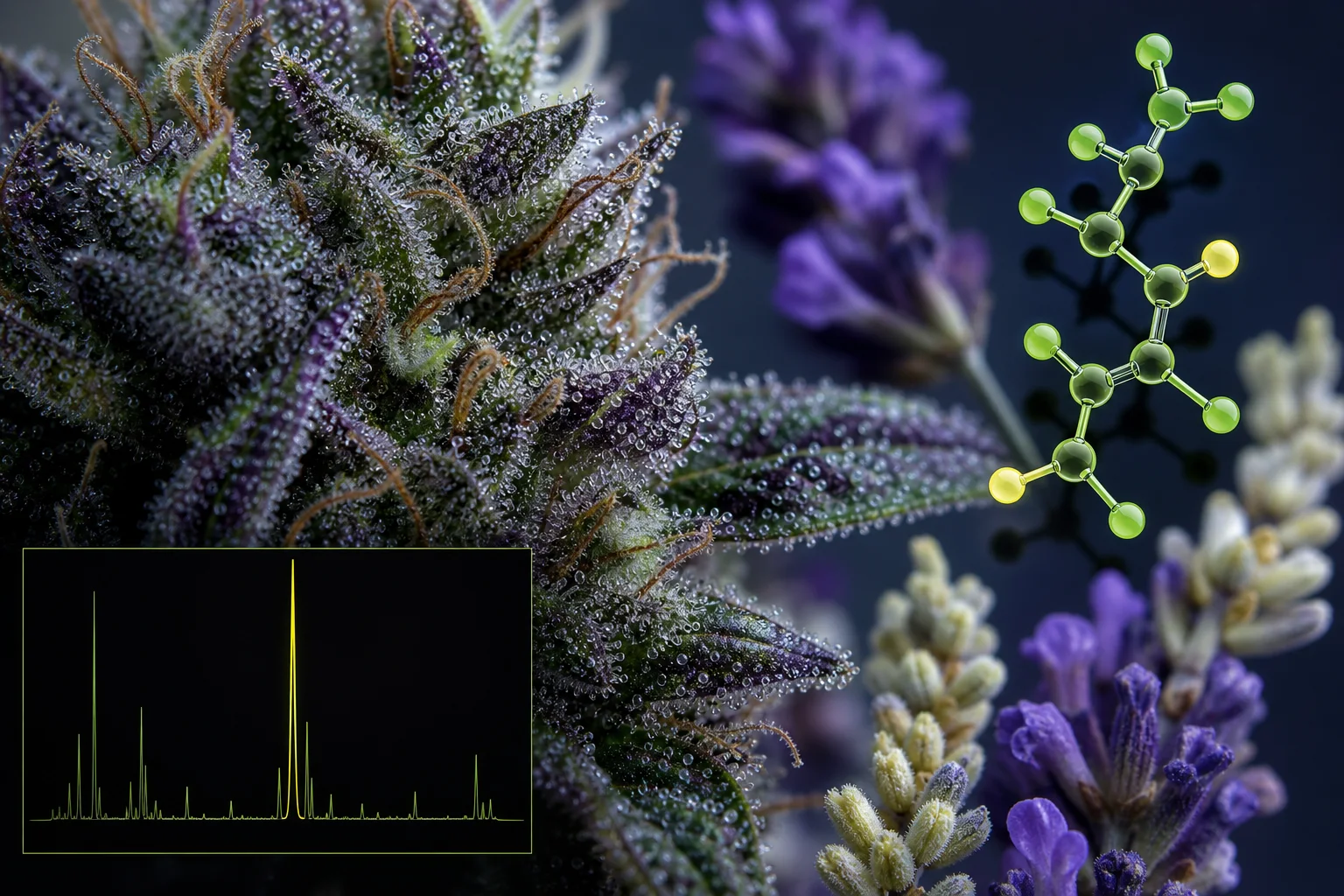
Trichomes (the plant's aromatic factories), linalool's molecular structure, and a schematic chromatographic peak — three scales of the same story: molecule, plant, and measurement.
Mainezilla original editorial visual · AI-assisted art directionWhat linalool is — the molecule and where cannabis finds it
Linalool (3,7-dimethyl-1,6-octadien-3-ol) is a monoterpene alcohol that smells universally described as floral, sweet, and slightly citrusy. It is not unique to lavender; linalool appears in dozens of plants and essential oils and therefore arrives in cannabis by the same biosynthetic machinery that makes other monoterpenes. Chemically it exists as enantiomers (mirror-image forms) and forms oxidation products when it ages or autoxidizes — features that matter for both smell and reactivity.
In cannabis, linalool is one of several common monoterpenes and shows up across THC-dominant and CBD-dominant chemotypes, sometimes at modest percentages of a flower's volatile profile. Its detection in cannabis samples reflects classical terpene biosynthesis in glandular trichomes rather than a specialty pathway unique to Cannabis sativa. The relative rank of linalool within a terpene profile varies by variety, harvest timing, and post-harvest handling.
Because linalool is widespread in the plant world, an aroma labeled 'lavender' in a cannabis strain can come from linalool but also from other terpenes and aroma-active oxidation products. In short: linalool is a common floral terpene, but aroma terms like 'lavender' are shorthand for a perceptual constellation, not proof of a single molecule's dominance.
Aroma in context: percentages, chemovars, and why 'lavender' is shorthand
Profile reports from laboratories typically present terpene data as concentrations (e.g., mg/g) or percent of the volatile fraction. Linalool is often present at low single‑digit percentage contribution to the measured terpene mix, but that can still be perceptually important: humans sense some terpenes at very low concentrations. Published chemotyping work shows that different chemovar categories (THC-dominant, CBD-dominant, intermediate) have differing typical terpene complements, and linalool is sometimes associated with particular chemotypes but not exclusively so.
A smell described as 'lavender' in tasting notes or product copy is a perceptual label, not a quantitative claim. The same sensory description can arise from similar ratios of linalool plus other floral or woody volatiles. Furthermore, the enantiomeric mix of linalool — (R)- vs (S)-linalool — influences odor quality, but routine cannabis terpene panels rarely report enantiomers, so the label 'linalool present' omits that nuance.
Because aroma depends on volatile mixtures, trace oxidation products, and human olfactory thresholds, you cannot reliably infer the intensity or quality of a 'lavender' aroma (or its likely psychoactive correlates) from a single number in a lab report. Laboratory measurement provides necessary data, but smell and effect are emergent properties of the whole volatile profile.
How labs measure linalool — methods, standards, and pitfalls
Analytical laboratories use gas chromatography variants (GC-FID, GC–MS, GC–MS/MS) and headspace sampling or solvent extraction to quantify terpenes in dried flower and extracts. Headspace solid‑phase microextraction (HS‑SPME) and direct headspace methods capture volatiles with less solvent bias. Validation studies show that method choice, internal standards, extraction efficiency, and instrument calibration materially change reported values; inter-laboratory variability is a real issue in published datasets.
Standards are essential. Reference spectra and retention data from the NIST Chemistry WebBook and the NIST/EPA/NIH mass spectral libraries underpin compound identification and confirmation. Some modern workflows also use isotopically labeled internal standards (for example, linalool‑d3) to correct for losses and matrix effects during extraction and analysis. If a lab report lacks method details (sampling, internal standard, LOD/LOQ), the numbers are less usable for comparing batches or studies.
Other common pitfalls: terpene loss during drying/curing, changes during storage and steam/heat processing, and autoxidation of linalool to allergenic products — all of which can lower measured linalool or change the odor. For credible interpretation look for validated methods (described parameters, limits of detection, calibration curves) rather than unannotated percentages.
Preclinical evidence: what models say about linalool's nervous‑system actions
A substantial preclinical literature — largely in rodents and in vitro systems — shows that linalool can modulate central nervous system activity through multiple mechanisms. Electrophysiology and receptor assays indicate linalool and some metabolic products modulate GABAA receptor function and inhibit excitatory glutamatergic transmission in preparations from mammal brain tissue. Those molecular data provide plausible mechanisms for calming or anticonvulsant effects reported in animal tests.
Behavioral work using odor exposure and brief vaporization paradigms finds anxiolytic‑like effects in mice and rats. Some studies report that linalool's effects require an intact olfactory pathway and can be antagonized by benzodiazepine-site blockers, suggesting engagement of GABAergic circuits downstream of olfactory processing. More recent rodent work also implicates hippocampal endocannabinoid signaling as part of the pathway linking inhaled floral odors (including linalool) to reduced anxiety-like behavior. These are important mechanistic clues but they are not direct evidence of comparable human responses to whole-plant cannabis.
Notably, preclinical inhalation studies often differ in exposure style (ambient odor vs. short vapor puffs), concentrations, sex of animals, and endpoints; one recent rodent study found sex-dependent differences in anxiolytic responses to linalool and β-myrcene. Those experimental variables make it hazardous to extrapolate a single, consistent human effect from the animal literature.
Route matters: inhalation, odor exposure, and systemic delivery
Route-of-exposure strongly shapes pharmacology. In rodent models, simple odor or inhalation exposures to linalool can produce behavioral effects without detectable systemic doses — effects that depend on olfactory signaling to brain circuits. By contrast, systemic administration (oral or parenteral) delivers linalool and its metabolites into circulation where they undergo hepatic metabolism; metabolites may have different receptor activities. Thus, an anxiolytic effect from smelling linalool is not the same mechanistically as an effect from ingesting or vaping a high concentration.
The plant matrix in cannabis modifies delivery. When linalool is embedded in dried flower or extract and inhaled with cannabinoids, terpenes, and combustion or aerosol byproducts, its partitioning into the inhaled vapor and the resulting dose differ from pure‑compound odor studies. Experimental inhalation paradigms that model human puffing provide better translational relevance than passive odor exposure, but they still simplify the real-world matrix. Published rodent vapor studies therefore offer plausibility but not proof of matched human effects.
Metabolism and dose scaling are additional complications: linalool is metabolized to multiple products, and the relative exposure to parent compound versus metabolites depends on whether the nose or lungs receive the bulk of the volatile, the rate of pulmonary absorption, and hepatic first‑pass after oral intake. Translating mg/kg animal doses to human experience has known limits. These pharmacokinetic realities mean that route- and dose‑specific human data are necessary to move from plausibility to confidence.
Why 'it smells like lavender' does not predict how a cannabis product will feel
A consumer or clinician seeing 'linalool' on a label often assumes a lavender-like calming effect. That shortcut collapses several distinctions: perception (aroma), pharmacology (molecular receptor activity), route and dose (odor vs inhaled aerosol vs oral), and the complex interactions inside the full plant matrix. Any one of those can change the sign or magnitude of an effect. In other words, floral scent is not a reliable proxy for a predictable nervous-system outcome when linalool occurs in cannabis.
Mixtures matter: terpenes interact perceptually and chemically. Some terpenes shift absorption or receptor engagement, and cannabinoids like THC and CBD have dose-dependent neuropharmacology that dominates subjective effects at typical consumer doses. Published chemoprofiling shows that linalool often co-occurs with many other terpenes and minor cannabinoids; therefore, isolated-linalool studies are mechanistically informative but not determinative for whole-plant experiences.
Expectations and context also shape subjective reports. Smell and prior beliefs about 'lavender' or calming strains influence how people describe effects; controlled human trials isolating linalool's contributions within cannabis are scarce or absent. Until high-quality human inhalation studies within a full-plant context are available, claims that 'linalool = lavender-like calm' are an attractive hypothesis, not settled fact.
Reading lab claims and labels: practical guidance for skepticism and sense-making
When you read a lab certificate or product copy, ask three concrete methodological questions: how were terpenes sampled (headspace, solvent extract, or intact flower), which analytical method was used (GC-FID, GC-MS), and what internal standards and limits of detection were reported. Reports that include method details and calibration data are inherently more trustworthy than single-column spreadsheets of percents with no metadata. If the lab lists linalool but gives no LOD/LOQ, the number has limited value for comparison.
Remember that batch-to-batch variability and post‑harvest handling change terpene content. Drying, curing, steam or heat treatments, and storage (temperature, oxygen exposure) alter volatile composition; small differences in processing can produce noticeable differences in aroma even if the cultivar name is the same. Good laboratory reports and reputable dispensary practice will pair terpene data with harvest and processing dates.
Finally, treat subjective product claims such as 'relaxing' or 'lavender-like calm' as marketing unless they are tied to controlled, peer‑reviewed human data. Use the lab numbers as a starting point for hypothesis‑making (e.g., 'this batch has 0.5% linalool by weight') rather than as a promise. The literature supports biological plausibility for linalool's calming mechanisms, but the translational gaps described above remain wide.
Questions this guide answers
Does linalool make cannabis 'calming'?
Preclinical studies show that linalool can produce anxiolytic-like effects in rodents via olfactory and GABAergic/endocannabinoid mechanisms, but human evidence in the context of whole-plant cannabis is lacking. Aroma alone is an unreliable predictor because route, dose, matrix interactions (other terpenes and cannabinoids), and expectation all shape outcomes.
Can a lab test tell me how much linalool I’ll inhale?
Not directly. Lab reports give concentration in plant material or extract (e.g., mg/g or percent of terpenes), but the fraction that transfers to inhaled vapor depends on the delivery method (combustion, vaporizer, aerosol), temperature, and the surrounding chemical matrix. Labs that provide method details and headspace or vapor-phase measurements offer the best information for inhalation estimates.
Is 'linalool present' the same as 'lavender'?
No. Linalool contributes a floral character that can be described as lavender-like, but the perceptual label 'lavender' is produced by mixtures of volatiles and sometimes by oxidation products. Enantiomeric composition — rarely reported — also affects smell. Treat sensory descriptors as helpful shorthand, not molecular proof.
Are there safety concerns about linalool in cannabis?
Linalool itself has low acute toxicity in common experimental contexts, but it autoxidizes to products that can cause allergic contact dermatitis in susceptible people. Accurate lab reporting and proper storage reduce the chance of significant autoxidation; products that list manufacturing dates and storage recommendations are more transparent. For systemic safety concerns or personal allergy risk, consult primary toxicology reviews and product-specific testing.
Where can I find reliable official information about Maine’s cannabis program?
For Maine-specific regulatory context, public education, and resources for both adult-use and medical programs consult the Maine Office of Cannabis Policy resources page maintained by the state. That page aggregates guidance, reports, and program materials relevant to Mainers.
Educational information only. This guide is not medical or legal advice and does not recommend a product, dose, treatment, or outcome.